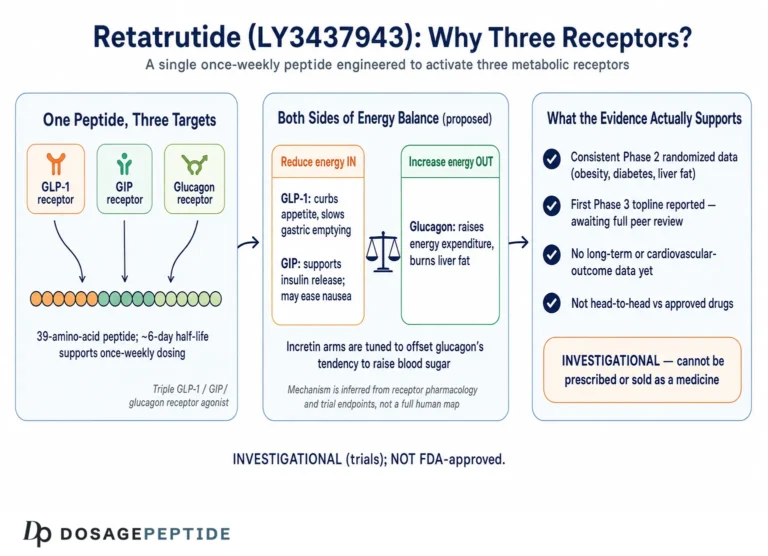
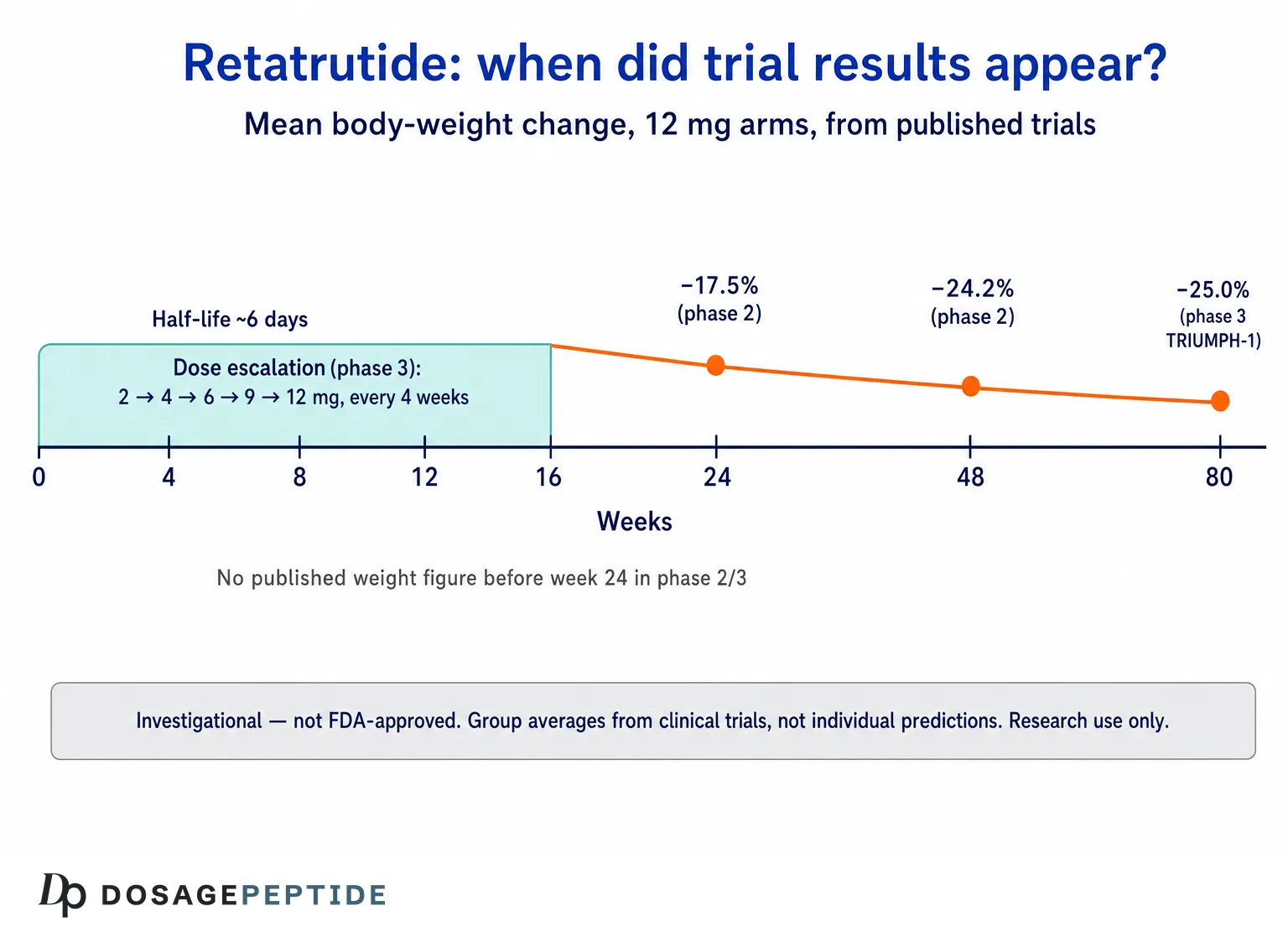
- In the blood: half-life of approximately 6 days, with dose-proportional pharmacokinetics, which is what makes once-weekly dosing workable.
- The first weeks are not the target dose. In phase 2 and phase 3, arms aiming at 12 mg started at 2 mg and stepped up every 4 weeks; in phase 3, 12 mg is reached at week 16 at the earliest.
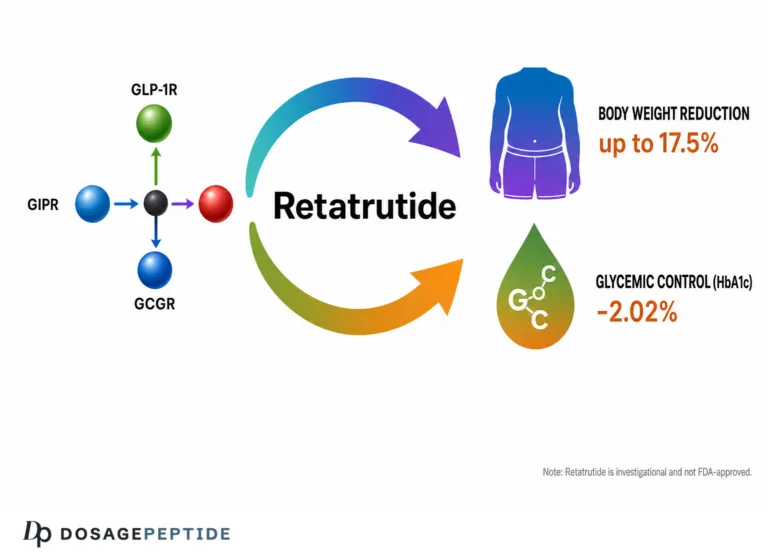
- First primary readout: week 24. In the phase 2 obesity trial, mean weight change was −17.5% on 12 mg versus −1.6% on placebo.
- Week 48: −24.2% on 12 mg, and the authors reported that a plateau had not yet been reached.
- Week 80 (phase 3, TRIUMPH-1): −25.0% on 12 mg versus −3.9% on placebo (treatment-regimen estimand). Group averages, not a prediction for anyone.
“How long does retatrutide take to work” can only be answered from trial calendars, because retatrutide (LY3437943), Eli Lilly’s triple GIP/GLP-1/glucagon receptor agonist, is still investigational: it is not FDA-approved for any use, and Lilly has said it plans to submit a Biologics License Application in the first quarter of 2027.[1] On that record, group-level weight change was already large at the first primary endpoint (week 24 in phase 2), was still falling at week 48, and the phase 3 TRIUMPH-1 trial measured its headline result at week 80.[2][3] Nothing below is an individual forecast or a protocol for human use.
The retatrutide timeline, week by week
Every row is a timepoint reported by a published paper, registry record or company topline release; cells that are inferences rather than measurements say so.
| Timepoint | Pharmacokinetic clock | Dose clock (12 mg arms) | What trials measured at this point |
|---|---|---|---|
| Dose 1 to day 43 | Half-life approximately 6 days; dose-proportional exposure[4] | 2 mg starting dose[2][5] | No efficacy endpoint. In the phase 1 single-dose study, a reduction in body weight persisted up to day 43 after one injection.[6] |
| Week 4 | About five half-lives have elapsed (~30 days) — an arithmetic inference, not a published steady-state figure | First 4-week escalation step[2][5] | Nothing scheduled in phase 2 or phase 3. |
| Week 12 | — | Phase 2: escalation complete (steps every 4 weeks for up to 12 weeks).[2] Phase 3: moving onto the 9 mg step.[5] | End of the 12-week phase 1b study in type 2 diabetes: placebo-adjusted body-weight change up to −8.96 kg in the 3/6/9/12 mg group; placebo-adjusted HbA1c −1.2 to −1.6 percentage points in the three highest-dose groups.[4] |
| Week 16 | — | Phase 3: 12 mg reached (2 → 4 → 6 → 9 → 12 mg, 4 weeks per step) | No published efficacy readout. |
| Week 24 | — | Maintenance | Phase 2 obesity primary endpoint: −17.5% (12 mg) vs −1.6% placebo.[2] Phase 2 T2D primary endpoint: HbA1c −2.02 points (12 mg) vs −0.01 placebo.[7] MASLD substudy: liver fat −82.4% (12 mg) vs +0.3% placebo.[8] |
| Week 36 | — | Maintenance | Phase 2 T2D secondary endpoint: body weight −16.94% (12 mg) vs −3.00% placebo; HbA1c findings consistent with week 24.[7] |
| Week 40 | — | Maintenance | Phase 3 TRANSCEND-T2D-1 primary endpoint: HbA1c −1.94 points (12 mg) vs −0.81 placebo; body weight −15.3% vs −2.6%.[9] |
| Week 48 | — | Maintenance | Phase 2 obesity secondary endpoint: −24.2% (12 mg) vs −2.1% placebo; curve had not plateaued.[2] Liver fat −86.0% (12 mg).[8] |
| Week 80 | — | Maintenance | TRIUMPH-1 primary endpoint: −25.0% (12 mg) vs −3.9% placebo, treatment-regimen estimand[3]; −28.3% vs −2.2% under Lilly’s efficacy estimand.[5] TRIUMPH-2 (T2D): −18.8% vs −5.1% (12 mg, treatment-regimen estimand).[10] |
| Week 104 | — | Extension at maximum tolerated dose (9 or 12 mg) | BMI ≥35 completer subset: −30.3% in the 12 mg-to-MTD group (efficacy estimand); company topline only.[5] |
For how much rather than when, the dose-by-dose magnitudes are laid out in our retatrutide before-and-after evidence review. This page sticks to the calendar.
What is retatrutide, and what is its regulatory status in October 2026?
Retatrutide is a single peptide conjugated to a fatty diacid moiety that activates the GIP, GLP-1 and glucagon receptors; in cell assays it is more potent than native GIP at the GIP receptor and less potent than the native ligands at the GLP-1 and glucagon receptors.[8] It is not an approved medicine anywhere we could confirm. Lilly’s July 2026 release states that the company is completing the chemistry, manufacturing and controls package and plans to submit a BLA to FDA in Q1 2027.[1] The evidence base as of this writing is therefore: a phase 1b study, two phase 2 trials (obesity and type 2 diabetes) plus a liver-fat substudy, the first peer-reviewed phase 3 papers (TRIUMPH-1 in NEJM, TRIUMPH-2 and TRANSCEND-T2D-1 in The Lancet), and company topline releases for results not yet peer-reviewed.[3][10][9] Completing phase 3 is not approval; a regulator can still decline, narrow an indication or ask for more data.
FDA’s own position, on its page about unapproved GLP-1 drugs (updated October 1, 2026), is that “retatrutide and cagrilintide cannot be used in compounding under federal law,” and that these substances have not been found safe and effective for any condition.[11]
How fast does retatrutide build up in the blood?
The phase 1b multiple-ascending-dose study in type 2 diabetes found that retatrutide’s pharmacokinetics were dose proportional and that its half-life was approximately 6 days, which the authors judged suitable for once-weekly dosing.[4] The Nature Medicine MASLD paper restates the same ~6-day figure.[8] Unlike tirzepatide, retatrutide has no FDA label, so there is no labelled time-to-peak concentration, bioavailability or official steady-state statement to cite.
What can be said is arithmetic, and should be read as such: with a ~6-day half-life, roughly five half-lives (about 30 days) pass before a fixed weekly dose approaches a stable plateau. That is consistent with the 4-week interval every trial used between escalation steps, but no retatrutide publication we reviewed reports a measured “steady state at week X” figure. The one hard early-effect datapoint is pharmacodynamic: in the phase 1 single-ascending-dose study, a reduction in body weight persisted up to day 43 after a single injection.[6] The drug also slows gastric emptying, which was characterized in a separate Lilly study.[12]
Why are the first weeks not the real dose?
This is the main reason “when it works” is not “when it is first injected.” In the phase 2 obesity trial, arms assigned to 4 mg or more started at 2 mg or 4 mg and then escalated every 4 weeks for up to 12 weeks; the 12 mg arm used the 2 mg start.[2] The phase 3 TRIUMPH program used a slower ladder with more rungs: all arms started at 2 mg weekly and stepped up every 4 weeks, with the 12 mg target reached via 2, 4, 6 and 9 mg.[5][1] Four 4-week steps means the 12 mg maintenance dose begins at week 16 at the earliest. The step-by-step structure is covered in our retatrutide titration schedule as published in the trials.
The escalation exists for tolerability, and the timing of side effects follows it. In phase 2, gastrointestinal adverse events occurred primarily during dose escalation, were more frequent at higher doses, and were partially mitigated by the lower 2 mg starting dose compared with 4 mg.[2] The same paper reports that heart rate rose in a dose-dependent manner up to 24 weeks and declined thereafter.[2] We catalogue the documented adverse-event profile in our retatrutide side-effect reference; trial designs that begin from a prior incretin are a separate question, discussed in what the evidence says about switching from tirzepatide to retatrutide.
When did the trials actually measure results?
Week 12: the phase 1b signal
The earliest multi-week human data come from a 12-week phase 1b study of 72 people with type 2 diabetes. At week 12, placebo-adjusted mean daily plasma glucose fell significantly in the three highest-dose groups, and placebo-adjusted body-weight reduction appeared dose dependent, reaching −8.96 kg in the group escalated 3/6/9/12 mg.[4] It was a small safety study with different escalation regimens; it shows direction, not a forecast.
Week 24: the first primary endpoint
The phase 2 obesity trial randomized 338 adults (mean baseline weight 107.7 kg) and deliberately put its primary endpoint at week 24, which the authors describe as an early assessment of efficacy.[2] Least-squares mean weight change at week 24 was −7.2% (1 mg), −12.9% (combined 4 mg), −17.3% (combined 8 mg) and −17.5% (12 mg), versus −1.6% on placebo.[2] The paper reports weight numerically at weeks 24 and 48; earlier visits appear only as plotted points in its figures, and we do not read values off them here.
The liver-fat clock ran faster than the weight clock. In the 98-participant MASLD substudy, relative liver-fat change at week 24 was −42.9%, −57.0%, −81.4% and −82.4% for 1, 4, 8 and 12 mg versus +0.3% for placebo, and 86% of the 12 mg group reached normal liver fat (<5%).[8] The authors state that most of the reduction occurred within the first 24 weeks, and that near-maximal liver-fat reduction coincided with roughly 20% body-weight loss.[8]
The glycemic clock: weeks 24, 36 and 40
In the phase 2 type 2 diabetes trial (281 participants), the primary endpoint was HbA1c change at week 24: −2.02 percentage points on 12 mg versus −0.01 on placebo and −1.41 on dulaglutide 1.5 mg; findings were consistent at 36 weeks, when body weight on 12 mg had fallen 16.94%.[7] In phase 3, TRANSCEND-T2D-1 placed its primary HbA1c endpoint at week 40: −1.94 points on 12 mg versus −0.81 on placebo.[9] HbA1c integrates glucose over the preceding months, so it is a lagging measure by design and cannot pinpoint onset.
Week 48: still descending
At week 48, the phase 2 obesity trial recorded −8.7% (1 mg), −17.1% (combined 4 mg), −22.8% (combined 8 mg) and −24.2% (12 mg) versus −2.1% on placebo.[2] So between week 24 and week 48 the 12 mg group’s mean moved from −17.5% to −24.2%: about seven more points in the second 24 weeks, after the larger move in the first 24.
Weeks 80 and 104: phase 3
TRIUMPH-1 randomized 2,339 adults with obesity and without diabetes to 4, 9 or 12 mg or placebo for 80 weeks. Under the treatment-regimen (intention-to-treat) estimand published in NEJM, mean weight change was −17.6%, −23.7% and −25.0% versus −3.9% on placebo.[3] Lilly’s topline release also reports an efficacy estimand (as if everyone had stayed on drug): −19.0%, −25.9% and −28.3% versus −2.2%.[5] Both are correct; they answer different questions, and comparing one trial’s efficacy estimand with another’s treatment-regimen number exaggerates the gap. In TRIUMPH-2 (1,152 adults with obesity and type 2 diabetes), the week-80 treatment-regimen result was −18.8% on 12 mg versus −5.1% on placebo.[10]
The 104-week data come from a pre-specified extension of 532 TRIUMPH-1 completers with BMI ≥35 who tolerated their dose and were escalated, blinded, to a maximum tolerated dose of 9 or 12 mg for 24 more weeks. The 12 mg-to-MTD group reached −30.3% (efficacy estimand). The group switched from placebo to retatrutide at week 80 recorded −19.2% at week 104.[5] That last figure comes from a selected completer subgroup in a company release, not a peer-reviewed paper, but it is the one window in the TRIUMPH-1 release in which a group began active treatment late, after 80 weeks on placebo.
Did the weight curve plateau?
Not by week 48 in phase 2: participants were still losing weight when treatment stopped, and the authors wrote that the curves’ trajectory indicated a plateau had not yet been reached.[2] Phase 3 then extended the observation window to 80 weeks, and in the BMI ≥35 extension subset Lilly reports that participants continued to lose weight through week 104; the release does not state whether a plateau was reached.[5] The 104-week numbers come from a narrower, BMI-selected group of completers, so they are not directly comparable with the 80-week full-population results. The liver, by contrast, did plateau early: the MASLD authors describe a floor effect, with the 24-week defatting maintained at week 48 rather than deepening much further.[8]
For comparison, our tirzepatide results timeline follows the SURMOUNT-1 curve to week 72, and our semaglutide results timeline does the same for the GLP-1 mono-agonist’s trial program. Populations, escalation ladders and estimands differ, so cross-trial comparisons stay informal.
Why trial averages are not a prediction
Every number on this page is a group mean or proportion from screened, supervised populations. The phase 2 trial excluded people with diabetes, recent weight change of more than 5 kg, prior pancreatitis and several other conditions, and gave every participant structured diet and activity counseling.[13][2] The spread inside each arm is wide: even at 12 mg in phase 2, about one in six participants did not reach 15% weight reduction at 48 weeks.[2] Discontinuation for adverse events in TRIUMPH-1 was 4.1%, 6.9% and 11.3% at 4, 9 and 12 mg versus 4.9% on placebo, so a meaningful share of people never completed the timeline at all.[5]
Why research-grade retatrutide is a different question
Material sold online as “retatrutide” for laboratory use is not the investigational product used in TRIUMPH or the phase 2 trials. It has not been through any regulatory review for identity, purity, potency, sterility or stability, and FDA states that unapproved versions do not undergo its review for safety, effectiveness and quality before they are marketed.[11] The same FDA page records warnings to companies selling retatrutide labelled “for research purposes” or “not for human consumption,” to telehealth companies marketing it, and to ingredient distributors supplying it to compounders.[11] None of the timelines above can be assumed to transfer to such material. Our retatrutide 30 mg vial reference is laboratory documentation of concentrations and volumes, not an instruction for human use.
Frequently Asked Questions
How long does retatrutide take to work?
The trials do not define an onset day. The half-life is about 6 days, and a single phase 1 dose was followed by weight reduction that persisted to day 43. The first primary efficacy readout was week 24 in phase 2 (−17.5% on 12 mg vs −1.6% placebo), the curve was still falling at week 48 (−24.2%), and phase 3 measured its headline result at week 80. Anything more precise is inference, not data.
How much weight was lost by week 24 in the trials?
In the phase 2 obesity trial, least-squares mean change at week 24 was −7.2% (1 mg), −12.9% (4 mg), −17.3% (8 mg) and −17.5% (12 mg) versus −1.6% on placebo. These are group averages in a screened, supervised population with lifestyle counseling, using an efficacy estimand. Individual changes varied widely around them, and we did not find a week-24 figure reported in the phase 3 publications.
When does retatrutide reach steady state?
No retatrutide publication we reviewed reports a measured steady-state timepoint, and there is no FDA label to cite. With a reported half-life of approximately 6 days, standard pharmacokinetic arithmetic puts a fixed weekly dose near plateau after roughly four to five weeks. That is an inference consistent with the trials’ 4-week escalation interval, not a published measurement.
Why did the trials start at 2 mg instead of the target dose?
For tolerability. In phase 2, gastrointestinal adverse events clustered during dose escalation and were partially mitigated by a 2 mg rather than 4 mg starting dose, so phase 3 started every arm at 2 mg with 4-week steps. This describes trial design; it is not a recommendation for any person, and dosing of an investigational drug belongs inside a supervised clinical protocol.
When did blood sugar change in the trials?
In the 12-week phase 1b study, placebo-adjusted mean daily glucose fell significantly at week 12 in the higher-dose groups. The phase 2 diabetes trial measured HbA1c at week 24 (−2.02 points on 12 mg vs −0.01 placebo), consistent at week 36. Phase 3 TRANSCEND-T2D-1 used week 40: −1.94 points on 12 mg vs −0.81 placebo.
Did retatrutide weight loss plateau?
Not by week 48 in phase 2; the authors wrote that a plateau had not yet been reached. Lilly reports continued weight loss to week 104 in a BMI ≥35 completer extension of TRIUMPH-1, without stating whether a plateau occurred. Liver fat behaved differently, reaching most of its reduction by week 24 and then holding.
Is retatrutide FDA-approved as of October 2026?
No. It remains investigational. Lilly has said it plans to submit a Biologics License Application to FDA in the first quarter of 2027, after phase 3 TRIUMPH and TRANSCEND results. FDA states that retatrutide cannot be used in compounding under federal law and has not been found safe and effective for any condition.
Would research-grade retatrutide follow the same timeline?
There is no basis for assuming so. Trial timelines were generated with Lilly’s investigational product under controlled protocols. Research-grade vendor material carries no regulatory guarantee of identity, purity, potency or sterility, and FDA has warned sellers using “research purposes” labelling. It is a laboratory reagent question, not a clinical one.
References
- Eli Lilly and Company. Lilly’s triple agonist, retatrutide, successful in two additional Phase 3 obesity trials, delivering significant improvements in weight and A1C. Press release (TRIUMPH-2 and TRIUMPH-3 topline; BLA planned Q1 2027), July 23, 2026. investor.lilly.com
- Jastreboff AM, Kaplan LM, Frías JP, et al. Triple-hormone-receptor agonist retatrutide for obesity — a phase 2 trial. N Engl J Med. 2023;389(6):514–526. pubmed.ncbi.nlm.nih.gov/37366315
- Jastreboff AM, Kaplan LM, Davies MJ, et al. Retatrutide, a triple hormone receptor agonist, for treatment of obesity. N Engl J Med. TRIUMPH-1 (NCT05929066). Published online September 29, 2026. doi:10.1056/NEJMoa2604169. pubmed.ncbi.nlm.nih.gov/42814954
- Urva S, Coskun T, Loh MT, et al. LY3437943, a novel triple GIP, GLP-1, and glucagon receptor agonist in people with type 2 diabetes: a phase 1b, multicentre, double-blind, placebo-controlled, randomised, multiple-ascending dose trial. Lancet. 2022;400(10366):1869–1881. pubmed.ncbi.nlm.nih.gov/36354040
- Eli Lilly and Company. Lilly’s triple agonist, retatrutide, delivered powerful weight loss in pivotal Phase 3 obesity trial. Press release (TRIUMPH-1 topline), May 21, 2026. investor.lilly.com
- Coskun T, Urva S, Roell WC, et al. LY3437943, a novel triple glucagon, GIP, and GLP-1 receptor agonist for glycemic control and weight loss: from discovery to clinical proof of concept. Cell Metab. 2022;34(9):1234–1247.e9. pubmed.ncbi.nlm.nih.gov/35985340
- Rosenstock J, Frias J, Jastreboff AM, et al. Retatrutide, a GIP, GLP-1 and glucagon receptor agonist, for people with type 2 diabetes: a randomised, double-blind, placebo and active-controlled, parallel-group, phase 2 trial conducted in the USA. Lancet. 2023;402(10401):529–544. pubmed.ncbi.nlm.nih.gov/37385280
- Sanyal AJ, Kaplan LM, Frias JP, et al. Triple hormone receptor agonist retatrutide for metabolic dysfunction-associated steatotic liver disease: a randomized phase 2a trial. Nat Med. 2024;30(7):2037–2048. pmc.ncbi.nlm.nih.gov/articles/PMC11271400
- Bajaj HS, Welch M, Shah P, et al. Efficacy and safety of retatrutide, a GIP, GLP-1, and glucagon receptor agonist, in people with type 2 diabetes and inadequate glycaemic control with diet and exercise (TRANSCEND-T2D-1): a double-blind, randomised, phase 3 trial. Lancet. 2026;407(10546):2402–2413. pubmed.ncbi.nlm.nih.gov/42250575
- Bellido V, le Roux CW, Ekinci EI, et al. Retatrutide in adults with obesity and type 2 diabetes (TRIUMPH-2): a double-blind, parallel-group, randomised, placebo-controlled, phase 3 trial. Lancet. 2026;408(10563):1455–1472. pubmed.ncbi.nlm.nih.gov/42810372
- U.S. Food and Drug Administration. FDA’s concerns with unapproved GLP-1 drugs used for weight loss. Content current as of October 1, 2026. fda.gov
- Urva S, O’Farrell L, Du Y, et al. The novel GIP, GLP-1 and glucagon receptor agonist retatrutide delays gastric emptying. Diabetes Obes Metab. 2023;25(9):2784–2788. pubmed.ncbi.nlm.nih.gov/37311727
- A Phase 2 Study of Once-Weekly LY3437943 Compared With Placebo in Participants Who Have Obesity or Are Overweight With Weight-Related Comorbidities, NCT04881760. ClinicalTrials.gov, U.S. National Library of Medicine. clinicaltrials.gov/study/NCT04881760
This page is an independent research reference compiled from published trial reports, registry records, company topline releases and FDA statements, for research and educational purposes only. Retatrutide is an investigational compound that is not approved by FDA or any comparable regulator. Nothing here is medical advice, a dosing recommendation or an instruction for human use. Research-grade peptide material is for laboratory research use only and is not the investigational product studied in clinical trials.