The direct answer first: as of August 2026 there is no published clinical trial of switching from tirzepatide to retatrutide, and no validated transition, washout or dose-conversion protocol exists in the peer-reviewed literature or in any regulatory document. The two compounds are also not in the same regulatory category — tirzepatide is FDA-approved under two brand names, while retatrutide remains investigational and is not approved for any indication in any jurisdiction. This page sets out what the receptor pharmacology, the pharmacokinetic record and the trial designs actually document, and where the evidence simply stops.
What each compound actually is
Most of the confusion around a “switch” disappears once the two molecules are placed side by side with their real status attached. They are not two versions of the same product at different price points. One is a marketed medicine with an approved label; the other is a development-stage molecule whose registrational dossier has not yet been filed.
| Attribute | Tirzepatide | Retatrutide (LY3437943) |
|---|---|---|
| Receptor targets | Dual agonist: GIP receptor + GLP-1 receptor[1] | Triple agonist: GIP receptor + GLP-1 receptor + glucagon receptor; in vitro profile described as balanced glucagon/GLP-1 activity with greater GIP activity[2] |
| Regulatory status (Aug 2026) | FDA-approved. Mounjaro: type 2 diabetes in adults and paediatric patients 10 years and older, adjunct to diet and exercise. Zepbound: chronic weight reduction and maintenance in adults with obesity or overweight plus a weight-related condition, and moderate-to-severe obstructive sleep apnea in adults with obesity[3][1] | Investigational. Not approved anywhere, for anything. Sponsor stated in July 2026 that a regulatory submission is planned for the first quarter of 2027[4] |
| Elimination half-life | Approximately 5 days on the type 2 diabetes label[3]; approximately 5–6 days in patients with overweight or obesity, with steady state reached after 4 weeks of once-weekly administration[1] | Approximately 6 days in the phase 1b multiple-ascending-dose study, with dose-proportional exposure[5] |
| Administration interval studied | Once weekly subcutaneous | Once weekly subcutaneous |
| Development stage | Marketed; post-approval and outcomes programmes ongoing | Phase 3 TRIUMPH programme; core obesity readouts announced as sponsor topline during 2026; the 10,000-participant cardiovascular and kidney outcomes trial has an estimated completion date of February 2029[6] |
| What the pivotal programme measured | SURMOUNT-1: percent weight change at 72 weeks in adults with obesity or overweight and without diabetes; −20.9% at 15 mg on the treatment-regimen estimand (−22.5% on the efficacy estimand), versus −3.1% on placebo[7] | TRIUMPH-1: percent weight change at 80 weeks in roughly 2,300 adults with obesity or overweight and without type 2 diabetes[8]. Sponsor topline announcement reported averages of 19.0% at 4 mg, 25.9% at 9 mg and 28.3% at 12 mg; not yet peer-reviewed[9] |
| Legal availability | Prescription medicine dispensed against an approved label | Not available as a medicine. Material sold to laboratories is unapproved research chemical, not a finished pharmaceutical[10] |
Why a “switch” is not a documented protocol
A transition protocol is not something that can be reasoned into existence from two separate datasets. In drug development it is a specific object: a prospectively registered study in which participants already stabilised on drug A are randomised to continue A or move to B, with a pre-specified interval between the last dose of A and the first dose of B, a pre-specified starting dose of B, and endpoints that capture what happens across the junction. That object exists for other incretin transitions — a 282-participant phase 4, open-label, active-controlled trial randomised adults with type 2 diabetes already stable on weekly dulaglutide either to switch to weekly tirzepatide or to continue dulaglutide with escalation, over 40 weeks[11]. Nothing equivalent has been registered or published for tirzepatide to retatrutide.
The retatrutide phase 3 trials point the other way. TRIUMPH-5, the only head-to-head study of retatrutide against tirzepatide, excludes anyone who has taken a weight-loss drug, including over-the-counter products, within 90 days before screening[12]. The same exclusion appears verbatim in the pivotal TRIUMPH-1 protocol[8] and in the phase 3b TRIUMPH-8 trial[13]. In other words, the population that generates the “should I switch?” question — people currently on a weekly incretin — is precisely the population the registrational programme was designed to keep out. Every efficacy figure quoted for retatrutide comes from participants who had not taken a weight-loss drug in the three months before screening. That is a deliberate design choice, and it means the trials cannot speak to a transition even indirectly.
Absence of evidence is the finding here, not a gap to be papered over. Any transition schedule circulating on forums, vendor pages or comparison sites is an extrapolation someone invented; it is not a protocol, and it has never been tested against a control arm.
What does the third receptor arm add?
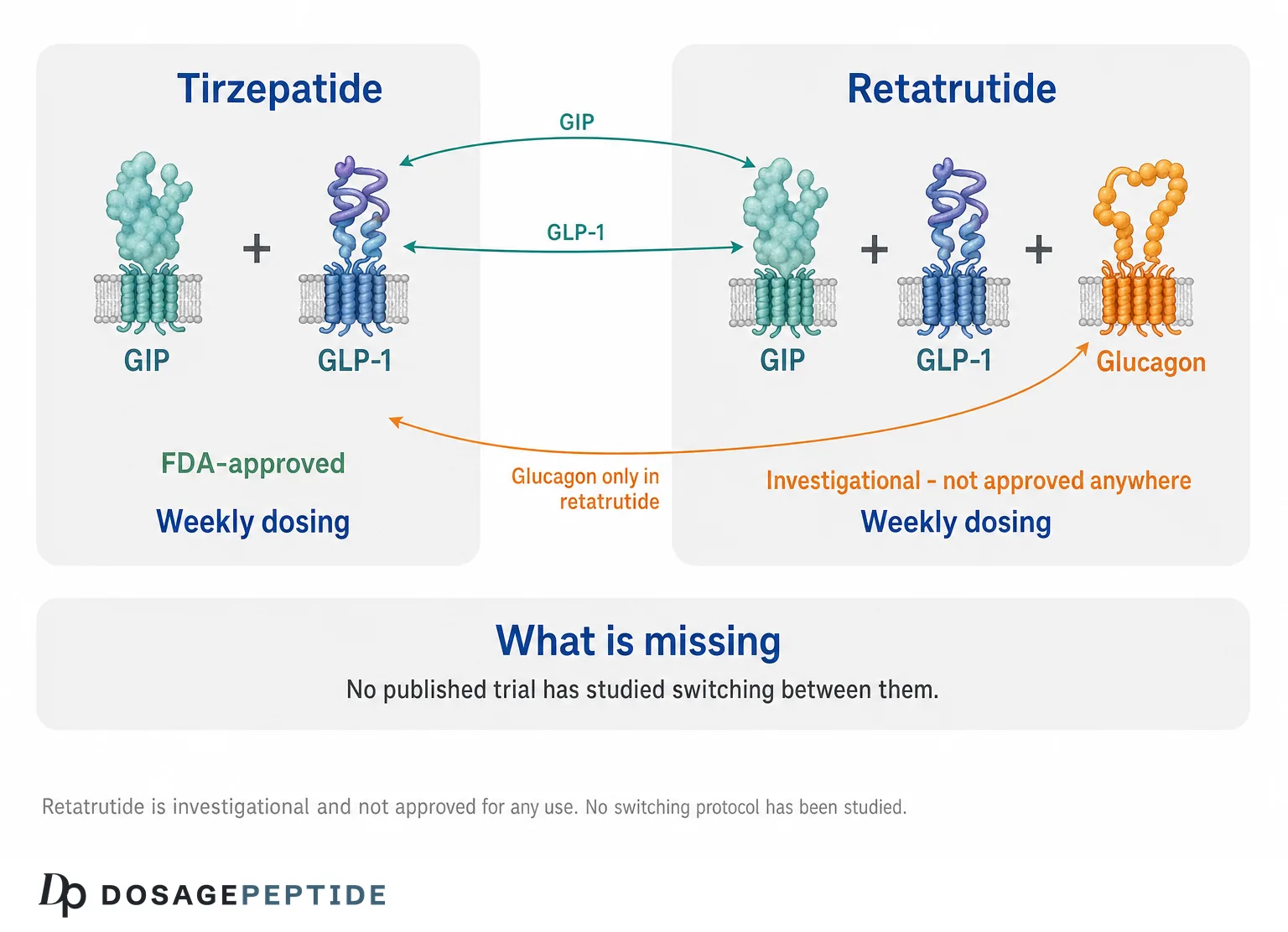
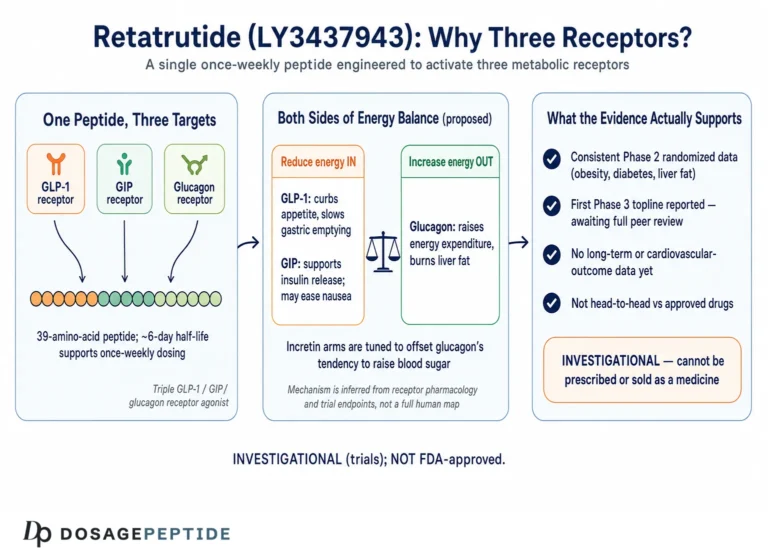
The mechanistic difference is real and it is not merely “more of the same.” Tirzepatide engages two incretin receptors whose dominant documented effects are on insulin secretion, gastric emptying and appetite. Retatrutide adds glucagon receptor agonism, which operates on a different axis: rather than reducing intake, glucagon receptor activation is associated with increased energy expenditure and with mobilisation of hepatic substrate.
The discovery paper describing the molecule reported that in obese mice, weight loss reflected a glucagon-receptor-mediated increase in energy expenditure layered on top of the GIP- and GLP-1-driven reduction in calorie intake[2]. That is a preclinical finding in mice, and it should be read as such: the energy-expenditure mechanism has not been isolated and quantified as a standalone contributor to any human endpoint. What the human trials report is the aggregate, not the share attributable to any one receptor. In the 48-week phase 2 obesity trial in 338 adults, the 12 mg group had a least-squares mean weight change of −24.2% versus −2.1% on placebo — a large effect, but one the trial made no attempt to partition between the glucagon arm and the GIP/GLP-1 arms[14]. Anyone claiming to know how much of a switch’s expected benefit comes from the third receptor is inferring, not reading data.
Does the extra arm change the tolerability question?
It changes what has to be monitored, which is not the same as saying it is worse. In that same phase 2 trial, the most common adverse events were gastrointestinal, dose-related, mostly mild to moderate, and partially mitigated by a lower starting dose — 2 mg rather than 4 mg — a profile broadly familiar from GLP-1 and GIP/GLP-1 agents. The distinguishing observation was cardiovascular: dose-dependent increases in heart rate that peaked at 24 weeks and declined thereafter[14]. That is a single phase 2 trial, not a body of literature. Glucagon receptor agonism also raises a theoretical glycaemic question, since glucagon opposes insulin — the phase 1b multiple-ascending-dose study in type 2 diabetes nonetheless documented significant placebo-adjusted reductions at week 12 in the three highest dose groups, of 2.8 to 3.1 mmol/L in mean daily plasma glucose and 1.2 to 1.6 percentage points in HbA1c, consistent with the incretin arms dominating that balance in that small early-phase population[5].
None of this has been characterised in people arriving from an existing incretin. Our summary of the documented adverse-event profile of retatrutide in published trials covers what has been reported and, importantly, in whom.
The pharmacokinetic overlap problem
Both molecules are engineered for weekly administration, and both carry long elimination half-lives to achieve it: roughly 5 days for tirzepatide, roughly 6 days for retatrutide[1][5]. Elementary pharmacokinetics then makes the transition question unavoidable rather than optional.
Washout to a negligible residual concentration takes on the order of four to five half-lives — for tirzepatide, roughly three to four weeks after the final dose. The tirzepatide label states that steady state is reached only after about four weekly doses, so the same arithmetic runs in reverse on the incoming side. This produces two mutually exclusive scenarios, and the published record supports neither:
- Short or no interval. Residual tirzepatide is still present while retatrutide accumulates. For a period of weeks, GIP and GLP-1 receptors are being engaged by two different molecules with different potency ratios at each receptor, alongside a glucagon receptor arm that was not present before. No trial has measured combined exposure of this kind, so its pharmacodynamic and tolerability consequences are simply unknown.
- Full washout. Exposure falls toward zero before the second agent reaches steady state. The relevant published evidence on what happens during unopposed incretin withdrawal comes from SURMOUNT-4, a randomised withdrawal trial in which participants switched from tirzepatide to placebo regained a mean of 14.0% of body weight over 52 weeks, whereas those continuing lost a further 5.5%[15]. That trial measured withdrawal to nothing, not withdrawal into a second agent, so it bounds the question without answering it.
This is a question for investigators with a protocol, an ethics committee and a data safety monitoring board. It is not a question this reference library, or any other, can resolve by picking a number of weeks. For context on how each agent’s own escalation was structured in the trials, see the documented tirzepatide titration schedules used in the SURPASS and SURMOUNT programmes and the corresponding retatrutide escalation schemes specified in the trial protocols.
Why we are not publishing a dose-equivalence table
Comparison pages frequently present a grid mapping tirzepatide milligrams onto retatrutide milligrams. We will not, and the reason is not caution for its own sake.
First, dose equivalence between two molecules requires either a validated pharmacodynamic bridging study or a head-to-head trial with matched titration and a common endpoint. Neither exists for this pair. TRIUMPH-5 is running, but it randomises participants who have not used a weight-loss drug in the preceding 90 days to one agent or the other from baseline — it will produce a between-arm efficacy comparison, not a conversion factor[12]. Second, the two molecules do not act on the same receptor set, so no scalar can map one onto the other; a milligram of a triple agonist is not a stronger milligram of a dual agonist. Third, and decisively: retatrutide has no approved label anywhere. Publishing a conversion table would be issuing a human dosing recommendation for an unapproved compound, which is exactly the line an independent research reference must not cross.
What can legitimately be documented is what the trial protocols specified and what the vials supplied to laboratories contain — for example the reconstitution mathematics for a 5 mg retatrutide research vial or a 20 mg retatrutide vial. Those pages describe laboratory handling arithmetic. They are not, and do not become, a transition schedule.
Why cross-trial percentage comparisons mislead
The most common argument for switching is arithmetic: retatrutide “beat” tirzepatide by some number of percentage points. That subtraction is not valid, because the two numbers were generated by different machines.
| Design variable | SURMOUNT-1 (tirzepatide) | TRIUMPH-1 (retatrutide) |
|---|---|---|
| Primary timepoint | 72 weeks[7] | 80 weeks, with an extension reported to 104 weeks[9] |
| Enrolment period | Recruited 2019–2021 | Recruited from 2023[8] |
| Top dose evaluated | 15 mg weekly | 12 mg weekly |
| Reported top-dose result | −20.9% at 15 mg, treatment-regimen estimand[7] | Sponsor-reported average of 28.3% at 12 mg at 80 weeks; estimand not specified in the announcement[9] |
| Evidence maturity | Peer-reviewed, published, label-supporting | Sponsor topline announcements; full peer-reviewed publications of the phase 3 obesity readouts still pending at the time of writing |
Beyond duration and dose ceiling, the populations differ in baseline BMI distribution, comorbidity mix, geography and era. Estimand conventions differ too: a treatment-policy estimand that includes participants who discontinued yields a smaller number than an efficacy estimand restricted to those on treatment, and the two are not interchangeable across programmes. The same caution applies to the other retatrutide phase 3 readouts announced in July 2026: in TRIUMPH-2, in adults with type 2 diabetes, and TRIUMPH-3, in adults with severe obesity and established cardiovascular disease, the 12 mg results at 80 weeks were reported at roughly 21% and roughly 23% respectively — lower than TRIUMPH-1, in populations that historically lose less weight[4]. Those too are topline sponsor announcements, not peer-reviewed publications. Population, not molecule, drives much of that spread. Our full receptor-level comparison of retatrutide and tirzepatide and the three-way retatrutide, semaglutide and tirzepatide evidence comparison handle these caveats trial by trial.
What a properly designed switch study would have to control for
Naming the missing study is more useful than guessing at its result. A trial capable of answering the transition question would need, at minimum:
- A stabilised run-in. Participants at a defined maintenance dose of tirzepatide for a fixed period, so the baseline is a plateau rather than an active weight-loss slope.
- Randomised transition intervals. Several pre-specified gaps between last tirzepatide dose and first retatrutide dose, since the interval is the variable under test.
- A continuation control arm. Participants who remain on tirzepatide, without which any change cannot be attributed to the switch rather than to time.
- Randomised re-escalation strategies. Full titration from the lowest starting dose versus entry at a higher step, to test whether prior incretin exposure alters gastrointestinal tolerability.
- Dense pharmacokinetic sampling across the junction. Concurrent concentrations of both molecules, to characterise the overlap window empirically instead of assuming it away.
- Pre-specified safety endpoints on the overlap. Heart rate, gastrointestinal severity grading, glycaemia and, in relevant populations, hypoglycaemia risk.
- Body-composition and endpoint discipline. Lean-mass preservation and a single pre-specified estimand, so results are not retrospectively reframed.
Until something resembling that exists, the honest state of knowledge is: retatrutide has strong sponsor-reported phase 3 weight-reduction data in populations screened to exclude recent weight-loss drug use, and zero data in people transitioning from tirzepatide.
Research-grade material is not the approved product
One final asymmetry deserves stating plainly. Tirzepatide dispensed as Mounjaro or Zepbound is a finished pharmaceutical made under approved manufacturing controls, with a label, a Medication Guide and post-market surveillance. Material sold to laboratories under the name “retatrutide” is none of those things: it is an unapproved research chemical with no regulatory review of identity, purity, sterility, endotoxin content or stability, and no approved indication anywhere in the world. The FDA addresses retatrutide by name in its statement on unapproved GLP-1 drugs used for weight loss, noting that retatrutide and cagrilintide cannot be used in compounding under federal law, are not components of any FDA-approved drug, and have not been found safe and effective for any condition[10]. Whatever the phase 3 results eventually support, they were generated with sponsor-manufactured trial material under protocol — not with vials bought from a vendor.
Frequently Asked Questions
Is there any published study on switching from tirzepatide to retatrutide?
No. As of August 2026 no registered or published clinical trial has evaluated a transition from tirzepatide to retatrutide. The retatrutide phase 3 obesity trials, including the head-to-head TRIUMPH-5 study, exclude participants who took weight-loss drugs within 90 days of screening, so even the head-to-head programme was not designed to answer transition questions. Any schedule presented as a switching protocol is an extrapolation, not evidence.
Is retatrutide approved by the FDA?
No. Retatrutide is investigational and is not approved for any indication in the United States or in any other jurisdiction. Its sponsor announced positive topline phase 3 TRIUMPH results during 2026 — TRIUMPH-1 in May 2026, TRIUMPH-2 and TRIUMPH-3 in July 2026 — and stated in July 2026 that a regulatory submission is planned for the first quarter of 2027. Announced trial results are not approval, and a planned submission is not a filing decision.
What is tirzepatide actually approved to treat?
Two labels exist. Mounjaro is indicated as an adjunct to diet and exercise to improve glycaemic control in adults and paediatric patients 10 years and older with type 2 diabetes. Zepbound is indicated, alongside a reduced-calorie diet and increased physical activity, for weight reduction and long-term weight maintenance in adults with obesity or overweight plus a weight-related condition, and for moderate-to-severe obstructive sleep apnea in adults with obesity.
How long does tirzepatide stay in the body?
The label documents an elimination half-life of approximately 5 days, and approximately 5 to 6 days in people with overweight or obesity. On that basis, concentrations fall toward negligible levels over roughly three to four weeks after a final dose. The label also notes steady state is reached only after about four weekly doses. These are label pharmacokinetics, reported here as record — not as a washout instruction.
Why won’t this page give a dose-equivalence table?
Because none exists and constructing one would amount to a human dosing recommendation for an unapproved compound. Dose equivalence requires a bridging or head-to-head study with matched titration, which has not been done for this pair. The molecules also engage different receptor sets, so no single conversion factor can map one onto the other even in principle.
Does the glucagon receptor arm make retatrutide harder to tolerate?
The published record does not support a simple yes or no. In the phase 2 obesity trial, the most common adverse events were gastrointestinal, dose-related and mostly mild to moderate, with dose-dependent heart-rate increases that peaked around 24 weeks and declined afterwards. Whether tolerability differs in people arriving from an existing incretin has never been studied, because those participants were excluded from the trials.
What happens if someone stops an incretin agent entirely?
The relevant randomised evidence comes from SURMOUNT-4, where participants switched from tirzepatide to placebo regained a mean of 14.0% of body weight over 52 weeks while those continuing lost a further 5.5%. That trial studied withdrawal to placebo, not withdrawal into another active agent, so it describes the consequence of stopping rather than the consequence of switching.
When will retatrutide versus tirzepatide head-to-head data be available?
TRIUMPH-5 is a phase 3 randomised double-blind study of roughly 800 adults with obesity comparing retatrutide with tirzepatide, with percent change in body weight at week 80 as the primary endpoint and estimated primary completion listed for November 2026. It will provide a between-arm comparison in participants who had not used a weight-loss drug in the 90 days before screening. It will not produce a conversion factor or a transition schedule.
Is research-grade retatrutide the same as what was used in the trials?
No. Trial material is sponsor-manufactured under pharmaceutical controls and administered under protocol. Material sold to laboratories carries no regulatory verification of identity, purity, sterility or stability, and no approved indication exists for retatrutide anywhere. Trial results describe the clinical-grade molecule under study conditions and cannot be transferred to vendor-supplied material.
References
- ZEPBOUND (tirzepatide) injection — US prescribing information, Eli Lilly and Company. DailyMed, National Library of Medicine. https://dailymed.nlm.nih.gov/dailymed/drugInfo.cfm?setid=487cd7e7-434c-4925-99fa-aa80b1cc776b
- Coskun T, Urva S, Roell WC, et al. LY3437943, a novel triple glucagon, GIP, and GLP-1 receptor agonist for glycemic control and weight loss: from discovery to clinical proof of concept. Cell Metab. 2022;34(9):1234-1247.e9. https://pubmed.ncbi.nlm.nih.gov/35985340/
- MOUNJARO (tirzepatide) injection — US prescribing information, Eli Lilly and Company. DailyMed, National Library of Medicine. https://dailymed.nlm.nih.gov/dailymed/drugInfo.cfm?setid=d2d7da5d-ad07-4228-955f-cf7e355c8cc0
- Lilly, with new data, to seek FDA approval of obesity drug retatrutide. BioPharma Dive, 23 July 2026. https://www.biopharmadive.com/news/lilly-retatrutide-fda-application-obesity-drug-results/825987/
- Urva S, Coskun T, Loh MT, et al. LY3437943, a novel triple GIP, GLP-1, and glucagon receptor agonist in people with type 2 diabetes: a phase 1b, multicentre, double-blind, placebo-controlled, randomised, multiple-ascending dose trial. Lancet. 2022;400(10366):1869-1881. https://pubmed.ncbi.nlm.nih.gov/36354040/
- ClinicalTrials.gov. NCT06383390 — TRIUMPH-Outcomes: a phase 3, randomized, double-blind, placebo-controlled, event-driven study of retatrutide on major adverse cardiovascular and kidney events (estimated enrolment 10,000; estimated completion February 2029). https://clinicaltrials.gov/study/NCT06383390
- Jastreboff AM, Aronne LJ, Ahmad NN, et al. Tirzepatide once weekly for the treatment of obesity (SURMOUNT-1). N Engl J Med. 2022;387(3):205-216. https://pubmed.ncbi.nlm.nih.gov/35658024/
- ClinicalTrials.gov. NCT05929066 — TRIUMPH-1: master protocol of once-weekly LY3437943 in participants without type 2 diabetes who have obesity or overweight. https://clinicaltrials.gov/study/NCT05929066
- Eli Lilly and Company. Lilly’s triple agonist, retatrutide, delivered powerful weight loss in pivotal Phase 3 obesity trial. Press release, 21 May 2026. https://investor.lilly.com/news-releases/news-release-details/lillys-triple-agonist-retatrutide-delivered-powerful-weight-loss
- US Food and Drug Administration. FDA’s concerns with unapproved GLP-1 drugs used for weight loss. https://www.fda.gov/drugs/drug-alerts-and-statements/fdas-concerns-unapproved-glp-1-drugs-used-weight-loss
- ClinicalTrials.gov. NCT05564039 — A phase 4, randomized, open-label, active-controlled study to investigate the efficacy and safety of switching from weekly dulaglutide to weekly tirzepatide in adults with type 2 diabetes (282 participants). https://clinicaltrials.gov/study/NCT05564039
- ClinicalTrials.gov. NCT06662383 — TRIUMPH-5: Phase 3 study of retatrutide compared to tirzepatide in adults who have obesity. https://clinicaltrials.gov/study/NCT06662383
- ClinicalTrials.gov. NCT07232719 — TRIUMPH-8: a phase 3b study of retatrutide once weekly in participants without type 2 diabetes who have obesity or overweight. https://clinicaltrials.gov/study/NCT07232719
- Jastreboff AM, Kaplan LM, Frías JP, et al. Triple-hormone-receptor agonist retatrutide for obesity — a phase 2 trial. N Engl J Med. 2023;389(6):514-526. https://pubmed.ncbi.nlm.nih.gov/37366315/
- Aronne LJ, Sattar N, Horn DB, et al. Continued treatment with tirzepatide for maintenance of weight reduction in adults with obesity: the SURMOUNT-4 randomized clinical trial. JAMA. 2024;331(1):38-48. https://pubmed.ncbi.nlm.nih.gov/38078870/
This page is an independent research reference. It is provided for research and educational purposes only and is not medical advice, a treatment recommendation, or a dosing protocol. Retatrutide is an investigational compound that is not approved for human use in any jurisdiction; material sold under that name to laboratories is an unapproved research chemical and is not the product studied in clinical trials. Tirzepatide is a prescription medicine whose approved indications are defined by its FDA label. Nothing here should be used to start, stop, change or transition between any medication. Decisions about prescribed therapy belong with a licensed clinician.