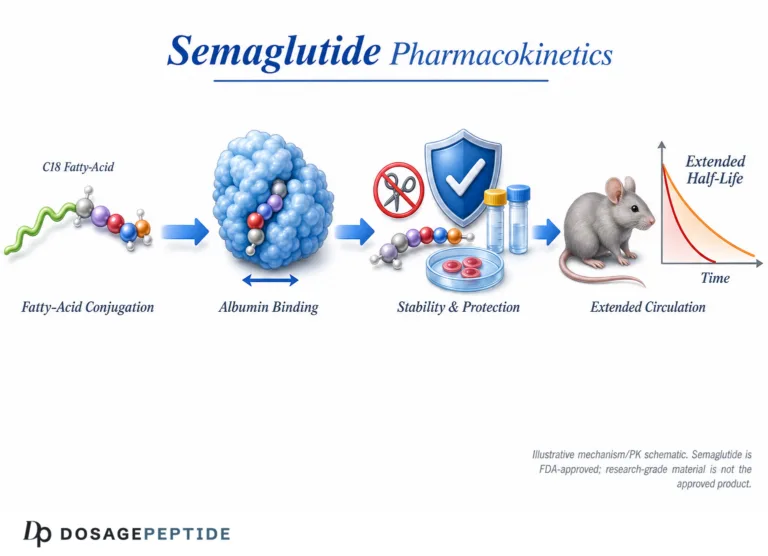
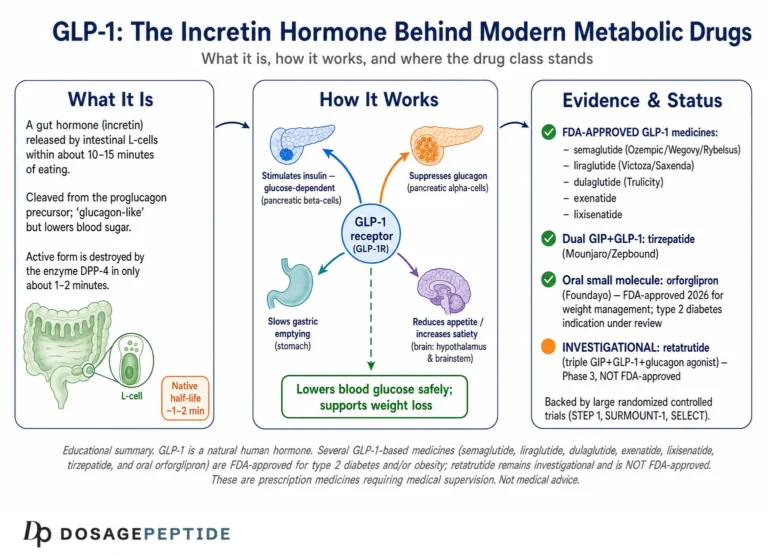
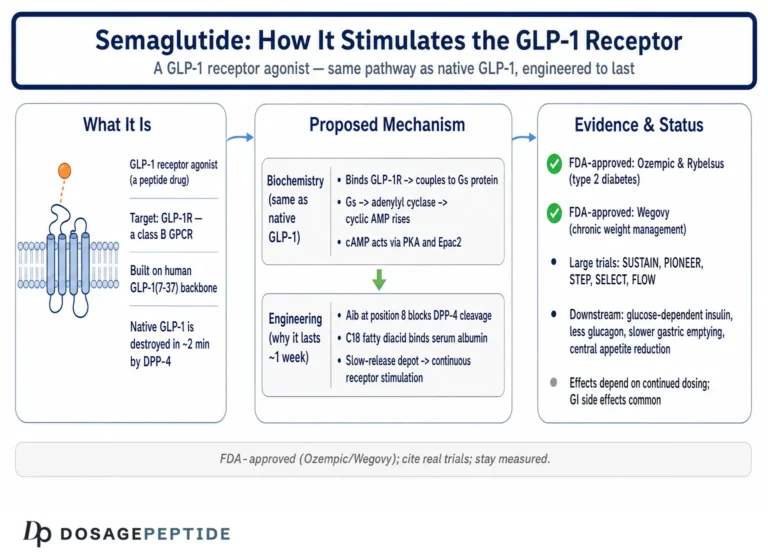
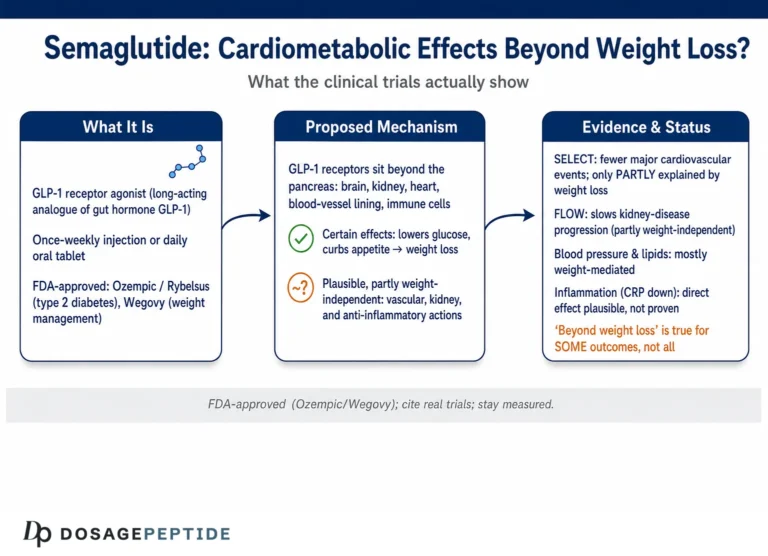
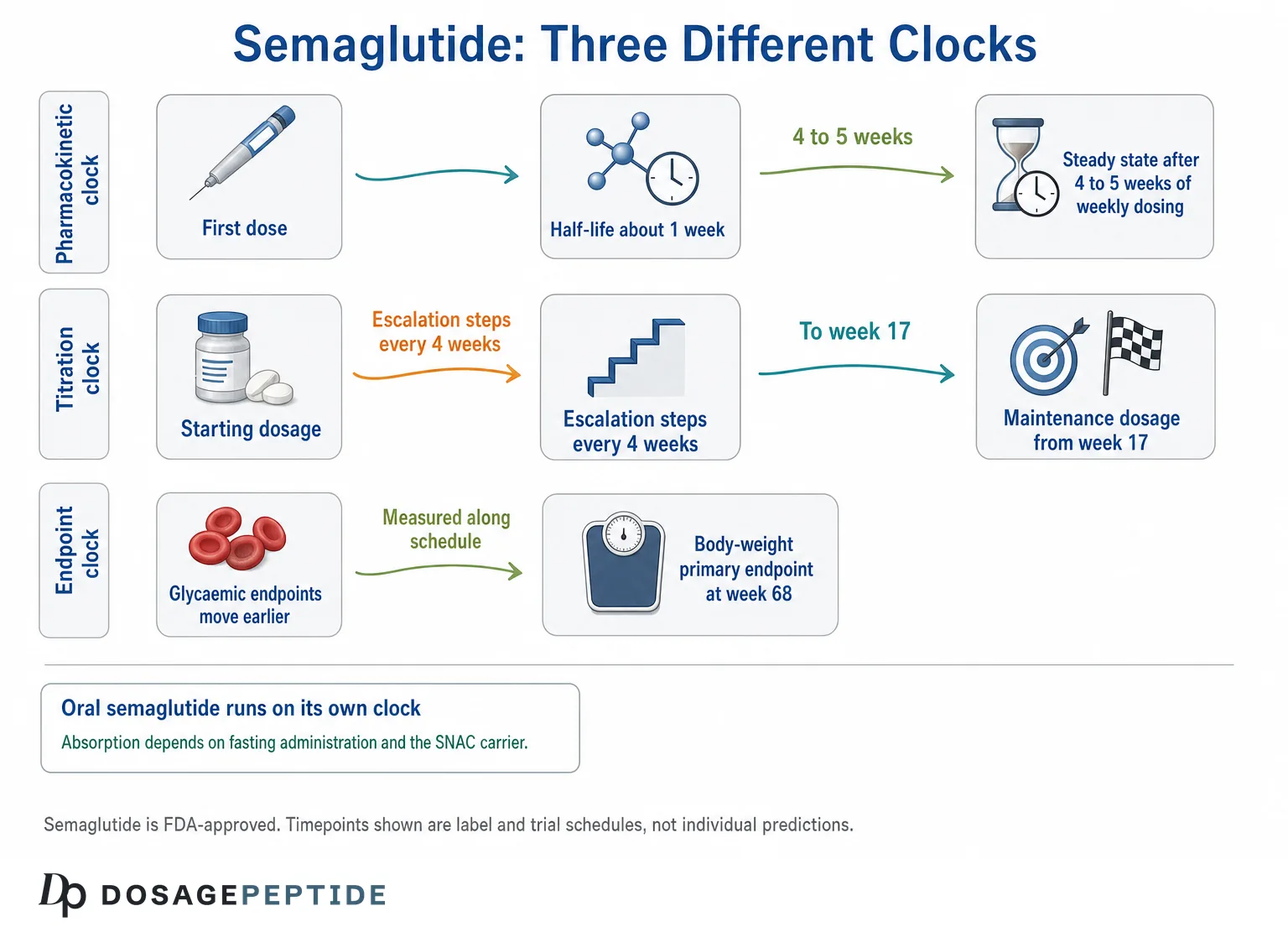
- In the blood: peak concentration 1 to 3 days after a subcutaneous dose, elimination half-life of about 1 week, steady state after 4 to 5 weeks of weekly dosing.
- The dose ramp runs longer than the drug does. On the Wegovy injection label, week 17 is the first week a maintenance dosage is designated, after 0.25 → 0.5 → 1 → 1.7 mg at four weeks each.
- Blood sugar and weight were measured on different schedules. SUSTAIN 1 set its HbA1c endpoint at week 30; STEP 1 set its weight endpoint at week 68 (−14.9% versus −2.4% on placebo).
- Oral semaglutide runs on its own clock: peak concentration about 1 hour after an empty-stomach dose, with absolute bioavailability of roughly 0.4–2%.
- Published timelines disagree mostly because they mix these three clocks together. Trial figures are group averages, not individual predictions.
Semaglutide reaches its maximum plasma concentration 1 to 3 days after a subcutaneous dose, has an elimination half-life of approximately one week, and reaches steady-state exposure only after 4 to 5 weeks of once-weekly administration.[1] That is the pharmacokinetic answer, and it is the only part of the question with a clean number. The clinical endpoint answer is entirely different: the registrational trials measured body weight at week 68 and week 104, HbA1c at week 30, liver histology at week 72, and cardiovascular events over a mean 39.8 months of follow-up. This page separates those two clocks and states which number came from which trial at which week.
The semaglutide timeline, week by week
Almost every disagreement about “how long semaglutide takes to work” comes from collapsing three independent timelines into one. The drug’s exposure clock is set by its half-life. The protocol clock is set by the dose-escalation schedule written into the label. The endpoint clock is set by whatever the trial sponsor chose to measure and when. Below is the documented record for each.
| Timepoint | What the record documents | Source type |
|---|---|---|
| Day 1–3 after a subcutaneous dose | Maximum plasma concentration (Tmax) is reached 1 to 3 days post dose | FDA label, section 12.3[1] |
| ~1 hour (oral tablets) | Tmax approximately 1 hour after administration on an empty stomach; absolute bioavailability 0.4–1% (Rybelsus) or 1–2% (Ozempic tablets) | FDA label, oral semaglutide[9] |
| ~1 week | Elimination half-life of approximately 1 week, for both the injectable and oral forms | FDA label[1] and published PK review[2] |
| Week 4–5 at any given dose level | Steady-state exposure is achieved following 4 to 5 weeks of once-weekly administration | FDA label, section 12.3[1] |
| Week 17 | First week the Wegovy injection label designates a maintenance dosage, after 0.25 → 0.5 → 1 → 1.7 mg at four weeks each; 2.4 mg is the usual recommended maintenance dosage and 1.7 mg an alternative, and the 7.2 mg dosage is reachable only after at least four further weeks at 2.4 mg | FDA label, section 2[3] |
| Week 30 | SUSTAIN 1 primary endpoint: HbA1c fell 1.45% (0.5 mg) and 1.55% (1.0 mg) from a baseline of 8.05%, vs 0.02% with placebo (p<0.0001) | Phase 3a RCT[5] |
| Week 64 | OASIS 4 co-primary endpoint: mean body-weight change −13.6% with oral semaglutide 25 mg vs −2.2% placebo (p<0.001) | Phase 3 RCT[10] |
| Week 68 | STEP 1 co-primary endpoint: mean body-weight change −14.9% with semaglutide 2.4 mg vs −2.4% placebo (p<0.001) | Phase 3 RCT[4] |
| Week 72 | ESSENCE part 1 interim analysis: resolution of steatohepatitis without worsening fibrosis in 62.9% vs 34.3% placebo (p<0.001) | Phase 3 RCT[8] |
| Week 104 | STEP 5 co-primary endpoint: mean body-weight change −15.2% vs −2.6% placebo | Phase 3 RCT[6] |
| Mean 39.8 months | SELECT: primary MACE composite in 6.5% vs 8.0% placebo (HR 0.80; 95% CI 0.72–0.90; p<0.001) | Event-driven outcomes trial[7] |
| 5–7 weeks after last dose | About 5 weeks in circulation after the last dose at the Ozempic dosages; about 5 to 7 weeks after a 2.4 mg or 7.2 mg Wegovy injection or a 25 mg oral dose | FDA labels, section 12.3[1][3] |
What is semaglutide approved for, as of August 2026?
Semaglutide is FDA-approved, and its indications differ by brand and route:
- Ozempic (semaglutide injection) — adjunct to diet and exercise to improve glycemic control in adults with type 2 diabetes; to reduce the risk of major adverse cardiovascular events in adults with type 2 diabetes and established cardiovascular disease; and to reduce the risk of sustained eGFR decline, end-stage kidney disease and cardiovascular death in adults with type 2 diabetes and chronic kidney disease.[1]
- Wegovy (semaglutide injection) — MACE risk reduction in adults with established cardiovascular disease plus obesity or overweight; reduction of excess body weight in adults and in pediatric patients aged 12 years and older with obesity, and in adults with overweight plus at least one weight-related comorbidity; and, under accelerated approval, noncirrhotic MASH with moderate-to-advanced fibrosis.[3]
- Wegovy tablets (oral semaglutide 25 mg) — approved 22 December 2025 under NDA 218316 for MACE risk reduction and body-weight reduction in adults; the first oral GLP-1 receptor agonist to carry a weight-management indication.[15][3]
- Rybelsus and Ozempic tablets (oral semaglutide) — glycemic control in adults with type 2 diabetes and MACE risk reduction.[9]
Every number in the timeline table comes from a study of one of these approved products, at a defined dose, in a defined population. None of it transfers automatically to research-grade material of unverified identity or purity. For background on the receptor class itself, see our overview of what a GLP-1 receptor agonist is and how it signals.
Why the first month is a dose ramp
A half-life of roughly one week means that after a single weekly dose, roughly half the drug from that dose remains when the next one is given. Concentrations accumulate until input equals clearance — four to five half-lives, hence the label’s 4 to 5 weeks to steady state.[2] Critically, that 4-to-5-week clock restarts at every dose increase. It describes the time to plateau at a given dose, not the time to plateau of the regimen.
The Wegovy injection schedule makes the consequence explicit. Weeks 1–4 are 0.25 mg, weeks 5–8 are 0.5 mg, weeks 9–12 are 1 mg, weeks 13–16 are 1.7 mg, and a maintenance dosage — usually 2.4 mg — is designated only from week 17 onward. The label states that this escalation exists to reduce the risk of gastrointestinal adverse reactions, and that escalation may be delayed by four weeks if a dose is not tolerated.[3] Adding the PK clock to the protocol clock, steady-state exposure at a 2.4 mg maintenance dosage is not reached until roughly week 21, and later still for anyone the label permits to escalate to 7.2 mg. In STEP 1, dose escalation itself consumed 16 of the trial’s 68 weeks.[11][14] So the first month of any semaglutide schedule sits at the lowest exposure that schedule ever produces — the step the label designates “Starting Dosage,” four escalation steps below the 2.4 mg dosage on which the STEP trials measured their endpoints. The mechanics of that ramp are laid out in more detail in our semaglutide titration schedule reference.
Does anything measurable happen before steady state?
Yes, and the mechanistic literature is the honest place to look, because it measured proximate outputs rather than long-horizon endpoints. In a 12-week randomized crossover trial in 30 participants with obesity, once-weekly semaglutide escalated to 1.0 mg reduced total ad libitum energy intake across all test meals by 24% versus placebo (−3036 kJ; p<0.0001), with less hunger, fewer food cravings and better reported control of eating; mean body weight fell 5.0 kg, predominantly fat mass.[12] That is a mechanism study at a 1.0 mg dose over 12 weeks — not a weight-management efficacy result, and not a statement about what any individual will observe.
Blood sugar and weight move on different schedules
HbA1c is a lagging composite: it reflects glycation accumulated over the lifespan of circulating red blood cells, roughly three months. Even instantaneous, complete normalization of glucose could not be fully expressed in HbA1c inside a few weeks. That is a property of the assay, not of the drug. The SUSTAIN program accordingly set its primary glycemic readout at week 30 — SUSTAIN 1 reported HbA1c falling by 1.45% and 1.55% at the 0.5 mg and 1.0 mg doses from a baseline of 8.05%, alongside body-weight reductions of 3.73 kg and 4.53 kg at the same visit.[5]
Body weight has no such assay lag, but the STEP program’s co-primary endpoints still sat at week 68 (STEP 1) and week 104 (STEP 5) because that is where the sponsor placed them.[4][6] Placing those two results side by side is instructive but has limits: −14.9% at week 68 in STEP 1 (1,961 randomized) and −15.2% at week 104 in STEP 5 (304 randomized), in similar but separately enrolled populations. Because they are different trials, the pair cannot be chained into a single curve. What it does rule out is a linear extrapolation — a further 36 weeks in a separate trial did not produce a proportionally larger mean change.
Cardiovascular endpoints run on the slowest clock. SELECT enrolled 17,604 participants with preexisting cardiovascular disease and overweight or obesity without diabetes, and required a mean 39.8 months of follow-up to accrue enough events for its primary composite.[7] SUSTAIN 6, in type 2 diabetes, ran 104 weeks for the same class of endpoint.[13]
Oral semaglutide runs on a separate absorption clock
Oral semaglutide is not simply the injectable in tablet form. The tablets are co-formulated with SNAC (sodium N-[8-(2-hydroxybenzoyl)amino] caprylate), an absorption enhancer that facilitates uptake across the gastric epithelium.[9] Absolute bioavailability remains very low — the label documents 0.4–1% for Rybelsus and 1–2% for Ozempic tablets — which is why oral milligram numbers cannot be compared with injectable milligram numbers.
Because absorption is so fragile, the label specifies the administration window tightly: the tablet is taken once daily on an empty stomach in the morning with no more than 4 ounces of water, swallowed whole, with at least 30 minutes elapsing before food, other beverages, or other oral medications.[9] Daily dosing does not shorten the systemic clock: the terminal half-life is still approximately one week, and steady state is still reached after 4 to 5 weeks. The escalation schedule is written in 30-day blocks — for Wegovy tablets, days 1–30 at 1.5 mg, days 31–60 at 4 mg, days 61–90 at 9 mg, and 25 mg from day 91 onward.[3]
OASIS 4 is a useful precision test. Its co-primary endpoint at week 64 was a mean body-weight change of −13.6% with oral semaglutide 25 mg versus −2.2% with placebo, in 307 randomized participants.[10] The figure of roughly 16.6% that circulates widely in sponsor communications and press coverage of the same trial is a different estimand — the effect estimated if treatment is adhered to without discontinuation — not the peer-reviewed co-primary result. Both are real; they answer different questions. Any timeline that quotes one without naming which is not reporting the record accurately.
What the record shows if you stop
The washout side of the clock is roughly symmetrical with the loading side, and it is dose-dependent. The Ozempic label documents semaglutide as remaining in the circulation for about 5 weeks after the last dose;[1] the Wegovy label, covering the higher weight-management dosages, documents about 5 to 7 weeks after a 2.4 mg or 7.2 mg injection or a 25 mg oral dose.[3] The endpoint side is not symmetrical at all. In the STEP 1 off-treatment extension, 327 participants who had completed 68 weeks stopped both semaglutide and the lifestyle intervention. From a mean 17.3% weight loss at week 68, the semaglutide group regained 11.6 percentage points by week 120, leaving a net 5.6% below baseline; most cardiometabolic variables reverted toward baseline over the same year.[11] The authors framed this as evidence that ongoing treatment is required to maintain the changes — an explicitly exploratory analysis, but a directionally important one for anyone reading a “timeline” as if it had an endpoint.
Why published timelines disagree with each other
Week-by-week numbers circulating online rarely reconcile with each other. The recurring reasons are all resolvable by checking the source:
- Different estimands from the same trial. As in OASIS 4, a treatment-policy result and an adherence-conditional result differ by several percentage points and are both correct within their own definition.
- Different doses. The 24% energy-intake reduction came from a 1.0 mg mechanism study;[12] the −14.9% weight figure came from a 2.4 mg trial.[4] They are not points on one curve.
- Different populations. SUSTAIN enrolled adults with type 2 diabetes; STEP largely excluded diabetes; ESSENCE required biopsy-defined MASH with fibrosis stage 2 or 3.[8]
- Group means presented as individual trajectories. Every number above is a mean across hundreds or thousands of participants with wide dispersion around it.
- Gastrointestinal adverse events on their own timeline. These were the most frequently reported events across the program and were generally described as transient and mild-to-moderate; that pattern is discussed separately in our summary of reported semaglutide adverse events.
Why research-grade semaglutide is a different question
The constants above were measured on approved products at specified strengths. Vials sold for laboratory research are not the approved product: identity, peptide content, purity and stability are not established by regulatory review, and a lyophilized vial labeled in milligrams carries no guarantee that the reconstituted concentration matches the label. Any timeline reasoning applied to such material inherits that uncertainty. Our 10 mg semaglutide vial reconstitution reference and the corresponding 5 mg vial reference document how the published dose steps map onto vial arithmetic for laboratory record-keeping; neither is a human-use instruction. For cross-molecule timelines, see our side-by-side of retatrutide, semaglutide and tirzepatide.
Frequently Asked Questions
How long does semaglutide take to reach steady state?
The FDA label states that steady-state exposure is achieved following 4 to 5 weeks of once-weekly administration, consistent with an elimination half-life of approximately one week. This applies to each dose level independently: after any dose increase, another 4 to 5 weeks pass before concentrations plateau at the new level. Oral semaglutide reaches steady state on the same 4-to-5-week schedule despite daily dosing.
What is semaglutide’s half-life?
Approximately one week, for both the subcutaneous injection and the oral tablets. The extended half-life comes from a fatty-acid side chain that promotes albumin binding and slows renal clearance, which is what makes once-weekly injection feasible. Washout is dose-dependent: the Ozempic label states semaglutide will be present in the circulation for about 5 weeks after the last dose, while the Wegovy label states about 5 to 7 weeks after a 2.4 mg or 7.2 mg injection or a 25 mg oral dose.
Why is the first month described as a titration ramp?
Because the label schedules it that way. The Wegovy injection schedule spends weeks 1–4 at 0.25 mg, weeks 5–8 at 0.5 mg, weeks 9–12 at 1 mg and weeks 13–16 at 1.7 mg, with a maintenance dosage designated only from week 17 onward. The label gives the reason: the escalation is there to reduce the risk of gastrointestinal adverse reactions. The first month is therefore the lowest exposure step in the entire schedule, and steady state at a 2.4 mg maintenance dosage falls around week 21.
At what week did STEP 1 measure its primary endpoint?
Week 68. STEP 1 randomized 1,961 adults with obesity, or overweight with at least one weight-related comorbidity and without diabetes, to once-weekly subcutaneous semaglutide 2.4 mg or placebo plus lifestyle intervention. Mean body-weight change from baseline to week 68 was −14.9% with semaglutide versus −2.4% with placebo, an estimated treatment difference of −12.4 percentage points.
Did two years of treatment produce more change than 68 weeks?
Only marginally, in the trials as published. STEP 5 reported a mean body-weight change of −15.2% at week 104 versus −2.6% with placebo, in 304 randomized participants. STEP 1 reported −14.9% at week 68 in a larger, related but not identical population. The two trials are not directly comparable, but neither shows continued linear change through the second year.
Why does HbA1c seem to lag behind other measures?
HbA1c reflects glycation accumulated over roughly three months of red-cell lifespan, so it structurally cannot register a rapid change in glucose within a few weeks. The SUSTAIN program set its primary glycemic endpoint at week 30 for this reason. SUSTAIN 1 documented HbA1c reductions of 1.45% and 1.55% at 0.5 mg and 1.0 mg from a baseline of 8.05%.
Do the oral tablets work on the same timeline as the injection?
Systemically, yes — the half-life and 4-to-5-week steady state are the same. Absorption is entirely different: bioavailability is 0.4–2% depending on product, the tablets are co-formulated with the SNAC absorption enhancer, and the label requires dosing on an empty stomach with up to 4 ounces of water and at least 30 minutes before food, other drinks or other oral medications. The escalation schedule runs in 30-day blocks.
What did the trials show after semaglutide was stopped?
In the STEP 1 off-treatment extension, 327 participants stopped semaglutide and lifestyle intervention at week 68 after a mean 17.3% weight loss. By week 120 they had regained 11.6 percentage points, leaving a net 5.6% below baseline, and most cardiometabolic improvements had reverted toward baseline. The analysis was exploratory, and the authors concluded that ongoing treatment appeared necessary to maintain the changes.
Is any of this a guide to what an individual should expect?
No. Every figure cited here is a group mean from a specific trial, at a specific dose, in a specific enrolled population, measured at a pre-specified visit. Dispersion around those means was wide, and none of these trials was designed to predict individual trajectories. This page reports what the published record documents; it is not medical advice and not a dosing recommendation.
References
- OZEMPIC (semaglutide) injection, solution — FDA prescribing information, Novo Nordisk. DailyMed, label revised 2026. https://dailymed.nlm.nih.gov/dailymed/drugInfo.cfm?setid=adec4fd2-6858-4c99-91d4-531f5f2a2d79
- Hall S, Isaacs D, Clements JN. Pharmacokinetics and Clinical Implications of Semaglutide: A New Glucagon-Like Peptide (GLP)-1 Receptor Agonist. Clin Pharmacokinet. 2018;57(12):1529–1538. https://pubmed.ncbi.nlm.nih.gov/29915923/
- WEGOVY (semaglutide) injection and tablets — FDA prescribing information, Novo Nordisk. DailyMed, label revised June 2026. https://dailymed.nlm.nih.gov/dailymed/drugInfo.cfm?setid=ee06186f-2aa3-4990-a760-757579d8f77b
- Wilding JPH, Batterham RL, Calanna S, et al. Once-Weekly Semaglutide in Adults with Overweight or Obesity (STEP 1). N Engl J Med. 2021;384(11):989–1002. https://pubmed.ncbi.nlm.nih.gov/33567185/
- Sorli C, Harashima SI, Tsoukas GM, et al. Efficacy and safety of once-weekly semaglutide monotherapy versus placebo in patients with type 2 diabetes (SUSTAIN 1). Lancet Diabetes Endocrinol. 2017;5(4):251–260. https://pubmed.ncbi.nlm.nih.gov/28110911/
- Garvey WT, Batterham RL, Bhatta M, et al. Two-year effects of semaglutide in adults with overweight or obesity: the STEP 5 trial. Nat Med. 2022;28(10):2083–2091. https://pubmed.ncbi.nlm.nih.gov/36216945/
- Lincoff AM, Brown-Frandsen K, Colhoun HM, et al. Semaglutide and Cardiovascular Outcomes in Obesity without Diabetes (SELECT). N Engl J Med. 2023;389(24):2221–2232. https://pubmed.ncbi.nlm.nih.gov/37952131/
- Sanyal AJ, Newsome PN, Kliers I, et al. Phase 3 Trial of Semaglutide in Metabolic Dysfunction-Associated Steatohepatitis (ESSENCE). N Engl J Med. 2025;392(21):2089–2099. https://pubmed.ncbi.nlm.nih.gov/40305708/
- RYBELSUS and OZEMPIC (oral semaglutide) tablets — FDA prescribing information, Novo Nordisk. DailyMed, SPL version 13, published 20 May 2026. https://dailymed.nlm.nih.gov/dailymed/drugInfo.cfm?setid=27f15fac-7d98-4114-a2ec-92494a91da98
- Wharton S, Lingvay I, Bogdanski P, et al. Oral Semaglutide at a Dose of 25 mg in Adults with Overweight or Obesity (OASIS 4). N Engl J Med. 2025;393(11):1077–1087. https://pubmed.ncbi.nlm.nih.gov/40934115/
- Wilding JPH, Batterham RL, Davies M, et al. Weight regain and cardiometabolic effects after withdrawal of semaglutide: The STEP 1 trial extension. Diabetes Obes Metab. 2022;24(8):1553–1564. https://pubmed.ncbi.nlm.nih.gov/35441470/
- Blundell J, Finlayson G, Axelsen M, et al. Effects of once-weekly semaglutide on appetite, energy intake, control of eating, food preference and body weight in subjects with obesity. Diabetes Obes Metab. 2017;19(9):1242–1251. https://pubmed.ncbi.nlm.nih.gov/28266779/
- Marso SP, Bain SC, Consoli A, et al. Semaglutide and Cardiovascular Outcomes in Patients with Type 2 Diabetes (SUSTAIN 6). N Engl J Med. 2016;375(19):1834–1844. https://pubmed.ncbi.nlm.nih.gov/27633186/
- Effect and Safety of Semaglutide 2.4 mg Once-weekly in Subjects With Overweight or Obesity (STEP 1), NCT03548935. ClinicalTrials.gov. https://clinicaltrials.gov/study/NCT03548935
- WEGOVY (semaglutide) tablets, NDA 218316 — original approval 22 December 2025. Drugs@FDA, U.S. Food and Drug Administration. https://www.accessdata.fda.gov/scripts/cder/daf/index.cfm?event=overview.process&ApplNo=218316
Research use only. DosagePeptide is an independent reference library, not a seller, pharmacy or clinic. Nothing on this page is medical advice, a treatment recommendation, or a dosing protocol for human use. All figures cited are group-level results reported in published trials of FDA-approved semaglutide products at specified doses; research-grade material obtained from laboratory suppliers is not the approved product and its identity, purity and concentration are not established by regulatory review. Decisions about any prescription medicine belong with a licensed clinician.