- In the blood: peak plasma concentration a median 24 hours after a dose (range 8–72 h); steady state after about 4 weeks of weekly dosing, with an elimination half-life of roughly 5 days.
- The first month is not the real dose. The 2.5 mg starting dose is documented in the label as being for treatment initiation and “not intended for glycemic control”. The earliest permitted step up is week 4.
- First scheduled weight readout: week 20. In SURMOUNT-1, least-squares mean weight change was −13.2 kg (pooled 10/15 mg) versus −2.5 kg on placebo.
- Headline results: weeks 40, 52 and 72. SURMOUNT-1 at week 72 recorded mean weight change of −15.0%, −19.5% and −20.9% for 5, 10 and 15 mg.
- The curve had not flattened at week 72 — it was still descending when the trial ended. These are group averages from trials, not a prediction for any one person.
“How long does tirzepatide take to work” has no single answer because three separate clocks are running at once: the drug’s own pharmacokinetics (steady-state plasma concentrations after roughly 4 weeks of weekly dosing, given an elimination half-life of about 5 days), the mandatory dose-escalation schedule (which means the first month is a starting dose the label explicitly says is not intended for glycemic control), and the trial calendars, where the earliest scheduled efficacy readout in the phase 3 obesity program sits at week 20 and the headline endpoints sit at week 40, 52 and 72.[1][2] The direct answer, reported from the record rather than promised: group-level change was already large by the first intermediate timepoint the obesity program published (week 20), and the SURMOUNT-1 weight curve was still descending at week 72.
The tirzepatide timeline, week by week
Every row is a documented timepoint from an FDA label, a registry record, or a published trial — not a “what you should feel” narrative.
| Timepoint | Pharmacokinetic clock | Dose clock | What trials measured at this point |
|---|---|---|---|
| Dose 1, hours 8–72 | Median time to maximum plasma concentration 24 h (range 8–72 h); absolute bioavailability ~80%[1] | 2.5 mg starting dose | No scheduled efficacy endpoint; phase 3 trials never assessed whether the drug “started working” on a given day. |
| Week 4 | Steady-state plasma concentrations reached after 4 weeks of once-weekly dosing[1] | Earliest permitted step to 5 mg[2] | Nothing scheduled. The 2.5 mg dosage is documented as being “for treatment initiation and… not intended for glycemic control”.[2] |
| Week 12 | Steady state at each new dose re-established ~4 weeks after each step | 3rd escalation window | Phase 2 (LY3298176) set its primary HbA1c endpoint at week 26, not week 12; the authors reported that the 12-week outcomes were similar to those at 26 weeks for all secondary outcomes.[10] |
| Week 20 | — | End of the 20-week escalation period in SURMOUNT-1[6] | Pre-specified secondary endpoint: LS mean weight change −13.2 kg (pooled 10/15 mg) vs −2.5 kg placebo; difference −10.7 kg (95% CI −11.2 to −10.1), p<0.001.[7] |
| Week 40 | — | Maintenance dose reached long before | Primary HbA1c endpoint in SURPASS-1 (−1.87 to −2.07 percentage points vs +0.04 placebo)[4] and SURPASS-2 (−2.01 to −2.30 vs −1.86 for semaglutide 1 mg).[5] |
| Week 52 | — | Maximum tolerated dose (10 or 15 mg) | Primary endpoint in SURMOUNT-OSA: change in apnea–hypopnea index, −25.3 vs −5.3 events/h (trial 1) and −29.3 vs −5.5 (trial 2).[9] |
| Week 72 | — | — | Primary endpoint in SURMOUNT-1: mean weight change −15.0%, −19.5%, −20.9% (5/10/15 mg) vs −3.1% placebo.[6] |
| Week 176 | — | — | SURMOUNT-1 extension (obesity + prediabetes): −12.3%, −18.7%, −19.7% vs −1.3% placebo.[8] |
What is tirzepatide, and what is actually approved?
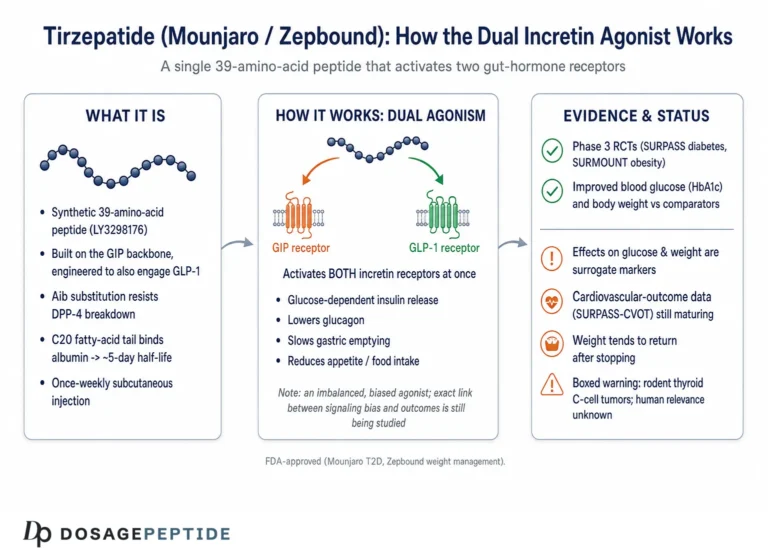
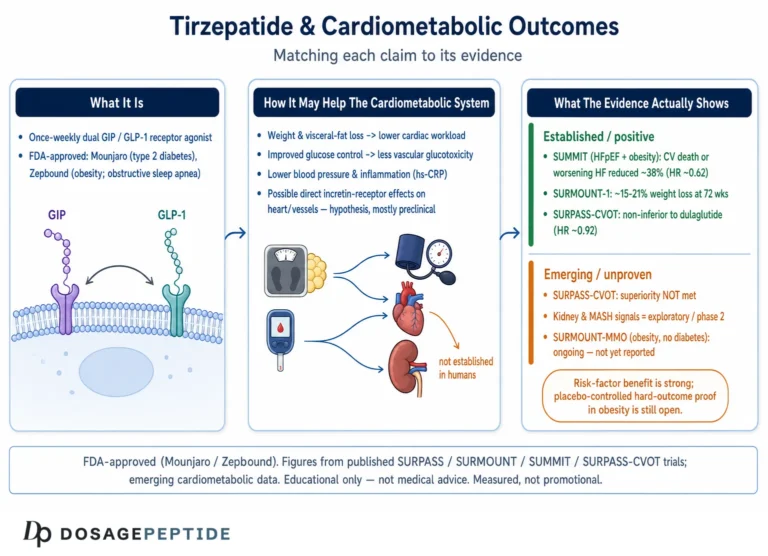
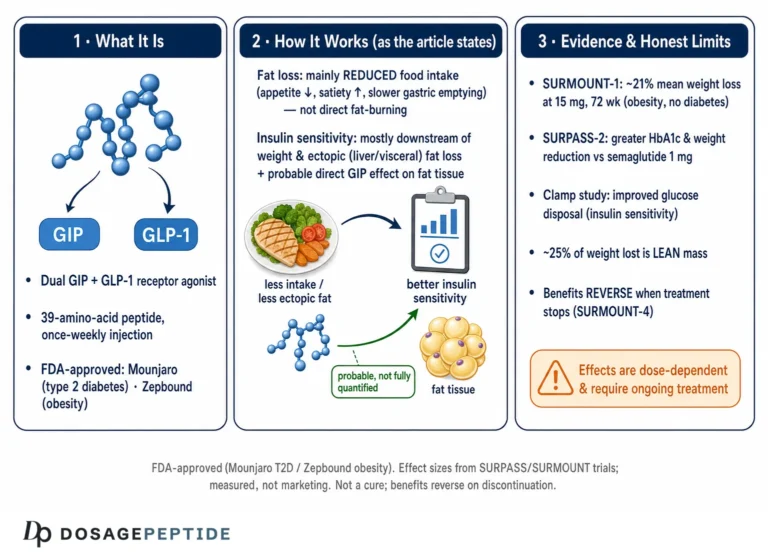
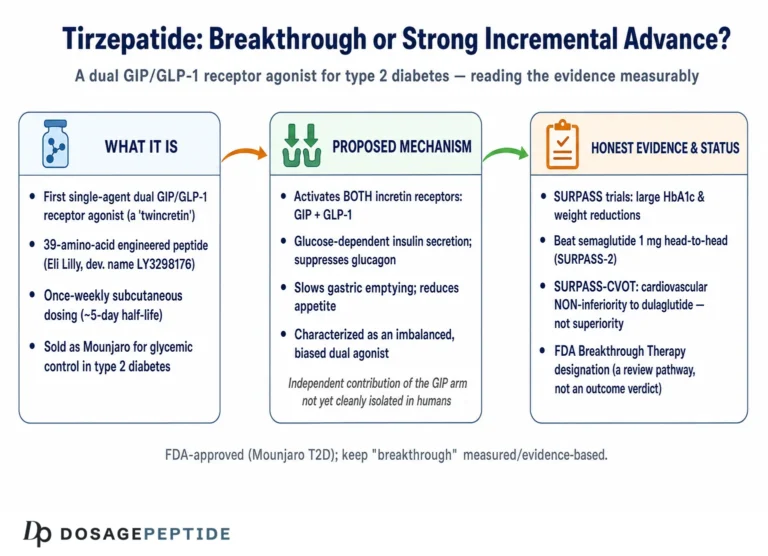
Tirzepatide is a single peptide engaging both the GIP and GLP-1 receptors, FDA-approved under two brand names with distinct indications. Mounjaro: adjunct to diet and exercise to improve glycemic control in adults and pediatric patients 10 years and older with type 2 diabetes mellitus.[2] Zepbound: with a reduced-calorie diet and increased physical activity, to reduce excess body weight and maintain weight reduction long term in adults with obesity or overweight plus a weight-related comorbid condition, and to treat moderate-to-severe obstructive sleep apnea in adults with obesity.[1] Mechanism is covered in our explainer on how the dual GIP/GLP-1 agonist works.
How fast does the drug build up in the blood?
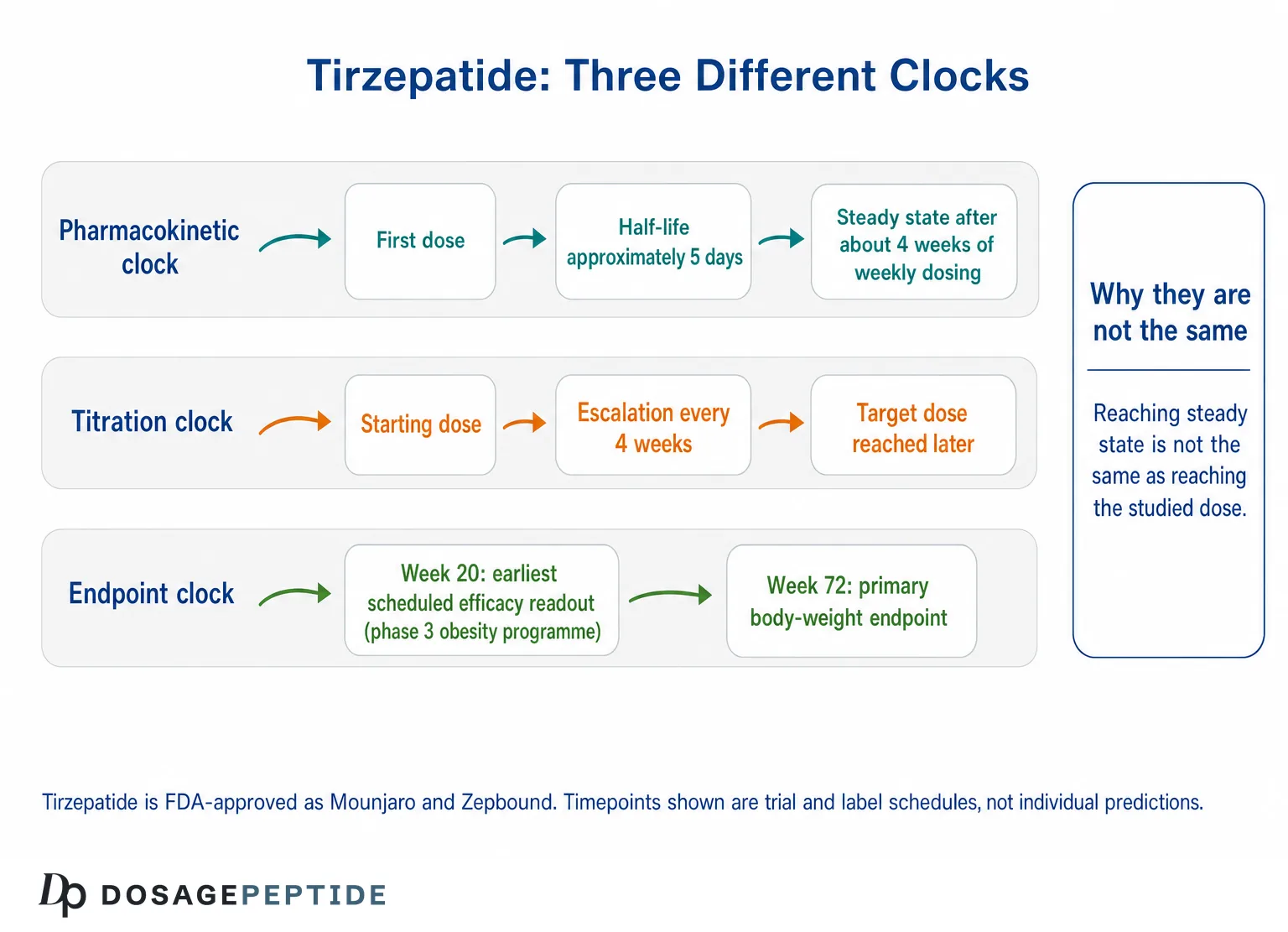
Absorption is not the bottleneck: median time to maximum plasma concentration is 24 hours (range 8 to 72 hours), and absolute bioavailability is about 80%.[1] Measurable plasma exposure therefore begins with the first dose. What that exposure does clinically on day one is not something the trials measured.
Accumulation is the bottleneck. The elimination half-life is approximately 5 days (the Zepbound label documents approximately 5–6 days in adults with overweight or obesity, and in adults with OSA and obesity); a published population pharmacokinetic model built from 19 pooled studies likewise reports a half-life of about 5 days, which the authors describe as enabling sustained exposure with once-weekly subcutaneous dosing.[3] Roughly five half-lives — about 25 days — are needed to approach a plateau, which is why both labels state that steady state was achieved following 4 weeks of once-weekly administration.[1] That is also why the 4-week interval between escalation steps is not arbitrary, and why the label’s missed-dose instruction allows a 4-day (96-hour) window before a dose is skipped.[2]
Why the first month is not the real dose
This is the single largest reason “when it works” is not “when you take it.” The approved schedule starts at 2.5 mg once weekly for 4 weeks, then 5 mg, with further increases in 2.5 mg increments after at least 4 weeks on the current dose, to a maximum of 15 mg once weekly.[2] The Mounjaro label is unusually blunt about what the opening month is for: “The 2.5 mg dosage is for treatment initiation and is not intended for glycemic control.”[2]
Arithmetically, reaching 15 mg from 2.5 mg requires five 4-week steps — week 20 at the earliest. SURMOUNT-1’s registry record describes exactly that ramp, and the publication describes a 20-week dose-escalation period inside its 72-week design.[6][7] Anyone comparing their week 6 to a trial’s week 72 headline is comparing a 5 mg exposure to a 15 mg one; the mechanics are covered in our breakdown of the tirzepatide titration schedule used in the trials.
The escalation design also shapes the tolerability timeline: in SURMOUNT-1 and its 3-year extension, gastrointestinal adverse events were the most common and occurred primarily during the dose-escalation period in the first 20 weeks.[8] We catalogue what the labels and trials document under tirzepatide adverse-event reporting.
When did the trials actually measure results?
Glycemic endpoints came first, and are structurally lagged
SURPASS-1 was a 40-week, double-blind, placebo-controlled trial in 478 adults with type 2 diabetes inadequately controlled by diet and exercise. Its single primary endpoint was change in HbA1c at week 40 — no earlier efficacy timepoint was registered.[11] At week 40, mean HbA1c fell by 1.87, 1.89 and 2.07 percentage points on 5, 10 and 15 mg versus +0.04 with placebo, and 87–92% of tirzepatide participants reached HbA1c <7.0% versus 20% on placebo.[4] SURPASS-2, an open-label 40-week trial in 1,879 participants, recorded HbA1c changes of −2.01, −2.24 and −2.30 percentage points versus −1.86 for semaglutide 1 mg.[5]
One caveat about the HbA1c clock specifically: HbA1c is a glycated fraction of hemoglobin measured, in the registry’s own words, “to identify average plasma glucose concentration over prolonged periods of time.”[11] It is a lagging integrator by construction and cannot resolve onset even in principle. The earliest published glycemic comparison in the program comes from the phase 2 dose-ranging trial, whose primary efficacy outcome was change in HbA1c at 26 weeks — not at week 12 — and whose authors reported that the 12-week outcomes were similar to those at 26 weeks for all secondary outcomes.[10] That is a statement about two later timepoints resembling each other, not a measurement of onset, and the trial used escalation regimens differing from the approved schedule. Treat it as a signal about the shape of the curve, not a substitute for phase 3 data.
The weight curve is much longer, and week 20 is the only published intermediate anchor
SURMOUNT-1 randomized 2,539 adults with obesity (or overweight plus a weight-related complication, excluding diabetes) to 5, 10 or 15 mg or placebo for 72 weeks. Its primary endpoints sit at week 72: mean weight change of −15.0%, −19.5% and −20.9% versus −3.1% for placebo, with 85–91% of tirzepatide participants losing at least 5% of body weight versus 35% on placebo.[6]
The one pre-specified intermediate readout is the week-20 secondary endpoint, and its posted result is the most useful number on this page: pooled 10 mg and 15 mg arms recorded an LS mean weight change of −13.2 kg against −2.5 kg for placebo, a difference of −10.7 kg (95% CI −11.2 to −10.1; p<0.001).[7] Against a trial-wide mean baseline weight of 104.8 kg — a figure covering all four arms, not the pooled 10/15 mg subset measured above — a large share of the group-level effect was already on the books by the end of escalation, while the curve kept descending for another 52 weeks.[7][6]
One caution before treating those two numbers as a ratio: the week-20 analysis excluded data after premature study-drug discontinuation, whereas the week-72 co-primary used a treatment-regimen estimand assessing effects regardless of discontinuation.[7][6] They are not like-for-like, and one is in kilograms while the other is a percentage. The direction of the curve is solid; “X% of your result by week 20” arithmetic is not.
The sleep apnea endpoint sits at week 52
SURMOUNT-OSA comprised two 52-week phase 3 trials in adults with moderate-to-severe obstructive sleep apnea and obesity — one without positive airway pressure at baseline, one with — at the maximum tolerated dose (10 or 15 mg). Mean AHI change at week 52 was −25.3 events/hour versus −5.3 with placebo in trial 1, and −29.3 versus −5.5 in trial 2.[9] No earlier AHI timepoint was primary, so the approved OSA claim rests on a one-year measurement.
Does the curve ever flatten?
The 3-year SURMOUNT-1 extension is the best public evidence. Among participants with obesity and prediabetes treated for 176 weeks, mean weight change was −12.3%, −18.7% and −19.7% on 5, 10 and 15 mg versus −1.3% on placebo — slightly less than the same doses at week 72, in people who stayed on treatment throughout.[8] That is consistent with a plateau near the end of year one, then broad maintenance. The same analysis recorded type 2 diabetes onset in 1.3% of tirzepatide participants versus 13.3% on placebo.[8]
Why trial averages are not a prediction
Every number above is a group mean or proportion, and the trials report the spread: in SURMOUNT-1, 50% and 57% of the 10 mg and 15 mg groups lost at least 20% of body weight — the same as saying roughly half did not — and 9–15% never reached the 5% threshold. Adverse events led to discontinuation in 4.3–7.1% of tirzepatide participants.[6] Populations were screened, too: SURMOUNT-1 excluded people with diabetes, prior pancreatitis, and recent weight change greater than 5 kg.[7] Trials also embed structured diet and activity co-interventions, and body-composition questions sit underneath the weight number — see our review of lean-mass changes with GLP-1-class compounds. Photographic before-and-after timelines circulating online are not endpoint data.
Why research-grade tirzepatide is a different question
Material sold as “tirzepatide” for laboratory use is not Mounjaro or Zepbound. It has not been through FDA review for identity, purity, potency, sterility or stability, so none of the timelines above — generated with the approved product under a controlled protocol — can be assumed to transfer to it. FDA states that unapproved versions of GLP-1 drugs, semaglutide and tirzepatide included, “do not undergo FDA’s review for safety, effectiveness and quality before they are marketed.” The same page documents dosing errors from patients measuring and self-administering incorrect doses of compounded injectable products, and adverse-event reports in patients given compounded semaglutide or tirzepatide at doses beyond the approved label; its salt-form warning is directed specifically at semaglutide sodium and semaglutide acetate rather than at tirzepatide.[12] In February 2026 the agency announced its intent to restrict GLP-1 active pharmaceutical ingredients destined for non-FDA-approved compounded drugs, and to act on misleading direct-to-consumer marketing.[13] Separately, FDA has warned at least one online peptide vendor selling tirzepatide that labeling such as “research use only,” “not for human consumption” and “lab purposes only” did not settle the question: the agency held that claims made on the seller’s own website established the products’ intended use as unapproved new drugs for human use.[14] Our vial reference pages — the tirzepatide 10 mg vial dosing protocol and the 30 mg vial reference — are laboratory documentation, not human-use instructions.
Frequently Asked Questions
How long does tirzepatide take to work?
There is no single onset figure in the record. Plasma concentrations peak within about 24 hours of a dose and reach steady state after roughly 4 weeks of weekly dosing. The earliest published intermediate efficacy timepoint in the obesity program is week 20; primary endpoints sit at week 40 (HbA1c), week 52 (apnea–hypopnea index) and week 72 (body weight). Anything more precise is inference, not data.
When does tirzepatide reach steady state?
Both FDA labels state that steady-state plasma concentrations were achieved following 4 weeks of once-weekly administration. That follows from an elimination half-life of approximately 5 days (about 5–6 days in adults with overweight or obesity), since roughly five half-lives are needed to plateau. Each dose increase restarts the process, so a new plateau is reached about 4 weeks after each escalation step.
What did trials record in the first month?
Nothing, by design. Neither SURMOUNT-1 nor SURPASS-1 registered an efficacy assessment before week 20 and week 40 respectively, and the first month is spent on the 2.5 mg starting dose, which the Mounjaro label describes as being for treatment initiation and not intended for glycemic control. Absence of a month-one endpoint is absence of evidence, not evidence of absence.
Why does dose escalation take 20 weeks?
The approved schedule starts at 2.5 mg for 4 weeks, moves to 5 mg, then rises in 2.5 mg increments after at least 4 weeks on each dose. Reaching the 15 mg maximum therefore takes five steps, or 20 weeks at the fastest permitted pace — which is why SURMOUNT-1 had a 20-week escalation period inside its 72-week design.
How much weight did SURMOUNT-1 record at week 20 versus week 72?
At week 20, the pooled 10 mg and 15 mg arms recorded a least-squares mean weight change of −13.2 kg versus −2.5 kg for placebo. At week 72, mean changes were −15.0%, −19.5% and −20.9% for 5, 10 and 15 mg versus −3.1% for placebo. The two are reported in different units and analyzed under different estimands, so they show direction, not a clean ratio.
Does weight loss plateau on tirzepatide?
The 3-year SURMOUNT-1 extension in participants with obesity and prediabetes recorded mean weight change of −12.3%, −18.7% and −19.7% at week 176 — slightly less than the same doses at week 72 — in people who remained on treatment throughout. That pattern is consistent with a plateau around the end of the first year, followed by broad maintenance rather than continued decline.
Is tirzepatide FDA-approved, and for what exactly?
Yes. Mounjaro is approved as an adjunct to diet and exercise to improve glycemic control in adults and pediatric patients aged 10 and older with type 2 diabetes. Zepbound is approved, alongside a reduced-calorie diet and increased physical activity, for long-term weight reduction and maintenance in adults with obesity or overweight with a weight-related comorbidity, and for moderate-to-severe obstructive sleep apnea in adults with obesity.
References
- ZEPBOUND (tirzepatide) injection — full prescribing information. Eli Lilly and Company. DailyMed, U.S. National Library of Medicine. dailymed.nlm.nih.gov
- MOUNJARO (tirzepatide) injection — full prescribing information. Eli Lilly and Company. DailyMed, U.S. National Library of Medicine. dailymed.nlm.nih.gov
- Schneck K, Urva S. Population pharmacokinetics of the GIP/GLP receptor agonist tirzepatide. CPT Pharmacometrics Syst Pharmacol. 2024;13(3):494–503. pubmed.ncbi.nlm.nih.gov/38356317
- Rosenstock J, Wysham C, Frías JP, et al. Efficacy and safety of a novel dual GIP and GLP-1 receptor agonist tirzepatide in patients with type 2 diabetes (SURPASS-1). Lancet. 2021;398(10295):143–155. pubmed.ncbi.nlm.nih.gov/34186022
- Frías JP, Davies MJ, Rosenstock J, et al. Tirzepatide versus semaglutide once weekly in patients with type 2 diabetes (SURPASS-2). N Engl J Med. 2021;385(6):503–515. pubmed.ncbi.nlm.nih.gov/34170647
- Jastreboff AM, Aronne LJ, Ahmad NN, et al. Tirzepatide once weekly for the treatment of obesity (SURMOUNT-1). N Engl J Med. 2022;387(3):205–216. pubmed.ncbi.nlm.nih.gov/35658024
- SURMOUNT-1 study record and posted results, NCT04184622. ClinicalTrials.gov, U.S. National Library of Medicine. clinicaltrials.gov/study/NCT04184622
- Jastreboff AM, le Roux CW, Stefanski A, et al. Tirzepatide for obesity treatment and diabetes prevention. N Engl J Med. 2025;392(10):958–971. pubmed.ncbi.nlm.nih.gov/39536238
- Malhotra A, Grunstein RR, Fietze I, et al. Tirzepatide for the treatment of obstructive sleep apnea and obesity (SURMOUNT-OSA). N Engl J Med. 2024;391(13):1193–1205. pubmed.ncbi.nlm.nih.gov/38912654
- Frias JP, Nauck MA, Van J, et al. Efficacy and safety of LY3298176, a novel dual GIP and GLP-1 receptor agonist, in patients with type 2 diabetes: a randomised phase 2 trial. Lancet. 2018;392(10160):2180–2193. pubmed.ncbi.nlm.nih.gov/30293770
- SURPASS-1 study record, NCT03954834. ClinicalTrials.gov, U.S. National Library of Medicine. clinicaltrials.gov/study/NCT03954834
- U.S. Food and Drug Administration. FDA’s concerns with unapproved GLP-1 drugs used for weight loss. fda.gov
- U.S. Food and Drug Administration. FDA intends to take action against non-FDA-approved GLP-1 drugs. FDA statement, February 6, 2026. fda.gov
- U.S. Food and Drug Administration, Center for Drug Evaluation and Research. Warning letter to USApeptide.com, MARCS-CMS 696885, February 26, 2025. fda.gov
This page is an independent research reference compiled from published trial records and FDA labeling, for research and educational purposes only. It is not medical advice, not a dosing recommendation, and not an instruction for human use. Research-grade peptide material is for laboratory research use only and is not the FDA-approved product. Decisions about any approved medicine belong with a licensed clinician.