If you searched “retatrutide before and after,” you were probably hoping to see dramatic transformation photos — a grid of side-by-side images promising a specific result. This page does not have those, and that is a deliberate choice. We do not publish transformation photos, testimonials, or promised outcomes for research compounds, because those images are unverifiable and, for a research-use-only material, misleading. What we can do is show you what the actual peer-reviewed research has measured over time. That is a more honest “before and after” than any photo.
Retatrutide (development code LY3437943) is an investigational “triple agonist” — a single peptide that activates the GIP, GLP-1, and glucagon receptors. It is developed by Eli Lilly and is not an approved medicine for weight loss or any other use as of August 2026. The phase 3 TRIUMPH programme has now reported, and Lilly has said it plans to file for approval in the first quarter of 2027 — so a decision, if it comes, is a 2027–2028 story. Everything below comes from clinical trials, not from anecdotes or our own products.
The short answer. In the pivotal phase 3 trial, average weight loss at 80 weeks was 28.3% on the highest dose versus 2.2% on placebo — roughly 70 lb (32 kg). It took the full 80 weeks to get there, on a slow dose-escalation schedule, under medical supervision, with nausea in about 4 of every 10 participants. That is the real “before and after”. The rest of this page shows where each of those numbers comes from.
What the research shows over time
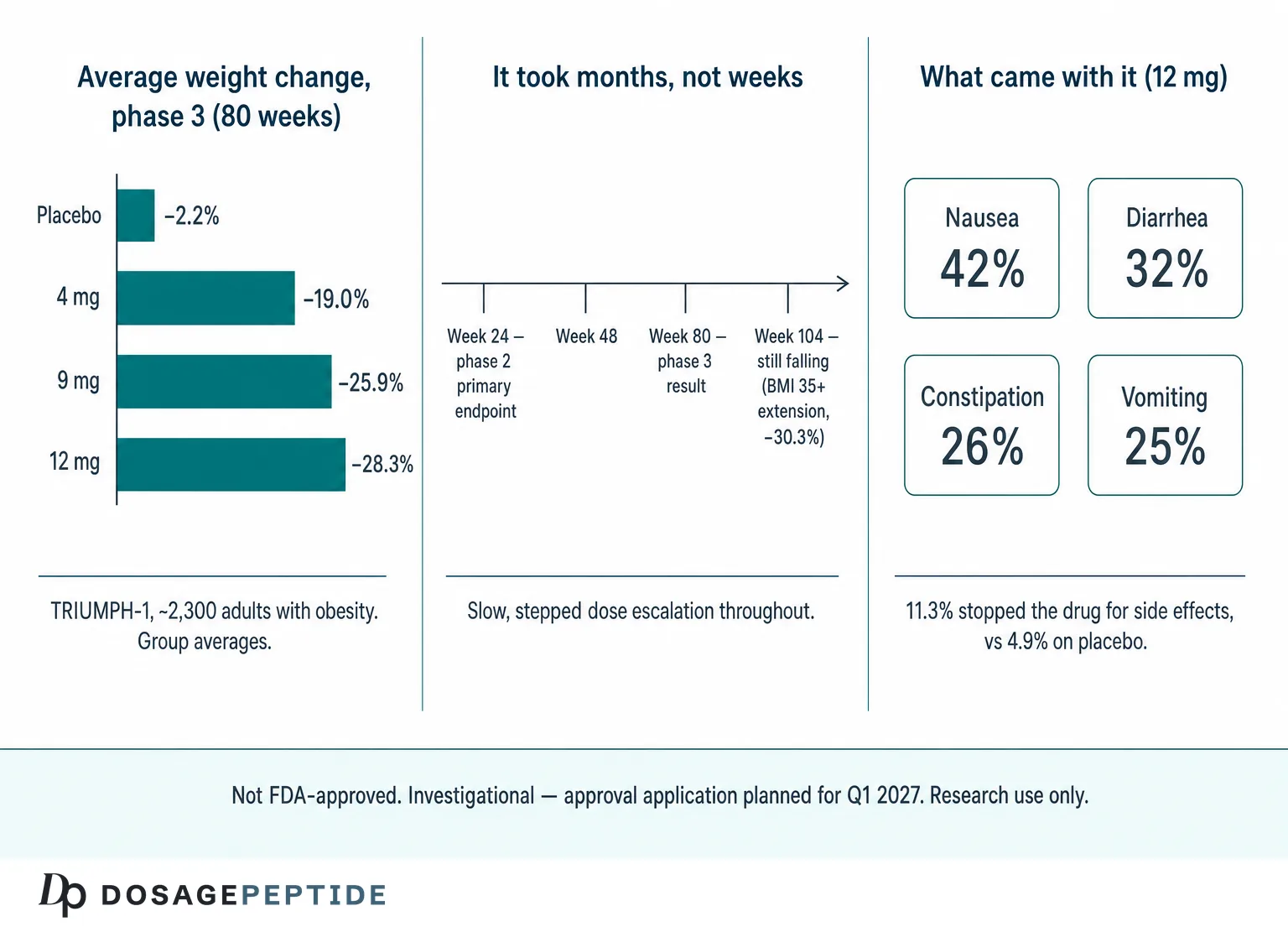
The biggest single dataset is TRIUMPH-1, the pivotal phase 3 obesity trial reported in May 2026: about 2,300 adults with obesity, randomised to retatrutide or placebo, followed for 80 weeks. Average weight change was −19.0% at 4 mg, −25.9% at 9 mg and −28.3% at 12 mg, against −2.2% on placebo. At the 12 mg dose, 45.3% of participants lost at least 30% of their body weight — a threshold previously associated with bariatric surgery. In a study extension limited to participants starting at a BMI of 35 or more, average loss reached 30.3% at 104 weeks, meaning weight was still falling well into the second year.
Before that, the picture came from three clinical (not preclinical, not anecdotal) phase 2 randomized, placebo-controlled trials, all sponsored by the manufacturer. They measured different endpoints — body weight, blood sugar, and liver fat — over 24 to 48 weeks. The consistent theme is that measured changes are gradual and dose-dependent, accumulating over months rather than appearing quickly.
In the pivotal obesity trial, the primary endpoint was the percentage change in body weight at 24 weeks, with participants followed to 48 weeks. Weight continued to decline throughout, and at the highest dose the average change was still trending downward at week 48 (Jastreboff et al., 2023).
| Study (year, journal) | Population & duration | What was measured | Key measured outcome (highest dose vs. placebo) |
|---|---|---|---|
| TRIUMPH-1 (phase 3 RCT, reported May 2026) | ~2,300 adults with obesity; 80 weeks | % body-weight change | −28.3% at 80 weeks (12 mg) vs −2.2% placebo; ≥30% weight reduction in 45.3% of the 12 mg group |
| Jastreboff et al., 2023 — NEJM (phase 2 RCT, NCT04881760) | 338 adults with obesity/overweight; 48 weeks | % body-weight change | −24.2% at 48 weeks (12 mg) vs −2.1% placebo; ≥15% weight reduction in 83% of the 12 mg group vs 2% placebo |
| Rosenstock et al., 2023 — Lancet (phase 2 RCT, NCT04867785) | 281 adults with type 2 diabetes; up to 36 weeks | HbA1c (blood sugar) + body weight | HbA1c −2.02% at 24 weeks (12 mg) vs −0.01% placebo; body weight −16.9% at 36 weeks |
| Sanyal et al., 2024 — Nature Medicine (phase 2a substudy, NCT04881760) | 98 adults with fatty-liver disease (MASLD); 24 weeks | Liver-fat content (imaging) | Liver fat −82.4% at 24 weeks (12 mg) vs +0.3% placebo; normal liver fat (<5%) reached by 86% at 12 mg vs 0% placebo |
A few honest caveats about this table. The three 2023–2024 rows are phase 2 studies — smaller, shorter, and designed to find a dose rather than to confirm one. The phase 3 row is the one that carries weight, and it broadly confirmed the phase 2 signal rather than shrinking it, which is not always what happens. Additional phase 3 trials in the TRIUMPH and TRANSCEND families have also reported positive results in adults with obesity, type 2 diabetes, knee osteoarthritis pain and obstructive sleep apnea. What is still not available is the thing that matters most for long-term use: a completed cardiovascular-outcome trial, and any real-world safety record outside supervised studies. Anything online presenting retatrutide as settled is running ahead of the evidence.
Realistic expectations
Here is what the data does support: in supervised trials, retatrutide produced substantial, dose-dependent reductions in body weight and liver fat over several months. Here is what it does not support: any specific promise for an individual. Trial results are group averages, and the spread between people was wide. Participants also received careful medical supervision, a slow dose-escalation schedule, and a defined pharmaceutical-grade formulation — none of which is guaranteed by material bought as a research chemical.
This is exactly why online “before and after” photos are unreliable for a compound like this. Such images cannot verify the identity or purity of what was actually used, the dose, the timeframe, concurrent diet or other drugs, or whether the photo was edited. A research-use-only material is not the clinically studied product, so attaching trial-sized expectations to it is not scientifically justified.
Safety & legal status
The trials did document a consistent safety signal, and the phase 3 numbers put a size on it. The most common adverse events were gastrointestinal — at the 12 mg dose in TRIUMPH-1, nausea was reported by about 42% of participants, diarrhea 32%, constipation 26% and vomiting 25%. These were dose-related, mostly mild to moderate, concentrated during dose escalation, and reduced by starting low. Stopping the drug because of side effects was also dose-related: 4.1%, 6.9% and 11.3% at 4, 9 and 12 mg, against 4.9% on placebo. A less familiar signal was dysesthesia — abnormal skin sensations such as tingling or burning — reported by 5.1%, 12.3% and 12.5% across the three doses versus 0.9% on placebo. A dose-dependent increase in heart rate was seen in phase 2, peaking around 24 weeks before declining, on the order of a few beats per minute (Jastreboff et al., 2023; Doggrell, 2023). In the phase 2 diabetes trial, there were no reports of severe hypoglycemia and no deaths (Rosenstock et al., 2023).
On legal status: retatrutide is an investigational compound that is not approved by the FDA or other major regulators for weight loss, diabetes, or any other indication. Completing phase 3 is not approval; Lilly has said it intends to file in the first quarter of 2027, and a regulator can still say no, narrow the indication, or ask for more data. Products referenced on this site are sold strictly for laboratory research use only — not for human consumption, and not as a treatment. Nothing here is medical advice.
Dosage reference
If you are documenting research handling and reconstitution, our Retatrutide dosage chart lays out the concentrations and volumes used in the published dose ranges. To convert a target dose into a syringe volume for a given vial and reconstitution, use our peptide dosage calculator. These are reference tools for research contexts only and do not imply any human use.
FAQ
Are there real before/after photos of retatrutide?
There is no verified, published set of “before and after” photos, and we do not host any. The genuine record is data: measured percentage changes in weight, liver fat, and blood sugar from randomized trials (Jastreboff et al., 2023; Sanyal et al., 2024). Photos circulating online cannot confirm what was used, the dose, or the timeline, so they should not be treated as evidence.
How long until changes appeared in the studies?
Slowly and steadily. The obesity trial measured its primary endpoint at 24 weeks and kept following participants to 48 weeks, with average weight still declining at the highest dose by the end (Jastreboff et al., 2023). Liver-fat reductions were measured over 24 weeks (Sanyal et al., 2024). These are multi-month changes on a supervised, escalating schedule — not overnight results.
How much weight did people actually lose?
In the pivotal phase 3 trial, an average of 28.3% of body weight at 80 weeks on the 12 mg dose, against 2.2% on placebo — around 70 lb (32 kg). Lower doses gave less: 25.9% at 9 mg and 19.0% at 4 mg. Those are group averages; individual results in the trials varied widely around them.
How long did it take?
Months, not weeks. The phase 2 obesity trial measured its primary endpoint at 24 weeks and kept following participants to 48; the phase 3 trial ran to 80 weeks, and in the participants who continued to 104 weeks average weight was still falling. Every trial used a slow, stepped dose escalation, which is also what kept the nausea manageable.
Is retatrutide proven and approved?
No. As of August 2026 it is not approved by the FDA or any comparable regulator. The phase 3 TRIUMPH programme has reported positive results, and Lilly has said it plans to submit an approval application in the first quarter of 2027, which puts any decision in the 2027–2028 window at the earliest. Until then it remains an investigational, research-use-only compound.
What were the most common side effects?
Gastrointestinal ones, by a wide margin: at the highest phase 3 dose, nausea in roughly 42% of participants, diarrhea 32%, constipation 26%, vomiting 25%. Around 11% of that group stopped the drug because of side effects, versus about 5% on placebo. Abnormal skin sensations (dysesthesia) were reported by about 12% at the higher doses versus 0.9% on placebo.