Human chorionic gonadotropin (HCG), gonadorelin, and human menopausal gonadotropin (HMG) are frequently grouped together as “fertility peptides,” yet they act at three entirely different levels of the same regulatory circuit. The central research question this article addresses is deceptively simple: if all three ultimately influence gonadal steroid and gamete output, why do they behave so differently — and what does the current evidence actually establish about each? To answer that, we use the hypothalamic–pituitary–gonadal (HPG) axis as the organizing frame, then compare the three agents by molecular target, site of action, half-life, hormonal activity profile, evidence tier, and regulatory status. Throughout, the goal is descriptive and educational: this is a reference comparison for researchers, not a protocol or a therapeutic recommendation.
Why Is the HPG Axis the Right Frame for Comparing These Three Agents?
Any meaningful comparison of HCG, gonadorelin, and HMG has to begin with the architecture they all plug into. The HPG axis is a three-tier neuroendocrine cascade. At the top, specialized neurons in the hypothalamus release gonadotropin-releasing hormone (GnRH) in discrete pulses into the hypophyseal portal circulation. Those pulses reach the anterior pituitary, where gonadotroph cells respond by secreting two glycoprotein gonadotropins — luteinizing hormone (LH) and follicle-stimulating hormone (FSH). LH and FSH travel through the systemic circulation to the gonads, where they drive steroidogenesis (testosterone in the testis, estradiol and progesterone in the ovary) and gametogenesis (spermatogenesis; folliculogenesis).[1]
The reason this framing matters is that each of the three agents intervenes at a different tier. Gonadorelin is a GnRH molecule — it acts at the top of the axis, on the pituitary. HMG (menotropins) is a gonadotropin preparation — it acts at the middle-to-bottom, substituting directly for pituitary LH and FSH. HCG is a placental hormone that mimics LH — it acts at the bottom, directly on the gonad. Understanding where an agent enters the cascade predicts almost everything else about it: whether it needs an intact pituitary to work, whether pulsatility matters, whether it supplies FSH-like activity, and how long it persists in circulation. A reader who wants the underlying vocabulary — gonadotroph, decapeptide, glycoprotein subunit — can consult the peptide research glossary alongside this discussion.
What the axis tells us about “fertility peptide” as a category
The phrase “fertility peptide” obscures a critical distinction. Only gonadorelin is a true peptide hormone in the small-decapeptide sense. HCG and HMG are large, heterodimeric glycoprotein hormones — each is built from an α subunit shared across the glycoprotein hormone family and a hormone-specific β subunit that confers receptor selectivity.[2] Grouping all three as “peptides” is a loose research-community shorthand rather than a precise biochemical statement, and the differences in molecular size, glycosylation, and receptor target explain most of the functional divergence described below. This matters practically as well: a small unmodified decapeptide such as gonadorelin is cleared within minutes and is not orally bioavailable, whereas the heavily glycosylated gonadotropins resist rapid degradation and circulate for hours — a size-and-sugar distinction that recurs throughout the comparison.[13]
Three levers on one circuit
A useful way to hold the whole comparison in mind is to picture the axis as a signaling relay with three access points. Gonadorelin presses the uppermost switch and asks the pituitary to do the rest of the work in its own physiological pattern. HMG bypasses the pituitary and delivers both of the pituitary’s output signals directly to the gonad. HCG bypasses everything above the gonad and speaks only to the LH receptor. Because each agent enters at a different point, they are not simply weaker or stronger versions of one another — they answer different experimental questions, and choosing among them is a question of where in the circuit the investigator wants to intervene, not merely how much stimulation to apply.
How Does the Hypothalamic–Pituitary–Gonadal Axis Actually Work?

The defining feature of the axis — and the single fact that most separates gonadorelin from the other two agents — is that GnRH signaling is pulsatile, not tonic. Hypothalamic GnRH neurons fire in coordinated bursts roughly every 60 to 120 minutes in the adult, and the frequency and amplitude of those pulses encode information that the pituitary decodes. Slower pulse frequencies tend to favor FSH secretion, while faster frequencies favor LH; a steady, non-pulsatile GnRH signal does not simply produce “more” gonadotropin output. Instead, continuous exposure desensitizes and down-regulates the GnRH receptor on gonadotrophs, shutting the axis down.[1] This paradox — pulses stimulate, continuous exposure suppresses — is the physiological reason that GnRH agonists are used clinically to suppress the axis in other contexts, and it is why any research use of gonadorelin to stimulate the pituitary must reproduce a pulsatile pattern.
Receptor-level signaling: how a pulse is decoded
The molecular basis of this behavior lies in the GnRH receptor itself, a G-protein-coupled receptor on the surface of pituitary gonadotrophs. When a GnRH pulse arrives, the receptor couples predominantly through the Gq/11–phospholipase-C pathway, mobilizing intracellular calcium and activating protein kinase C to trigger synthesis and release of LH and FSH. A structural quirk of the mammalian GnRH receptor is its unusually short intracellular carboxy-terminal tail, which slows the receptor’s internalization and helps it resensitize between pulses. The clean gaps between pulses are therefore not incidental — they are what allow the receptor to reset before the next signal.[13] When the gaps are erased by continuous exposure, the receptor is progressively uncoupled and down-regulated, and gonadotropin output falls rather than rises. This is the mechanistic reason a molecule identical to natural GnRH can either switch the axis on or switch it off depending only on the temporal pattern of delivery.
Upstream control: kisspeptin and the pulse generator
GnRH neurons do not set their own rhythm in isolation. A network of kisspeptin-expressing neurons in the hypothalamus — often described together with neurokinin B and dynorphin as the “KNDy” population — provides the principal excitatory drive that generates the GnRH pulse, integrating signals about energy status, sex steroids, and developmental stage. Kisspeptin signaling sits one tier above GnRH, and continuous kisspeptin stimulation likewise desensitizes its own receptor, mirroring the pulsatility logic seen one level down.[13] Kisspeptin is the subject of its own active research program; readers exploring that upstream node can review the dedicated discussion of kisspeptin and reproductive hormone signaling. For the purposes of this comparison, the key point is that none of the three agents here acts at the kisspeptin level — they all enter the cascade at GnRH or below, which is precisely why kisspeptin serves as a useful reference point for what “further upstream” would look like.
Downstream: the two gonadal cell targets
In the testis, LH acts on the Leydig cells of the interstitium, stimulating the steroidogenic pathway that converts cholesterol to testosterone. The resulting intratesticular testosterone concentration is far higher than serum testosterone, and this local androgen environment is indispensable for spermatogenesis. FSH, meanwhile, acts on the Sertoli cells within the seminiferous tubules, supporting the structural and nutritive environment for developing germ cells and driving the production of inhibin B, a marker of Sertoli-cell function that also feeds back on pituitary FSH secretion. The evidence that both signals matter is unusually direct: in men with complete gonadotropin deficiency, FSH combined with exogenous testosterone failed to initiate spermatogenesis, and when exogenous testosterone was substituted for LH activity in men whose sperm production had already been induced, sperm counts collapsed to zero within six months.[10] That experiment demonstrates why serum-level testosterone cannot replace LH-driven intratesticular testosterone — a distinction that becomes central when comparing HCG to gonadorelin and HMG. In the ovary, the same two-cell logic applies in a different guise: LH drives androgen production in theca cells, and FSH drives its aromatization to estradiol in the neighbouring granulosa cells, so that follicular estrogen output depends on both gonadotropins acting in concert.
What Is HCG and How Does It Work in Research Models?
Human chorionic gonadotropin is a glycoprotein hormone produced physiologically by the placenta during pregnancy. Its clinical and research interest in the reproductive axis comes from a structural coincidence: the HCG molecule binds and activates the same receptor as LH — the LH/choriogonadotropin receptor (LHCGR) — because HCG and LH share substantial homology in their receptor-binding regions. Functionally, then, HCG is an LH-receptor agonist. In the male testis it stimulates Leydig cells to produce testosterone; in the female ovary it drives theca-cell steroidogenesis and, at mid-cycle levels, can trigger the events of ovulation.[2] The approved-product labeling captures this equivalence succinctly, describing the action of HCG as essentially identical to that of pituitary LH in stimulating the interstitial (Leydig) cells of the testis to produce androgens.[15] A deeper narrative treatment of this mechanism is available in the reference article on HCG, testosterone, and fertility research, and the corresponding HCG reconstitution and handling reference covers the research-vial logistics.
Inside the Leydig cell: the steroidogenic cascade
Tracing what happens after HCG binds the LH receptor clarifies why it is such a durable steroidogenic stimulus. LHCGR is a G-protein-coupled receptor that signals principally through Gs, activating adenylyl cyclase and raising intracellular cyclic AMP, which in turn activates protein kinase A. The rate-limiting step that follows is the transport of cholesterol across the mitochondrial membrane by the steroidogenic acute regulatory (StAR) protein, after which the cholesterol side-chain cleavage enzyme converts cholesterol to pregnenolone and the downstream enzymatic chain yields testosterone. Because HCG occupies the same receptor as LH and engages the same intracellular machinery, a rise in testosterone following HCG is read, in research settings, as direct evidence that this entire Leydig-cell pathway is intact and responsive.[2] This is the conceptual basis of the HCG stimulation test discussed below.
The half-life advantage
What makes HCG pharmacologically distinctive among LH-active molecules is its long circulating half-life. Native LH is cleared rapidly; HCG’s β subunit carries an extended, heavily glycosylated carboxy-terminal peptide that dramatically slows renal clearance. The practical consequence in research and clinical settings is that a single HCG administration produces a prolonged, sustained stimulation of the LH receptor rather than a brief spike — which is why HCG has historically been used as a durable LH surrogate. This same carboxy-terminal-peptide strategy has been deliberately engineered into other long-acting gonadotropin analogs to extend their half-lives; corifollitropin alfa, for example, fuses the HCG β-subunit carboxy-terminal peptide onto FSH and thereby achieves a circulating half-life roughly one-and-a-half to two times that of recombinant FSH, confirming that the glycosylated tail is the operative cause of the sustained activity.[12]
What HCG demonstrably does — and does not — provide
Because HCG activates only the LH receptor, it supplies LH-like activity and essentially no FSH activity. In research on hypogonadotropic hypogonadism, the HCG stimulation test is used precisely because a rise in testosterone after HCG demonstrates intact Leydig-cell capacity; one controlled study showed significant increases in total testosterone, free testosterone, and inhibin B measured 72 hours after HCG administration, with the testosterone response strongly correlated to baseline inhibin B as a marker of testicular reserve.[5] In that study the observed increments were substantial — total testosterone rose roughly two-and-a-half to three-fold from baseline — but the sample was small and drawn from a specific patient group, so the numbers illustrate the direction and mechanism of the response rather than a generalizable effect size. The dependence of the response on an intact LH-receptor pathway is underscored by the human and animal genetics of LH deficiency: individuals with inactivating mutations of the LH β-subunit gene present with hypogonadism, absent Leydig-cell maturation, and impaired spermatogenesis,[4] and LHβ-knockout mice show blocked Leydig-cell differentiation and arrested spermatogenesis that can be pharmacologically rescued by exogenous HCG — direct preclinical evidence that HCG can substitute for absent LH signaling in a research model.[3] Individual variation in the downstream androgen receptor — for example, the length of the CAG repeat polymorphism — has also been associated with the magnitude of response to HCG-based regimens, a reminder that receptor-level genetics modulate outcomes.[6]
What Is Gonadorelin and Why Does Pulsatility Matter?
Gonadorelin is synthetic GnRH — the identical decapeptide (a 10–amino-acid sequence, pGlu-His-Trp-Ser-Tyr-Gly-Leu-Arg-Pro-Gly-NH2) that the hypothalamus secretes. Unlike HCG and HMG, it does not act on the gonad at all. It acts one tier up, on the GnRH receptor of pituitary gonadotrophs, prompting the pituitary to release its own LH and FSH. In principle this is the most physiological of the three interventions, because it recruits the body’s intact downstream machinery and preserves the natural ratio and regulation of the two gonadotropins.[13]
The delivery constraint that defines gonadorelin
Gonadorelin’s defining pharmacologic feature is an extremely short circulating half-life — on the order of only a few minutes, with the native decapeptide commonly reported at roughly two to four minutes, reflecting rapid enzymatic degradation by peptidases in the portal and peripheral circulation.[13] Combined with the axis biology described earlier, this creates a strict requirement: to stimulate the pituitary, gonadorelin must be delivered in intermittent pulses that mimic native GnRH secretion, historically via a programmable infusion pump delivering a small subcutaneous or intravenous bolus every 60 to 120 minutes. A continuous infusion of the same molecule does the opposite — it saturates and down-regulates the GnRH receptor and suppresses gonadotropin output. This is the single most important operational fact about gonadorelin, and it separates it sharply from HCG and HMG, which are effective with intermittent bolus dosing precisely because they act below the desensitization-prone pituitary receptor. The pulsatile-delivery principle is not unique to men; pulsatile GnRH is also used in research on female hypothalamic disorders, where treatment duration and gonadotropin deficits shape the response.[9] A more detailed narrative on this molecule is available in the reference article on gonadorelin, GnRH, testosterone, and fertility research, with vial-handling details in the gonadorelin research reference.
The same molecule, two opposite uses
One of the most instructive features of GnRH pharmacology is that longer-acting agonist analogs of the same decapeptide are used to accomplish the exact opposite of stimulation. Because they occupy the receptor continuously rather than in pulses, GnRH agonists first produce a transient “flare” of gonadotropin release and then a sustained down-regulation that suppresses LH, FSH, and gonadal steroid output — a property exploited in the management of hormone-dependent conditions and in assisted-reproduction protocols.[13] Native pulsatile gonadorelin and long-acting GnRH agonists thus sit at opposite ends of the same pharmacological spectrum, differing not in their target but in the temporal pattern of receptor occupancy. Holding those two uses side by side is the clearest possible illustration of why “pulsatile versus continuous” is the organizing variable for anything acting at the GnRH receptor, and why gonadorelin cannot be understood by dose alone.
The prerequisite gonadorelin cannot bypass
Because gonadorelin works by stimulating the pituitary, it can only work if the pituitary is capable of responding. In research subjects whose deficiency lies at the hypothalamic level — that is, they lack the GnRH signal but retain functional gonadotrophs — pulsatile gonadorelin can restore downstream gonadotropin and gonadal output. In subjects whose pituitary itself is damaged or absent, gonadorelin has no target to act on, and gonadotropin replacement (HMG, HCG) becomes the only viable route. This dependence on an intact pituitary is a structural limitation that neither HCG nor HMG shares, and it is the reason clinical series stratify patients by the anatomical level of their lesion before choosing between GnRH and gonadotropin regimens.[8]
What Is HMG / Menotropins and What Does Dual FSH+LH Activity Add?
Human menopausal gonadotropin, or menotropins, is a purified gonadotropin preparation historically extracted from the urine of postmenopausal women, whose elevated pituitary output makes their urine a rich source of gonadotropins. The defining feature of HMG is that it provides both FSH and LH activity in roughly balanced amounts — in classic preparations, LH activity is supplied in part by naturally co-purified HCG. This dual activity is precisely what distinguishes HMG from HCG: where HCG is a pure LH-receptor agonist, HMG delivers FSH-receptor stimulation as well. The composition is standardized by bioactivity; a representative approved menotropin product supplies 75 international units of FSH activity together with 75 international units of LH activity per vial.[15] The HMG reconstitution reference covers the research-vial specifics of these preparations.
Why FSH activity is not redundant
The value of the FSH component is best understood through the spermatogenesis data. FSH acts on Sertoli cells, and while LH-driven intratesticular testosterone is necessary, FSH support materially improves the completeness and efficiency of germ-cell development in gonadotropin-deficient research subjects. This is why regimens for inducing spermatogenesis in hypogonadotropic hypogonadism classically combine HCG (for LH-like Leydig stimulation) with HMG (to add the FSH component), rather than using HCG alone.[2] The complementary roles are dissociable experimentally: recombinant FSH and FSH-based long-acting analogs bind the FSH receptor selectively with essentially no LH-receptor or thyroid-stimulating-hormone-receptor activity, confirming that FSH- and LH-directed effects can be pharmacologically separated and then recombined at will.[12] In other words, the “both signals” property of HMG is not simply an accident of impurity but a functional feature: it reconstitutes at the gonad the two-receptor input that the pituitary normally provides.
Urinary, highly purified, and recombinant preparations
“HMG” is not a single molecule but a class of preparations that have evolved considerably. The earliest products were crude urinary extracts; later highly purified urinary menotropins reduced the non-gonadotropin protein burden and improved batch consistency; and modern biotechnology has produced fully recombinant FSH, recombinant LH, and long-acting recombinant analogs that allow the FSH and LH components to be dosed independently rather than as a fixed ratio.[12] Each generation trades off differently between cost, precise control of the FSH-to-LH ratio, and source-related variability. For the mechanistic comparison in this article the important point is conceptual rather than commercial: whatever the source, an HMG-type preparation is defined functionally by delivering FSH-receptor and LH-receptor stimulation together, and it is that dual activity — not the manufacturing route — that places it in a different mechanistic category from single-receptor HCG.
Ovarian versus testicular contexts
In female reproductive research and assisted-reproduction practice, the FSH activity of HMG is used to drive multi-follicular development, with the LH activity supporting the steroidogenic and maturational aspects of the follicle. In male research on spermatogenesis, the same dual activity substitutes for both missing gonadotropins simultaneously. That versatility — one preparation covering both receptor pathways — is HMG’s principal conceptual advantage, and also the reason its composition and standardization (urinary-derived versus highly purified versus recombinant equivalents) is an active area of pharmaceutical development.[11]
HCG vs Gonadorelin vs HMG: How Do They Compare Head-to-Head?
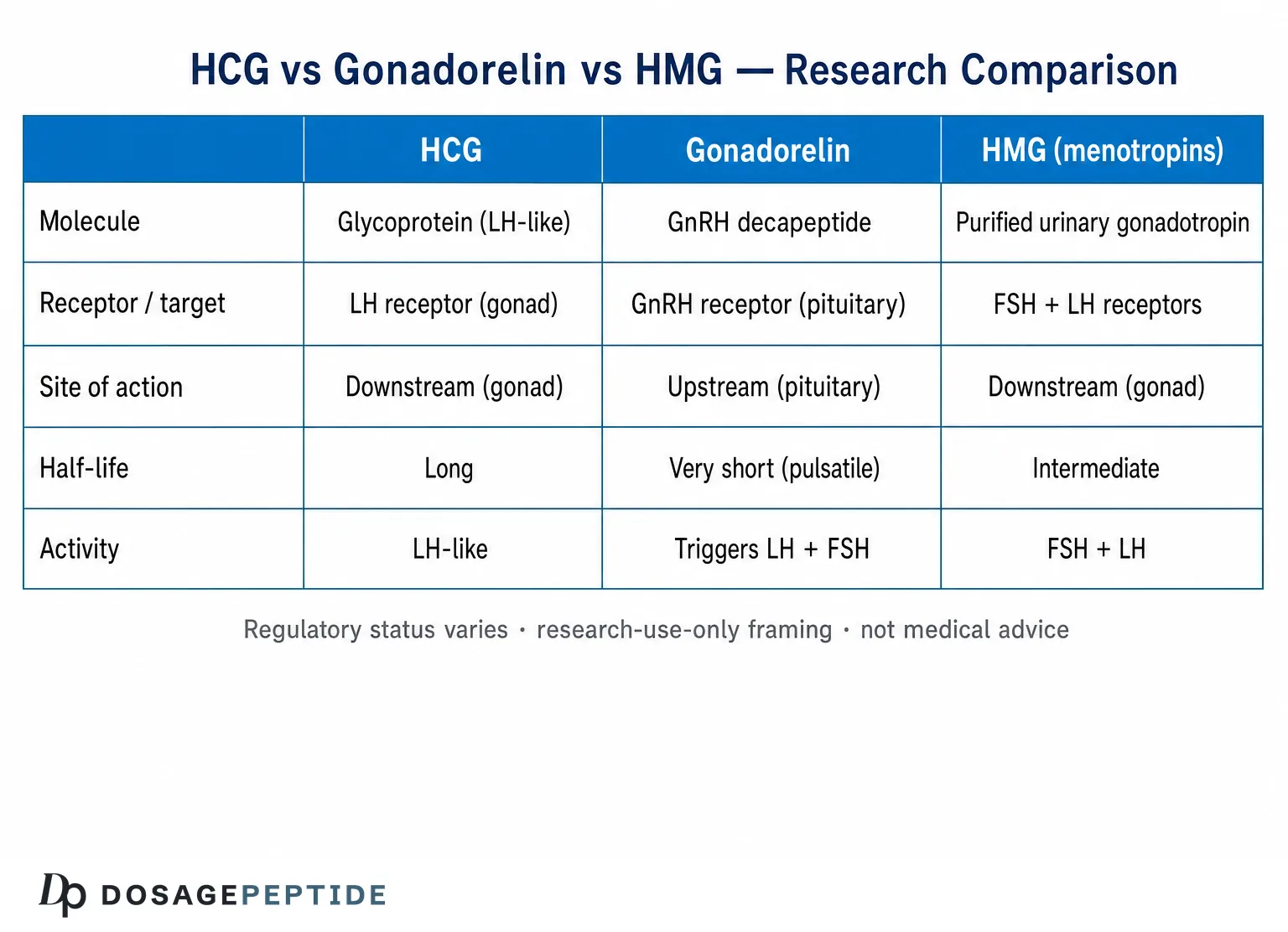
The table below consolidates the mechanistic and pharmacologic differences developed above. It is a conceptual comparison of the molecules and their research context, not a dosing guide.
| Feature | HCG (human chorionic gonadotropin) | Gonadorelin (synthetic GnRH) | HMG / menotropins |
|---|---|---|---|
| Molecular class | Large heterodimeric glycoprotein hormone (α/β subunits) | Decapeptide (10 amino acids) | Purified glycoprotein gonadotropin mixture |
| Primary receptor target | LH/choriogonadotropin receptor (LHCGR) | GnRH receptor on pituitary gonadotrophs | FSH receptor and LH/CG receptor |
| Tier of the HPG axis | Bottom — acts directly on the gonad | Top — acts on the pituitary | Middle/bottom — substitutes for pituitary gonadotropins |
| FSH vs LH activity | LH-like activity only; no FSH activity | Induces the pituitary’s own LH and FSH | Both FSH and LH activity supplied directly |
| Circulating half-life | Long (extended by glycosylated C-terminal peptide) | Very short (only a few minutes)[13] | Intermediate (glycoprotein clearance) |
| Delivery requirement | Intermittent bolus is effective | Must be pulsatile; continuous exposure suppresses the axis | Intermittent bolus is effective |
| Requires intact pituitary? | No | Yes — pituitary must be able to respond | No |
| Representative research/clinical context | LH surrogate; Leydig-cell / steroidogenesis stimulation; ovulation trigger | Physiologic axis restoration in hypothalamic-level deficiency | FSH+LH replacement; folliculogenesis; spermatogenesis induction |
| Example FDA-approved product | Pregnyl, Novarel (hCG) | Factrel, Lutrepulse (both discontinued as US human products) | Menopur (menotropins) |
| US regulatory status of that product | Approved and marketed[15] | No approved human product currently marketed[14] | Approved and marketed[15] |
| Principal limitation | No FSH activity; supraphysiologic sustained LH signal | Pump-dependent; needs functional gonadotrophs | Composition variability; source/standardization issues |
Reading the table: three ways to raise gonadal output
The comparison crystallizes into a simple conceptual map. If a research question concerns Leydig-cell or theca-cell steroidogenesis in isolation and the downstream gonad is intact, HCG provides a durable LH-like signal. If the question concerns restoring the whole axis in a physiologic pattern and the pituitary is functional, pulsatile gonadorelin is the most upstream option. If the question requires FSH-driven gametogenesis alongside LH activity — and especially if the pituitary cannot respond — HMG supplies both gonadotropins directly. These are not interchangeable tools; they are complementary probes of different tiers of the same system.
What Does the Current Evidence Show About Comparative Efficacy?
The most informative comparative data come from research on inducing spermatogenesis in men with congenital or acquired hypogonadotropic hypogonadism, because that setting directly pits the “upstream” strategy (pulsatile gonadorelin/GnRH) against the “gonadotropin replacement” strategy (HCG combined with HMG).
Head-to-head: pulsatile GnRH versus HCG/HMG
A 2025 single-center retrospective cohort of 155 post-pubertal men with congenital hypogonadotropic hypogonadism compared pulsatile GnRH therapy directly against combined HCG/HMG therapy. The two approaches produced statistically indistinguishable rates of successful spermatogenesis induction (82.1% versus 75.8%), with no difference in sperm-concentration category. However, pulsatile GnRH achieved the outcome in a shorter mean time (about 12.3 versus 14.7 months) and was associated with greater final testicular volume (15 versus 12 mL). On multivariate analysis, only baseline testicular volume independently predicted success.[7] The interpretation the authors themselves draw is measured: the two strategies are broadly comparable in whether they work, with modest differences in how fast and in testicular development.
The older evidence base agrees
This modern finding echoes a much older and frequently cited case series. In a review of 42 men with secondary hypogonadism, both pulsatile GnRH and HCG/HMG doubled testicular volume within 5 to 12 months and induced sperm in the ejaculate in 54 of 57 treatment courses, with no statistically significant difference between the two modalities in time to appearance of sperm or in pregnancy rates.[8] The convergence of a 1998 series and a 2025 cohort on the same conclusion — comparable efficacy, with pulsatile GnRH conferring modest testicular-development advantages — is one of the more stable observations in this literature.
Readouts researchers actually track
Interpreting these comparisons requires knowing what the studies measure, because the endpoints themselves reveal the mechanistic logic. Testicular volume is used as a gross index of the combined trophic effect of LH and FSH on both compartments; the appearance and concentration of sperm in the ejaculate is the definitive gametogenic endpoint; and inhibin B and testosterone serve as biochemical markers of Sertoli-cell and Leydig-cell function respectively. In the 2025 cohort, the finding that only baseline testicular volume independently predicted success illustrates why researchers weight that particular readout so heavily.[7] That the same variable also tends to reflect the depth of the underlying deficit — smaller baseline testes typically indicating more complete gonadotropin absence — is a recurring reason why raw comparisons between agents can be confounded by who was enrolled.
Evidence tier, stated precisely
It is essential to grade this evidence honestly. The comparative human data are drawn largely from retrospective cohort and case-series designs in specific, uncommon clinical populations (congenital hypogonadotropic hypogonadism, Kallmann syndrome, hypopituitarism), not from large randomized controlled trials in general or healthy populations. The mechanistic claims — LH-receptor agonism by HCG, pulsatility-dependence of GnRH, dual FSH/LH activity of HMG — are well established, but the strongest single causal demonstrations (LHβ-knockout rescue by HCG; failure of FSH+testosterone to sustain spermatogenesis) are from animal models and small human studies, respectively.[3][10] No part of this evidence base supports use of any of these agents outside their studied, regulated contexts, and none of it constitutes a basis for self-directed use.
How Do the Three Agents Differ in Female Versus Male Research Contexts?
Although this comparison emphasizes the male HPG axis, all three agents have distinct female-axis applications, and contrasting them across sexes sharpens the mechanistic picture.
Gonadorelin and FSH-driven follicular research
In women, pulsatile GnRH has been studied for restoring ovulatory cycles in hypothalamic-level disorders. A 2024–2025 cohort comparing functional hypothalamic amenorrhea with congenital hypogonadotropic hypogonadism found comparable ongoing-pregnancy rates per initiated cycle (about 21–22%), but the congenital-deficiency group had more pronounced baseline FSH deficiency and required more days of GnRH administration — a direct illustration that the depth of the underlying gonadotropin deficit, not just the agent, shapes the outcome.[9] Within that same congenital group, a higher baseline FSH level was itself associated with a greater chance of ongoing pregnancy, reinforcing the theme that FSH-pathway reserve is a limiting variable.
Luteal-phase support and the role of hCG in female protocols
An instructive contrast emerges in how hCG is deployed on the female side of the axis. Beyond its mid-cycle use as an ovulation trigger — where a bolus of hCG substitutes for the natural LH surge because of its LH-receptor agonism and long half-life — hCG is also used to support corpus-luteum function after ovulation, sustaining progesterone output during the luteal phase. Expert reviews of managing hypothalamic hypogonadotropic hypogonadism note that when pulsatile GnRH delivery is unavailable, luteal-phase support is essential and is often provided by hCG injections precisely to optimize corpus-luteum function.[14] The same LH-mimetic property that makes hCG a Leydig-cell stimulus in the male thus makes it a corpus-luteum stimulus in the female — one receptor mechanism, two sex-specific applications.
The isolated-FSH experiments
Research using pulsatile intravenous recombinant FSH to probe ovarian function has shown that FSH pharmacodynamics can be studied in isolation from LH, and that FSH exposure can partially correct the relative hypogonadotropic state associated with obesity — work that helps dissect which gonadal effects belong to the FSH pathway specifically.[11] These isolated-FSH studies are the mirror image of the HCG stimulation test, which isolates the LH pathway. Together they explain why HMG — carrying both activities — occupies a distinct niche from either pure-LH HCG or pituitary-level gonadorelin. Related growth-axis and receptor concepts appear in the reference material on IGF-1 LR3 mechanism research for readers comparing endocrine signaling systems more broadly.
Where Does Each Agent Sit in the Current Regulatory Landscape?
Regulatory status is where careless writing most often goes wrong, so this section is deliberately precise. The key principle: the molecule and the approved product are not the same thing, and research-grade material is neither.
HCG
Human chorionic gonadotropin is available as FDA-approved prescription products — historically including brands such as Pregnyl and Novarel — with labeled indications that in males have included selected cases of hypogonadotropic hypogonadism and in females include induction of ovulation in appropriately selected, pre-treated patients. The approved hCG labeling reflects its LH-mimetic mechanism and its use in specific fertility and hypogonadism settings.[15] These are the regulated pharmaceutical products; any vial sold as a “research chemical” is not the approved drug and is not authorized for human use.
HMG / menotropins
Menotropin products (for example, Menopur) are FDA-approved and are labeled primarily for use in assisted-reproductive-technology and ovulation-induction contexts, supplying combined FSH and LH activity in a standardized, bioassayed formulation.[15] As with hCG, the approved indication, formulation, and standardization are properties of the licensed product, not of generic “HMG” material.
Gonadorelin — the most nuanced status
Gonadorelin is the regulatory outlier. FDA-approved human gonadorelin products did once exist — Factrel (gonadorelin hydrochloride, historically used for diagnostic pituitary-gonadotroph testing) and Lutrepulse-type pulsatile products for ovulation induction — but these branded human products have been discontinued, and there is currently no marketed FDA-approved gonadorelin product for clinical use in humans in the United States. Contemporary expert reviews explicitly frame their treatment recommendations around the situation in which pulsatile GnRH therapy is unavailable or its delivery device is not marketed, underscoring that the once-standard pulsatile-GnRH product is not reliably on the market.[14] Where gonadorelin is dispensed today for human use, it is generally prepared by licensed compounding pharmacies, which is a regulatory category distinct from an FDA-approved drug product. The available evidence indicates the branded discontinuations reflected commercial and device-manufacturing decisions rather than a safety withdrawal, but the practical result is the same: the once-approved products are not marketed. Research-grade gonadorelin vials are, again, neither the historical approved product nor a compounded prescription — they are research-use-only reagents.
The bottom line on status
Two of the three molecules (hCG, menotropins) underlie currently marketed FDA-approved products with defined fertility and hypogonadism indications; the third (gonadorelin) does not currently have a marketed approved human product in the US and lives mainly in the compounding and research spheres. In all three cases, material labeled “for research use only” is explicitly outside the approved-drug framework and carries no clinical authorization.
How Do Researchers Conceptualize Combining or Sequencing These Agents?
A recurring theme in the literature is that these agents are often complementary rather than competing, and understanding the logic clarifies the mechanistic map without implying any protocol.
The HCG-plus-HMG logic
The classic gonadotropin regimen for inducing spermatogenesis in gonadotropin-deficient men combines HCG and HMG for a reason grounded in receptor biology: HCG covers the LH-receptor (Leydig, intratesticular testosterone) arm, and HMG adds the FSH-receptor (Sertoli, germ-cell support) arm. Reviews of hCG-based approaches emphasize that LH activity is necessary but, on its own, often insufficient for complete spermatogenesis, which is why the FSH component is typically added once Leydig-cell function has been established.[2] This is a direct application of the axis map: two receptor pathways, two components. The frequently described sequencing — establishing an androgen environment with LH-like activity first, then layering in FSH activity — mirrors the physiological order in which these signals become rate-limiting as spermatogenesis advances from Leydig-cell maturation toward complete germ-cell development.
Why gonadorelin is an alternative rather than an add-on
Pulsatile gonadorelin is conceptually different because it recruits both gonadotropins from the subject’s own pituitary in their native ratio. It is therefore typically an alternative to the HCG/HMG combination rather than something layered on top of it — and the comparative data suggest the two strategies reach broadly similar endpoints, with the trade-off being gonadorelin’s pump-dependence and pituitary-competence requirement versus the more straightforward bolus administration of gonadotropins.[7] The choice, in research settings, is dictated by the anatomical level of the deficiency and by practical delivery considerations, not by any general superiority of one molecule. Readers comparing related growth-hormone-axis secretagogues can see analogous “upstream versus downstream” logic in the discussion of CJC-1295 DAC versus no-DAC, where the same theme — pulsatile physiological signaling versus sustained receptor occupancy — recurs in a different endocrine axis.
What Are the Limitations of the Current Evidence?
Several constraints should temper any strong comparative conclusion, and they apply across all three agents.
Study design and population
The comparative human evidence is dominated by retrospective cohorts and case series conducted in specialized referral centers, in rare disease populations such as congenital hypogonadotropic hypogonadism and Kallmann syndrome.[7][8] Retrospective designs are vulnerable to selection and confounding, and small, single-center samples limit generalizability. Randomized head-to-head trials with modern standardized preparations are scarce, so effect-size estimates should be read as indicative rather than definitive. The apparent testicular-volume advantage of pulsatile GnRH, for instance, could reflect a genuine biological difference or could partly reflect which patients were selected for pump-based therapy in the first place.
Preparation heterogeneity
“HMG” is not a single standardized entity — urinary-derived menotropins, highly purified menotropins, and recombinant FSH/LH combinations differ in composition and LH-activity source.[2] Older studies used different preparations than are available today, complicating cross-study comparison. Similarly, HCG products differ (urinary versus recombinant), and gonadorelin’s current compounded status introduces additional variability in what a given vial actually contains. When effect sizes are compared across decades of literature, some of the apparent differences between agents may in fact be differences between the specific preparations used.
Mechanism-to-outcome gaps
Some of the cleanest mechanistic evidence is preclinical — the LHβ-knockout mouse rescue by HCG being a prime example — and animal findings do not translate one-to-one to humans.[3] Even in humans, response is modulated by individual factors such as baseline testicular volume, degree of FSH deficiency, and androgen-receptor genetics, meaning group-level comparisons obscure substantial individual variability.[6][9]
What the evidence cannot support
Finally, and most importantly, none of this literature was designed to answer questions about non-clinical, non-indicated, or self-directed use. The studies enrolled diagnosed patients under specialist supervision with defined endpoints. Extrapolating from “pulsatile GnRH and HCG/HMG produced comparable spermatogenesis in men with hypogonadotropic hypogonadism” to any conclusion about use in other populations, or outside medical supervision, is not supported by the data.
Related research: enclomiphene, a SERM studied for endogenous testosterone.
Frequently Asked Questions
What is the single biggest difference between HCG, gonadorelin, and HMG?
The tier of the HPG axis each one targets. Gonadorelin acts at the top, on the pituitary, prompting it to release its own LH and FSH. HMG substitutes for pituitary output by supplying both FSH and LH activity directly. HCG acts at the bottom, mimicking LH at the gonadal receptor to drive steroidogenesis. Where an agent enters the cascade predicts its half-life needs, delivery pattern, and whether it requires an intact pituitary.[1]
Why does gonadorelin have to be given in pulses?
Because the pituitary GnRH receptor decodes a pulsatile signal. Intermittent pulses stimulate gonadotropin release, but continuous exposure desensitizes and down-regulates the receptor, suppressing the axis. Combined with gonadorelin’s very short half-life (only a few minutes), this means only a pump-delivered pulsatile pattern reproduces natural GnRH signaling. HCG and HMG avoid this constraint because they act below the pituitary and are effective as intermittent boluses.[13]
Does HCG provide any FSH activity?
No. HCG is a selective LH-receptor agonist and supplies essentially no FSH activity. That is precisely why research and clinical regimens aiming to induce complete spermatogenesis typically pair HCG (for LH-like Leydig-cell stimulation) with HMG (to add the FSH component that supports Sertoli-cell function). If a research question requires FSH-receptor stimulation, HCG alone cannot address it.[2]
Is one of these three clearly more effective than the others?
Not in the head-to-head data. In men with hypogonadotropic hypogonadism, pulsatile GnRH and combined HCG/HMG achieved comparable rates of spermatogenesis induction, with pulsatile GnRH showing modestly shorter time to success and greater testicular volume in one 2025 cohort. The choice depends on the anatomical level of the deficiency and practical delivery factors, not on any general superiority.[7]
Why can’t exogenous testosterone simply replace HCG or LH?
Because spermatogenesis depends on very high intratesticular testosterone generated locally by LH-stimulated Leydig cells, which serum-level testosterone cannot reproduce. In a controlled study, FSH plus exogenous testosterone failed to initiate spermatogenesis, and substituting testosterone for LH activity caused previously induced sperm counts to fall to zero within six months — direct evidence that LH-driven local androgen production is not interchangeable with systemic testosterone.[10]
Are these products FDA-approved?
It varies. hCG products (such as Pregnyl and Novarel) and menotropin products (such as Menopur) are FDA-approved with defined fertility and, for hCG, selected hypogonadism indications.[15] Gonadorelin is different: the historical approved human products (Factrel, Lutrepulse) have been discontinued, and there is currently no marketed FDA-approved human gonadorelin product in the US, with human use now mainly through compounding pharmacies.[14]
Does gonadorelin work if the pituitary is damaged?
No. Gonadorelin acts by stimulating pituitary gonadotrophs, so it requires a pituitary capable of responding. In deficiencies located at the hypothalamic level — where the GnRH signal is missing but the gonadotrophs are intact — pulsatile gonadorelin can restore downstream output. If the pituitary itself is absent or non-functional, gonadotropin replacement with HCG and HMG becomes the only viable route, because those agents act below the pituitary.[8]
What does HMG add that HCG doesn’t?
FSH activity. HMG (menotropins) supplies both FSH and LH activity, whereas HCG supplies only LH-like activity. The FSH component stimulates Sertoli cells and supports germ-cell development in males and follicular development in females. Because FSH- and LH-directed effects are pharmacologically separable, combining or supplying both is what lets HMG cover a broader slice of gonadal function than HCG alone.[12]
How strong is the evidence behind these comparisons?
The mechanisms are well established, but the comparative human data come largely from retrospective cohorts and case series in rare disease populations, not large randomized trials. Preparation heterogeneity and individual variability (baseline testicular volume, FSH deficiency, androgen-receptor genetics) further limit firm conclusions. The evidence supports mechanistic understanding and specialist clinical use, not any extrapolation to non-indicated or self-directed contexts.[1]
Research-use and medical disclaimer: This article is an educational reference intended for scientific and informational purposes only. It describes findings from published research and the regulatory status of specific pharmaceutical products; it is not medical advice, a treatment protocol, or a recommendation to use, obtain, or self-administer any substance. HCG, gonadorelin, and HMG discussed as “research-grade” materials are research-use-only reagents and are not the FDA-approved drug products referenced here. Decisions about fertility, hypogonadism, or any medical condition should be made only with a qualified, licensed healthcare professional. Nothing here should be interpreted as a claim that any of these agents is safe, effective, or approved for uses beyond those explicitly described.
References
- Boehm U, Bouloux PM, Dattani MT, et al. Expert consensus document: European Consensus Statement on congenital hypogonadotropic hypogonadism — pathogenesis, diagnosis and treatment. Nat Rev Endocrinol. 2015;11(9):547–564. https://doi.org/10.1038/nrendo.2015.112
- Esteves SC, Viana MC, Achermann APP, Santi D. Human chorionic gonadotropin-based clinical treatments for infertile men with non-obstructive azoospermia. Andrology. 2025;14(4):1029–1063. https://doi.org/10.1111/andr.70003
- Kumar TR. Functional analysis of LHbeta knockout mice. Mol Cell Endocrinol. 2007;269(1–2):81–84. https://doi.org/10.1016/j.mce.2006.10.020
- Basciani S, Watanabe M, Mariani S, et al. Hypogonadism in a patient with two novel mutations of the luteinizing hormone β-subunit gene expressed in a compound heterozygous form. J Clin Endocrinol Metab. 2012;97(9):3031–3038. https://doi.org/10.1210/jc.2012-1986
- Yazici M, Sahin M, Bolu E, et al. Prediction of testosterone response to human chorionic gonadotrophin in idiopathic hypogonadotropic hypogonadism patients. J Natl Med Assoc. 2009;101(1):71–76. https://doi.org/10.1016/s0027-9684(15)30814-2
- Firouzi V, Borjian Boroujeni P, Rokhsat Talab Z, et al. Possible role of the androgen receptor gene in therapeutic response of infertile men with hypogonadotropic hypogonadism. Syst Biol Reprod Med. 2019;65(4):326–332. https://doi.org/10.1080/19396368.2019.1590478
- Zheng Y, Bai HZ, Zhao GC, et al. Comparison of outcomes between pulsatile gonadotropin releasing hormone and combined gonadotropin therapy of spermatogenesis in patients with congenital hypogonadotropic hypogonadism. Reprod Biol Endocrinol. 2025;23(1):46. https://doi.org/10.1186/s12958-025-01370-7
- Büchter D, Behre HM, Kliesch S, Nieschlag E. Pulsatile GnRH or human chorionic gonadotropin/human menopausal gonadotropin as effective treatment for men with hypogonadotropic hypogonadism: a review of 42 cases. Eur J Endocrinol. 1998;139(3):298–303. https://doi.org/10.1530/eje.0.1390298
- Everaere H, Simon V, Bachelot A, et al. Pulsatile gonadotropin-releasing hormone therapy: comparison of efficacy between functional hypothalamic amenorrhea and congenital hypogonadotropic hypogonadism. Fertil Steril. 2025;123(2):270–279. https://doi.org/10.1016/j.fertnstert.2024.08.354
- Schaison G, Young J, Pholsena M, Nahoul K, Couzinet B. Failure of combined follicle-stimulating hormone–testosterone administration to initiate and/or maintain spermatogenesis in men with hypogonadotropic hypogonadism. J Clin Endocrinol Metab. 1993;77(6):1545–1549. https://doi.org/10.1210/jcem.77.6.8263139
- Luu TH, Kuhn K, Bradford AP, et al. Effects of pulsatile intravenous follicle-stimulating hormone treatment on ovarian function in women with obesity. Fertil Steril. 2023;120(4):890–898. https://doi.org/10.1016/j.fertnstert.2023.05.170
- Verbost P, Sloot WN, Rose UM, de Leeuw R, Hanssen RGJM, Verheijden GFM. Pharmacologic profiling of corifollitropin alfa, the first developed sustained follicle stimulant. Eur J Pharmacol. 2010;651(1–3):227–233. https://doi.org/10.1016/j.ejphar.2010.10.078
- Casteel CO, Singh G. Physiology, Gonadotropin-Releasing Hormone. In: StatPearls [Internet]. Treasure Island (FL): StatPearls Publishing; updated 2023. https://www.ncbi.nlm.nih.gov/books/NBK558992/
- Robin G, Maitrot-Mantelet L, Dubourdieu S, et al. Management of infertility in women with hypothalamic hypogonadotropic hypogonadism: an expert opinion. Reprod Biol Endocrinol. 2026;24(1):16. https://doi.org/10.1186/s12958-026-01535-y
- U.S. National Library of Medicine, DailyMed. FDA-approved prescribing information: NOVAREL (chorionic gonadotropin) for injection and MENOPUR (menotropins) for injection. Novarel label; Menopur label.