Among the compounds studied as alternatives to conventional testosterone replacement, enclomiphene occupies an unusual position: it is not a hormone, not a peptide, and not a novel molecule, but rather a purified single isomer of a drug that has been in clinical use since the 1960s. The central research question this article examines is how enclomiphene — the trans-isomer of clomiphene citrate and a selective estrogen receptor modulator (SERM) — is proposed to raise a man’s own testosterone through the hypothalamic-pituitary-gonadal axis rather than supplying testosterone from outside, and what the actual clinical-trial record and regulatory status say about that idea. This is a reference overview for people who study endocrine pharmacology; it is not medical advice and it does not describe a treatment you should undertake.
What Is Enclomiphene? Defining the Compound and Its Research Context
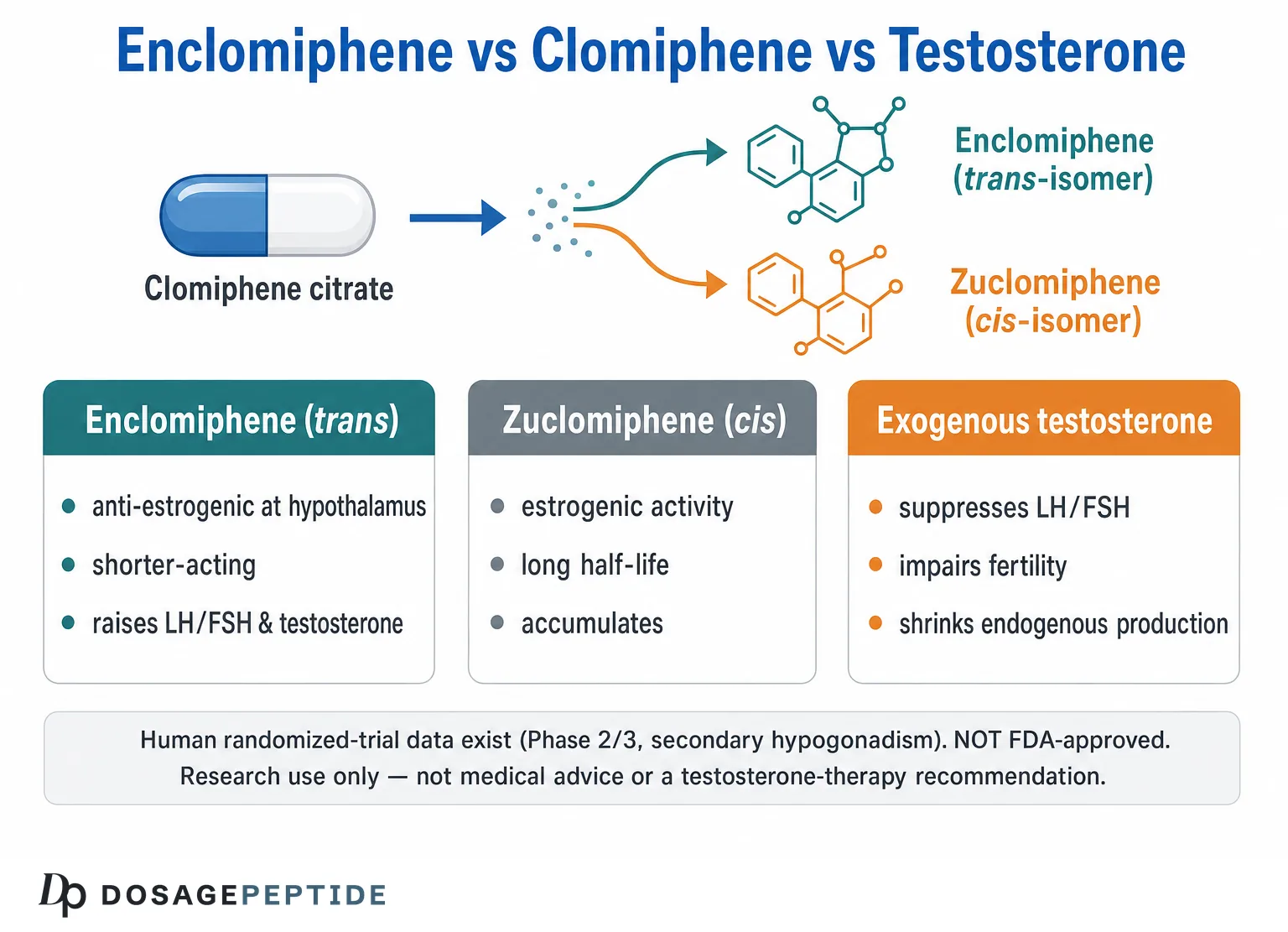
Enclomiphene citrate is the trans-(E)-stereoisomer of clomiphene citrate, a non-steroidal triphenylethylene that acts as a selective estrogen receptor modulator.[6] Clomiphene citrate — the familiar fertility drug marketed as Clomid and Serophene — is not a single compound at all. It is a roughly 62:38 mixture of two geometric isomers: enclomiphene (the trans/E-isomer) and zuclomiphene (the cis/Z-isomer). Chemically the two isomers are near-mirror arrangements around the same ethylene double bond, yet they behave very differently in the body. The research premise behind isolating enclomiphene is that most of the desirable, testosterone-raising, gonadotropin-stimulating activity of clomiphene resides in the trans-isomer, while the long-lived cis-isomer contributes comparatively little to that goal and may drive some of the estrogenic and slow-clearing properties of the mixture.[7]
In the scientific literature enclomiphene is best understood as an investigational compound. It was developed under the trade name Androxal by Repros Therapeutics as a candidate oral treatment for secondary hypogonadism — that is, low testosterone caused by insufficient signaling from the brain rather than by failure of the testes themselves. A sequence of Phase II and Phase III trials was completed in the 2010s, generating a genuine body of human data, but the compound was ultimately never approved by the U.S. Food and Drug Administration.[7] Understanding enclomiphene therefore means holding two facts together at once: there is real, peer-reviewed, randomized-controlled-trial evidence describing what it does to hormone levels in men, and there is no regulatory approval that would make it an established therapy. Everything below is framed with that distinction in mind.
For readers building a working vocabulary around this class of molecules, the peptide and hormone research glossary defines the recurring terms — SERM, gonadotropin, HPG axis, negative feedback, spermatogenesis — that appear throughout the enclomiphene literature. Compound-specific reference material is collected on the enclomiphene reference protocol page, which catalogs how the compound was administered in the published trials without presenting any of it as a recommendation.
Why the Isomer Distinction Matters
The reason researchers care so much about which isomer is which comes down to pharmacokinetics and receptor behavior. Enclomiphene is cleared from the body relatively quickly, with a plasma presence measured in hours to a few days, whereas zuclomiphene is markedly more lipophilic, accumulates in tissue, and can be detected in circulation for weeks after a single dose.[10] A single-dose pharmacokinetic study of the two isomers in women found that after one 50 mg oral dose of clomiphene citrate, enclomiphene exposure (area under the curve over 72 hours) was a small fraction of zuclomiphene exposure, and that the terminal kinetics of both were “very flat” and long-tailed — signatures of an extensively distributed, fat-soluble molecule.[10] In practical research terms, this means that when someone takes ordinary mixed clomiphene, the fast-acting trans-isomer does its work and disappears, while the cis-isomer lingers. Isolating enclomiphene is an attempt to keep the useful signal and shed the slow-clearing passenger.
How Is Enclomiphene Different From Clomiphene? (Enclomiphene vs Clomiphene)
The most common point of confusion in this area is the relationship between enclomiphene vs clomiphene. They are not two separate drugs discovered independently; enclomiphene is literally one of the two ingredients inside clomiphene. When a clinician prescribes clomiphene off-label to a man with low testosterone, that man receives both isomers. When a researcher studies enclomiphene, they study only the trans-isomer, purified. This is analogous to the difference between a racemic drug and a single-enantiomer version, except that here the isomers are geometric (cis/trans around a double bond) rather than optical.
The functional consequences of this purification have been probed most directly in animal work. A chronic oral-dosing toxicology study in male mice compared isolated enclomiphene citrate against isolated zuclomiphene citrate at matched doses. The two isomers produced strikingly different profiles: zuclomiphene treatment was associated with adverse effects on Leydig cells, epididymis, seminal vesicles, and kidneys, along with changes in testosterone, FSH, and LH, whereas the isolated enclomiphene isomer had positive effects on testosterone production and no adverse effects on testicular histology.[5] The authors framed this as a rationale for developing a mono-isomeric enclomiphene preparation rather than continuing to rely on the mixture. It is important to read that study for exactly what it is: a preclinical, animal-only investigation of the two isomers’ reproductive-tissue effects, not a demonstration of human safety or efficacy.
There is a second, regulatory layer to the difference. Clomiphene citrate is an FDA-approved drug — but only for the treatment of ovulatory dysfunction in women seeking to conceive. It has no FDA-approved indication in men; every use of clomiphene for male hypogonadism or male infertility is off-label.[8] Enclomiphene, by contrast, has no FDA approval for any indication at all — it never cleared the approval process despite completing late-stage trials. So the honest summary is: clomiphene is an approved women’s fertility drug used off-label in men, while enclomiphene is an unapproved investigational compound that was studied specifically for men but never authorized.
| Attribute | Clomiphene citrate (mixed) | Enclomiphene citrate (isolated) |
|---|---|---|
| Composition | ~62% enclomiphene + ~38% zuclomiphene | Trans-(E)-isomer only |
| FDA status | Approved for female anovulatory infertility; off-label in men | Not FDA-approved for any indication |
| Clearance profile | Mixed; zuclomiphene component persists for weeks | Relatively rapid clearance (hours to days) |
| Development name | Clomid, Serophene | Androxal (Repros Therapeutics) |
| Primary research population | Women (approved); men (off-label) | Men with secondary hypogonadism (investigational) |
How Does Enclomiphene Work? The SERM Mechanism and the HPG Axis

To understand the proposed mechanism, you first need the normal feedback loop it acts on: the hypothalamic-pituitary-gonadal (HPG) axis. In healthy male physiology, the hypothalamus releases gonadotropin-releasing hormone (GnRH) in pulses. GnRH tells the anterior pituitary to secrete two gonadotropins — luteinizing hormone (LH) and follicle-stimulating hormone (FSH). LH stimulates the Leydig cells of the testis to produce testosterone; FSH acts on the Sertoli cells to support sperm production (spermatogenesis). Testosterone and its downstream metabolite estradiol then feed back negatively on the hypothalamus and pituitary, dialing GnRH, LH, and FSH back down. Estradiol is a particularly potent brake: a substantial share of the negative feedback that suppresses gonadotropin output in men is mediated through estrogen receptors in the hypothalamus and pituitary.[6]
Enclomiphene is a SERM, meaning it binds estrogen receptors and acts as an antagonist in some tissues while behaving differently in others. In the hypothalamus and pituitary, enclomiphene is proposed to act as an estrogen receptor antagonist: it occupies those receptors and blocks estradiol from delivering its “turn down the gonadotropins” signal.[9] When the brain stops sensing estrogenic negative feedback, it interprets the situation as though sex-steroid levels were low and responds by increasing GnRH pulsatility. That, in turn, drives the pituitary to release more LH and FSH, and the elevated LH stimulates the testes to manufacture more of the man’s own testosterone. This is why enclomiphene is described as promoting endogenous testosterone production — the hormone rise comes from the testes being stimulated harder, not from an external supply.
Enclomiphene, LH and FSH: The Signature That Defines It
The behavior of enclomiphene on LH and FSH is the single most diagnostic feature separating it from conventional testosterone products, and it is exactly what the human trials measured. When a man takes exogenous testosterone (a gel, an injection, a patch), the added hormone strengthens negative feedback, so the pituitary shuts down: LH and FSH fall, often to near-undetectable levels, and the testes go quiet. When a man in the enclomiphene trials took the compound, the opposite happened — LH and FSH rose alongside testosterone, because the feedback brake had been released rather than pressed.[1] In the head-to-head comparisons, testosterone-gel groups showed suppressed gonadotropins while enclomiphene groups showed elevated gonadotropins, even when both approaches raised total testosterone to similar ranges.[4] This divergence is the mechanistic heart of the entire research story: enclomiphene works through the axis, testosterone replacement works around it.
One nuance worth noting is that the timing of the hormonal response is not tightly coupled to peak drug levels. In the detailed pharmacodynamic/pharmacokinetic study, researchers found no clean temporal association between the moment enclomiphene reached its maximum blood concentration and the moment LH or testosterone peaked, and the effects on LH and testosterone persisted for at least a week after the compound was stopped.[2] That lingering effect suggests the compound resets the feedback set-point for a period rather than acting like a short-lived stimulant.
Why “Selective” Is the Operative Word
The “selective” in SERM is not marketing language; it reflects the fact that estrogen receptors do different things in different tissues, and a SERM can antagonize the receptor in one place while acting as a partial agonist elsewhere. Enclomiphene’s value proposition rests on being an antagonist precisely where it needs to be — at the hypothalamic/pituitary estrogen receptors that govern gonadotropin feedback. Because it is not supplying androgen and is not a steroid, its action depends entirely on an intact, responsive HPG axis and functional testes. This is why the compound was studied specifically in secondary hypogonadism, where the testes are capable but under-stimulated, and would not be expected to work in primary hypogonadism, where the testes themselves have failed.[6]
The Role of Estradiol and Aromatase in the Loop
To appreciate why an anti-estrogen raises a male hormone, it helps to be explicit about the counterintuitive role estrogen plays in men. Testosterone is continuously converted to estradiol by the enzyme aromatase, which is abundant in adipose tissue, and estradiol is a potent regulator of male gonadotropin secretion — arguably more potent than testosterone itself at the level of the hypothalamus. When estradiol rises, the brain reads it as a signal that sex-steroid production is sufficient and throttles GnRH, LH, and FSH accordingly. Enclomiphene inserts itself into exactly this node: by occupying hypothalamic and pituitary estrogen receptors, it prevents estradiol from delivering its suppressive message, so the brain behaves as though estrogen were low even when circulating estradiol is normal or high.[6]
This framing also explains a recurring observation in the trials: enclomiphene tends to raise estradiol alongside testosterone, rather than lowering it. That may seem paradoxical for an “anti-estrogen,” but it is entirely consistent with the mechanism. Enclomiphene does not reduce estrogen production; it blocks the estrogen receptor at one specific site. Because it drives more testosterone, and because more testosterone means more substrate for aromatase, systemic estradiol commonly increases even as the brain remains blind to it.[3] This distinguishes a SERM sharply from an aromatase inhibitor, which lowers estradiol by shutting down its synthesis — a different pharmacological tool that engages the same feedback loop from the opposite direction.
What Does “Secondary Hypogonadism” Mean in Enclomiphene Research?
Because enclomiphene’s entire logic depends on the target population, the concept of SERM secondary hypogonadism deserves its own section. Hypogonadism — clinically low testosterone accompanied by symptoms — is classified by where the problem originates. In primary hypogonadism (also called hypergonadotropic hypogonadism), the testes cannot produce adequate testosterone despite strong signaling; the pituitary shouts louder and louder, so LH and FSH are high while testosterone stays low. Klinefelter syndrome, testicular injury, and certain chemotherapy or radiation exposures are classic causes. In secondary hypogonadism (hypogonadotropic hypogonadism), the testes are structurally capable, but the upstream signal is deficient: the hypothalamus or pituitary is not sending enough GnRH, LH, or FSH, so testosterone is low while gonadotropins are low or “inappropriately normal.”[12]
Enclomiphene targets the second category, and the clinical trials defined their populations accordingly — enrolling men with low morning total testosterone (generally at or below roughly 300–350 ng/dL) together with low or normal LH, confirmed on more than one occasion.[4] The rationale is mechanical: if the brake on the axis is the problem, a compound that releases the brake can restore output; but if the engine (the testis) is broken, releasing the brake accomplishes nothing. This is why the trials repeatedly described enclomiphene as reversing “the two hallmarks of secondary hypogonadism, namely low serum total testosterone and low or inappropriately normal LH.”[3]
The Functional-Hypogonadism Population
A large and growing share of men with low testosterone fall into a subtype often described as functional secondary hypogonadism, frequently associated with obesity and metabolic syndrome. In this setting, excess adipose tissue increases aromatase activity, converting more testosterone to estradiol, which strengthens the estrogenic negative feedback and further suppresses gonadotropins — a self-reinforcing loop. Several enclomiphene trials deliberately enrolled overweight men precisely because this population illustrates the mechanism so clearly, and because an early review noted an unanticipated favorable signal on fasting glucose in this group.[9] A SERM that blocks the estrogenic brake is, at least in theory, well matched to a feedback loop that is being driven by estrogen. Whether that theoretical fit translates into durable clinical benefit is a separate question that the evidence, discussed next, only partially answers.
The metabolic angle deserves a note of caution as much as interest. The early review that flagged a favorable effect on fasting plasma glucose framed it as an unanticipated observation, situated within a broader body of evidence for a bidirectional relationship between low testosterone and obesity or metabolic syndrome in men.[9] An incidental biomarker signal in early-phase work is a hypothesis, not a demonstrated metabolic benefit, and no enclomiphene trial was designed or powered to prove that the compound improves glycemic control or metabolic outcomes. It is exactly the kind of preliminary observation that reads well in a summary but requires dedicated, adequately powered studies to confirm — studies that were never completed because the development program did not advance to approval. Readers should treat the metabolic story as an interesting thread in the compound’s history rather than an established property.
What Has Clinical Research Actually Shown About Enclomiphene and Testosterone?
This is the core of the enclomiphene testosterone research record, and it is more substantial than for most compounds discussed in the research-chemical space — enclomiphene went through genuine, registered, randomized controlled trials. The findings below are reported as the studies described them, in research subjects, without any implication that they establish a treatment.
The Proof-of-Concept and Phase II Data
An early proof-of-principle, randomized, open-label, two-center Phase IIB study enrolled 12 men with secondary hypogonadism who had previously used topical testosterone. After discontinuing the gel, their morning total testosterone averaged around 165 pg/dL. Over the following months, both enclomiphene and testosterone gel raised total testosterone to a comparable range (roughly 500–550 pg/dL by six months), but only the enclomiphene group showed increased LH and FSH.[1] The sperm findings were the headline: enclomiphene elevated sperm counts in all evaluable men, whereas the gel failed to raise sperm concentrations above the reference threshold in most participants.[1] The authors concluded that the concomitant LH and FSH changes suggested normalization of endogenous testosterone production through the HPG axis. With only 12 subjects, this was a signal-generating study, not a definitive one.
The magnitude of the sperm-count divergence in this first study is worth quoting precisely, because it is the concrete detail that every later trial was designed to confirm. In the enclomiphene arm, sperm concentrations reached roughly 75 to 334 million per mL, whereas the topical-testosterone arm failed to raise counts above 20 million per mL in any of the five evaluable men at three months.[1] One month after treatment stopped, total testosterone in both groups fell back toward the pre-treatment baseline, underscoring that the hormonal effect was contingent on continued dosing rather than a permanent reset of the axis.[1] Small as it was, the study established the template every subsequent comparison would follow: match the testosterone rise, then look at what happened to gonadotropins and sperm.
A more detailed pharmacodynamic and pharmacokinetic Phase II study then enrolled 48 men (44 completing per protocol) and tested three enclomiphene doses (6.25 mg, 12.5 mg, and 25 mg daily) against transdermal testosterone, sampling total testosterone and LH hourly across 24 hours. After six weeks of continuous dosing, the 25 mg enclomiphene group reached a mean baseline (C0hr) total testosterone of about 604 ng/dL, compared with roughly 500 ng/dL for transdermal testosterone — not statistically different from each other, but achieved by opposite means: enclomiphene raised LH and FSH while the gel suppressed them.[2] Notably, enclomiphene did not significantly affect TSH, ACTH, cortisol, lipids, or bone markers over that window, though both enclomiphene and testosterone lowered IGF-1, with somewhat greater suppression in the enclomiphene groups.[2]
The Pivotal Comparisons
A Phase II trial published in Fertility and Sterility (registered as ClinicalTrials.gov NCT01270841) compared oral enclomiphene against 1% topical testosterone gel in men with secondary hypogonadism, again finding that enclomiphene increased morning serum testosterone, estradiol, and LH to levels comparable with the gel, while increasing FSH and LH and conserving sperm counts — reversing the biochemical hallmarks of the condition while preserving spermatogenesis.[3][13] The accompanying editorial commentary in the same journal placed these results in the broader context of using SERMs for male hypogonadism and infertility.[11]
The largest and most rigorous data came from two parallel randomized, double-blind, double-dummy, placebo-controlled, multicenter Phase III studies (designated ZA-304 and ZA-305). These enrolled overweight men aged 18–60 with secondary hypogonadism — morning total testosterone at or below 300 ng/dL and low or normal LH — and evaluated two enclomiphene doses against testosterone gel over 16 weeks.[4] The results reproduced the earlier pattern at scale: total testosterone rose across all active groups, but FSH and LH increased with enclomiphene and decreased with the gel, and enclomiphene maintained sperm concentration in the normal range while the testosterone-gel group showed a marked reduction in spermatogenesis.[4] The authors summarized the contrast with the memorable phrase “restoration instead of replacement.”
A methodological detail explains why these Phase III studies carry the most weight in the whole enclomiphene record. Because an oral capsule and a topical gel cannot be blinded to one another by appearance, the trials used a double-dummy design, in which every participant received both a capsule and a gel — one active and one matching placebo — so that neither investigators nor subjects could infer the treatment assignment from the dosage form.[4] That rigor is exactly what makes the divergent gonadotropin and sperm findings hard to dismiss as an artifact of unblinding, even though the program still did not convert this evidence into a regulatory approval.
| Study (year) | Phase / design | Population | Core finding on gonadotropins & sperm |
|---|---|---|---|
| Kaminetsky 2013[1] | Phase IIB, open-label, n=12 | Secondary hypogonadism, prior gel users | Enclomiphene raised LH/FSH and sperm counts; gel did not |
| Wiehle 2013[2] | Phase II PD/PK, n=48 | Men with secondary hypogonadism | Dose-related TT rise; LH/FSH up vs. gel suppression |
| Wiehle 2014[3] | Phase II RCT vs. topical T | Secondary hypogonadism | Reversed low TT + low LH; sperm counts conserved |
| Kim 2016[4] | Phase III, double-blind (ZA-304/305) | Overweight men, TT ≤300 ng/dL | TT restored; sperm preserved with enclomiphene, reduced with gel |
How Is Enclomiphene Absorbed and Cleared? Pharmacokinetics in Brief
The pharmacokinetics of enclomiphene are worth understanding because they shape how the compound behaves and how it differs from the parent mixture. Enclomiphene is orally absorbed and, relative to zuclomiphene, cleared comparatively quickly — a property that is central to the rationale for isolating it. In the single-dose isomer study, the trans-isomer’s systemic exposure after one dose of mixed clomiphene was a small fraction of the cis-isomer’s, and both isomers displayed a “very flat” terminal phase and long residence time, reflecting the lipophilic, widely distributed nature of the triphenylethylene scaffold.[10] The clinically important contrast is that zuclomiphene can persist in the circulation for weeks, whereas the enclomiphene signal resolves far faster — which is precisely why chronic dosing of mixed clomiphene can lead to gradual accumulation of the slower isomer.
A subtlety that emerged from the detailed pharmacodynamic study is that enclomiphene’s hormonal effect is not tightly locked to its peak blood concentration. Investigators found no clean temporal association between the drug’s maximum plasma level and the peaks in LH or testosterone, and the hormonal effects persisted for at least a week after dosing stopped.[2] In other words, the compound appears to shift the feedback set-point of the axis for a period rather than acting as a moment-to-moment stimulant tied to its own concentration curve. The trials also mapped a dose-response relationship: across the 6.25 mg, 12.5 mg, and 25 mg daily arms, all three doses raised the various measures of total testosterone (average, maximum, minimum, and range across 24 hours), with the highest dose producing the largest baseline testosterone.[2] These figures are reported strictly to describe the pharmacology observed in a controlled trial; they are not a dosing guide, and no self-administration is implied or endorsed.
Enclomiphene vs Exogenous Testosterone: The Fertility Distinction
The clearest, most consistently reproduced observation across the enclomiphene literature is the divergence in effect on fertility, and it flows directly from the mechanism. Exogenous testosterone — whether gel, injection, or pellet — is genuinely effective at raising serum testosterone and relieving symptoms of deficiency, and testosterone therapy is an established, guideline-supported treatment for men with confirmed hypogonadism.[12] But because added testosterone suppresses LH and FSH, it also suppresses the intratesticular testosterone and Sertoli-cell signaling that spermatogenesis requires. The predictable result is that many men on testosterone therapy experience a substantial drop in sperm production, sometimes to azoospermia. For a young man who wants to preserve fertility, that is a meaningful trade-off.
This trade-off is explicit in professional guidance rather than merely theoretical: the Endocrine Society’s clinical practice guideline recommends against starting testosterone therapy in men who are planning fertility in the near term, precisely because exogenous androgen suppresses the gonadotropin drive that spermatogenesis depends on.[12] Enclomiphene was investigated as a way to raise testosterone for exactly the population that guidance flags — men who need the hormone but want to protect fertility — even though it never earned an approved indication to fill that role.
Enclomiphene was studied as a way around that trade-off. By raising testosterone via increased LH and FSH rather than by adding external hormone, it keeps the testes stimulated, and the trials consistently reported preserved or increased sperm concentrations where testosterone gel reduced them.[4] This is the “restoration versus replacement” framing: replacement supplies the end hormone and lets the factory idle; restoration pushes the factory to run. A review of the compound’s development emphasized that this fertility-preserving property is the principal reason enclomiphene attracted interest as a distinct option rather than just another way to raise testosterone.[7]
It is worth stating plainly what this does and does not establish. The trials demonstrate, in research subjects, that enclomiphene raises testosterone while maintaining gonadotropins and sperm counts over the studied intervals. They do not establish long-term pregnancy or live-birth outcomes, and they do not make enclomiphene an approved fertility treatment. The fertility distinction is a mechanistic and biomarker finding, robust as far as it goes, but it lives inside the evidence limits described in the next sections.
There is also a conceptual reason the fertility contrast is so reproducible: it is a direct, almost deterministic consequence of the mechanism rather than an incidental effect that might or might not appear. Any intervention that raises testosterone by suppressing gonadotropins will tend to impair spermatogenesis, and any intervention that raises testosterone by increasing gonadotropins will tend to preserve it. Enclomiphene sits firmly in the second camp, testosterone gels and injections in the first. This is why the “restoration versus replacement” language recurs across independent reviews of the compound — it captures a structural feature of how the two approaches engage the axis, not a fragile experimental result.[7] The same logic is why off-label clomiphene has long been favored over testosterone in men who want to raise testosterone without sacrificing fertility, even though neither the mixture nor the isolated isomer is FDA-approved for that purpose.[8]
What Is the Current Evidence Level and Regulatory Status of Enclomiphene?
Stating the evidence tier precisely is essential here, because enclomiphene is easy to over-sell. The accurate characterization is: enclomiphene is an investigational compound with genuine human randomized-controlled-trial data that was never FDA-approved. This is a more advanced evidence position than a purely preclinical or animal-only compound — there are real Phase II and Phase III results in men — but it is fundamentally different from an approved drug, and it must not be described as one.
The development history is specific and instructive. Repros Therapeutics developed enclomiphene as Androxal and completed a late-stage program, including the pivotal Phase III trials, aimed at an indication of secondary hypogonadism. Despite that program, the compound did not receive FDA approval; the regulatory path stalled in the mid-2010s. Reviews of the compound have explicitly discussed “the difficulties associated with the FDA approval of a new molecular entity related to the treatment of hypogonadism,” reflecting questions the agency raised about the appropriate indication, the clinical meaningfulness of the endpoints, and how a testosterone-raising, fertility-preserving agent should be positioned relative to existing testosterone products.[7] The net outcome is that, as a matter of regulatory fact, there is no FDA-approved enclomiphene product on the U.S. market.
Placing Enclomiphene on the Evidence Ladder
A useful way to keep the status straight is to lay the compound’s evidence against a simple ladder, from strongest to weakest, and mark where each relevant fact sits.
- FDA-approved for the exact use: Not applicable to enclomiphene for any indication. (Clomiphene — the mixture — is FDA-approved, but only for female anovulatory infertility, not for men.[8])
- Investigational / in human trials, not approved: This is where enclomiphene sits — completed Phase II and Phase III RCTs in men with secondary hypogonadism, but no approval.[4][7]
- Preclinical / animal-only signals: The comparative isomer study in mice supports the rationale for a mono-isomeric preparation but is animal data only.[5]
- Research-chemical / not approved for human use: Material sold as “research enclomiphene” falls here — it is not an approved medicine and is not quality-assured for human consumption.
Reading down that ladder, enclomiphene is simultaneously better-evidenced than most compounds in the research-chemical category and still, in regulatory terms, unapproved. Both halves of that sentence are true and neither should be dropped. The off-label use of the parent drug clomiphene in men — which some clinicians do practice — is a separate clinical decision governed by prescriber judgment and is not a statement about enclomiphene’s approval status.[8]
How Does Enclomiphene Compare to Other Fertility-Preserving Approaches?
Enclomiphene sits within a small family of strategies that aim to raise or maintain testosterone while keeping the testes active. Understanding the neighbors clarifies what is distinctive about the SERM approach. The other principal tools operate at different points on the HPG axis, and the site of action is the key to telling them apart.
Enclomiphene vs hCG
Human chorionic gonadotropin (hCG) is an LH mimic: it binds the LH receptor on Leydig cells directly and stimulates testosterone production, bypassing the brain entirely. Because it acts at the testis, hCG can work even when the pituitary signal is deficient, which is why it is used to preserve or restore intratesticular function. The mechanistic contrast with enclomiphene is instructive — enclomiphene works one level higher, by releasing the hypothalamic-pituitary brake so the body makes its own LH, whereas hCG substitutes for LH from outside. Readers comparing the two can review the dedicated overview of hCG in testosterone and fertility research alongside the hCG reference protocol page, both of which frame hCG’s evidence base in the same research-only terms.
Enclomiphene vs Gonadorelin and GnRH Agents
Gonadorelin is synthetic GnRH — the hypothalamic hormone itself. It acts at the pituitary to stimulate LH and FSH release, sitting one step above where enclomiphene acts. The comparison highlights that enclomiphene does not add a signaling molecule at all; it removes an inhibitory signal so the endogenous GnRH pulse generator ramps up. For the mechanistic background, the explainer on what gonadorelin is and how GnRH relates to testosterone and fertility and the gonadorelin reference protocol page lay out that upstream biology. A side-by-side treatment of the three testis-preserving gonadotropin strategies is available in the hCG vs gonadorelin vs hMG comparison, which situates the peptide options against the SERM approach embodied by enclomiphene.
The practical upshot of these comparisons is that no single one of these tools is universally “better”; they act at different levels of the same axis and were studied in different contexts. Enclomiphene’s particular niche in the research literature is that it is an oral agent acting at the very top of the feedback loop, which is part of why it drew interest as a potentially more convenient way to engage the axis than injectable gonadotropins — a convenience argument that, again, never converted into regulatory approval.[6]
| Agent | Class | Site of action | Effect on endogenous LH/FSH |
|---|---|---|---|
| Enclomiphene | SERM (estrogen receptor antagonist) | Hypothalamus / pituitary (blocks feedback) | Increases both |
| Clomiphene (mixed) | SERM | Hypothalamus / pituitary | Increases both (off-label in men) |
| hCG | Gonadotropin analog | Testis (LH receptor) | Substitutes for LH; may suppress endogenous |
| Gonadorelin | GnRH analog | Pituitary | Stimulates release of both |
| Exogenous testosterone | Androgen | Systemic (adds hormone) | Suppresses both |
What Are the Documented Effects, Safety Signals, and Limitations?
Any honest overview has to weight the limitations at least as heavily as the findings, because the limitations are what separate an interesting trial record from an established therapy. This section collects both the reported effects and the reasons the evidence should not be over-read.
Reported Effects and Signals in the Trials
Within the studied windows, enclomiphene’s biochemical effects were fairly consistent: dose-related increases in total testosterone, increases in LH and FSH, an increase in estradiol (expected, since more testosterone means more aromatization substrate), and preserved sperm concentrations.[3] Short-term safety data in the Phase II work were described as satisfactory and broadly comparable to testosterone gel and placebo, without significant effects on thyroid hormones, cortisol, lipids, or bone markers over the studied interval, although a decrease in IGF-1 was observed with both enclomiphene and testosterone.[2][9] The broader SERM literature, drawn largely from off-label clomiphene experience, notes reported adverse effects that can include headache, dizziness, visual disturbances, gynecomastia, and mood changes; these are class-level observations rather than enclomiphene-specific rates and vary across studies.[8]
Limitations of the Evidence
The limitations are substantial and specific:
- No approval and no long-term outcome data. The trials measured hormones and sperm counts over weeks to months. They did not establish long-term safety, cardiovascular outcomes, fracture reduction, or — critically for a fertility argument — pregnancy and live-birth rates. Biomarker improvement is not the same as a clinical outcome.[7]
- Sponsor-conducted studies. Much of the pivotal data was generated by the developer, Repros Therapeutics, whose staff appear among the authors. This is normal for drug development but is a reason for independent replication before firm conclusions are drawn.[3]
- Modest sample sizes for the mechanistic studies. The most detailed mechanistic and proof-of-concept studies enrolled a dozen to a few dozen men; even the Phase III trials were sized for a specific regulatory endpoint, not for rare adverse events.[1]
- The regulatory endpoint question. Part of why approval stalled is that raising a biomarker (testosterone) into a target range does not automatically prove clinical benefit, and the agency’s expectations for a hypogonadism indication were not clearly met by the submitted data.[7]
- Research-grade material is unregulated. Compound sold for laboratory use is not an approved medicine, is not manufactured to pharmaceutical standards, and carries no assurance of identity, purity, or dose accuracy. Any discussion of enclomiphene’s trial effects refers to the pharmaceutical-grade compound studied under controlled conditions, not to research-chemical supply.
Holding these limitations in view, the responsible reading of the enclomiphene record is that it is a mechanistically coherent, trial-supported investigational compound whose development did not reach approval — a genuinely interesting case study in HPG-axis pharmacology, not a validated therapy.
What Should Researchers Understand About Research-Grade Enclomiphene?
Because enclomiphene is not an approved product, any material labeled as enclomiphene and sold outside a regulated pharmaceutical channel is, by definition, a research chemical not approved for human use. That framing has practical consequences worth spelling out for anyone handling reference information about the compound. First, there is no standardized, approved dosage form, so the doses that appear in the literature (for example, the 6.25 mg, 12.5 mg, and 25 mg daily arms of the pharmacodynamic study) are descriptions of what was administered in controlled clinical trials, not instructions.[2] Second, identity and purity cannot be assumed: because the parent drug is a two-isomer mixture, material that is nominally “enclomiphene” but not verified could contain variable proportions of zuclomiphene, whose animal-model profile was the less favorable of the two isomers.[5]
A further practical point concerns how the compound’s pharmacology interacts with quality-control gaps. Because enclomiphene and zuclomiphene are geometric isomers of the same molecule, they are not trivially distinguished without appropriate analytical methods; a material could pass a crude identity check as “clomiphene-related” while containing an isomer ratio nothing like the purified trans-preparation studied in the trials. Given that the animal isomer study specifically implicated the cis-isomer in adverse reproductive-tissue effects, isomeric purity is not a cosmetic concern but a substantive one, and it is exactly the sort of assurance that regulated pharmaceutical manufacturing provides and unregulated supply does not.[5] This is one more reason the trial data — generated with characterized, pharmaceutical-grade enclomiphene under supervision — cannot be assumed to transfer to arbitrary research-labeled material.
For those maintaining reference libraries, the appropriate posture is documentation, not endorsement. The enclomiphene reference protocol page exists to catalog the compound’s trial parameters and mechanism in one place, and the research glossary anchors the terminology; neither should be read as a protocol to follow. The scientific interest in enclomiphene is real precisely because it illustrates a clean pharmacological principle — that you can raise a man’s testosterone by removing an inhibitory signal rather than by adding a hormone — and that principle is worth understanding on its own terms, independent of any personal use.
Frequently Asked Questions
Is enclomiphene the same thing as clomiphene?
No, but they are closely related. Clomiphene citrate is a mixture of two isomers — enclomiphene (the trans-isomer) and zuclomiphene (the cis-isomer). Enclomiphene is the isolated trans-isomer only. Most of clomiphene’s testosterone-raising, gonadotropin-stimulating activity is attributed to the enclomiphene component, while the longer-lived zuclomiphene contributes less to that effect and showed a less favorable profile in animal isomer studies.
Is enclomiphene FDA-approved?
No. Enclomiphene has no FDA approval for any indication. It was developed as Androxal by Repros Therapeutics for secondary hypogonadism and completed Phase II and Phase III trials, but the program stalled and never received approval. The parent drug clomiphene is FDA-approved, but only for female ovulatory dysfunction; its use in men is off-label. So enclomiphene is best described as investigational and not approved.
How does enclomiphene raise testosterone without adding testosterone?
Enclomiphene is a SERM that blocks estrogen receptors in the hypothalamus and pituitary. Normally, estradiol signals the brain to reduce gonadotropin output. By blocking that estrogenic feedback, enclomiphene prompts the brain to increase GnRH, which raises LH and FSH, which in turn stimulate the testes to make more of the body’s own testosterone. It works by releasing a brake on the axis rather than by supplying external hormone.
Why does enclomiphene preserve fertility when testosterone gels do not?
Exogenous testosterone strengthens negative feedback, so LH and FSH fall and the testes reduce sperm production, sometimes dramatically. Enclomiphene raises testosterone by increasing LH and FSH, which keeps the testes stimulated. In the trials, enclomiphene maintained or increased sperm counts while testosterone gel reduced them — the “restoration versus replacement” distinction. However, no trial established long-term pregnancy outcomes, so this is a biomarker finding, not a proven fertility treatment.
What did the enclomiphene clinical trials actually measure?
The registered Phase II and Phase III trials measured hormonal endpoints — total testosterone, LH, FSH, and estradiol — along with semen parameters over intervals of roughly 6 to 16 weeks. They compared enclomiphene against topical testosterone gel and placebo in men with secondary hypogonadism. They did not measure long-term outcomes such as cardiovascular events, fracture rates, or live births, which is one reason the evidence remains investigational.
Is enclomiphene a steroid or a peptide?
Neither. Enclomiphene is a small non-steroidal molecule — a triphenylethylene selective estrogen receptor modulator. It is not an anabolic steroid, and it is not a peptide. Its action depends entirely on modulating estrogen receptor signaling in the brain to change gonadotropin output, which is a fundamentally different mechanism from androgens (which add hormone) or peptide gonadotropins like hCG (which act directly at the testis).
What is the difference between enclomiphene and hCG or gonadorelin?
All three engage the HPG axis but at different levels. Enclomiphene acts at the hypothalamus and pituitary by blocking estrogen feedback, so the body increases its own LH and FSH. Gonadorelin is synthetic GnRH acting at the pituitary to stimulate gonadotropin release. hCG mimics LH and acts directly at the testis, bypassing the brain. Enclomiphene is oral; the gonadotropin agents are typically injectable.
Can enclomiphene help men with primary (testicular) hypogonadism?
Mechanistically, no. Enclomiphene works by increasing the brain’s signal to the testes, which only helps if the testes are capable of responding. In primary hypogonadism, the testes themselves have failed and already receive high LH and FSH, so removing the feedback brake accomplishes little. This is why the trials studied only secondary (hypogonadotropic) hypogonadism, where the testes are intact but under-stimulated.
Is research-grade enclomiphene safe to use?
This article cannot make a safety recommendation. Enclomiphene is not an approved medicine, and material sold for research is not manufactured to pharmaceutical standards, so its identity, purity, and dose accuracy are not assured — and because the parent drug is a two-isomer mixture, unverified material may contain variable zuclomiphene. The trial safety data describe pharmaceutical-grade compound under medical supervision, which is not comparable to unregulated supply. Questions about personal health belong with a licensed clinician.
Research-Use Disclaimer
This article is an educational, informational reference intended for scientific and research audiences. It is not medical advice, and nothing in it should be interpreted as a recommendation to obtain, administer, or self-administer enclomiphene or any other compound. Enclomiphene is not approved by the FDA for any use; descriptions of doses and effects reflect what was reported in published clinical trials of pharmaceutical-grade material under medical supervision and are not instructions. Compounds referred to as “research-grade” are not approved products and are not intended for human consumption. Testosterone, hypogonadism, and fertility are medical matters that require evaluation and management by a qualified, licensed healthcare professional. Always consult a physician regarding any health condition or before making any medical decision.
References
- Kaminetsky J, Werner M, Fontenot G, Wiehle RD. Oral enclomiphene citrate stimulates the endogenous production of testosterone and sperm counts in men with low testosterone: comparison with testosterone gel. J Sex Med. 2013;10(6):1628–35. PubMed 23530575.
- Wiehle R, Cunningham GR, Pitteloud N, et al. Testosterone restoration by enclomiphene citrate in men with secondary hypogonadism: pharmacodynamics and pharmacokinetics. BJU Int. 2013;112(8):1188–1200. PubMed 23875626.
- Wiehle RD, Fontenot GK, Wike J, Hsu K, Nydell J, Lipshultz L. Enclomiphene citrate stimulates testosterone production while preventing oligospermia: a randomized phase II clinical trial comparing topical testosterone. Fertil Steril. 2014;102(3):720–7. PubMed 25044085.
- Kim ED, McCullough A, Kaminetsky J. Oral enclomiphene citrate raises testosterone and preserves sperm counts in obese hypogonadal men, unlike topical testosterone: restoration instead of replacement. BJU Int. 2016;117(4):677–85. PubMed 26496621.
- Fontenot GK, Wiehle RD, Podolski JS. Differential effects of isomers of clomiphene citrate on reproductive tissues in male mice. BJU Int. 2015;117(2):344–50. PubMed 26220499.
- Rodriguez KM, Pastuszak AW, Lipshultz LI. Enclomiphene citrate for the treatment of secondary male hypogonadism. Expert Opin Pharmacother. 2016;17(11):1561–7. PubMed 27337642.
- Earl JA, Kim ED. Enclomiphene citrate: a treatment that maintains fertility in men with secondary hypogonadism. Expert Rev Endocrinol Metab. 2019;14(3):157–65. PubMed 31063005.
- Wheeler KM, Sharma D, Kavoussi PK, Smith RP, Costabile R. Clomiphene citrate for the treatment of hypogonadism. Sex Med Rev. 2019;7(2):272–6. PubMed 30522888.
- Hill S, Arutchelvam V, Quinton R. Enclomiphene, an estrogen receptor antagonist for the treatment of testosterone deficiency in men. IDrugs. 2009;12(2):109–19. PubMed 19204885.
- Ghobadi C, Mirhosseini N, Shiran MR, et al. Single-dose pharmacokinetic study of clomiphene citrate isomers in anovular patients with polycystic ovary disease. J Clin Pharmacol. 2009;49(2):147–54. PubMed 19033451.
- Ross LS. Selective estrogen receptor modulators, male hypogonadism, and infertility (editorial commentary). Fertil Steril. 2014;102(3):687–8. PubMed 25044078.
- Bhasin S, Brito JP, Cunningham GR, et al. Testosterone therapy in men with hypogonadism: an Endocrine Society clinical practice guideline. J Clin Endocrinol Metab. 2018;103(5):1715–44. PubMed 29562364.
- ClinicalTrials.gov. Normalization of morning testosterone levels in men with secondary hypogonadism (Identifier NCT01270841). U.S. National Library of Medicine. clinicaltrials.gov/study/NCT01270841.