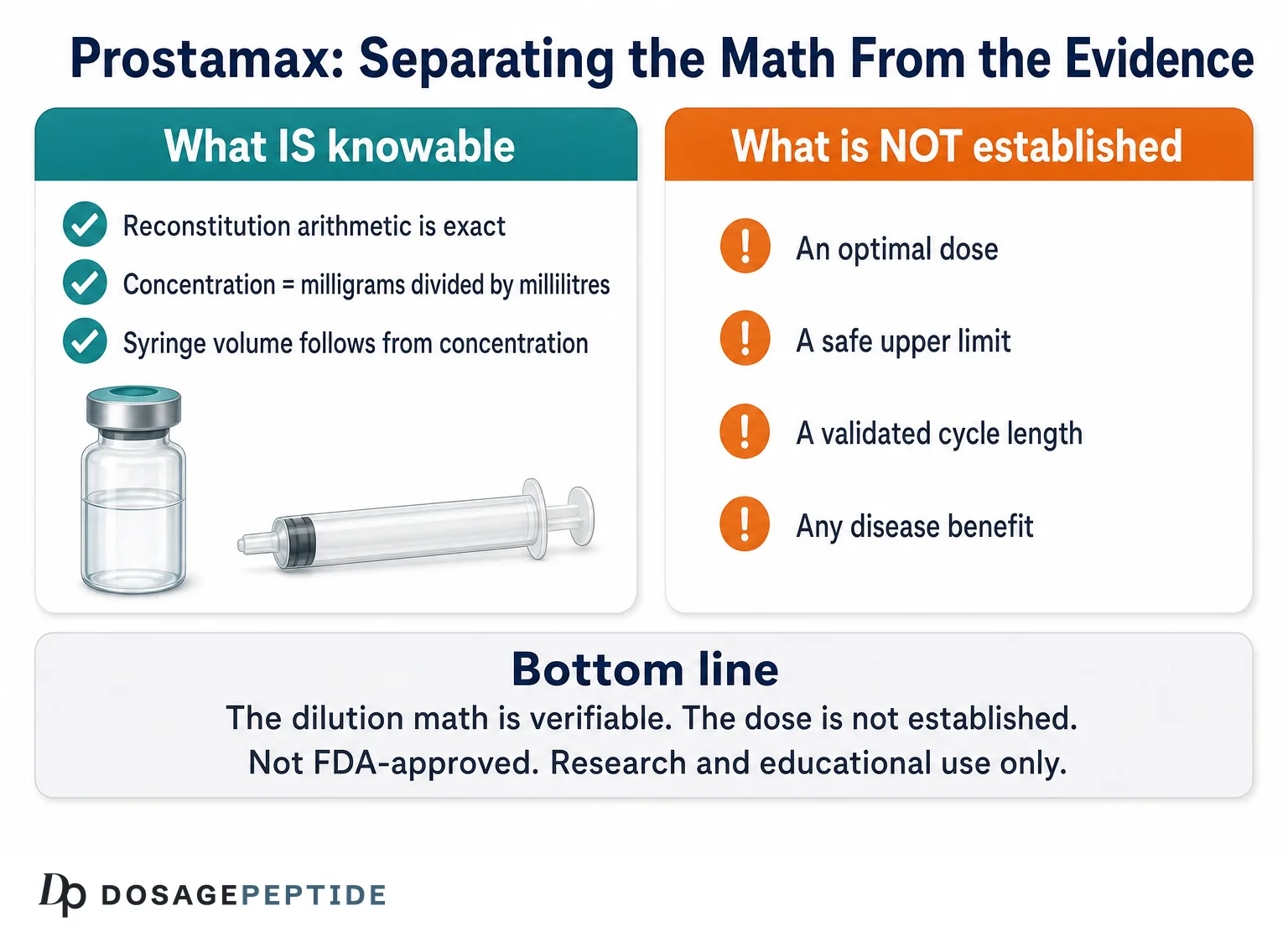
Someone holding a 20 mg vial of Prostamax wants two numbers: how much bacteriostatic water goes in, and how many units come out. The first number has a clean, verifiable answer. The second does not — and this article exists to explain precisely why, because the dose figures circulating across vendor pages and protocol sites (including our own) are not anchored to any controlled dose-ranging study, any peer-reviewed toxicology report, or any registered clinical trial.
The central research question here is narrower and more answerable than “what is the Prostamax dose?” It is this: what does the documentary record on Prostamax actually establish, what kind of documents is that record made of, and how large is the honest gap between it and the injectable milligram-per-week protocols described online? The answer turns out to be unusually clear-cut, because the entire Prostamax record is small enough to read in an afternoon — and because most of what exists is not where people look for it.
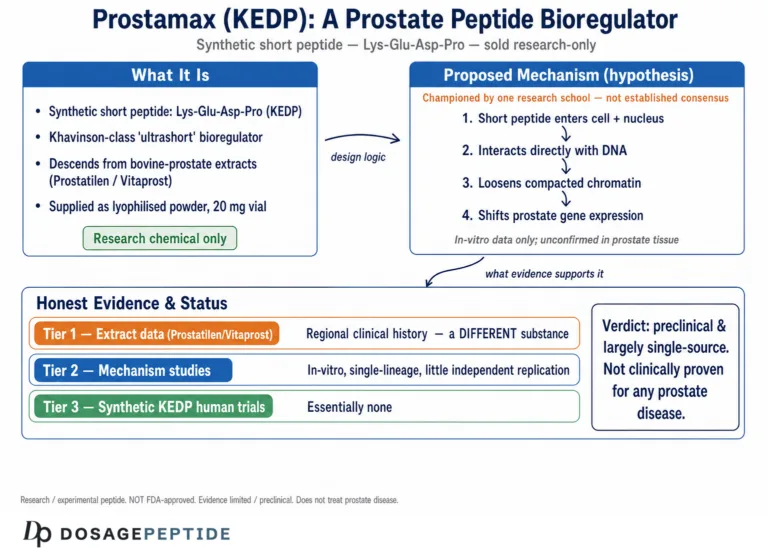
What Is Prostamax, and Is It the Same Thing as Prostatilen or Vitaprost?
This is the first place most write-ups go wrong, and it is worth getting right before touching a syringe. Vendor listings describe Prostamax variously as a “prostate peptide complex,” a “bovine prostate extract,” a tetrapeptide, and occasionally as a synonym for the Russian registered drugs Prostatilen or Vitaprost. Those descriptions are not compatible with each other, and at least some of them are simply wrong.
The Sequence Can Be Verified
The sequence can be verified, and from authoritative sources rather than a supplement blog. The U.S. National Library of Medicine maintains a MeSH Supplementary Concept Record for Prostamax — unique ID C500342 — which lists the entry terms “lysyl-glutamyl-aspartyl-proline” and “H-Lys-Glu-Asp-Pro-OH,” and maps the concept to the heading Oligopeptides[1]. In plain terms: Prostamax is the synthetic tetrapeptide Lys-Glu-Asp-Pro (KEDP).
This is independently corroborated twice over. Russian patent RU2177802C1 — “Tetrapeptide regulating prostate function, pharmacological agent based thereof and method of its using,” filed 25 January 2001 and published 10 January 2002 by the St. Petersburg Institute of Bioregulation and Gerontology, with Khavinson, Malinin and Grigoriev named as inventors — describes the compound in full analytical detail: gross formula C20H33N5O9, molecular weight 487.51 without counterion, acetate counterion, an odourless white amorphous powder, synthesised by classical solution-phase chemistry and purified by preparative reverse-phase HPLC to 98.36% main substance[2]. Separately, the 2012 Georgian Medical News paper reporting the most substantive Prostamax chromatin experiment carries the sequence in its own title — “Deheterochromatinization of the chromatin in old age induced by oligopeptide bioregulator (Lys-Glu-Asp-Pro)” — and its abstract names the substance tested as Prostamax[3].
Three independent anchors, one of them the NLM’s own controlled vocabulary and one of them the originating institute’s own patent, is a sound basis for the identification. So on the narrow question of chemical identity, the honest answer is not “nobody knows.” It is: Prostamax is KEDP, a four-residue synthetic peptide of molecular weight 487.51 daltons. Anyone who tells you the sequence is unknowable has not looked in the two places where it is written down.
One Honest Complication
There is a wrinkle worth reporting rather than smoothing over, because it is the reason vendors disagree. In 2013 a group at the Goldberg Research Institute of Pharmacology in Tomsk published a rat study of “the drug Prostamax” in which the text, introducing the comparator Samprost, reads that Samprost “represents, also as well as Prostamax, bioregulatory peptide, the agent, which is created on the basis of an extract of prostate”[7]. That sentence, in a translated Russian original, is ambiguous, but on its most natural reading it groups Prostamax with extract-derived agents rather than synthetic ones. The following year the same institute published a study in the same indication area that names its test article not “Prostamax” but “Tertapeptide Lys-Glu-Asp-Pro”[8].
The reasonable reading is that “Prostamax” is a trade name the originating programme attached to synthetic KEDP, and that a downstream laboratory used loose language about its provenance in a translated manuscript. But the practical consequence for anyone holding a vial is real: the confusion between a defined synthetic tetrapeptide and a tissue extract is present in the primary literature itself, not only in vendor marketing. That makes independent identity confirmation of a purchased vial more important here than for most research peptides, not less.
Prostatilen and Vitaprost Are Different Substances
This is the single most consequential confusion in the entire topic, because it is the mechanism by which a genuinely thin evidence base gets dressed in someone else’s clinical data.
Prostatilen and Vitaprost are real, registered Russian pharmaceutical products, and they are bovine tissue extracts — complex, heterogeneous peptide preparations of the class Russian literature calls “cytomedins,” not defined synthetic molecules. The NLM’s MeSH record for Prostatilen (unique ID C069549) defines it explicitly as a “drug obtained from the prostate of cattle” used for the treatment of prostatitis in man. Vitaprost has its own separate record (unique ID C524164), defined as “a complex of peptides extracted from cattle prostate tissue for therapy of patients with prostatic adenoma”[11]. They are two distinct registered products, each with its own controlled-vocabulary identity, and neither is Prostamax.
These products have a substantial clinical literature. A PubMed search on Prostatilen and Vitaprost returns roughly 65 records, including a phase III randomised, multicentre, open-label trial of Prostatilen AC rectal suppositories in 98 men aged 25–45 with chronic abacterial prostatitis and related reproductive dysfunction. That trial compared Prostatilen AC (n=49) against Prostatilen (n=49) over a 10-day treatment course — an active comparator, not placebo — and reported changes in sperm motility and morphology[12]. Whatever one thinks of an unblinded design without a placebo arm, that is a registered product, with a registered route, a registered strength (3 mg suppositories), and randomised human data.
A PubMed search on Prostamax returns six records, one of which is a 2017 sequence-analysis paper on short-peptide motifs in long- and short-lived rodent proteomes that is indexed to the Prostamax concept without testing the compound at all.
| Attribute | Prostamax | Prostatilen / Vitaprost |
|---|---|---|
| Substance type | Defined synthetic tetrapeptide (Lys-Glu-Asp-Pro, MW 487.51) | Bovine prostate tissue extract (heterogeneous) |
| NLM MeSH record | C500342 | C069549 (Prostatilen); C524164 (Vitaprost) |
| PubMed records | 6 | ~65 |
| Registered anywhere | None located; no registration confirmed from a primary registry source | Yes (Russian Federation) |
| Documented human route | Intramuscular — described only in the compound’s own patent, not in any peer-reviewed publication | Rectal suppository; oral tablet |
| Registered strength | — | 3 mg suppository |
| Randomised human trials | None located | Yes, incl. phase III (open-label) |
| FDA status | Not approved | Not approved in the U.S. |
The practical upshot is blunt. Clinical claims made for Prostatilen or Vitaprost do not transfer to Prostamax. They are different substances, made differently, given by a different route, at a different strength. When a page cites “clinical studies in men with prostatitis” in support of an injectable Prostamax protocol, that page is either citing Prostatilen data or citing nothing at all. Neither is a basis for a dose.
What KEDP Is Not
KEDP is not a hormone. It is not a growth factor. It has no receptor assigned to it in any pharmacological database, no established binding partner, no published pharmacokinetic profile, and no characterised metabolic fate. It is a short string of four amino acids — lysine, glutamic acid, aspartic acid, proline — with a molecular weight of 487.51 daltons, smaller than many conventional small-molecule drugs. In the Khavinson framework, the proposed mode of action is direct interaction with DNA and chromatin rather than receptor binding. Anyone arriving from the world of receptor-mediated secretagogues, where a defined receptor and a measurable downstream hormone give you a dose-response curve to work with, should recognise that essentially none of that machinery exists here. There is no biomarker you can draw blood for to tell whether an injection did anything.
Research Context: Where Prostamax Comes From
Prostamax belongs to a family of short synthetic peptides developed at the St. Petersburg Institute of Bioregulation and Gerontology under Vladimir Khavinson. Understanding the programme’s internal logic is necessary to read its outputs honestly — neither dismissing them nor inflating them.
The programme began with tissue extracts, not synthetic peptides. Khavinson’s 2002 monograph-length review in Neuroendocrinology Letters lays out the sequence of reasoning: extracts were prepared from various organs, each was observed to stimulate outgrowth of explants from its own source tissue but not from others, and from the amino-acid composition of those extracts the group then designed short synthetic peptides intended to reproduce the tissue-specific activity[9]. Epitalon (Ala-Glu-Asp-Gly) is the best-known product of that design step. Prostamax is presented as the prostate-directed member of the same family — though it is worth noting that the 2002 review’s own list of designed tetrapeptides names the heart, liver, brain cortex and pineal gland rather than the prostate, so the prostate arm of the programme is documented in the patent rather than in that review.
This history explains the Prostatilen confusion precisely. The extract (Prostatilen) and the designed synthetic peptide (Prostamax) are two different generations of the same research programme. The extract carries the clinical data; the synthetic peptide carries the design rationale. Vendors, and a great deal of secondary web content, collapse the two — and because the two generations share an institution, a vocabulary and a set of claims, the collapse is easy to make and hard for a reader to detect. Our broader explainer on what peptide bioregulators are and where the Khavinson short-peptide research came from covers this lineage across the whole family, and the Prostamax compound overview covers the identity question in more depth.
The Family Around It
Prostamax is rarely discussed alone, and its siblings are worth knowing because they illustrate how consistent — and how consistently limited — the evidence pattern is across the group. The 2004 Bulletin of Experimental Biology and Medicine paper by Khavinson, Lezhava and Malinin studied five of them side by side in the same assay: Vilon, Epithalon, Livagen, Prostamax and Cortagen[4]. Readers can compare the individual pictures for Vilon, the lysyl-glutamic acid dipeptide and for Testagen, the reproductive-system bioregulator, which is the compound most often stacked with or substituted for Prostamax in circulating protocols.
Adjacent work on the same organotypic platform has tested the tripeptide Glu-Asp-Pro — KEDP minus its N-terminal lysine — on rat skin explants rather than prostate. That is a different molecule in a different tissue, and it is not Prostamax evidence; it is mentioned here only because it is exactly the kind of near-miss that gets recruited into vendor bibliographies, where a reader who does not check the sequence letter by letter will take it for the real thing.
The pattern that emerges across the family is worth stating plainly: the assays are shared, the research group is shared, the interpretive framework is shared — and so are the methodological gaps. Evidence for one member does not independently corroborate another when both come from the same laboratory using the same interpretive lens. A dozen studies from one programme are not a dozen independent confirmations; they are one programme, repeated.
What Mechanisms Have Been Studied, and What Was Actually Tested on Prostamax Itself?
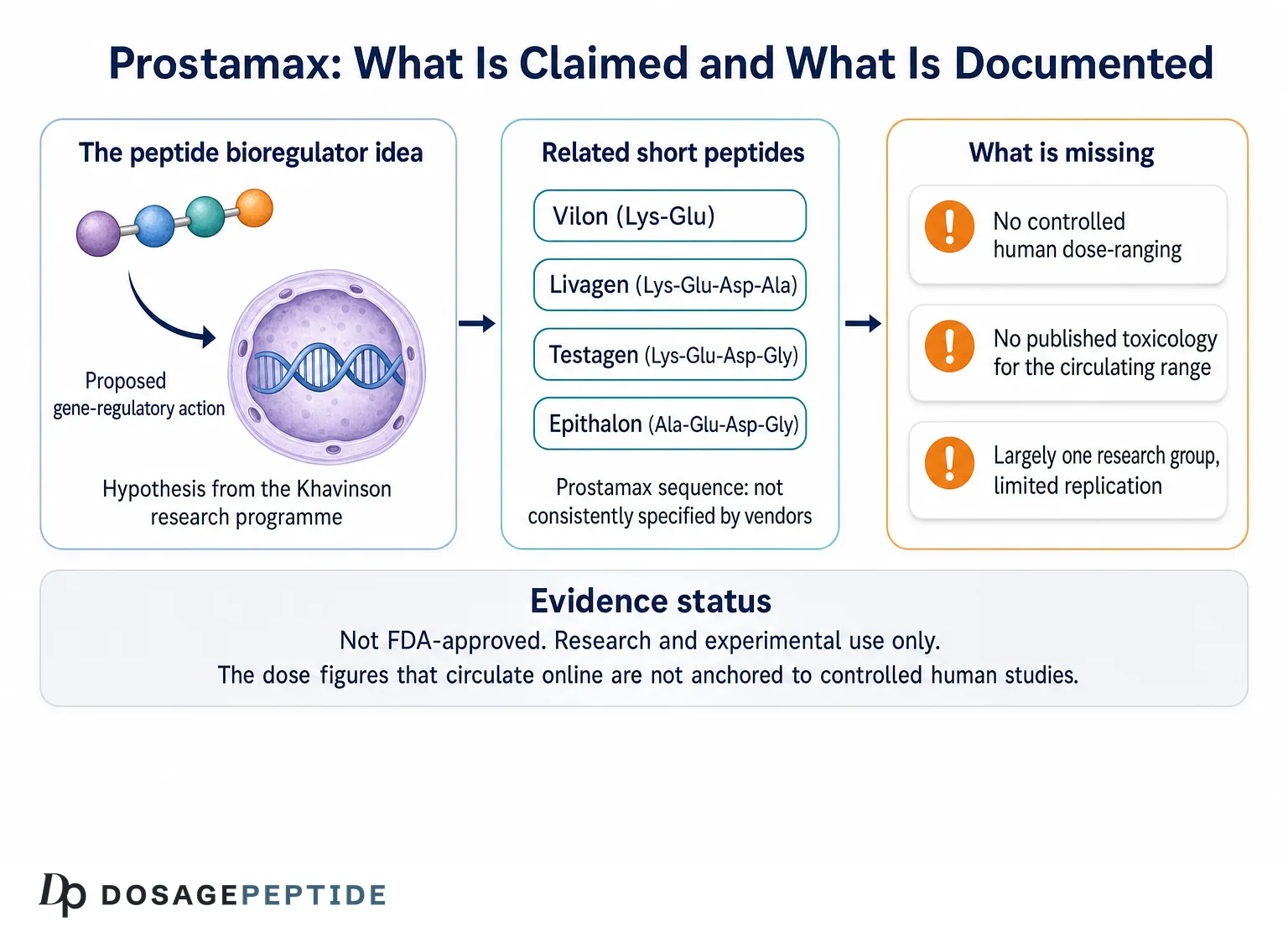
The proposed mechanism for the Khavinson short peptides is direct, sequence-specific interaction with DNA and chromatin, producing epigenetic changes in gene expression. This is a genuine, testable hypothesis with real supporting work behind it, and it is important to represent it accurately rather than caricature it.
Peptide–DNA Interaction
Khavinson, Fedoreyeva and Vanyushin reported that short peptides of two to four amino-acid residues inhibit or stimulate hydrolysis of lambda phage DNA by eukaryotic endonucleases in a manner dependent on DNA methylation status; that the peptides bind not only particular DNA sequences but discriminate their methylation state; that they bind single-stranded oligonucleotides containing methylated NG- and CG-sites; and that their effects are themselves modulated by histone H1[10]. The authors propose that site-specific peptide–DNA interaction could epigenetically control genetic functions of the cell. Related lines of work in the same programme have used molecular docking to propose complementarity between short peptides and specific promoter motifs, and have reported tissue-specific expression changes in cell culture that correlate, in some cases but explicitly not all, with promoter methylation changes.
Two honest observations about this body of work. First, it is real mechanistic research, published in indexed journals, and it is not fraudulent. Second, and critically: none of it tested Prostamax. These papers studied other peptides in the family. The mechanism is a family-level hypothesis extrapolated to Prostamax, not a mechanism demonstrated for Prostamax. There is no published account of KEDP binding a specific DNA sequence, no promoter it is known to act on, and no gene whose expression it is documented to change by any route in a living animal.
It is also worth being clear about what the mechanistic work does not attempt. A wheat-seedling endonuclease assay on phage DNA is a biochemistry experiment about whether a peptide can touch DNA at all. It is a long way from that to a peptide reaching a prostate cell nucleus in a living body after a subcutaneous injection. Every step in between — surviving plasma peptidases, crossing a cell membrane, crossing a nuclear membrane, arriving at a concentration that matters — is unaddressed for this compound. A plausible mechanism at the bench is a hypothesis about the organism, not a finding about it.
What Was Actually Tested on Prostamax Itself
Stripped to the work that genuinely tested KEDP, the record is as follows — and it is larger than a PubMed search suggests, because a substantial part of it sits outside MEDLINE.
Chromatin decondensation in human lymphocytes (in vitro). The 2012 Georgian Medical News study exposed cultured lymphocytes from donors aged 75–86 to Prostamax and reported an increase in sister chromatid exchange (SCE) frequency to 12.0 ± 0.28 per cell versus 5.9 ± 0.2 in intact cells, an increase in Ag-positive nucleolar organiser regions to 2.5 per cell versus 0.95, and a reduction in large pericentromeric heterochromatin segments on chromosomes 1 and 9. The authors interpreted this as deheterochromatinisation releasing age-repressed genes[3].
A necessary caveat on that finding. Sister chromatid exchange is conventionally used in toxicology as a biomarker of genotoxic stress. A roughly two-fold rise in SCE frequency is, in most experimental contexts, read as a signal of DNA damage rather than rejuvenation. The Khavinson-school interpretation — that this reflects benign chromatin decondensation — is a plausible reading, but it is an interpretation, and it is not the default one in the wider genotoxicology literature. This ambiguity has not, as far as we can determine, been resolved by independent work. It deserves flagging rather than quiet omission, and it is emphatically not an argument for casually escalating exposure.
Lymphocyte chromatin in senile subjects (in vitro). The 2004 Bulletin of Experimental Biology and Medicine study tested Prostamax alongside Vilon, Epithalon, Livagen and Cortagen in leukocytes from subjects aged 75–88, reporting activation of ribosomal genes, decondensation of densely packed chromatin fibrils, and decondensation of pericentromeric structural chromatin on chromosome 1 for Epithalon, Livagen and Prostamax specifically[4].
Chromatin thermal stability (in vitro). Microcalorimetry work reported that Prostamax shifted denaturation endotherms of human lymphocyte chromatin to lower temperatures by 2.9 °C and 1.0 °C, interpreted as partial relaxation of the 30-nm fibre[5]. A follow-up from the same group examined Prostamax alongside copper and cadmium ions in the same calorimetric system.
Organotypic tissue culture (ex vivo). The most prostate-relevant indexed study exposed explants of heart, lung, prostate and pancreas from young (3-week) and aged (18-month) rats to cardiogen, bronchogen, prostamax and pancragen, and reported tissue-specific stimulation of explant outgrowth at a peptide concentration of 0.05 ng/mL — each peptide acting on its corresponding tissue[6].
The Whole-Organism Work Most Write-Ups Miss
Here is where nearly every Prostamax article on the internet, including an earlier version of this one, gets it wrong. It is commonly asserted that Prostamax has never been given to a living organism. That is false. The animal work exists; it simply is not in PubMed, because it was published in a journal not indexed in MEDLINE.
Rat chronic aseptic prostatitis (2013). A group at the Goldberg Research Institute of Pharmacology in Tomsk induced chronic aseptic inflammation of the prostate in 60 male Wistar rats (330–500 g, four months old) by through-suturing the ventral lobe with silk thread. Beginning on day 30 after surgery, Prostamax was given intramuscularly at 20 mcg/kg for 15 days, against two comparators: Samprost, a prostate extract, at the same dose and route, and Prostamol Uno, a Serenoa repens extract, at 50 mg/kg intragastrically. The authors reported reduced signs of chronic inflammation and reported that Prostamax, unlike the comparators, blocked the development of atrophic processes[7].
Rat benign prostatic hyperplasia model (2014). The following year, largely overlapping authors at the same institute used 40 male Wistar rats (ten months, 450–660 g) with hyperplasia induced by sulpiride at 40 mg/kg intraperitoneally for 60 days. The treatment group received Lys-Glu-Asp-Pro intramuscularly at 20 mg/kg daily for 60 days, against Serenoa repens extract at 50 mg/kg orally. Reported outcomes versus the hyperplasia control were a 24% reduction in lateral prostate mass, a 25% reduction in weight coefficient, a 40% reduction in volume, and a 22.4% reduction in relative acinar epithelium area[8].
Those are preclinical model findings in rats. They do not establish that KEDP does anything in a human being, and no claim that Prostamax treats, prevents or mitigates benign prostatic hyperplasia, prostatitis, prostate cancer or infertility is supported by them. But note the number that matters most for a dosage article: 20 mcg/kg in 2013 and 20 mg/kg in 2014 — a thousand-fold discrepancy, for the same compound, in the same indication area, from the same institute, two years apart. Neither study was a dose-ranging study; each used a single dose level. Whether that gap is a unit typographical error in one paper or a deliberate escalation, it went unremarked in both, and no third study exists to break the tie. A literature that disagrees with itself by three orders of magnitude on dose is not a literature from which a dose can be read off.
The Patent Is Where the Rest of the Record Lives
The compound’s own patent[2] contains, in its worked examples, more experimental description than the entire indexed literature. Reported there by the applicant are: an acute toxicity study in 78 outbred male mice given single intramuscular doses of 1, 2, 3, 4 and 5 mg/kg with no deaths at 72 hours or 14 days; a 90-day subacute study in 48 rats dosed intramuscularly at 1 mcg/kg, 0.3 mg/kg and 3 mg/kg; a six-month chronic study in 56 rats dosed intramuscularly at 1 mcg/kg, 0.1 mg/kg and 1 mg/kg, with no pathological changes detected on haematology, biochemistry or pathomorphology; a chicken-embryo bladder explant assay showing a 23% increase in area index at 20 ng/mL; a rat model of E. coli-induced chronic bacterial prostatitis treated subcutaneously at 0.1 mcg per injection for 10 days; and an antioxidant study in 24-month-old rats on the same subcutaneous schedule.
It also contains two human examples: 35 men aged 23–45 with chronic prostatitis, and 19 men aged 51–67 with stage I–II prostate adenoma, each given the agent intramuscularly once daily at 0.01–100 mcg/kg of body weight for 10–40 days, against small comparator groups of 14 and 17 respectively receiving traditional treatment.
What this does and does not mean. It means the flat assertion “Prostamax has never been given to a human” is wrong, and this article previously made that error. It does not mean human data exist in any sense a clinician or a regulator would recognise. A patent example is written by the applicant, in support of a property claim, without peer review, without trial registration, without blinding or allocation concealment, without a published protocol, without an independent data monitor, and without the underlying data being available for anyone to appraise. No part of it has ever appeared in a peer-reviewed journal. It is an assertion in a legal document drafted by a party with a direct commercial interest in the assertion being granted — and the patent itself lapsed for non-payment of fees in January 2018.
Treating that as clinical evidence would be a category error. But pretending it does not exist is simply inaccurate, and the difference between “no evidence” and “evidence of a kind that cannot be appraised” is exactly the distinction this topic requires. The first invites a reader to stop looking. The second tells them what to look for.
What Dose Does the Research Actually Document?
This is the question the reader came for, and it deserves a direct answer rather than a hedge.
No dose of Prostamax has been established for humans by any route. There is no dose-ranging study in any species. There is no published maximum tolerated dose. There is no peer-reviewed toxicology report — the toxicology that exists is the applicant’s own account inside a lapsed patent. There is no pharmacokinetic study at all: no half-life, no bioavailability figure, no clearance data, no plasma concentration ever measured after an injection in any animal or person. And there is no registered clinical trial: a search of ClinicalTrials.gov for Prostamax, Prostatilen, Vitaprost, Epithalon, Vilon and Pinealon as interventions returns zero registered studies[14].
The exposure figures that do exist point in wildly different directions. In the indexed literature the only number is 0.05 ng/mL — a concentration in cell-culture medium[6]. That describes how much peptide was in a dish surrounding a tissue explant. It is not a dose and cannot be converted into one: the conversion would require absorption, distribution, protein binding, proteolytic stability and tissue-penetration data, none of which exist for this compound. Anyone presenting an arithmetic bridge from 0.05 ng/mL to a milligram figure for a person is fabricating the intermediate steps, and we will not do it here. The same refusal applies to the rat figures. 20 mcg/kg and 20 mg/kg cannot be scaled into a human number, and the fact that they contradict each other a thousand-fold means there is nothing coherent to scale in the first place.
The Patent’s Numbers Do Not Rescue the Protocol — They Indict It
The patent’s claimed human range, 0.01 to 100 mcg/kg, deserves particular scrutiny, because it is the closest thing to a documented human dosing figure that exists and it is routinely misread by anyone who finds it.
First, it spans four orders of magnitude. A ten-thousand-fold range is not a dose-ranging result; it is a patent claim drafted for breadth, designed to capture as much territory as possible for the applicant. No dose-finding exercise ever produced a 10,000-fold window and called it an answer. The claim tells you what the applicant wanted to own, not what works.
Second, and more revealing, the patent contradicts its own claim. Describing the acute toxicity study, it states that intramuscular doses of 1 to 5 mg/kg in mice were “several thousand times the therapeutic dose recommended for clinical study.” Describing the subacute and chronic studies, it states that the doses used exceeded the therapeutic dose by 100 to 1,000 times — and the top doses there were 3 mg/kg and 1 mg/kg. Run the document’s own arithmetic and the therapeutic dose the applicant actually had in mind sits in the region of 1 to 3 mcg/kg — roughly thirty to a hundred times below the 100 mcg/kg upper bound claimed a few pages later in the same document[2].
A document that implies two different intended doses two orders of magnitude apart is not an anchor. It is evidence that no anchor was ever established. And it should be said plainly that the direction of that internal contradiction is unhelpful to the circulating protocol in one reading and superficially helpful in the other — which is precisely why neither reading can be used. You do not get to pick the number you like out of a document that cannot make up its mind.
The Circulating Protocol, Reported Neutrally
With that established, here is what actually circulates. The dilution and dose figures that appear across vendor listings and protocol material — including our own Prostamax 20 mg vial dosage protocol page — reference a daily range of 500–3,000 mcg once daily, raised stepwise across a 12-week course, corresponding to roughly 3.5 mg/week at the starting step and roughly 21 mg/week at the top step.
| Step | Circulating daily figure | Weekly total | Evidentiary basis |
|---|---|---|---|
| Weeks 1–2 | 500 mcg | 3.5 mg | None located |
| Weeks 3–4 | 1,000 mcg | 7 mg | None located |
| Weeks 5–6 | 2,000 mcg | 14 mg | None located |
| Weeks 7–12 | 3,000 mcg | 21 mg | None located |
The right-hand column is not rhetorical. We went looking for the source of these numbers and could not find one. There is no controlled human dose-ranging study establishing 500–3,000 mcg/day of Prostamax, and no peer-reviewed toxicology supporting the top of that range. These figures are not established, not evidence-based, not validated, and not demonstrated to be safe. They are conventions that propagated through the research-peptide market, and their repetition — including on this site — is not evidence.
Three specific mismatches are worth naming, because each one is checkable in a few minutes.
- The unit is wrong. Every documented dosing figure for KEDP — the patent’s 0.01–100 mcg/kg, the rats’ 20 mcg/kg and 20 mg/kg — is expressed per kilogram of body weight. The circulating protocol is a flat figure applied identically to a 60 kg person and a 110 kg person. A protocol that has discarded the only unit its source material uses has not been derived from that material; it has been written alongside it.
- The duration is wrong. The patent’s human examples run 10 to 40 days. The Prostatilen course is 10 days[12]. The circulating protocol runs 84 days — roughly double the longest documented course of anything in this space, and at its highest step for the final 42 of them.
- The route was changed without arithmetic. Every documented human administration is intramuscular. The circulating protocol is subcutaneous. Changing route changes systemic exposure by whatever the bioavailability ratio happens to be, and that ratio has never been measured for this compound in any species, so nobody proposing the switch can say whether the same number delivers more, less, or the same.
For calibration, the registered prostate product with actual randomised human data, Prostatilen, is a 3 mg rectal suppository given for 10 days[12]. Set that beside a circulating protocol of 21 mg per week by injection for six consecutive weeks. The circulating Prostamax protocol is not a cautious extrapolation from anything. It is discontinuous with every document that exists.
Prostamax 20 mg Reconstitution: The Arithmetic
Here the news is better. The dose has no evidentiary anchor, but the reconstitution math is deterministic and can be presented correctly. If a laboratory is characterising this material, the concentration arithmetic is legitimate even where the dose selection is not.
The Core Calculation
Concentration is simply mass divided by volume:
- Concentration = total peptide mass (mg) ÷ diluent volume (mL)
- 20 mg ÷ 3.0 mL = 6.67 mg/mL, i.e. 6,667 mcg/mL
On a U-100 insulin syringe, the unit markings are volume markings, not mass markings. The conversion never changes:
- 1 unit = 0.01 mL (100 units = 1.0 mL)
- At 6,667 mcg/mL: 0.01 mL × 6,667 mcg/mL = 66.7 mcg per unit
From there, units = target mcg ÷ 66.7:
| Figure (mcg) | Volume (mL) | U-100 units | Arithmetic |
|---|---|---|---|
| 500 | 0.075 | 7.5 | 500 ÷ 66.7 = 7.5 |
| 1,000 | 0.15 | 15 | 1,000 ÷ 66.7 = 15.0 |
| 1,500 | 0.225 | 22.5 | 1,500 ÷ 66.7 = 22.5 |
| 2,000 | 0.30 | 30 | 2,000 ÷ 66.7 = 30.0 |
| 2,500 | 0.375 | 37.5 | 2,500 ÷ 66.7 = 37.5 |
| 3,000 | 0.45 | 45 | 3,000 ÷ 66.7 = 45.0 |
The internal check: 40 draws of 0.075 mL equals exactly 3.0 mL, and 40 × 500 mcg equals 20,000 mcg, which is the 20 mg of peptide in the vial. The mass and volume books balance. Our peptide dosage calculator performs the same arithmetic for any vial size and diluent volume, and the full peptide reconstitution guide covers the physical technique — slow addition down the vial wall, gentle swirling rather than shaking, and full dissolution before any draw.
A Physical Problem the Protocol Pages Miss
Before adding 3.0 mL of anything, check the vial. Several vendors supply 20 mg of Prostamax in a 2 mL vial. Three millilitres of bacteriostatic water does not fit into a 2 mL vial. This is not a subtle point, but it is one that generic protocol copy — which assumes a vial size it never states — reliably fails to mention, and it produces exactly the kind of improvised, unmeasured correction that ruins a preparation.
The diluent volume must physically fit, with headspace to spare, because a lyophilised cake also occupies volume and because a vial filled to its brim cannot be swirled or drawn from cleanly. If the vial is 2 mL, the maximum practical fill is well under 2 mL. The concentration then changes, and so does every unit figure downstream. This table gives the correct arithmetic across the plausible fills:
| Diluent volume | Concentration | mcg per unit | Units for 500 mcg | Units for 1,000 mcg | Fits a 2 mL vial? |
|---|---|---|---|---|---|
| 1.0 mL | 20 mg/mL | 200 | 2.5 | 5 | Yes |
| 1.5 mL | 13.3 mg/mL | 133 | 3.75 | 7.5 | Yes |
| 2.0 mL | 10 mg/mL | 100 | 5 | 10 | No headspace |
| 3.0 mL | 6.67 mg/mL | 66.7 | 7.5 | 15 | No |
| 4.0 mL | 5 mg/mL | 50 | 10 | 20 | No |
| 5.0 mL | 4 mg/mL | 40 | 12.5 | 25 | No |
Note the trade-off that runs through this table. Higher concentration means fewer units per draw and worse measurement resolution at the low end — at 20 mg/mL, a 500 mcg figure is 2.5 units, and a half-unit misread is a 20% error. Lower concentration improves resolution but requires a vial that can hold the volume. Below roughly 5 units per draw, the graduations on a standard U-100 barrel stop being a reliable way to measure anything, which is a general property of insulin syringes rather than anything specific to this compound. The practical consequence is that with a 2 mL vial, the low end of the circulating protocol lands squarely in the region where the syringe itself is the largest source of error.
Vial Economics, and What They Reveal
One arithmetic exercise is worth doing because of what it exposes about the circulating protocol. Total the full 12-week course:
- Weeks 1–2: 14 days × 500 mcg = 7,000 mcg
- Weeks 3–4: 14 days × 1,000 mcg = 14,000 mcg
- Weeks 5–6: 14 days × 2,000 mcg = 28,000 mcg
- Weeks 7–12: 42 days × 3,000 mcg = 126,000 mcg
- Course total = 175,000 mcg = 175 mg
At 20 mg per vial, that is 8.75 vials — 175 mg of a compound whose entire whole-organism record consists of two rat studies at single dose levels that disagree with each other a thousand-fold, plus a set of applicant-authored examples in a lapsed patent. Stating the cumulative figure makes the evidentiary gap concrete in a way the per-day number conceals. It is one thing to read “3,000 mcg” and quite another to read “175 milligrams, cumulative, against a record like that.”
There is also a stability collision hiding in the same arithmetic. Bacteriostatic water’s benzyl alcohol preservative supports a beyond-use window conventionally taken as about 28 days under refrigeration. At the 500 mcg step, 3.0 mL provides 40 days of draws (3.0 mL ÷ 0.075 mL = 40) — the solution outlives its preservative window before the vial empties. At the 3,000 mcg step, the same 3.0 mL is exhausted in under 7 days (3.0 mL ÷ 0.45 mL = 6.7). Neither step aligns cleanly with the container, which is another sign that these figures were not designed against the physical product. A protocol derived from a real preparation tends to produce vial volumes that land near the preservative window; this one produces a solution that is either stale or gone.
Why Is Prostamax Injected, and Where Did the Subcutaneous Protocol Come From?
This question rarely gets asked, and answering it correctly requires abandoning a tidy story that circulates widely — including in the earlier version of this article.
The tidy story goes: the Khavinson bioregulators are oral products in their country of origin, sold as capsules in microgram amounts, and the injectable framing is purely an artefact of the Western research-peptide market, which sells lyophilised powder in vials because that is what it sells. That story is wrong for Prostamax specifically, and it is worth correcting because getting it wrong produces the opposite error from the one it is meant to prevent.
Parenteral administration of KEDP is in the source material. The patent claims a pharmacological agent “intended for parenteral administration,” and every human example in it is intramuscular[2]. Both rat studies used the intramuscular route[7][8]. The patent’s own rat prostatitis and ageing models used subcutaneous injection. Injection is not a Western invention here. For this compound it is the original route, and anyone claiming otherwise has not read the patent.
What is unsupported is the specific leap now circulating. Not “why inject at all,” but: from per-kilogram intramuscular dosing over 10 to 40 days, at single dose levels never subjected to dose-ranging, to daily subcutaneous self-administration of a flat 500 to 3,000 mcg for twelve consecutive weeks. The route has a precedent. The dose, the unit, the duration and the delivery site do not.
The Oral Question, Handled Honestly
The oral-versus-injectable argument still deserves a hearing, because it is the reasoning most people actually use, and it does not survive contact with the evidence in the direction they expect.
Several members of this family are sold in Russia as oral capsules, and the Khavinson group’s position has long been that these peptides are absorbed intact from the gut in sufficient quantity to act. Someone reasoning from first principles might doubt that — oral bioavailability of small peptides is generally poor, and this is among the less independently corroborated parts of the framework. Bypassing the gut is a coherent instinct.
But notice where that reasoning leads. If oral bioavailability is poor, then the injected equivalent of any given oral figure would be smaller, not larger — possibly by a wide margin, since you are removing the losses the oral route imposes. A bioavailability argument, taken seriously, pushes the injectable number down. The circulating protocol pushes it up, into milligrams per week. The argument and the protocol point in opposite directions, and the protocol does not invoke the argument anyway. Our Pinealon dosage and cycle-length reference documents how the same tension plays out for the neurological member of the family.
It is also worth being careful about what the family’s human record actually contains, because it is thinner than the calibration arguments built on it assume. The one human study of two family members — Pinealon and Vesugen in 32 people aged 41–83 with polymorbidity and organic brain syndrome in remission — is small and uncontrolled, and its published abstract does not state the route or the daily amount[13]. It cannot anchor either. The microgram-scale oral figures widely quoted for Pinealon are product and vendor figures, not dose-ranging results, and we have not been able to trace them to a primary registration document. Anyone citing them as an anchor is doing the very thing this article is about.
And that same study is worth reading past its headline, because an article arguing that absent safety data is not reassuring safety data should not omit the one adverse signal in the family’s human record. Alongside reported anabolic and neuroprotective effects, the authors reported prooxidant activity on chemiluminescence and a significant decrease in circulating CD34+ haematopoietic progenitor cells, which they read as inhibition of haemopoiesis[13]. They also reported that neither peptide affected chromatin condensation, concluding on that basis that the peptides were safe at the nuclear genetic level while noting the property should be studied further. The family’s human record is not merely thin. It is not uniformly reassuring, and the parts that are not reassuring are rarely quoted in the protocol material that leans on it.
Storage, Stability and Handling
The handling parameters for Prostamax are the generic ones for a lyophilised research peptide; there is no compound-specific stability study to refine them.
- Lyophilised powder: conventionally stored at −20 °C, dry and dark. Short peptides are relatively robust in the dry state. The patent describes the material as an odourless white amorphous powder, which is what the vial should contain.
- After reconstitution: refrigerated at 2–8 °C, protected from light, not frozen. Freeze–thaw cycling is the standard enemy of a reconstituted peptide solution.
- Labelling: date and concentration on the vial. With a compound whose concentration depends entirely on a diluent volume chosen by the operator, an unlabelled vial is an unknown solution within days.
- Solution appearance: a clear solution that becomes cloudy, or develops visible particulate, has changed. Cloudiness is not a cosmetic issue.
What does not exist for Prostamax specifically: any published stability-indicating assay, any characterisation of degradation products, and any potency-over-time data. The storage guidance above is extrapolated from peptide handling generally, not measured for KEDP. There is no shelf-life figure for this compound because nobody has published one, and a vendor quoting one is quoting a convention rather than a measurement.
Purity and Identity Verification
A point that deserves more attention than it gets. Because Prostamax is not a registered pharmaceutical anywhere we could confirm, there is no pharmacopoeial monograph defining what a compliant article of it is — no reference standard, no assay specification, no impurity limits. A certificate of analysis from a research supplier is a document produced by or for the seller. It may be entirely accurate. But there is no independent standard against which the claim “99% purity” is being made, and given that even the primary literature has been loose about whether this is a synthetic tetrapeptide or an extract, identity itself — not merely purity — is an open question at the point of purchase.
The patent is unusually useful here, because it publishes analytical specifications a buyer can actually check a COA against: amino-acid analysis returning Lys 0.98, Glu 1.01, Asp 1.01, Pro 1.00; main substance content 98.36% by HPLC at 220 nm; specific optical rotation of −69.2°; a molecular weight of 487.51 without counterion, with acetate as the counterion; and a moisture content of 6%[2]. A mass-spectrometry trace consistent with 487.51 plus counterion is a meaningful identity check. An amino-acid analysis returning four residues in roughly equimolar ratio is another. A purity percentage with no identity confirmation attached is neither.
How to Read a Prostamax Vendor Page
Given that identity itself is contested at the point of sale, a few concrete checks separate a coherent listing from an incoherent one.
- Does it state a sequence, and is it Lys-Glu-Asp-Pro? A listing that says “prostate peptide complex,” “bovine extract,” or gives a different sequence is describing something other than the compound in the KEDP record. A listing that gives no sequence at all is not identifying its product.
- Does it cite Prostatilen or Vitaprost data? If the page supports its claims with prostatitis trials, sperm-parameter improvements, or suppository studies, it is borrowing another substance’s literature. That is the single most common tell.
- Does it state the vial volume, not just the peptide mass? “20 mg” is a mass. Without the vial’s physical capacity, the reconstitution instruction cannot be checked, and the 2 mL-vial problem above stays invisible until the water is already flowing.
- Does it claim clinical validation? There is none in the peer-reviewed literature. A page describing Prostamax as “clinically studied,” “clinically proven,” or trial-supported is making a claim no published trial contains.
- Does the COA identify the substance, or only assay a purity figure? Purity of what is the question that matters when the primary literature itself has been inconsistent about what the product is.
- Does it quote a per-kilogram dose, or a flat one? Every source figure is per kilogram. A vendor quoting a flat milligram figure has not read the sources it gestures at.
None of these checks validate the dose. They only establish that the vial contains the compound the record describes, which is a precondition for any discussion of it rather than a substitute for one.
What Is the Current Evidence Level for Prostamax?
Stated precisely, with no inflation in either direction:
| Evidence tier | Status for Prostamax |
|---|---|
| FDA-approved for any indication | No. Prostamax is not approved by FDA for any indication. |
| Approved by any other regulator | No approval located in any jurisdiction. |
| Investigational (in registered trials) | No. Zero records on ClinicalTrials.gov. |
| Randomised human trials | None located. |
| Peer-reviewed human studies of any design | None located. |
| Human administration described anywhere | Yes — but only in the applicant’s own examples inside a lapsed patent (35 + 19 men, IM, 0.01–100 mcg/kg, 10–40 days). Not peer-reviewed, not registered, not appraisable. |
| In vivo animal studies | Yes — two rat studies (IM) from one Tomsk group in a journal not indexed in MEDLINE, single dose level each, contradicting each other a thousand-fold on dose. Plus patent-described rat models. |
| Dose-ranging study (any species) | None located. |
| Ex vivo / organotypic culture | Yes — rat prostate explants at 0.05 ng/mL[6] |
| In vitro (human cells) | Yes — chromatin studies in donor lymphocytes[3] |
| Peer-reviewed toxicology | None located. Toxicology exists only as the applicant’s account inside the patent. |
| Pharmacokinetics (any species) | None located. |
The honest one-line summary: Prostamax has a small in vitro literature, a two-study non-indexed animal literature that contradicts itself on dose, and a human record that exists only inside a lapsed patent written by the people who wanted the patent. Any characterisation of it as “clinically studied” is false. Any characterisation drawing on Prostatilen’s trial data is describing a different substance. And any characterisation claiming there is no animal or human record at all is also false — which matters, because that particular overstatement is the one most likely to make a reader stop checking, and a reader who stops checking is exactly who a bad protocol needs.
It is equally important not to overcorrect in the other direction. This is not a fabricated compound. It has an NLM MeSH identity, a fully characterised sequence and molecular weight, a patent from a real research institute containing real analytical data, a real if small primary literature, and a mechanistic hypothesis with genuine supporting work at the family level. The correct statement is not “Prostamax is fake” but “Prostamax is real, early-stage, and nowhere near the evidentiary maturity implied by the protocols written for it.”
How Does It Compare With Its Siblings?
Placing Prostamax against the rest of the family clarifies where it sits, and readers frequently arrive at this compound after encountering the others.
| Compound | Nature | Most advanced evidence located |
|---|---|---|
| Prostamax (KEDP) | Synthetic tetrapeptide | In vitro, organotypic, and two non-indexed rat studies |
| Epithalon (AEDG) | Synthetic tetrapeptide | Animal lifespan work; largest family literature |
| Pinealon / Vesugen | Synthetic tripeptides | Small uncontrolled human study, route and dose unstated[13] |
| Vilon, Livagen, Cortagen | Synthetic di/tetrapeptides | Shared in vitro chromatin assays[4] |
| Prostatilen / Vitaprost | Bovine prostate extract | Registered in Russia; randomised human trials[12] |
Prostamax is toward the thin end even within a family that is thin overall, though not the thinnest — the two rat studies put it ahead of the members that have never left a dish. Regarding stacking, a common question given that Prostamax is frequently combined with Testagen or other bioregulators, the position follows from the above. Combination requires knowing the behaviour of each component; when neither component has pharmacokinetics or a dose-ranging study, a combination has strictly less evidentiary support than its parts, not more, because you have added an interaction nobody has characterised to two compounds nobody has characterised. Stacking multiplies unknowns; it does not average them out.
What Would Change the Picture?
It is worth stating what evidence would actually move Prostamax forward, because it makes the current gap legible and distinguishes an early-stage compound from a dead end.
First, pharmacokinetics. A single well-conducted study measuring plasma KEDP concentrations over time after a defined injection, in any species, would transform the picture — it would establish whether the compound survives administration at all and for how long. That this does not exist after two decades, despite the compound having been patented, injected into rats and described as given to men, is itself informative. A four-residue peptide is not hard to assay.
Second, a real dose-ranging study. Not one dose level. Not a 10,000-fold patent claim. Three or more dose levels with a measured response, in an indexed venue, so the 20 mcg/kg versus 20 mg/kg contradiction can be resolved rather than inherited by every article written afterwards.
Third, independent replication of the chromatin findings. An unaffiliated laboratory reproducing the SCE and NOR results, with genotoxicity controls, would resolve whether the flagship in vitro finding is rejuvenation or damage — a question on which the entire interpretive edifice rests and which nobody outside the originating school has tested.
Fourth, a peer-reviewed toxicology package. The patent asserts one. Assertions in patents are not toxicology packages. Dose-range-finding and repeat-dose toxicity in two species, published and appraisable, is the conventional prerequisite before any human exposure.
Fifth, a registered trial. Not a case series, not an applicant-authored patent example, but a registered, controlled study with pre-specified endpoints. The registry currently holds nothing for this compound or any of its siblings[14].
Until at least the first two exist, dose figures for Prostamax are not conservative estimates awaiting refinement. They are numbers without a referent.
Limitations of the Prostamax Evidence Base
Concentration in Very Few Hands
The in vitro corpus originates almost entirely with the Khavinson group at the St. Petersburg Institute of Bioregulation and Gerontology, or with closely collaborating laboratories in Tbilisi. The Georgian Medical News chromatin papers, the calorimetry work, the organotypic studies and the mechanistic Bulletin of Experimental Biology and Medicine papers share authors, methods and interpretive framework. The patent is the institute’s own.
The in vivo work does come from a different institution — the Goldberg Research Institute of Pharmacology in Tomsk — which at first looks like the independent corroboration the field lacks. It is weaker than it appears. Both studies appeared in a journal not indexed in MEDLINE; the 2013 author list includes an author affiliated with the compound’s commercial developer; and the two papers contradict each other on the dose by three orders of magnitude, which is not what independent corroboration looks like. Genuinely independent, adequately powered replication in an indexed venue remains absent. This is not a nationality-based criticism — the identical concern would apply to any compound whose entire record traced to one programme and one commercial interest.
Publication and Appraisal Barriers
Much of the work is Russian-language, published in journals with limited international circulation or none at all, and typically reported without trial registration, blinding, allocation concealment or pre-specified endpoints. Several papers are available only as English abstracts of Russian originals, which means the methods sections — where an appraisal would actually live — are not readable by most Western reviewers. Notably, even the registered comparator’s flagship trial, the Prostatilen AC phase III study, was open-label and used an active comparator rather than placebo[12] — so the standard this article applies to Prostamax also finds the strongest comparator wanting. None of this makes the findings wrong. It makes them hard to appraise, which is a different problem and, for the reader’s purposes, a more frustrating one: the work cannot be confidently accepted or confidently dismissed.
The Indexing Trap
This article’s own history illustrates a limitation worth naming explicitly. A PubMed search on Prostamax returns six records, none of them in vivo, and it is easy to conclude from that search alone that no whole-organism work exists. Two rat studies and a patent full of animal and human examples say otherwise. PubMed is not a census of the world’s research; it is a census of MEDLINE-indexed journals. For a compound whose literature is largely Russian, largely outside the major indexes, and partly locked inside patent filings, a database search is a starting point that quietly produces false negatives — and a confident false negative is more dangerous than an admitted gap, because it ends the search. Readers evaluating any Khavinson-family compound should assume the same trap applies to it.
The In Vitro to In Vivo Chasm
Every mechanistic Prostamax finding comes from peptide applied directly to cells or explants. Systemic administration introduces every variable the dish removes: absorption from the injection site, distribution, plasma protein binding, and above all proteolysis. A four-residue peptide in circulation faces an array of peptidases; without pharmacokinetic data there is no way to know whether an injected dose reaches prostate tissue intact, in what concentration, for how long, or at all. The organotypic result showing tissue-specific stimulation at 0.05 ng/mL is genuinely interesting. It is also completely silent on whether any injected quantity produces that concentration at the target tissue — and the rat studies, which did inject, measured organ endpoints rather than concentrations, so they do not close the gap either. Nobody has ever measured KEDP in blood.
The Interpretive Ambiguity
As noted above, the flagship in vitro Prostamax finding — a roughly two-fold increase in sister chromatid exchange — is interpreted by its authors as beneficial chromatin decondensation but is conventionally a genotoxicity marker. This ambiguity is unresolved, and it sits at the foundation of the entire “prostate rejuvenation” narrative built on this compound. A finding whose sign is genuinely uncertain cannot support confident claims in either direction.
Absent Safety Data Is Not Reassuring Safety Data
A recurring error in research-peptide discussion is treating the absence of reported adverse events as evidence of tolerability. The patent reports no toxicity across acute, subacute and chronic animal studies, and reports no adverse events in its human examples. That sounds reassuring until you ask who wrote it, who reviewed it, and where the data are: the applicant, nobody, and nowhere. Adverse events are not reported for Prostamax because no independent party has ever published a systematic account of administering it. An empty safety record and a clean safety record look identical on a vendor page and are opposites in reality — and a safety record supplied entirely by the party seeking the patent occupies a third category that is neither, and that no regulator would accept.
What Is the Regulatory Status of Prostamax?
Prostamax is not approved by the FDA for any indication, and we located no approval in any other jurisdiction. It is sold in the United States as a research chemical, labelled research-use-only, and it is not a dietary supplement — it does not qualify as one, and vendors do not market it as one.
The compounding question comes up often enough to answer precisely. Under Section 503A of the Federal Food, Drug, and Cosmetic Act, a state-licensed physician or pharmacist may compound with a bulk drug substance only if that substance complies with an applicable United States Pharmacopeia or National Formulary monograph and the USP chapter on pharmacy compounding; or is a component of an FDA-approved drug product where no such monograph exists; or appears on FDA’s list of bulk drug substances that can be used in compounding — the 503A bulks list — where no monograph exists and it is not a component of an approved drug. Bulk substances must additionally be accompanied by a valid certificate of analysis and be manufactured by an establishment registered with FDA under section 510[15].
Prostamax satisfies none of the three routes. There is no USP or NF monograph for Lys-Glu-Asp-Pro. It is not a component of any FDA-approved drug product. It does not appear on the 503A bulks list in any category. So its status is simply: an unapproved research chemical, not authorised for human therapeutic use, and not lawfully compoundable.
The peptide compounding landscape has been in active motion in recent years, with substances moving between categories and advisory committee meetings scheduled to consider further changes. Because that landscape changes, readers should verify current status directly against the FDA’s bulk drug substances resources[15] rather than relying on any secondary summary, this one included. Note also that Prostamax has never been nominated, considered, or listed in this process at all. It is not a compound in the queue; it is a compound outside the queue, and nothing currently scheduled would change that.
Frequently Asked Questions
What is the correct Prostamax dosage per day?
There is no established dose. No dose-ranging study exists in any species, no pharmacokinetic study exists at all, and no peer-reviewed toxicology has been published. Protocol material circulating online references 500–3,000 mcg once daily, and we could locate no study supporting those figures. Every documented source figure is expressed per kilogram of body weight; the circulating protocol is a flat number. That mismatch alone shows it was not derived from the sources it gestures at.
How much bacteriostatic water for a 20 mg Prostamax vial?
Circulating protocols reference 3.0 mL, giving 6.67 mg/mL (6,667 mcg/mL), so one U-100 unit of 0.01 mL carries about 66.7 mcg. Check the vial first: several vendors ship 20 mg in a 2 mL vial, into which 3.0 mL will not physically fit. With a 2 mL vial, a smaller fill is required and every unit figure changes accordingly — 2.0 mL gives 10 mg/mL and 100 mcg per unit, and 1.0 mL gives 20 mg/mL and 200 mcg per unit.
Is Prostamax the same as Prostatilen or Vitaprost?
No. Prostamax is the synthetic tetrapeptide Lys-Glu-Asp-Pro, molecular weight 487.51 (NLM MeSH C500342). Prostatilen and Vitaprost are bovine prostate tissue extracts with their own separate MeSH records, C069549 and C524164 respectively, registered in Russia and given as rectal suppositories or tablets. They are chemically different substances with different routes and strengths. The clinical literature belonging to Prostatilen does not transfer to Prostamax, though it is frequently borrowed for it.
How many units of Prostamax is 500 mcg?
At 6.67 mg/mL — 20 mg reconstituted in 3.0 mL — 500 mcg is 0.075 mL, which is 7.5 units on a U-100 insulin syringe. The arithmetic: 500 ÷ 66.7 mcg per unit = 7.5. At 10 mg/mL (2.0 mL diluent), the same 500 mcg figure would be 5 units. The concentration is set entirely by the diluent volume chosen, so any unit count quoted without stating the diluent volume is meaningless.
Has Prostamax ever been given to animals or people?
Yes, and most articles get this wrong. Two rat studies from a Tomsk institute administered it intramuscularly — at 20 mcg/kg for 15 days in one, and at 20 mg/kg for 60 days in the other, a thousand-fold discrepancy neither paper addresses. Both appeared in a journal not indexed in MEDLINE, which is why database searches miss them. Human administration is described only inside the compound’s own lapsed patent, in applicant-authored examples covering 54 men, without peer review, registration, blinding, or any data available for appraisal.
Are there human clinical trials of Prostamax?
No. A search of ClinicalTrials.gov returns zero registered studies for Prostamax or its sibling bioregulators, and PubMed contains no human study of Prostamax at all. The six PubMed records are in vitro or ex vivo work, plus one sequence-analysis paper that does not test the compound. The patent’s human examples are not clinical trials in any sense a regulator would recognise: no registration, no protocol, no blinding, no published data.
Is Prostamax FDA-approved or legal?
Prostamax is not FDA-approved for any indication, and we located no approval in any jurisdiction. It is sold as a research chemical labelled research-use-only, and is not a dietary supplement. It is not lawfully compoundable under Section 503A: there is no USP or NF monograph for Lys-Glu-Asp-Pro, it is not a component of any approved drug, and it does not appear on the 503A bulks list. Its status is an unapproved research chemical, not authorised for human therapeutic use.
Does Prostamax treat BPH, prostatitis, or prostate cancer?
No such claim is supported. Prostamax has never been studied in human patients in any peer-reviewed publication, for any indication. The only disease-relevant work is two rat studies — a sulpiride-induced hyperplasia model and a chronic aseptic prostatitis model — in a non-indexed journal, each at a single dose level, with no toxicology and no pharmacokinetics. Animal-model findings do not establish that a compound does anything in humans. Any prostate or urinary concern warrants assessment by a qualified physician.
Why do protocol pages list a 12-week Prostamax course if there is no evidence for it?
Because the figures propagated through the research-peptide market and were repeated, including on this site’s own protocol page. Repetition is not evidence. Totalled out, the circulating 12-week course amounts to 175 mg cumulative — roughly 8.75 vials — at roughly double the longest documented course length, by a route no human example used, in a unit no source figure uses. We report the figures because readers search for them, and label them accurately because they are not validated.
References
- Prostamax. MeSH Supplementary Concept Record C500342. U.S. National Library of Medicine.
- Khavinson VKh, Malinin VV, Grigoriev EI. Tetrapeptide regulating prostate function, pharmacological agent based thereof and method of its using. Patent RU2177802C1, St. Petersburg Institute of Bioregulation and Gerontology. Filed 25 January 2001; published 10 January 2002; lapsed for non-payment of fees January 2018.
- Dzhokhadze TA, Buadze TZh, Gaiozishvili MN, Baratashvili NA, Lezhava TA. Deheterochromatinization of the chromatin in old age induced by oligopeptide bioregulator (Lys-Glu-Asp-Pro). Georgian Med News. 2012;(212):76-82. PMID 23221144.
- Khavinson VKh, Lezhava TA, Malinin VV. Effects of short peptides on lymphocyte chromatin in senile subjects. Bull Exp Biol Med. 2004;137(1):78-81. PMID 15085253.
- Meskhi T, Khachidze D, Barbakadze Sh, Madzhagaladze G, Gorgoshidze M, Monaselidze D, Lezhava T, Tadumadze N. The influence of the peptide bioregulator prostamax on heterochromatin of human lymphocytes in situ. Biofizika. 2004;49(6):1091-3. PMID 15612551.
- Zakutskii AN, Chalisova NI, Ryzhak GA, Aniskina AI, Filippov SV, Zeziulin PN. The tissue-specific effect of synthetic peptides-biologic regulators in organotypic tissues culture in young and old rats. Adv Gerontol. 2006;19:93-6. PMID 17152728.
- Borovskaya TG, Pakhomova AV, Vychuzhanina AV, Poluektova ME, Fomina TI, Ermolaeva LA, Schemerova JA, Granstrem OK, Neplochov EA. Experimental studying of the drug efficiency Prostamax in the therapy of chronic aseptic prostatitis and its complications. Modern Research in Inflammation. 2013;2(3):54-58. DOI 10.4236/mri.2013.23007. (Not indexed in MEDLINE.)
- Borovskaya TG, Fomina TI, Shchemerova JA, Poluektova ME, Vychuzhanina AV, Kamalova SI, Ermolaeva LA. Experimental Study of Efficiency of Tertapeptide Lysil-Glutamyl-Aspartyl-Proline Using the Model of Benign Prostatic Hyperplasia. Modern Research in Inflammation. 2014;3(3):108-112. DOI 10.4236/mri.2014.33013. (Not indexed in MEDLINE.)
- Khavinson VKh. Peptides and Ageing. Neuro Endocrinol Lett. 2002;23 Suppl 3:11-144. PMID 12374906.
- Khavinson VKh, Fedoreyeva LI, Vanyushin BF. Site-specific binding of short peptides with DNA modulated eukaryotic endonuclease activity. Bull Exp Biol Med. 2011;151(1):66-70. PMID 22442805.
- Prostatilen. MeSH Supplementary Concept Record C069549; and Vitaprost. MeSH Supplementary Concept Record C524164. U.S. National Library of Medicine.
- Rybalov M, Borovets S, Petlenko S, Krasnov A, Apryatina V. Influence of adding zinc arginyle-glycinate to improve efficacy of bioregulatory peptides of the prostate gland in treatment of patients with impaired sperm parameters. Georgian Med News. 2022;(328-329):108-114. PMID 36318852.
- Meshchaninov VN, Tkachenko EL, Zharkov SV, Gavrilov IV, Katyreva IuE. Effect of synthetic peptides on aging of patients with chronic polymorbidity and organic brain syndrome of the central nervous system in remission. Adv Gerontol. 2015;28(1):62-7. PMID 26390612.
- ClinicalTrials.gov search for Prostamax, Prostatilen, Vitaprost, Epithalon, Vilon and Pinealon as interventions — zero registered studies (searched 16 July 2026). U.S. National Library of Medicine.
- U.S. Food and Drug Administration. Bulk Drug Substances Used in Compounding Under Section 503A of the FD&C Act.
Research use only. Prostamax is not approved by the FDA or any other regulator for human therapeutic use, and is not a dietary supplement. Nothing above is medical advice, a treatment recommendation, or a dosing instruction. The dose figures reported in this article — including those drawn from the compound’s patent and from animal studies — are described because they exist in the documentary record and readers search for them; they are documented, not endorsed, and no controlled dose-ranging study or peer-reviewed toxicology supports the protocols built on them. This article does not claim that Prostamax treats, cures, prevents or mitigates any disease, and no such claim is supported by the literature. Anyone with a prostate or urinary concern should consult a licensed physician.