Search “oxytocin peptide dosage” and you will find confident-sounding numbers: so many micrograms, so many units, subcutaneously, so many times per week. Almost none of it is anchored to anything in the published human literature. This page takes the opposite approach: it works through the reconstitution arithmetic for a 5 mg or 10 mg oxytocin research vial honestly, states precisely what human studies of oxytocin have actually administered — and explains why the single most important fact about oxytocin dosage is that the human social-cognition literature is essentially all intranasal, not subcutaneous, and that no established subcutaneous protocol for those endpoints exists at all.
That is not evasion. It is the finding. Oxytocin occupies an unusual position: it is simultaneously an old, FDA-approved hospital drug with a tightly defined obstetric label, and an investigational compound in a behavioural-neuroscience literature that is currently in the middle of a serious replication reckoning. The two worlds use different routes, different settings, different indications, and even different units. Conflating them is where nearly every error in this topic originates.
Research Context: Two Completely Separate Oxytocin Literatures
Oxytocin is a nine-amino-acid cyclic peptide (a nonapeptide) synthesised in the magnocellular neurons of the hypothalamic paraventricular and supraoptic nuclei and released into the systemic circulation from the posterior pituitary. It also has a central release pathway — dendritic and axonal release within the brain — and it is that central pathway, not the circulating hormone, that the behavioural literature is interested in. Its structure differs from vasopressin by only two residues, which matters mechanistically and turns up later in this article.
When a reader encounters “oxytocin dosage,” they are almost certainly looking at one of two entirely disjoint bodies of evidence. The two literatures share a molecule and nothing else — not the route, not the unit, not the setting, not the endpoint, and not the evidence tier. Almost every confused number circulating on this topic is the product of a claim being carried across that boundary as though the boundary were not there.
Literature one: the approved obstetric drug
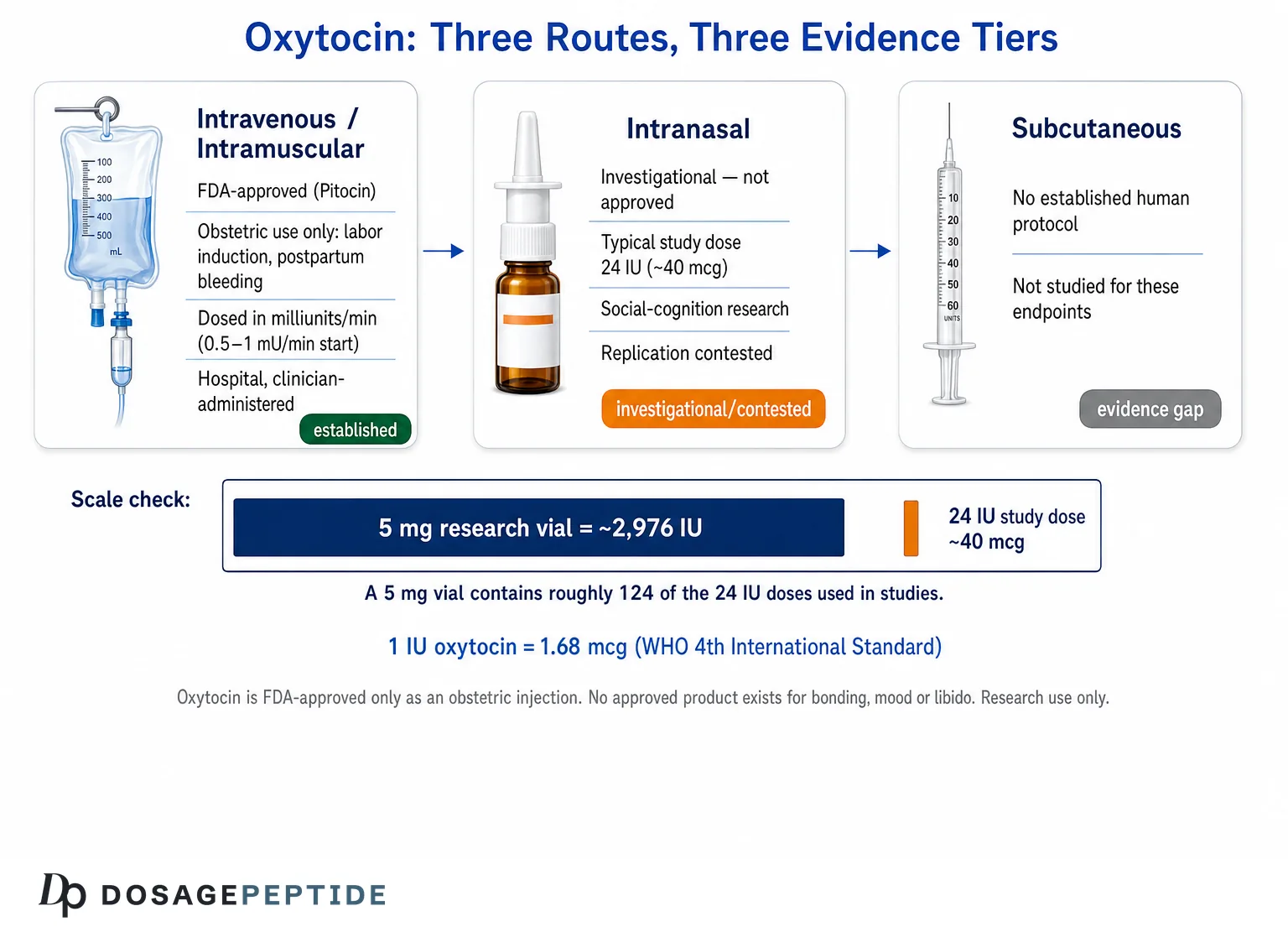
Synthetic oxytocin injection has been an approved medicine for decades. In the United States it is marketed as Pitocin and as oxytocin injection USP. Its labelled indication is narrow and obstetric: “the initiation or improvement of uterine contractions, where this is desirable and considered suitable for reasons of fetal or maternal concern, to achieve vaginal delivery,” plus control of postpartum uterine bleeding[1]. It is administered by clinicians in a hospital, by dilute intravenous infusion controlled with a pump, and dosed in milliunits per minute — starting at 0.5–1 mU/min and titrated upward in 1–2 mU/min increments[1]. The label also states explicitly that oxytocin “is not indicated for elective induction of labor.”
Note what that dose looks like. One milliunit per minute is one thousandth of an International Unit per minute. The entire approved therapeutic range for the world’s most-used oxytocin indication sits in the milliunit-per-minute domain, in a hospital, under fetal monitoring, with continuous assessment of uterine tone and fetal heart rate, and with the infusion rate adjusted in response to what the uterus is actually doing. The dose is not a number chosen in advance; it is a number discovered in real time against a measurable physiological endpoint. That is worth holding onto, because nothing in the research-vial world has an equivalent feedback signal.
Literature two: the investigational behavioural research
Separately, since roughly the mid-2000s, a large experimental literature has asked whether oxytocin administered to healthy volunteers changes trust, social cognition, emotion recognition, or amygdala reactivity. This literature is investigational. There is no FDA-approved oxytocin product for social bonding, mood, anxiety, libido, arousal, “connection,” or any related endpoint. Not one. And this literature is overwhelmingly intranasal — the canonical study design uses a single intranasal dose, most often 24 IU, delivered by nasal spray[3].
A reader with a 5 mg lyophilised vial and a U-100 insulin syringe is standing in neither literature. They are holding a research chemical whose mass is calibrated to nothing in either evidence base. Understanding why requires the unit conversion that almost every discussion of this topic skips. For general orientation on the peptide itself, see our overview of what oxytocin is and what the social bonding and mood research examines.
Milligrams vs International Units: The Conversion That Breaks Everything
This is the crux of the article, so it goes early.
Research vials are labelled in milligrams — 5 mg, 10 mg. The approved obstetric product and the entire human research literature are dosed in International Units (IU) or USP units. These are not interchangeable and the conversion factor is not intuitive. A milligram is a mass; an International Unit is a unit of biological activity defined by reference to a physical standard preparation. For a molecule as potent as oxytocin, the gap between the two is where the entire confusion lives.
The WHO 4th International Standard for oxytocin (NIBSC code 76/575) is a synthetic oxytocin preparation in which each ampoule contains approximately 21 µg of peptide with an assigned potency of 12.5 IU[2]. That defines the relationship:
| Quantity | Arithmetic | Result |
|---|---|---|
| 1 IU oxytocin | 21 µg ÷ 12.5 IU | 1.68 µg |
| 1 mg oxytocin | 1,000 µg ÷ 1.68 µg/IU | ≈ 595 IU (~600 IU) |
| 24 IU (typical study dose) | 24 × 1.68 µg | ≈ 40.3 µg |
| 40 IU (higher study dose) | 40 × 1.68 µg | ≈ 67.2 µg |
| 10 IU (obstetric IM dose) | 10 × 1.68 µg | ≈ 16.8 µg |
Note that individual papers sometimes state a slightly different constant — de Groot and colleagues use 1.71 µg/IU (their sublingual arm was 400 IU, stated as 684 µg)[8] — reflecting the standard preparation and assay in use at the time. The ~2% spread is immaterial next to the order-of-magnitude vial/study mismatch discussed below, but it is a reason to treat any single-decimal mg↔IU figure as approximate. A “24 IU” study dose is not 40.32 µg to two decimal places; it is roughly 40 µg, and the roughness is inherent to a biological-activity unit rather than a defect in anyone’s arithmetic. Wherever this page shows more precision than that, the extra digits exist so the arithmetic can be checked, not because the underlying quantity is known to that resolution.
Now run it the other way, which is the number that should stop a reader in their tracks:
| Vial | IU equivalent | Equivalent number of 24 IU study doses |
|---|---|---|
| 5 mg | 5,000 µg ÷ 1.68 µg/IU ≈ 2,976 IU | 2,976 ÷ 24 ≈ 124 doses |
| 10 mg | 10,000 µg ÷ 1.68 µg/IU ≈ 5,952 IU | 5,952 ÷ 24 ≈ 248 doses |
A single 5 mg oxytocin research vial contains roughly 124 times the entire single dose used in the classic human intranasal experiments. A 10 mg vial contains about 248 of them. For comparison against the approved drug: a 10 mg vial contains close to 6,000 IU, whereas the labelled intramuscular postpartum dose is 10 units[1] — roughly one six-hundredth of the vial.
What a milliunit per minute actually weighs
The infusion figures on the approved label are worth converting into mass, because the result is startling and it is pure arithmetic. One milliunit is 0.001 IU, which at 1.68 µg/IU is 1.68 nanograms. A labour-augmentation infusion running at, say, 20 mU/min is therefore delivering 20 × 1.68 = 33.6 ng per minute, or 33.6 × 60 ≈ 2.0 µg per hour.
Two micrograms an hour. That is the mass throughput of an established, clinically effective, continuously monitored obstetric infusion at a mid-range rate. A 5 mg vial contains 5,000 µg, which at that rate is 5,000 ÷ 2.0 ≈ 2,480 hours of infusion — about 103 continuous days. Even at the label’s upper caution threshold of 40–50 mU/min, where it warns about water intoxication[1], the throughput is only about 4–5 µg per hour, and the vial still represents well over a month of continuous infusion.
This is the single most useful thing this page can convey, and it does not depend on any contested claim: it is division. The mismatch between what is in a research vial and what anyone in either literature has ever administered is not a rounding difference. It is a two-to-three-order-of-magnitude gap. That gap is itself a standing reason for caution, and it is the reason the reconstitution arithmetic below has to be done with real care rather than copied off a chart.
Mechanisms Studied
Oxytocin’s peripheral biology is well characterised and uncontroversial. Its central biology, as it relates to human social behaviour, is not.
The oxytocin receptor
Oxytocin signals through the oxytocin receptor (OXTR), a class A G-protein-coupled receptor. In the myometrium, OXTR activation couples predominantly to Gq/11, driving phospholipase C, inositol trisphosphate generation, and intracellular calcium release — producing uterine smooth-muscle contraction. This is the mechanism underlying the approved obstetric indication, and it is the best-established oxytocin mechanism in humans by a wide margin. In the mammary myoepithelium, the same receptor mediates milk ejection.
Myometrial OXTR expression is not static: it rises markedly towards term, which is part of why the same infusion rate produces very different uterine responses at different gestational stages. That receptor-density dependence is a useful reminder that oxytocin’s effect is a property of the tissue’s receptor state as much as of the amount administered — a point that generalises badly to any setting where the receptor state is unknown and unmeasurable.
OXTR is also expressed in the central nervous system, at far lower density and with a distribution that has been difficult to map in living humans. The relationship between where central receptors sit and where administered oxytocin produces measurable effects is an active area of investigation rather than a settled map, and this page does not treat any particular receptor-distribution claim as established.
Vasopressin receptor cross-talk
Because oxytocin and vasopressin differ by only two amino acids, oxytocin has appreciable affinity for vasopressin receptors, and vice versa. The clinical consequence is on the approved label: the antidiuretic effect of oxytocin at high infusion rates can produce water intoxication with convulsions, which the Pitocin label flags as a serious complication when large doses (40–50 mU/min) are infused over long periods[1]. This receptor promiscuity is one reason the “more is better” intuition does not transfer to oxytocin: raising the concentration does not simply raise oxytocin-receptor occupancy, it recruits a second receptor system with its own physiology.
The proposed central mechanism — and why it is contested
The behavioural literature rests on a chain of assumptions: that intranasally delivered oxytocin reaches the brain in meaningful amounts, that it reaches the specific circuits of interest, that it does so at concentrations sufficient to occupy central receptors, and that receptor occupancy produces the reported behavioural changes. Each link in that chain has been challenged, and this is covered in detail in the Limitations section below.
Two proposed routes of nose-to-brain access are discussed: transport along the olfactory and trigeminal nerve pathways, bypassing the blood–brain barrier; and simple systemic absorption across the nasal mucosa followed by whatever fraction crosses the blood–brain barrier (which for a peptide of this size and polarity is generally assumed to be very small). Human neuroimaging work has attempted to disentangle these. Martins and colleagues compared 40 IU intranasal spray, 40 IU by nebuliser, and 10 IU intravenous infusion, and reported that oxytocin-induced decreases in amygdala perfusion were explained entirely by the rise in systemic oxytocin following either route — but that certain regional cerebral blood flow increases following intranasal administration were not explained by plasma levels, consistent with some direct nose-to-brain contribution[4].
That split result deserves emphasis, because it is more interesting than either camp’s summary of it. It says that the effect most often cited as evidence of central oxytocin action — amygdala modulation — was, in this study, fully accounted for by peripheral exposure, which any route could in principle produce. And it simultaneously says that something else, in other regions, was not accounted for that way. A reader looking for a clean verdict will not find one here; what the data support is that “intranasal oxytocin does something to the brain” and “intranasal oxytocin reaches the brain directly in behaviourally sufficient quantity” are different propositions with different amounts of evidence behind them.
Non-human primate work has pushed in the same direction. Studies administering isotopically labelled oxytocin to rhesus macaques reported that labelled peptide was quantifiable in specific brain regions after intranasal but not intravenous administration[5]. That is an animal study, and it establishes detectability, not behavioural sufficiency — a distinction the field has not always been careful about. Detecting a labelled molecule in tissue answers “did any arrive?”, not “did enough arrive to occupy receptors and change behaviour?”
The mechanistic bottom line: nose-to-brain transfer of oxytocin is plausible and has some direct experimental support, the magnitude is small and disputed, and no comparable body of work supports subcutaneous administration reaching central targets. If terminology in this section is unfamiliar, our peptide research glossary defines the receptor and pharmacokinetic terms used here.
What Have Human Studies Actually Administered?
Here is what the literature genuinely documents, with the route and unit stated exactly as used. Note that not a single row in this table is subcutaneous.
| Setting | Amount | Route | Frequency / duration | Source |
|---|---|---|---|---|
| Labor induction/augmentation (FDA-approved) | 0.5–1 mU/min initial, titrated by 1–2 mU/min | IV dilute infusion, pump-controlled | Continuous, clinician-supervised, in hospital | Pitocin label[1] |
| Control of postpartum uterine bleeding (FDA-approved) | 10–40 units added to infusion; or 10 units IM after placental delivery | IV infusion or IM | Single administration / infusion | Pitocin label[1] |
| Trust game experiment (investigational) | 24 IU (3 puffs per nostril × 4 IU) | Intranasal | Single dose, 50 min before task | Kosfeld 2005[3] |
| Regional cerebral blood flow (investigational) | 40 IU spray; 40 IU nebuliser; 10 IU IV over 10 min | Intranasal / IV | Single dose, 2 h imaging window | Martins 2020[4] |
| Autism spectrum disorder, phase 2 RCT (investigational, negative) | Target total 48 IU/day | Intranasal | Daily, 24 weeks; 290 randomised, 277 in primary analysis | Sikich 2021[6] |
| Safety review across RCTs (investigational) | 18–40 IU range | Intranasal | Mostly single doses; 38 RCTs, 1,529 participants | MacDonald 2011[7] |
| Sublingual bioavailability (investigational) | 400 IU (684 µg) sublingual vs 1 IU IV (1.71 µg) | Sublingual / IV | Single dose, 6 subjects | de Groot 1995[8] |
| Social/mood endpoints, subcutaneous | No established human protocol identified in the published literature. | |||
Read the last row again. It is the honest answer to the query that brings most people to this page. The row is not blank because the search was lazy; it is blank because the field never went there, and the next section explains why it never went there.
What About the Subcutaneous Route?
Search volume for “oxytocin peptide dosage subcutaneous” is real, and the honest response is uncomfortable: the research literature does not establish a subcutaneous oxytocin protocol for social, mood, or behavioural endpoints. There is no consensus amount, no consensus frequency, no dose-ranging study, no pharmacokinetic characterisation of subcutaneous oxytocin in humans for these purposes that this article was able to identify and verify.
This absence is not an oversight in the literature. It follows from the field’s own logic:
- The whole point of intranasal delivery was to avoid the systemic compartment. The behavioural field adopted the nasal route specifically because of the hypothesis that it provides some degree of direct nose-to-brain access. A subcutaneous injection deposits peptide into the systemic circulation — precisely the compartment the intranasal hypothesis was designed to bypass. Choosing subcutaneous administration discards the only rationale the field has for expecting central effects.
- Where systemic administration has been studied, it has been intravenous, and controlled. Martins and colleagues used 10 IU IV over 10 minutes, in a research imaging setting[4]. Quintana’s review notes the key comparison: despite comparable peripheral oxytocin levels after intravenous and intranasal administration, social-cognitive and neural effects were observed only after the intranasal route[9]. That is a direct experimental argument that raising plasma oxytocin, by itself, is not the mechanism.
- Systemic oxytocin is uterotonic. This is not a theoretical concern — it is the drug’s approved pharmacological action, and it is dose-dependent from the milliunit range upward. Any systemic exposure carries that pharmacology with it, in anyone with responsive myometrium, whether or not it is the effect of interest.
- Prolonged systemic exposure has been studied in animals, with non-trivial findings. Preclinical rat work has reported that prolonged subcutaneous oxytocin administration accelerated angiotensin II-induced hypertension and renal damage[10]. That is an animal model and does not translate directly, but it is the kind of signal that exists on the systemic-exposure side of the ledger and does not exist on the reassurance side. The asymmetry matters: the tolerability data people cite for oxytocin are intranasal data, and they do not cover this.
Anyone presenting a specific subcutaneous oxytocin schedule — “X mcg, Y times per week” — as though it were derived from research is presenting an invention. Vendor literature and forum consensus are not evidence tiers. Where a number has no study behind it, this reference library says so rather than filling the gap. The absence of a number here is the most accurate thing this page contains.
Oxytocin Reconstitution Math: 5 mg and 10 mg Vials
Reconstitution arithmetic is arithmetic — it is true regardless of what the evidence does or does not establish about administration, and it is legitimate to set out. What follows describes the concentration produced by a given amount of bacteriostatic water. It is not a recommendation to administer anything, and the tables below deliberately stop at concentration. They do not name a target dose, because — as established above and restated below — there is no target dose to name.
The underlying formula
For a vial containing X mg of lyophilised peptide reconstituted with Y mL of bacteriostatic water:
- Concentration = X ÷ Y mg per mL
- A U-100 insulin syringe has 100 units per 1 mL, so 1 unit = 0.01 mL
- Per unit = (X ÷ Y) ÷ 100 mg = (X ÷ Y) × 10 µg per unit
- To convert to IU: divide µg per unit by 1.68
5 mg oxytocin vial
Before reading this table: it describes concentration only. The 24 IU figure that appears throughout this article is an intranasal quantity, and there is no established equivalence between an intranasal IU figure and any injected amount. No row below should be read as an injectable dose, because no study establishes one.
| Bacteriostatic water | Concentration | Per 1 unit (U-100) | IU per unit |
|---|---|---|---|
| 1 mL | 5 mg/mL (5,000 µg/mL) | 50 µg | ≈ 29.8 IU |
| 2 mL | 2.5 mg/mL (2,500 µg/mL) | 25 µg | ≈ 14.9 IU |
| 3 mL | ≈1.67 mg/mL (1,667 µg/mL) | ≈ 16.7 µg | ≈ 9.9 IU |
| 5 mL | 1 mg/mL (1,000 µg/mL) | 10 µg | ≈ 5.95 IU |
Checking a row explicitly: 5 mg ÷ 2 mL = 2.5 mg/mL. 2.5 mg/mL × 10 = 25 µg per unit. 25 ÷ 1.68 = 14.88 IU per unit. Every other row follows the same two operations, and a reader who disagrees with any of them can redo them in a line.
10 mg oxytocin vial
The same caveat applies with equal force: these are concentrations, not doses. The literature documents no injected oxytocin amount for behavioural endpoints, and nothing below supplies one.
| Bacteriostatic water | Concentration | Per 1 unit (U-100) | IU per unit |
|---|---|---|---|
| 1 mL | 10 mg/mL (10,000 µg/mL) | 100 µg | ≈ 59.5 IU |
| 2 mL | 5 mg/mL (5,000 µg/mL) | 50 µg | ≈ 29.8 IU |
| 3 mL | ≈3.33 mg/mL (3,333 µg/mL) | ≈ 33.3 µg | ≈ 19.8 IU |
| 5 mL | 2 mg/mL (2,000 µg/mL) | 20 µg | ≈ 11.9 IU |
Checking: 10 mg ÷ 5 mL = 2 mg/mL. 2 × 10 = 20 µg per unit. 20 ÷ 1.68 = 11.9 IU per unit.
What these tables actually reveal
Look at the concentrations, and hold them against the mass figures from earlier in this article. Even at the most dilute practical reconstitution of a 5 mg vial — 5 mL, which is already at or beyond the physical capacity of many small vials — the solution is 1 mg per mL. The mass equivalent of the 24 IU used in the classic intranasal studies is about 40 µg. That is four hundredths of a milligram: a quantity so small relative to the container that the vial holds roughly 124 of them, and one that at less dilute reconstitutions sits below the resolution at which a standard insulin syringe can be read with any honesty.
This is the arithmetic telling you something. When the only mass figure the literature offers does not resolve on the instrument, that is not a problem to be engineered around with a finer syringe — it is a signal that the vial format was not designed with reference to any documented protocol. The vial size is a commercial and manufacturing artefact. It is not a dosing hint, and it should not be read as one.
And the deeper point is one no amount of dilution repairs. The 24 IU figure is an intranasal quantity in the first place, with no established equivalence to any injected route — and the field’s own route comparison suggests the two are not behaviourally equivalent even at matched plasma levels[9]. So the exercise of “matching the study dose subcutaneously” collapses at the premise, not at the arithmetic. There is no conversion factor because there is no study establishing one. The mass comparison above is offered as an argument about scale, not as an instruction: it tells a reader how far the container sits from the evidence, and nothing else.
For the general procedure — needle handling, adding diluent down the vial wall rather than directly onto the cake, swirling rather than shaking, and letting the peptide dissolve fully — see our peptide reconstitution guide. To check any of the arithmetic above independently, our peptide dosage calculator performs the same mg-per-mL and per-unit computation, and the companion article on how much bacteriostatic water to use for reconstitution covers the constraint that the diluent must actually fit inside the vial — a real limit on small-format vials. Vial-specific breakdowns are set out on our oxytocin 5 mg vial dosage protocol page and the oxytocin 10 mg vial dosage protocol page. For how syringe graduations are read in general, see our guide to insulin syringe units for peptides.
Pharmacokinetics: Why the Half-Life Dominates Everything
The approved label states oxytocin has “a plasma half-life of about 1 to 6 minutes which is decreased in late pregnancy and during lactation”[1]. Independent pharmacokinetic work using intravenous dosing in six male volunteers described a two-compartment model with a distribution half-life of 0.049 ± 0.106 h, an elimination half-life of 0.33 ± 0.23 h, total body clearance of 67.1 ± 13.4 L/h and a volume of distribution of 33.2 ± 28.1 L[8].
A handful of minutes in plasma, and a clearance figure — 67 litres per hour — that is more than the entire volume of distribution every half hour. Oxytocin is cleared by the liver and kidney and degraded by circulating oxytocinase (placental leucine aminopeptidase), which rises markedly in pregnancy — hence the shortened half-life in late gestation.
Three consequences follow directly:
- The obstetric drug is infused, not bolused, precisely because of this. You cannot maintain a stable uterotonic effect with a compound that disappears in minutes except by continuous administration. The label’s requirement for pump-controlled infusion is a pharmacokinetic necessity, not bureaucratic caution.
- Plasma is a poor proxy for the central compartment. Leng and Ludwig argued that claims that peripheral oxytocin measurements reflect central release are questionable at best, and that much of the published oxytocin measurement literature used discredited assay methodology[11]. The two compartments have different kinetics and are not reliably coupled.
- Timing dominates study design. Intranasal studies typically impose a waiting interval — Kosfeld used 50 minutes[3], and Quintana’s review discusses the debate over the appropriate post-dose window[9]. A behavioural effect observed 50 minutes after dosing cannot be attributed to circulating oxytocin, which is long gone. Whatever mediates the reported effects, it is not sustained plasma exposure — which is a further reason the systemic route lacks a coherent rationale for these endpoints.
What the sublingual data show about route — and why they matter here
The de Groot study is usually cited only for its half-life figures, but its bioavailability result is the more instructive half, and it is directly relevant to why route dominates this compound. After a 400 IU (684 µg) sublingual dose — a quantity roughly seventeen times the mass of a 24 IU intranasal study dose — the investigators observed bioavailability between 0.007% and 0.07%, a ten-fold variation across just six subjects[8].
Work that through. At the top of that range, 0.07% of 684 µg is about 0.48 µg reaching the circulation. At the bottom, 0.007% of 684 µg is about 0.048 µg — 48 nanograms. From the same dose, in the same study, in a homogeneous group of healthy young men. The absorption profile was equally unruly: a subject-dependent lag time of 0.12–0.30 h with 40% coefficient of variation, an absorption half-life of 0.45 ± 0.29 h, and an apparent elimination half-life of 0.69 ± 0.26 h — the last of these being longer than the true intravenous elimination half-life, which is the classic signature of absorption-rate-limited kinetics rather than a change in how the body clears the drug. The authors’ own conclusion was that the sublingual route, with its long lag time and long absorption half-life, would not seem a reliable route for accurate high dosing[8].
Three things follow, and all of them bear on the question this page exists to answer. First, oxytocin is a compound for which the route is not a detail — it is most of the pharmacokinetics. A ten-fold within-study spread in how much drug arrives, from a mucosal surface, in six people, is not noise around a usable number; it means the administered mass and the delivered mass are only loosely related. Second, this is why milligram-scale quantities appear at all in the oxytocin literature: 684 µg sublingual was not a “high dose” in any pharmacological sense, it was an attempt to overcome catastrophic bioavailability, and it still delivered less than half a microgram. A milligram of oxytocin is not a large amount of drug effect; it is a large amount of powder attached to a route that wastes it. Third, and most importantly, none of this transfers to injection. Subcutaneous administration does not share the sublingual route’s absorption barrier, so nothing in these numbers can be used to reason toward an injected quantity — they establish only that route-specific pharmacokinetics for oxytocin have to be measured, not inferred, and for the subcutaneous route in humans they have not been measured for these endpoints.
Dose-response is not monotonic
An important and counterintuitive finding: higher is not reliably better, and may be worse. Quintana’s review reports that 8 IU — but not 24 IU — was the most efficacious intranasal dose for eliciting an amygdala response to emotional faces in one line of work, while other work found 24 IU effective where 12 and 48 IU were not[9]. These findings are inconsistent with each other, which is itself informative: the field does not have a settled dose-response curve even within its own preferred route. Proposed explanations include receptor desensitisation and cross-reactivity at vasopressin receptors at higher concentrations. Either way, the “escalate until something happens” heuristic that circulates in research-chemical spaces has no support here and arguably has evidence against it.
Storage and Stability
Oxytocin’s stability profile is well documented on the pharmaceutical side and is one of the more practically useful parts of this topic.
The approved injectable solution is stored between 20°C and 25°C (68–77°F)[1]. Beyond that label figure, oxytocin injection is a well-known subject of thermostability concern in global medicine supply chains, and pharmacopoeial and public-health bodies have repeatedly examined its storage specifications because the peptide degrades measurably with heat exposure over time. That is a live logistics problem rather than an academic one — which tells a reader something useful about the molecule’s chemistry: it is not robust.
General principles for a lyophilised research vial, which follow from peptide chemistry rather than from any oxytocin-specific protocol:
- Lyophilised (unreconstituted) powder is the stable state. Peptides in dry form, protected from light and moisture, are far more stable than the same peptide in solution. The freeze-drying is not packaging convenience; it is the preservation strategy.
- Once in solution, the clock starts. Aqueous peptide solutions degrade through hydrolysis, oxidation, and — for a cyclic peptide with a disulfide bridge like oxytocin — disulfide exchange and dimerisation. Refrigeration slows this; it does not stop it.
- Bacteriostatic water contains 0.9% benzyl alcohol as a preservative, which suppresses microbial growth but does nothing about chemical degradation of the peptide itself. Sterility and potency are separate properties, and only one of them is being protected.
- Heat and freeze-thaw cycling are both destructive. Repeated freezing and thawing of a reconstituted solution is a known route to aggregation and loss of potency.
- A vial holding 124 study-dose-equivalents’ worth of peptide will sit in solution for a very long time if drawn on in study-sized quantities. That is an obvious and underdiscussed stability problem with the large-vial format — the arithmetic mismatch discussed above has a chemistry consequence as well as a dosing one. A degradation curve that is irrelevant over three days is not irrelevant over four months, and there is no assay in a kitchen drawer that will tell anyone where on that curve a given vial has ended up.
Our detailed guide on how to store peptides before and after reconstitution covers temperature, light protection, and the practical trade-offs in more depth.
Current Evidence Level: A Precise Accounting
This section states the tier for each claim a reader is likely to encounter. Precision here is the entire value of this page.
| Claim / use | Evidence tier | Detail |
|---|---|---|
| Induction/augmentation of labor | FDA-approved | Pitocin / oxytocin injection USP; IV dilute infusion, pump-controlled, in hospital; mU/min. Not indicated for elective induction[1] |
| Control of postpartum uterine bleeding | FDA-approved | IV infusion (10–40 units in solution) or 10 units IM after placental delivery[1] |
| Uterine contraction mechanism (OXTR/Gq/calcium) | Well established | Underpins the approved indication |
| Trust, social bonding, “connection” | Investigational — and contested | Intranasal only; original finding has not replicated reliably[12][13] |
| Autism social functioning | Investigational — negative phase 2 RCT | 290 randomised (277 in primary analysis), 24 weeks, intranasal, no benefit over placebo[6] |
| Amygdala/rCBF neuroimaging effects | Investigational | Effects detectable; mediation partly systemic, partly not[4] |
| Nose-to-brain transport | Animal + limited human; disputed | Macaque labelled-peptide detection[5]; magnitude challenged[11] |
| Sublingual/oral absorption | Investigational — characterised and poor | Bioavailability 0.007–0.07%, ten-fold spread across six subjects[8] |
| Mood, anxiety, libido, arousal | Investigational; no approved product | No FDA-approved oxytocin product for any of these |
| Subcutaneous administration for any behavioural endpoint | No established human protocol | Not characterised; systemic route lacks the field’s own mechanistic rationale |
Oxytocin’s regulatory status is a good illustration of a distinction that matters across this whole field: “FDA-approved” attaches to a specific product, for a specific indication, by a specific route, at a specific dose. It does not attach to a molecule. Readers interested in how this distinction plays out for other peptides may find the parallel instructive in our coverage of hCG in testosterone and fertility research, where an approved product likewise coexists with a much broader unapproved use landscape, and of kisspeptin in reproductive hormone signalling research, which sits entirely on the investigational side.
What the evidence does not establish
The table above is an accounting stated positively. Here is the same accounting stated negatively, because this is what a reader is entitled to:
- It does not establish a subcutaneous oxytocin protocol for social, mood, bonding, libido, or anxiety endpoints. No amount. No frequency. No duration. Any specific figure offered for these purposes is not derived from published human research.
- It does not establish that oxytocin reliably increases trust in humans. The foundational finding failed a preregistered replication[12] and a critical review found no robust convergent evidence[13].
- It does not establish that oxytocin improves social functioning in autism. The largest RCT was negative[6].
- It does not establish a mg-to-IU-to-route equivalence for behavioural endpoints. There is no validated conversion from an intranasal IU figure to an injected amount, because the routes are not pharmacologically equivalent — and the field’s own comparison suggests they are not behaviourally equivalent either[9].
- It does not establish a dose-response relationship even within the intranasal route. Findings across 8, 12, 24 and 48 IU are mutually inconsistent[9].
- It does not establish long-term safety of any oxytocin administration outside the approved obstetric context. The safety review covers short-term intranasal use in trials[7].
- It does not establish that peripheral oxytocin measurements reflect central oxytocin activity[11].
- It does not establish anything at all about unregulated research-chemical oxytocin, whose identity, purity, peptide content and endotoxin status are not verified by any regulatory process. Every study cited on this page used pharmaceutical-grade material of known composition — a precondition, not a detail.
Limitations: The Replication Problem Is the Story
If this article stopped at “the evidence is investigational,” it would be understating the situation. The intranasal oxytocin social-cognition literature is not merely young — it is under sustained and specific methodological attack from within the field, an attack that has been contested in print rather than settled.
The foundational finding did not replicate
Kosfeld and colleagues’ 2005 Nature paper reporting that 24 IU intranasal oxytocin increased transfers in a trust game[3] is the paper that launched the field, and it is the source of the 24 IU figure that propagates through this entire topic — including, ironically, through pages that present that figure as an injectable target. Nave, Camerer and McCullough’s critical review concluded that the cumulative evidence does not provide robust convergent evidence that human trust is reliably associated with, or caused by, oxytocin — and specifically that the simplest promising finding had not replicated well[13]. Declerck and colleagues then ran a preregistered registered-replication study, carefully reproducing the original’s minimal-social-contact condition that later studies had omitted, and found no effect of oxytocin on trusting behaviour[12].
The studies were underpowered
Walum, Waldman and Young analysed the statistical properties of the intranasal oxytocin literature and concluded that these studies are generally underpowered, and that there is a high probability most published intranasal oxytocin findings do not represent true effects[14]. This is not a hedge. In a low-powered literature, published “significant” findings are disproportionately likely to be false positives or badly inflated effect sizes — which is exactly the pattern that a failed replication produces. Low power does not only reduce the chance of detecting a real effect; it degrades the meaning of the positives that do get published, because only unusually large sample-specific fluctuations clear the threshold.
There is documented publication bias
Lane and colleagues did something unusual and admirable: they opened their own file drawer. Reporting in the Journal of Neuroendocrinology, they disclosed that their publication portfolio had become progressively less representative of their actual findings, reported the contents of their own file drawer — eight studies performed between 2009 and 2014 on 453 subjects, across 25 different paradigms and 13 dependent variables, yielding only five publications, of which just one reported a null finding — and urged other laboratories to do the same[15]. That is direct, first-person evidence of publication bias in this specific literature from a lab that contributed to it. The implication is that the published record overstates the true effect — and note that this is a disclosure from one laboratory that chose to make it. Nothing about that lab’s incentives was unusual, which is the uncomfortable part.
The pharmacological premise is questioned — and the questioning was answered
Leng and Ludwig’s “Intranasal Oxytocin: Myths and Delusions” argued that rat data suggest significant amounts of intranasally administered oxytocin do not reach brain areas at levels sufficient to change immediate early gene expression, neural activity, or behaviour in the ways claimed[11]. If the peptide is not arriving in sufficient quantity, the behavioural findings need an explanation other than central oxytocin receptor occupancy.
This page has an obligation to tell the rest of that story, because a critique presented as unanswered would be its own kind of distortion. The critique did not stand unopposed: it prompted a published exchange in the same journal. Quintana and Woolley replied under the title “Intranasal Oxytocin Mechanisms Can Be Better Understood, but Its Effects on Social Cognition and Behavior Are Not to Be Sniffed At,” arguing in substance that uncertainty about the delivery mechanism is not the same as absence of an effect, and that the behavioural and neural literature should not be discarded because its pharmacokinetic account is incomplete. Leng and Ludwig published a reply to that reply in the same issue[11]. Later primate and human imaging work has since provided partial counter-evidence to the strongest form of the critique[5][4].
So the accurate characterisation is: a live, unresolved, two-sided dispute among serious researchers about whether the field’s central pharmacological premise holds. Not a settled debunking, and not a settled vindication. That distinction is worth being precise about, because both overstatements are available and both are wrong. What survives the dispute intact, and is relevant here, is narrower and harder to argue with: every participant in it is arguing about the intranasal route. Nobody in this exchange is defending an injected behavioural protocol, because there is none to defend.
The largest clinical test was negative
Sikich and colleagues randomised 290 children and adolescents with autism spectrum disorder to a 24-week, placebo-controlled phase 2 trial of intranasal oxytocin, with 277 included in the primary analysis — a well-powered, adequately-long, adequately-dosed test of the field’s most prominent clinical hypothesis, at a target of 48 IU per day. Intranasal oxytocin did not improve social functioning relative to placebo[6]. When a field’s flagship clinical application fails at scale after promising small studies, the base rate of the underlying small studies being real drops accordingly. This is the outcome the power analysis predicted, arriving on schedule.
Moderator analyses may be papering over the gap
A recurring pattern in this literature is the turn to moderators — sex, attachment style, baseline traits, context — to rescue findings that do not hold on average. Post hoc moderator discovery in an underpowered literature is a well-understood route to unreplicable results, because the number of candidate moderators is large and the sample sizes are small. Notably, even the Declerck replication’s suggestion that oxytocin might increase trust in individuals with low disposition to trust was explicitly an exploratory post hoc analysis[12] — a hypothesis, not a finding. The authors labelled it as such; readers of secondary coverage frequently do not.
On tolerability specifically
One area where the intranasal literature is comparatively reassuring: MacDonald and colleagues reviewed 38 randomised controlled trials from 1990–2010 covering 1,529 participants receiving intranasal oxytocin or placebo, and found only 279 reports of mild side effects — mainly calmness or increased energy, light-headedness, drowsiness or headache, and nasal or oral dryness and irritation — concluding that at 18–40 IU intranasally, oxytocin produced no obvious side effects or adverse outcomes[7]. Read that carefully and note its boundaries: it covers intranasal administration, at 18–40 IU, mostly as single doses, in supervised trials, with pharmaceutical-grade product. It says nothing whatsoever about injected administration, about repeated administration over months, about doses outside that range, or about unregulated material of unverified identity and purity. It is not transferable to any of those situations, and it is routinely transferred to all of them.
Frequently Asked Questions
How much oxytocin peptide should I inject?
This page does not provide personal dosing guidance, and more importantly, the research literature does not establish an injected oxytocin protocol for social, mood, or bonding endpoints. The human behavioural literature is intranasal, most commonly a single 24 IU dose. The only injected oxytocin with an established protocol is the FDA-approved obstetric product, dosed in milliunits per minute by IV infusion in a hospital for labor and postpartum bleeding — a completely different indication, route, and setting.
How many IU is 5 mg of oxytocin?
Approximately 2,976 IU. The conversion derives from the WHO 4th International Standard, in which about 21 µg of oxytocin has an assigned potency of 12.5 IU — giving roughly 1.68 µg per IU, or about 595 IU per milligram. So a 5 mg vial contains roughly 2,976 IU and a 10 mg vial roughly 5,952 IU. For scale, that is about 124 and 248 times, respectively, the 24 IU single dose used in the classic human intranasal studies.
Is oxytocin FDA-approved?
Yes, but only as an obstetric drug. Pitocin and oxytocin injection USP are approved for initiating or improving uterine contractions to achieve vaginal delivery where medically indicated, and for control of postpartum uterine bleeding. They are given intravenously by dilute pump-controlled infusion, or intramuscularly postpartum, by clinicians. There is no FDA-approved oxytocin product for social bonding, mood, anxiety, libido, or arousal — those uses are investigational.
Why is the research literature intranasal instead of subcutaneous?
Because the field’s central hypothesis is that intranasal delivery provides some direct nose-to-brain access along olfactory and trigeminal pathways, bypassing the blood–brain barrier that a large polar peptide would otherwise struggle to cross. Subcutaneous injection delivers peptide to the systemic circulation — the compartment the intranasal route was chosen to bypass. Research comparing routes found that despite comparable plasma levels, social-cognitive and neural effects were observed only after intranasal administration.
What is oxytocin’s half-life?
The FDA label states a plasma half-life of about 1 to 6 minutes, decreased further in late pregnancy and during lactation due to rising oxytocinase activity. Independent pharmacokinetic work reports an elimination half-life of about 0.33 hours — roughly 20 minutes — after intravenous dosing. This is why the approved obstetric use requires continuous infusion rather than bolus dosing, and why circulating oxytocin cannot explain behavioural effects measured 50 minutes after intranasal administration.
How much bacteriostatic water should I use for a 5 mg oxytocin vial?
That is a dilution choice, not a dosing recommendation, and it depends on the vial’s physical capacity — small vials often will not hold more than about 3 mL. Arithmetically: 5 mg in 2 mL yields 2.5 mg/mL, or 25 µg per U-100 unit; 5 mg in 5 mL yields 1 mg/mL, or 10 µg per unit. Our reconstitution guide and dosage calculator work through the mechanics and the vial-capacity constraint.
Did the oxytocin trust study replicate?
No. Kosfeld and colleagues’ 2005 Nature study using 24 IU intranasal oxytocin in a trust game is the foundation of this literature. A preregistered registered-replication study by Declerck and colleagues, published in Nature Human Behaviour in 2020 and carefully reproducing the original’s conditions, found no effect of oxytocin on trusting behaviour. A separate critical review concluded the cumulative evidence does not robustly support an oxytocin–trust link.
Is more oxytocin better?
The evidence does not support that, and in places contradicts it. Within the intranasal literature, findings across doses are inconsistent: one line of work found 8 IU more efficacious than 24 IU for amygdala response, while other work found 24 IU effective where 12 and 48 IU were not. Proposed explanations include receptor desensitisation and cross-reactivity at vasopressin receptors at higher concentrations. On the approved label, high infusion rates carry a documented risk of water intoxication via oxytocin’s antidiuretic effect.
Why does the amount in a research vial not match the studies?
Because research vial formats are not calibrated to the published literature. A 5 mg vial holds 5,000 µg — roughly 124 times the ~40 µg mass equivalent of the 24 IU single dose used in human intranasal studies, and enough peptide to supply a mid-range obstetric infusion for about 100 continuous days. The vial size reflects manufacturing and commercial convention, not any documented protocol. That mismatch is a reason for caution, not an engineering problem to solve.
References
- Pitocin (Oxytocin Injection, USP) Synthetic — FDA prescribing information, DailyMed, U.S. National Library of Medicine.
- WHO International Standard, Oxytocin, 4th International Standard (NIBSC code 76/575) — Instructions for Use. National Institute for Biological Standards and Control.
- Kosfeld M, Heinrichs M, Zak PJ, Fischbacher U, Fehr E. Oxytocin increases trust in humans. Nature. 2005;435:673–676.
- Martins DA, Mazibuko N, Zelaya F, et al. Effects of route of administration on oxytocin-induced changes in regional cerebral blood flow in humans. Nat Commun. 2020;11:1160.
- Lee MR, Shnitko TA, Blue SW, et al. Labeled oxytocin administered via the intranasal route reaches the brain in rhesus macaques. Nat Commun. 2020;11:2783.
- Sikich L, Kolevzon A, King BH, et al. Intranasal Oxytocin in Children and Adolescents with Autism Spectrum Disorder. N Engl J Med. 2021;385:1462–1473.
- MacDonald E, Dadds MR, Brennan JL, Williams K, Levy F, Cauchi AJ. A review of safety, side-effects and subjective reactions to intranasal oxytocin in human research. Psychoneuroendocrinology. 2011;36(8):1114–1126.
- de Groot AN, Vree TB, Hekster YA, Pesman GJ, Sweep FC, van Dongen PJ, van Roosmalen J. Bioavailability and pharmacokinetics of sublingual oxytocin in male volunteers. J Pharm Pharmacol. 1995;47(7):571–575.
- Quintana DS, Lischke A, Grace S, Scheele D, Ma Y, Becker B. Advances in the field of intranasal oxytocin research: lessons learned and future directions for clinical research. Mol Psychiatry. 2021;26:80–91.
- Phie J, Haleagrahara N, Newton P, et al. Prolonged Subcutaneous Administration of Oxytocin Accelerates Angiotensin II-Induced Hypertension and Renal Damage in Male Rats. PLoS One. 2015;10(9):e0138048.
- Leng G, Ludwig M. Intranasal Oxytocin: Myths and Delusions. Biol Psychiatry. 2016;79(3):243–250. Open-access copy: Edinburgh Research Explorer. The published exchange: Quintana DS, Woolley JD. Intranasal Oxytocin Mechanisms Can Be Better Understood, but Its Effects on Social Cognition and Behavior Are Not to Be Sniffed At. Biol Psychiatry. 2016;79(8):e49–e50; and Leng G, Ludwig M. Reply. Biol Psychiatry. 2016;79(8):e51–e52.
- Declerck CH, Boone C, Pauwels L, Vogt B, Fehr E. A registered replication study on oxytocin and trust. Nat Hum Behav. 2020;4:646–655.
- Nave G, Camerer C, McCullough M. Does Oxytocin Increase Trust in Humans? A Critical Review of Research. Perspect Psychol Sci. 2015;10(6):772–789.
- Walum H, Waldman ID, Young LJ. Statistical and Methodological Considerations for the Interpretation of Intranasal Oxytocin Studies. Biol Psychiatry. 2016;79(3):251–257.
- Lane A, Luminet O, Nave G, Mikolajczak M. Is there a Publication Bias in Behavioural Intranasal Oxytocin Research on Humans? Opening the File Drawer of One Laboratory. J Neuroendocrinol. 2016;28(4).
Research-use-only disclaimer. This article is an educational reference summarising published scientific literature and regulatory labelling. It is not medical advice, not a dosing recommendation, and not a suggestion that any person administer oxytocin or any other compound to themselves or to anyone else. Oxytocin is approved by the FDA only as an obstetric injectable medicine (Pitocin / oxytocin injection USP) for the initiation or improvement of uterine contractions to achieve vaginal delivery where medically indicated, and for control of postpartum uterine bleeding — administered by qualified clinicians in a clinical setting. No oxytocin product is approved for social bonding, mood, anxiety, libido, arousal, or any related purpose; those applications are investigational, are supported by a literature with serious and unresolved replication problems, and have no established subcutaneous protocol. The reconstitution arithmetic on this page describes concentrations only and does not identify, imply, or endorse any administered amount. Compounds sold as research chemicals are not evaluated by any regulatory authority for identity, purity, potency, sterility, or safety, and are intended for laboratory research use only by qualified personnel in appropriate settings — not for human or veterinary consumption. Anyone with questions about a medical condition should consult a licensed healthcare professional.