Short answer: PT-141 is the one that was developed into an approved drug for low sexual desire; Melanotan II is the tanning peptide that was never approved anywhere. PT-141 (bremelanotide) is marketed as VYLEESI for acquired, generalized hypoactive sexual desire disorder in premenopausal women.[1] Melanotan II has no approval from the FDA, the EMA, or any comparable regulator, for any indication.[6]
They are not independent inventions. PT-141 is the deamidated derivative — and a metabolite — of Melanotan II. That single chemical change narrows the receptor profile: PT-141 acts mainly on the brain melanocortin receptors tied to arousal, with little pigment effect, while Melanotan II hits the wider melanocortin family, which is why tanning, nausea and appetite suppression travel with it.
One thing no comparison can give you: a winner measured directly. No head-to-head trial, human or animal, has ever put the two against each other. Every ranking — including anything implied below — is inference stitched across separate studies, populations and endpoints. This page is educational reference material summarizing published research and regulatory status. It is not medical advice and not instructions for human use; Melanotan II is not a licensed medicine and its distribution for human use is unlawful in the US, UK and EU.
Related pages
PT-141 vs Melanotan 2: The Differences That Matter
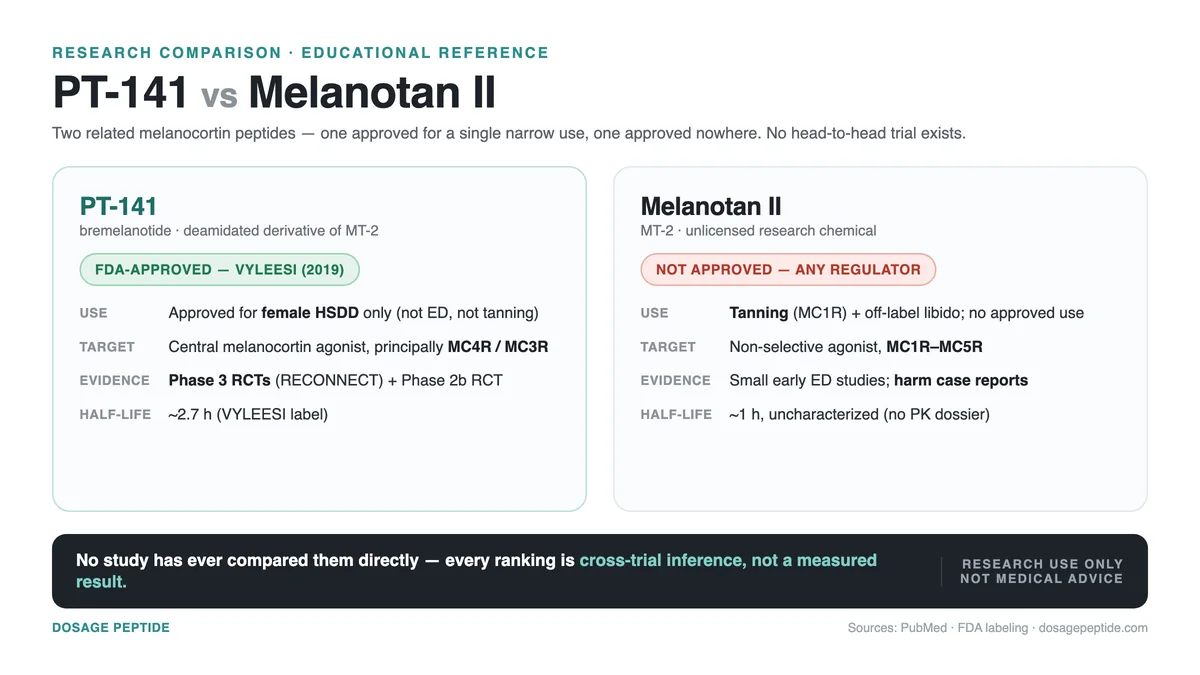
If you read only one section, read this one. PT-141 and Melanotan II share a molecular family — both are synthetic cyclic heptapeptide analogues of α-melanocyte-stimulating hormone (α-MSH) that switch on melanocortin receptors. Where they diverge is destiny. PT-141 was narrowed toward the central sexual-desire pathway, ran the full clinical gauntlet, and became an approved drug for one specific female indication.[1] Melanotan II was developed as a tanning agent, its formal drug development was abandoned, and today it circulates as an unlicensed “research chemical” whose modern medical literature is dominated by case reports of harm rather than trials of benefit.[6] The table below is the orientation; every row is unpacked, with citations, in the sections that follow.
| Attribute | PT-141 (bremelanotide) | Melanotan II (MT-2) |
|---|---|---|
| Class / mechanism | Synthetic cyclic heptapeptide α-MSH analogue; non-selective melanocortin-receptor agonist acting centrally, principally at MC4R (also MC3R); the deamidated derivative/metabolite of Melanotan II[5] | Synthetic cyclic heptapeptide α-MSH analogue; non-selective agonist at MC1R, MC3R, MC4R and MC5R — MC1R drives tanning, MC3R/MC4R drive erectogenic and autonomic effects[4] |
| Primary / approved use | Sexual desire & arousal; approved indication is acquired, generalized HSDD in premenopausal women. Earlier male erectile-dysfunction program was discontinued[3] | Skin tanning (MC1R melanogenesis) is the dominant use, plus off-label erectogenic/libido effects; no legitimate approved therapeutic use |
| Highest human evidence tier | Two identical Phase 3 RCTs (RECONNECT) + a Phase 2b dose-ranging RCT. FDA-approved on this dossier[1][2] | Small early double-blind crossover ED studies (n≈20), development discontinued. Modern literature is dominated by case reports of harm[4] |
| Route | Subcutaneous injection (approved single-use autoinjector, abdomen/thigh); intranasal was studied historically but is not the approved route | Subcutaneous injection, self-administered from reconstituted lyophilized powder in the unregulated market |
| Half-life | ~2.7 hours mean (range ~1.9–4 h) per the VYLEESI clinical-pharmacology data | Poorly characterized in humans; reported to be short (on the order of ~1 h); no regulatory-grade PK dossier exists |
| Approval status | FDA-approved as VYLEESI (21 June 2019) for female HSDD only — not for ED, not for tanning; not approved by the EMA[1] | Not approved anywhere, for any indication; an unlicensed research chemical whose distribution for human use is unlawful[6] |
What Is PT-141 (Bremelanotide)?
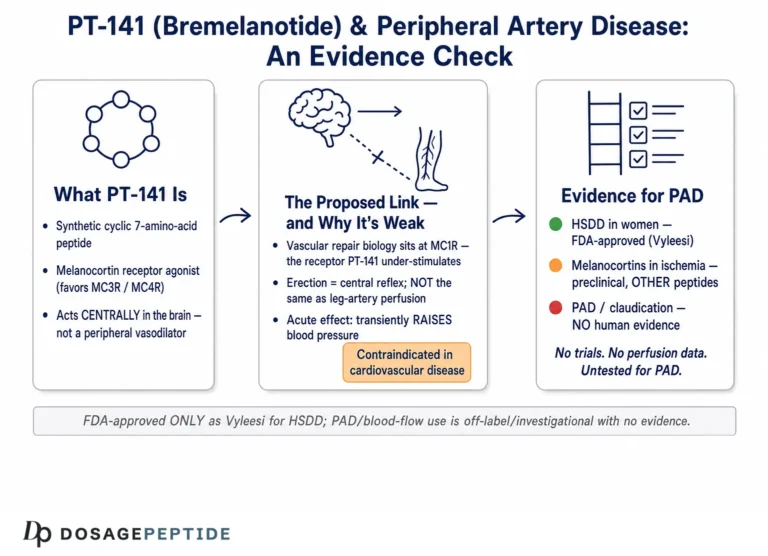
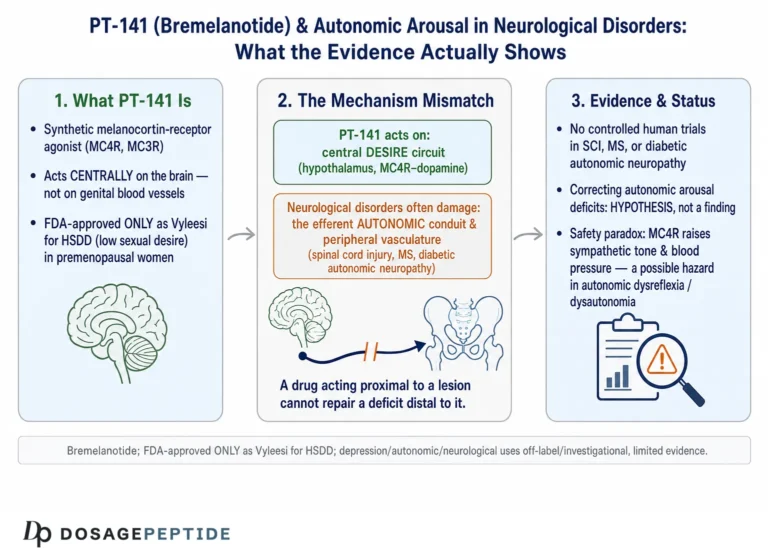
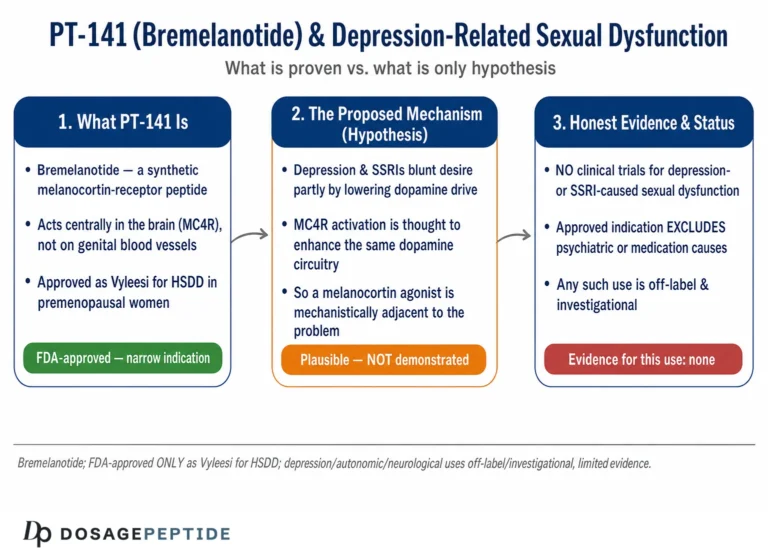
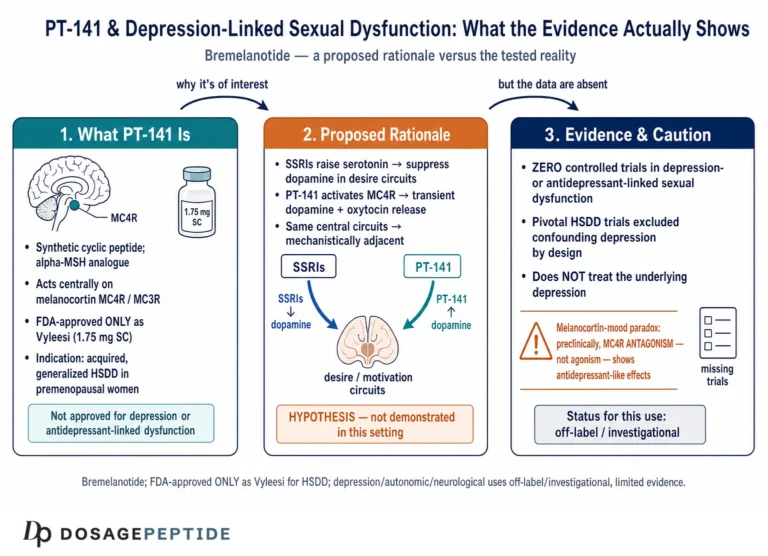
PT-141, generic name bremelanotide, is a synthetic cyclic seven–amino-acid (heptapeptide) analogue of α-MSH. It is a non-selective melanocortin-receptor agonist whose clinically relevant action is central: it activates melanocortin receptors in the brain — principally MC4R, with contribution from MC3R — along pathways that regulate sexual desire and arousal.[5] This is a fundamentally different mechanism from the erectile-dysfunction drugs most people know: sildenafil (Viagra) and the other PDE5 inhibitors act peripherally on the nitric-oxide/vascular pathway to permit an erection, whereas bremelanotide acts upstream in the central nervous system on motivation and desire itself. That distinction is why PT-141 was investigated in populations who did not respond adequately to a PDE5 inhibitor.[3]
Chemically, bremelanotide is the deamidated derivative of Melanotan II — the same cyclic scaffold, with the C-terminal amide replaced by a carboxylic acid — and it is also a metabolite that Melanotan II is converted into in the body. That parent–offspring relationship is the single biggest reason the two are conflated online, but it does not make them interchangeable: only bremelanotide was purified, characterized, dosed, and trialed as a regulated drug candidate. Its approved formulation is a subcutaneous single-use autoinjector delivering a fixed dose into the abdomen or thigh; the research-use conventions catalogued on this site are framed as laboratory reference only, as on the PT-141 10 mg vial research dosage reference.
What Is Melanotan II? (And Why It Is Confused With Two Other Peptides)
Melanotan II (often written “MT-2” or “Melanotan 2”) is a synthetic cyclic heptapeptide analogue of α-MSH, and it is the least selective of this family: it activates MC1R, MC3R, MC4R and MC5R. MC1R activation on skin melanocytes drives melanogenesis — the increased pigmentation that made it popular as an injectable “tanning” agent — while MC3R/MC4R activation produces the erectogenic and libido effects, and MC4R and sympathetic activation produce autonomic effects such as nausea, flushing and blood-pressure changes.[4] It is sold as an unlicensed research chemical, typically as a reconstituted lyophilized powder for self-injection, entirely outside any approved supply chain.[6]
The name causes three separate confusions, and untangling them is one of this article’s main jobs. First, Melanotan II is not PT-141, even though PT-141 is derived from it. Second, Melanotan II is not “Melanotan I” — that name refers to afamelanotide, a different α-MSH analogue that is an approved medicine (marketed as SCENESSE) for a rare photosensitivity disorder. The existence of one approved “Melanotan” drug is frequently misused to imply Melanotan II is approved; it is not.[6] Third, “bremelanotide” and “Melanotan II” are sometimes used loosely as if identical. The disambiguation table separates all four ideas.
| Name | What it is | Approval status |
|---|---|---|
| Melanotan II (MT-2) | Non-selective α-MSH analogue (MC1R–MC5R); used for tanning and off-label libido/erection | Not approved anywhere, for any indication; unlicensed research chemical[6] |
| PT-141 (bremelanotide) | Deamidated derivative/metabolite of MT-2; central MC4R/MC3R agonist for sexual desire | FDA-approved as VYLEESI (2019) for acquired, generalized HSDD in premenopausal women[1] |
| Afamelanotide (“Melanotan I”, SCENESSE) | A different, more MC1R-directed α-MSH analogue — NOT Melanotan II | Approved (e.g. for erythropoietic protoporphyria); commonly confused with MT-2[6] |
| PDE5 inhibitors (sildenafil, etc.) | Not melanocortin agonists at all — peripheral vascular/nitric-oxide drugs | Approved for ED; a different mechanism, listed only to prevent category errors |
Shared Mechanism: Both Are Melanocortin-Receptor Agonists
Despite their divergent fates, PT-141 and Melanotan II converge on the same molecular family: the melanocortin receptors (MC1R through MC5R), a set of G-protein-coupled receptors normally activated by α-MSH and related peptides. Both compounds are non-selective agonists, meaning they switch on more than one receptor subtype at once, and both can therefore produce the same cluster of melanocortin effects — changes in pigmentation, sexual arousal, appetite, and autonomic tone.[5] The sexual effect that both share is central: activation of MC4R (and MC3R) in the brain increases sexual motivation, which is mechanistically distinct from the peripheral vasodilation produced by PDE5 inhibitors.[3]
The practical difference lies in emphasis and selectivity of use, not in a clean mechanistic wall between them. Melanotan II’s strong MC1R activity makes tanning its defining action, with erection and libido as prominent secondary effects; bremelanotide was advanced specifically for the central MC4R-mediated desire pathway and dosed for that purpose. Because both hit MC4R and engage sympathetic (sympathomimetic) tone, both can raise blood pressure and provoke nausea and flushing — a shared liability discussed in the safety section. Terms such as melanocortin receptor, α-MSH, agonist, and heptapeptide used throughout this article are defined in our peptide research glossary.
How We Got Here: From a Tanning Peptide to an Approved Drug
The two compounds trace to one research program. Melanotan peptides originated in academic work on α-MSH analogues designed to stimulate pigmentation without sun exposure — the origin of the “tanning injection” concept. Melanotan II, the more potent, less selective analogue, produced not only tanning but consistent spontaneous erections in early human observations, which redirected attention to its sexual effects.[4] That observation is the seed of the entire “melanocortin agonist for sexual dysfunction” field.[5]
From there the paths split. Rather than develop the messy, tan-everything Melanotan II, developers pursued its cleaner derivative, bremelanotide (PT-141), through formal clinical trials — first for male erectile dysfunction, then, after that program was discontinued, refocused on female HSDD, where it ultimately earned approval.[3][1] Melanotan II, meanwhile, was never carried to approval and drifted into the grey and black markets as a tanning-and-libido “research chemical.” The result is the asymmetry at the heart of this comparison: a parent molecule that stayed unregulated, and an offspring that became a licensed drug for a single, narrow use.
Regulatory and Approval Reality
Stated plainly: PT-141 (bremelanotide) is an approved drug for one specific indication; Melanotan II is approved for nothing, anywhere. Bremelanotide was approved by the FDA as VYLEESI on 21 June 2019 for acquired, generalized hypoactive sexual desire disorder in premenopausal women — a diagnosis of persistently low sexual desire causing distress, not attributable to another condition, medication, or relationship problem.[1] Three honest caveats sit on that approval. First, it is narrow: VYLEESI is not approved for male erectile dysfunction (that program was discontinued), not for postmenopausal women, and not for tanning.[3] Second, it is region-specific — the European marketing application was not pursued to approval, so bremelanotide is not EMA-approved. Third, an approval for HSDD says nothing about the safety or efficacy of research-grade PT-141 powder used for any other purpose.
Melanotan II has no approval from the FDA, the EMA, or any major regulator, for any indication. It is not a licensed medicine, and its sale and distribution for human use are unlawful in the United States, the United Kingdom, and the European Union; multiple national health agencies have issued explicit safety warnings against it.[6] The one legitimate approved α-MSH analogue in this space is a different molecule — afamelanotide (SCENESSE) — and its approval must never be read across to Melanotan II.[6]
PT-141: What the Human Evidence Shows
PT-141’s human record is the strongest in this pair by a wide margin, and it is worth being precise about what it does and does not establish. The pivotal evidence is RECONNECT: two identical Phase 3, randomized, double-blind, placebo-controlled, multicenter trials of bremelanotide 1.75 mg self-administered subcutaneously as needed in premenopausal women with HSDD. Across the safety population of 1,247 women, bremelanotide produced statistically significant improvements versus placebo in the co-primary endpoints — sexual desire (Female Sexual Function Index desire domain) and desire-related distress (Female Sexual Distress Scale) — with a favorable, tolerability-driven safety profile.[1] A Phase 2b dose-ranging study established the 1.75 mg dose and the responder definitions later used in the registration trials.[2]
The earlier PT-141 literature came from the other direction — erectile dysfunction. In a Phase 1/2 program, subcutaneous PT-141 produced statistically significant erectile responses in healthy men at doses above 1.0 mg and in men with ED who had responded inadequately to sildenafil, and it was safe and well tolerated in both settings.[3] The honest framing of the whole PT-141 record: the effect on sexual desire/arousal is real, reproducible, and demonstrated in adequately powered human RCTs — but the approved benefit is a modest, statistically significant improvement in one female indication, not a dramatic or universal effect, and the male-ED application never reached approval. It is genuine human evidence, represented at its true weight.
Melanotan II: What the Human Evidence Shows
Melanotan II’s human evidence is thin, old, and mostly about erections rather than efficacy in any modern sense. The core clinical data are small, early double-blind, placebo-controlled crossover studies from the late 1990s and early 2000s. In the most-cited of these, Melanotan II was given to 20 men with erectile dysfunction; in the absence of sexual stimulation it produced penile erection in 17 of 20 men and increased self-reported sexual desire significantly more often than placebo — but nausea was common, and at higher doses a meaningful fraction of subjects reported severe nausea.[4] These studies confirmed the melanocortin sexual effect and directly motivated the development of bremelanotide.[5]
What Melanotan II does not have is a completed drug-development program or any efficacy trial supporting its dominant real-world use — tanning — as safe. Its formal development was discontinued, and, tellingly, its modern medical literature is not a story of larger and better efficacy trials but of accumulating case reports of harm: systemic sympathomimetic toxicity, rhabdomyolysis and acute kidney injury, renal infarction, and melanocytic changes including new or atypical moles and reports of melanoma.[7][8][9] When the most recent evidence about a compound is a series of toxicity reports rather than trials of benefit, that is itself an evidence signal.
Head-to-Head vs. Cross-Trial: The Only Fair Comparisons
This is the section that keeps the rest honest. There is no study in which PT-141 and Melanotan II were administered to comparable subjects and measured against each other — not in humans, and not even in the same animal model. Any statement that one is “stronger,” “safer,” or “better” is cross-trial inference: it stitches together numbers from separate studies run years apart in different people, which cannot establish superiority because population, dose, assay, and design all confound the read. What can be said fairly is narrow: PT-141 has adequately powered human RCTs and an approval; Melanotan II has small early crossover studies and a harm-dominated modern literature. The evidence-grading table below makes each reported role explicit.
| Reported research role | Strongest evidence tier | Honest interpretation |
|---|---|---|
| PT-141 improves sexual desire/distress in premenopausal HSDD | Two Phase 3 RCTs (RECONNECT) + Phase 2b RCT[1][2] | Well supported for that specific population/endpoint; the basis of its FDA approval — effect is real but modest |
| PT-141 produces erection in men with ED | Phase 1/2 clinical studies[3] | Demonstrated short-term effect; the male-ED program was discontinued, not approved |
| Melanotan II produces erection/desire in men with ED | Small double-blind crossover study (n≈20)[4] | Real early signal; hypothesis-generating; development discontinued, never approved |
| Melanotan II for tanning (its dominant use) | No efficacy/safety trial; case reports of harm[6][9] | Not established as safe; associated with melanocytic changes and national warnings |
| PT-141 “beats” Melanotan II (or vice versa) | No head-to-head trial | Cannot be claimed from the evidence; cross-trial inference only |
| Either peptide for a shared, directly comparable endpoint | No direct comparison exists | The approved use (female HSDD) and MT-2’s dominant use (tanning) do not even overlap |
Notice a subtlety the table exposes: even the “same” effect — the central sexual effect — was studied in different populations (women with HSDD for PT-141; men with ED for both PT-141 and Melanotan II), so a clean apples-to-apples read is impossible. And the two compounds’ dominant real-world uses — approved female HSDD versus off-label male tanning-and-libido — barely intersect, which makes any “which is better” framing a category error before the evidence is even weighed.
Reading the Numbers Honestly: The Full Specification Table
With the evidence framed, here is the detailed side-by-side specification. Two columns carry a heavy caveat: for PT-141 the figures come from a regulatory dossier (the VYLEESI clinical pharmacology and label), whereas for Melanotan II most numbers are poorly characterized because no regulatory-grade pharmacokinetic study exists. Any Melanotan II half-life or dose figure is a research-market convention, not established human pharmacology.
| Property | PT-141 (bremelanotide) | Melanotan II (MT-2) |
|---|---|---|
| Peptide class | Synthetic cyclic heptapeptide α-MSH analogue | Synthetic cyclic heptapeptide α-MSH analogue (parent of PT-141) |
| Receptor profile | Non-selective; central action principally MC4R (also MC3R)[5] | Non-selective; MC1R, MC3R, MC4R, MC5R[4] |
| Best-studied research use | Female HSDD (approved); male ED (discontinued)[1][3] | Tanning (dominant); off-label erection/libido[4] |
| Typical route | Subcutaneous autoinjector (abdomen/thigh); intranasal studied historically | Subcutaneous self-injection from reconstituted powder (unregulated) |
| Half-life | ~2.7 h mean (range ~1.9–4 h), per VYLEESI clinical pharmacology | Poorly characterized; reported short (~1 h); no regulatory PK dossier |
| Highest human evidence tier | Phase 3 RCTs (RECONNECT) + Phase 2b RCT[1][2] | Small early crossover ED studies (n≈20); harm case reports[4] |
| Approval status | FDA-approved (VYLEESI, 2019) for female HSDD; not EMA-approved | Not approved anywhere; unlawful for human use[6] |
Anyone converting these figures into vial concentrations should treat them strictly as laboratory reference points; our peptide reconstitution guide and dosage calculator explain the arithmetic without implying any human protocol.
Research-Use Dosing Conventions (Laboratory Reference Only)
The figures below are reported from the regulatory label (for PT-141) and from unregulated research-market convention (for Melanotan II). They are provided to help interpret the literature, not as a protocol for human use, and Melanotan II in particular has no approved or validated dose of any kind.
- PT-141 (bremelanotide) — the approved VYLEESI label specifies 1.75 mg subcutaneously as needed, at least 45 minutes before anticipated activity, with a maximum of one dose per 24 hours and no more than eight doses per month. That is a clinical label figure, reproduced here only to characterize the compound; on this site the research-use conventions are framed laboratory-only on the PT-141 10 mg vial research dosage reference.
- Melanotan II — there is no approved or validated dose. Unregulated use has reported small subcutaneous amounts (roughly 0.25–1 mg), while a single 6 mg self-injection produced serious systemic toxicity in a documented case — a stark illustration of how meaningless any “standard” figure is for an uncharacterized product.[7] Any number is research-use-only, not a clinical dose; the Melanotan II 10 mg vial research dosage reference is framed accordingly.
Side Effects: What Each One Actually Causes
Safety is where the asymmetry becomes most consequential. Both compounds share a melanocortin/sympathomimetic liability — nausea, flushing, and blood-pressure effects — but only PT-141 has a characterized, monitored safety profile from controlled trials, while Melanotan II’s safety record is built largely from emergency-department case reports.
| Safety dimension | PT-141 (bremelanotide) | Melanotan II (MT-2) |
|---|---|---|
| Common adverse effects | Nausea, flushing, headache (each ≥10% in RCTs); mostly mild–moderate[1] | Nausea (sometimes severe at higher doses), flushing, spontaneous yawning[4] |
| Cardiovascular | Transient rises in blood pressure and reductions in heart rate; label cautions against use in uncontrolled hypertension or known cardiovascular disease | Sympathomimetic excess documented, including hypertension and tachycardia in overdose[7] |
| Serious documented harms | Focal hyperpigmentation (including gums) with repeated dosing; serious events uncommon in trials | Rhabdomyolysis and acute kidney injury; renal infarction[7][8] |
| Skin / melanocytic | Pigmentation changes reported, generally reversible | Darkening of existing moles, new/dysplastic nevi, and melanomas reported during or shortly after use[6][9] |
| Product-quality risk | Approved product is manufactured to pharmaceutical standards; research-grade powder is not | Unregulated product raises purity, sterility, and dosing concerns; national agencies have warned against it[6] |
The melanocytic-change signal deserves particular emphasis because it strikes at Melanotan II’s dominant use. The compound that people inject specifically to change their skin pigmentation is the same one associated in the literature with darkening and change in melanocytic lesions, and case reports have described dysplastic nevi and melanoma emerging during or after use.[6][9] These are case reports, not proof of causation — but they are exactly the safety questions a controlled program would have to answer, and Melanotan II never ran one.
Which One Is Studied for Which Purpose?
Mapping each peptide to its actual research context prevents the most common category error — treating them as interchangeable “melanocortin” peptides. PT-141 is studied and approved for one thing in humans: female sexual desire (HSDD), with a discontinued earlier program in male ED.[1][3] Melanotan II is used mostly for tanning, with off-label erectogenic effects, and its modern literature is safety-focused.[6]
| Research area | PT-141 evidence | Melanotan II evidence | Strongest tier in this pair |
|---|---|---|---|
| Female sexual desire (HSDD) | Phase 3 RCTs (approved)[1] | No dedicated data | Human RCT (PT-141) |
| Male erectile dysfunction | Phase 1/2 studies (discontinued)[3] | Small crossover study (n≈20)[4] | Early human (both; neither approved for ED) |
| Skin tanning | Not a use; PT-141 not developed for tanning | Dominant use; no efficacy/safety trial[6] | None — unstudied for safety |
| Safety / toxicology signals | Characterized in RCTs[1] | Case reports: rhabdomyolysis, AKI, renal infarction, melanocytic change[7][8] | Controlled data (PT-141) |
What the Evidence Does Not Show
Because the marketing around these two compounds is expansive, it is worth stating explicitly what the published record does not establish:
- It does not show which peptide is superior, safer, or “stronger,” because no head-to-head study — human or animal — has ever compared PT-141 with Melanotan II.
- It does not show that Melanotan II is safe or effective for tanning, its dominant use; there is no efficacy or safety trial for that purpose, and the literature carries melanocytic-change and melanoma reports.
- It does not show that PT-141’s approval extends beyond female HSDD — not to male ED, not to postmenopausal women, and not to tanning.
- It does not show that Melanotan II shares PT-141’s regulatory status; the approval of afamelanotide (a different molecule) does not transfer to Melanotan II.
- It does not establish a validated human dose, half-life, or safety margin for Melanotan II; the circulating figures are unregulated conventions.
- It does not show that a research vial’s label guarantees its contents; research-market identity and purity are unverified (see below).
Limitations of This Comparison
Several structural limitations constrain everything above, and honest readers should keep them in view:
- No head-to-head data. Comparing the two requires stitching together studies that differ in population, endpoint, era, and design — a chain with several weak links.
- Non-overlapping primary uses. PT-141’s approved use (female HSDD) and Melanotan II’s dominant use (tanning) barely intersect, so a “which is better” question is often malformed.
- Asymmetric evidence quality. One side has Phase 3 RCTs and a regulatory dossier; the other has small early crossover studies and case reports — different tiers that cannot be equated.
- Old and small MT-2 data. Melanotan II’s human efficacy evidence is decades old and involved very few subjects, with no modern replication.
- Research-chemical identity. Melanotan II sold research-use-only is of unverified identity and purity; trial or label data do not describe an arbitrary vial.
- No approved comparison endpoint. Because their approved/dominant uses differ, there is no single regulatory endpoint on which both have been measured.
Practical and Research Context
For readers using this material to interpret the literature rather than to guide any human use, a few practical anchors help. The laboratory handling parameters — reconstitution, storage, and concentration arithmetic — are covered generically in our reconstitution guide and dosage calculator, and the research-context dosing references live on each compound’s protocol page: the PT-141 10 mg vial research dosage reference and the Melanotan II 10 mg vial research dosage reference. Neither is a recommendation for human administration.
Because research-grade material is sold outside any approved supply chain, its identity and purity are unverified — and for these melanocortin peptides that is not a formality: a documented Melanotan II toxicity case required mass-spectrometry confirmation just to establish what had actually been injected.[7] Trial and label data describe a characterized study drug, not the contents of an arbitrary vial, so identity confirmation by mass spectrometry and HPLC and a batch certificate of analysis are the minimum a rigorous research setting should require; reference vials of research-grade peptides are catalogued by research-use-only suppliers such as Prime Lab Peptides. Sourcing a tested material does not change the evidence picture described above — the trial data for PT-141 and the harm reports for Melanotan II still do not transfer to any specific product, this is not a protocol for use, and nothing here is a therapeutic recommendation.
Common Misconceptions About PT-141 and Melanotan II
“PT-141 and Melanotan 2 are basically the same peptide.”
They are chemically related — PT-141 is the deamidated derivative and a metabolite of Melanotan II — but they are not interchangeable. Only PT-141 (bremelanotide) was developed and approved as a drug, for female HSDD. Melanotan II is unapproved, less selective (it strongly activates MC1R for tanning), and carries a harm-dominated safety literature.
“There’s an approved Melanotan, so Melanotan 2 must be safe.”
The approved α-MSH analogue is afamelanotide (SCENESSE), a different molecule sometimes called “Melanotan I.” Its approval does not transfer to Melanotan II, which is not approved by any major regulator and is unlawful to distribute for human use.
“PT-141 is an FDA-approved way to boost anyone’s sex drive.”
PT-141 is approved only for acquired, generalized HSDD in premenopausal women. It is not approved for male erectile dysfunction (that program was discontinued), not for postmenopausal women, and not for general libido enhancement. The approved effect is modest and specific.
“Melanotan 2 is a proven tanning shortcut with just some nausea.”
There is no efficacy or safety trial supporting Melanotan II for tanning. Its documented harms extend well past nausea to systemic toxicity, rhabdomyolysis, acute kidney injury, renal infarction, and melanocytic changes including reports of melanoma — which is why multiple national health agencies have warned against it.
Key Takeaways
- Approval is the headline. PT-141 (bremelanotide) is FDA-approved as VYLEESI for HSDD in premenopausal women; Melanotan II is approved nowhere, for anything.
- No head-to-head trial exists. Every ranking of the two is cross-trial inference, not a measured result.
- Same family, different destiny. PT-141 is the deamidated derivative/metabolite of Melanotan II, but only PT-141 completed the regulatory pathway.
- Evidence quality is lopsided. PT-141 rests on Phase 2b/Phase 3 RCTs; Melanotan II rests on small early crossover studies plus a modern literature dominated by case reports of harm.
- Their primary uses barely overlap. PT-141’s approved use is female HSDD; Melanotan II is used mostly for tanning — so framing them as interchangeable is misleading.
- Research-market material is unverified. Trial and label data are not product data; nothing here is medical advice or a protocol for use.
Frequently Asked Questions
Is PT-141 or Melanotan 2 better?
There is no head-to-head trial, so “better” cannot be established from evidence. On the strength of human data and regulatory status, PT-141 (bremelanotide) is far better documented — Phase 3 RCTs and FDA approval for female HSDD — whereas Melanotan II has small early crossover studies and no approval. Their dominant uses (female desire vs tanning) also barely overlap, so any direct ranking is a category error.
Are PT-141 and Melanotan 2 the same thing?
No. They are closely related — PT-141 is the deamidated derivative and a metabolite of Melanotan II, and both are cyclic heptapeptide α-MSH analogues — but they are chemically distinct and behave differently. Melanotan II is less selective and strongly drives MC1R-mediated tanning; PT-141 was developed for the central MC4R sexual-desire pathway and became an approved drug.
Is PT-141 (bremelanotide) FDA-approved?
Yes, for one narrow use. Bremelanotide was approved by the FDA as VYLEESI on 21 June 2019 for acquired, generalized hypoactive sexual desire disorder in premenopausal women. It is not approved for male erectile dysfunction, not for postmenopausal women, not for tanning, and it is not approved by the European Medicines Agency.
Is Melanotan II FDA-approved?
No. Melanotan II has never been approved by the FDA, the EMA, or any major regulator for any indication. It is an unlicensed research chemical, and its distribution for human use is unlawful in the United States, United Kingdom, and European Union. Do not confuse it with afamelanotide (SCENESSE), a different, approved α-MSH analogue.
How do PT-141 and Melanotan 2 work?
Both are non-selective agonists at melanocortin receptors. The shared sexual effect is central — activation of MC4R (and MC3R) in the brain increases sexual motivation — which differs from PDE5 inhibitors like sildenafil that act on the peripheral vascular pathway. Melanotan II additionally activates MC1R strongly, driving skin pigmentation (tanning), which is not PT-141’s primary clinical action.
What are the side effects of each?
In PT-141 trials the most common effects were nausea, flushing, and headache (each 10% or more), with transient blood-pressure rises; the label cautions against uncontrolled hypertension or known cardiovascular disease. Melanotan II shares nausea and flushing but its literature also documents serious harms — sympathomimetic toxicity, rhabdomyolysis, acute kidney injury, renal infarction, and melanocytic changes including reports of melanoma.
Does Melanotan 2 really cause tanning, and is that safe?
Melanotan II does stimulate MC1R-driven melanogenesis, which is why it is injected for tanning — but no efficacy or safety trial supports that use. The same melanocortin activity is linked in the medical literature to darkening and change of moles, new or dysplastic nevi, and reported melanomas, and several national health agencies have issued warnings. This article is not a recommendation to use it.
Can either peptide be used for erectile dysfunction?
Neither is approved for ED. PT-141 showed erectile responses in Phase 1/2 studies in men, but that program was discontinued rather than approved; Melanotan II produced erections in a small early crossover study but was never developed to approval. PT-141’s only approval is for female HSDD, and any ED use of either peptide is off-label or research-use and unproven for that purpose.
Is any of this a recommendation for human use?
No. This article is educational reference material summarizing published research and regulatory status. It is not medical advice, not a therapeutic recommendation, and not instructions for human use. Melanotan II is unapproved and unlawful to distribute for human use; PT-141’s approval is narrow. Any doses cited describe regulatory labeling or laboratory research conventions only.
References
- Kingsberg SA, Clayton AH, Portman D, Williams LA, Krop J, Jordan R, Lucas J, Simon JA. Bremelanotide for the Treatment of Hypoactive Sexual Desire Disorder: Two Randomized Phase 3 Trials. Obstet Gynecol. 2019;134(5):899–908. doi:10.1097/AOG.0000000000003500. PMID 31599840.
- Althof S, Derogatis LR, Greenberg S, Clayton AH, Jordan R, Lucas J, Spana C. Responder Analyses from a Phase 2b Dose-Ranging Study of Bremelanotide. J Sex Med. 2019;16(8):1226–1235. doi:10.1016/j.jsxm.2019.05.012. PMID 31277966.
- Rosen RC, Diamond LE, Earle DC, Shadiack AM, Molinoff PB. Evaluation of the safety, pharmacokinetics and pharmacodynamic effects of subcutaneously administered PT-141, a melanocortin receptor agonist, in healthy male subjects and in patients with an inadequate response to Viagra. Int J Impot Res. 2004;16(2):135–142. doi:10.1038/sj.ijir.3901200. PMID 14999221.
- Wessells H, Levine N, Hadley ME, Dorr R, Hruby V. Melanocortin receptor agonists, penile erection, and sexual motivation: human studies with Melanotan II. Int J Impot Res. 2000;12 Suppl 4:S74–S79. doi:10.1038/sj.ijir.3900582. PMID 11035391.
- Ueckert S, Bannowsky A, Albrecht K, Kuczyk MA. Melanocortin receptor agonists in the treatment of male and female sexual dysfunctions: results from basic research and clinical studies. Expert Opin Investig Drugs. 2014;23(11):1477–1483. doi:10.1517/13543784.2014.934805. PMID 25096243.
- Habbema L, Halk AB, Neumann M, Bergman W. Risks of unregulated use of alpha-melanocyte-stimulating hormone analogues: a review. Int J Dermatol. 2017;56(10):975–980. doi:10.1111/ijd.13585. PMID 28266027.
- Nelson ME, Bryant SM, Aks SE. Melanotan II injection resulting in systemic toxicity and rhabdomyolysis. Clin Toxicol (Phila). 2012;50(10):1169–1173. doi:10.3109/15563650.2012.740637. PMID 23121206.
- Peters B, Hadimeri H, Wahlberg R, Afghahi H. Melanotan II: a possible cause of renal infarction: review of the literature and case report. CEN Case Rep. 2020;9(2):159–161. doi:10.1007/s13730-020-00447-z. PMID 31953620.
- Sivyer GW. Changes of melanocytic lesions induced by Melanotan injections and sun bed use in a teenage patient with FAMMM syndrome. Dermatol Pract Concept. 2012;2(3):203a10. doi:10.5826/dpc.0203a10. PMID 23785612.
Research-use disclaimer: This article is educational reference material summarizing published research and regulatory context. It is not medical advice, not a therapeutic recommendation, and not instructions for human use. PT-141 (bremelanotide) is FDA-approved only as VYLEESI for acquired, generalized HSDD in premenopausal women; Melanotan II is not approved by any major regulator for any indication and is unlawful to distribute for human use. Any dosing or handling figures refer to regulatory labeling or laboratory research settings only. Always verify current clinical-trial and regulatory status through primary sources such as PubMed, ClinicalTrials.gov, and the FDA.