Few molecules illustrate the elegance — and the fragility — of neuroendocrine control as clearly as gonadotropin-releasing hormone. So what is gonadorelin, and why does a ten-amino-acid peptide with a half-life measured in minutes sit at the very top of the reproductive hormone cascade? This article examines gonadorelin as the synthetic form of native GnRH, traces how the pulsatile rhythm of its release governs the hypothalamic–pituitary–gonadal (HPG) axis, and surveys what the research literature actually establishes about its study in fertility and testosterone contexts — while carefully separating well-documented endocrinology from the popularized claims that have outrun the evidence.
What Is Gonadorelin? Defining the Native GnRH Decapeptide
Gonadorelin is the pharmaceutical name for synthetic gonadotropin-releasing hormone (GnRH), a decapeptide (ten amino acids) produced by specialized neurons in the hypothalamus. It is chemically identical to the endogenous hormone that the human body uses to signal the anterior pituitary gland to release luteinizing hormone (LH) and follicle-stimulating hormone (FSH). Because gonadorelin is native GnRH rather than a modified analogue, it behaves in the body exactly as the natural signal does — including its most defining and consequential feature: an extremely short circulating half-life.[1]
The isolation and sequencing of GnRH in the early 1970s was a landmark in endocrinology. Working with extracts from hundreds of thousands of animal hypothalami, Andrew Schally’s laboratory determined that a single decapeptide could trigger the release of both gonadotropins — work for which Schally shared the 1977 Nobel Prize in Physiology or Medicine with Roger Guillemin (and Rosalyn Yalow) for discoveries concerning the peptide hormone production of the brain.[2] The primary structure was reported by Matsuo and colleagues as pyroGlu-His-Trp-Ser-Tyr-Gly-Leu-Arg-Pro-Gly-NH₂, a sequence conserved across most mammalian species.[3] That sequence is the molecular blueprint reproduced in synthetic gonadorelin.
Structure and Nomenclature
Gonadorelin’s decapeptide chain is flanked by two features that shape its pharmacology. At the N-terminus sits a pyroglutamate residue (a cyclized glutamine), and at the C-terminus a glycine-amide group. These terminal modifications matter because the biologically active conformation of GnRH depends on a folded, hairpin-like geometry that presents specific residues to its receptor. The names encountered in the literature — gonadorelin, GnRH, LHRH (luteinizing hormone-releasing hormone), gonadoliberin, and the historical brand names Factrel and Lutrepulse — all refer to this same native decapeptide or its acetate/hydrochloride salts. It is worth noting that “LHRH” is a slightly dated term; because the peptide releases both LH and FSH, “GnRH” is the preferred modern designation.
A useful mental model is that gonadorelin is the “master switch signal” of reproduction — but a switch that only works when flicked rhythmically. The critical vulnerability of the native molecule is that peptidases in blood and tissue cleave it rapidly, particularly at the Gly⁶-Leu⁷ and Pro⁹-Gly¹⁰ bonds. This rapid degradation is not an incidental nuisance; as later sections explain, it is the mechanistic foundation of how the entire axis is designed to be governed by pulses rather than a steady tonic signal. The engineered agonists that dominate modern clinical practice were designed precisely to defeat this vulnerability — typically by substituting the readily cleaved glycine at position 6 with a bulky, protease-resistant D-amino acid, and often by modifying the C-terminus — which is why they persist in the circulation for hours rather than minutes.
Gonadorelin Versus GnRH Agonists and Antagonists
One of the most common sources of confusion — and one this reference library treats as non-negotiable to clarify — is the distinction between gonadorelin (native GnRH) and the family of engineered GnRH analogues. These are pharmacologically very different classes despite acting at the same receptor.
- Gonadorelin (native GnRH): chemically identical to the natural hormone, very short half-life (approximately 2–4 minutes), and capable of either stimulating or suppressing gonadotropins depending entirely on how it is delivered.
- GnRH agonists (e.g., leuprolide, goserelin, buserelin, triptorelin): synthetic analogues with amino-acid substitutions (often at position 6 and the C-terminus) that resist enzymatic degradation, greatly extending half-life and receptor-binding potency. Given continuously, they produce an initial “flare” of gonadotropins followed by profound, sustained suppression — the basis of their FDA-approved use in prostate cancer, endometriosis, central precocious puberty, and assisted reproduction.[4]
- GnRH antagonists (e.g., cetrorelix, ganirelix, degarelix): analogues that competitively block the GnRH receptor, producing immediate suppression of LH/FSH without an initial flare.
The crucial insight is that leuprolide and gonadorelin are frequently discussed together in online forums as if interchangeable, yet they occupy opposite ends of a functional spectrum. A stable, long-acting agonist administered continuously suppresses the axis; native gonadorelin administered in physiological pulses stimulates it. Confusing the two — or assuming that “GnRH equals stimulation” — is the single most important conceptual error to avoid when reading about this molecule. The antagonists add a third behavior: because they occupy the receptor without activating it, they suppress gonadotropins from the first dose without the transient flare that agonists produce, which is why they are favored where an initial testosterone or estradiol surge would be undesirable.
Research Context: Why GnRH Sits at the Top of the HPG Axis
To understand why researchers care so intensely about gonadorelin, it helps to place it within the architecture of the reproductive control system. The HPG axis is a three-tier hierarchical cascade in which each level regulates the next through hormonal messengers, with feedback loops running in both directions.
The Hypothalamic–Pituitary–Gonadal Cascade
At the top, GnRH neurons in the hypothalamus — a surprisingly small population of only a few thousand cells scattered across the preoptic area and arcuate nucleus — release GnRH into the hypophyseal portal circulation, a specialized set of blood vessels that carries the signal directly to the anterior pituitary. There, GnRH binds its receptor on pituitary gonadotroph cells and stimulates the synthesis and secretion of LH and FSH. These gonadotropins travel through the general circulation to the gonads, where in males LH drives testosterone production by Leydig cells and FSH supports Sertoli-cell function and spermatogenesis, while in females they orchestrate follicular development, estradiol production, and ovulation. The sex steroids and gonadal peptides (such as inhibin) then feed back to the hypothalamus and pituitary to modulate the entire loop.[5]
What makes GnRH the “keystone” is that it is the final common pathway through which the brain communicates its reproductive intentions to the endocrine system. Everything upstream — nutritional status, stress, circadian rhythm, sex-steroid feedback, and the timing of puberty — ultimately converges on the GnRH pulse generator. This centrality is precisely why a synthetic version like gonadorelin became such a valuable research and diagnostic tool: administering it allows investigators to probe the responsiveness of the pituitary directly, bypassing the natural hypothalamic signal. It also explains why disorders at different levels of the axis produce characteristically different hormone patterns — low LH/FSH with low sex steroids points upstream to the hypothalamus or pituitary (secondary or tertiary hypogonadism), whereas high LH/FSH with low sex steroids points to the gonad itself (primary hypogonadism).
Historical Discovery and Early Physiology
The physiological significance of GnRH pulsatility was not appreciated immediately after the peptide was sequenced. It took the work of Ernst Knobil and colleagues in the late 1970s, using rhesus monkeys with lesions that abolished endogenous GnRH, to reveal that the pattern of delivery — not merely the presence of the hormone — was what mattered.[6] This discovery reframed the entire field and established the conceptual foundation on which all modern GnRH pharmacology rests. Knobil’s later synthesis of the neuroendocrine control of the reproductive cycle remains a canonical reference.[7] Readers new to the terminology may find the site’s peptide research glossary helpful for the endocrine vocabulary used throughout this discussion.
How Does the Hypothalamic Pulse Generator Work?
If pulsatility is the defining feature of GnRH signaling, the obvious question is: what generates the pulses? For decades this “GnRH pulse generator” was a black box — a functional concept inferred from the rhythmic bursts of LH observed in blood sampling, but without a defined cellular substrate. Over the past two decades, that black box has been substantially opened.
KNDy Neurons and the Arcuate Nucleus
The current model centers on a population of neurons in the arcuate nucleus of the hypothalamus that co-express three signaling molecules: kisspeptin, neurokinin B, and dynorphin — giving rise to the acronym “KNDy” neurons.[8] These cells are now regarded as the leading candidate for the intrinsic pulse generator. The prevailing hypothesis is that neurokinin B acts to initiate and synchronize bursts of KNDy-neuron activity, while dynorphin (an inhibitory opioid peptide) terminates each burst, and kisspeptin serves as the primary output signal that drives the GnRH neurons themselves. The interplay of an excitatory starter and an inhibitory brake within a reciprocally connected network provides a plausible oscillator capable of generating the roughly hourly rhythm observed in primates.
This model is elegant because it explains how a rhythm can arise from a network rather than requiring each GnRH neuron to be an independent clock. It also clarifies why so many upstream influences — leptin and metabolic signals, estradiol and testosterone feedback, and stress mediators — can adjust pulse frequency: they act largely on the KNDy network rather than on the GnRH neurons directly. It is worth stressing that this remains an actively investigated model rather than a fully settled account; the precise ionic and synaptic mechanisms by which the network sets its interval, and how well rodent findings map onto primate physiology, are still being worked out.
Kisspeptin as the Upstream Gatekeeper
Kisspeptin deserves particular emphasis because its discovery reshaped reproductive neuroendocrinology. In 2003, two independent groups reported that loss-of-function mutations in GPR54 (the kisspeptin receptor, now called KISS1R) cause hypogonadotropic hypogonadism — a failure of puberty and reproductive maturation — establishing kisspeptin signaling as an obligatory gatekeeper for GnRH release.[9][10] In other words, GnRH neurons do not fire autonomously; they require kisspeptin input to drive their rhythmic secretion. This places kisspeptin one tier above gonadorelin in the control hierarchy and explains why kisspeptin itself has become an intense focus of research as a potential means of stimulating the axis more “upstream” than GnRH. Our companion article on kisspeptin and reproductive hormone signaling explores that upstream layer in detail.
The practical takeaway for understanding gonadorelin is this: the natural signal reaching the pituitary is not a smooth infusion but a series of discrete, roughly hourly pulses whose frequency encodes physiological information. Faster pulse frequencies tend to favor LH secretion; slower frequencies favor FSH. Any exogenous GnRH such as gonadorelin, if it is to reproduce physiology, must respect this rhythmic code. This frequency-encoding is not a curiosity but a central design principle: across the menstrual cycle, for example, the pulse generator speeds up and slows down under sex-steroid feedback, biasing the pituitary toward LH or FSH output at the appropriate phase.
At the molecular level, this frequency-decoding is thought to operate through differential regulation of the genes encoding the gonadotropin subunits. The common α-subunit and the hormone-specific LHβ and FSHβ subunits respond differently to the tempo of GnRH input: faster pulse frequencies tend to favor transcription of the LHβ gene, whereas slower frequencies favor FSHβ, in part because the two promoters integrate the intracellular signals triggered by each pulse over different time windows. The upshot is that a single ligand, acting at a single receptor, can bias the pituitary’s output between two different hormones purely by the rhythm at which it arrives — a striking example of temporal, rather than chemical, information encoding. For anyone interpreting claims about gonadorelin, this reinforces the central lesson that outcome depends on pattern, and that a regimen which fails to reproduce the physiological tempo cannot be assumed to reproduce the physiological result.
Mechanisms Studied: Pulsatile Versus Continuous GnRH Signaling
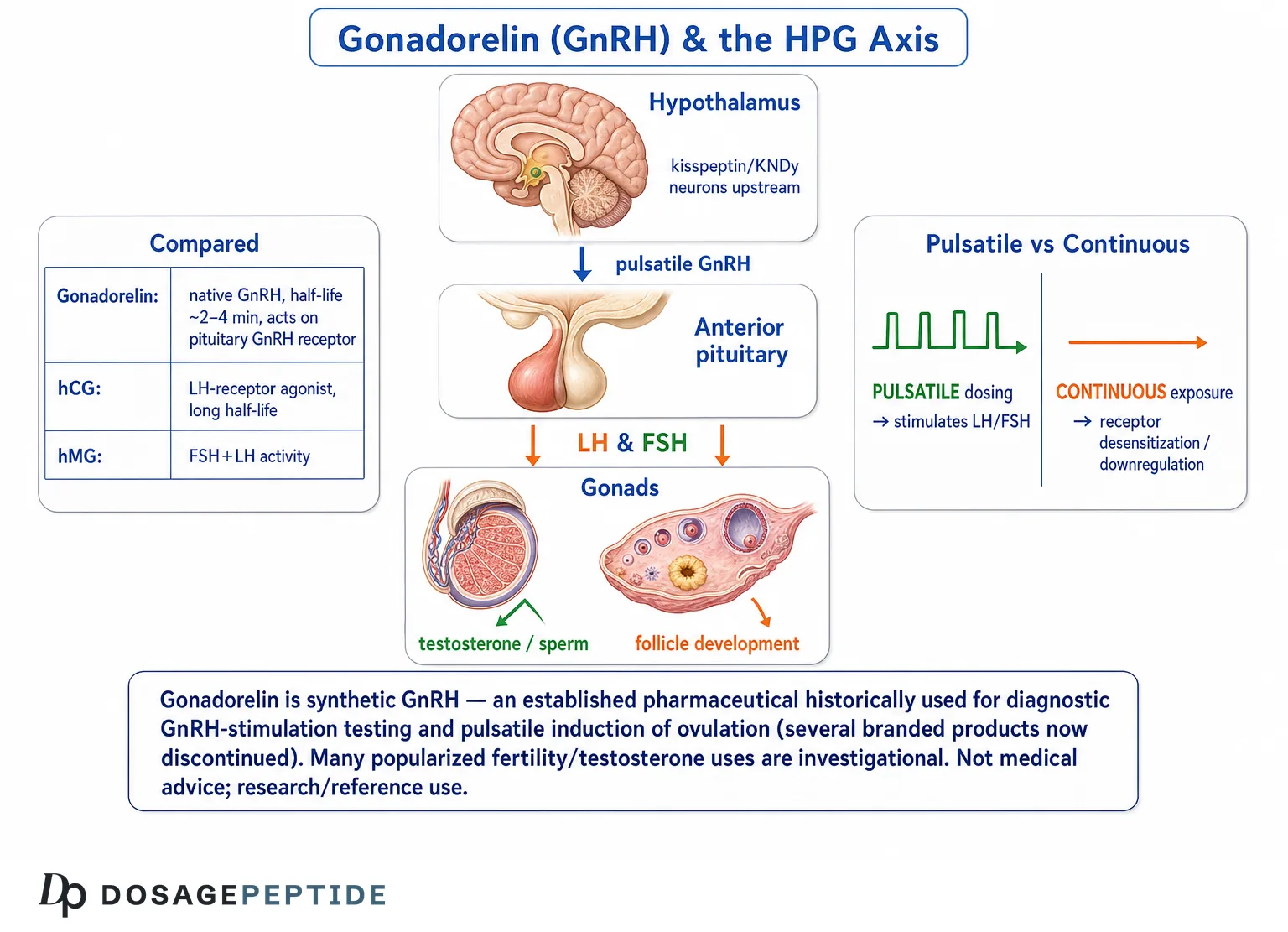
This is the mechanistic heart of gonadorelin pharmacology and the concept that most distinguishes it from ordinary hormones. The same molecule, at the same receptor, produces opposite biological outcomes depending solely on the temporal pattern of delivery. Understanding this dichotomy is essential to interpreting every claim made about gonadorelin.
The Knobil Paradigm: Pattern Is Everything
The definitive demonstration came from Belchetz, Plant, Knobil and colleagues in 1978. Working with rhesus monkeys whose endogenous GnRH had been abolished by hypothalamic lesions, they showed that intermittent (pulsatile) infusion of GnRH — one pulse per hour — restored and sustained normal LH and FSH secretion. But when the identical total dose of GnRH was delivered as a continuous infusion, gonadotropin secretion initially rose and then paradoxically fell to low levels within a day or two. Crucially, when the continuous infusion was stopped and the pulsatile regimen resumed, gonadotropin secretion recovered.[6]
This experiment established the central paradigm now taught in every endocrinology curriculum: pulsatile GnRH stimulates the axis; continuous GnRH suppresses it. It is difficult to overstate the reach of this single finding. It simultaneously explains how pulsatile GnRH (or gonadorelin) can be used to drive the axis in states of hypothalamic GnRH deficiency, and how continuous exposure to a long-acting GnRH agonist can be used to shut down the axis in hormone-dependent cancers, endometriosis, and precocious puberty. The reversibility Knobil documented is equally important: because suppression reflects a functional desensitization rather than destruction of the gonadotrophs, the axis can be reawakened once the appropriate pulsatile pattern is restored.
The clinical corollary is the “flare” that precedes agonist-induced suppression. When a long-acting agonist such as leuprolide is first administered, the receptor is initially fully engaged and the gonadotroph responds with a surge of LH and FSH, transiently raising sex-steroid levels before desensitization sets in over the following days to weeks. In hormone-dependent prostate cancer this transient testosterone rise can briefly aggravate the disease, which is why an anti-androgen is often co-administered at the start of agonist therapy, and why antagonists — which suppress without a flare — are sometimes preferred. None of this applies to native gonadorelin delivered in physiological pulses, but the contrast is instructive: it shows that the very same receptor can be recruited either to stimulate or to shut down the axis, and that the clinical strategy is chosen deliberately around the pattern of exposure rather than around any fixed property of the molecule. Understanding the flare also guards against a common misconception in popular writing — that a burst of gonadotropins early in a suppressive regimen signals success, when in the agonist context it is merely the prelude to the intended shutdown.
Receptor Desensitization and Downregulation
The molecular explanation for this paradox lies in the behavior of the GnRH receptor under different signaling conditions. When GnRH pulses arrive intermittently, the receptor has time between pulses to recover — to be recycled to the cell surface, to reset its coupling to intracellular signaling machinery, and to replenish the gonadotroph’s stores of LH and FSH. Each pulse thus elicits a fresh, robust secretory response.
Under continuous exposure, that recovery window is eliminated. The GnRH receptor undergoes desensitization — a rapid uncoupling from its downstream signaling cascade — followed over hours to days by receptor internalization and downregulation, reducing the number of receptors on the cell surface.[11] The net result is a gonadotroph that becomes progressively deaf to the signal. This desensitization is not a defect; it is the intended mechanism of GnRH-agonist therapy, which deliberately exploits continuous receptor occupancy to achieve a “medical castration” state after an initial flare.
The GnRH Receptor and Signal Transduction
The GnRH receptor is a G-protein-coupled receptor (GPCR) belonging to the rhodopsin-like family, and it is notable for an unusual structural feature: the mammalian type I GnRH receptor lacks the intracellular C-terminal tail found in most GPCRs, which contributes to its comparatively slow desensitization kinetics and its distinctive signaling behavior. Upon GnRH binding, the receptor couples predominantly to Gq/11, activating phospholipase C, generating inositol trisphosphate and diacylglycerol, mobilizing intracellular calcium, and activating protein kinase C — the cascade that ultimately drives gonadotropin synthesis and exocytosis.[11] Because gonadorelin is native GnRH, it engages this receptor with the natural ligand’s affinity and produces the physiological signaling profile — which is exactly why its behavior is so exquisitely dependent on delivery pattern rather than on any intrinsic “stimulatory” or “suppressive” property of the molecule itself. The absence of the C-terminal tail is thought to blunt the recruitment of β-arrestin and the rapid internalization that terminates signaling in most GPCRs, which is one reason the gonadotroph can mount a sustained response to appropriately spaced pulses rather than shutting down after the first exposure.
What Are Gonadorelin’s Pharmacokinetics? Understanding the Half-Life
No single property of gonadorelin has more practical consequence than its pharmacokinetics, and specifically its gonadorelin half-life. The native decapeptide is cleared from the circulation extraordinarily quickly.
Absorption, Metabolism, and the 2–4 Minute Half-Life
After intravenous administration, gonadorelin’s plasma half-life is generally reported at roughly 2–4 minutes, with rapid degradation by peptidases in plasma, the kidney, and the pituitary itself, and clearance that is essentially complete within an hour.[1] Subcutaneous administration produces a somewhat more gradual absorption profile but does not fundamentally alter the fact that the molecule is short-lived. This is a direct consequence of the peptide bonds that peptidases readily cleave — the same vulnerability that engineered agonists were designed to overcome through amino-acid substitution.
From a research standpoint, the short half-life is a double-edged property. On one hand, it makes gonadorelin an almost ideal probe for pituitary responsiveness: a single bolus produces a discrete, time-limited LH/FSH response that can be measured cleanly. On the other hand, it makes gonadorelin an inconvenient agent for sustained physiological replacement, because reproducing the natural hourly rhythm requires either repeated dosing or, historically, a programmable infusion pump. The contrast with the long-acting agonists is instructive: the very persistence that makes leuprolide convenient for suppression is exactly what makes it useless for reproducing a pulse, and the very brevity that makes gonadorelin awkward for therapy is exactly what makes it an unmatched instantaneous probe.
Delivery Implications: Why Pulsatility Requires Special Hardware
The combination of a very short half-life and an obligatory pulsatile requirement leads to a demanding delivery problem. To physiologically drive the HPG axis with native GnRH, one must deliver small boluses at approximately hourly intervals over extended periods. Historically this was accomplished with a portable programmable infusion pump — a device worn continuously that administered a micro-bolus of gonadorelin subcutaneously or intravenously roughly every 60 to 120 minutes, mimicking the endogenous pulse generator. This is a materially different proposition from a simple once-daily or twice-weekly injection, and it is a key reason why native gonadorelin, despite its physiological fidelity, has largely been displaced in clinical practice by longer-acting gonadotropin preparations that are more convenient to administer. For readers interested in the mechanics of preparing lyophilized research peptides generally, the site maintains a peptide reconstitution guide and a reconstitution dosage calculator for educational reference — noting that these are informational tools only, not endorsements of self-administration.
Historical Clinical and Diagnostic Use of Gonadorelin
Gonadorelin occupies an interesting position in pharmaceutical history: it is a genuinely approved GnRH product with a documented clinical and diagnostic track record, yet many of its branded formulations have been discontinued for commercial rather than safety reasons. Precision about its evidence tier matters here, so this section states plainly what is established.
GnRH Stimulation Testing
The best-documented and most enduring application of gonadorelin is diagnostic: the GnRH (or gonadorelin) stimulation test. In this test, a single bolus of gonadorelin is administered and blood is sampled at intervals to measure the LH and FSH response. Because gonadorelin acts directly on the pituitary, the pattern of gonadotropin release helps clinicians distinguish between hypothalamic and pituitary causes of hypogonadism, evaluate the tempo of pubertal development, and assess pituitary reserve. The test’s validity rests directly on the short half-life and clean, time-limited response profile discussed above. This diagnostic role reflects gonadorelin’s status as a real, historically approved pharmaceutical — not a research chemical of unknown provenance.[12]
A practical caveat has emerged over the decades: a single native-GnRH stimulation test is an imperfect discriminator between constitutional delay of puberty and true hypogonadotropic hypogonadism, and between hypothalamic and pituitary lesions, because a chronically understimulated but intrinsically normal pituitary may respond sluggishly to a first exposure. This is one reason longer-acting agonist-stimulation tests and repeated priming protocols were later explored. The interpretive nuance does not diminish the test’s value; it simply underscores that the read-out reflects the pituitary’s recent history of GnRH exposure, not merely its intrinsic capacity.
Pulsatile Pump Therapy and the Fate of the Branded Products
The most physiologically ambitious use of gonadorelin was pulsatile pump therapy for hypogonadotropic hypogonadism — conditions such as idiopathic hypogonadotropic hypogonadism and Kallmann syndrome, in which the hypothalamus fails to produce adequate GnRH. In these specific disorders, the pituitary and gonads are intrinsically capable of normal function; the defect is purely the absence of the upstream GnRH signal. Restoring a physiological pulsatile GnRH input via a pump can therefore induce puberty, restore gonadotropin secretion, and in many cases support fertility. Landmark studies documented that pulsatile GnRH therapy could initiate and sustain testicular growth and spermatogenesis in men with isolated hypogonadotropic hypogonadism.[13] The broader physiology of pulsatile GnRH secretion in men and women was characterized in detail by Crowley and colleagues.[14]
In women, the same principle was applied to induce ovulation in hypothalamic amenorrhea: pulsatile gonadorelin delivered by pump could restore an ovulatory cycle in patients whose sole defect was deficient hypothalamic GnRH output, and it did so with a comparatively low risk of the multiple gestation and ovarian hyperstimulation that can accompany direct gonadotropin therapy — because the intact pituitary retains its own feedback regulation. The branded product Lutrepulse (gonadorelin acetate) was marketed for exactly this indication, and the diagnostic product Factrel (gonadorelin hydrochloride) for stimulation testing. Both have since been discontinued in major markets.
It is essential to frame this evidence accurately. The demonstrated efficacy of pulsatile gonadorelin applies specifically to individuals with an intact pituitary-gonadal unit but a deficient hypothalamic signal. It does not automatically generalize to men with primary gonadal failure, to routine testosterone optimization, or to the population most often discussed in online testosterone-replacement communities. Branded pulsatile products such as Lutrepulse and diagnostic products such as Factrel were marketed in various countries but have been widely discontinued — a commercial reality driven by small patient populations and the availability of easier-to-administer alternatives, not by any question about the underlying physiology.
Gonadorelin Versus hCG Versus hMG: How Do Researchers Compare Them?
Because gonadorelin, human chorionic gonadotropin (hCG), and human menopausal gonadotropin (hMG) all touch the HPG axis, they are frequently compared — and frequently conflated. They act at entirely different levels of the cascade, however, and understanding those differences is central to understanding why researchers choose one over another for a given question. The comparison of gonadorelin vs hCG in particular is one of the most commonly searched and most commonly misunderstood distinctions.
The Key Conceptual Difference: Level of Action
The single most important distinction is where in the cascade each agent acts:
- Gonadorelin acts at the top — on the pituitary. It asks the pituitary to release its own LH and FSH. It therefore requires an intact, responsive pituitary and, to work physiologically, must be delivered in pulses.
- hCG acts at the bottom — at the gonad. hCG is a glycoprotein that mimics LH by binding the LH/hCG receptor on Leydig cells (in males) or theca and granulosa cells (in females), directly stimulating steroidogenesis. It bypasses both the hypothalamus and the pituitary entirely. Its long half-life is what makes it convenient. Our dedicated discussion of hCG in testosterone and fertility research examines this LH-mimetic mechanism further.
- hMG acts at the bottom as well — it is a purified preparation containing both FSH and LH activity, used to provide gonadotropin input directly, again bypassing the upper axis.
This levels-of-action framework explains the essential trade-off. Gonadorelin, by working through the pituitary, preserves the natural regulatory architecture and its feedback loops — but only if the pituitary is intact and only if pulsatility is respected. hCG and hMG replace the downstream signal directly, which is simpler to administer but overrides the body’s own control. The comparison table below summarizes the pharmacological distinctions.
| Property | Gonadorelin (native GnRH) | hCG | hMG (menotropin) |
|---|---|---|---|
| Molecular class | Decapeptide (10 amino acids) | Glycoprotein hormone | Purified glycoprotein mixture |
| Molecular target | GnRH receptor on pituitary gonadotrophs | LH/hCG receptor on gonads | FSH and LH receptors on gonads |
| Level of action | Top of axis (pituitary) | Bottom of axis (gonad) | Bottom of axis (gonad) |
| Primary effect | Triggers endogenous LH & FSH release | Mimics LH; drives steroidogenesis | Supplies FSH + LH activity directly |
| Approximate half-life | ~2–4 minutes | ~24–36 hours | ~several hours to a day (component-dependent) |
| Delivery requirement | Pulsatile (pump or repeated dosing) | Intermittent injection | Intermittent injection |
| Requires intact pituitary? | Yes | No | No |
| Effect of continuous exposure | Desensitizes/suppresses axis | Sustained gonadal stimulation | Sustained gonadal stimulation |
Why the Distinction Drives Research Design
For a researcher trying to answer a mechanistic question, the choice among these agents is dictated by which part of the axis they wish to interrogate or engage. To test whether a person’s pituitary can respond, gonadorelin is the natural probe. To model direct gonadal stimulation independent of central control, hCG is the tool of choice. To supply combined FSH/LH gonadotropin input — important where FSH-driven processes such as spermatogenesis or follicular recruitment are the focus — hMG or recombinant gonadotropins are used. The site’s protocol references for hCG 5000 IU and hMG 75 IU catalog how these downstream agents are handled in a research context, and the gonadorelin 2 mg vial dosage protocol page provides the corresponding reconstitution reference for the peptide discussed here. None of these pages should be read as endorsements of human self-administration; they are informational references for a research audience.
Current Evidence Level: What Does the Research Actually Support?
Honesty about the evidence tier is where many popular discussions of gonadorelin fail, so this section states the landscape as precisely as the literature allows. Gonadorelin is genuinely different from the many “research chemical” peptides discussed online in that it is a real pharmaceutical GnRH with decades of clinical documentation. But the strength of the evidence varies enormously depending on the specific claim.
What Is Well-Established
Three domains rest on strong, reproducible evidence:
- The pulsatile-versus-continuous paradigm. The Knobil experiments and the vast body of work that followed constitute some of the most robust findings in all of endocrinology. That pulsatile GnRH stimulates and continuous GnRH suppresses the axis is not in serious dispute.[6]
- Diagnostic stimulation testing. Gonadorelin’s use as a pituitary-response probe is well-validated and has a long clinical history.[12]
- Pulsatile therapy for hypogonadotropic hypogonadism. In the specific population with an intact pituitary-gonadal unit but deficient hypothalamic GnRH, pulsatile gonadorelin delivered by pump has documented efficacy for inducing puberty, restoring gonadotropin secretion, and supporting fertility.[13]
What Is Weakly Supported or Extrapolated
By contrast, several popularized applications rest on far thinner ground:
- Routine adjunct to testosterone-replacement therapy. The idea — widely circulated in online communities — that intermittent subcutaneous gonadorelin can substitute for hCG to maintain testicular size and intratesticular testosterone during exogenous testosterone use is largely an extrapolation from the pulsatile-physiology literature rather than a conclusion supported by robust, dedicated randomized trials. The pharmacologic logic is questionable, because widely spaced injections of a molecule with a 2–4 minute half-life do not obviously reproduce the hourly pulsatile rhythm on which physiological stimulation depends. This is an open question, not an established practice.
- General “testosterone boosting” in men with normal axes. There is no strong evidence that gonadorelin meaningfully raises testosterone in eugonadal men, and the desensitization risk of improperly timed dosing runs directly counter to that goal.
The overarching, honest summary is this: gonadorelin is a real drug with strong evidence for specific diagnostic and hypothalamic-deficiency indications, and weak-to-absent high-quality evidence for the general enhancement and TRT-adjunct uses that dominate its online popularity. Any material sold as “research-grade gonadorelin” for such purposes is, by definition, not an approved product for those uses and should be regarded as research-use-only.
Why Do Researchers Study Gonadorelin in Fertility and Testosterone Contexts?
Given the practical inconveniences of the short half-life and pulsatility requirement, why does gonadorelin remain scientifically interesting? The answer lies in what it uniquely reveals about the axis — the theme captured by the phrase gonadorelin testosterone fertility research.
It Preserves the Natural Regulatory Architecture
Unlike hCG, which overrides the pituitary and drives the gonad directly, gonadorelin works through the endogenous system. For researchers interested in questions of feedback, pulse-frequency coding, and the integrity of the pituitary-gonadal unit, this is invaluable. Studying how the axis responds to defined pulsatile GnRH input allows investigators to dissect the contributions of the hypothalamus, pituitary, and gonad separately — a resolution that downstream agents cannot provide. This is the same rationale that motivated the classic pulse-frequency studies distinguishing conditions that favor LH versus FSH secretion.[12]
It Anchors the Comparison With Upstream and Downstream Signals
Gonadorelin also serves as the reference point in a broader research program that now includes agents acting both above and below it. Above GnRH sits kisspeptin, which has drawn intense interest precisely because it can stimulate the axis at a level upstream of the GnRH neuron, potentially offering a more “physiological” lever than GnRH itself. Below GnRH sit hCG and hMG, which offer direct gonadal input. By positioning gonadorelin between these, researchers can construct a full map of the axis and ask which intervention point is optimal for a given question — whether the goal is modeling fertility, understanding testosterone regulation, or probing feedback dynamics. The dedicated discussions of kisspeptin signaling and hCG in fertility research complete this map from the upstream and downstream directions respectively.
It Remains the Cleanest Probe of Pituitary Reserve
Finally, gonadorelin’s very short half-life — a liability for therapy — is an asset for measurement. A single bolus produces a sharp, self-limiting gonadotropin response that reflects pituitary readiness at that moment. No long-acting agent can provide such a clean temporal read-out. This is why, even as branded gonadorelin products have been discontinued for commercial reasons, the underlying molecule retains enduring value as a physiological research tool.
Limitations & Open Questions
An honest assessment of gonadorelin must foreground its limitations as prominently as its established roles. Several of these constraints are intrinsic to the molecule; others reflect genuine gaps in the evidence.
The Half-Life and Pulsatility Constraints
The 2–4 minute half-life is the defining practical limitation. Any attempt to use gonadorelin for sustained physiological stimulation confronts the fact that the molecule disappears from the circulation almost immediately, requiring either a programmable pump delivering hourly micro-boluses or a delivery strategy that inevitably departs from natural physiology. Widely spaced injections — the format most convenient for non-clinical use — do not reproduce the hourly pulse rhythm and therefore have an uncertain and unproven relationship to the physiological stimulation demonstrated in the pump literature.[6] This is arguably the single largest gap between how gonadorelin is popularly used and how the evidence base was actually generated.
The Desensitization Trap
A second, subtler limitation is that improper timing does not merely fail to help — it can actively suppress. Because continuous or excessively frequent receptor occupancy drives desensitization and downregulation, a dosing schedule intended to stimulate the axis could, if mistimed, produce the opposite effect. This bidirectional pharmacology has no analogue in most hormones and makes gonadorelin unusually unforgiving of protocol errors. It also means that extrapolating from the agonist-suppression literature or the diagnostic literature to a stimulation protocol is fraught with pitfalls.[4]
Evidence Gaps for Popularized Uses
The most consequential open questions concern the applications for which gonadorelin is most heavily marketed and discussed online — principally its use as a hCG substitute during testosterone-replacement therapy to preserve fertility and testicular volume. Rigorous, dedicated, adequately powered clinical trials directly comparing intermittently injected gonadorelin against hCG for these specific endpoints are sparse. The physiological rationale is contestable given the pharmacokinetic mismatch, and much of the supporting argument is extrapolated from the distinct context of pulsatile pump therapy in hypogonadotropic hypogonadism. Until such trials exist, the honest position is that these uses are investigational at best and speculative at worst — not established therapy.
Regulatory and Product Status
Finally, the discontinuation of most branded gonadorelin products means that material circulating outside of regulated clinical channels lacks the quality assurance of an approved pharmaceutical. Any such material should be treated as research-use-only, of unverified identity and purity, and not as an approved product for the enhancement or fertility-preservation uses commonly discussed. This regulatory reality compounds the scientific uncertainty: not only is the evidence for many uses weak, but the product itself may not be what it claims to be. Even the pharmacology that is well understood carries documented cautions — native GnRH can occasionally provoke hypersensitivity reactions, and the flare associated with continuous agonist exposure is precisely the sort of context-dependent effect that makes casual extrapolation hazardous.
Related research: read about a side-by-side comparison of HCG, gonadorelin and HMG.
Frequently Asked Questions
What is gonadorelin in simple terms?
Gonadorelin is the synthetic, chemically identical form of gonadotropin-releasing hormone (GnRH), the ten-amino-acid decapeptide the hypothalamus uses to tell the pituitary gland to release luteinizing hormone (LH) and follicle-stimulating hormone (FSH). It sits at the very top of the reproductive hormone cascade and is best understood as the “master signal” that must be delivered rhythmically — in pulses — to function normally.
How is gonadorelin different from hCG?
They act at opposite ends of the reproductive axis. Gonadorelin acts on the pituitary, prompting it to release the body’s own LH and FSH, and requires an intact, responsive pituitary. hCG bypasses the pituitary entirely and acts directly on the gonads by mimicking LH at the LH/hCG receptor. Gonadorelin’s half-life is only minutes; hCG’s is roughly a day, which is why their delivery and behavior differ so markedly.
Why does GnRH have to be pulsatile?
The landmark work of Knobil and colleagues showed that intermittent (roughly hourly) GnRH pulses stimulate LH and FSH, whereas the same hormone delivered continuously first stimulates and then suppresses gonadotropin release. Continuous exposure desensitizes and downregulates the GnRH receptor, making pituitary cells unresponsive. Pulses allow the receptor to reset between signals. This pattern-dependence is the defining feature of GnRH pharmacology and the basis of both stimulation and suppression strategies.
What is gonadorelin’s half-life?
Native gonadorelin has an extremely short plasma half-life, generally reported at approximately 2–4 minutes, because peptidases in blood and tissue rapidly cleave the decapeptide. Clearance is essentially complete within an hour. This brevity makes gonadorelin an excellent diagnostic probe of pituitary responsiveness but a demanding agent for sustained therapy, historically requiring a programmable pump to reproduce the natural hourly pulse rhythm.
Is gonadorelin FDA-approved?
Gonadorelin is a real pharmaceutical GnRH that has held regulatory approval historically — for example for diagnostic GnRH stimulation testing (Factrel) and pulsatile therapy of hypothalamic disorders such as GnRH-deficient amenorrhea (Lutrepulse). However, many branded products have since been discontinued for commercial reasons. Its approved uses were specific and diagnostic or deficiency-focused; the enhancement and TRT-adjunct uses popular online are not established, approved indications and should be regarded as research-use-only.
Can gonadorelin replace hCG during testosterone therapy?
This is an open, unresolved question rather than an established practice. The idea is extrapolated largely from pulsatile-GnRH physiology, but widely spaced injections of a molecule with a 2–4 minute half-life do not clearly reproduce the hourly pulses required for physiological stimulation, and mistimed dosing risks desensitizing rather than stimulating the axis. Rigorous head-to-head trials for this specific endpoint are sparse, so no therapeutic claim can responsibly be made.
How does kisspeptin relate to gonadorelin?
Kisspeptin sits one level upstream of GnRH. KNDy neurons in the hypothalamus release kisspeptin, which is now understood to be an obligatory gatekeeper driving GnRH neurons to fire — loss-of-function mutations in the kisspeptin receptor cause failure of puberty. So while gonadorelin stimulates the pituitary, kisspeptin stimulates the GnRH neurons themselves, making it a more “upstream” lever that researchers study alongside gonadorelin.
What is the difference between gonadorelin and GnRH agonists like leuprolide?
Gonadorelin is native GnRH with a very short half-life and pattern-dependent effects. GnRH agonists such as leuprolide are engineered analogues with amino-acid substitutions that resist degradation, giving them long half-lives and high potency. Given continuously, agonists produce an initial flare followed by profound, sustained suppression — the basis of their approved use in prostate cancer, endometriosis, and precocious puberty. Functionally they are near-opposites of pulsatile gonadorelin despite acting at the same receptor.
Why did branded gonadorelin products get discontinued?
The discontinuations largely reflected commercial and practical factors rather than safety concerns. The patient populations for pulsatile pump therapy were small, the pump-based delivery was cumbersome, and easier-to-administer gonadotropin preparations such as hCG and recombinant hormones offered simpler alternatives for many clinical goals. The underlying physiology of gonadorelin remains sound; it is the marketability of the specific branded formulations that declined.
References
- DrugBank. Gonadorelin (DB00644): pharmacology, mechanism, and pharmacokinetics. https://go.drugbank.com/drugs/DB00644
- Schally AV, Arimura A, Kastin AJ, Matsuo H, Baba Y, Redding TW, et al. Gonadotropin-releasing hormone: one polypeptide regulates secretion of luteinizing and follicle-stimulating hormones. Science. 1971;173(4001):1036–1038. https://pubmed.ncbi.nlm.nih.gov/4938639/
- Matsuo H, Baba Y, Nair RMG, Arimura A, Schally AV. Structure of the porcine LH- and FSH-releasing hormone. I. The proposed amino acid sequence. Biochem Biophys Res Commun. 1971;43(6):1334–1339. https://pubmed.ncbi.nlm.nih.gov/4936338/
- Wilson AC, Meethal SV, Bowen RL, Atwood CS. Leuprolide acetate: a drug of diverse clinical applications. Expert Opin Investig Drugs. 2007;16(11):1851–1863. https://pubmed.ncbi.nlm.nih.gov/17970643/
- Conn PM, Crowley WF Jr. Gonadotropin-releasing hormone and its analogues. N Engl J Med. 1991;324(2):93–103. https://pubmed.ncbi.nlm.nih.gov/1984190/
- Belchetz PE, Plant TM, Nakai Y, Keogh EJ, Knobil E. Hypophysial responses to continuous and intermittent delivery of hypothalamic gonadotropin-releasing hormone. Science. 1978;202(4368):631–633. https://pubmed.ncbi.nlm.nih.gov/100883/
- Knobil E. The neuroendocrine control of the menstrual cycle. Recent Prog Horm Res. 1980;36:53–88. https://pubmed.ncbi.nlm.nih.gov/6774388/
- Lehman MN, Coolen LM, Goodman RL. Minireview: kisspeptin/neurokinin B/dynorphin (KNDy) cells of the arcuate nucleus: a central node in the control of gonadotropin-releasing hormone secretion. Endocrinology. 2010;151(8):3479–3489. https://pubmed.ncbi.nlm.nih.gov/20501670/
- Seminara SB, Messager S, Chatzidaki EE, et al. The GPR54 gene as a regulator of puberty. N Engl J Med. 2003;349(17):1614–1627. https://pubmed.ncbi.nlm.nih.gov/14573733/
- de Roux N, Genin E, Carel JC, Matsuda F, Chaussain JL, Milgrom E. Hypogonadotropic hypogonadism due to loss of function of the KiSS1-derived peptide receptor GPR54. Proc Natl Acad Sci USA. 2003;100(19):10972–10976. https://pubmed.ncbi.nlm.nih.gov/12944565/
- Millar RP, Lu ZL, Pawson AJ, Flanagan CA, Morgan K, Maudsley SR. Gonadotropin-releasing hormone receptors. Endocr Rev. 2004;25(2):235–275. https://pubmed.ncbi.nlm.nih.gov/15082521/
- Marshall JC, Kelch RP. Gonadotropin-releasing hormone: role of pulsatile secretion in the regulation of reproduction. N Engl J Med. 1986;315(23):1459–1468. https://pubmed.ncbi.nlm.nih.gov/3097540/
- Liu L, Banks SM, Barnes KM, Sherins RJ. Two-year comparison of testicular responses to pulsatile gonadotropin-releasing hormone and exogenous gonadotropins from the inception of therapy in men with isolated hypogonadotropic hypogonadism. J Clin Endocrinol Metab. 1988;67(6):1140–1145. https://pubmed.ncbi.nlm.nih.gov/3142911/
- Crowley WF Jr, Filicori M, Spratt DI, Santoro NF. The physiology of gonadotropin-releasing hormone (GnRH) secretion in men and women. Recent Prog Horm Res. 1985;41:473–531. https://pubmed.ncbi.nlm.nih.gov/3931190/
Research-use-only disclaimer: This article is an independent educational reference intended for scientists, students, and researchers. It is not medical advice and does not constitute a recommendation for human use, self-administration, or any therapeutic protocol. Gonadorelin’s approved historical indications are limited and specific (principally diagnostic stimulation testing and pulsatile therapy for hypothalamic GnRH deficiency); the enhancement, testosterone-optimization, and fertility-preservation uses commonly discussed online are not established, approved indications and remain investigational or speculative. Any material described as “research-grade” gonadorelin is not an approved pharmaceutical product for those purposes and should be handled in accordance with applicable laws and institutional guidelines. Consult a qualified physician for any health-related decision.