
Skin, Wound & Regeneration

What Current Scientific Evidence Says About Melanotan II Preventing Dermatologic Disease?
No, the published evidence does not show that Melanotan II prevents skin cancer — and the human case literature points the other…

Does Scientific Evidence Support BPC-157 as a Long-Term Tendonitis Therapy?
No human trial has tested BPC-157 for tendonitis. Every result showing faster tendon healing comes from rats or from tendon cells in…
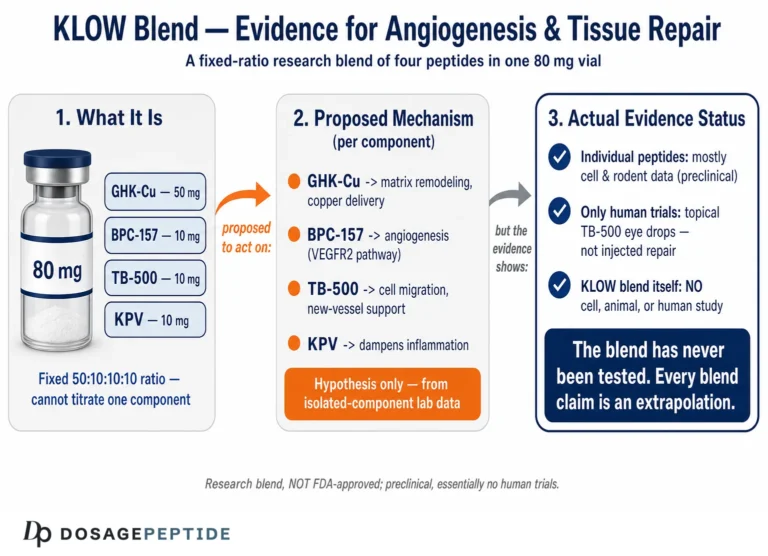
KLOW Peptide Blend: What’s In It, What It Does, and What the Evidence Shows
KLOW is a fixed-ratio research blend that packs four separate peptides into a single 80 mg vial: GHK-Cu (50 mg), BPC-157 (10 mg), TB-500 (10 mg),…
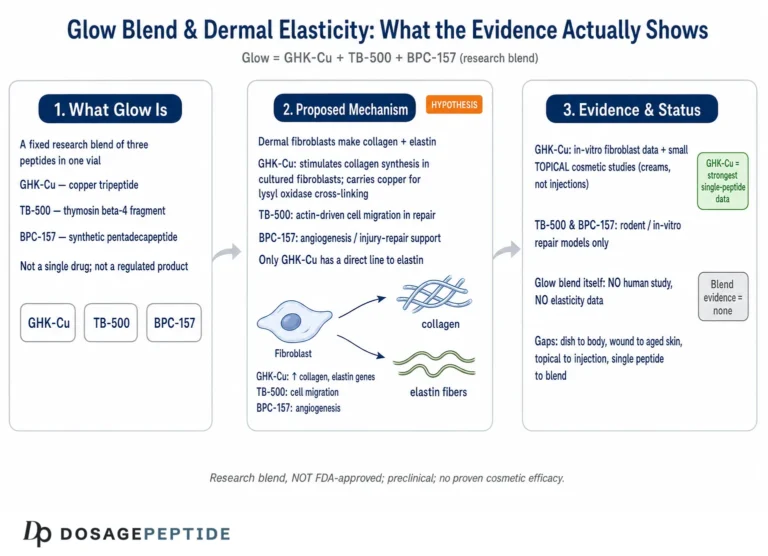
Does Glow Peptide Stimulate Fibroblast Activity to Enhance Dermal Elasticity?
The question in this article’s title — does Glow peptide stimulate fibroblast activity to enhance dermal elasticity? — reads like a settled…

How Does Melanotan II Influence Erectile Performance Mechanistically?
The question of how Melanotan II might influence erectile performance is, on its surface, a question about a mechanism. But it is…

What Mechanisms Link NAD+ to DNA Repair and Cancer Prevention?
Short answer: NAD+ is genuinely required for DNA repair, but no study shows that raising it prevents cancer in people. The mechanism…

Can BPC-157 Actually Help Heal Nerves and Boost Brain Health?
Short answer: not proven, and not close. As of 2026 BPC-157 is not an approved therapy for any neurological condition anywhere in…

GHK-Cu for Hair Growth: What It Does to Follicle Stem Cells, and What to Expect
GHK-Cu — the copper complex of the tripeptide glycyl-L-histidyl-L-lysine — is one of the most heavily marketed “hair growth” peptides on the…

Is TB-500 a Promising Therapy for Chronic Inflammatory Conditions?
Search the phrase “TB-500 for inflammation” and you will encounter confident language: a peptide that calms the immune system, resolves chronic swelling,…
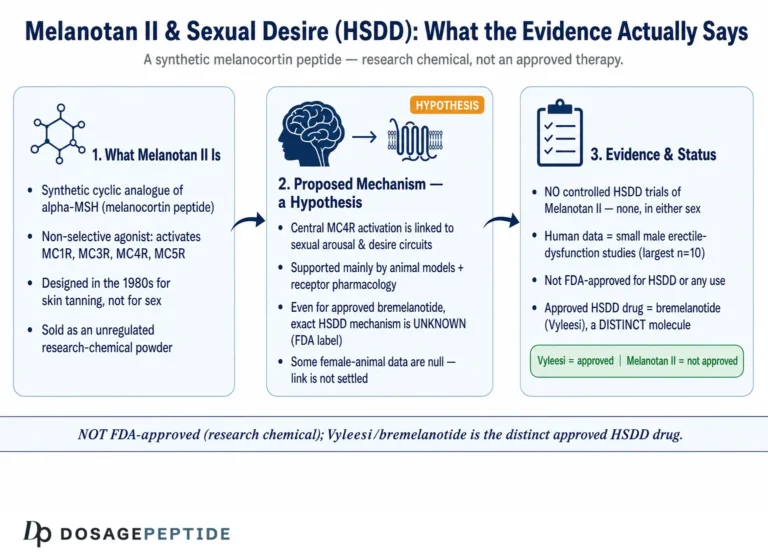
Melanotan II and Low Sexual Desire: Evidence and Risks (2026)
Melanotan II is not approved anywhere, for any indication, and it has never completed a controlled trial for hypoactive sexual desire disorder…