
Skin, Wound & Regeneration

NAD+ and Parkinson’s: What the Trials Found (2026)
No approved treatment raises NAD+ to slow, stop, or reverse Parkinson’s disease. The completed randomized trials of NAD+ precursors in Parkinson’s were…

GHK-Cu After Surgery: Does It Help Recovery? (2026)
GHK-Cu has never been tested as a therapy for organ or tissue transplantation in humans, and it is not approved for any…

BPC-157 for Joint Pain: What the Evidence Shows (2026)
BPC-157 is not an established treatment for joint pain or inflammation, and no regulator has approved it for any indication. Nearly all…

GHK-Cu for Chronic Wounds: What the Evidence Shows (2026)
GHK-Cu is not an approved treatment for chronic wounds anywhere, and the human evidence is thin. Almost everything known about it comes…
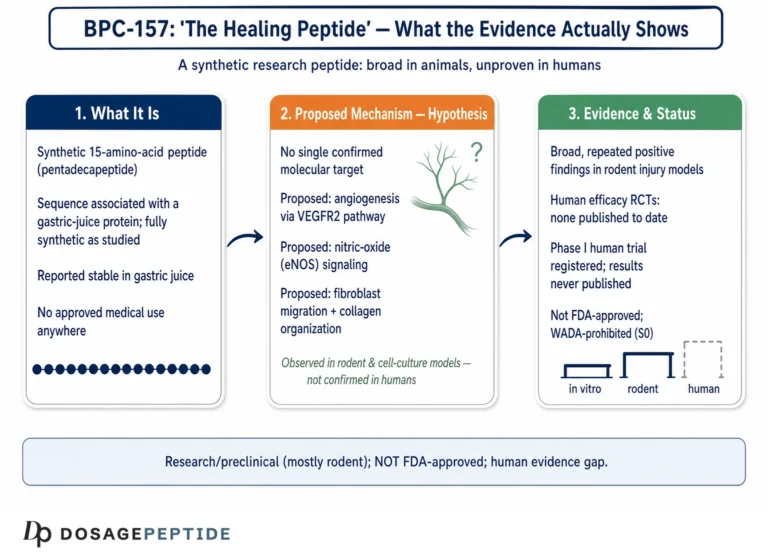
What is BPC-157? The Healing Peptide Explained
Few compounds in the peptide-research world carry as much popular momentum as BPC-157, and few carry a nickname as loaded as “the…
What is KPV? The Anti-Inflammatory Peptide for Gut, Skin, and Beyond
KPV is a three-amino-acid fragment of the hormone alpha-MSH — lysine–proline–valine — and it is studied for one thing above all: calming…
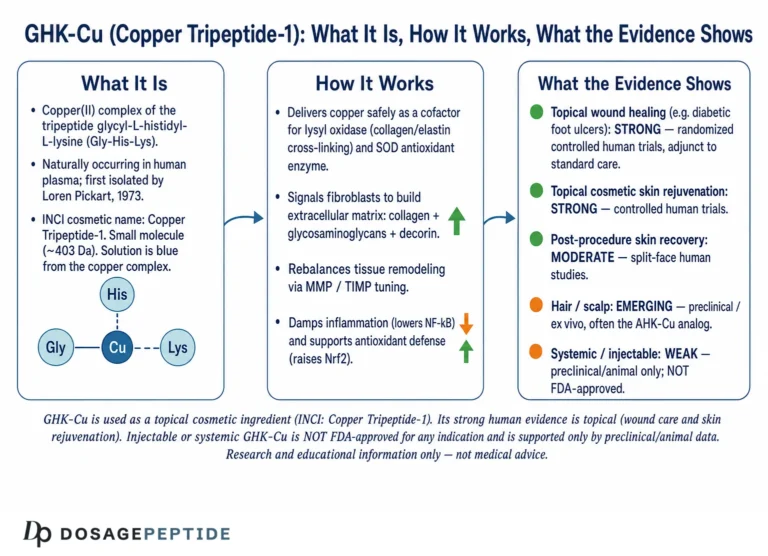
What is GHK‑Cu? Mechanism, Benefits, Risks & How to Use
GHK-Cu is a three-amino-acid peptide — glycyl-L-histidyl-L-lysine — bound to copper, first isolated from human plasma in 1973. It works as both…