No, the published evidence does not show that Melanotan II prevents skin cancer — and the human case literature points the other way. Multiple reports describe new and changing moles, dysplastic naevi, and melanoma appearing during or shortly after Melanotan II use, sometimes arising inside a mole the person already had.34 Causation is not established in those cases, but the signal runs opposite to the protective effect the compound was originally designed to produce.
The confusion is understandable, because the origin story is real. In the mid-1980s, chemists at the University of Arizona built a synthetic analogue of the body’s tanning hormone precisely because they hypothesised that inducing protective pigment without ultraviolet exposure might reduce sun-driven skin cancers.1 Melanotan II came out of that programme. Four decades later the hypothesis is still a hypothesis, while the molecule itself has drifted out of any clinical pathway and into an unregulated grey market for cosmetic tanning.2
Throughout, Melanotan II is discussed strictly as an unapproved research chemical. It is not a medicine, not a supplement, and not a cosmetic that any major regulator has cleared for human use. The closest thing to a validated melanocortin therapy—afamelanotide, a related but distinct MC1R agonist—is used as a comparator here only to show what a rigorous evidence base looks like, and how far Melanotan II sits from it. Nothing below is medical advice or a protocol for use.
What Melanotan II Is and Where It Came From
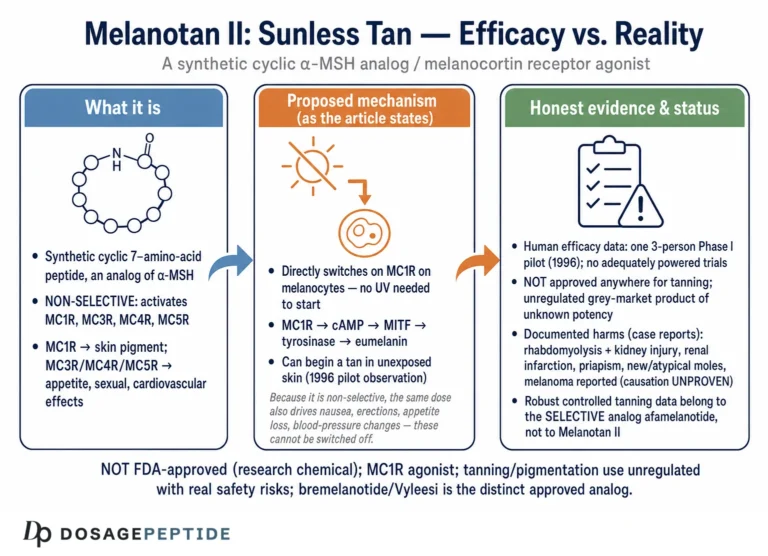
Melanotan II (often written MT-II or MT2) is a synthetic cyclic heptapeptide—seven amino acids joined into a closed ring—engineered as an analogue of alpha-melanocyte-stimulating hormone (α-MSH), one of the peptides the body naturally uses to regulate skin pigmentation.1 The cyclization is the key design feature. Native α-MSH is a linear 13-amino-acid peptide that the body degrades very quickly, which makes it useless as a sustained pigmentary agent. By building a lactam bridge that locks the pharmacophore into a rigid ring, the Arizona chemists produced a molecule that resists enzymatic breakdown, binds melanocortin receptors with much higher potency, and remains active far longer than the parent hormone.1
The intellectual roots go back to the laboratories of Mac Hadley and Victor Hruby at the University of Arizona. Their reasoning was straightforward and, at the time, scientifically reasonable: epidemiology had long shown that darker constitutive pigmentation is associated with lower rates of ultraviolet-driven skin cancer, and that people who tan readily tend to burn less. If a peptide could switch on the pigmentary system directly—producing a “tan” through receptor signaling rather than through the DNA-damaging UV exposure that normally triggers it—then in principle one might obtain the photoprotective benefit of melanin while sidestepping the mutagenic cost of the sunlight that usually generates it. Early preformulation and animal work explicitly described the molecule as “a potential skin cancer chemopreventive peptide,” and that language appears in the peer-reviewed record from the early 1990s.1
It is essential to hold two facts side by side here. First, that chemopreventive framing was a research aspiration, tested mainly in preformulation chemistry, cell systems, and animal models—not a demonstrated clinical outcome. Second, the developmental lineage soon split. The Arizona program’s more receptor-selective, linear analogue—originally “Melanotan I” and now known as afamelanotide—was carried forward through formal pharmaceutical development and eventually earned a narrow regulatory approval for a rare photodermatosis (discussed later). Melanotan II, the more potent but far less selective cyclic peptide, was not developed into an approved drug. Its intense pigmentary effect, combined with off-target actions on appetite and sexual function, made it commercially attractive to the unregulated market long before any safety or efficacy questions were resolved.2,3
What exists today, therefore, is a molecule with a legitimate scientific pedigree that has been almost entirely detached from legitimate science in practice. Melanotan II is manufactured by peptide suppliers of highly variable quality, sold as a lyophilized powder labeled “for research use only,” and reconstituted and injected by consumers seeking a tan, appetite suppression, or libido effects.2 Regulators in the United States, United Kingdom, European Union, and Australia have repeatedly stated that it is not approved and should not be used, and that products sold under its name carry contamination and dosing risks because nobody is verifying what is actually in the vial.5,6 For readers interested in how the compound is described in a research-education context, dosagepeptide.com maintains a Melanotan II research overview that repeatedly foregrounds its unapproved status. The compound’s biology is real; its clinical validation is not.
The Molecular Mechanism: Melanocortin Receptors and Pigmentation
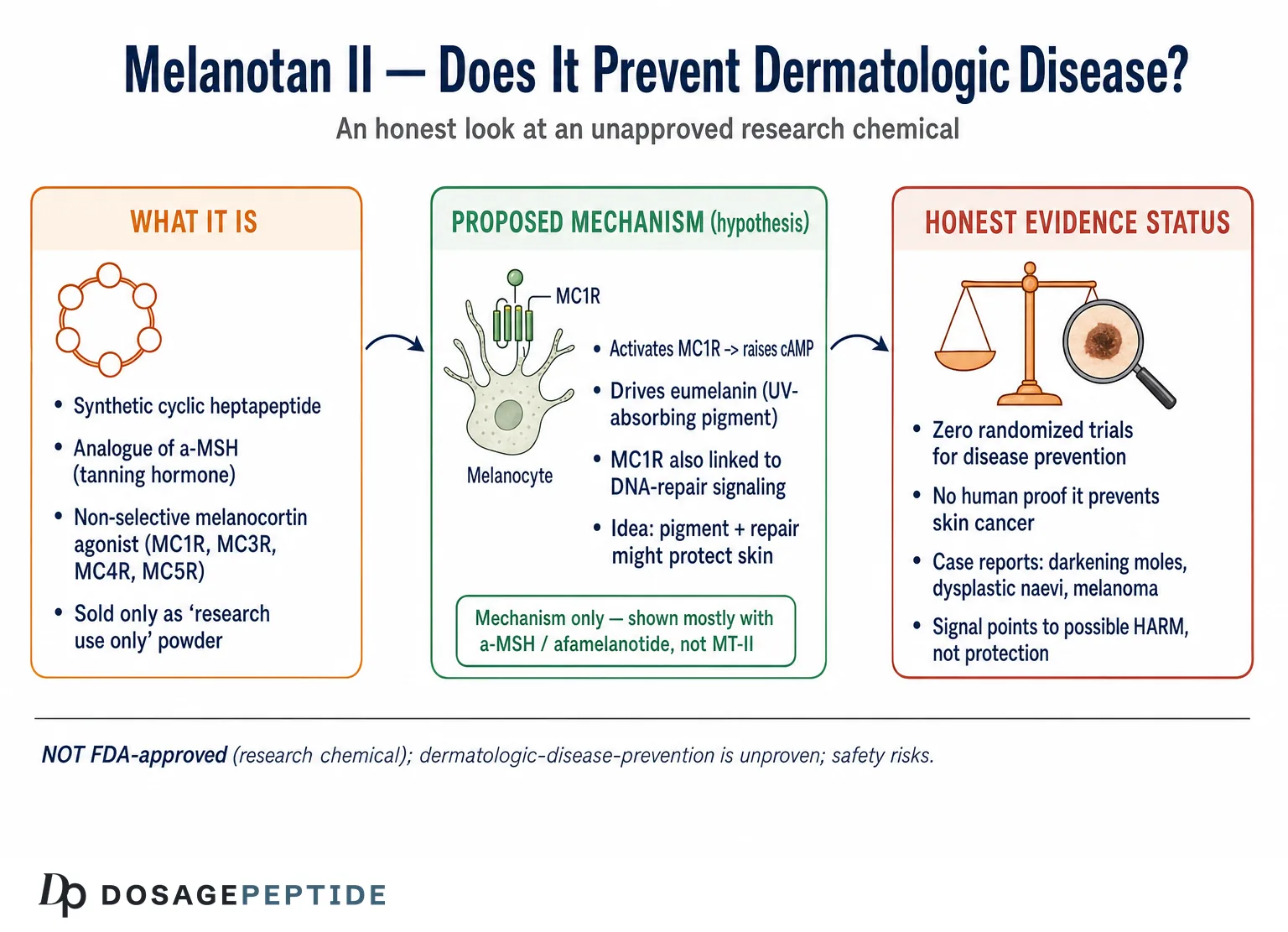
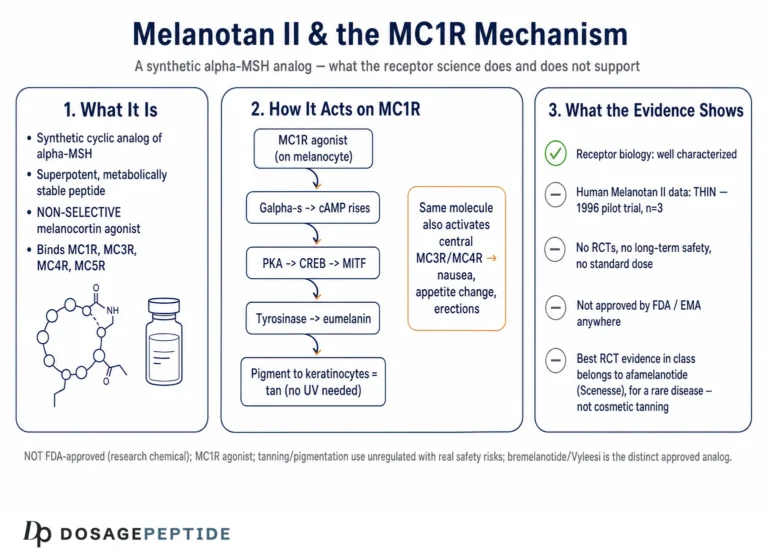
To understand why anyone ever thought Melanotan II might prevent skin disease—and why that idea is more fragile than it first appears—you have to start with the melanocortin receptor family. There are five of these G-protein-coupled receptors, designated MC1R through MC5R, distributed across different tissues. Native α-MSH acts on several of them. Melanotan II is a broad, non-selective agonist: it activates MC1R, MC3R, MC4R, and MC5R.3,7 That promiscuity is the single most important fact about its pharmacology, because it explains both the pigmentary effect people seek and the diffuse off-target effects (nausea, flushing, appetite loss, spontaneous erections) they do not.
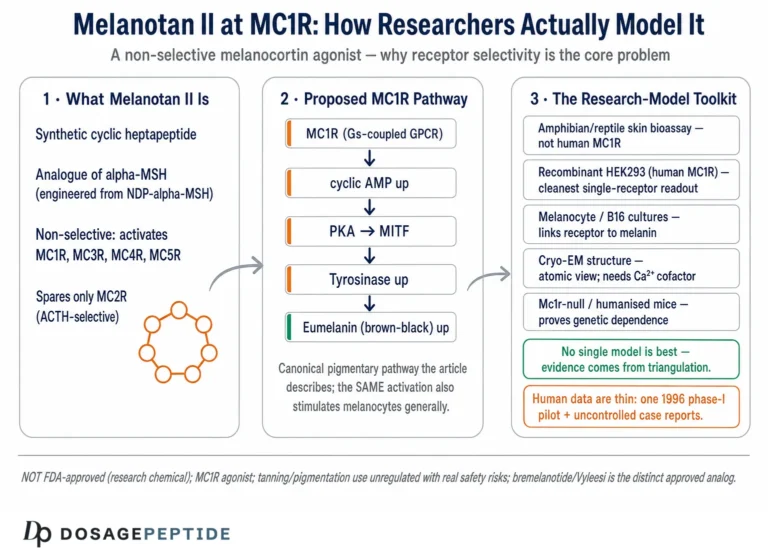
The pigmentary action runs through MC1R on the surface of melanocytes in the basal layer of the epidermis. When Melanotan II binds MC1R, it activates the enzyme adenylate cyclase, which raises intracellular cyclic AMP (cAMP). Elevated cAMP activates protein kinase A (PKA), which phosphorylates the transcription factor CREB, which in turn drives expression of microphthalmia-associated transcription factor (MITF)—the master regulator of the melanocyte.7,8 MITF switches on the genes for tyrosinase and the other enzymes of melanin synthesis. Crucially, strong MC1R signaling biases production toward eumelanin, the brown-black pigment that absorbs and scatters UV effectively, and away from pheomelanin, the red-yellow pigment that is a poor sunscreen and can even generate reactive oxygen species under UV.8 The visible result is skin darkening; the theoretical result is a photoprotective pigment shield.
| Receptor | Main tissue / role | Relevance to Melanotan II effects |
|---|---|---|
| MC1R | Melanocytes; pigmentation, DNA-repair signaling | Drives eumelanin synthesis (the intended tanning effect) |
| MC2R | Adrenal cortex (ACTH receptor) | Not meaningfully targeted; ACTH-specific |
| MC3R | Hypothalamus; energy balance | Off-target; contributes to metabolic/appetite effects |
| MC4R | CNS; appetite, sexual function | Off-target; appetite suppression, erectile effects, nausea |
| MC5R | Exocrine glands; sebum | Off-target; possible effects on sebaceous secretion |
Here is where the mechanism becomes double-edged. MC1R signaling does not distinguish between a normal melanocyte and one sitting inside a pre-existing mole, dysplastic naevus, or a cell already carrying an early oncogenic mutation. When you flood the system with a potent, long-acting agonist, you stimulate proliferation, dendricity, and pigment production across the whole melanocytic population indiscriminately.3,4 That is precisely why dermatologists worry: the same cAMP-MITF drive that darkens ordinary skin also darkens and activates atypical naevi. A pigmentary “protective” signal delivered to the wrong cell is not protective at all—it is a growth and pigment stimulus applied to lesions that may already be on a pathway toward malignancy.
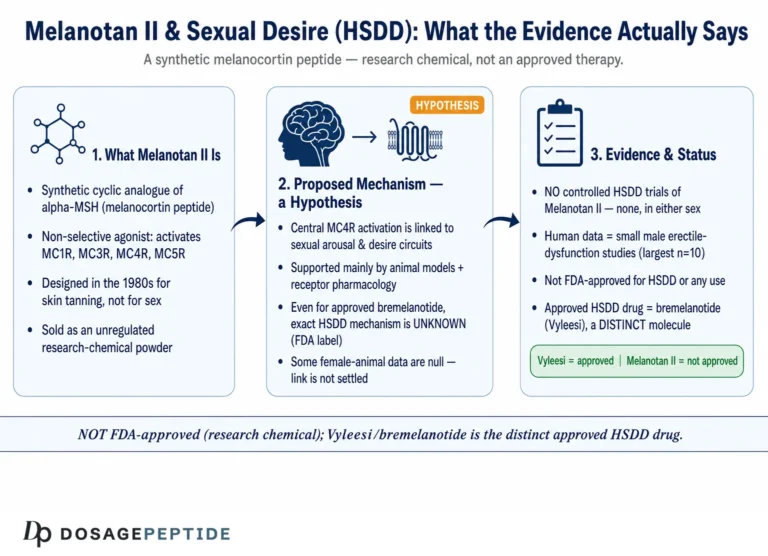
The off-target receptor activity is not merely a nuisance. MC4R stimulation in the central nervous system accounts for the near-universal nausea and flushing, the appetite suppression, and the priapism reported with Melanotan II.2,7 Interestingly, this same MC4R activity is the basis of a separate approved drug, bremelanotide (PT-141), which is a metabolite-derived melanocortin agonist licensed for a sexual-desire indication—a useful reminder that “melanocortin agonist” is a broad category with very different molecules and very different evidence bases. Readers can compare the pharmacology in the PT-141 research overview. The point for this article is that Melanotan II’s mechanism is a blunt instrument: it activates a receptor system whose pigmentary arm could be photoprotective, but does so without any of the targeting, dosing precision, or safety framework that would be required to turn a mechanism into a disease-prevention strategy.
The DNA-Repair and Photoprotection Hypothesis
The scientifically interesting core of the “disease prevention” question is not the tan you can see; it is the biology of the MC1R pathway beyond pigment. Over the past fifteen years, laboratory work has built a genuinely compelling case that MC1R signaling participates directly in the repair of UV-induced DNA damage—independent of melanin—and that is the mechanism that would have to be operative for any melanocortin agonist to plausibly lower skin-cancer risk at the cellular level.8,9
The evidence runs roughly as follows. Ultraviolet light damages DNA primarily by creating cyclobutane pyrimidine dimers and other photolesions, which the cell removes through nucleotide excision repair (NER). Multiple groups have shown that α-MSH/MC1R signaling, acting through cAMP and PKA, enhances NER capacity in melanocytes and keratinocytes. Mechanistically, MC1R activation promotes PKA-mediated phosphorylation of the DNA-damage sensor kinase ATR (notably at serine 435), which facilitates recruitment of the repair protein XPA to sites of UV damage and accelerates clearance of photolesions.9,10 α-MSH has also been shown to enhance UV-induced DNA repair in keratinocytes through a xeroderma-pigmentosum-group-A-dependent mechanism, and to reduce oxidative DNA damage and apoptosis after UV exposure.10 The tumor-suppressor protein p53 sits upstream of this whole axis: UV damage activates p53, which drives POMC/α-MSH expression, which then feeds back to boost both pigmentation and repair. In this model, MC1R is not just a pigment switch but a node in the skin’s genome-protection network.8,9
The strongest human-genetic support for the hypothesis is inverse. People carrying loss-of-function MC1R variants—the “red-hair-color” alleles—have not only fair, poorly tanning skin but also demonstrably impaired nucleotide excision repair and oxidative-lesion repair in their melanocytes, and they carry substantially elevated melanoma risk.8 Restoring or mimicking MC1R signaling in such cells (for example, with melanocortin peptides in culture) can partially rescue the repair deficit. That is the cleanest mechanistic argument that MC1R agonism could, in principle, be photoprotective at the DNA level rather than merely cosmetic.
But three cautions must travel with this hypothesis, and they are the reason it does not translate into an endorsement of Melanotan II. First, essentially all of this repair biology has been established with native α-MSH, with afamelanotide, or with genetic models—not with Melanotan II specifically. It is an assumption, not a demonstration, that a non-selective cyclic heptapeptide reproduces the same beneficial ATR/XPA signaling in intact human skin at the doses people actually inject.3,8 Second, enhanced repair capacity in a cell culture is a surrogate several long steps removed from a reduction in actual tumors in actual people over years; no melanocortin agonist has ever been shown in a controlled human trial to lower incidence of melanoma, squamous cell carcinoma, or basal cell carcinoma. Third, and most importantly, the repair-enhancement model applies to normal cells responding appropriately. It says nothing reassuring about what happens when a potent agonist is delivered to melanocytes that have already accumulated driver mutations—and, as the safety section details, that is exactly the population in which Melanotan II case reports cluster. A pathway can be protective in a healthy melanocyte and permissive in a transformed one. The DNA-repair hypothesis is real and worth researching; it is not evidence that Melanotan II prevents disease.
What the Actual Evidence Shows (An Honest Reading of the Level)
Stripped to its essentials, the evidence picture for Melanotan II and dermatologic-disease prevention is stark: there are zero randomized controlled trials, and zero prospective cohort studies, testing whether Melanotan II prevents skin cancer or any other dermatologic disease in humans. None. The chemopreventive rationale that launched the molecule was never carried into the pivotal clinical trials that would be required to answer the title’s question.1,3 Every affirmative claim you may encounter online that Melanotan II “protects against sun damage” or “reduces skin cancer risk” is an extrapolation from mechanism or from a different molecule—never a citation to a trial of Melanotan II showing a disease-outcome benefit.
What does exist falls into three tiers, and it is worth being precise about each. The first tier is preclinical and preformulation work from the original development era—chemistry, receptor-binding assays, animal pigmentation and tumor models—which established that the peptide is a potent melanocortin agonist and framed it as a chemoprevention candidate.1 This is hypothesis-generating science, not efficacy evidence. The second tier is mechanistic cell and molecular biology of the MC1R-repair axis, described in the previous section, most of it done with α-MSH or afamelanotide rather than Melanotan II.8,9,10 The third tier—the only substantial human clinical data anywhere in the melanocortin space—belongs to afamelanotide, a related but distinct and more MC1R-selective drug, and even that data is about symptom prevention in a rare light-sensitivity disorder, not skin-cancer prevention.11,12
| Evidence type | Available for Melanotan II? | What it can and cannot support |
|---|---|---|
| In-vitro receptor/pigment assays | Yes | Confirms potent melanocortin agonism; not a clinical outcome |
| Animal chemoprevention models | Limited, historical | Hypothesis-generating only; does not predict human benefit |
| MC1R DNA-repair mechanism | Yes, but mostly with α-MSH/afamelanotide | Plausible rationale; not proof MT-II repairs DNA in vivo |
| Randomized trial for skin-cancer prevention | No | The evidence that would answer the title does not exist |
| Prospective safety cohort | No | Safety data are case reports and pharmacovigilance only |
| Case reports of harm | Yes, multiple | Signal of possible melanocytic risk, not proof of causation |
Set against the absence of benefit data is a body of evidence that points the other way. The human literature specific to Melanotan II is dominated not by prevention signals but by reports of dermatologic harm: rapid darkening and enlargement of existing moles, eruptive new naevi including dysplastic ones, and—most seriously—several published case reports of melanoma arising during or after use.3,4,13,14 These are case reports, which cannot by themselves prove that the peptide causes melanoma; they are subject to reporting bias and confounding (many users also use sunbeds and have high-risk phenotypes). But they are the closest thing to human outcome data that exists for this molecule, and they run in the direction of concern, not reassurance.
It is worth pausing on why the “prevention” framing is so seductive despite this evidence vacuum, because the psychology matters for how the compound is marketed. The chain of reasoning sounds airtight in isolation: melanin protects against UV; Melanotan II makes more melanin; therefore Melanotan II protects against UV-driven disease. Each link is superficially true, yet the conclusion does not follow, because the syllogism ignores dose, cell context, off-target effects, and—above all—the difference between a surrogate and an outcome. A tan produced by a non-selective agonist is not equivalent to constitutive dark pigmentation acquired over evolutionary time, and it does nothing to remove the underlying UV exposure if users treat their new color as license to sunbathe or use tanning beds more, as many case reports suggest they do.3,13 A “protective” tan that encourages more UV exposure could plausibly increase net risk rather than lower it. Readers evaluating any melanocortin compound in a research-education context—whether via the Melanotan II research page or the broader catalog—should treat the pigment-equals-protection shortcut as the single most misleading claim in this space.
An intellectually honest summary is therefore uncomfortable but clear. If you weigh the evidence the way you would for any candidate intervention—asking “what controlled human data shows this prevents disease?”—the answer for Melanotan II is nothing. The mechanistic story is genuinely interesting and is the reason the melanocortin system is still studied for photoprotection. But an interesting mechanism plus a founding aspiration plus a portfolio of harm reports does not equal a preventive therapy. Anyone presenting Melanotan II as protective against skin disease is inverting the actual balance of evidence.
Comparisons: Melanotan II, Afamelanotide, and Bremelanotide
Because the internet routinely blurs these molecules together, disentangling them is one of the most useful things this article can do. All three are melanocortin agonists derived from the same α-MSH scaffold, but they differ dramatically in selectivity, development history, evidence base, and legal status—and only one of them has ever earned an approval for anything.
| Feature | Melanotan II (MT-II) | Afamelanotide (Scenesse) | Bremelanotide (PT-141, Vyleesi) |
|---|---|---|---|
| Structure | Cyclic heptapeptide | Linear 13-aa α-MSH analogue | Cyclic MT-II metabolite (deamidated) |
| Receptor profile | Non-selective (MC1/3/4/5R) | More MC1R-selective | MC1R/MC4R, favors MC4R action |
| Approved indication | None | Prevent phototoxicity in EPP | Hypoactive sexual desire disorder (women) |
| Delivery in approved use | N/A (unapproved) | Controlled subcutaneous implant, in-clinic | Prefilled subcutaneous auto-injector |
| Human trial evidence | None for disease prevention | Randomized, placebo-controlled (NEJM) | Randomized phase 3 program |
| Regulatory stance | Warned against; illegal to sell for use | FDA-approved 2019; EMA-approved | FDA-approved 2019 |
Afamelanotide is the instructive comparator for the disease-prevention question, because it is the melanocortin agonist that actually went through rigorous development. Two multicenter, randomized, double-blind, placebo-controlled trials—74 patients in the European Union and 94 in the United States—tested 16 mg subcutaneous implants in adults with erythropoietic protoporphyria (EPP), a rare inherited disorder in which sunlight causes severe, disabling phototoxic pain. Those trials were published in the New England Journal of Medicine in 2015 and showed that afamelanotide increased pain-free light exposure and shortened recovery from phototoxic reactions.11 On that basis, the FDA approved afamelanotide (Scenesse) in October 2019, and it is also authorized in the EU.12 Note carefully what this approval is and is not: it is prevention of a light-triggered symptom in a rare metabolic disease, delivered as a controlled clinical implant. It is not an approval for skin-cancer prevention, and it is not an endorsement of Melanotan II, which is a different, less selective, unapproved molecule.11,12
The afamelanotide story also demolishes a common rhetorical move—”melanocortin peptides are FDA-approved, so Melanotan II is basically legitimate.” That inference fails on every axis. The approved molecule is chemically distinct and more receptor-selective; it went through controlled trials Melanotan II never underwent; it is manufactured to pharmaceutical standards and administered by clinicians rather than reconstituted at a kitchen table; and its approved use is a narrow orphan indication, not tanning or cancer prevention. If anything, the contrast underlines how much evidence and quality control separate a real melanocortin therapy from a research chemical.
Bremelanotide (PT-141) completes the picture. It is literally a metabolite of Melanotan II—the deamidated, ring-opened breakdown product—and it was developed specifically for its central MC4R activity on sexual desire, gaining FDA approval in 2019 for hypoactive sexual desire disorder in premenopausal women. It has essentially no role as a tanning or photoprotective agent, and its existence explains why Melanotan II users frequently report sexual side effects: they are dosing a compound whose own metabolite is a licensed libido drug. Some users combine the two, a practice discussed at dosagepeptide.com’s peptide stacks overview, but combining an unapproved compound with anything compounds the underlying safety and legality problems rather than resolving them. The broad peptide dosage index catalogs how these melanocortin agents are characterized in research-education terms. The bottom line across all three molecules: shared ancestry does not mean shared evidence, and Melanotan II is the one member of this family with no approved use and no disease-prevention data.
Research Models and Methodology
Understanding how melanocortin photoprotection is studied clarifies why the Melanotan II literature is so thin on outcomes. The field uses a layered set of models, each answering a different question, and Melanotan II appears mostly at the earliest, least translatable layers.
At the most reductionist level are receptor-binding and reporter assays: cells engineered to express a specific melanocortin receptor are exposed to the peptide, and researchers measure cAMP generation or downstream reporter activity to quantify potency and receptor selectivity. This is where Melanotan II’s profile as a potent, non-selective MC1/3/4/5R agonist was established.7 These assays are excellent for pharmacology but say nothing about disease. One level up are primary human melanocyte and keratinocyte cultures, in which investigators can expose cells to UV, add a melanocortin agonist, and measure endpoints such as eumelanin content, cyclobutane-pyrimidine-dimer clearance, ATR/XPA activation, oxidative damage, and apoptosis. This is the layer that generated most of the DNA-repair evidence—but, importantly, that work predominantly used α-MSH or afamelanotide, and even where a benefit is seen, the endpoint is a molecular surrogate (repair rate) rather than a tumor.9,10
Three-dimensional skin equivalents and ex vivo human skin explants add architectural realism, letting researchers observe pigment distribution and UV responses in tissue-like context. Beyond that sit animal models—historically the pigmentary and chemoprevention work that framed Melanotan II as a candidate, and more recently genetic mouse models (for example, MC1R-deficient strains) used to dissect how receptor signaling modulates melanoma susceptibility.1,8 Animal chemoprevention data are notoriously poor predictors of human cancer outcomes, which is one reason a positive signal in a 1990s rodent model never justified clinical prevention claims.
The methodological gold standard—the randomized, double-blind, placebo-controlled trial with a clinical endpoint—has been applied to afamelanotide but never to Melanotan II. The afamelanotide EPP program is a good template for what rigor looks like: predefined co-primary endpoints (hours of pain-free sun exposure), objective and patient-reported measures, placebo control, multi-site enrollment, and regulatory scrutiny of the full dataset.11 Nothing remotely comparable exists for Melanotan II. Instead, the human-level “methodology” for Melanotan II is essentially pharmacovigilance and case reporting: dermatologists documenting patients who developed new or changed pigmented lesions, and regulators aggregating adverse-event reports.3,4,5,6 That design can raise a safety signal but cannot establish efficacy and cannot, on its own, prove causation of harm.
This methodological gap is not a minor technicality; it is the whole story. Preventing a disease is one of the hardest claims to substantiate in all of medicine, because it requires following large numbers of people for years and showing fewer events in the treated group than in controls. Surrogate endpoints—more melanin, faster DNA repair, better assay numbers—have repeatedly failed to translate into real prevention for other interventions, sometimes even reversing (beta-carotene and lung cancer being the classic cautionary example). For Melanotan II, we do not even have the surrogate data in humans, let alone the outcome data. Any honest methodological appraisal has to conclude that the compound sits at the pre-clinical and case-report ends of the evidence spectrum, with an unbridged chasm between it and the standard required to claim disease prevention.
Melanotan II and Melanoma: What the Case Reports Show
The safety literature is where the “prevention” premise most sharply collides with reality, because the compound proposed as skin-protective is repeatedly associated with the very lesions it is imagined to guard against. Melanotan II’s adverse-effect profile spans from near-universal nuisance effects to rare but grave events, and—uniquely for this article—includes a cluster of dermatologic reports that are directly relevant to skin cancer.2,3
The common, expected effects follow directly from broad melanocortin agonism. Most users experience nausea, facial flushing, and reduced appetite, driven largely by central MC3R/MC4R activation; spontaneous penile erections and, in some men, priapism; and darkening not only of skin generally but of specific structures such as freckles, existing moles, the areolae, and the face.2,7 Injection-site reactions are common. Because the market supply is unregulated, an additional and unquantifiable hazard is product contamination and dose uncertainty: vials sold as Melanotan II are not verified for identity, purity, sterility, or peptide content, so users cannot know what they are actually injecting.5,6 Rare but serious systemic events reported in the literature include rhabdomyolysis and renal infarction, underscoring that the compound’s reach extends well beyond the skin.2
| Category | Reported effects | Frequency / severity |
|---|---|---|
| Common, mechanism-linked | Nausea, flushing, appetite loss, spontaneous erections, generalized skin darkening | Common; usually mild-moderate |
| Pigmentary / dermatologic | Darkening & enlargement of existing moles, new/eruptive naevi, dysplastic naevi | Repeatedly reported; clinically concerning |
| Oncologic (serious) | Melanoma and melanoma in-situ arising during/after use | Rare in reports; causation unproven but signal present |
| Rare systemic | Rhabdomyolysis, renal infarction, priapism | Rare; potentially severe |
| Supply-related | Contamination, wrong/absent peptide, non-sterility, dose error | Unquantifiable; inherent to unregulated market |
The dermatologic reports deserve the most attention because they bear directly on the disease question. Multiple published cases describe patients developing eruptive melanocytic and dysplastic naevi after starting melanotan injections, and several describe melanoma or melanoma in-situ emerging in temporal association with use—sometimes arising within a pre-existing mole.3,4,13,14 A particularly instructive case documented dramatic changes in melanocytic lesions in a teenager with familial atypical multiple mole melanoma (FAMMM) syndrome who used both melanotan injections and a sunbed, illustrating how the peptide’s indiscriminate melanocyte stimulation may be especially hazardous in someone already predisposed.13
The mechanistic worry is coherent and worth stating plainly: Melanotan II activates all melanocytes, including those within atypical naevi and those that may already carry early transforming mutations. In such cells, a potent proliferative and pigmentary drive is the opposite of protective—it is a growth stimulus applied to lesions that need scrutiny, not stimulation.3,4 There is a second, more subtle harm: because the peptide darkens and changes moles, it can obscure or mimic the early warning signs that dermatologists rely on for melanoma detection (a changing, darkening, enlarging lesion), potentially delaying diagnosis. A tool that both stimulates melanocytes and camouflages the clinical signals of malignancy is difficult to reconcile with any protective role.
Two honest qualifications belong here. First, case reports cannot establish causation; many melanotan users are fair-skinned, sunbed-using, high-naevus-count individuals whose baseline melanoma risk is already elevated, so temporal association is not proof.3 Second, precisely because no controlled safety study exists, the true incidence of these events is unknown—we see the reports that reach the literature, not a denominator. But neither qualification supports use. The appropriate reading of an uncharacterized compound with a plausible harm mechanism and a recurring pattern of concerning case reports is caution, not reassurance. On the specific question this article asks, the safety data do not merely fail to show prevention—they actively raise the possibility of net dermatologic harm.
Handling and Reconstitution in a Research Context
Because Melanotan II circulates as a lyophilized research powder, questions about reconstitution and handling arise constantly. This section describes those practices only as they are documented in a laboratory-research context and to explain the associated risks—not as instructions for human use. Nothing here should be read as endorsing self-administration of an unapproved compound; the entire premise of legitimate handling is that the material stays in a controlled research setting.
In research handling, Melanotan II is supplied as a white lyophilized powder, typically in vials nominally labeled with a mass such as 10 mg, and stored desiccated and frozen or refrigerated and protected from light until use.2 Reconstitution in a research context uses bacteriostatic water (water containing 0.9% benzyl alcohol as a preservative) added slowly down the vial wall rather than injected forcefully onto the powder, because melanocortin peptides are sensitive to shear and foaming. The vial is swirled gently, not shaken. The resulting concentration is a simple ratio of peptide mass to solvent volume—for instance, adding a given volume of solvent to a 10 mg vial yields a stock whose per-unit-volume content is used to compute the volume corresponding to any nominal microgram amount for an experiment. dosagepeptide.com’s research pages describe these arithmetic relationships in an educational format, but the numbers are meaningful only in a laboratory context, not as a green light for injection.
The stability and sterility considerations are the substantive part. Reconstituted peptide is far less stable than the dry powder and is generally regarded as usable for only a short window—on the order of days to a couple of weeks—when kept refrigerated and shielded from light; freeze-thaw cycling and warmth accelerate degradation.2 The preservative in bacteriostatic water limits, but does not guarantee against, microbial growth, and every needle entry into a multi-use vial is a contamination opportunity. In a real laboratory these steps happen under aseptic technique with characterized materials; in the grey-market reality they typically do not, which compounds the earlier point about unverified product. There is simply no way for an end user to confirm that the vial contains what the label claims, that it is sterile, or that it is free of endotoxin or process contaminants.5,6
This is the crux of why “handling” cannot be separated from the safety verdict. Even setting aside the biological concerns about melanocyte stimulation, the practical reality of an unregulated injectable—unknown identity, unknown purity, unknown sterility, unknown dose, self-administered outside any clinical oversight—is itself a substantial and independent hazard.5,6 A compound that would need pharmaceutical-grade manufacturing, sterility assurance, and clinical supervision to be handled responsibly is, in practice, handled with none of those safeguards. That gap between how the material should be handled in research and how it is actually handled in the consumer market is, by itself, a reason the research-only framing must be taken literally.
Limitations and the Human-Evidence Gap
It is worth consolidating, in one place, exactly how large the gap is between what would be needed to answer this article’s title affirmatively and what actually exists. The limitations are not incidental caveats; they are the defining feature of the evidence base.
The first and largest limitation is the absence of any controlled human efficacy data. To claim that an intervention prevents a dermatologic disease—melanoma, keratinocyte carcinomas, actinic damage, or anything else—you need prospective, controlled human studies showing fewer disease events in treated versus untreated groups over a meaningful time horizon. For Melanotan II, this literature is empty.1,3 The compound skipped straight from preclinical chemoprevention framing into unregulated cosmetic use, bypassing the entire clinical-development pathway that generates prevention evidence. No amount of mechanistic plausibility substitutes for that missing tier.
The second limitation is the surrogate-endpoint problem. Even the encouraging mechanistic findings—enhanced nucleotide excision repair, ATR/XPA activation, a shift toward photoprotective eumelanin—are surrogate markers, and mostly demonstrated with α-MSH or afamelanotide rather than Melanotan II.8,9,10 The history of cancer prevention is littered with surrogates that looked protective and then failed, or reversed, in outcome trials. Extrapolating from “improves a DNA-repair assay in cultured cells” to “prevents cancer in people” is precisely the leap that responsible science refuses to make without confirmation.
The third limitation is that the human data we do have point toward harm, not benefit. The case-report literature—darkening and enlargement of naevi, eruptive dysplastic moles, melanoma in temporal association with use—is observational and cannot prove causation, but it is uncontradicted by any offsetting body of human benefit data.3,4,13,14 When the only human-outcome signals for a compound are adverse, and the proposed benefit rests entirely on unconfirmed mechanism, the honest posture is skepticism bordering on caution against use.
The fourth limitation is confounding and phenotype. Melanotan II users disproportionately have fair, sun-sensitive skin, high mole counts, and concurrent UV exposure from sunbeds or sun-seeking behavior—the exact high-risk profile in which melanoma is more likely regardless of any peptide.3 This makes both directions of inference treacherous: it inflates the apparent association with melanoma in case reports, and it would also confound any naive attempt to credit the peptide with protection. Only a randomized design could disentangle the peptide’s effect from the population using it, and no such design has been run.
The fifth limitation is product heterogeneity. Because there is no regulated supply, “Melanotan II” is not a standardized entity. Different sources deliver different actual contents, purities, and contaminants, which means even the existing case reports may not describe a single consistent exposure.5,6 This undermines any attempt to generalize either safety or efficacy conclusions from one batch or one user to another. Taken together, these five limitations do not merely weaken the prevention claim—they leave it with no supporting foundation at all, while a coherent mechanism-plus-case-report argument for potential harm remains standing. The intellectually defensible conclusion is that the question is open at the level of basic science and closed, in the negative, at the level of demonstrated clinical benefit.
Regulatory Status
The regulatory picture is unusually unanimous and leaves little room for ambiguity: no major medicines regulator has approved Melanotan II for any use, and several have issued explicit public warnings against it. This consensus is itself a data point about how authorities weigh the current evidence.
In the United States, Melanotan II is not an approved drug; the FDA has not evaluated it for safety or efficacy for any indication, and marketing it for human use runs afoul of the Federal Food, Drug, and Cosmetic Act.5 It is sold, when sold at all, under “research use only” labeling that does not confer any approval for human administration. In the United Kingdom, the Medicines and Healthcare products Regulatory Agency (MHRA) issued public warnings as early as 2009 stating that melanotan products are unlicensed medicines, illegal to sell for human use, and potentially harmful.6 In Australia, the Therapeutic Goods Administration (TGA) has repeatedly warned about Melanotan products, intercepted shipments at the border, and cited adverse events including changes in moles and systemic effects.6 Across the European Union, it is likewise unapproved, and national authorities treat it as an illegal unlicensed medicine.5,6
The contrast with afamelanotide is the clearest way to see what regulatory approval actually requires and how far Melanotan II sits from it. Afamelanotide (Scenesse) was approved by the FDA in October 2019 and is authorized in the EU, but only after randomized placebo-controlled trials, only for the narrow indication of preventing phototoxicity in adults with erythropoietic protoporphyria, and only as a controlled subcutaneous implant administered by trained clinicians.11,12 That approval says nothing favorable about Melanotan II: it is a different, more selective molecule, with trial evidence, pharmaceutical manufacturing, clinical administration, and an orphan indication that has nothing to do with tanning or cancer prevention. If anything, the juxtaposition makes the regulatory absence around Melanotan II more conspicuous—the melanocortin system can yield an approvable drug when the work is done, and that work was never done for Melanotan II.12
It also bears emphasizing what “not approved” practically means for the disease-prevention question. Regulators approve preventive indications only on the strength of outcome data, and no such application has ever been made or granted for Melanotan II for any dermatologic disease. There is no regulator anywhere that recognizes Melanotan II as preventing skin cancer, photoaging, or any other skin condition.5,6 The uniform stance—unapproved, warned-against, illegal to sell for human use—reflects a considered judgment that the risks are real and the benefits unproven. For the purposes of this article, the regulatory status is not a bureaucratic footnote; it is the institutional confirmation of everything the scientific sections have already shown: the premise of the title is not established, and the compound remains an unvalidated research chemical.
Frequently Asked Questions
Does Melanotan II prevent skin cancer?
No—there is no controlled human evidence that Melanotan II prevents skin cancer or any other dermatologic disease.1,3 The molecule was originally conceived as a possible skin-cancer chemoprevention candidate, and the MC1R pathway it activates is linked in the laboratory to photoprotection and DNA repair.8,9 But that founding rationale was never tested in the randomized trials required to support a prevention claim, and the human case literature actually reports melanoma and atypical moles in association with use.3,4 Mechanistic plausibility is not proof of benefit.
Is Melanotan II FDA-approved?
No. Melanotan II is not approved by the FDA, EMA, MHRA, or TGA for any indication, and selling it for human use is illegal in the US, UK, and EU.5,6 It is sold only as a “research use only” chemical of unverified quality. The FDA-approved melanocortin drug people sometimes confuse it with is afamelanotide (Scenesse), a different, more MC1R-selective molecule approved narrowly for a rare light-sensitivity disorder—not for tanning or disease prevention.11,12
If MC1R helps repair UV-damaged DNA, doesn’t that mean Melanotan II is protective?
Not necessarily. The DNA-repair biology is real, but it was largely established with native α-MSH or afamelanotide, not with Melanotan II, and it is measured as a molecular surrogate (repair rate) rather than as fewer tumors in people.9,10 Crucially, the repair-enhancement model applies to normal, healthy melanocytes; it does not reassure us about what a potent, non-selective agonist does to atypical moles or cells that already carry mutations—the very cells implicated in the harm reports.3,8
Why do dermatologists worry about moles with Melanotan II?
Because the peptide stimulates all melanocytes indiscriminately, including those inside existing and dysplastic naevi. Published case reports describe darkening and enlargement of moles, eruptive new and dysplastic naevi, and melanoma arising during or after use.3,4,13 There is also a detection concern: by changing and darkening moles, the compound can obscure the early warning signs dermatologists rely on to catch melanoma, potentially delaying diagnosis.
How is Melanotan II different from afamelanotide?
They share the α-MSH scaffold but differ fundamentally. Melanotan II is a cyclic heptapeptide that hits MC1R, MC3R, MC4R, and MC5R non-selectively and has no approval or trial evidence for disease prevention. Afamelanotide is a more MC1R-selective linear analogue that underwent randomized placebo-controlled trials, is manufactured to pharmaceutical standards, is delivered as a clinician-administered implant, and is approved only for preventing phototoxicity in erythropoietic protoporphyria.11,12 Shared ancestry does not mean shared evidence.
Are the melanoma case reports proof that Melanotan II causes cancer?
No—case reports cannot establish causation, and many users have independent risk factors (fair skin, high mole counts, sunbed use) that confound the association.3 But the reports are the only human-outcome data that exist for this compound, they recur across independent publications, and they align with a biologically plausible harm mechanism.3,4,13 The honest reading is a genuine safety signal that warrants caution, not dismissal—and certainly not a protective interpretation.
Is there any safe way to use Melanotan II for tanning or skin health?
There is no established safe use. Beyond the biological concerns, the product itself is unregulated—unverified for identity, purity, sterility, and dose—so users cannot know what they are injecting.5,6 Regulators uniformly warn against it. This article describes handling only in a controlled research context to explain the risks, not to endorse self-administration.
What does the current evidence actually let us conclude?
Two things. First, the melanocortin/MC1R system remains a legitimate and active area of photoprotection research, which is why the underlying science is interesting. Second, Melanotan II specifically has no controlled human evidence of preventing any dermatologic disease, has a plausible mechanism for harm, has recurring adverse case reports, and is unapproved and warned-against everywhere.3,5,6 The prevention question is open in basic science and unsupported in the clinic.
References
- Lan EL, Ugwu SO, Blanchard J, Fang X, Hruby VJ, Sharma SD. Preformulation studies with melanotan-II: a potential skin cancer chemopreventive peptide. J Pharm Sci. 1994;83(8):1081-1084. PubMed PMID 7983590.
- DermNet NZ. Melanotan II. https://dermnetnz.org/topics/melanotan-ii
- Langan EA, Nie Z, Rhodes LE. Melanotropic peptides: more than just “Barbie drugs” and “sun-tan jabs”? British Journal of Dermatology. 2010;163(3):451-455.
- Hueso-Gabriel L, Mahiques Santos L, Terrádez Mas L, Santonja López N. Eruptive dysplastic naevi following melanotan use. Actas Dermo-Sifiliográficas. 2012;103(4):327-329. PubMed PMID 22425244. https://actasdermo.org/en-eruptive-dysplastic-nevi-following-melanotan-articulo-S1578219012001357
- U.S. Food and Drug Administration. Notice of Opportunity for Hearing (NOOH), Manookian, Edward (Aug 5, 2016): Melanotan II marketed as an injectable tanning product is an unapproved new drug in violation of the Federal Food, Drug, and Cosmetic Act. https://www.fda.gov/regulatory-information/electronic-reading-room/notice-opportunity-hearing-nooh-manookian-edward-8516. (Corroborating third-party source, an industry advocacy nonprofit—not an FDA body: Partnership for Safe Medicines. https://www.safemedicines.org/injectable-tanning-serum-subject-to-counterfeit)
- Medicines and Healthcare products Regulatory Agency (MHRA, UK). Warning against unlicensed “Melanotan” tanning injections and nasal sprays, January 2009 (dated report reproducing the MHRA notice: Cancer Research UK, 28 January 2009). https://news.cancerresearchuk.org/2009/01/28/melanotan-injections-are-illegal-and-possibly-unsafe/. Therapeutic Goods Administration (TGA, Australia). Media release: Individual issued 27 infringement notices for allegedly supplying Melanotan II. https://www.tga.gov.au/news/media-releases/individual-issued-27-infringement-notices-allegedly-supplying-melanotan-ii
- Hruby VJ, Lu D, Sharma SD, de L Castrucci A, Kesterson RA, Al-Obeidi FA, Hadley ME, Cone RD. Cyclic lactam α-melanotropin analogues of Ac-Nle4-cyclo[Asp5,D-Phe7,Lys10]α-MSH(4-10)-NH2: potency and selectivity at melanocortin receptors (MC1R–MC5R). Journal of Medicinal Chemistry. 1995;38(18):3454-3463. PubMed PMID 7658432.
- Jarrett SG, D’Orazio JA. Beyond red hair and sunburns: uncovering the molecular mechanisms of MC1R signaling and repair of UV-induced DNA damage. Journal of Investigative Dermatology. https://www.sciencedirect.com/science/article/pii/S0022202X15601853
- Abdel-Malek ZA, et al. Defining the contribution of MC1R physiological ligands to ATR phosphorylation at Ser435, a predictor of DNA repair in melanocytes. PMC4648643. https://pmc.ncbi.nlm.nih.gov/articles/PMC4648643/
- Kadekaro AL, et al. Melanocyte-stimulating hormone directly enhances UV-induced DNA repair in keratinocytes by a xeroderma pigmentosum group A-dependent mechanism. Cancer Research. 2010;70(9):3547. https://aacrjournals.org/cancerres/article/70/9/3547/567714/
- Langendonk JG, Balwani M, Anderson KE, et al. Afamelanotide for erythropoietic protoporphyria. New England Journal of Medicine. 2015;373(1):48-59. https://www.nejm.org/doi/full/10.1056/NEJMoa1411481
- U.S. Food and Drug Administration. SCENESSE (afamelanotide) implant, for subcutaneous use—prescribing information; FDA approval October 2019. https://www.accessdata.fda.gov/drugsatfda_docs/label/2019/210797s000lbl.pdf
- Changes of melanocytic lesions induced by melanotan injections and sun-bed use in a teenage patient with FAMMM syndrome. PMC3663356. https://pmc.ncbi.nlm.nih.gov/articles/PMC3663356/
- Melanoma associated with the use of Melanotan-II (case report). Dermatology / case-report literature. https://www.researchgate.net/publication/259394012
Educational and research-use disclaimer: This article is provided solely for scientific and educational purposes. Melanotan II is an unapproved research chemical, not a medicine, supplement, or cosmetic, and it is not approved by the FDA, EMA, MHRA, TGA, or any other major regulator for any human use. Nothing here is medical advice, a treatment recommendation, or a protocol for self-administration, and nothing here should be read as a claim that Melanotan II treats, cures, or prevents melanoma, other skin cancers, or any dermatologic disease. The current evidence does not establish any such preventive benefit, and human case reports raise concerns about possible harm. Consult a qualified, licensed healthcare professional and a board-certified dermatologist for any question about skin health, mole surveillance, sun protection, or skin-cancer risk.