Short answer: not proven, and not close. As of 2026 BPC-157 is not an approved therapy for any neurological condition anywhere in the world, and it has never completed a randomised controlled trial for nerve or brain outcomes in humans.1 Nearly everything encouraging written about its neurological potential comes from rodent experiments, most of them run by a single research group.
That does not make the work worthless — the rodent nerve-crush, spinal-cord and traumatic-brain-injury data are real experiments with real readouts, and the proposed mechanisms are coherent. It does mean the appropriate posture is skeptical curiosity rather than confidence. This page separates the animal data from the human data, walks through the pathways researchers propose, looks at how the preclinical studies were actually built, and says plainly where the evidence is thin or absent. One rule runs through it: a promising result in a rat is a hypothesis about people, never a conclusion.
What BPC-157 Is and Where It Came From
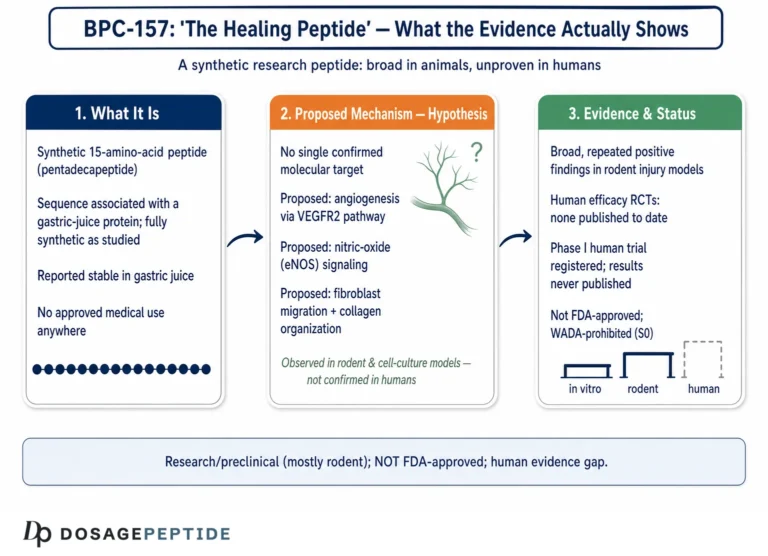
BPC-157 is a synthetic peptide made of fifteen amino acids, which is why it is often called a “pentadecapeptide.” Its sequence is Gly-Glu-Pro-Pro-Pro-Gly-Lys-Pro-Ala-Asp-Asp-Ala-Gly-Leu-Val.2 The letters “BPC” stand for “Body Protection Compound,” and the number reflects the peptide’s position within a larger protective protein that researchers reported isolating from human gastric juice. In other words, BPC-157 is not a molecule that exists intact in the body; it is a laboratory-designed fragment based on a partial sequence of a naturally occurring gastric protein, synthesized because that fragment appeared to retain biological activity on its own.2
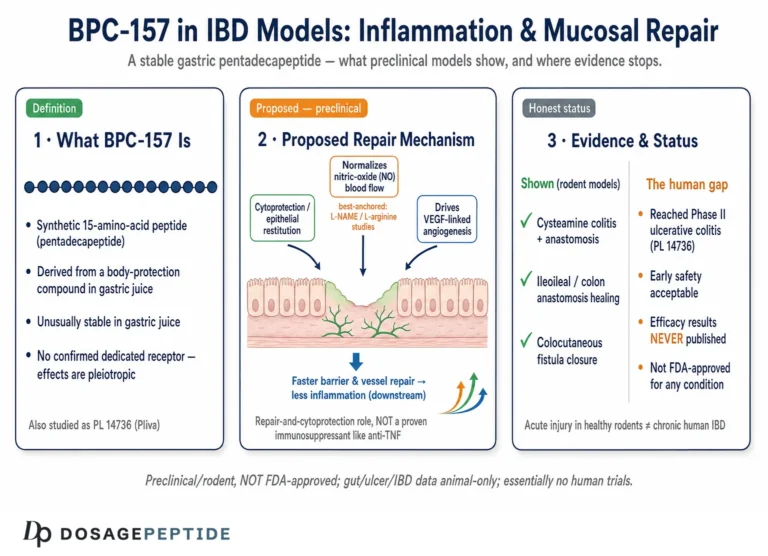
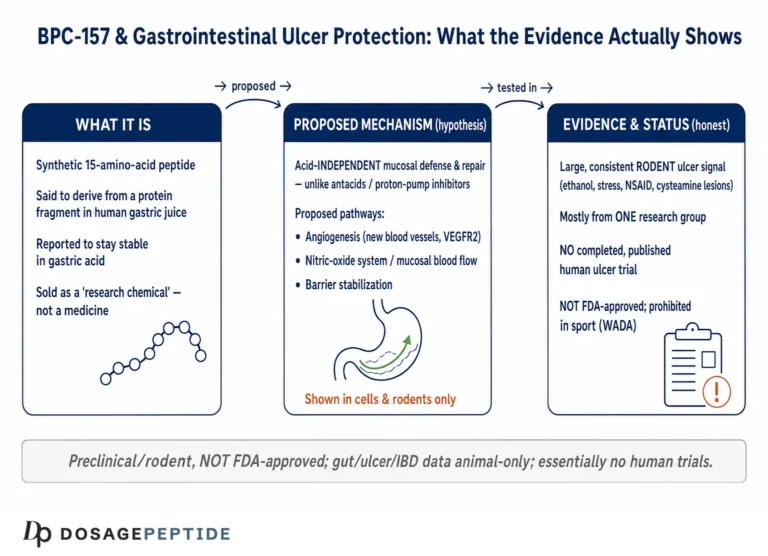
The compound emerged from the laboratory of Professor Predrag Sikiric and colleagues at the University of Zagreb in Croatia, with the earliest descriptions appearing in the early 1990s.1 The original interest was gastrointestinal: the parent protein was studied for its role in protecting the stomach and gut lining, and BPC-157 was initially characterized as a “cytoprotective” agent, meaning something that helps cells and tissues resist injury. Only later did the research program expand outward to tendon, muscle, bone, blood vessels, and eventually the nervous system. This lineage is important context. The neurological claims did not arise from a program designed to study the brain; they grew out of a broad “body protection” hypothesis that was extended, model by model, into new tissues.
A recurring theme in the marketing around BPC-157 is that it is “natural” because it derives from a gastric protein. This framing is misleading. The peptide sold and studied today is a manufactured synthetic compound. It is not extracted from anyone’s stomach, and the fifteen-amino-acid fragment is not something the human body produces as a discrete signaling molecule. Describing it as natural blurs the line between a naturally occurring parent protein and an engineered research chemical, and that blurring tends to make an unproven substance sound safer and more established than the evidence supports.
One genuinely interesting property, reported across several papers, is stability. Many peptides are fragile and degrade rapidly in the acidic, enzyme-rich environment of the stomach, which is why they usually have to be injected. BPC-157 has been reported to be unusually resistant to gastric acid and to degradation in human gastric juice, which is part of why some rodent studies were able to test it via oral gavage rather than injection.3 That stability is a plausible reason the compound attracted attention as a potential orally deliverable agent, though, as we will see, stability in a test tube is not the same as clinical efficacy in a person.
It is also worth being precise about naming. In research listings the compound appears as BPC-157, BPC 157, “PL-14736,” or “pentadecapeptide BPC 157,” and vendors sometimes list an acetate salt form. These refer to the same base peptide. On education-focused sites such as the BPC-157 dosage protocol reference, the compound is consistently framed as a research material whose human efficacy is unproven, which aligns with the regulatory reality discussed later in this article.
The timeline of the research program is itself informative. The gastrointestinal work of the 1990s established BPC-157 as a candidate “cytoprotective” agent, a term borrowed from an older tradition in gastric physiology describing substances that shield the mucosa from injury without simply neutralizing acid. From there the investigators reasoned that a compound protecting one epithelial and vascular tissue might protect others, and they progressively tested it in tendon, ligament, muscle, bone, and vascular models before reaching the nervous system. Understanding this outward trajectory helps explain why the neurological claims feel simultaneously broad and thinly independent: they are extensions of a single unifying “body protection” thesis rather than the product of a dedicated, multi-lab neuroscience effort. A reader encountering the compound for the first time should hold that history in mind, because it shapes how much weight the neurological literature can bear.
The Proposed Molecular Mechanism
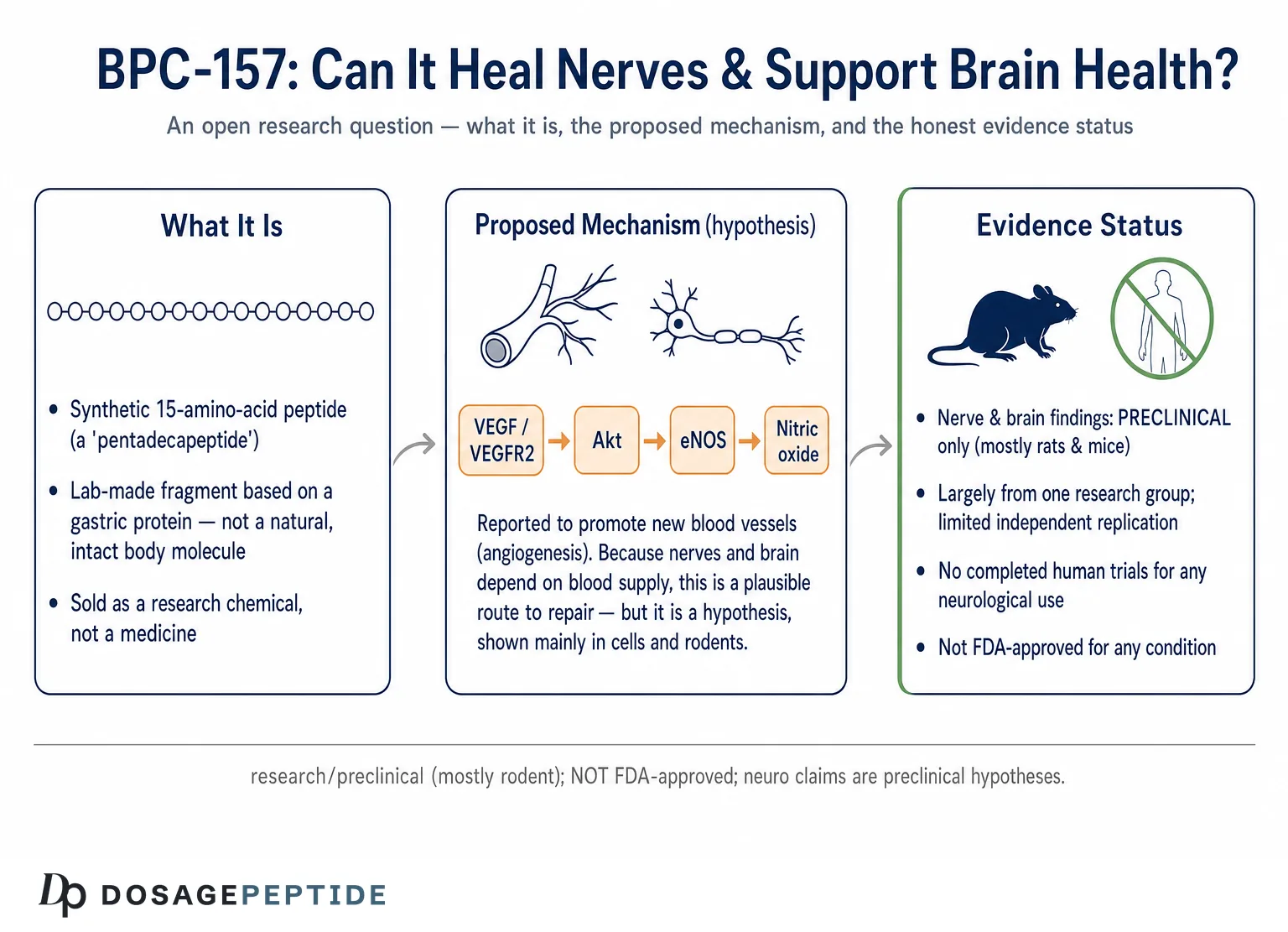
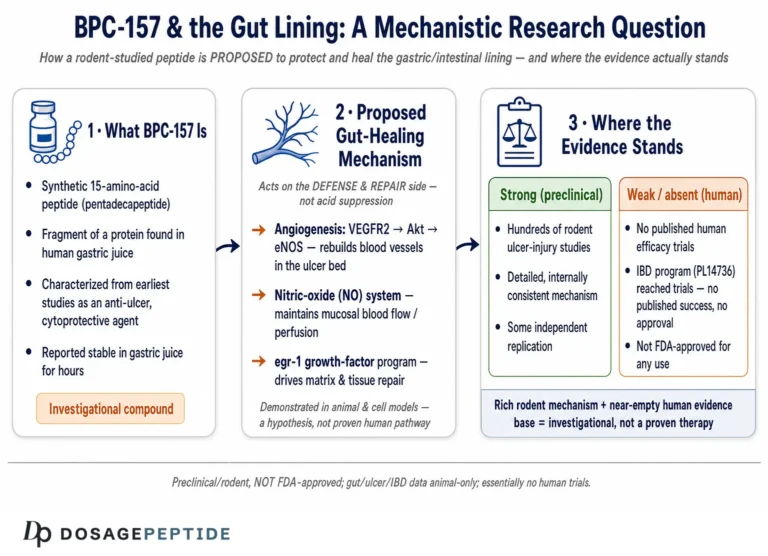
To evaluate whether BPC-157 could plausibly influence nerves and brain tissue, it helps to understand the mechanisms researchers have proposed. The most consistently reported theme is an effect on blood vessels. Multiple in-vitro and rodent studies describe BPC-157 as pro-angiogenic, meaning it appears to promote the formation of new blood vessels and to support the function of the endothelial cells that line them.4 Because nervous tissue is exquisitely dependent on blood supply, and because both peripheral nerve regeneration and recovery from brain ischemia hinge on adequate perfusion, a genuine pro-angiogenic effect is a mechanistically reasonable route by which a compound might influence neural repair.
At the signaling level, the central pathway implicated is the VEGF/VEGFR2 axis coupled to nitric oxide. Laboratory work reports that BPC-157 upregulates vascular endothelial growth factor (VEGF) and increases phosphorylation of its receptor VEGFR2 in endothelial cells, which then activates the downstream Akt kinase, which in turn activates endothelial nitric oxide synthase (eNOS) to produce nitric oxide.4 Nitric oxide is a signaling gas that relaxes blood vessels and supports endothelial cell survival, proliferation, and migration. A separate mechanistic paper describes an additional route in which BPC-157 drives phosphorylation of Src kinase, which modifies caveolin-1 and releases its brake on eNOS, again ending in more nitric oxide.5 The recurring endpoint across these proposed pathways is the nitric oxide system, and several papers frame BPC-157 as a modulator of NO signaling that can counteract the effects of both NO blockade and NO excess.5
The gene-expression data from a rat brain study add texture here. In a model of hippocampal ischemia and reperfusion, BPC-157 treatment was associated with elevated expression of genes including Vegfr2, Nos1, Nos3, Akt1, Src, Kras, Egr1, Foxo, and Srf, while Nos2 and the inflammatory regulator Nfkb were reduced.6 That pattern is internally consistent with the angiogenesis-and-nitric-oxide story: more of the pathway that builds and maintains vessels, less of the pathway associated with inflammatory signaling. It is a coherent molecular narrative.
Beyond vasculature, papers describe BPC-157 as interacting with neurotransmitter systems, reporting effects on serotonergic and dopaminergic signaling and, in some work, the release of serotonin in specific brain regions.7 This is often folded into a broader “brain-gut axis” hypothesis, in which a gut-protective peptide might exert central effects through the bidirectional communication between the gastrointestinal tract and the brain.7 Some reviews additionally invoke effects on growth-factor expression and on gut microbiome-related signaling as possible contributors.
| Proposed pathway | Reported effect | Evidence type |
|---|---|---|
| VEGFR2 → Akt → eNOS | Increased nitric oxide, angiogenesis | Cell culture + rodent4 |
| Src → caveolin-1 → eNOS | Vasomotor modulation, NO release | Rodent vascular study5 |
| Neurotransmitter modulation | Serotonergic / dopaminergic effects | Rodent behavioral7 |
| Brain-gut axis signaling | Central effects via gut protection | Hypothesis / review7 |
It is worth spelling out why a vascular mechanism is so attractive as an explanation for nerve and brain effects specifically. Peripheral nerves are supplied by a network of small vessels called the vasa nervorum, and regeneration after a nerve is crushed or cut depends heavily on re-establishing that blood supply so that regrowing axons and their supporting Schwann cells receive oxygen and nutrients. In the brain, the entire premise of ischemia-reperfusion injury is that interrupted and then restored blood flow damages neurons, so anything that stabilizes the vasculature and moderates the nitric oxide response during reperfusion has a plausible route to a protective effect. This is why the angiogenesis story is not a marketing flourish but a genuinely reasonable mechanistic hypothesis: the tissues where BPC-157 is claimed to help are tissues where vascular health and neural outcome are tightly linked. The hypothesis being reasonable, however, is a separate matter from the hypothesis being confirmed in humans.
A subtler point concerns the relationship between the peptide’s very short residence time in the body and its claimed durable effects. If BPC-157 is cleared from circulation within minutes, any lasting influence on tissue repair must be explained not by the peptide lingering at the site but by it triggering signaling cascades, such as the VEGF-nitric-oxide feedback loop, that continue to operate after the peptide itself is gone. Some of the literature frames the compound as a “trigger” or “modulator” rather than a sustained agonist, which is internally consistent with the pharmacokinetics but also raises the bar for proof, because transient triggers that produce durable biological change are exactly the kind of claim that demands rigorous, independent verification.
Two cautions belong with any mechanism discussion. First, a plausible mechanism is not proof of a clinical effect; the history of drug development is full of compounds with elegant mechanistic stories that failed in humans. Second, much of this mechanistic work comes from the same research network that reports the downstream benefits, so independent replication of the core signaling claims would strengthen confidence considerably.
What the Nerve and Brain Evidence Actually Shows
This is the heart of the matter, so it deserves an unvarnished accounting. The nerve-and-brain evidence for BPC-157 is real, but it is almost entirely preclinical, mostly in rats and mice, and heavily concentrated in one research lineage. There is no human trial evidence for any neurological indication.1
On peripheral nerves, the most-cited work is a rat study of traumatic sciatic-nerve injury. In transected-nerve models, BPC-157 given after injury was associated with faster axonal regeneration, better-organized nerve fascicles, increased density and size of regenerating fibers, and improved functional recovery measured by walking tests (the sciatic functional index) and electromyography over one to two months.8 Taken at face value, these are meaningful morphological and functional improvements. Taken in context, they are single-lineage rodent findings that, to date, have not been reproduced in a controlled human study of nerve injury.
On the spinal cord, a rat study of spinal cord compression injury reported that BPC-157 improved the healing course and led to partial functional recovery, with treated animals showing better motor outcomes and reduced tissue damage than controls.9 On the brain specifically, the hippocampal ischemia/reperfusion study described earlier reported that BPC-157 given during reperfusion counteracted both early and delayed neuronal damage and, in some measures, produced near-complete recovery on the Morris water maze and motor-coordination tests.6 A separate line of work in a mouse traumatic-brain-injury model reported reduced lesion severity, less edema and hemorrhage, and improved consciousness scores in treated animals.10 And in a cuprizone model used to mimic aspects of multiple sclerosis, BPC-157 was reported to counteract demyelination-associated brain injury and motor disability.11
Read together, this is a broad and consistent preclinical portfolio spanning peripheral nerve, spinal cord, ischemic brain injury, traumatic brain injury, and demyelination. The consistency is genuinely notable and is the main reason the compound is taken seriously as a research candidate rather than dismissed. But consistency within a related body of work is not the same as robustness across independent laboratories, and the honest bottom line for a reader is stark: none of these findings has been shown to translate to humans, and the leap from “recovered walking ability in a rat” to “heals nerves in people” is exactly the leap that repeatedly fails in translational medicine.
| Model | Species | Reported outcome | Human data? |
|---|---|---|---|
| Sciatic nerve transection8 | Rat | Faster axonal regeneration, better walking index | None |
| Spinal cord compression9 | Rat | Improved healing, partial motor recovery | None |
| Hippocampal ischemia/reperfusion6 | Rat | Reduced neuronal damage, maze recovery | None |
| Traumatic brain injury10 | Mouse | Less edema/lesion, better consciousness | None |
| Cuprizone demyelination11 | Rat | Reduced brain injury, less motor disability | None |
It is also fair to note what the evidence does and does not claim within its own frame. Even in the rodent studies, BPC-157 is generally presented as improving the course of recovery, accelerating and completing repair that might otherwise be slower or partial, rather than as regenerating tissue that is fundamentally incapable of regenerating. Peripheral nerves in rodents have real intrinsic regenerative capacity, and the sciatic-nerve studies are best read as reports that treated animals recovered faster and more completely than untreated ones, not that a severed nerve was made whole by the peptide alone. This distinction matters because popular summaries often escalate “improved the rate and quality of an already-possible recovery in rats” into “heals nerve damage,” which is a materially stronger and unsupported claim. Reading the primary papers, rather than the summaries built on top of them, consistently reveals more modest and more conditional language than the marketing implies.
Another honest observation is that the brain studies measure recovery on standardized behavioral batteries whose relationship to meaningful human outcomes is indirect. Performing better on a Morris water maze after experimental ischemia is a legitimate signal of preserved hippocampal function in a rat, but it is a long way from demonstrating preserved memory, cognition, or quality of life in a human patient. Surrogate behavioral endpoints in rodents have repeatedly failed to predict patient-centered outcomes in neurology, which is one more reason the appropriate reading of even the strongest BPC-157 brain data is “hypothesis-generating,” not “efficacy-establishing.”
So can BPC-157 heal nerves and boost brain health? The truthful answer is that it produces nerve- and brain-protective effects in specific rodent models, and that whether any of this applies to humans is entirely unknown. Anyone stating otherwise is overreaching the data. For readers comparing recovery-oriented compounds, the same caveat applies across the board, including to popular combinations discussed on pages like the BPC-157 and TB-500 recovery blend explainer, where the “recovery” framing is likewise built on preclinical rather than clinical evidence.
How BPC-157 Compares to Other Researched Neuro Peptides
Placing BPC-157 alongside other peptides studied for neurological effects helps calibrate expectations, because it shows that being an interesting research molecule is common and being a proven therapy is rare. Several peptides circulate in the same research-and-education space, each with its own evidence profile, and none of the ones discussed here is an approved neurological drug in the United States.
Semax and Selank are two of the more frequently referenced comparators. Both originated in Russian research programs, and both have a longer history of human use in their country of origin than BPC-157 does, with some clinical literature published in Russian journals. Semax in particular is often discussed for cognitive and neuroprotective research contexts and is described as influencing brain-derived neurotrophic factor. However, the Western peer-reviewed evidence base for these peptides remains limited, the regulatory status outside Russia is that of unapproved substances, and much of the clinical literature has not been replicated to modern international trial standards. A reader can find a research-oriented overview on the Semax protocol reference, but the appropriate framing there, as with BPC-157, is experimental rather than therapeutic.
Thymosin beta-4, and its fragment often marketed as TB-500, is the comparator most closely tied to BPC-157 in practice because the two are frequently studied and discussed together for tissue repair. Thymosin beta-4 has its own preclinical literature suggesting roles in cell migration, angiogenesis, and wound healing, and some neurological repair models. It shares BPC-157’s fundamental limitation: encouraging animal data, sparse human data, and no approval for neural indications. The rationale for combining the two, covered on pages such as the TB-500 and BPC-157 protocol reference, is theoretical and rests on the idea of complementary repair mechanisms rather than on any controlled human comparison.
What distinguishes BPC-157 within this group is less its evidence quality and more its breadth of claimed effects and its unusual reported stability. Few research peptides have been pushed through such a wide range of injury models by their originating lab. But breadth cuts both ways: a compound reported to help almost every tissue and injury type invites the skeptical question of whether the effect sizes and models have been independently scrutinized as rigorously as the volume of publications suggests.
| Peptide | Primary research focus | Human evidence level | Approved neuro drug? |
|---|---|---|---|
| BPC-157 | Tissue/nerve repair, cytoprotection | Preclinical only | No |
| Semax | Cognition, neuroprotection | Limited (mostly Russian) | No (US/EU) |
| Selank | Anxiety, neuromodulation | Limited (mostly Russian) | No (US/EU) |
| Thymosin beta-4 / TB-500 | Tissue repair, angiogenesis | Sparse | No |
The comparison is not meant to rank these compounds but to underline a shared reality: a crowded field of research peptides with intriguing mechanisms and thin human evidence. BPC-157 is a prominent member of that field, not an exception to it. Treating any of them as established medicine confuses research interest with clinical proof.
Research Models and Methodology Behind the Neuro Claims
Understanding how the neurological studies were built is essential to interpreting them, because the strength of a conclusion is bounded by the design that produced it. The BPC-157 nerve-and-brain literature relies on a fairly standard toolkit of rodent injury models, and knowing their strengths and limitations lets a reader weigh the headlines appropriately.
The typical subjects are male Wistar or albino rats, often around 200 grams body weight, or mice, with group sizes commonly in the range of roughly ten animals per condition per time point.8 Injuries are induced surgically or chemically: a nerve is transected or crushed, the spinal cord is compressed, cerebral blood flow is interrupted by clamping carotid arteries, a controlled impact produces traumatic brain injury, or a neurotoxin such as cuprizone is fed to the animals to provoke demyelination.6,9,11 BPC-157 is then administered, frequently shortly after injury, by intraperitoneal or intragastric routes or applied locally, at microgram-to-nanogram-per-kilogram doses. Outcomes are assessed with a mix of behavioral tests (walking indices, the Morris water maze, beam-walking, coordination tests), electrophysiology, histology, and molecular measures such as gene expression.6,8
These models are legitimate and widely used across neuroscience; the sciatic-nerve crush and the Morris water maze are standard instruments, not idiosyncratic inventions. That is a point in the literature’s favor. But several methodological features constrain how far the results can travel. The dosing is often given immediately after a precisely controlled injury, a timing that rarely matches real-world clinical scenarios where treatment starts hours or days later. Effect sizes and variability are not always reported in the detail an independent meta-analyst would want. And, critically, a large share of the neurological work originates from an interconnected group of authors, which raises the standard question in preclinical science: how much of this has been reproduced by teams with no stake in the outcome?
There is also the broader translational problem that afflicts nearly all neuroprotection research. Countless compounds have rescued neurons in rodent stroke and injury models and then failed completely in human trials; the graveyard of failed neuroprotectants is one of the most sobering features of the field. Rodent nervous systems differ from human ones in size, healing capacity, immune response, and timescale, and controlled surgical injuries differ from the messy, heterogeneous injuries humans actually sustain. None of this invalidates the BPC-157 findings, but it means the base rate for successful translation is low, and a prior of caution is the statistically appropriate stance.
The dosing conventions in the preclinical literature also deserve scrutiny because they are frequently misused in popular translation. Many rodent studies report striking effects across a remarkably wide dose range, sometimes spanning several orders of magnitude from nanograms to micrograms per kilogram, and sometimes report similar benefit at both very low and comparatively high doses. A flat or extremely broad dose-response relationship can be interpreted charitably as a wide therapeutic window, but it can also be a red flag, because well-characterized pharmacological agents usually show a clearer relationship between dose and effect. When a compound appears to work almost regardless of dose, a careful reader should ask whether the measured endpoints are sensitive enough, whether the effect sizes are being reported with appropriate variability, and whether the dose-response has been mapped rigorously rather than sampled at a few convenient points. None of this is disqualifying, but it is the kind of question that independent replication is designed to answer and that remains incompletely addressed.
Species and injury-model choices further bound interpretation. Rodents heal faster than humans, have different immune dynamics, and are studied over compressed timescales of days to a few months, whereas human nerve and brain recovery unfolds over many months to years. Surgical transections and controlled cortical impacts are clean, reproducible injuries, which is a virtue for experimental control but a limitation for external validity, since human nerve and brain injuries are heterogeneous, often complicated by comorbidity, and rarely treated within minutes of onset. Each of these gaps individually is manageable; collectively they explain why the translational failure rate in neuroprotection is so high and why a cautious prior is warranted here.
Finally, publication and reporting dynamics deserve mention. A body of consistently positive results can reflect a real effect, but it can also reflect selective emphasis on successful experiments. Without pre-registration, blinded outcome assessment described in detail, and independent replication, a reader cannot fully distinguish a robust phenomenon from an optimistic one. The methodological verdict, then, is that the BPC-157 neuro studies use accepted models competently, but that the concentration of the work in one lineage and the absence of human data leave the central questions open. Readers who want to understand how the dosing figures in these papers relate to the microgram schedules discussed in research contexts can consult the broader peptide dosage reference library, keeping in mind that rodent dosing does not translate directly to any human protocol.
Safety and Tolerability Signals in Preclinical Work
Safety is where enthusiasm most often outruns evidence, so precision matters. The frequently repeated claim that BPC-157 has an “excellent safety profile” needs an important qualifier: that reputation is built almost entirely on animal studies and anecdote, not on systematic human safety data.12 A compound can look benign in short-term rodent experiments and still carry unknown risks in humans over longer exposure, and the absence of documented harm is not the same as documented safety.
What the preclinical literature does report is reassuring on its own terms. Across many rodent studies, BPC-157 was generally well tolerated, with no overt signs of toxicity described at the doses used, and toxicology efforts reportedly struggled to establish a lethal dose even at levels far above the ranges producing biological effects.12 Pharmacokinetic studies in rats and dogs characterized absorption, distribution, metabolism, and excretion and reported a very short elimination half-life, on the order of minutes rather than hours, following intravenous dosing, with limited but measurable bioavailability by intramuscular and oral routes.3 A short half-life means the parent peptide does not linger long in circulation, which some interpret as favorable for a safety standpoint, though it also complicates the mechanistic story of durable tissue effects.
The theoretical safety concerns are as important as the observed ones. First is immunogenicity: any synthetic peptide can in principle provoke an immune response, and regulators have specifically cited immunogenicity risk and the potential for peptide-related impurities as reasons for caution.13 Second is the angiogenesis question. The same pro-angiogenic activity that might aid tissue repair could, in theory, be undesirable in the presence of a tumor, since growing blood vessels can support tumor growth; this concern is discussed in the literature as a plausible risk that has not been resolved by human data.4 Third is product quality. Much of the BPC-157 that circulates outside formal research settings is sold as an unregulated research chemical, and independent testing of such products has repeatedly found problems with purity, identity, and dosing accuracy across the peptide market. A “safe” molecule delivered as an impure or misdosed product is not safe in practice.
It is worth dwelling on the product-quality issue because it is the safety concern most often ignored and most immediately relevant. Independent analyses of the broader research-peptide market have repeatedly found vials whose actual contents diverge from their labels, including underdosed, overdosed, degraded, or contaminated products, and BPC-157 sold as a research chemical is subject to none of the manufacturing controls that govern approved injectable medicines. This means that even setting aside every question about the molecule itself, the physical material a person might encounter carries risks, from bacterial contamination to unknown impurities, that have nothing to do with BPC-157’s intrinsic pharmacology and everything to do with the absence of oversight. A perfectly benign molecule delivered through an unregulated channel is not a safe product, and conflating the two is one of the most common errors in the popular discourse around this compound.
There is also a near-total gap in long-term data. Chronic-exposure, carcinogenicity, reproductive, and developmental studies that would be standard for an approved drug have not been conducted to regulatory standards in humans, and even in animals the long-horizon picture is incomplete. Interactions with medications, effects in people with existing disease, and consequences of repeated cycling are essentially uncharacterized. The responsible summary is that BPC-157 has not raised alarming safety signals in short-term animal work, that this is genuinely different from having established human safety, and that unresolved theoretical risks around immunogenicity and angiogenesis, combined with an unregulated supply chain, make confident safety claims unjustified.
Handling and Reconstitution in a Research Context
This section is included because the peptide is handled in laboratory settings, and accurate technical information is safer than vague or wrong information. It is descriptive, not a protocol or an encouragement to use the compound; BPC-157 is not an approved medicine, and nothing here should be read as clinical guidance.
BPC-157 is typically supplied as a lyophilized (freeze-dried) white powder in a sealed vial, commonly in quantities such as 5 mg or 10 mg. Lyophilized peptides are usually the most stable form and are generally stored cold, often refrigerated or frozen, and protected from light and moisture until reconstitution, after which stability decreases and cold storage becomes more important. In research, the powder is brought into solution by adding a sterile diluent, most often bacteriostatic water, which contains a small amount of benzyl alcohol as a preservative. The standard laboratory technique is to swab the vial stopper with alcohol, introduce the diluent slowly down the inner wall of the vial rather than directly onto the powder, and allow the peptide to dissolve with gentle swirling; vigorous shaking is avoided because mechanical agitation can damage fragile peptide structures.
The concentration of the resulting solution is determined by how much diluent is added to a known mass of peptide, and this is where a reconstitution calculation matters. If, for example, 3 mL of diluent is added to a 10 mg vial, the solution contains roughly 3.33 mg per mL; adding a different volume changes the concentration proportionally. Converting a target amount in micrograms into a volume, and then into insulin-syringe units, is the kind of arithmetic that reconstitution tools are built to handle. General-purpose resources such as a BPC-157 reconstitution reference walk through these conversions, but the numbers there describe research handling of the material, not a validated human treatment.
| Vial amount | Diluent added | Resulting concentration |
|---|---|---|
| 5 mg | 2 mL | 2.5 mg/mL |
| 10 mg | 2 mL | 5.0 mg/mL |
| 10 mg | 3 mL | ~3.33 mg/mL |
Beyond concentration, sterile technique is the dominant handling consideration in any laboratory context, because a reconstituted peptide solution is an injectable-format liquid with no antimicrobial safeguards beyond the preservative in bacteriostatic water. Contamination, particulate matter, or degradation from improper storage all compromise the material. It also bears repeating that the identity and purity of a given vial cannot be assumed from a label; without independent analytical verification, a researcher does not actually know what mass of peptide, or what impurities, a vial contains. Handling information, in short, describes how the material behaves physically and says nothing about whether it works or is safe to use in people.
Limitations and the Human-Evidence Gap
Every previous section has circled the same central limitation, so it is worth confronting it directly and completely: there is no credible human evidence that BPC-157 heals nerves or improves brain health. The entire neurological case is preclinical.1 This is not a minor caveat to be tucked into a disclaimer; it is the single most important fact about the compound’s neurological reputation.
Consider what “no human evidence” actually means here. There are no completed randomized controlled trials of BPC-157 for nerve injury, stroke, traumatic brain injury, neuropathy, multiple sclerosis, cognitive performance, or any other neurological outcome. There are no large observational cohorts with proper controls, no dose-finding studies in patients, and no long-term follow-up data in humans. The scattered reports of human use that appear in some discussions are typically small, uncontrolled, or anecdotal, and a handful of early human studies that exist focused on non-neurological contexts and were not randomized controlled trials.1 When a claim about a person’s nerves or brain is supported only by rat data, the correct description is “hypothesis,” full stop.
The single-lineage concentration of the preclinical work compounds this. A striking feature of the BPC-157 literature is how much of the most favorable data traces back to an interconnected group of researchers. Reproducibility by fully independent teams is one of the strongest signals in science, and it is precisely the signal that remains underdeveloped here. This does not imply any impropriety; it simply means the evidence has not yet been stress-tested by the adversarial, independent replication that turns an interesting finding into an accepted one.
The translational track record adds a further layer of caution. Neuroprotection is arguably the field with the widest gap between rodent promise and human failure. Agent after agent has protected neurons in animal models of stroke and injury and then shown no benefit, or harm, in human trials. There is no reason to assume BPC-157 will escape this pattern, and considerable reason, given the base rate, to expect that many of its rodent effects may not translate at all or may translate with much smaller magnitude.
Practical limitations round out the picture. Because BPC-157 is not an approved drug, the material available in the wild is unregulated, of uncertain purity, and inconsistently dosed, so even the people using it cannot be sure what they are taking. Optimal dosing, timing, route, and duration for any hypothetical human effect are unknown. Interactions and contraindications are uncharacterized. And the marketing environment actively distorts the evidence, presenting hypotheses as conclusions and preclinical findings as proven benefits. The honest synthesis is that BPC-157 is a scientifically interesting compound with a coherent mechanistic story and a consistent but single-source preclinical record, sitting on the wrong side of a very wide, entirely unbridged human-evidence gap. Curiosity is warranted; belief is not.
Regulatory Status in 2026
The regulatory picture for BPC-157 is both clear in its essentials and genuinely in flux around the edges, so it is worth stating carefully. The essential fact is stable and unambiguous: as of 2026, BPC-157 is not approved by the U.S. Food and Drug Administration, the European Medicines Agency, or any comparable regulator as a treatment for any condition, neurological or otherwise. It has no approved medical indication anywhere. It is, in regulatory terms, an unapproved substance.13
The moving parts concern pharmacy compounding in the United States. In 2023, the FDA placed BPC-157 into “Category 2” of bulk substances under Section 503A of the Federal Food, Drug, and Cosmetic Act, a designation for substances the agency flagged as raising significant safety questions, citing concerns such as immunogenicity risk, peptide-related impurities, and limited safety characterization. Category 2 placement effectively barred its use as a bulk substance in traditional compounding.13 In 2026, following withdrawal of the underlying nominations, the FDA removed BPC-157 from Category 2. Crucially, removal from Category 2 did not move it to Category 1, the list of substances that may be used in compounding; it left BPC-157 in a gray zone, neither affirmatively permitted for compounding nor formally prohibited, and still without FDA approval and without a recognized USP/NF monograph.14 Reports indicate the compound remained subject to further review by the relevant compounding advisory process.14
It is easy to misread these developments as a softening of the regulatory stance that amounts to a green light. It is not. Removal from a prohibited list is not approval, and a compound can sit in a regulatory gray zone while still lacking any demonstrated safety or efficacy for human use. The core status, unapproved, is unchanged by the compounding reshuffle.
For sport, the World Anti-Doping Agency’s position is also relevant to a meaningful audience. BPC-157 is a synthetic peptide that regulators and anti-doping bodies treat with scrutiny, and athletes subject to testing should assume that non-approved peptides of this kind carry doping risk and verify current status directly against the prohibited list rather than relying on secondary summaries. The prudent default for a tested athlete is avoidance.
Two practical implications follow from the regulatory reality. First, virtually all BPC-157 in circulation is sold and labeled as a research chemical “not for human consumption,” a label that reflects genuine legal and safety status rather than mere formality. Second, that research-chemical channel is not subject to the manufacturing, purity, and labeling controls that apply to approved medicines, which is exactly why product-quality concerns recur throughout any honest discussion of the compound. The regulatory bottom line for 2026 is simple to state and important to internalize: BPC-157 is an unapproved, experimental substance whose compounding status shifted but whose fundamental lack of approval, and lack of proven human benefit, did not.
Frequently Asked Questions
Is BPC-157 proven to heal nerve damage in humans?
No. There is no human clinical trial evidence that BPC-157 heals nerve damage. The nerve-regeneration findings come from rodent models, principally rat sciatic-nerve and spinal-cord injury studies, where treated animals showed faster axonal regeneration and better functional recovery than controls.8,9 These are preclinical results and represent a hypothesis about humans, not a demonstrated human benefit.
Can BPC-157 improve brain health or cognition?
There is no human evidence supporting cognitive or brain-health benefits. Rodent studies report neuroprotective effects in models of ischemic brain injury, traumatic brain injury, and demyelination, along with effects on serotonergic and dopaminergic systems.6,10,11 Whether any of this translates to improved brain function in people is completely unknown, and no controlled human study has tested it.
Why is so much of the research from one group?
A large share of the most favorable BPC-157 literature originates from an interconnected group of researchers associated with the compound’s original development. This is a recognized limitation. Independent replication by unaffiliated laboratories is one of the strongest indicators that a finding is robust, and for BPC-157’s neurological claims that independent replication remains limited, which is a reason for caution rather than confidence.1
Is BPC-157 FDA-approved or legal to use?
BPC-157 is not FDA-approved for any condition. In 2023 it was placed in the FDA’s Category 2 bulk-substances list, and in 2026 it was removed from that list without being moved to the permitted Category 1, leaving it in a regulatory gray zone but still unapproved and without a recognized pharmacopeial monograph.13,14 It is generally sold as a research chemical labeled not for human consumption.
What are the main safety concerns?
Short-term rodent studies reported good tolerability and difficulty establishing a lethal dose, but there is no systematic human safety data.12 Theoretical concerns include immunogenicity, the possibility that pro-angiogenic activity could be undesirable in the presence of a tumor, and, very importantly, the poor quality control of unregulated research-chemical products, which may be impure or misdosed.4,13 Long-term human safety is uncharacterized.
How does BPC-157 compare to Semax or TB-500 for the nervous system?
All three are research peptides without approval for neurological indications. Semax has a longer history of human use in Russia but limited international trial evidence; thymosin beta-4/TB-500 shares BPC-157’s pattern of encouraging animal data and sparse human data. None is a proven neurological therapy, and combinations rest on theory rather than controlled human comparison.
Does BPC-157’s short half-life affect its plausibility?
BPC-157’s elimination half-life in animals is very short, on the order of minutes after intravenous dosing.3 This is sometimes cited favorably for safety, since the parent peptide clears quickly. It also raises a mechanistic question, because durable tissue and nerve effects would need to be explained by downstream signaling cascades triggered during brief exposure rather than by sustained presence of the peptide itself.
Should any of this be taken as medical advice?
No. This article is educational and describes the state of preclinical research on an unapproved, experimental compound. It is not medical advice, not a treatment protocol, and not an endorsement of use. Anyone considering questions about nerve or brain health should consult a qualified, licensed healthcare professional.
References
- U.S. National Library of Medicine. ClinicalTrials.gov search for “BPC-157” (no completed randomized controlled trials for neurological indications). clinicaltrials.gov/search?term=BPC-157. See also Jozwiak M, et al. “Multifunctionality and Possible Medical Application of the BPC 157 Peptide—Literature and Patent Review.” Pharmaceuticals. 2025. PMC11859134 (documents the single-group, preclinical concentration of the evidence). ncbi.nlm.nih.gov/pmc/articles/PMC11859134
- Jozwiak M, et al. “Multifunctionality and Possible Medical Application of the BPC 157 Peptide—Literature and Patent Review.” Pharmaceuticals. 2025. PMC11859134 (sequence Gly-Glu-Pro-Pro-Pro-Gly-Lys-Pro-Ala-Asp-Asp-Ala-Gly-Leu-Val, gastric-juice origin). ncbi.nlm.nih.gov/pmc/articles/PMC11859134
- He L, et al. “Pharmacokinetics, distribution, metabolism, and excretion of body-protective compound 157, a potential drug for treating various wounds, in rats and dogs.” Front Pharmacol. 2022. PMC9794587. ncbi.nlm.nih.gov/pmc/articles/PMC9794587
- Seiwerth S, et al. “Stable Gastric Pentadecapeptide BPC 157 and Wound Healing” (angiogenesis and VEGFR2/NO pathways). PMC8275860. ncbi.nlm.nih.gov/pmc/articles/PMC8275860
- Hsieh MJ, et al. “Modulatory effects of BPC 157 on vasomotor tone and the activation of Src-Caveolin-1-endothelial nitric oxide synthase pathway.” Sci Rep. 2020. PMC7555539. ncbi.nlm.nih.gov/pmc/articles/PMC7555539
- Vukojevic J, et al. “The effect of pentadecapeptide BPC 157 on hippocampal ischemia/reperfusion injuries in rats.” Brain Behav. 2020. PMC7428500. ncbi.nlm.nih.gov/pmc/articles/PMC7428500
- Sikiric P, et al. “Brain-gut Axis and Pentadecapeptide BPC 157: Theoretical and Practical Implications.” PMC5333585. pmc.ncbi.nlm.nih.gov/articles/PMC5333585
- Gjurasin M, et al. “Peptide therapy with pentadecapeptide BPC 157 in traumatic nerve injury.” Regul Pept. 2010;160(1-3):33-41. ScienceDirect S0167011509002274. sciencedirect.com/science/article/abs/pii/S0167011509002274
- Perovic D, et al. “Stable gastric pentadecapeptide BPC 157 can improve the healing course of spinal cord injury and lead to functional recovery in rats.” J Orthop Surg Res. 2019. PMC6604284. ncbi.nlm.nih.gov/pmc/articles/PMC6604284
- Tudor M, et al. “Traumatic brain injury in mice and pentadecapeptide BPC 157 effect.” Regul Pept. 2010;160(1-3):26-32. ScienceDirect S0167011509002341. sciencedirect.com/science/article/abs/pii/S0167011509002341
- Klicek R, et al. “Stable gastric pentadecapeptide BPC 157 heals cysteamine-colitis and cuprizone-induced multiple sclerosis-like brain injuries and motor disability.” J Physiol Pharmacol. 2013. jpp.krakow.pl/journal/archive/10_13/articles/09_article.html
- Jozwiak M, et al. “Multifunctionality and Possible Medical Application of the BPC 157 Peptide—Literature and Patent Review” (tolerability/toxicology summary; no toxic dose determined). Pharmaceuticals. 2025. PMC11859134. ncbi.nlm.nih.gov/pmc/articles/PMC11859134
- U.S. Food and Drug Administration. “Bulk Drug Substances Nominated for Use in Compounding Under Section 503A of the FD&C Act” (Category 2 — substances raising significant safety risks, incl. immunogenicity and impurity concerns cited for BPC-157). fda.gov/drugs/human-drug-compounding/bulk-drug-substances-nominated-503a
- U.S. Food and Drug Administration. “Pharmacy Compounding Advisory Committee (PCAC) Meeting Announcement, July 23-24, 2026” (BPC-157 among substances scheduled for review following Category 2 removal). fda.gov/advisory-committees/advisory-committee-calendar
Educational and research context only. This article summarizes preclinical research on BPC-157, an experimental compound that is not approved by the FDA, EMA, or any comparable regulator for the treatment of nerve injury, brain conditions, or any other disease. Nothing here is medical advice, a treatment recommendation, or an endorsement of use in humans. The neurological findings discussed are drawn overwhelmingly from rodent studies and represent open research questions, not demonstrated human benefits. Consult a qualified, licensed healthcare professional for any medical concern.