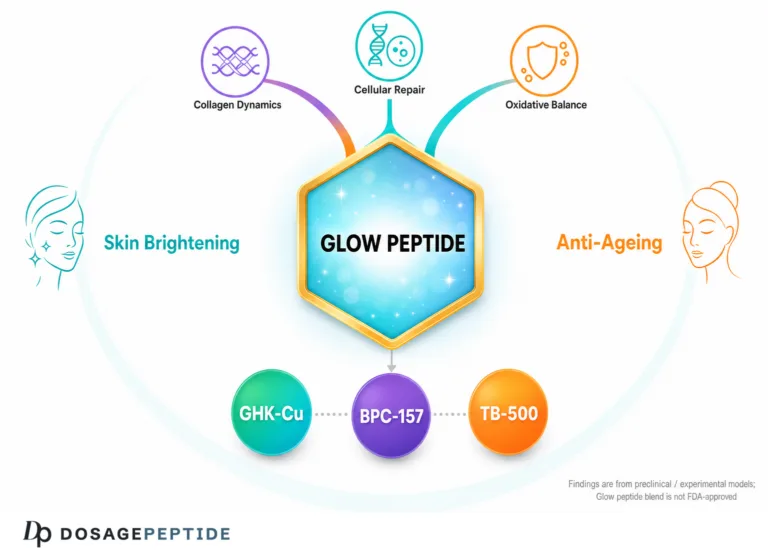
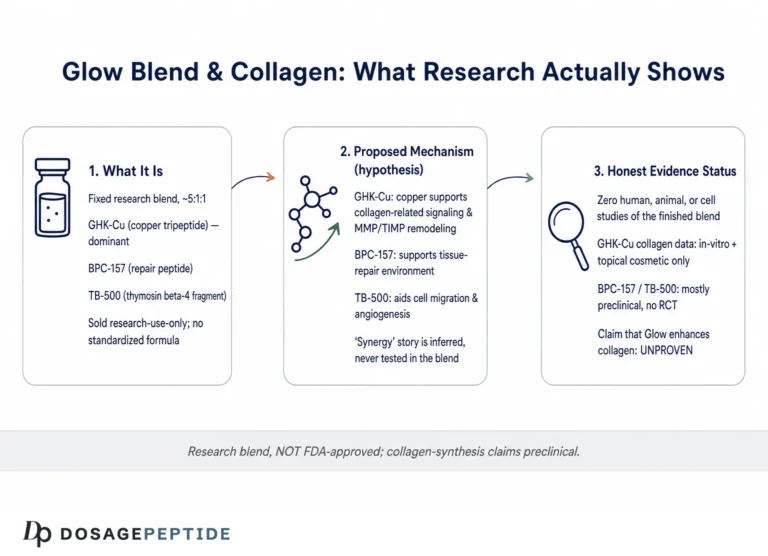
The question in this article’s title — does Glow peptide stimulate fibroblast activity to enhance dermal elasticity? — reads like a settled claim waiting to be confirmed. It is not. The honest framing, which this page holds to throughout, is that “Glow” is an unregulated multi-peptide research blend, that no controlled human trial has ever tested the finished blend for any skin endpoint, and that the phrase “enhance dermal elasticity” belongs to marketing rather than to the peer-reviewed record. What we can examine is far narrower and far more interesting: the individual peptides inside the blend have decades of preclinical literature, and one of them — the copper tripeptide GHK-Cu — has genuinely stimulated collagen synthesis in cultured fibroblasts at picomolar concentrations and has been tested in topical cosmetic form in human volunteers.1 That is a real body of work. It is also not the same thing as proving that an injected three-peptide “Glow” blend makes human skin more elastic.
Glow is typically sold as a fixed combination of three research compounds: GHK-Cu (a copper-binding tripeptide), TB-500 (a synthetic fragment corresponding to part of the actin-regulating protein thymosin beta-4), and BPC-157 (a synthetic pentadecapeptide derived from a sequence in gastric juice). Each has been studied in isolation, almost entirely in cell culture and rodent models, and each touches fibroblast biology through a different mechanism. The commercial logic of putting them together is that their pathways might be complementary. The scientific reality is that combining three under-characterized peptides does not sum their individual evidence — it creates a new, wholly untested entity whose pharmacokinetics, interactions, and safety profile no one has formally measured.
This article walks through what each component actually does at the bench, how strong (or weak) the evidence for a dermal-elasticity effect really is, how the research models were built and where they fall short, what is known about safety and tolerability, how such material is handled in a laboratory context, and what regulators currently say. Nothing here is medical advice, a dosing recommendation, or an endorsement. The goal is to let a reader distinguish the small kernel of real cell-biology evidence from the large surrounding cloud of unverified promotional claims. For general orientation on the individual copper peptide, our explainer on what GHK-Cu is, its mechanism, benefits and risks is a useful companion.
What the Glow blend is and where it comes from
“Glow” is not a single molecule, a pharmaceutical product, or a named drug candidate in any regulatory pipeline. It is a trade label applied by research-chemical vendors to a fixed-ratio mixture of three separate peptides supplied together, most commonly in a single lyophilized vial. The composition that appears most consistently across suppliers is GHK-Cu, TB-500, and BPC-157, and vendor listings for a 70 mg vial describe the three peptides combined in one container.2 Our own reference page for the Glow 70 mg vial documents how this format is typically reconstituted in a research setting. Because there is no standardizing authority, the exact milligram split between the three components varies from seller to seller, and a buyer generally cannot verify the ratio without third-party analysis. This is the first and most important fact about Glow: it is a category of product defined by convention and marketing, not by a monograph.
The three constituents have very different origins. GHK-Cu — glycyl-L-histidyl-L-lysine bound to copper(II) — is the most pedigreed of the three. It was isolated in 1973 by Loren Pickart as an activity in human plasma albumin that caused aged human liver tissue to synthesize proteins in the manner of younger tissue, and it was subsequently identified as this specific tripeptide with a strong affinity for copper ions.3 GHK is a genuinely endogenous human molecule: it is present in plasma, saliva, and urine, and its plasma concentration declines with age, from roughly 200 ng/mL around age 20 to about 80 ng/mL by age 60, a fall that coincides with the general decline in regenerative capacity.3 This age-related decline is the biological hook on which most of the “restore youthful skin” narrative hangs.
TB-500 is a synthetic peptide marketed as a proxy for thymosin beta-4 (T-beta-4), a naturally occurring 43-amino-acid protein that is one of the major intracellular actin-sequestering molecules in mammalian cells. Strictly, “TB-500” and “thymosin beta-4” are not identical — TB-500 is often described as corresponding to the actin-binding fragment of the parent protein — but vendors and much of the grey literature use the names interchangeably, and the mechanistic evidence usually invoked for TB-500 is in fact the T-beta-4 literature.4 This conflation matters, because it means claims made “for TB-500” frequently rest on studies that used the full-length protein rather than the marketed fragment.
BPC-157 is a synthetic pentadecapeptide (15 amino acids) whose sequence is derived from a partial sequence of a protein found in human gastric juice, hence “Body Protection Compound.”7 Unlike GHK, BPC-157 as sold is not a naturally circulating molecule; it is a stabilized synthetic construct studied almost exclusively in rodents. It has never completed a controlled human efficacy trial for any indication.8
A brief word on the biology of dermal elasticity itself helps frame why these three peptides get bundled toward that endpoint. The mechanical resilience of skin — its ability to deform under load and snap back — is governed principally by two extracellular-matrix systems produced by dermal fibroblasts: the collagen network, which provides tensile strength, and the elastic-fiber system (elastin plus fibrillin-rich microfibrils), which provides recoil. Both are cross-linked by the copper-dependent enzyme lysyl oxidase, and both degrade with chronological aging and ultraviolet exposure, partly through elevated matrix metalloproteinase activity that outpaces synthesis. Any compound that plausibly raises fibroblast matrix-protein output, supplies the copper that lysyl oxidase needs, or restrains MMP-driven breakdown could, in principle, touch elasticity. GHK-Cu is invoked precisely because it engages all three of those levers in cell culture. The problem, examined below, is that plausibility in a dish is a starting hypothesis, not a demonstrated skin outcome — and the two peptides bundled alongside GHK-Cu do not clearly engage elastin biology at all.
Putting these three together under one cap produces a product with a split identity. GHK-Cu carries the only meaningful human-skin data; TB-500 and BPC-157 contribute rodent wound-healing and angiogenesis data that is mechanistically suggestive but clinically unproven. Crucially, the “Glow” concept relies on the assumption that combining them yields additive or synergistic benefit for skin. No study has tested that assumption. When you read a supplier describing Glow as a tool “for skin and collagen remodeling,” the collagen-remodeling evidence they are leaning on is almost entirely the GHK-Cu literature, borrowed and generalized to the whole blend. Readers comparing multi-peptide products may also encounter the closely related KLOW blend, which adds a fourth peptide (KPV) to a similar base; the same evidentiary caveats apply.
Molecular mechanism: how each peptide touches fibroblast biology
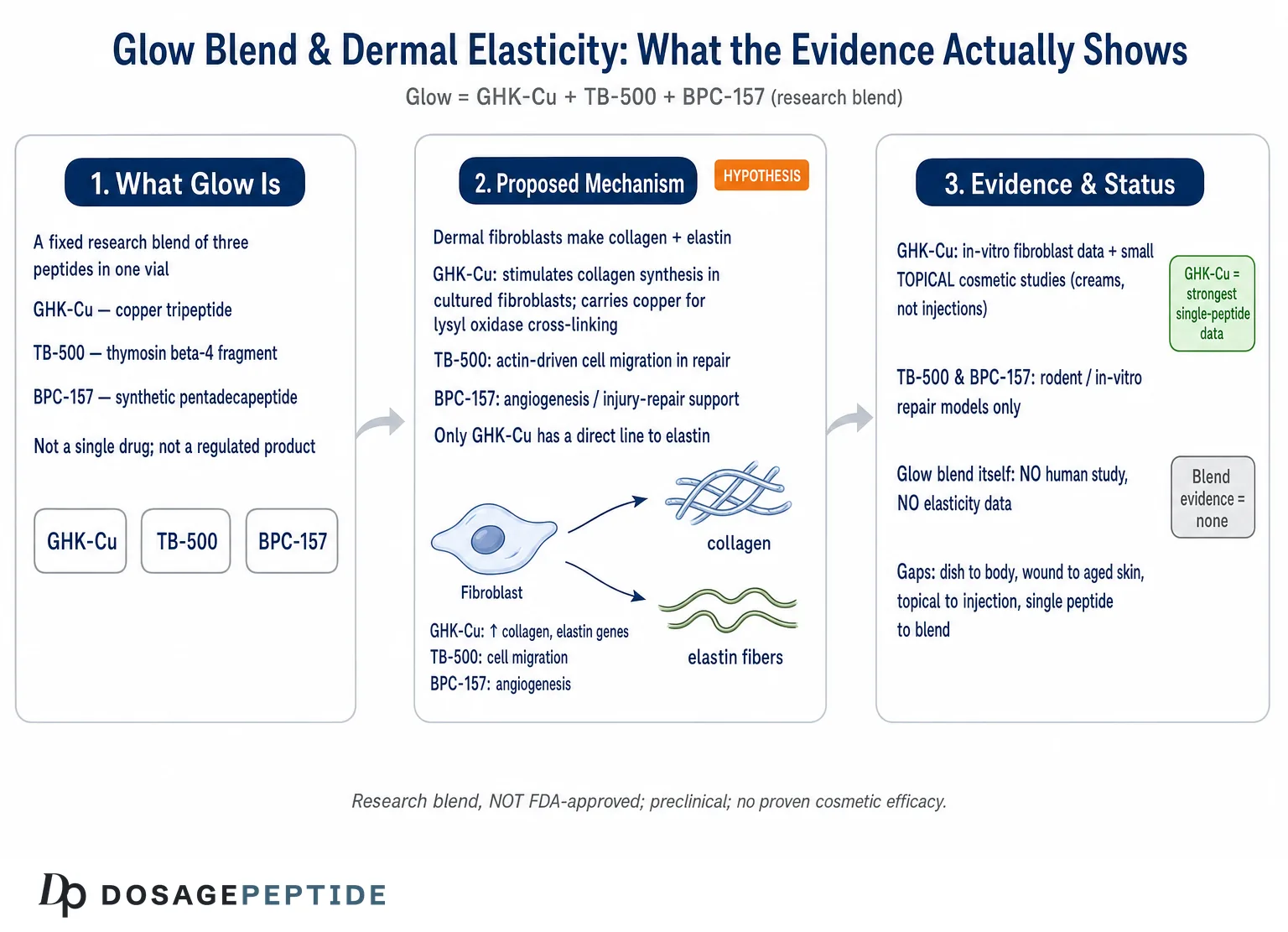
To evaluate whether Glow could plausibly influence dermal elasticity, the relevant question is what its components do to fibroblasts — the resident dermal cells that manufacture collagen, elastin, and the glycosaminoglycan matrix that gives skin its mechanical bounce. Each peptide engages this biology by a distinct route, and it is worth being precise about each because the mechanisms are frequently overstated.
GHK-Cu has the best-characterized mechanism. In cultured fibroblasts, GHK-Cu stimulates collagen synthesis, and the classic 1988 study by Maquart, Pickart and colleagues showed this effect at concentrations as low as 10-12 M (picomolar), with a peak effect near 10-9 M and, importantly, independent of any increase in cell number.1 The picomolar potency is genuinely unusual; most cosmetic actives require micromolar-to-millimolar concentrations for a measurable culture effect. Beyond raw collagen output, GHK-Cu upregulates genes for collagen, elastin, dermatan sulfate, chondroitin sulfate, and decorin, and it modulates the balance between matrix metalloproteinases (MMPs, which break down matrix) and their inhibitors (TIMPs).3,6 Because copper is a required cofactor for lysyl oxidase — the enzyme that cross-links collagen and elastin fibers — GHK-Cu’s role as a copper carrier gives it a direct, chemically coherent link to the cross-linking machinery that underlies elastic-fiber integrity. A 2018 gene-expression analysis reported that GHK influences a large number of human genes, generally in the direction of tissue remodeling and antioxidant defense.6 This is the strongest mechanistic thread in the entire Glow story, and it is worth stressing that it is a GHK-Cu thread, not a blend thread.
TB-500 / thymosin beta-4 acts through actin. The parent protein is an actin-sequestering peptide: by binding monomeric G-actin, it participates in the dynamic assembly and disassembly of the actin cytoskeleton that cells need in order to change shape and crawl. In wound-healing terms, this cytoskeletal fluidity is what allows keratinocytes, fibroblasts, and endothelial cells to migrate toward an injury. In migration assays, thymosin beta-4 has been reported to stimulate keratinocyte and endothelial cell migration by roughly two- to three-fold over control, an effect detectable at very low (picogram-range) amounts.4,5 T-beta-4 has also been reported to promote endothelial cell migration and angiogenesis and to influence MMP-mediated matrix remodeling.4 The mechanistic point relevant to elasticity is indirect: T-beta-4 does not itself stimulate elastin synthesis the way GHK-Cu stimulates collagen; rather, it facilitates the cell movement and vascularization that support tissue repair. Whether that translates into greater dermal elasticity in intact, un-wounded human skin is entirely unestablished.
BPC-157 is described mechanistically as a cytoprotective and pro-angiogenic peptide. In vitro work with human umbilical vein endothelial cells (HUVECs) has reported that BPC-157 increases phosphorylation of VEGF receptor-2 (VEGFR2) and activates downstream signaling linked to nitric-oxide pathways via the Akt-eNOS axis.13 Separately, a 2011 study in cultured tendon fibroblasts reported dose-dependent increases in cell migration, together with greater tendon-cell outgrowth and survival, but did not demonstrate a direct effect on proliferation.7 So BPC-157 does have a fibroblast-touching mechanism — but the fibroblasts in question were tendon fibroblasts in a healing-tendon model, not dermal fibroblasts in aging facial skin, and the leap from one to the other is an assumption, not a finding.
It is worth pausing on a mechanistic asymmetry that the “synergy” pitch tends to gloss over. Of the three peptides, only GHK-Cu has a demonstrated line to elastin specifically — both through upregulation of elastin gene expression in the reported gene-data analyses and through its role as a copper carrier for lysyl oxidase, the enzyme that cross-links elastin into functional fibers.3,6 TB-500’s actin biology and BPC-157’s VEGFR2/FAK biology are, at their core, about cell movement and vascular support during repair, not about laying down or cross-linking elastic fibers in resting dermis. So when a product is marketed for “elasticity,” two of its three ingredients are being credited for a mechanism they have not been shown to possess. The most a careful reader can say is that TB-500 and BPC-157 might create a more favorable healing environment in which fibroblasts operate; the specific elastin-and-collagen synthesis story is a GHK-Cu story with two passengers.
A second nuance concerns copper homeostasis. GHK-Cu’s fibroblast effects in culture depend on delivering copper to the cell, but in a living organism copper is tightly regulated by transport proteins and chaperones, and both deficiency and excess are harmful. The elegant picomolar potency seen in a dish assumes the peptide-copper complex reaches fibroblasts at a controlled concentration; in intact tissue, systemic copper buffering may blunt, saturate, or complicate that delivery. This is one reason a mechanism can be genuine at the bench and yet fail to produce a proportional effect in the body — the regulatory context that the culture dish removed is exactly the context that determines the real outcome.
Laid side by side, the three mechanisms are real but heterogeneous: GHK-Cu drives matrix-protein gene expression and supplies copper for cross-linking; TB-500 mobilizes the cytoskeleton for cell migration; BPC-157 supports angiogenesis and fibroblast activity in injury models. A promoter can string these into a tidy “regeneration synergy” narrative, but nothing in the literature demonstrates that the three act synergistically, or even additively, on human dermal elasticity when co-administered.
The key evidence, stated at its honest level
The single most important thing a reader can carry away is a clear sense of what level of evidence exists, because the level differs sharply by compound and drops to zero for the blend itself. The following table summarizes it plainly.
| Component | Highest evidence level for skin/fibroblast effect | Human data? | Direct elasticity evidence? |
|---|---|---|---|
| GHK-Cu | In-vitro fibroblast collagen synthesis; small topical cosmetic trials | Yes, but topical cosmetic use in small studies | Indirect (skin density/firmness measures in topical studies) |
| TB-500 / T-beta-4 | Rodent dermal wound-healing; in-vitro migration assays | No controlled dermal-cosmetic trial | No |
| BPC-157 | Rodent tissue-repair and angiogenesis models | No completed controlled efficacy trial | No |
| “Glow” blend | None — no study of the finished blend | No | No |
Start with the strongest strand. For GHK-Cu, the fibroblast collagen-synthesis finding is robust and replicated at the cell-culture level: the 1988 Maquart study demonstrated concentration-dependent stimulation of collagen synthesis in dermal fibroblast cultures,1 and a 1993 Journal of Clinical Investigation rat wound-chamber study reported concentration-dependent increases in connective-tissue accumulation and collagen synthesis in vivo.14 On the human side, the most cited work is a 12-week randomized study of a GHK-Cu-containing facial cream in women with photoaged skin, presented at the American Academy of Dermatology and summarized in the peer-reviewed GHK-Cu literature, which reported improvements in skin density, thickness, laxity, fine lines, and clarity versus vehicle control.3,9 A separate report on MMP/TIMP expression and facial-wrinkle parameters described broadly consistent changes with GHK-Cu; it appeared in a journal from a publisher widely flagged for weak peer review, so it carries little independent evidentiary weight beyond the mechanism already established in the Pickart reviews.6,10 These are real human studies — but note three constraints: they tested topical cosmetic formulations, not injected blends; they were small; and several were sponsor-linked cosmetic studies rather than independent clinical trials. “Improved laxity and density on instrumental measures” is the closest the literature comes to “enhanced elasticity,” and it applies to a cream, not to Glow.
For TB-500 / thymosin beta-4, the key data are preclinical wound-healing experiments. A frequently cited rat full-thickness wound study reported that T-beta-4 accelerated wound closure, increased angiogenesis and collagen deposition, and increased re-epithelialization by roughly 42% at four days and up to 61% at seven days over saline controls.5 These are meaningful effect sizes — in rats, in acute wounds. There is no controlled trial showing that TB-500 improves the elasticity of intact human skin.
For BPC-157, the evidence base is the largest in raw study count and the weakest in translational value. A 2025 systematic review in the HSS Journal synthesized 36 studies published between 1993 and mid-2024 and found 35 preclinical animal studies plus a single uncontrolled human chart review — that is, zero completed controlled human efficacy trials.8 Whatever BPC-157 does to tendon fibroblasts in rats, its effect on human dermal elasticity is simply unknown.
And for the Glow blend as an entity, the evidence level is nil. No published study has administered the three-peptide combination and measured any skin outcome. Every favorable statement about “Glow for skin” is an extrapolation that borrows GHK-Cu’s cosmetic data and the rodent wound literature of the other two, then applies it to a product no one has tested. That is the central honesty point of this article: the premise of the title is not supported by direct evidence, and the most defensible answer to “does Glow stimulate fibroblast activity to enhance dermal elasticity?” is “the individual peptides have fibroblast-relevant mechanisms in preclinical models, but the blend itself has never been shown to enhance human dermal elasticity.”
How Glow compares with its components and with related blends
A useful way to pressure-test the “Glow” concept is to compare it against what you would get from the components individually, and against neighboring blends on the market. The comparison exposes how much of Glow’s marketing rests on one ingredient doing the heavy lifting.
Against GHK-Cu alone, Glow adds two peptides that contribute no independent human dermal-elasticity evidence. If the elasticity rationale is real, it is essentially the GHK-Cu rationale — and GHK-Cu on its own has been studied topically, which is the route with actual human skin data behind it. Injecting a blend does not inherit the topical cream studies; the delivery route is different, and dermal outcomes measured after topical application cannot be assumed for subcutaneous injection of a mixture. Our page on GHK-Cu as a single peptide documents how the isolated compound is handled in research contexts, which is a cleaner reference point than the blend for anyone trying to reason about the copper-peptide mechanism specifically.
Against the BPC-157 + TB-500 pairing — the classic “recovery” duo sold in its own right — Glow simply adds GHK-Cu. The BPC-157/TB-500 combination is marketed around tissue repair and connective-tissue recovery rather than cosmetic skin outcomes; our explainer on why researchers stack BPC-157 and TB-500 and the associated 10 mg blend reference lay out that rationale. Viewed this way, Glow is best understood as “the recovery duo plus a copper peptide,” and the skin-elasticity angle is contributed almost entirely by the copper peptide that was bolted on.
Against multi-peptide blends like Tri-Heal (which combines TB-500, BPC-157, and KPV), Glow occupies a similar conceptual space: several under-characterized peptides packaged for a broadly “regenerative” pitch, with the specific endpoint shifting according to which ingredient the marketing wants to foreground. Our Tri-Heal reference page shows how interchangeable these blend concepts are at the margin. The pattern across all of them is the same: the sum is marketed as more than its parts, but no blend-level study exists to justify that framing.
| Product concept | Components | Marketed emphasis | Blend-level human evidence |
|---|---|---|---|
| GHK-Cu (single) | GHK-Cu | Skin, collagen, hair | Small topical cosmetic studies |
| BPC-157 + TB-500 | 2 peptides | Tissue recovery | None |
| Glow | GHK-Cu + TB-500 + BPC-157 | Skin + recovery (“glow”) | None |
| KLOW | GHK-Cu + BPC-157 + TB-500 + KPV | Skin + repair + anti-inflammatory | None |
| Tri-Heal | TB-500 + BPC-157 + KPV | Repair + anti-inflammatory | None |
The comparison drives home a simple conclusion: adding peptides to a blend multiplies the marketing claims but does not multiply the evidence. Every column in the “blend-level human evidence” cell that matters reads “none.” A researcher genuinely interested in the copper-peptide-and-fibroblast question gets a cleaner experimental system by studying GHK-Cu alone, where the mechanism is defined and the confounders from two additional peptides are removed.
Research models and methodology behind the claims
Understanding how the underlying studies were done is essential to judging how much weight the “fibroblast activity” and “dermal elasticity” claims can bear. The evidence comes from a small number of model types, each with characteristic strengths and blind spots.
The foundational GHK-Cu collagen data come from fibroblast cell culture. In the 1988 Maquart experiments, dermal fibroblasts were grown in culture and exposed to graded concentrations of GHK-Cu, and newly synthesized collagen was quantified biochemically.1 Cell culture is powerful for isolating a direct effect on a specific cell type — it showed unambiguously that GHK-Cu can act on fibroblasts to raise collagen output without merely increasing cell number. Its limitation is equally clear: a monolayer of fibroblasts in a dish bathed in a defined peptide concentration bears little resemblance to intact dermis, where peptide has to reach the cells through the stratum corneum (topically) or the circulation (by injection), where copper homeostasis is tightly buffered, and where dozens of cell types interact. A picomolar effect in a dish does not guarantee any effect in living skin at achievable exposures.
The next tier is rodent wound models. The T-beta-4 wound-healing data used rat full-thickness punch or excisional wounds with topical or intraperitoneal peptide, followed by histological measurement of re-epithelialization, contraction, angiogenesis, and collagen deposition.5 BPC-157’s tendon data used a Sprague-Dawley rat Achilles-transection model paired with cultured tendon fibroblasts.7 These models are informative about acute injury repair: they answer “does the peptide help a wound close faster?” They are poorly suited to the cosmetic question, which is about chronically aged, un-wounded skin. Accelerating repair of an open wound is a different biological problem from increasing the baseline elasticity of intact dermis, and evidence for the former is routinely, and incorrectly, marketed as evidence for the latter.
The human GHK-Cu studies are the only clinical tier, and they used topical cosmetic formulations in modest numbers of volunteers, with outcomes measured by instrumental skin analysis (ultrasound skin density and thickness), expert grading of laxity and fine lines, and in some cases biopsy for collagen or MMP/TIMP assessment.9,10 Methodologically these are cosmetic-efficacy studies: often sponsor-funded, sometimes without the blinding and pre-registration expected of drug trials, and reporting composite improvements that are real but modest. They also, critically, tested creams, not injections, and none tested the Glow blend.
It is also worth naming what a study capable of actually answering the title question would look like, because the contrast makes the current evidence gap concrete. It would be a randomized, vehicle-controlled human trial of the specific Glow blend, administered by the route it is actually sold for, in participants with defined baseline skin aging, followed for long enough for matrix remodeling to occur (months, not days), with a pre-registered primary endpoint measured on a validated instrument — for example cutometer-based elasticity parameters (R2, R5, R7) or ultrasound-quantified dermal density — plus paired biopsies to confirm that any change traces to fibroblast matrix synthesis rather than transient edema or vascular effects. It would require blinded outcome assessment and an intention-to-treat analysis, and ideally independent (non-vendor) funding. No study of this design exists for Glow, and none exists even for the injected use of the individual components for a cosmetic elasticity endpoint. Describing that missing study concretely is the fairest way to show how far the marketing claim sits from the evidentiary standard that would substantiate it.
A methodological theme runs through all of this: the delivery route and model rarely match the marketed use. The strongest mechanism (GHK-Cu on fibroblasts) is a culture finding. The human skin data are topical. The rodent data are acute-wound. The marketed product is an injected blend for cosmetic skin improvement. Each translational gap — dish to organism, wound to intact skin, topical to injected, single peptide to blend — is a place where an effect can vanish or reverse, and every one of those gaps sits between the evidence and the claim. Any competent reading of the methodology concludes that the research was designed to answer questions adjacent to, but not the same as, “does injected Glow enhance human dermal elasticity.”
Safety and tolerability
Because Glow is unapproved and untested as a blend, its safety profile is inferred from the individual peptides and from general principles, not from formal toxicology of the finished product. This section describes what is reported in the literature and what remains unknown; it is not a safety assurance, and the absence of documented harm in a sparse literature is not evidence of safety.
For GHK-Cu, topical cosmetic use in the published human studies was generally reported as well tolerated over the study periods, which is unsurprising for a small endogenous peptide applied to skin.9 The distinct consideration for GHK-Cu is copper: the molecule delivers copper, and copper is an essential but potentially toxic trace metal. Topical exposure delivers trivial amounts, but the safety of repeated injected copper-peptide dosing — the route implied by a reconstituted vial — has not been characterized in controlled human studies, and copper overload has real systemic toxicity. This is a meaningful and under-discussed distinction between the cream studies people cite and the injectable product people buy.
For TB-500, human safety data are essentially absent outside of thymosin beta-4 investigational contexts, and a recurring theoretical concern raised in the literature and by anti-doping bodies is that a strongly pro-angiogenic, pro-proliferative agent could, in principle, be undesirable in the setting of occult malignancy, since tumors also depend on angiogenesis. This is a mechanistic caution, not a demonstrated harm, but it is a reason the compound is treated seriously by regulators.
For BPC-157, rodent studies have generally reported a wide margin of tolerability, but the 2025 systematic review makes the decisive point: with essentially no controlled human data, human safety is unknown, and reassurance from rat studies does not transfer.8 Long-term human safety, carcinogenicity, reproductive effects, and immunogenicity are all uncharacterized.
There is also a specific pharmacological reason to be cautious about reasoning from single-agent safety to blend safety. Each of these peptides is biologically active at low concentrations, and combining them means their effects on shared pathways — angiogenesis, MMP/TIMP balance, cell proliferation — could overlap and compound. GHK-Cu, TB-500, and BPC-157 have all been described as pro-angiogenic or pro-proliferative in at least some models; stacking three such signals is precisely the kind of combination whose net effect single-agent studies were never designed to capture. Whether that overlap is benign, additive, or problematic is unknown, and “unknown” is the accurate word rather than “probably fine.”
Layered on top of these compound-specific unknowns are the risks intrinsic to unregulated research-chemical material, which apply to any such blend regardless of the peptides named on the label:
- Purity and identity uncertainty. Without independent testing, a buyer cannot confirm that a vial contains the stated peptides, in the stated amounts, in the stated ratio, or that it is free of synthesis byproducts, residual solvents, or bacterial endotoxin.
- Endotoxin and sterility. Injectable use of non-pharmaceutical-grade material carries infection and pyrogenic risk that has nothing to do with the peptides’ intrinsic activity.
- Immunogenicity. Injected peptides — particularly synthetic constructs — can provoke immune responses; this is unstudied for these compounds at the population level.
- Interaction unknowns. Co-administering three biologically active peptides can produce interactions (pharmacodynamic or pharmacokinetic) that none of the single-agent studies could detect.
The honest tolerability summary is therefore this: individual-peptide reports and rodent studies suggest the components are not overtly toxic at the exposures tested, but there is no controlled human safety data for the Glow blend, the injectable copper-dosing question is genuinely open, and the risks of unregulated sourcing are real and independent of the peptide biology. None of this constitutes a green light; it is a catalog of unknowns that a responsible reader should weigh heavily.
Handling and reconstitution in a research context
This section describes, for completeness and laboratory accuracy, how lyophilized peptide blends are typically handled in a research setting. It is provided as technical context only. It is not an endorsement of self-administration, not a dosing recommendation, and nothing in it should be read as encouraging human use of an unapproved product.
Peptide blends like Glow are supplied as a lyophilized (freeze-dried) powder under vacuum in a sealed vial, a form chosen because dry peptide is far more stable than peptide in solution. In a research workflow the powder is brought into solution (“reconstituted”) with a sterile diluent — most commonly bacteriostatic water, which contains a small percentage of benzyl alcohol as a preservative for multi-use vials, though the appropriate diluent depends on the specific study protocol. Vendor documentation for a 70 mg Glow vial typically references reconstitution with roughly 3 mL of bacteriostatic water.2
Standard laboratory technique for handling a delicate peptide emphasizes gentleness, because peptides can be denatured by mechanical shear:
- The diluent is added slowly, directed down the inner glass wall of the vial rather than jetted directly onto the powder, to minimize foaming and shear stress on the peptide.
- The vial is left to stand and then gently swirled until fully dissolved. It is not shaken — vigorous agitation can fragment or aggregate peptides and degrade the material.
- Reconstituted solution is generally kept refrigerated and protected from light, and used within a limited window, because peptides in solution are markedly less stable than the dry form.
A specific complication for blends is that the three peptides do not necessarily share identical solubility or stability characteristics, and reconstituting them together means they cannot be handled separately. GHK-Cu is a copper complex with its own chemistry; TB-500 and BPC-157 are larger constructs. Co-formulation trades convenience for control: a researcher loses the ability to dissolve, store, or dose the components independently, and any incompatibility affects the whole vial. This is one more reason the single-peptide format is preferable for genuine mechanistic work. General handling principles common to these products are also discussed in our single-compound references, such as the GHK-Cu 100 mg vial page.
Concentration bookkeeping is the other technical point. Reconstituting a 70 mg vial in 3 mL yields a total peptide concentration on the order of 23 mg/mL across all three components combined — but because the milligram split between the three peptides is set by the manufacturer and typically not disclosed with analytical precision, the per-peptide concentration in the resulting solution is often not exactly known. That uncertainty is a structural weakness of blends for any quantitative research use: you cannot report a clean dose-response for a component whose exact starting amount you cannot verify. Again, none of this should be taken as guidance toward human use; it is a description of why blends are analytically awkward even in a pure laboratory setting.
Limitations and the human-evidence gap
It is worth consolidating the limitations into one place, because they are the heart of an honest answer to the title question and they are easy to lose amid the mechanistic detail. The gap between “interesting preclinical biology” and “proven cosmetic treatment” is not a narrow one here; it is a chasm.
No blend-level study exists. This is the first and largest gap. Not a single published study has administered the Glow combination and measured any skin, fibroblast, or elasticity endpoint. Everything positive said about Glow is inference from its parts. In evidence terms, the finished product sits at the very bottom of the hierarchy — below even a single case report, because there is no direct data at all.
The best component data are the wrong format for the claim. GHK-Cu’s human evidence is topical and cosmetic, in small studies, often industry-linked; its strongest mechanistic evidence is in cell culture. Neither supports the specific proposition that an injected blend enhances dermal elasticity. The TB-500 and BPC-157 data are rodent and in-vitro, mostly in acute-injury or tendon models, which is a different biological question from cosmetic aging of intact skin.
Translational gaps stack multiplicatively. To get from the evidence to the claim you must cross four unproven bridges at once: cell culture to living organism; acute wound to chronically aged skin; topical or in-vitro exposure to systemic injection; and single peptide to three-peptide blend. Each bridge independently could nullify the effect. Crossing all four on the strength of extrapolation is not science; it is marketing wearing the vocabulary of science.
Measurement of “elasticity” is itself slippery. Even in the topical GHK-Cu studies, the reported outcomes were composite skin-quality measures — density, thickness, laxity, fine-line grading — not a single validated “elasticity” endpoint attributable to fibroblast stimulation. “Enhance dermal elasticity” is a clean, quantifiable-sounding phrase that the underlying data do not actually deliver in that clean a form.
Publication and sponsorship bias. The cosmetic-peptide literature is enriched for positive results and for studies connected to the ingredient’s commercial promoters. Negative or null studies of these compounds are scarce, which likely reflects both genuine biology and a literature that under-reports failures. A cautious reader discounts accordingly.
One further limitation deserves explicit mention because it is easy to overlook: the endogenous-decline argument does not, by itself, justify supplementation. It is true that circulating GHK falls with age, and it is tempting to reason that “replacing” it should restore youthful function. But a declining biomarker is not automatically a treatable deficiency — many molecules fall with age as a consequence of aging rather than a cause of it, and restoring one input to a complex, dysregulated aged system does not reliably reverse the downstream phenotype. The GHK-decline observation is a legitimate reason to study the peptide; it is not evidence that adding it back enhances elasticity, and it certainly says nothing about the two non-endogenous synthetic peptides bundled alongside it in Glow.
The net result is that the strongest defensible statement remains modest: GHK-Cu can stimulate fibroblast collagen synthesis in vitro and has shown skin-quality improvements in small topical human studies; TB-500 and BPC-157 have fibroblast-relevant mechanisms in preclinical injury models; and the Glow blend combining all three has never been tested for dermal elasticity in humans. Anyone who compresses that into “Glow enhances dermal elasticity” has crossed from evidence into assertion. This is precisely the kind of premise this site exists to reframe rather than affirm.
Regulatory status
None of Glow’s components is an FDA-approved drug, and “Glow” as a product is not approved by any regulatory authority for any use, cosmetic or medical. The regulatory picture for each component is worth stating precisely, because it is frequently misrepresented by sellers.
GHK-Cu appears in cosmetics as a topical ingredient, which is a different regulatory category from an approved drug. Its presence in over-the-counter skincare does not mean it is an approved treatment for any condition; cosmetic ingredients are permitted to make appearance claims, not therapeutic ones. There is no FDA-approved injectable GHK-Cu drug product.
BPC-157 has had a turbulent regulatory recent history. In 2023 the FDA placed BPC-157 in “Category 2” of the substances evaluated for use in compounding under section 503A of the Federal Food, Drug, and Cosmetic Act — the category for substances flagged as raising significant safety concerns or lacking sufficient data, effectively barring its use in 503A compounding.11 In 2026 the FDA removed BPC-157 from that Category 2 list, but — and this is the point vendors distort — removal from Category 2 is not approval and does not place it on the positive list of permitted compounding bulk substances; it left the compound in a regulatory limbo pending further advisory-committee review.11 BPC-157 remains an unapproved, investigational compound.
TB-500 / thymosin beta-4 is likewise not an approved drug for cosmetic or general use. Both TB-500 and BPC-157 are treated as prohibited substances in elite sport, though under different headings: BPC-157 is classified under the S0 “non-approved substances” category of the World Anti-Doping Agency framework, while TB-500/thymosin beta-4 is handled as a prohibited peptide/growth factor. Organizations such as USADA have issued explicit warnings that these experimental peptides are prohibited and create risk for athletes.12 An athlete subject to testing should treat any Glow-type blend as a compliance hazard.
Across the board, these compounds are commonly sold with “research use only” or “not for human consumption” labeling. That label is a legal posture that keeps the sale outside the drug-regulatory framework; it is not a safety statement, and it explicitly disclaims the human use that the marketing simultaneously implies. The gap between what the label says (research chemical, not for human use) and what the marketing suggests (skin-rejuvenating injectable) is itself a signal about the product’s regulatory standing. For a general primer on the individual copper peptide’s regulatory and mechanistic status, see our GHK-Cu overview.
Frequently Asked Questions
Does the Glow blend actually enhance dermal elasticity?
There is no direct evidence that it does. No published study has tested the finished Glow blend for elasticity or any other skin endpoint in humans. The claim is an extrapolation from the individual peptides — chiefly GHK-Cu, which stimulated collagen synthesis in cultured fibroblasts and improved skin-quality measures in small topical cosmetic studies. Those findings are real but do not demonstrate that an injected three-peptide blend enhances human dermal elasticity. The honest answer is “unproven.”
Which peptide in Glow is responsible for the skin claims?
Almost entirely GHK-Cu. It is the only component with human skin data and the best-defined fibroblast mechanism, including copper-dependent support of the lysyl oxidase enzyme that cross-links collagen and elastin.1,6 TB-500 and BPC-157 contribute rodent wound-healing and angiogenesis mechanisms that are relevant to repair but have no direct human dermal-elasticity data. In effect, Glow borrows GHK-Cu’s cosmetic reputation for the whole blend.
Is Glow FDA-approved?
No. Neither the blend nor its components is an FDA-approved drug. GHK-Cu is used as a topical cosmetic ingredient, which is a separate category from an approved medicine. BPC-157 was placed in the FDA’s Category 2 for compounding in 2023 and removed in 2026, but removal is not approval and does not authorize its use as a compounding substance.11 The products are sold as research chemicals labeled “not for human consumption.”
How strong is the evidence for the individual peptides?
It varies. GHK-Cu has the strongest base: replicated in-vitro fibroblast findings plus small topical human studies.1,9 TB-500/thymosin beta-4 has solid rodent wound-healing data.5 BPC-157 has the largest number of studies but a 2025 systematic review found essentially all of them were animal studies, with zero completed controlled human efficacy trials.8 None of this evidence tested the blend, and none tested injected use for cosmetic elasticity.
Are the individual-peptide studies about the same thing as the cosmetic claim?
Usually not. The GHK-Cu human studies used creams, not injections; the animal studies used acute wounds, not aged intact skin; the strongest mechanism data are from cell culture. The marketed use is an injected blend for cosmetic skin improvement. Every one of those mismatches — route, model, and single-agent-versus-blend — is a gap where an effect could disappear. That is why the studies cannot be treated as proof of the elasticity claim.
Is Glow safe?
Its safety as a blend is unknown because it has never been formally studied. Individual peptides appear reasonably tolerated in the limited settings tested, but injectable copper dosing (from GHK-Cu) is not well characterized, TB-500’s pro-angiogenic activity raises theoretical concerns, and BPC-157 has no controlled human safety data.8 On top of that, unregulated research-chemical vials carry purity, sterility, and endotoxin risks independent of the peptides themselves. Absence of reported harm is not evidence of safety.
Would using Glow affect drug testing in sport?
Yes. Both TB-500 and BPC-157 are prohibited under the World Anti-Doping Agency framework — BPC-157 under the S0 non-approved-substances category and TB-500 as a prohibited peptide/growth factor — and USADA has warned athletes explicitly.12 Any athlete subject to testing should regard a Glow-type blend as a serious anti-doping compliance risk.
Is a single peptide better than the blend for research?
For genuine mechanistic research, yes. A single peptide gives you known identity, a verifiable concentration, cleaner handling, and no confounding from co-administered compounds. Blends combine three peptides of possibly differing solubility and stability, with an often-undisclosed ratio, making quantitative dose-response work unreliable. If the copper-peptide-and-fibroblast question is what interests you, studying GHK-Cu alone is the cleaner experimental system.
References
- Maquart FX, Pickart L, Laurent M, Gillery P, Monboisse JC, Borel JP. Stimulation of collagen synthesis in fibroblast cultures by the tripeptide-copper complex glycyl-L-histidyl-L-lysine-Cu2+. FEBS Letters. 1988;238(2):343-346. doi:10.1016/0014-5793(88)80509-X. https://febs.onlinelibrary.wiley.com/doi/abs/10.1016/0014-5793(88)80509-X
- Vendor product documentation for GLOW (GHK-Cu, TB-500, BPC-157) 70 mg blend vial, describing composition and reconstitution (representative listing). https://biolongevitylabs.com/product/glow-blend-ghk-cu-bpc-157-tb-500/
- Pickart L, Vasquez-Soltero JM, Margolina A. GHK Peptide as a Natural Modulator of Multiple Cellular Pathways in Skin Regeneration. BioMed Research International. 2015;2015:648108. PMCID: PMC4508379. https://pmc.ncbi.nlm.nih.gov/articles/PMC4508379/
- Frontiers review: Progress on the Function and Application of Thymosin β4. Frontiers in Endocrinology. 2021;12:767785. https://www.frontiersin.org/journals/endocrinology/articles/10.3389/fendo.2021.767785/full
- Malinda KM, Sidhu GS, Mani H, et al. Thymosin beta4 accelerates wound healing. Journal of Investigative Dermatology. 1999;113(3):364-368. PMID: 10469335. https://pubmed.ncbi.nlm.nih.gov/10469335/
- Pickart L, Margolina A. Regenerative and Protective Actions of the GHK-Cu Peptide in the Light of the New Gene Data. International Journal of Molecular Sciences. 2018;19(7):1987. PMID: 29986520. https://pubmed.ncbi.nlm.nih.gov/29986520/
- Chang CH, Tsai WC, Lin MS, Hsu YH, Pang JH. The promoting effect of pentadecapeptide BPC 157 on tendon healing involves tendon outgrowth, cell survival, and cell migration. Journal of Applied Physiology. 2011;110(3):774-780. doi:10.1152/japplphysiol.00945.2010. https://pubmed.ncbi.nlm.nih.gov/21030672/
- Vasireddi N, Hahamyan H, Salata MJ, et al. Emerging Use of BPC-157 in Orthopaedic Sports Medicine: A Systematic Review. HSS Journal. 2025. doi:10.1177/15563316251355551. (35 preclinical animal studies and 1 uncontrolled human chart review; zero completed controlled human efficacy trials.) https://journals.sagepub.com/doi/10.1177/15563316251355551
- Leyden J, Stephens T, Finkey MB, et al. Skin-care benefits of a copper-peptide (GHK-Cu) containing facial cream: 12-week randomized study in photoaged skin. Presented at the American Academy of Dermatology (2002). Reviewed in Pickart L, Vasquez-Soltero JM, Margolina A, BioMed Research International 2015;2015:648108 (PMC4508379). https://pmc.ncbi.nlm.nih.gov/articles/PMC4508379/
- Effects of GHK-Cu on MMP and TIMP Expression, Collagen and Elastin Production, and Facial Wrinkle Parameters. Journal of Aging Science (open access). https://www.walshmedicalmedia.com/open-access/effects-of-ghkcu-on-mmp-and-timp-expression-collagen-and-elastin-production-and-facial-wrinkle-parameters-2329-8847-1000166.pdf
- U.S. Food and Drug Administration — 503A bulk drug substances evaluation; BPC-157 Category 2 designation (2023) and subsequent 2026 removal. Regulatory summary. https://www.sheppard.com/insights/blogs/what-to-watch-status-update-on-peptide-regulation
- U.S. Anti-Doping Agency. BPC-157: an unapproved and prohibited peptide (BPC-157 under the S0 non-approved-substances category; TB-500/thymosin beta-4 handled as a prohibited peptide/growth factor). https://www.usada.org/spirit-of-sport/bpc-157-peptide-prohibited/
- Hsieh MJ, Liu HT, Wang CN, et al. Therapeutic potential of pro-angiogenic BPC157 is associated with VEGFR2 activation and up-regulation. Journal of Molecular Medicine. 2017;95(3):323-333. doi:10.1007/s00109-016-1488-y. PMID: 27847966. https://pubmed.ncbi.nlm.nih.gov/27847966/
- Maquart FX, Bellon G, Chaqour B, et al. In vivo stimulation of connective tissue accumulation by the tripeptide-copper complex glycyl-L-histidyl-L-lysine-Cu2+ in rat experimental wounds. Journal of Clinical Investigation. 1993;92(5):2368-2376. doi:10.1172/JCI116844. PMID: 8227353. https://pubmed.ncbi.nlm.nih.gov/8227353/
Educational and research-use disclaimer: This article is provided solely for scientific and educational purposes. It is not medical advice, and nothing in it should be interpreted as a recommendation to obtain, reconstitute, or administer any peptide or peptide blend. The Glow blend and its components (GHK-Cu, TB-500, BPC-157) are unapproved research compounds; they are not FDA-approved drugs and are not established to treat, cure, prevent, or improve any condition, including skin aging. The evidence discussed is predominantly preclinical (cell-culture and animal) or limited topical-cosmetic data on single ingredients, and no controlled human study has evaluated the finished blend for dermal elasticity or any other endpoint. Handling and reconstitution information is included only to describe standard laboratory practice, not to facilitate human use. Anyone considering any peptide for any purpose should consult a qualified, licensed healthcare professional and comply with all applicable laws and anti-doping regulations.