The only chemical difference that matters is the preservative: Bacteriostatic Water for Injection (BWFI), USP contains benzyl alcohol — 0.9% w/v (9 mg/mL), some products at 1.1% (11 mg/mL) — while Sterile Water for Injection (SWFI), USP “contains no bacteriostat, antimicrobial agent or added buffer”.13 Everything downstream follows: BWFI comes in a multiple-dose container for repeated withdrawals, SWFI “only in single-dose containers,” and benzyl alcohol carries a toxicity record that makes BWFI formally contraindicated in one specific population.13
And neither is isotonic as supplied — the second thing most comparisons get wrong.
Decision table: BWFI vs SWFI vs 0.9% Sodium Chloride Injection
| Property | Bacteriostatic Water for Injection, USP | Sterile Water for Injection, USP | 0.9% Sodium Chloride Injection, USP |
|---|---|---|---|
| Preservative | Benzyl alcohol 0.9% (9 mg/mL) or 1.1% (11 mg/mL)1 | None — “contains no bacteriostat, antimicrobial agent or added buffer”3 | None in the plain product; a separate Bacteriostatic version with 0.9% benzyl alcohol exists as a distinct article45 |
| Tonicity | Not isotonic as supplied — “must be made approximately isotonic prior to use”1 | Not isotonic as supplied — “Hypotonic and hemolytic. Do not inject until made approximately isotonic”2 | Isotonic; 308 mOsmol/L, Na⁺ 154 mEq/L, Cl⁻ 154 mEq/L4 |
| Container | Multiple-dose vial, “from which repeated withdrawals may be made”1 | “Supplied only in single-dose containers”3 | Single-dose (plain); multiple-dose vial (bacteriostatic version)45 |
| Contraindicated population | Neonates — “WARNING: NOT FOR USE IN NEONATES”1 | None preservative-based | Plain: none. Bacteriostatic version: “NOT FOR USE IN NEWBORNS”5 |
| Main handling caveat | Benzyl alcohol is not inert — documented to accelerate aggregation of some therapeutic proteins1011 | No preservative margin once entered; “do not store reconstituted solutions of drugs for injection unless otherwise directed by the manufacturer of the solute”3 | Adds electrolytes — a compositional change, not just a volume change |
The one difference — and what it does not cover
Side by side, the two US labels differ in one substantive respect: BWFI is water for injection “containing 0.9% (9 mg/mL) or 1.1% (11 mg/mL) of benzyl alcohol added as a bacteriostatic preservative,” in a multiple-dose container, with “The pH is 5.7 (4.5 to 7.0)”;1 SWFI is the same water with the preservative sentence removed and the container sentence inverted to single-dose.3 What that difference does not cover is the purity of the material being reconstituted, the sterility of the technique, or the chemical stability of the dissolved compound. Choosing between the two selects an in-use microbiological margin; it is not a quality assurance step. Broader handling context is in the peptide reconstitution guide.
What “bacteriostatic” actually means
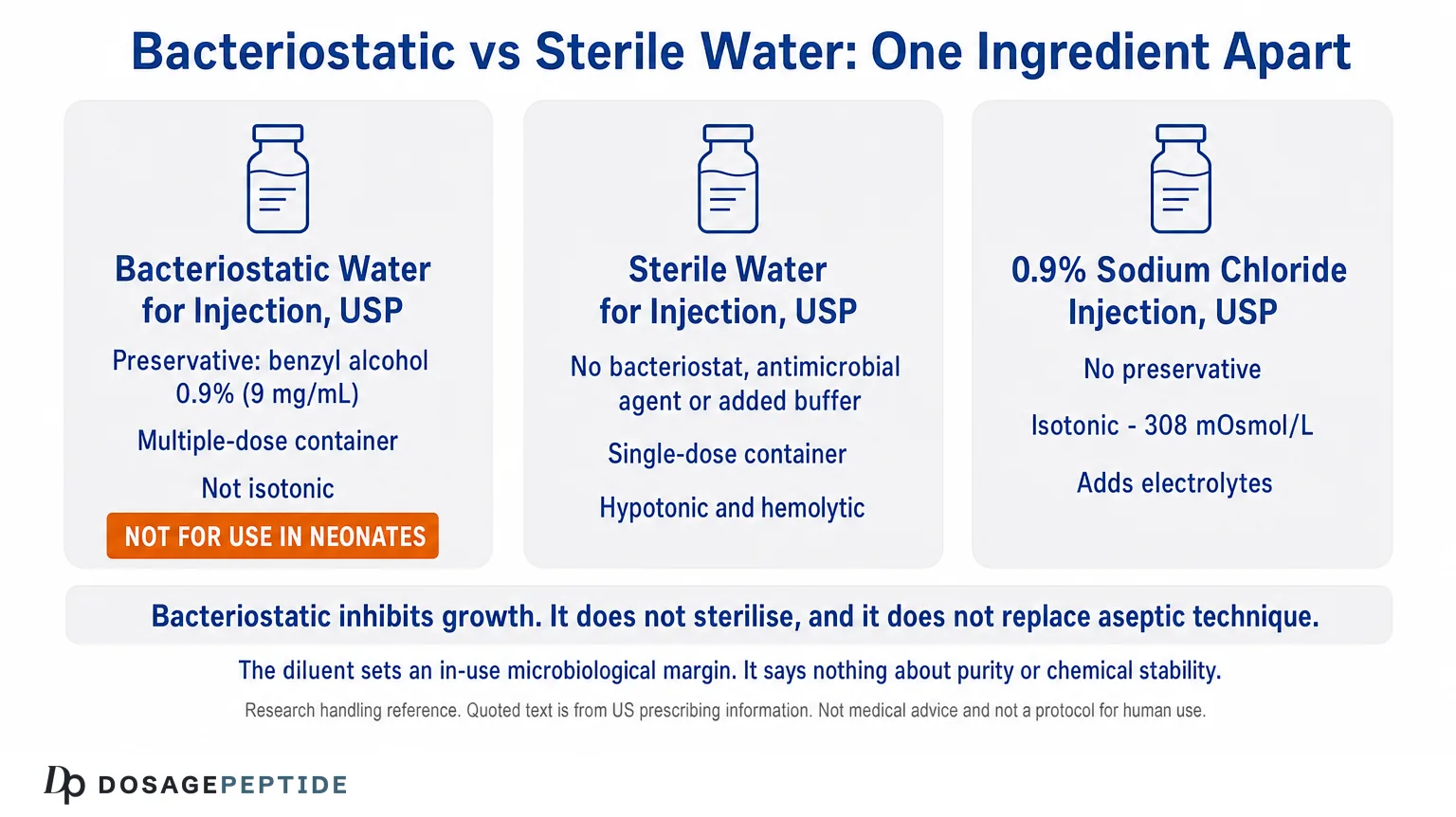
A bacteriostatic agent inhibits bacterial replication; a bactericidal agent kills. The categories are separable by the in vitro definition, though a widely cited review of antibacterial therapy argues the distinction becomes more arbitrary once clinical outcomes are considered.12 Three consequences follow, each routinely misread:
- Bacteriostatic is not sterilising. A preservative suppresses proliferation of what gets in; it does not sterilise a vial’s contents.
- It does not rescue a contaminated vial. Preservative performance is established against a defined laboratory challenge — USP General Chapter <797> requires an aqueous multiple-dose compounded sterile preparation to pass antimicrobial effectiveness testing in accordance with General Chapter <51>.9 A bounded test, not protection against arbitrary insult.
- It does not make aseptic technique optional. The BWFI label is explicit: “Use aseptic technique for single or multiple entry and withdrawal from all containers.”1
And no preservative addresses viruses, particulate contamination, endotoxin, or a compound that was impure before it met water.
Why neither water is isotonic
Sterile Water for Injection carries an explicit warning: “Hypotonic and hemolytic. Do not inject until made approximately isotonic by addition of appropriate solute.”2 The mechanism is osmosis: solute-free water drives water into red cells until they lyse. The point that gets lost is that BWFI carries the same requirement — benzyl alcohol confers no tonicity. Its label states it “must be made approximately isotonic prior to use,” and that “intravenous administration of Bacteriostatic Water for Injection without a solute may result in hemolysis.”1 Both are, in regulatory terms, vehicles: the tonicity of the finished solution is set by what is dissolved in them — which is why 0.9% Sodium Chloride Injection occupies a different column entirely.4
Benzyl alcohol: the documented safety record
Gasping syndrome and the neonatal contraindication
The neonatal contraindication on every BWFI vial is not precautionary boilerplate. Gershanik and colleagues, in the New England Journal of Medicine in November 1982, described ten premature infants who deteriorated across multiple organ systems and died — a picture they attributed to benzyl alcohol poisoning and named the “gasping syndrome.” The infants had received repeated flushes of heparinised bacteriostatic sodium chloride and medications reconstituted with bacteriostatic water, both at 0.9% benzyl alcohol.6 The American Academy of Pediatrics followed in Pediatrics in September 1983 with “Benzyl alcohol: toxic agent in neonatal units,” on umbilical vessel catheters flushed from multiple-dose vials, recording the FDA advisory of May 1982 against benzyl alcohol-preserved flush solutions in newborns.7
The European Medicines Agency’s questions-and-answers document on benzyl alcohol as an excipient names the mechanism: “the risk of accumulation in newborn babies (pre- and full-term) due to metabolic immaturity.” Intravenous benzyl alcohol at 100 to 200 mg/kg/day “has been linked to the ‘gasping syndrome’ in several pre-term newborns with metabolic acidosis,” and “the majority of poisonings were fatal.”8 The label response is permanent, in capitals — “WARNING: NOT FOR USE IN NEONATES” — and continues: “Where water is required for preparing or diluting medications for use in neonates, only preservative-free Sterile Water for Injection should be used.”1
The accumulation and volume problem
Toxicity here is a dose-and-clearance problem, and the BWFI label flags its evidence tier: while adverse effects of injecting 0.9% benzyl alcohol “are not known to occur in man,” experimental studies in several species of animals indicated that “an estimated intravenous dose up to 30 mL may be safely given to an adult without toxic effects,” whereas “administration of an estimated 9 mL to a 6 kg infant or neonate is potentially capable of producing blood pressure changes.” The label also bars benzyl alcohol-containing parenteral preparations from fluid replacement and from epidural or spinal anaesthesia.1
One number circulates widely and is usually misattributed. The 90 mg/kg/day parenteral threshold, above which products were not to be used in infants and children up to 3 years old, comes from the 2003 EU excipients guideline — reproduced only as a historical annex in the current EMA document, which states plainly that those earlier recommendations were “incomplete and too strict.” What replaced it sets a package-leaflet declaration threshold of zero for all routes: any amount must be declared; the excipient should not be used in neonates but “may be used for children aged older than 4 weeks with caution”; and the leaflet warns against use beyond a week in children under 3 because of accumulation. That document also concedes that “the minimum amount of benzyl alcohol at which toxicity may occur is not known.”8 The concern attaches to cumulative volume and to immature clearance, not to a measured no-effect level.
Hypersensitivity
Benzyl alcohol is also a recognised contact allergen, named Allergen of the Year for 2026 by the American Contact Dermatitis Society, partly because it “is not included in many standard patch test series.”14 EMA guidance separately requires the statement “Benzyl alcohol may cause allergic reactions” across all routes at any concentration.8 Known hypersensitivity is one of the situations where labelling directs the preservative-free article specifically rather than treating the two as interchangeable.13 Broader context is in the reference page on peptide safety and its limits.
Compatibility: when the preservative is the wrong choice
The under-discussed point here is that benzyl alcohol is not inert toward the material dissolved in it. Zhang and colleagues, in the Journal of Pharmaceutical Sciences in 2004, described the mechanism for benzyl alcohol-induced aggregation of recombinant human interleukin-1 receptor antagonist: minor perturbation of tertiary structure that increased partially unfolded, aggregation-competent species, with sucrose partially inhibiting the effect.10 Bis and colleagues reported in 2015 that benzyl alcohol induced concentration-dependent aggregation of interferon α-2a through partial rather than global unfolding.11
Two honest caveats. These are therapeutic proteins, larger and more conformationally complex than most research peptides, so the finding does not automatically transfer to a short sequence; and the effect is formulation-dependent. The literature establishes that “preservative” and “inert” are not synonyms — not that benzyl alcohol degrades every peptide.
The regulatory record illustrates the same principle. Serostim (somatropin) is supplied in presentations that differ by diluent, and the in-use periods differ with them. The 4 mg single-patient-use vial is co-packaged with BWFI, USP (0.9% benzyl alcohol) and, once reconstituted, “may be refrigerated at 2°C to 8°C (36°F to 46°F) for up to 14 days.” The 5 mg and 6 mg presentations are co-packaged with SWFI, USP, are single-dose, and are directed to immediate use: “Discard any unused portion.” The label also directs that the preserved diluent not be used in known benzyl alcohol hypersensitivity or in pregnant or lactating women, and that SWFI be used instead.13
Those figures belong to Serostim’s own stability programme, and the presentations differ in container design as well as diluent, so they cannot be transplanted onto an unrelated compound. What generalises is the rule they illustrate: the diluent is determined by the material’s own documentation, not by a general rule about water. The BWFI label says as much under Drug Interactions — “Some drugs for injection may be incompatible in a given vehicle, or when combined in the same vehicle or in a vehicle containing benzyl alcohol.”1 See also the reference on combining peptides in the same syringe.
In-use and storage implications
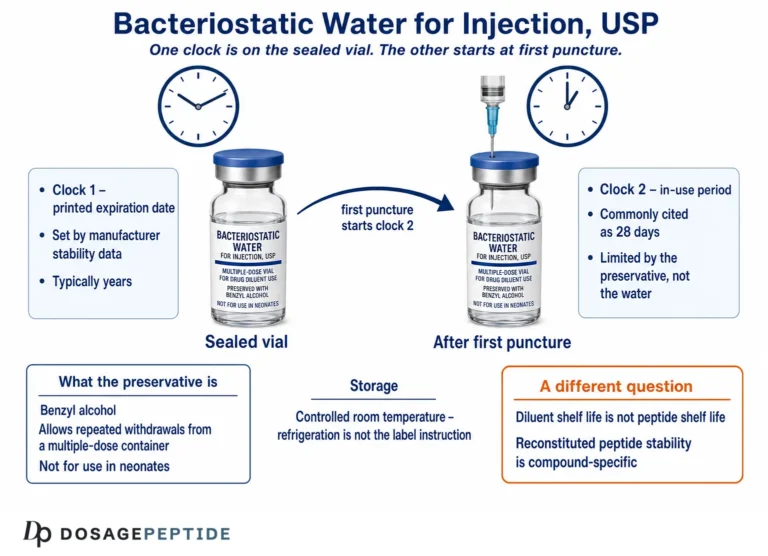
Repeated vial entry is a materially different proposition, and the compendial standards reflect that. Under USP General Chapter <797> — published 1 November 2022, official since 1 November 2023 — a multiple-dose container must not be used for more than 28 days after first puncture unless the labelling specifies otherwise; a vial with a longer assigned beyond-use date “must still be discarded no later 28 days after first puncture.” A conventionally manufactured single-dose container must be entered inside an ISO Class 5 or cleaner primary engineering control and may then be used for up to 12 hours if storage conditions hold; opened single-dose ampules, and vials whose closure integrity is compromised, “must not be stored for any period of time.”9
Three things about that 28-day figure need saying precisely, because it is the most misquoted number here:
- It is a microbiological in-use limit on the container, silent on the chemical stability of what is dissolved in it.
- Its scope is compounded sterile preparations in facilities operating under USP <797> — not a universal law of vials, nor a research-material stability specification.
- It is subordinate to the manufacturer’s labelling. Serostim, at 14 days with BWFI, is exactly such a case — shorter, not longer.13
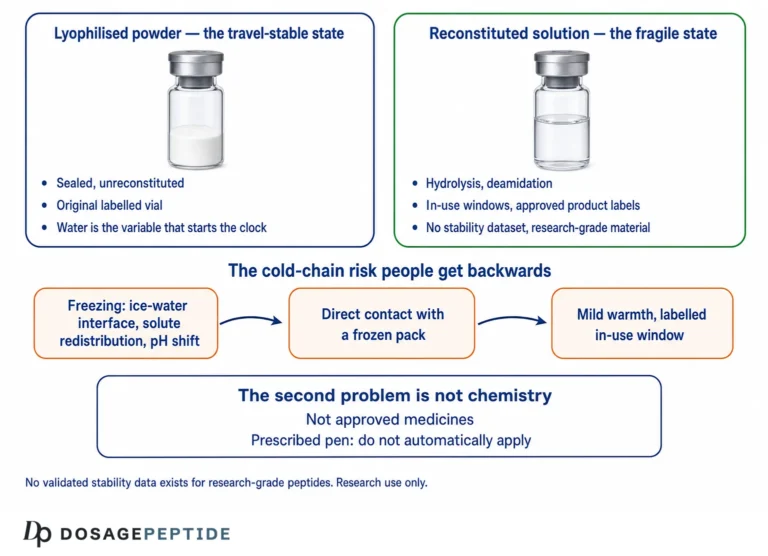
Refrigeration and light act independently. The preservative addresses microbial growth; temperature and light address chemical degradation — deamidation, oxidation, hydrolysis, physical aggregation — which proceeds whether or not a preservative is present.15 A preserved vial stored warm is not protected against chemical decay; an unpreserved vial stored cold is not protected against contamination. These are orthogonal controls, covered in the references on storage before and after reconstitution and on refrigeration requirements.
Where 0.9% sodium chloride fits
The third column exists because preservative status and tonicity are independent variables; treating “bacteriostatic” as a synonym for “salted” is a common error. 0.9% Sodium Chloride Injection, USP is “sterile, nonpyrogenic, isotonic and contains no bacteriostatic or antimicrobial agents.”4 Separately, Bacteriostatic 0.9% Sodium Chloride Injection, USP is its own labelled product — isotonic, sodium chloride 9 mg/mL and 0.9% benzyl alcohol, in multiple-dose vials, with its own “NOT FOR USE IN NEWBORNS” heading.5 Four combinations of preservative and tonicity exist commercially, so the vial label — not the category name — is the reliable identifier.
What diluent choice does not tell you
It does not validate purity or identity. Neither says anything about what was in the vial before the water was added. Purity and identity are analytical questions answered by lot-specific third-party testing — mass spectrometry and HPLC — not by the vehicle.
It does not extend chemical stability indefinitely. The preservative constrains microbial growth for a bounded period. It does not stop peptide bond hydrolysis, deamidation, oxidation, disulfide scrambling or physical aggregation, all established degradation routes for protein pharmaceuticals in aqueous solution.15 Nothing about benzyl alcohol slows those pathways, and for some molecules it does the opposite.1011 Molecule-specific stability programmes — the kind behind the figures on an approved label — are largely absent from the public literature for research chemicals; figures circulated for those are extrapolation or convention, not a regulator-reviewed in-use claim.
It does not determine volume. How much diluent to add is concentration arithmetic, independent of which diluent is used; see the reference on reconstitution volume, the concentration calculator, and the insulin syringe units reference.
Frequently Asked Questions
What is the actual difference between bacteriostatic water and sterile water?
One ingredient. BWFI, USP contains benzyl alcohol as a preservative, conventionally 0.9% (9 mg/mL); SWFI, USP “contains no bacteriostat, antimicrobial agent or added buffer.” Everything else — the water, the sterility, the non-pyrogenicity, the absence of tonicity — is common to both.13
Is bacteriostatic water sterile?
Yes. Both are labelled sterile and nonpyrogenic as supplied. “Bacteriostatic” describes an added preservative that inhibits growth after the container is entered; it is not a claim about initial sterility, which both share.13
Does the preservative kill bacteria that get into the vial?
No — bacteriostatic agents inhibit replication, bactericidal agents kill.12 A preservative gives a bounded in-use margin against small numbers of organisms; it does not sterilise a contaminated container and does not substitute for aseptic technique, which the BWFI label requires for every entry and withdrawal.1
Why is bacteriostatic water contraindicated in neonates?
Documented benzyl alcohol toxicity: 1982 case reports and the 1983 American Academy of Pediatrics statement established the association with fatal gasping syndrome in premature infants,67 and EMA guidance attributes it to accumulation from metabolic immaturity.8 The US label states “WARNING: NOT FOR USE IN NEONATES” and directs preservative-free SWFI instead.1
Is sterile water isotonic?
No. Its label warns that it is hypotonic and hemolytic and must not be injected until made approximately isotonic by an appropriate solute.2 BWFI carries the same requirement.1 The isotonic article here is 0.9% Sodium Chloride Injection, USP, at 308 mOsmol/L.4
Does the 28-day rule apply to reconstituted research peptides?
Not as a general fact. It is the limit USP General Chapter <797> places on a multiple-dose container after first entry, unless labelling specifies otherwise, scoped to compounded sterile preparations in facilities operating under that chapter.9 It is a microbiological in-use limit, not a chemical stability claim.
Can benzyl alcohol damage the compound being reconstituted?
It can for some molecules. Work in the Journal of Pharmaceutical Sciences documents benzyl alcohol accelerating aggregation of recombinant human interleukin-1 receptor antagonist, and a comparable role with interferon α-2a.1011 Those are therapeutic proteins rather than short peptides, so it should not be over-generalised — but a preservative is not a neutral additive.
Does choosing bacteriostatic water say anything about the quality of the material?
Nothing at all. The diluent has no bearing on the identity, purity, potency or endotoxin content of whatever was in the vial beforehand — those are answered by lot-specific third-party testing.
References
- Bacteriostatic Water for Injection, USP (Hospira, Inc.) — prescribing information, rev. 08/2019. DailyMed. dailymed.nlm.nih.gov
- Sterile Water for Injection USP (B. Braun Medical Inc.) — prescribing information. DailyMed. dailymed.nlm.nih.gov
- Sterile Water for Injection, USP (Hospira, Inc.) — approved labelling. Pfizer Labeling Information. labeling.pfizer.com
- 0.9% Sodium Chloride Injection USP (B. Braun Medical Inc.) — prescribing information. DailyMed. dailymed.nlm.nih.gov
- Bacteriostatic Sodium Chloride Injection, USP 0.9% (Fresenius Kabi USA, LLC) — prescribing information. DailyMed. dailymed.nlm.nih.gov
- Gershanik J, Boecler B, Ensley H, McCloskey S, George W. The gasping syndrome and benzyl alcohol poisoning. N Engl J Med. 1982;307(22):1384–8. PMID 7133084. pubmed.ncbi.nlm.nih.gov/7133084
- American Academy of Pediatrics, Committee on Fetus and Newborn and Committee on Drugs. Benzyl alcohol: toxic agent in neonatal units. Pediatrics. 1983;72(3):356–8. PMID 6889041. pubmed.ncbi.nlm.nih.gov/6889041
- European Medicines Agency (CHMP). Questions and answers on benzyl alcohol used as an excipient in medicinal products for human use. EMA/CHMP/508188/2013, published 9 October 2017. ema.europa.eu (PDF)
- United States Pharmacopeial Convention. General Chapter <797> Pharmaceutical Compounding — Sterile Preparations: FAQs, updated 11 December 2023. pages.usp.org (PDF)
- Zhang Y, Roy S, Jones LS, et al. Mechanism for benzyl alcohol-induced aggregation of recombinant human interleukin-1 receptor antagonist in aqueous solution. J Pharm Sci. 2004;93(12):3076–89. PMID 15514986. pubmed.ncbi.nlm.nih.gov/15514986
- Bis RL, Singh SM, Cabello-Villegas J, Mallela KMG. Role of benzyl alcohol in the unfolding and aggregation of interferon α-2a. J Pharm Sci. 2015;104(2):407–15. PMID 25100180. pubmed.ncbi.nlm.nih.gov/25100180
- Pankey GA, Sabath LD. Clinical relevance of bacteriostatic versus bactericidal mechanisms of action in the treatment of Gram-positive bacterial infections. Clin Infect Dis. 2004;38(6):864–70. PMID 14999632. pubmed.ncbi.nlm.nih.gov/14999632
- SEROSTIM (somatropin) for injection — FDA-approved prescribing information (EMD Serono, Inc.). DailyMed. dailymed.nlm.nih.gov
- Le NT, Wu PA. Benzyl alcohol: Allergen of the Year 2026. Dermatitis. 2026;37(1):4–12. PMID 41649135. doi:10.1177/17103568251386038. pubmed.ncbi.nlm.nih.gov/41649135
- Manning MC, Chou DK, Murphy BM, Payne RW, Katayama DS. Stability of protein pharmaceuticals: an update. Pharm Res. 2010;27(4):544–75. PMID 20143256. pubmed.ncbi.nlm.nih.gov/20143256
Research use only. This page is a laboratory-handling and diluent-chemistry reference compiled from regulatory labelling, compendial standards and peer-reviewed literature. It is not medical advice, not a treatment protocol, and not a recommendation for human use; the neonatal and toxicology material is reproduced as documented regulatory record. Any clinical question belongs with a qualified healthcare professional, and the manufacturer’s documentation governs the handling of any specific material.