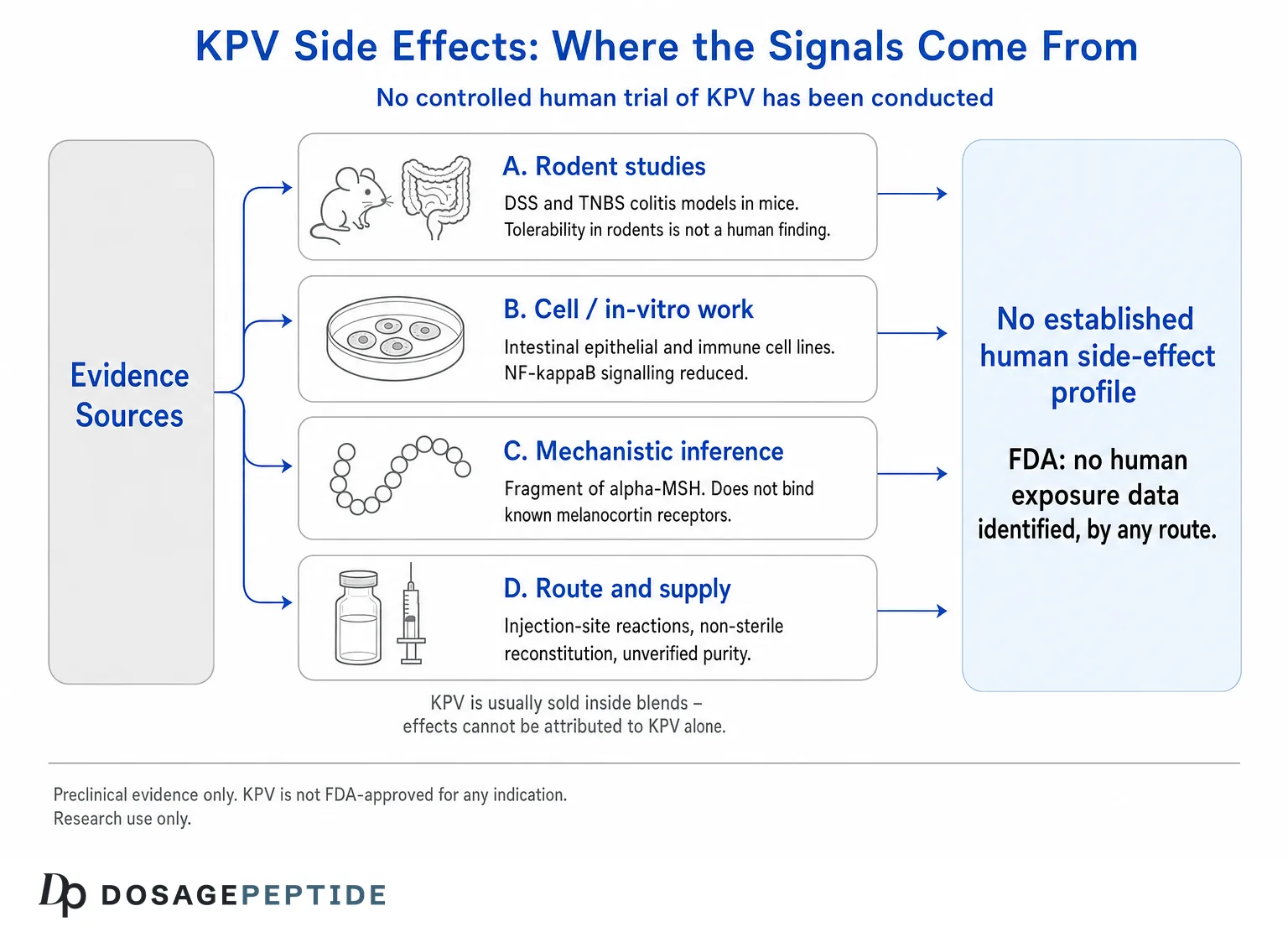
There is no controlled human clinical trial of KPV, so there is no established human side-effect profile — and that is not a stylistic hedge, it is the regulator’s own position. In its evaluation of KPV-related bulk drug substances, the FDA states plainly that it “has not identified any human exposure data on drug products containing KPV administered via any route of administration,” and that it lacks the information needed to know whether KPV would cause harm if administered to humans.[1] Every “KPV side effects” list circulating online is therefore an extrapolation — from alpha-MSH biology, from rodent studies, from anecdote, or from risks that belong to the injection itself rather than to the molecule. This article separates those sources so you can see exactly which is which.
What can actually be said about KPV side effects, by evidence source?
The table below is not a list of reported human adverse reactions, because no such list exists. Each row states where the signal comes from, how strong it is, and what is still unknown.
| Potential effect | Where the signal comes from | Evidence strength | What remains unknown |
|---|---|---|---|
| Injection-site redness, swelling, soreness, bruising | Route-related. Generic to any subcutaneous injection; not specific to KPV | High for the route itself; zero KPV-specific human data | Whether KPV in solution is itself irritating to human tissue at any concentration |
| Local infection, abscess, cellulitis | Preparation-related. Non-sterile reconstitution, handling, or storage | High as a general injection risk; no KPV-specific incidence data | Contamination rates in research-grade vials and home reconstitution |
| Immunogenicity / anti-drug antibody response | Mechanistic and regulatory inference. FDA notes peptides can aggregate and that aggregation is a risk factor for immunogenicity | Theoretical. FDA states available data are insufficient to conclude KPV does not present this risk[2] | Whether a tripeptide this small provokes a clinically meaningful response; never measured in humans |
| Reactions to synthesis impurities (truncated sequences, residual solvents, reagents) | Supply-related. FDA chemistry review found most KPV certificates of analysis report purity only | Documented supply-chain gap, not a documented clinical event[2] | Actual impurity burden of any individual vial |
| Skin darkening / tanning | Mechanism. KPV did not displace radiolabelled alpha-MSH at melanocortin receptors[2] and did not raise cAMP in MC1R-expressing macrophages[10] | Consistent across in-vitro and animal work; no human data | Never formally tested in people; inference only |
| Gastrointestinal effects after oral exposure | Animal. Oral KPV in drinking water in DSS- and TNBS-colitis mice | Preclinical only; effect direction was anti-inflammatory, and no toxicology studies were run[5] | Human oral tolerability, absorption, and dose — entirely unstudied |
| Systemic effects after topical application | In-vitro. KPV showed no detectable passive permeation across human cadaver skin | Single in-vitro study; suggests low systemic exposure from intact skin[13] | What happens over broken skin, or when microneedling/iontophoresis is used to force penetration |
| Any effect experienced while using a KPV-containing blend | Formulation. KPV is commonly sold inside multi-peptide blends | Attribution to KPV is logically impossible in a blend | Which component of the blend — if any — produced the effect |
What is KPV, and why does its mechanism matter to the safety question?
KPV is the tripeptide lysine–proline–valine, corresponding to residues 11–13 at the C-terminus of alpha-melanocyte-stimulating hormone (alpha-MSH). The free base has the molecular formula C16H30N4O4 and a molecular weight of 342.43 g/mol.[2] Reconstitution arithmetic and the resulting concentrations for a standard vial are set out separately in our KPV 10mg dosage chart and reconstitution, and the background on the molecule itself, rather than its risks, is covered in our overview of what KPV is and where it has been studied.
Mechanism matters because the most common fear about KPV — that it will behave like alpha-MSH — appears, on the available preclinical evidence, to be misplaced. Alpha-MSH drives pigmentation by activating the melanocortin-1 receptor on melanocytes. KPV lacks the sequence motif required to bind any of the known melanocortin receptors[12] and, on FDA’s reading of the binding literature, failed to displace radiolabelled alpha-MSH from rat brain tissue, murine melanoma cells and MC1R-expressing macrophages, and unlike alpha-MSH did not raise cAMP in those macrophages.[2] In a crystal-induced peritonitis model, KPV retained anti-inflammatory activity in mice with a non-functional MC1 receptor, and its effect was not blocked by an MC3/MC4 antagonist — leading the authors to conclude it is unlikely to act through melanocortin receptors at all.[10] Reviews in this field describe the C-terminal tripeptide as retaining much of the parent hormone’s anti-inflammatory capacity[11][14] while displaying a lack of pigmentary action.[12]
Two caveats. First, this is an inference from receptor pharmacology in cells and rodents, not a human finding — nobody has looked for pigmentary changes in people given KPV, because nobody has published giving KPV to people. Second, an approved alpha-MSH analog does exist: afamelanotide (SCENESSE), an MC1-R agonist approved to increase pain-free light exposure in adults with a history of phototoxic reactions from erythropoietic protoporphyria.[15] That approval belongs to a different molecule with a different receptor profile and a different indication. It confers nothing on KPV.
What do the animal and in-vitro tolerability data actually show?
The KPV literature is real — anti-inflammatory effects in murine colitis have been reported by more than one independent group[5][6] — but it is almost entirely about efficacy signals in rodents and cell lines, not about toxicity.
Colitis models in mice
The foundational paper showed nanomolar KPV inhibiting NF-kappaB and MAP kinase signalling in human intestinal epithelial cell lines (Caco2-BBE, HT29-Cl.19A) and Jurkat T cells, entering via the di/tripeptide transporter PepT1; oral KPV in drinking water reduced the severity of both DSS- and TNBS-induced colitis in mice.[5] A separate group tested KPV in DSS colitis and CD45RB-high transfer colitis, reporting faster recovery, greater weight regain, reduced histological infiltrate and lower myeloperoxidase activity.[6] In the AOM/DSS colitis-associated cancer model, KPV reduced tumorigenesis in wild-type mice but not in PepT1-knockout mice, reinforcing the transporter-dependent mechanism.[9]
Nanoparticle and oral-delivery work
Because free KPV is poorly retained in the gut, much of the field moved to delivery systems. KPV-loaded nanoparticles (~400 nm) in an alginate–chitosan hydrogel did not affect cell viability or epithelial barrier function in vitro and protected DSS-colitis mice at a KPV concentration roughly 12,000-fold lower than free solution.[7] Hyaluronic-acid-functionalised KPV nanoparticles were similarly described as non-toxic and biocompatible with intestinal cells in a mouse ulcerative colitis model.[8]
What that does and does not establish
“Non-toxic to Caco-2 cells” and “well tolerated in a mouse colitis model” are not human safety findings. They are efficacy experiments with a tolerability footnote, run in small numbers of inbred mice over days to weeks, using formulations nothing like a reconstituted vial. Crucially, FDA’s May 2026 review searched for the studies that would constitute a safety package — pharmacokinetics, acute toxicity, repeat-dose toxicity, genotoxicity, developmental and reproductive toxicity, and carcinogenicity — and identified none for either KPV free base or KPV acetate.[2] That is the single most important fact in this article: not that KPV looked dangerous, but that the experiments capable of detecting danger were never done.
Why are the anecdotal reports not evidence?
Search results are full of claimed KPV effects — fatigue, headache, flushing, mild nausea, injection-site reactions. Treat them as uninformative for four structural reasons, none of which implies the reporters are lying.
- No surveillance system captures them. FDA searched the FDA Adverse Event Reporting System (FAERS) and the medical literature for KPV adverse events through 3 December 2025 and retrieved no reports at all; a parallel search of the Human Foods Complaint System covering 2004 to December 2025 likewise returned no cases where KPV was administered.[2] Zero reports is not evidence of safety — it is evidence that nothing is being systematically collected.
- There is no denominator. Ten forum posts describing headaches mean nothing without knowing whether ten or ten thousand people used the compound.
- There is no control condition. Nobody reports the headaches they would have had anyway. Without a comparator, attribution is guesswork.
- Exposure is rarely clean. Most reports involve blends, stacked compounds, unverified sourcing, or concurrent lifestyle changes.
Anecdote is not worthless in principle — clusters of unusual, specific, temporally-linked events have historically flagged real drug risks. But in KPV’s case the anecdotal record is too thin and too confounded to support any claim in either direction.
What risks come from the route and the preparation rather than the molecule?
These are the risks that are real regardless of what KPV does pharmacologically, and they are the ones most worth understanding.
Subcutaneous injection and reconstitution
Any subcutaneous injection can produce local redness, swelling, tenderness, bruising or a small nodule, and any non-sterile injection can seed infection. None of that is KPV-specific; it is a property of putting a needle through skin. Research vials arrive as lyophilised powder requiring reconstitution, which introduces contamination risk at every step — stopper technique, needle re-use, storage temperature, and how long a reconstituted vial is kept. Our peptide reconstitution guide covers sterile technique and bacteriostatic versus sterile water.
A large share of what gets called a “side effect” is arithmetic: miscalculating diluent volume changes the delivered amount by a multiple, not a percentage. The worked numbers for a standard vial are in the KPV dosage chart linked earlier, with route-by-route conversions in the accompanying KPV dosage chart and route comparison. Both describe what published research protocols used; neither recommends administering anything.
Oral and topical formulations
Oral and enteric-coated KPV products are widely marketed, so be precise about what the science supports: the successful oral experiments used nanoparticle and hydrogel systems engineered to survive the upper gut and release in the colon[7][8] — not loose powder in a capsule. For topical use, an in-vitro study on human skin found KPV permeation below the detection limit by passive diffusion; only microneedle abrasion and iontophoresis produced meaningful penetration.[13] FDA notes this cuts both ways: poor permeation limits systemic toxicity, but also limits whether a topical product reaches anything below the stratum corneum — and whether deliberately breaching the skin barrier raises systemic absorption is unknown.[2] Unfamiliar terms are defined in our peptide research glossary.
Why does the blend problem make KPV side effects unknowable in practice?
This is the most under-discussed issue in the entire topic. KPV rarely arrives alone. It is a component of the KLOW blend (GHK-Cu, BPC-157, TB-500 and KPV) and of Tri-Heal (TB-500, BPC-157 and KPV), and FDA’s own review notes it is promoted commercially alongside BPC-157, TB-500, AOD-9604 and Follistatin-344.[2]
Three consequences follow. First, attribution becomes impossible: if someone reports flushing on KLOW, there is no principled way to assign it to KPV rather than to GHK-Cu, BPC-157, TB-500, an excipient, or the injection itself. Second, the risk is additive but the evidence is not — injectable GHK-Cu and TB-500 both appear on FDA’s list of nominated bulk substances flagged for immunogenicity and aggregation concerns, with FDA noting it has identified no human exposure data for TB-500 either.[1] Third, blends multiply the analytical burden: a four-peptide vial requires four sets of related impurities to be characterised, and FDA’s review found KPV certificates typically report a purity figure and little else.[2]
In short: any “KPV side effect” sourced from blend use is, at best, a blend side effect.
What is KPV’s regulatory status right now?
KPV is not an FDA-approved drug for any indication. There is no USP or National Formulary monograph for KPV free base or KPV acetate, and neither is a component of any FDA-approved drug product.[2] It is supplied as a research chemical, labelled for research use only and not for human consumption.
On the compounding side the picture is genuinely in motion. KPV appears on FDA’s public list of bulk drug substances that may present significant safety risks, in the section covering substances previously in category 2 of the interim policies whose nominations were withdrawn; FDA’s stated concern is the absence of any human exposure data.[1] FDA nevertheless continued evaluating KPV free base and KPV acetate on its own initiative, and in a briefing document dated 12 May 2026 concluded the statutory criteria “weigh against” adding either to the 503A Bulks List, citing poor physicochemical characterisation, unknown extent of compounding use and non-existent human data.[2] The Pharmacy Compounding Advisory Committee was scheduled to discuss KPV-related substances on 23 July 2026, for the evaluated uses of wound healing and inflammatory conditions.[3] The committee then voted against FDA’s own staff position: it recommended KPV for the 503A Bulks List by 8 votes to 6 with one abstention — the same tally recorded that day for BPC-157 and TB-500, with MOTS-c passing 7 to 5 with two abstentions.[16] That recommendation changes nothing about KPV’s current legal status, and it adds no new safety evidence: the vote was taken on the same empty human dataset described above.
Two things must not be blurred. An advisory committee makes non-binding recommendations; FDA generally follows them but is not legally bound to.[3] And placement on the 503A Bulks List — which would only permit use in preparations compounded by licensed pharmacists and physicians — happens through notice-and-comment rulemaking and is a different thing entirely from drug approval.[4] Neither the committee’s favourable vote nor eventual list placement would establish that KPV is safe or effective.
What would have to happen for a real KPV safety profile to exist?
The path is not mysterious; it is simply unwalked.
- Nonclinical toxicology. Acute and repeat-dose toxicity, genotoxicity, developmental and reproductive toxicity, and — for chronic use — carcinogenicity. FDA found none of these for KPV.[2]
- A characterised, reproducible drug substance: consistent nomenclature (free base and acetate are distinct active ingredients), a defined impurity profile, aggregate testing, and microbiological limits — the exact gaps FDA identified.[2]
- A phase 1 study. Single then multiple ascending dose in healthy volunteers, with pharmacokinetics and an immunogenicity assay. No human PK data of any kind currently exist.
- Dose-ranging and placebo-controlled efficacy trials in a defined condition, powered to detect adverse events.
- Post-marketing surveillance to catch rare events trials are too small to see.
Until at least steps 1 through 3 exist in the public record, the accurate statement about KPV side effects is not “mild and rare.” It is “unknown.”
Frequently Asked Questions
Is KPV safe?
Nobody knows, and that is the accurate answer rather than an evasive one. Safety is a conclusion drawn from data, and for KPV the relevant data do not exist: no human trials, no human pharmacokinetics, no acute or repeat-dose toxicity, no genotoxicity or reproductive toxicity testing. FDA has stated it has not identified any human exposure data for KPV by any route. Absence of reported harm is not evidence of safety when nothing is being systematically recorded.
Does KPV cause tanning or skin darkening?
There is no evidence that it does, and mechanistic reasoning suggests it should not. Alpha-MSH drives pigmentation through the melanocortin-1 receptor, but KPV lacks the sequence motif required to bind any known melanocortin receptor, does not displace radiolabelled alpha-MSH in binding assays, and does not raise cAMP in MC1R-expressing cells. Review authors describe it as retaining anti-inflammatory activity without pigmentary action. That is an inference from cell and animal work, not a human finding.
Can KPV be taken orally?
Oral KPV products are sold, but the published oral research used engineered delivery systems — nanoparticles encapsulated in alginate–chitosan hydrogels designed to survive the stomach and release in the colon — not plain powder in a capsule. Those studies were conducted in mice with chemically induced colitis. There is no human data on oral KPV absorption, bioavailability, dosing, or tolerability, so no oral protocol can be described as validated.
Why do so many websites list specific KPV side effects if there are no trials?
Because the lists are assembled from three borrowed sources: alpha-MSH pharmacology (a different, larger molecule), generic injection-related effects that would occur with sterile saline, and forum anecdote without controls or denominators. None is a KPV-specific human observation. A list that reads like a drug label but has no trial behind it is a formatting choice, not evidence.
Is KPV FDA-approved for anything?
No. KPV is not approved for any indication, has no USP or National Formulary monograph, and is not a component of any FDA-approved drug. It is supplied for research use only. An FDA-approved alpha-MSH analog does exist — afamelanotide, approved to increase pain-free light exposure in adults with a history of phototoxic reactions from erythropoietic protoporphyria — but that is a different molecule with a different receptor profile, and its approval says nothing about KPV.
Does the July 2026 FDA advisory committee vote mean KPV is now approved?
No. On 23 July 2026 the Pharmacy Compounding Advisory Committee voted 8 to 6, with one abstention, to recommend KPV-related bulk substances for inclusion on the 503A Bulks List — a favourable vote, and one taken against FDA staff’s own written position that the criteria weigh against listing. But a committee recommendation is non-binding, FDA has not acted on it, and list placement proceeds through notice-and-comment rulemaking that has not occurred. If KPV is eventually added, that would permit use by licensed compounders under specific conditions — it is not drug approval and is not a finding of safety or efficacy. No human data were generated by the vote.
Are KPV injection-site reactions caused by the peptide?
There is no way to tell. Redness, swelling, tenderness and small nodules occur with subcutaneous injections generally, including with inactive solutions, and can reflect technique, needle gauge, depth, solution pH, preservative content, or contamination. Without a controlled comparison against vehicle alone in humans, an injection-site effect cannot be attributed to KPV rather than to the act of injecting.
Is KPV in a blend riskier than KPV alone?
A blend makes the risk unmeasurable rather than demonstrably higher. KPV appears in multi-peptide products alongside GHK-Cu, BPC-157 and TB-500, each of which FDA has separately flagged for immunogenicity and aggregation concerns. The human data behind them differ in degree rather than kind: FDA states it has identified no human exposure data for TB-500, describes the data in humans for injectable GHK-Cu as limited, and says it has identified no, or only limited, safety-related information for BPC-157. Combining them multiplies the number of uncharacterised substances and removes any possibility of attributing an observed effect to one component.
References
- U.S. Food and Drug Administration. Certain Bulk Drug Substances for Use in Compounding that May Present Significant Safety Risks. FDA, accessed 2026.
- U.S. Food and Drug Administration. FDA Briefing Document for KPV-Related Bulk Drug Substances (KPV free base and KPV acetate), Pharmacy Compounding Advisory Committee, July 23–24, 2026. FDA, 2026.
- U.S. Food and Drug Administration. July 23–24, 2026: Meeting of the Pharmacy Compounding Advisory Committee. FDA, 2026.
- U.S. Food and Drug Administration. Bulk Drug Substances Used in Compounding Under Section 503A of the FD&C Act. FDA, 2026.
- Dalmasso G, et al. PepT1-mediated tripeptide KPV uptake reduces intestinal inflammation. Gastroenterology, 2008;134(1):166–178.
- Kannengiesser K, et al. Melanocortin-derived tripeptide KPV has anti-inflammatory potential in murine models of inflammatory bowel disease. Inflammatory Bowel Diseases, 2008;14(3):324–331.
- Laroui H, et al. Drug-loaded nanoparticles targeted to the colon with polysaccharide hydrogel reduce colitis in a mouse model. Gastroenterology, 2010;138(3):843–853.
- Xiao B, et al. Orally targeted delivery of tripeptide KPV via hyaluronic acid-functionalized nanoparticles efficiently alleviates ulcerative colitis. Molecular Therapy, 2017;25(7):1628–1640.
- Viennois E, et al. Critical role of PepT1 in promoting colitis-associated cancer and therapeutic benefits of the anti-inflammatory PepT1-mediated tripeptide KPV in a murine model. Cellular and Molecular Gastroenterology and Hepatology, 2016;2(3):340–357.
- Getting SJ, Schiöth HB, Perretti M. Dissection of the anti-inflammatory effect of the core and C-terminal (KPV) alpha-melanocyte-stimulating hormone peptides. Journal of Pharmacology and Experimental Therapeutics, 2003;306(2):631–637.
- Brzoska T, Luger TA, Maaser C, Abels C, Böhm M. Alpha-melanocyte-stimulating hormone and related tripeptides: biochemistry, antiinflammatory and protective effects in vitro and in vivo, and future perspectives for the treatment of immune-mediated inflammatory diseases. Endocrine Reviews, 2008;29(5):581–602.
- Brzoska T, Böhm M, Lügering A, Loser K, Luger TA. Terminal signal: anti-inflammatory effects of alpha-melanocyte-stimulating hormone related peptides beyond the pharmacophore. Advances in Experimental Medicine and Biology, 2010;681:107–116.
- Pawar K, Kolli CS, Rangari VK, Babu RJ. Transdermal iontophoretic delivery of lysine-proline-valine (KPV) peptide across microporated human skin. Journal of Pharmaceutical Sciences, 2017;106(7):1814–1820.
- Böhm M, Luger T. Are melanocortin peptides future therapeutics for cutaneous wound healing? Experimental Dermatology, 2019;28(3):219–224.
- DailyMed / U.S. National Library of Medicine. SCENESSE (afamelanotide) implant — prescribing information. Accessed 2026.
- Jacobus N. FDA panel votes to loosen restrictions for four peptides. Pharmaceutical Executive, 24 July 2026.
Research use only. KPV is not an FDA-approved drug for any indication and is not approved for human therapeutic use. Nothing in this article is medical advice, a dosing recommendation, or a suggestion to administer any compound to a human or animal. It is a summary of published preclinical literature and publicly available regulatory documents, compiled for researchers and for readers evaluating claims they encounter elsewhere.