
Enclomiphene (25 mg) Dosage Protocol
An oral SERM and the trans-isomer of clomiphene citrate, studied as a research chemical for its effects on the HPTA and endogenous testosterone production — not an approved standalone drug in most markets.
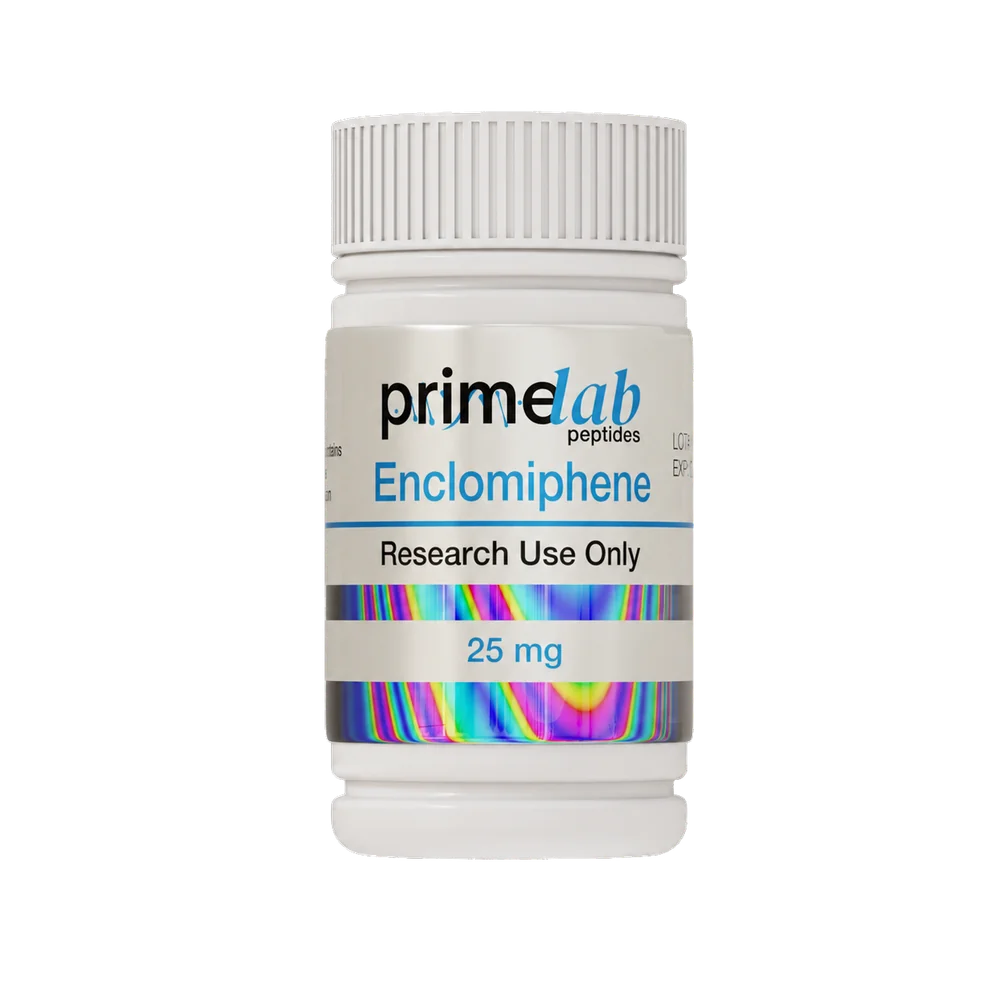
Estrogen-receptor antagonist at the hypothalamus/pituitary; studied for lifting negative feedback to raise LH, FSH and endogenous testosterone.
Doses of 12.5 mg and 25 mg once daily appear across the published human trials; presented here as reference data, not advice.
Oral compound, typically supplied as 12.5 mg or 25 mg capsules of enclomiphene citrate; no reconstitution required.
Store sealed, dry, at room temperature away from light and humidity per general small-molecule handling practice.
Quickstart Highlights
Enclomiphene citrate is the trans-isomer of clomiphene and an orally active selective estrogen-receptor modulator (SERM) — effectively the purified, more strongly anti-estrogenic half of the compound long marketed as Clomid, stripped of the long-accumulating estrogenic isomer zuclomiphene[1]. In the research literature it is studied almost entirely around the male hypothalamic–pituitary–testicular axis (HPTA): investigators have asked whether a SERM can raise a man’s own testosterone while preserving the pituitary drive to the testes and sperm production — something exogenous testosterone cannot do[3].
The doses and findings below reflect published trials and are provided strictly for research and educational reference — enclomiphene is not an approved standalone medicine in most markets, and nothing here is medical advice or a recommendation to self-administer.
Supplies Needed
Enclomiphene is an oral small molecule, so there is no reconstitution, needles or cold chain. The practical requirements come down to confirmed identity, consistent dosing and sensible storage.
Protocol Overview
At the 25 mg reference dose, a 30-capsule pack of 25 mg enclomiphene citrate corresponds to a 30-day window of once-daily use, while a 12.5 mg arm halves the per-dose amount. Because the studies used fixed dose arms rather than a titration, supply math is simply capsules per day × number of days.
Unlike a reconstituted vial there is no diluent to age out, but capsule-to-capsule content only stays accurate if the manufacturer’s quality control is real — a stated 25 mg is only as reliable as the batch behind it.
Dosing Protocol
The amounts below are the doses that appear in the published human research, listed as reference data to describe what was studied — not a recommendation to follow.
| Reference Arm | Daily Dose | Notes / Timing |
|---|---|---|
| Lower-dose arm | 12.5 mg once daily | Produced measurable rises in testosterone, LH and FSH in some men[1]. |
| Higher-dose arm | 25 mg once daily | Frequently the dose reaching target testosterone ranges in the trials[2]. |
| Timing | Once daily, oral | Short half-life underlies daily dosing; taken with water at a consistent time of day. |
| Trial duration | Weeks to months | Hormonal changes were observable within ~14 days; studies ran longer to assess durability[1]. |
Why Enclomiphene draws research interest
These are the directions researchers and the peptide community most often explore Enclomiphene for — so you know you’re in the right place. They describe what is being studied, not proven benefits, approved uses, or promised results.
Endogenous testosterone
Investigated for raising the body's own testosterone through central estrogen-receptor blockade — a research-chemical (SERM) approach rather than an approved therapy.
Fertility preservation
Studied for stimulating LH and FSH and maintaining sperm parameters, in contrast to exogenous testosterone, which suppresses spermatogenesis.
Secondary hypogonadism models
Examined in men with low testosterone and intact HPTA signaling; developed as Androxal but never FDA-approved.
Isomer pharmacology
Researched as the trans-isomer of clomiphene, of interest for a cleaner anti-estrogenic profile than the mixed parent compound.
Evidence ranges from early laboratory work to clinical trials depending on the use — the sections below cover the actual data and sources.
12.5 – 25 mg once daily — the two oral doses used across the human trials.
Once daily; enclomiphene’s relatively short half-life underlies daily oral dosing.
Swallowed with water at a consistent time of day — no reconstitution or injection needed.
Investigational SERM / research chemical — a real Phase II–III human dataset, but never FDA-approved.
Oral Dosing Guide
Enclomiphene reached the clinic as an investigational oral SERM, so the numbers below are the amounts that actually appear in the published human trials — reported strictly as reference data to describe what was studied, not a protocol to follow.
Documented Dosing Approach
Across the trial program enclomiphene citrate was studied at 12.5 mg and 25 mg taken orally once daily, strengths chosen to mirror the doses that raised testosterone, LH and FSH in men with secondary hypogonadism[1]. There is no titration schedule in the classic sense — the research compared fixed dose arms rather than ramping the dose upward week by week.
Individual response varied widely: baseline estradiol, LH reserve, aromatase activity and body composition all shaped how much testosterone moved at a given dose, and pushing harder raised estradiol along with testosterone rather than producing a clean linear gain[5]. In every study these figures were paired with laboratory monitoring — the objective feedback any unsupervised use lacks.
Storage Instructions
Keep enclomiphene capsules sealed, dry and at room temperature, protected from light and humidity — consistent with general small-molecule stability practice.
Store away from heat and out of reach of children and pets; a desiccant helps in humid environments. Discard any product that is discolored, damaged or past a reliable expiry.
Important Notes
Practical points for anyone reading the enclomiphene data critically.
- ▪Identity is the first problem: Because enclomiphene and clomiphene are so closely related, a product sold as “enclomiphene” can in practice be clomiphene citrate — which carries the long-accumulating zuclomiphene isomer. That substitution is invisible without HPLC / Certificate-of-Analysis verification[7].
- ▪Response is highly individual: Two people at the same nominal dose can show very different LH and testosterone changes depending on baseline hormones, aromatase activity and body composition.
- ▪More is not linearly better: SERM dose–response can plateau, and harder estrogen-receptor blockade raises estradiol alongside testosterone, since more testosterone means more aromatization[5].
- ▪Monitoring was part of the research: In the trials, testosterone, estradiol, LH, FSH and semen parameters were measured under clinical supervision — the objective anchors absent in any unsupervised setting[3].
- ▪Wrong-population risk: The mechanism only works with an intact HPTA (secondary hypogonadism); in primary testicular failure it is mechanistically inapplicable, and self-selection without a diagnosis is a fundamental hazard[4].
How This Works
The mechanism studied for enclomiphene is central estrogen-receptor antagonism. In men, estradiol produced by aromatization of testosterone provides negative feedback to the hypothalamus and pituitary, dialing down gonadotropin-releasing hormone (GnRH) and, downstream, luteinizing hormone (LH) and follicle-stimulating hormone (FSH). By occupying estrogen receptors in the hypothalamus and pituitary, enclomiphene is thought to make the brain “read” estrogen as lower than it truly is, lifting the brake on GnRH so LH and FSH rise and the testes are driven to make more testosterone[1][2].
The key contrast researchers highlight is upstream stimulation versus downstream replacement. Because the stimulus originates above the testes and works through the pituitary, the testes keep receiving their LH/FSH signal and sperm production is largely preserved — whereas exogenous testosterone replaces the hormone and suppresses the very signaling that maintains spermatogenesis. That distinction is the entire reason enclomiphene is studied in men who wish to preserve fertility[3].
Lifestyle Factors
In the trials that define this molecule, enclomiphene was studied under clinical supervision with repeated bloodwork rather than as a stand-alone lever — the research read testosterone, estradiol, LH, FSH and semen parameters to interpret any change, alongside a confirmed diagnosis of secondary hypogonadism[3].
Body composition matters mechanistically: adipose tissue is a major site of aromatase, so higher body fat can raise the estradiol feedback the compound is designed to block. Sleep, general metabolic health and body composition are the ordinary factors that shape endogenous testosterone in the first place.
Potential Benefits & Side Effects
What the peer-reviewed human literature reports for enclomiphene — a genuinely interesting short-to-medium-term hormonal dataset, but one that stalled in regulatory development, so short-term endpoints should not be read as proof of long-term benefit or safety.
Reported Effects
- ▪Endogenous testosterone restoration: Across controlled trials enclomiphene raised serum testosterone in men with secondary hypogonadism — described by researchers as restoration rather than replacement[3][4].
- ▪Fertility preservation: Unlike testosterone gel, enclomiphene maintained sperm concentration while raising testosterone — the finding that drove its development[2][4].
- ▪Gonadotropin rise: LH and FSH increased dose-dependently, consistent with disinhibited pituitary output[1].
- ▪Rapid onset in studies: Measurable hormonal shifts appeared within roughly two weeks of daily oral dosing[1].
Common Side Effects
- ▪Estradiol-driven effects: Because more testosterone means more aromatization, rising estradiol can itself cause breast tenderness or fluid changes[5].
- ▪Visual disturbances: Blurred vision, spots or flashes (scintillating scotomata) and light sensitivity are a recognized class effect of clomiphene-type SERMs, increasing with dose and duration and not always reversible[7].
- ▪Mood / neuropsychiatric changes: The clomiphene/SERM class is associated with mood changes and irritability; whether enclomiphene is meaningfully cleaner has not been settled by large, long-term studies[6].
- ▪Thromboembolic / vascular signals: SERMs as a class carry venous-thromboembolism warnings, and long-term cardiovascular data specific to enclomiphene are limited[6].
- ▪No approval, limited long-term data: Enclomiphene never obtained FDA approval, so there is no regulator-vetted long-term safety dossier — trial follow-up was measured in weeks to months, not years[8].
Oral Administration
Enclomiphene is a swallowed capsule, so “administration” is mostly about consistency, identity and knowing what you cannot see without laboratory work.
Before You Dose
- ▪Confirm what the material actually is: for a research chemical this close to clomiphene, an HPLC result or Certificate of Analysis is the only way to verify the trans-isomer[7].
- ▪Pick a consistent time of day; the studies used once-daily oral administration.
- ▪Understand that a baseline is only meaningful with bloodwork — the trials anchored every decision to labs, which self-administration lacks[3].
Taking Your Dose
- ▪Swallow the capsule whole with water; there is no reconstitution, measuring or injection involved.
- ▪Take it once daily as studied — doubling up after a missed dose is not part of any reference protocol.
- ▪Keep the dose fixed rather than escalating impulsively; SERM dose–response plateaus and over-blockade raises estradiol[5].
After Dosing
- ▪Reseal the pack with its desiccant and return it to dry, room-temperature storage away from light.
- ▪In the research setting, testosterone, estradiol, LH, FSH and semen parameters were tracked over time — that monitoring is what made the data interpretable[3].
- ▪Treat new visual changes or mood shifts as signals that historically prompted discontinuation in clinical use, not effects to push through[7].
Recommended Source
For high-purity research peptides, we point researchers to Prime Lab Peptides for Enclomiphene (25 mg Capsules).
Why Prime Lab Peptides?
- ▪Top-rated on Trustpilot: Independently reviewed as the highest-rated peptide lab on Trustpilot — making it the best current source in the USA.
- ▪Third-party tested: Every batch ships with a Certificate of Analysis (COA) confirming purity and composition.
- ▪Consistent quality: ISO-aligned manufacturing and handling keep product integrity reliable batch to batch.
- ▪Cold-chain integrity: Temperature-controlled shipping and storage across the whole fulfilment chain.
- ▪Research-grade purity: Fit for educational and research use that demands high-quality peptides.
Note: Product availability and specifications subject to change. Verify current product details on supplier website.
References
- 1
BJU International (PubMed)Wiehle RD, et al. Testosterone restoration by enclomiphene citrate in men with secondary hypogonadism: pharmacodynamics and pharmacokinetics. BJU Int. 2013;112(8):1188-1200.
- 2
Fertility and Sterility (PubMed)Wiehle RD, et al. Enclomiphene citrate stimulates testosterone production while preventing oligospermia: a randomized phase II trial vs topical testosterone. Fertil Steril. 2014;102(3):720-727.
- 3
Journal of Sexual Medicine (PubMed)Kaminetsky J, et al. Oral enclomiphene citrate stimulates endogenous testosterone and sperm counts vs testosterone gel in men with low testosterone. J Sex Med. 2013;10(6):1628-1635.
- 4
BJU International (PubMed)Kim ED, McCullough A, Kaminetsky J. Enclomiphene raises testosterone and preserves sperm counts in obese hypogonadal men, unlike topical testosterone. BJU Int. 2016;117(4):677-685.
- 5
Expert Review of Endocrinology & Metabolism (PubMed)Earl JA, Kim ED. Enclomiphene citrate: a treatment that maintains fertility in men with secondary hypogonadism. Expert Rev Endocrinol Metab. 2019;14(3):157-165.
- 6
Journal of Urology (PubMed)Krzastek SC, et al. Long-term safety and efficacy of clomiphene citrate for the treatment of hypogonadism. J Urol. 2019;202(5):1029-1035.
- 7
Clomiphene citrate (Clomid) prescribing information — DailyMedU.S. National Library of Medicine label for the parent SERM mixture, documenting visual disturbances and class warnings relevant to enclomiphene.
- 8
ClinicalTrials.gov — enclomiphene / AndroxalRegistry of the Repros Therapeutics enclomiphene (Androxal) trial program, documenting its investigational, never-FDA-approved status.
How to take Enclomiphene
- 1Confirm the capsule strength and your target dose from the schedule on this page (each capsule is a fixed strength).
- 2Take the required number of Enclomiphene capsules by mouth once daily, swallowed whole with water, with or without food.
- 3Keep the daily dose consistent and follow any documented gradual 4-week escalation steps.
- 4Store the capsules sealed at room temperature, dry and away from light — no mixing or refrigeration needed.
Enclomiphene — frequently asked questions
How is Enclomiphene taken?
Enclomiphene is taken by mouth as one or more capsules once daily, swallowed whole with or without food. There is no mixing, reconstitution, or injection — it is an oral small-molecule compound, not an injectable peptide.
Do I need bacteriostatic water or syringes for Enclomiphene?
No. Because Enclomiphene is an oral capsule, none of the injectable-peptide supplies (bacteriostatic water, insulin syringes, alcohol swabs) apply — you simply take the capsule(s) by mouth.
How many capsules make up each dose?
Each capsule is a fixed strength, so a target dose is reached by taking the matching number of capsules at that strength. The dosing table on this page lists the reference dose for each step of a documented research schedule — match your capsule strength to it rather than assuming a fixed number.
How should I store Enclomiphene?
Keep the capsules in their original sealed container at controlled room temperature, dry and away from heat, light and moisture, and follow the specific storage guidance supplied with your product. No refrigeration or reconstitution is required.
How does Enclomiphene differ from injectable peptide protocols?
The main practical difference is the route of administration: Enclomiphene is swallowed as a capsule, so there is no reconstitution, bacteriostatic water, or sterile injection technique involved. Its specific mechanism of action and the research behind it are described in the "How This Works" section on this page.
Is the research-grade Enclomiphene sold here approved for human use?
No. Research-grade Enclomiphene is supplied strictly for laboratory and research purposes and is not an approved medicine for human use — regardless of whether an approved pharmaceutical product containing this ingredient exists. Everything here is research information, not medical advice; consult a licensed healthcare professional and the approved product labeling before any use.
New protocols & dosing updates
Reconstitution charts, new peptide protocols and safety updates — straight to your inbox. No spam, unsubscribe anytime.