Cortagen is marketed for memory, focus and recovery after brain injury. It is a synthetic tetrapeptide, sequence Ala-Glu-Asp-Pro (AEDP), built in the 1990s at the St. Petersburg Institute of Bioregulation and Gerontology as a defined-sequence analogue of the brain-cortex extract Cortexin. What sits behind those claims is fifteen PubMed-indexed records as of July 2026 — almost all in rats, mice, chicks and cultured cells, produced by a narrow group of collaborating Russian laboratories with very little independent replication. No controlled human trial has been published, so no human side-effect profile has been established either, and Cortagen is not approved by the FDA, the EMA or any comparable Western regulator for any human indication. Below: what each study actually tested, where Cortagen did nothing, and what that means for anyone reading a vendor page.
That combination — a plausible-sounding mechanism, a real but thin literature, and essentially no controlled human data — is the honest starting point for anyone researching this compound. This article walks through what Cortagen actually is chemically, how it differs from the frequently confused preparation Cortexin, what each published study genuinely tested, where Cortagen produced no measurable effect, and why the question “what are Cortagen’s side effects?” currently has no evidence-based answer.
What is Cortagen?
Cortagen is a short synthetic peptide made of four amino acid residues: alanine, glutamic acid, aspartic acid, and proline — abbreviated AEDP or Ala-Glu-Asp-Pro. Its molecular formula is C17H26N4O9, with a molecular weight of approximately 430.4 g/mol, catalogued in PubChem under CID 18439621 and CAS registry number 335591-03-2.[1] The AEDP sequence is confirmed by the compound’s IUPAC description, which resolves to an alanyl-glutamyl-aspartyl-proline chain.
The design rationale, as stated by the originating group, is straightforward: Cortexin — a peptide preparation extracted from bovine cerebral cortex — was subjected to amino acid analysis, and Cortagen was then produced by directed synthesis to reproduce what the authors believed was the biologically relevant short-peptide motif of that extract.[2] In the terminology used by that school, the natural tissue extracts are called cytomedins and the synthetic short peptides derived from them are called cytogens. Cortagen is a cytogen; Cortexin is a cytomedin.
Because Cortagen is a very short peptide with no protecting groups or unusual residues, it is chemically simple to synthesise. That simplicity is part of why it circulates widely as a research chemical despite the absence of any regulatory approval — and part of why product identity and purity vary so much between suppliers. If terms like cytogen, cytomedin, or bioregulator are unfamiliar, our peptide research glossary defines them alongside the rest of the vocabulary used in this literature.
Cortagen vs Cortexin — clearing up the confusion
This is the single most common error in searches around Cortagen, and it matters because the two products have very different evidence profiles and very different regulatory histories. They are not the same substance and should never be treated as interchangeable.
| Property | Cortagen | Cortexin |
|---|---|---|
| Type of substance | Single synthetic tetrapeptide, defined sequence | Complex polypeptide fraction extracted from animal (bovine/porcine) cerebral cortex |
| Composition | Ala-Glu-Asp-Pro (AEDP), MW ~430 Da[1] | Heterogeneous mixture of low-molecular-weight polypeptides; not a single defined molecule |
| Origin | Directed chemical synthesis based on amino acid analysis of Cortexin[2] | Biological extraction from animal brain tissue |
| Regulatory status | No FDA or EMA approval; no registered clinical trials[3] | Manufactured and used as a pharmaceutical preparation in Russia[4]; not FDA- or EMA-approved |
| Published volume | 15 PubMed-indexed records (July 2026), mostly preclinical | Larger Russian-language literature, plus some recent animal pharmacology[4] |
| Class | Cytogen (synthetic short peptide) | Cytomedin (natural peptide complex) |
A concrete illustration of how differently the two behave: a 2011 rat study in Eksperimental’naia i klinicheskaia farmakologiia tested Cortexin and Cortagen side by side in a chronic cerebral ischemia model, precisely because they are distinct preparations whose effects had to be compared rather than assumed equivalent.[5] Marketing copy that treats “Cortagen” as simply “synthetic Cortexin” is skipping over exactly the question the researchers were trying to answer.
Note also that whatever national marketing status Cortexin holds in Russia rests on a separate regulatory system operating to a different evidentiary standard. It confers nothing on Cortagen, and it is not an FDA or EMA approval for either substance.
The Khavinson bioregulator framework and the proposed mechanism
Cortagen only makes sense inside the theoretical framework it came from. The core proposition of the Khavinson school is that very short peptides (roughly two to seven residues) act as endogenous signalling molecules that can enter cells, reach the nucleus, and interact directly with DNA and histone proteins — thereby modulating gene expression in a tissue-selective way. A 2021 systematic review from that group lays out the argument, describing short peptides binding to nucleosomes, single- and double-stranded DNA, and histones, and proposing effects on DNA methylation status as the epigenetic layer of the mechanism.[6] We cover this framework, its claims, and its methodological weaknesses in detail in our overview of Khavinson peptide bioregulators and the short-peptide research programme.
Two important caveats belong in the same breath. First, that systematic review is authored by the same institute that developed the compounds it reviews — it is a self-assessment of a research programme, not an independent evaluation. Second, and more specific to Cortagen: most of the direct molecular-modelling and DNA-binding work in this literature has been done on other peptides in the family, particularly AEDG (Epitalon) and EDR, rather than on AEDP itself. The mechanism attributed to Cortagen is largely inherited by analogy from its structural relatives, not demonstrated for Cortagen specifically.
The second mechanistic claim in the framework is tissue specificity: that each cytogen preferentially stimulates the tissue whose extract inspired its sequence. In an organotypic culture study, Cortagen was reported to stimulate the growth of explants of rat brain cortex, with Epithalon, Livagen, and Vilon stimulating subcortical structures, liver, and thymus respectively — each peptide stimulating the tissue of origin of the cytomedin it was derived from.[7] This is an in-vitro explant result, in rats, measuring explant growth area — not a demonstration of cognitive or clinical effect.
What does the published research actually show?

Here is the honest inventory, broken out by model type. Note as you read that essentially every entry is rodent, avian, or cell-culture work, and that the great majority originates from the St. Petersburg Institute of Bioregulation and Gerontology or laboratories collaborating directly with it.
In-vitro and cell-culture findings
In rat organotypic tissue culture, Cortagen stimulated growth of cerebral cortex explants specifically; the other cytogens in the same experiment each stimulated a different tissue, which is the observation the authors report as tissue specificity.[7]
In cultured mouse splenocytes, Cortagen activated interleukin-2 mRNA synthesis without a specific inducer — but the authors explicitly reported that Cortagen produced a less pronounced effect than Vilon or Epithalon.[8]
In human lymphocyte cultures from donors aged 75–88, Cortagen was one of several short peptides reported to activate ribosomal genes and decondense tightly packed chromatin.[9] These are cytogenetic observations in cultured cells taken from elderly donors — they are not human clinical trials, and they measure chromosome staining and melting behaviour, not health outcomes.
Animal findings — peripheral nerve regeneration
This is the most concrete and most frequently cited animal result. In Wistar rats whose sciatic nerve had been transected and sutured, intramuscular Cortagen at 10 µg/kg for ten days increased the growth rate of regenerating nerve fibres by 27% and conduction velocity by 40% relative to controls.[10] A companion paper from the same Pavlov Institute group reported a delayed effect on the restoration of injured nerve function; that record carries no abstract in PubMed, so its design and results cannot be checked without the full text.[11]
To be precise about what this is: a small rat sciatic-nerve transection-and-suture model, from one laboratory group, without published independent replication. It is genuine preclinical evidence of a nerve-regeneration signal in rodents. It is not evidence that Cortagen repairs nerves in humans.
Animal findings — brain ischemia, behaviour, and oxidative stress
In rats subjected to chronic cerebral ischemia, both Cortexin and Cortagen were reported to accelerate recovery of individual behaviour and to limit excessive lipid peroxidation in brain tissue, with the effects differing between animals bred for high versus low hypoxia resistance.[5] That study is one of very few in which Cortagen and Cortexin were assessed against each other under identical conditions, and it is a rat model of induced ischemic injury — not a study of healthy cognition.
A separate rat study reported that injections of Epithalon and Cortagen decreased lipid peroxidation products and oxidative modification of proteins in serum and cerebral cortex.[12] Worth flagging honestly: the English abstract of that paper simultaneously describes the reduction in oxidation markers as “paralleled by suppression of antioxidant activity,” which is internally confusing and may reflect a translation artefact. It is an example of why this body of work is hard to interpret at face value.
Animal findings — gene expression
A cDNA microarray study in 6-month-old female CBA mice given Cortagen for five consecutive days found altered expression in 234 clones (about 1.5% of 15,247 transcripts assayed), mapping to 110 known genes, with maximum up- and down-regulation of +5.42 and −2.86 fold. Notably, the tissue examined was the heart, not the brain, and the authors framed it as an exploratory search for molecular targets rather than a demonstration of benefit.[2] An exploratory microarray with no replication cohort and no functional confirmation is hypothesis-generating only; a 1.5% hit rate across 15,247 transcripts is also within the range where multiple-comparison artefacts are a live concern.
Where Cortagen did nothing — the negative results
These matter as much as the positive ones, and they are almost never mentioned in commercial descriptions of the compound.
In mouse thymocytes, Cortagen produced no comitogenic effect on proliferation and did not modulate interleukin-1β activity, while Vilon did so potently and Epithalon less so. In the same study, Vilon stimulated sphingomyelinase activity in thymocyte membranes more than either Epithalon or Cortagen; no ranking between Epithalon and Cortagen on that measure was reported.[13]
More strikingly, in neonatally hypophysectomised and aged chickens, forty days of Epithalon (AEDG) injections fully reversed the induced deficits in erythrocytes, immunity, and haemostasis — while Cortagen (AEDP), which differs from Epithalon only by a terminal proline in place of glycine, did not affect any of the studied parameters.[14] A single-residue substitution abolishing the effect entirely is a useful reminder that “bioregulator peptide” is not a category with uniform activity, and that findings for one member of the family cannot be transferred to another.
Human data
There is no PubMed-indexed randomised controlled trial of Cortagen. A search of ClinicalTrials.gov for Cortagen or Ala-Glu-Asp-Pro as an intervention returns zero registered studies.[3]
The 2004 microarray paper contains a background assertion that “in humans, Cortagen demonstrated a pronounced therapeutic effect upon the structural and functional posttraumatic recovery of peripheral nerve tissue,” with additional cardiovascular and cerebrovascular observations.[2] That sentence is the origin of most human-efficacy claims circulating about Cortagen. It is an unsourced-to-PubMed background statement in the introduction of an animal microarray paper — not a reported trial, not accompanied by design, sample size, blinding, or outcome data that can be retrieved and checked. Treating it as clinical evidence would be a serious overreach.
What is known — and not known — about safety and side effects
“Cortagen side effects” is one of the most searched phrases around this compound, so it deserves a direct and uncomfortable answer: there is no adequately sized controlled human safety dataset for Cortagen, so its safety profile in humans is genuinely uncharacterised.
What that means in practice:
- No published human trial has systematically collected and reported adverse events for Cortagen, at any dose, by any route, over any duration.
- No pharmacokinetic profile in humans has been published — absorption, distribution, half-life, metabolism, and elimination are not established. The compound’s behaviour after administration in people is essentially unmapped.
- No long-term toxicology in humans exists. The animal studies were short (typically five to forty days) and were designed around efficacy endpoints, not toxicity endpoints.
- No drug-interaction data exists.
- No reproductive or developmental safety data exists.
Absence of reported side effects in a literature that never systematically looked for them is not the same as absence of side effects. Any source presenting Cortagen as “well tolerated” or “with no known side effects” is describing a gap in the data, not a safety finding. Equally, we cannot invent a plausible-sounding list of adverse effects — that would be fabrication in the opposite direction. The truthful position is that the question is open.
Two further practical realities compound the uncertainty. First, material sold as Cortagen outside a regulated pharmaceutical supply chain has no guaranteed identity, purity, endotoxin limit, or sterility, and independent analyses of the wider research-peptide market have repeatedly found mislabelled and off-specification products. Second, this class of peptide is typically supplied lyophilised and requires reconstitution; our laboratory peptide reconstitution guide and the compound-specific Cortagen 20 mg vial reconstitution and dosage-protocol reference document the arithmetic and storage considerations used in research settings, without implying any human use.
What is Cortagen’s regulatory status?
Cortagen has no approved therapeutic indication in the United States, the European Union, the United Kingdom, Canada, or Australia. A search of Drugs@FDA, the agency’s database of approved drug products, returns no record for Cortagen,[15] and we could find no European Medicines Agency marketing authorisation for it.
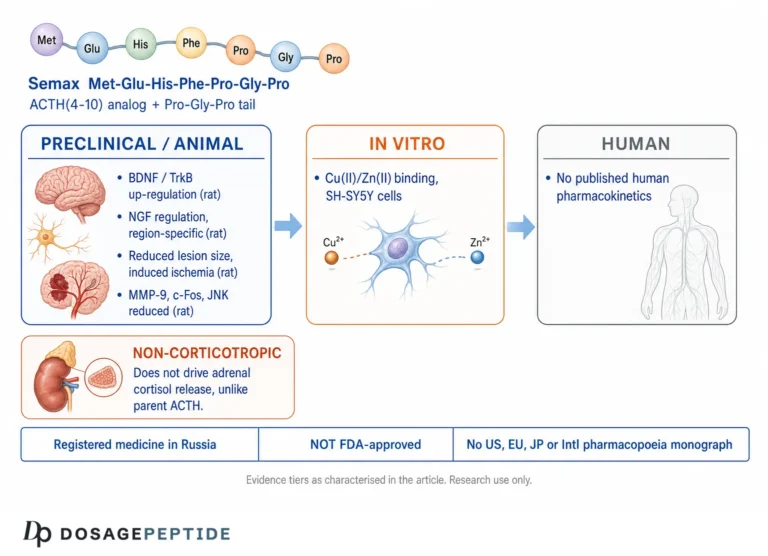
It is also worth noting what Cortagen is not part of. Under section 503A of the FD&C Act the FDA evaluates substances nominated for use in pharmacy compounding, sorting them into categories that reflect nomination completeness and identified safety risks.[15] Several research peptides have been through that process and placed on the agency’s list of bulk substances that may present significant safety risks — among them Epitalon, Semax, Selank, BPC-157, and thymosin beta 4 (the substance marketed as TB-500). Cortagen does not appear on that list.[15] Its absence is not a clean bill of health; it means only that Cortagen has not entered the regulatory pipeline its better-known relatives have, so no FDA assessment of it exists in either direction. It should also be understood that appearing on a compounding bulks list is a compounding decision rather than an FDA drug approval — and that placement in the significant-safety-risks category is the opposite of an endorsement.
In practice, Cortagen circulates as a research chemical sold for laboratory use only. That designation carries a legal meaning — it is not authorised for human administration — and it should be read literally rather than as a formality.
How does Cortagen sit alongside other neuro-oriented peptides?
Searchers comparing Cortagen against other cognition- or brain-adjacent peptides should be aware that the evidence tiers differ sharply between them, even within the same broad “nootropic peptide” bucket.
Within the bioregulator family, Cortagen’s closest relatives are AEDG (Epitalon) and the tripeptide Pinealon, both of which have more published work behind them: as of July 2026 PubMed indexes 132 records for Epitalon and 22 for Pinealon, against 15 for Cortagen. The Epitalon gap is substantial; the Pinealon one is modest, and none of these counts is large in absolute terms — all three sit in a thinly evidenced corner of the literature. Epitalon has also been examined by the FDA — but the outcome of that examination was placement on the agency’s list of bulk substances that may present significant safety risks,[15] which is engagement with the regulator rather than endorsement by it. Our explainer on Pinealon and the neuroprotective bioregulator research covers the closest neuro-directed comparator; Cartalax, the cartilage-directed bioregulator, illustrates the same tissue-specificity logic applied to a completely different organ system, which is useful for judging how much weight the “tissue specificity” claim can bear.
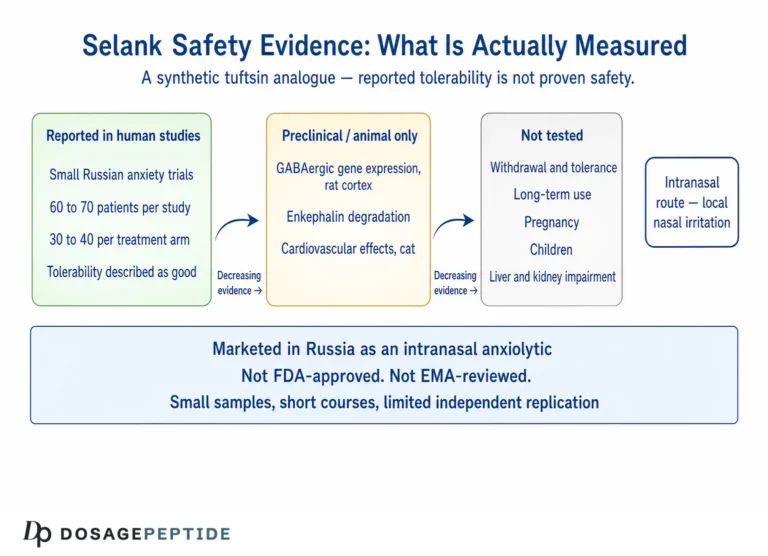
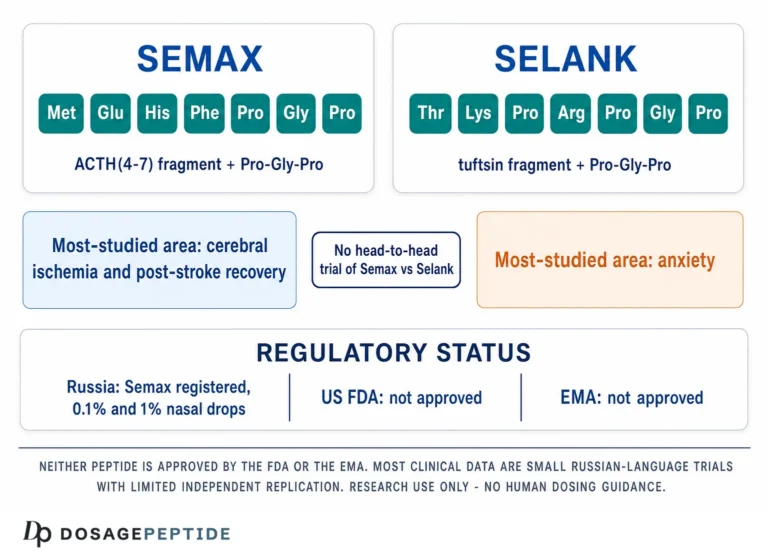
Outside the bioregulator family, peptides like Selank sit on a different evidentiary footing again, with a somewhat larger — though still limited — published human literature. Our review of Selank as a nootropic peptide studied for anxiety and cognition makes a useful contrast: neither compound is FDA-approved, but they are not at the same distance from clinical evidence, and lumping them together as “nootropic peptides” obscures a real difference.
The general point is that “peptide bioregulator” and “nootropic peptide” are marketing categories, not evidentiary ones. Each compound has to be judged on its own published record.
What are the limitations of the Cortagen evidence base?
Five limitations should shape how any of the above is read.
1. Concentration of authorship. The overwhelming majority of Cortagen publications share authors — Khavinson, Malinin, and collaborators at the St. Petersburg Institute of Bioregulation and Gerontology and affiliated institutes. Independent replication by laboratories with no connection to the originating school is, as far as the indexed literature shows, close to absent. This is the single largest weakness in the dataset.
2. Journal concentration and language. Most records appear in Bulletin of Experimental Biology and Medicine, Advances in Gerontology, and Neuro Endocrinology Letters. Several are Russian-language with English abstracts only, meaning methods and statistics cannot be scrutinised without the full translated text.
3. Small studies, short duration, brief reports. Many of these papers are one- to three-page communications reporting a single endpoint. Sample sizes, randomisation procedures, blinding, and effect-size confidence intervals are frequently not recoverable from the published abstracts.
4. Species and model distance. A rat sciatic nerve, a mouse heart transcriptome, a chicken haemostasis panel, and a lymphocyte chromatin preparation from an 80-year-old donor are four very different things. None of them is a human cognitive outcome, and the leap from any of them to “brain support” in people is not supported by data.
5. Mechanism largely borrowed. The DNA- and histone-binding mechanism attributed to Cortagen has mostly been demonstrated for other peptides in the family, not for AEDP itself. Given that a single terminal residue change abolished activity entirely in the chicken model,[14] mechanistic transfer within this family should be treated with caution rather than assumed.
This article is an independent research reference. Cortagen is an investigational research compound that is not approved by the FDA, the EMA, or any comparable regulator for any human therapeutic use, and no adequate controlled human safety or efficacy data exist for it. Nothing here is medical advice, a treatment recommendation, or human dosing guidance, and no information on this page should be used to guide human administration. All findings described are from in-vitro, animal, or ex-vivo cell studies unless explicitly stated otherwise. Consult a qualified healthcare professional for any health question.
Frequently Asked Questions
What is Cortagen peptide?
Cortagen is a synthetic tetrapeptide with the sequence Ala-Glu-Asp-Pro (AEDP), molecular weight approximately 430 Da. It was designed by the St. Petersburg Institute of Bioregulation and Gerontology as a defined-sequence synthetic counterpart to Cortexin, a bovine brain-cortex peptide extract. It belongs to the Khavinson “peptide bioregulator” family and is studied almost exclusively in preclinical models.
Is Cortagen FDA-approved?
No. Cortagen has no FDA approval for any indication, no EMA authorisation, and no approval from other major regulators. It does not appear in Drugs@FDA as an approved drug product, and it does not appear on the FDA’s section 503A list of bulk substances that may present significant safety risks — a list that does include several other research peptides, among them Epitalon, Semax, Selank, BPC-157, and thymosin beta 4. It is sold as a research chemical for laboratory use only.
What are Cortagen’s claimed benefits, and are they proven?
Claimed benefits centre on nerve regeneration, neuroprotection, and cognitive support. The underlying data are preclinical: increased sciatic nerve fibre growth and conduction velocity in rats, behavioural and antioxidant effects in rat chronic cerebral ischemia models, and gene-expression changes in mice. None of these has been confirmed in a controlled human trial, so no benefit in humans is proven.
What are the side effects of Cortagen?
No controlled human safety study of adequate size has been published for Cortagen, so its side-effect profile is genuinely unknown. There is no human pharmacokinetic data, no long-term toxicology, no drug-interaction data, and no reproductive safety data. Sources claiming Cortagen is “well tolerated with no side effects” are describing an absence of investigation, not an established safety finding.
What is the difference between Cortagen and Cortexin?
Cortexin is a heterogeneous polypeptide fraction extracted from animal brain cortex and manufactured as a pharmaceutical preparation in Russia. Cortagen is a single synthetic tetrapeptide (AEDP) whose sequence was derived from amino acid analysis of Cortexin. They are different substances with different compositions, different evidence bases, and different regulatory statuses, and they have been directly compared as separate treatments in animal studies.
Is Cortagen the same as Epitalon?
No, though they are closely related. Epitalon is AEDG (Ala-Glu-Asp-Gly); Cortagen is AEDP (Ala-Glu-Asp-Pro). They differ by a single terminal residue — proline in place of glycine. That one substitution is not trivial: in a study of hypophysectomised and aged chickens, Epitalon corrected the induced immune and haemostatic deficits while Cortagen produced no effect on the same parameters.
Has Cortagen been studied in humans?
There is no PubMed-indexed randomised controlled trial of Cortagen and no registered study on ClinicalTrials.gov. Human effects on peripheral nerve recovery are asserted in the introduction of a 2004 animal microarray paper, but that assertion is not accompanied by retrievable trial data — no design, sample size, blinding, or outcome measures — so it cannot be treated as clinical evidence.
Why is the Cortagen research considered limited?
Almost all published Cortagen studies come from one research school and its direct collaborators, mostly in a small set of Russian journals, often as brief reports with unstated sample sizes and statistics. Several are Russian-language with English abstracts only. Independent replication outside the originating group is essentially absent from the indexed literature, which means the findings have not been externally validated.
Is Cortagen a nootropic?
“Nootropic” is a marketing category, not a regulatory or evidentiary one, and applying it to Cortagen overstates what has been shown. No human cognitive endpoint has been tested in a controlled trial. The behavioural data that exist come from rat models of chronic brain ischemia, where the outcome measured was recovery of individual behaviour after an induced injury — not cognitive enhancement in healthy subjects.
References
- National Center for Biotechnology Information. PubChem Compound Summary for CID 18439621, Cortagen (Ala-Glu-Asp-Pro; CAS 335591-03-2). https://pubchem.ncbi.nlm.nih.gov/compound/18439621
- Anisimov SV, Khavinson VKh, Anisimov VN. Elucidation of the effect of brain cortex tetrapeptide Cortagen on gene expression in mouse heart by microarray. Neuro Endocrinol Lett. 2004;25(1-2):87–93. PMID 15159690. https://pubmed.ncbi.nlm.nih.gov/15159690/
- ClinicalTrials.gov. Search for interventional studies of Cortagen (U.S. National Library of Medicine) — zero registered records as of retrieval. https://clinicaltrials.gov/search?intr=Cortagen
- Kurkin DV, Bakulin DA, Morkovin EI, et al. Neurotropic Effects of Cortexin on Models of Mental and Physical Developmental Delay. Biomedicines. 2025;13(4):860. doi:10.3390/biomedicines13040860. PMID 40299434. https://pubmed.ncbi.nlm.nih.gov/40299434/
- Zarubina IV, Shabanov PD. [Cortexin and cortagen as correcting agents in functional and metabolic disorders in the brain in chronic ischemia]. Eksp Klin Farmakol. 2011;74(2):8–15. Russian. PMID 21476278. https://pubmed.ncbi.nlm.nih.gov/21476278/
- Khavinson VKh, Popovich IG, Linkova NS, Mironova ES, Ilina AR. Peptide Regulation of Gene Expression: A Systematic Review. Molecules. 2021;26(22):7053. doi:10.3390/molecules26227053. PMID 34834147. https://pmc.ncbi.nlm.nih.gov/articles/PMC8619776/
- Khavinson VK. Tissue-specific effects of peptides. Bull Exp Biol Med. 2001;132(2):807–808. doi:10.1023/a:1013058701974. PMID 11713572. https://pubmed.ncbi.nlm.nih.gov/11713572/
- Kazakova TB, Barabanova SV, Khavinson VKh, et al. In vitro effect of short peptides on expression of interleukin-2 gene in splenocytes. Bull Exp Biol Med. 2002;133(6):614–616. doi:10.1023/a:1020210615148. PMID 12447482. https://pubmed.ncbi.nlm.nih.gov/12447482/
- Khavinson VKh, Lezhava TA, Malinin VV. Effects of short peptides on lymphocyte chromatin in senile subjects. Bull Exp Biol Med. 2004;137(1):78–81. doi:10.1023/b:bebm.0000024393.40560.05. PMID 15085253. https://pubmed.ncbi.nlm.nih.gov/15085253/
- Turchaninova LN, Kolosova LI, Malinin VV, Moiseeva AB, Nozdrachev AD, Khavinson VK. Effect of tetrapeptide cortagen on regeneration of sciatic nerve. Bull Exp Biol Med. 2000;130(12):1172–1174. PMID 11276314. https://pubmed.ncbi.nlm.nih.gov/11276314/
- Kolosova LI, Moiseeva AB, Turchaninova LN, Malinin VV, Polyakov EL, Nozdrachev AD, Khavinson VKh. The delayed effect of cortagen on the restoration of injured nerve function. Dokl Biol Sci. 2002;384:183–184. doi:10.1023/a:1016098302564. PMID 12134478. https://pubmed.ncbi.nlm.nih.gov/12134478/
- Kozina LS. Effects of bioactive tetrapeptides on free-radical processes. Bull Exp Biol Med. 2007;143(6):744–746. doi:10.1007/s10517-007-0230-8. PMID 18239817. https://pubmed.ncbi.nlm.nih.gov/18239817/
- Khavinson VKh, Rybakina EG, Malinin VV, Pivanovich IYu, Shanin SN, Korneva EA. Effects of short peptides on thymocyte blast transformation and signal transduction along the sphingomyelin pathway. Bull Exp Biol Med. 2002;133(5):497–499. doi:10.1023/a:1019830308824. PMID 12420072. https://pubmed.ncbi.nlm.nih.gov/12420072/
- Kuznik BI, Pateiuk AV, Baranchugova LM, Rusaeva NS. [Effects of epithalon and cortagene on immunity and hemostasis in neonatally hypophysectomized chicken and old birds]. Adv Gerontol. 2008;21(3):372–381. Russian. PMID 19432169. https://pubmed.ncbi.nlm.nih.gov/19432169/
- U.S. Food and Drug Administration — regulatory sources consulted for this article. (a) Drugs@FDA: FDA-Approved Drugs (searched for “cortagen” as brand and generic name; no record returned): https://www.accessdata.fda.gov/scripts/cder/daf/. (b) Bulk Drug Substances Used in Compounding Under Section 503A of the FD&C Act (category framework): https://www.fda.gov/drugs/human-drug-compounding/bulk-drug-substances-used-compounding-under-section-503a-fdc-act. (c) Certain Bulk Drug Substances for Use in Compounding May Present Significant Safety Risks (the list naming Epitalon, Semax, Selank, BPC-157, and thymosin beta 4; Cortagen is absent): https://www.fda.gov/drugs/human-drug-compounding/certain-bulk-drug-substances-use-compounding-may-present-significant-safety-risks