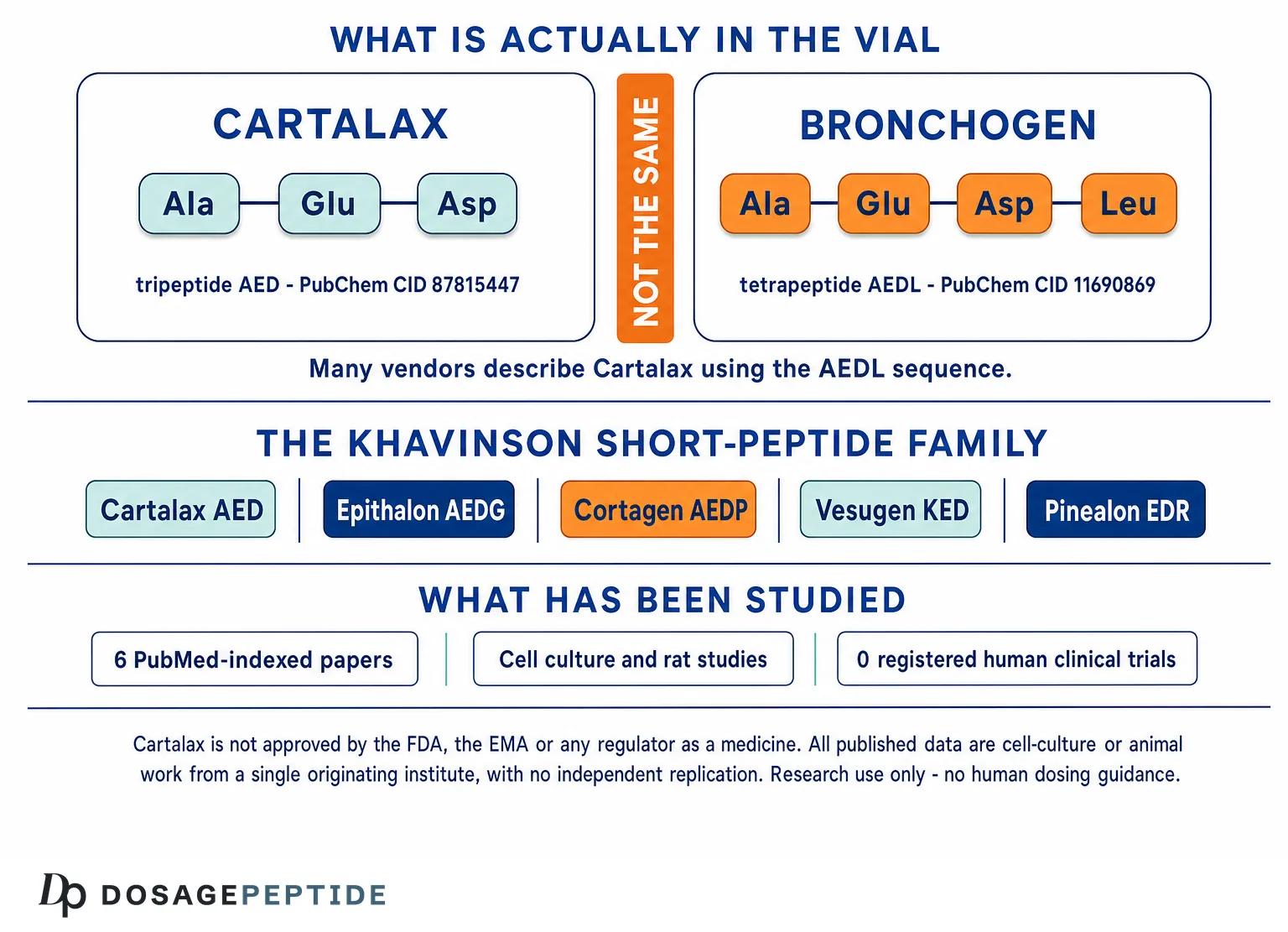
Cartalax is a synthetic short peptide from the Russian “bioregulator” family developed at the St. Petersburg Institute of Bioregulation and Gerontology, marketed as a cartilage- and connective-tissue-specific compound. In the indexed scientific literature it is the tripeptide Ala-Glu-Asp (AED) — not the tetrapeptide AEDL that most vendor listings print — and a PubMed query for the compound returns six indexed papers, none of which measured a cartilage endpoint. A small Russian-language literature outside PubMed adds one unreplicated chondrocyte experiment, which we describe and bound below. There are no registered human clinical trials, no approval by any drug regulator, and no published dose-ranging or toxicology data in humans.
That paragraph is essentially the whole honest answer. What follows is the evidence for each part of it, including the sequence problem, which is serious enough that a buyer and a reader may not be discussing the same molecule.
What is Cartalax supposed to be?
Cartalax belongs to a class of compounds that Vladimir Khavinson’s group has been developing since the 1970s. The original products were cytomedins — crude polypeptide extracts of animal organs, each intended to act on the tissue it came from. A cartilage extract was supposed to act on cartilage, a pineal extract on the pineal gland, and so on. Later, the group synthesised very short peptides — two to four amino acids — that they proposed were the active fragments of those extracts. These synthetic versions are the cytogens, and they are what circulates today as “peptide bioregulators.” Our overview of the class as a whole is in what peptide bioregulators actually are.
Cartalax is the cartilage entry in that catalogue. The name is marketing nomenclature from the institute, not a chemical name, and it carries no evidentiary weight: calling a tripeptide “the cartilage peptide” does not mean cartilage was the tissue it was tested in. As this article shows, it very nearly never has been.
Is Cartalax the tripeptide AED or the tetrapeptide AEDL?
This is the question the page exists to answer, and it resolves cleanly once you check chemical and bibliographic databases rather than product listings.
What PubChem and PubMed record
Searching PubChem for “Cartalax” resolves to a single compound: CID 87815447, molecular formula C12H19N3O8, molecular weight 333.29 Da, with an IUPAC name corresponding to L-alanyl-L-glutamyl-L-aspartic acid — a tripeptide, Ala-Glu-Asp[1]. Searching PubChem for “Ala-Glu-Asp” returns the same CID.
PubMed agrees. A PubMed query for “Cartalax” is silently expanded by the search engine into the Supplementary Concept alanyl glutamyl aspartic acid — the controlled-vocabulary record for the tripeptide. That expansion is not our inference; it is visible in PubMed’s own query translation, and it explains why a search for the trade name returns papers whose abstracts only ever write “AED.”
Where AEDL actually comes from
Ala-Glu-Asp-Leu is a real, studied Khavinson peptide. It is simply a different one. In a 2011 paper on peptide–DNA interaction, the group writes plainly of “bronchogen (Ala-Glu-Asp-Leu)” alongside epithalon and pinealon[4]. A 2012 paper is more explicit still about tissue assignment: “pancragen (Lys-Glu-Asp-Trp) in pancreatic cells, bronchogen (Ala-Glu-Asp-Leu) in bronchial epithelial cells, and vesugen (Lys-Glu-Asp) in fibroblasts”[5].
PubChem confirms it chemically: Bronchogen is CID 11690869, C18H30N4O9, 446.5 Da, with an IUPAC name terminating in a 4-methylpentanoic acid residue — leucine[2].
So AEDL is Bronchogen, the bronchial bioregulator. Vendor pages describing Cartalax as “the tetrapeptide Ala-Glu-Asp-Leu” are, whatever their intent, printing the sequence of a lung peptide on a cartilage product.
A revealing arithmetic error
A detail worth noticing: many listings that print the AEDL formula C18H30N4O9 also print a molecular weight near 430 Da. Those two figures are incompatible. C18H30N4O9 weighs 446.5 Da[2]; 430.4 Da is the mass of Cortagen, Ala-Glu-Asp-Pro, C17H26N4O9[3]. In other words, the copy circulating online has blended three distinct molecules — a tripeptide’s name, a bronchial tetrapeptide’s formula, and a cortical tetrapeptide’s mass — into one product description. That is a strong signal these descriptions are being copied between sites rather than derived from a certificate of analysis.
What this means practically
We cannot tell you what is in any particular vial; only independent mass spectrometry can. What we can say is that the compound named in the literature and the compound described on most product pages are two different molecules, differing by a leucine residue of 113.16 Da. Anyone reading a paper about AED and assuming it applies to a vial labelled AEDL is making an unsupported leap.
What has Cartalax actually been studied in?
Six PubMed-indexed records mention the compound, as of 27 July 2026. Here is what each one actually did.
One methodological caveat governs every negative claim on this page, and it should be stated before the table rather than buried after it. The query above searches indexed literature in PubMed only. The St. Petersburg group also publishes in Russian-language journals — Advances in Gerontology, Vrach and others — that PubMed indexes patchily or not at all, and we found at least one AED chondrocyte study that the query does not return. Statements below of the form “no indexed study” are bounded by indexation and language, and the Russian-language work we did locate has not been translated in full, independently verified, or replicated by anyone outside the originating institute.
| Study | System | What AED was reported to do | Evidence tier |
|---|---|---|---|
| Ashapkin et al., 2020[6] | Human embryonic bone marrow MSC line (FetMSC), two in vitro ageing models | IGF1 expression raised 3.5–5.6-fold and NF-κB expression stimulated, at nanomolar concentrations — but the paper attributes both to the three tested peptides collectively (AED, KED, KE), not to AED individually | Cell culture only; effect not isolated to AED |
| Caputi et al., 2019[7] | Human periodontal ligament stem cells | AED tested both alone and inside a four-peptide compound; the GAP43 and Nestin increases were attributed to KED alone and to the full compound, not to AED | Cell culture only — individual null result for AED |
| Lin’kova et al., 2016[8] | Rat skin fibroblasts ageing in culture | All four tested peptides (KE, KED, AED, AEDG) suppressed MMP-9 and raised Ki-67 and CD98hc — not an AED-specific effect. Only the reduction in caspase-dependent apoptosis was attributed to AED, and to AEDG alongside it | Cell culture only; effects largely not isolated to AED |
| Chalisova et al., 2015[9] | Organotypic kidney explants from young and old rats | T-31 (AED) and T-35 (EDL) raised Ki-67 and lowered p53 — but less than the calf-kidney polypeptide extract they were compared against | Ex vivo tissue culture |
| Khavinson et al., 2014[10] | Ageing renal cell culture, plus in silico docking | AED and EDL together reduced p16, p21 and p53 and raised SIRT-6; both were modelled as binding the DNA minor groove at AT-rich sequences | Cell culture plus computational modelling |
| Lin’kova et al., 2011[11] | Aged (passage 8) human thymocyte culture | No effect. Of the three peptides tested, only AB-9 was reported active; T-31 was not | Cell culture only — negative result |
Two observations follow directly. First, every record in the table above is in vitro or ex vivo, and none involves a human subject. The only whole-animal study of the synthetic peptide anywhere in the indexed literature is the 2007 rat experiment discussed below, and its endpoint was bone mineral density rather than cartilage[12]. Second, the tissues in the table are bone marrow, periodontal ligament, skin, kidney and thymus. None is cartilage.
One caveat on identification: the 2011 thymocyte paper[11] refers only to code names (T-31, AB-17, AB-9) and does not spell out sequences. We map T-31 to AED because the 2015 kidney paper from the same institute writes “short peptides T-31 (AED) and T-35 (EDL)”[9]. That is a cross-paper inference, and we flag it as one. The 2007 bone paper uses the same code name without a sequence, so the same inference carries it.
Is there any cartilage research on Cartalax at all?
Almost none, none of it independently replicated, and the one direct experiment measures the wrong thing.
The single chondrocyte experiment
One Russian-language paper outside PubMed does apply AED to chondrocytes. Myakisheva and colleagues, writing in Vrach in 2023, tested a polypeptide complex isolated from bovine cartilage and its constituent AED peptide on primary chondrocyte cultures from young (3-month) and old (20-month) rats, following cell growth curves over five days at 20, 200 and 2000 ng/mL. AED at an effective concentration of 200 ng/mL raised chondrocyte numbers by 1.4–1.8-fold in cultures from young animals and 1.6–2.1-fold in cultures from old animals; the polypeptide complex, at 2000 ng/mL, gave 1.7–2.2-fold and 1.8–2.5-fold[14].
Three limitations bound what that result can carry. The endpoint is cell number, not matrix: no COL2A1, ACAN or SOX9 was measured, so this is a proliferation finding, not a demonstration of cartilage repair. The cells are rat, not human articular chondrocytes. And the authors are the originating institute, publishing in a journal PubMed does not index, with no independent replication of any kind. It is one unreplicated in vitro proliferation result — more than nothing, and considerably less than the branding implies.
The 2007 rat study
The closest thing to a musculoskeletal in vivo experiment is a 2007 Russian-language paper in Advances in Gerontology. In an ovariectomy-induced osteoporosis model in rats, the investigators compared a cartilage tissue extract against “T-31 substance.” Both showed an osteoprotective effect on bone mineral density — but the paper reports the tissue extract as significantly more effective than the synthetic peptide[12]. The endpoint was bone density, not cartilage integrity, and the result argues for the crude extract over the very molecule sold today.
What the 2023 review actually argues
More telling is what the Khavinson group published in 2023. They wrote an entire review in the International Journal of Molecular Sciences on peptide regulation of chondrogenic differentiation[13]. Its abstract names as most promising for chondrogenesis a set of peptides based on growth-factor structures (printed there as SK2.1, BMP, B2A and SSPEPS) and on cartilage extracellular-matrix components (printed as LPP, CFOGER, CMP, RDG and an N-cadherin mimetic peptide). Several of those strings are typographical errors for the standard names — CK2.1, GFOGER and RGD — which is a small illustration in miniature of how quickly peptide nomenclature degrades in transmission. AED is not among them.
AED appears only in the body of the review, and the argument made for it there runs as follows: the authors note that the polypeptide cartilage complex contains AED among peptides of 75–846 Da, cite the human MSC gene-expression study and the rat skin fibroblast study, then reason that because chondrocytes resemble fibroblasts in structure and function, the fibroblast data “may also demonstrate” reparative properties in cartilage tissue[13].
That is an analogy, offered as an analogy by the compound’s own developers, and it crosses two gaps at once — rat to human, and skin to cartilage — on a result that was not specific to AED in the first place[8]. It is not a cartilage result. When the originating laboratory’s published case for a cartilage peptide is an inference from rat skin cells, backed by a single unindexed proliferation experiment, the honest reading is that the cartilage indication remains a hypothesis with one thin data point under it.
An internal tension the review half-acknowledges
There is a further problem inside that same review. The primary cell-culture finding involving AED is that it — along with KED and KE — increases NF-κB gene expression[6]. Elsewhere the same review describes NF-κB activation in chondrocytes as induced by stress and inflammatory signals, suppressing Sox9 expression and triggering catabolic processes[13]. The authors do register the difficulty, but they resolve it inside a single sentence, suggesting that the AED effect on NF-κB gene expression “accelerates MSC aging and can reduce inflammation during OA”[13] — two opposite valuations of the same effect, offered together and not reconciled. We are not asserting that AED harms cartilage; the one chondrocyte experiment measured proliferation and reported an increase. We are noting that the mechanistic story has not been worked through even at the level of the review proposing it.
Where does Cartalax sit in the bioregulator family?
Sequences in this family are widely misreported, so every entry below is checked against PubChem and against the primary papers rather than against secondary sources. Where a tissue label comes from institute nomenclature rather than from a cited experiment, we say so.
| Name | Sequence | Formula and mass | Nominal tissue |
|---|---|---|---|
| Cartalax | Ala-Glu-Asp (AED) | C12H19N3O8, 333.29 Da[1] | Cartilage (asserted) |
| Epithalon / Epitalon | Ala-Glu-Asp-Gly (AEDG) | C14H22N4O9, 390.35 Da[3] | Pineal (institute nomenclature) |
| Bronchogen | Ala-Glu-Asp-Leu (AEDL) | C18H30N4O9, 446.5 Da[2] | Bronchial epithelium[5] |
| Cortagen | Ala-Glu-Asp-Pro (AEDP) | C17H26N4O9, 430.4 Da[3] | Cerebral cortex (institute nomenclature) |
| Pinealon | Glu-Asp-Arg (EDR) — not KED | C15H26N6O8, 418.40 Da[3] | Brain and neurons (institute nomenclature; no tissue-assignment experiment cited here) |
| Vesugen | Lys-Glu-Asp (KED) | C15H26N4O8, 390.39 Da[3] | Fibroblasts, prostatic[5]; the “vascular” label is institute nomenclature, not from that paper |
| Vilon | Lys-Glu (KE) | C11H21N3O5, 275.30 Da[3] | Thymus and immune tissue (institute nomenclature) |
Two corrections deserve emphasis. Pinealon is EDR, Glu-Asp-Arg — the 2011 DNA-binding paper states this outright[4] and PubChem’s structure for Pinealon contains the guanidino group of arginine[3]. The frequent claim that Pinealon is KED is a vendor error; KED is Vesugen. And Cartalax is a tripeptide in a family whose near neighbours are tetrapeptides, which is probably part of why the AEDL confusion took hold in the first place. See our separate pages on Epithalon, Pinealon, Cortagen and Crystagen, plus the definitions in our peptide glossary.
What does “bioregulator” actually mean here?
The term is not a pharmacological category. Within the Khavinson programme it denotes a specific hypothesis: that very short peptides enter cells and nuclei, bind DNA in a sequence-selective way, and thereby switch tissue-specific genes on or off — a form of endogenous epigenetic regulation that the peptides are said to restore as it fails with age.
The supporting work is real but narrow, and narrower than it is usually described. Fluorescently labelled epithalon, pinealon and testagen were shown to enter HeLa cell cytoplasm, nucleus and nucleolus. Separately — and this part was cell-free, not cellular — fluorescence-quenching constants measured against synthetic deoxyribooligonucleotides suggested sequence-preferential binding by those peptides and by bronchogen, including discrimination by cytosine methylation status[4]. AED was not among the peptides tested in that work. For AED specifically, the DNA-binding claim rests on molecular docking — a computational model placing the peptide in the minor groove of an AT-rich decamer[10]. Docking generates hypotheses; it does not measure binding.
Three gaps are worth stating plainly. There is no published crystal or NMR structure of AED bound to DNA. There is no demonstration that AED reaches a chondrocyte nucleus in a living animal at any administered dose. And the specificity problem is unresolved: a free tripeptide of alanine, glutamate and aspartate is small, highly charged, and a plausible substrate for peptidases and amino-acid transporters, which makes tissue-selective nuclear delivery a strong claim requiring correspondingly strong evidence.
Has any of this been replicated independently?
This deserves its own answer, because it is the single biggest constraint on how much weight the literature can bear.
All six indexed records on AED list Khavinson and/or the St. Petersburg Institute of Bioregulation and Gerontology among the authors[6][7][8][9][10][11], as do the 2023 review[13] and the 2023 chondrocyte paper[14]. Even the study with substantial non-Russian participation — the periodontal ligament stem cell work at Chieti-Pescara — carries institute co-authors, and it tested AED both alone and inside a four-peptide compound, attributing the GAP43 and Nestin increases to KED and to the compound rather than to AED[7].
We could not find a single AED study conducted by a group with no connection to the originating institute. That does not make the findings wrong. It does mean no result here has cleared the ordinary bar of independent reproduction, and that a reader should treat the whole AED literature as one laboratory’s research programme rather than as a body of converging evidence. The same caution applies, in varying degrees, across this entire peptide family.
Is Cartalax approved anywhere?
Cartalax is not an approved medicine in the United States or the European Union. It is not an FDA-approved drug for any indication and does not appear among the bulk drug substances the FDA permits for use in compounding under section 503A[15]. It holds no European Medicines Agency marketing authorisation[15]. Material sold to Western buyers is supplied as a research chemical — not as a drug, and not as a dietary supplement.
Russia is where the picture needs care, because this family is often described loosely as “approved in Russia.” This much is checkable against a public reference. The Russian pharmaceutical directory RLS lists Cartalax not among medicines but in its dietary-supplement section, as 0.2 g capsules described as an additional source of peptides — alanine, glutamic acid and aspartic acid[15]. A food-supplement listing is a market-entry formality, not a demonstration of efficacy, and it is not equivalent to registration as a medicine. It is also a different product from the lyophilised vial sold internationally: a supplement capsule and a research-chemical vial share a name and little else. We cite this as a regulatory and market record rather than as evidence of effect, and we were not able to verify an individual state registration certificate number against a primary register.
One related item does concern a genuine clinical programme, and it is not about Cartalax. The 2023 review states that the polypeptide complex extracted from animal cartilage is in phase 2 trials for osteoarthritis in Russia[13]. That is the multi-component tissue extract, not the synthetic tripeptide, and we could not locate a corresponding registration in ClinicalTrials.gov. Progress by the extract would not transfer automatically to AED — any more than it did in the 2007 rat study, where the extract outperformed the peptide[12], or in the 2023 chondrocyte cultures, where the complex produced the larger proliferative effect[14].
How many human clinical trials exist?
Zero. A ClinicalTrials.gov intervention query for Cartalax, run on 27 July 2026, returns no studies at all; a broader general-term search returns exactly one fuzzy match, an unrelated enteral-nutrition trial of a product with a superficially similar name[15]. A parallel intervention query for “Ala-Glu-Asp” returns two studies, both fuzzy amino-acid matches — a chronic kidney disease cohort and a prandial metabolism study — and neither concerns the peptide. A query for the originating investigator returns nothing.
No registered trial means no controlled human efficacy data, no controlled human safety data, no pharmacokinetics and no adverse-event surveillance. Absence of reported harm here reflects absence of systematic looking, not evidence of safety — a distinction that matters more, not less, for a compound that has been in circulation for years.
What about the dosing figures circulating online?
Figures of the shape “5–10 mg daily for 10–20 days” appear across vendor pages, forum posts and aggregator sites for Cartalax and for most of this peptide family. It is worth being blunt about where those numbers come from: they are conventions, not evidence-derived doses.
There is no published human dose-ranging study for AED. There is no published toxicology package, no no-observed-adverse-effect level, no exposure–response relationship and no bioavailability figure for any route. The cell-culture work that does exist used nanomolar concentrations in a dish[6], and no legitimate calculation converts that into a milligram figure for a whole organism. A number repeated across a thousand pages is still a number with nothing underneath it; repetition is not evidence, and a widely copied convention can be widely and identically wrong.
That criticism includes our own site. Our Cartalax 20 mg vial page exists to document what is sold under that name and what the circulating conventions are, so readers can see them stated plainly and sourced honestly. It is a description of the marketed product, not evidence that the marketed material is the studied material, and not an endorsement of the figures — which neither we nor anyone else can currently justify from the literature.
What would change the picture?
A short, concrete list. Any one of these would be more informative than another decade of copied product descriptions.
- An independent identity check. Mass spectrometry on material sold as Cartalax, published openly, would settle whether vials contain AED, AEDL or something else.
- A proper chondrocyte experiment. The only existing chondrocyte data measured cell counts in rat cultures[14]. AED applied to human articular chondrocytes with COL2A1, ACAN and SOX9 as endpoints — matrix synthesis rather than cell number — would be the first test of the cartilage claim on the endpoints that actually define cartilage repair.
- An animal model of osteoarthritis using the synthetic peptide rather than the tissue extract, with histological cartilage endpoints rather than bone mineral density.
- Replication outside St. Petersburg. Any of the existing findings, reproduced by an unaffiliated laboratory, in an indexed and translated journal.
- Basic pharmacokinetics. Plasma exposure and tissue distribution after a defined dose, establishing whether a free tripeptide survives long enough to reach joint tissue at all.
- A registered trial. Even a phase 1 safety study would move Cartalax from research chemical to investigational compound.
None of those is technically difficult or expensive by the standards of modern cell biology. That none has been done in the roughly two decades the compound has been on sale is itself among the more informative facts on this page.
Research use only. This article is an educational review of published literature and public database records. Cartalax is not approved by the FDA, the EMA or any comparable regulator for the diagnosis, treatment, prevention or cure of any condition in humans or animals, and nothing here should be read as a therapeutic claim, a recommendation for human use, or personal medical advice. It deliberately contains no dosing guidance, no route of administration and no reconstitution or handling instructions. Anyone with a joint or connective-tissue condition should consult a qualified clinician about evidence-based options.
Frequently Asked Questions
Is Cartalax AED or AEDL?
In the scientific literature and in chemical databases, Cartalax is the tripeptide Ala-Glu-Asp (AED), PubChem CID 87815447, molecular weight 333.29 Da. AEDL — Ala-Glu-Asp-Leu — is Bronchogen, a different Khavinson peptide assigned to bronchial epithelium, PubChem CID 11690869, 446.5 Da. Most vendor listings describe Cartalax as AEDL, so the marketed description and the studied molecule do not match.
Is Cartalax proven to repair cartilage?
No. None of the six PubMed-indexed AED papers measured a cartilage endpoint; they used bone marrow stem cells, periodontal ligament cells, rat skin fibroblasts, kidney explants and thymocytes. One Russian-language paper outside PubMed reports that AED raised cell counts in rat chondrocyte cultures, but it measured proliferation rather than COL2A1, ACAN or SOX9, and no independent group has replicated it.
How many clinical trials of Cartalax are there?
None. A ClinicalTrials.gov intervention search for Cartalax on 27 July 2026 returned no registered studies, and searches for the sequence and for the originating investigator returned only unrelated fuzzy matches or nothing at all. There are consequently no controlled human safety data, no efficacy data and no pharmacokinetic data for this compound in people.
Is Cartalax approved by the FDA?
No. Cartalax is not an FDA-approved drug for any indication, holds no EMA marketing authorisation, and does not appear among the bulk drug substances permitted for compounding under section 503A. The Russian pharmaceutical directory RLS lists it as a 0.2 g dietary-supplement capsule rather than as a medicine — a food-supplement listing is a market-entry formality, not a demonstration of safety or efficacy.
What is the recommended Cartalax dose?
There is no evidence-derived dose. Figures such as “5–10 mg daily for 10–20 days” circulate widely but have no controlled human dose-ranging study and no published toxicology behind them; they are copied conventions. The existing cell-culture work used nanomolar concentrations in a dish, which cannot be converted into a milligram dose for an organism. This article gives no dosing guidance.
How is Cartalax different from Epithalon?
They differ by one residue and by their entire evidence base. Epithalon is Ala-Glu-Asp-Gly (AEDG), a tetrapeptide with a comparatively large literature centred on telomerase and pineal function. Cartalax is Ala-Glu-Asp (AED), a tripeptide with six indexed records. Structural similarity between short peptides does not imply similar biological activity, and neither compound is approved by any regulator.
Why is the Cartalax research base so small?
Because effectively all of it comes from one institute. All six indexed AED records list Khavinson and/or the St. Petersburg Institute of Bioregulation and Gerontology among the authors, as do the main review of the area and the only chondrocyte experiment. No unaffiliated laboratory appears to have tested AED independently, so nothing in this literature has cleared the ordinary bar of external replication.
Does Cartalax bind DNA?
That is the proposed mechanism, not a demonstrated one. Sequence-preferential DNA interaction was reported for other peptides in this family — epithalon, pinealon, testagen and bronchogen — in a cell-free fluorescence-quenching assay against synthetic oligonucleotides, and AED was not among them. For AED the evidence is molecular docking, a computational model. No crystal or NMR structure of AED bound to DNA has been published.
Is Cartalax safe?
Unknown, and the honest answer is that nobody has looked systematically. There is no published toxicology, no no-observed-adverse-effect level, no human safety trial and no adverse-event surveillance for this compound. The absence of reported harm reflects the absence of monitoring rather than evidence of safety, and material sold as a research chemical carries no assurance of identity or purity.
References
- PubChem Compound Summary, CID 87815447, Ala-Glu-Asp (Cartalax). National Center for Biotechnology Information. https://pubchem.ncbi.nlm.nih.gov/compound/87815447
- PubChem Compound Summary, CID 11690869, Ala-Glu-Asp-Leu (Bronchogen). National Center for Biotechnology Information. https://pubchem.ncbi.nlm.nih.gov/compound/11690869
- PubChem Compound Summaries for related bioregulator peptides: CID 219042 (Epithalon, AEDG); CID 18439621 (Cortagen, AEDP); CID 10273502 (Pinealon, EDR); CID 87571363 (Lys-Glu-Asp, Vesugen); CID 7010502 (Lys-Glu, Vilon).
- Fedoreyeva LI, Kireev II, Khavinson VKh, Vanyushin BF. Penetration of short fluorescence-labeled peptides into the nucleus in HeLa cells and in vitro specific interaction of the peptides with deoxyribooligonucleotides and DNA. Biochemistry (Moscow). 2011;76(11):1210–19. PMID 22117547
- Khavinson VKh, Linkova NS, Polyakova VO, Kheifets OV, Tarnovskaya SI, Kvetnoy IM. Peptides tissue-specifically stimulate cell differentiation during their aging. Bulletin of Experimental Biology and Medicine. 2012;153(1):148–51. PMID 22808515
- Ashapkin V, Khavinson V, Shilovsky G, Linkova N, Vanuyshin B. Gene expression in human mesenchymal stem cell aging cultures: modulation by short peptides. Molecular Biology Reports. 2020;47(6):4323–29. PMID 32399807
- Caputi S, Trubiani O, Sinjari B, Trofimova S, Diomede F, Linkova N, Diatlova A, Khavinson V. Effect of short peptides on neuronal differentiation of stem cells. International Journal of Immunopathology and Pharmacology. 2019;33:2058738419828613. PMC6376556
- Lin’kova NS, Drobintseva AO, Orlova OA, Kuznetsova EP, Polyakova VO, Kvetnoy IM, Khavinson VKh. Peptide regulation of skin fibroblast functions during their aging in vitro. Bulletin of Experimental Biology and Medicine. 2016;161(1):175–8. PMID 27259496
- Chalisova NI, Lin’kova NS, Nichik TE, Ryzhak AP, Dudkov AV, Ryzhak GA. Peptide regulation of cell renewal processes in kidney tissue cultures from young and old animals. Bulletin of Experimental Biology and Medicine. 2015;159(1):124–7. PMID 26033601
- Khavinson VKh, Tarnovskaya SI, Lin’kova NS, et al. Tripeptides slow down aging process in renal cell culture [in Russian]. Advances in Gerontology. 2014;27(4):651–6. PMID 25946838
- Lin’kova NS, Polyakova VO, Trofimov AV, Kvetnoy IM, Khavinson VKh. Peptidergic regulation of thymocyte differentiation, proliferation, and apoptosis during aging of the thymus. Bulletin of Experimental Biology and Medicine. 2011;151(2):239–42. PMID 22238759
- Povorozniuk VV, Khavinson VKh, Makogonchuk AV, Ryzhak GA, Kreslov EA, Gopkalova IV. Effect of peptide regulators on the structural and functional status of bone tissue in ageing rats [in Russian]. Advances in Gerontology. 2007;20(2):134–7. PMID 18306703
- Linkova N, Khavinson V, Diatlova A, Myakisheva S, Ryzhak G. Peptide regulation of chondrogenic stem cell differentiation. International Journal of Molecular Sciences. 2023;24(9):8415. PMC10179481
- Myakisheva SN, Linkova NS, Polyakova VO, Ryzhak GA. Peptides of cartilage tissue: regulation of chondrocyte proliferation, geroprotection and prospects for use in osteoarthrosis [in Russian; English abstract]. Vrach (The Doctor). 2023;34(10):46–9. Not indexed in PubMed. vrachjournal.ru/en/25877305-2023-10-08
- Regulatory, registry and market records (cited as records, not as evidence of effect): U.S. Food and Drug Administration, Bulk drug substances used in compounding under section 503A of the FD&C Act; European Medicines Agency, database of authorised medicines; ClinicalTrials.gov, intervention search for Cartalax, queries run 27 July 2026; RLS (Russian pharmaceutical directory), dietary-supplement entry for Cartalax.