Adamax is a research-chemical peptide sold as an ACTH(4-10)-derived relative of Semax and promoted for memory, focus and neuroprotection. So what does it actually do? No published study answers that question. Searches of PubMed, PMC and the clinical-trial registries return no dedicated pharmacology, toxicology, pharmacokinetic or clinical work on Adamax — which means every effect attributed to it is borrowed from the Semax literature rather than demonstrated for Adamax itself.
That absence is the finding, and it is worth understanding properly rather than waved away. Below: what Adamax is claimed to be chemically, how the ACTH(4-10)/Semax family it is placed in genuinely works, what the Semax evidence does and does not license anyone to say about a relative, how Adamax is positioned against Semax and Selank, and what it would take to validate an Adamax-specific claim. Adamax is not an approved drug anywhere; it is sold as research-use-only (RUO) material.
What Is Adamax? Defining a Poorly-Characterized Research Neuropeptide
Adamax is a short synthetic peptide sold by research-chemical vendors and typically described as an analog or derivative within the adrenocorticotropic hormone fragment family — specifically the ACTH(4-10) melanocortin region — and positioned as a “next-generation” or “enhanced” relative of Semax. It is marketed for neurotrophic and nootropic research: modulation of brain-derived neurotrophic factor (BDNF), neuroprotection, cognition, and stress resilience. Those are the claims. The verifiable identity, pharmacology, and clinical status of Adamax are another matter entirely.
The Claimed Identity: An ACTH(4-10)-Derived Analog
The recurring vendor framing is that Adamax belongs to the same class of melanocortin/ACTH-derived neuropeptides as Semax and shares the general mechanistic theme of that family: engaging melanocortin-related signaling and upregulating neurotrophins. Because Semax is itself an ACTH(4-7) fragment extended with a Pro-Gly-Pro (PGP) tail, describing a “sister” compound as ACTH(4-10)-derived places Adamax rhetorically inside a legitimate and productive area of Russian neuropeptide chemistry. That framing is plausible in the sense that many peptides in this space are built by taking a bioactive ACTH/melanocortin core and adding protective residues — but plausibility is not documentation. A defined, published amino-acid sequence for the specific commercial product called “Adamax,” along with independent characterization of its purity and biological activity, is what would move it from marketing category to characterized research tool, and that documentation is what is conspicuously missing from mainstream scientific databases.
Research-Use-Only Status and the Evidence Problem
Adamax is not FDA-approved for any use, is not an approved drug in the European Union, and — unlike Semax and Selank in Russia — does not appear to hold a national regulatory registration under the Adamax name. It is sold strictly as a research-use-only material, meaning it is not manufactured, tested, or labeled to pharmaceutical standards and is not intended for human or veterinary administration. The core evidence problem is that when you search the peer-reviewed literature (PubMed, PMC, indexed journals) and clinical-trial registries for “Adamax” as a neuropeptide, you do not find a body of dedicated studies. What you find instead is a rich literature on Semax and the ACTH(4-10) family that vendors then reference by association. For anyone evaluating Adamax, this distinction is the single most important fact: the science being cited is almost never about Adamax. Readers wanting the practical handling reference — reconstitution math, storage, vial specifications framed for research only — can consult the Adamax 10 mg vial dosage protocol reference, but that page documents handling conventions, not proof of efficacy.
Research Context: The ACTH(4-10) and Melanocortin Peptide Family
To understand what Adamax is claimed to be, you have to understand the family it is placed in. The melanocortin peptides are a group of signaling molecules derived from a single large precursor protein, proopiomelanocortin (POMC). Enzymatic cleavage of POMC yields adrenocorticotropic hormone (ACTH), the melanocyte-stimulating hormones (α-, β-, γ-MSH), and other fragments. These share a common core sequence — the His-Phe-Arg-Trp motif — that is central to melanocortin receptor binding.
From Adrenocorticotropic Hormone to Neuropeptide Fragments
ACTH is best known as the pituitary hormone that drives cortisol release from the adrenal cortex. But decades of research established that ACTH and its fragments have direct effects on the central nervous system that are independent of the adrenal (steroidogenic) axis. The ACTH(4-10) fragment — Met-Glu-His-Phe-Arg-Trp-Gly — captures the neuroactive “message” portion without the full hormone’s endocrine machinery. This fragment, and shorter pieces of it, became the starting material for a research program aimed at building small peptides that could influence learning, memory, attention, and neuronal survival while minimizing classical hormonal side effects.
De Wied and the Birth of the “Neuropeptide” Concept
Much of the conceptual foundation traces to David de Wied and colleagues, whose work from the 1960s onward showed that ACTH and MSH fragments influence behavior, learning, and memory consolidation in animals independent of their peripheral endocrine actions. This helped establish the modern idea of a “neuropeptide” — a peptide acting as a signaling molecule within the brain. Reviews of melanocortins in the brain trace how these early behavioral observations matured into a receptor-based pharmacology once the melanocortin receptors were cloned in the early 1990s.[1] The through-line matters for Adamax: the entire rationale for an “ACTH(4-10)-derived nootropic” rests on this half-century of melanocortin neuroscience, not on anything unique to Adamax.
It is worth pausing on why the de Wied program was conceptually radical. Before it, ACTH was understood almost exclusively through the hypothalamic–pituitary–adrenal (HPA) axis: the pituitary secretes ACTH, ACTH drives adrenal cortisol, and cortisol feeds back to restrain the system. De Wied’s observation that fragments of ACTH — pieces too short to meaningfully stimulate steroidogenesis — could still alter the extinction of avoidance behavior implied that the peptide sequence carried “information” the brain could read directly, decoupled from the endocrine cascade. That insight is the intellectual seed of every ACTH(4-10)-derived nootropic since, Semax included. The commercial hazard is that a marketing narrative can borrow the prestige of this lineage — “built on decades of Russian and Dutch neuropeptide science” — while attaching it to a specific molecule (Adamax) that has never been through the experiments the lineage was built on. Lineage is inherited; data is not.
The processing of POMC is also more tissue-specific than a single cleavage diagram suggests, and this matters for interpreting fragment pharmacology. In the anterior pituitary, prohormone convertase 1/3 predominantly liberates ACTH and β-lipotropin; in the intermediate lobe and in certain hypothalamic neurons, prohormone convertase 2 and carboxypeptidase E further process ACTH into α-MSH and corticotropin-like intermediate peptide (CLIP), and enzymes such as peptidylglycine α-amidating monooxygenase and N-acetyltransferase add the modifications that tune receptor activity. The practical consequence is that the same precursor yields different active species in different cells, and small synthetic fragments like ACTH(4-10) and its analogs sample only a slice of that biology. A short peptide can capture a behaviorally active “message” sequence without reproducing the full receptor pharmacology of the parent hormone — which is exactly why the fragment field exists, and exactly why claims about any one fragment analog have to be tested on that analog.
Melanocortin Receptors in the Brain
Five melanocortin receptors (MC1R–MC5R) have been identified. Within the central nervous system, MC3R and MC4R are the most relevant. MC4R in particular is widely expressed in the brain and has been repeatedly implicated in energy balance, but also in neuroprotection, modulation of inflammation, and cognitive processes. Contemporary reviews describe how melanocortin receptor signaling can be protective against neurodegenerative and ischemic insults, positioning the system as a candidate drug-target family for neuroprotection.[2] Experimental work has also shown that full-length ACTH(1-39), acting as a melanocortin receptor agonist, can protect cultured rat forebrain neurons from apoptotic, excitotoxic, and inflammation-related damage — a concrete demonstration of the neuroprotective potential attributed to this receptor system.[3]
Mechanistically, the melanocortin receptors are class A (rhodopsin-like) G-protein-coupled receptors that classically couple to Gs, activating adenylyl cyclase, raising intracellular cyclic AMP, and engaging protein kinase A and downstream transcription factors such as CREB. This canonical Gs/cAMP route is how full-length ACTH and α-MSH exert many central effects, and it plausibly contributes to the neuroprotective phenotypes reviewed for the system. Adding this receptor-signaling detail is not pedantry: it defines precisely what an honest Adamax claim would have to demonstrate — that the specific molecule in the vial actually binds a defined melanocortin receptor and moves a measurable second-messenger or transcriptional readout — rather than resting on the word “melanocortin” in a product description.
An important nuance, often blurred in marketing, is that short ACTH(4-10)-type fragments and their derivatives do not necessarily act as classical high-affinity melanocortin receptor agonists in the way full ACTH does. Semax, for instance, has documented effects on neurotrophin systems that appear to involve mechanisms beyond simple MC receptor activation, and much of its best-characterized biology is described at the level of gene and protein expression rather than a single clean receptor-binding curve. So “melanocortin family” describes lineage and inspiration more than it guarantees a single, well-defined receptor mechanism. For definitions of terms used throughout this section, the site’s peptide research glossary covers melanocortins, neurotrophins, and receptor terminology.
What Is Semax, and Why Does It Anchor the Adamax Story?
Semax is the reference point against which Adamax is sold, so any honest evaluation of Adamax requires a clear picture of Semax. Semax is a synthetic heptapeptide developed in Russia at the Institute of Molecular Genetics of the Russian Academy of Sciences. It is genuinely well-studied by the standards of this niche, with dozens of published rodent studies and Russian clinical use — a stark contrast to Adamax’s empty literature.
Structure: Met-Glu-His-Phe-Pro-Gly-Pro
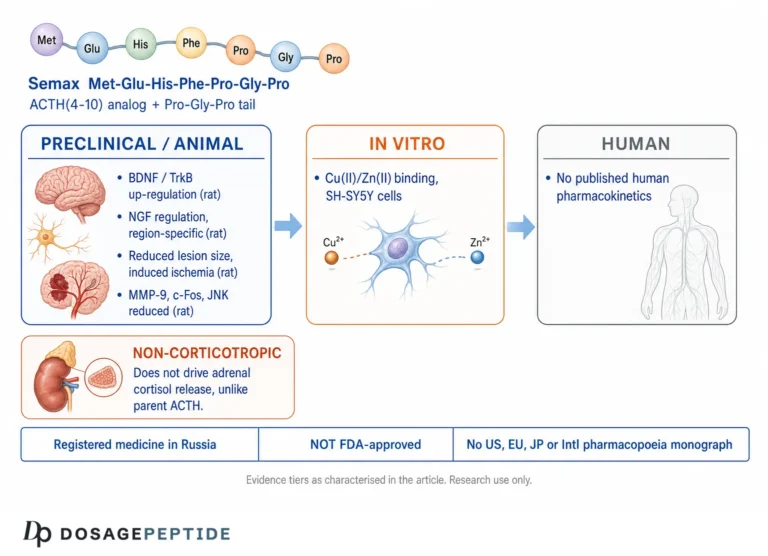
Semax has the amino-acid sequence Met-Glu-His-Phe-Pro-Gly-Pro (MEHFPGP). The first four residues, Met-Glu-His-Phe, correspond to the ACTH(4-7) fragment — the neuroactive core — and the trailing Pro-Gly-Pro (PGP) is a synthetic addition. So Semax is accurately described as an ACTH(4-7) analog stabilized with a C-terminal PGP tripeptide, and because ACTH(4-7) sits inside ACTH(4-10), the broader “ACTH(4-10) analog” label is also used in the literature. The foundational pharmacology paper by Dolotov and colleagues explicitly frames Semax as “an analog of ACTH(4-10)” when reporting its effects on hippocampal BDNF and trkB.[4]
The Pro-Gly-Pro Stabilization Strategy
The PGP tail is not decorative. Native peptide fragments are degraded rapidly by peptidases, giving them very short half-lives — frequently on the order of minutes in plasma. The problem is acute for a molecule that has to survive long enough to act centrally: unprotected small peptides are cleaved at their termini by aminopeptidases and carboxypeptidases almost as fast as they are introduced. Adding a C-terminal Pro-Gly-Pro shields the terminus because proline’s cyclic side chain is a poor substrate for many exopeptidases, so the imino-acid-rich cap dramatically slows enzymatic breakdown and extends the functional lifetime of the molecule. That extra stability is what makes an intranasally administered dose plausibly able to reach and act on the brain rather than being destroyed en route.
The intranasal route itself is part of the design logic and deserves a clear-eyed description. Peptides cross the blood–brain barrier poorly, and they are digested if swallowed, so the nasal mucosa — with its olfactory and trigeminal pathways offering partial direct access toward the CNS and its rich vasculature offering systemic absorption — is the delivery compromise the Russian formulations adopted. It is important not to overstate this: “nose-to-brain” transport is real but fractional and route-dependent, and the amount of an intranasal peptide dose that actually reaches brain tissue in humans is generally small and hard to quantify. For Adamax specifically, none of this is characterized — there is no published nasal-absorption, distribution, or CNS-exposure data for the molecule, so even the delivery premise is inherited from Semax rather than measured.
Notably, the PGP fragment itself is not inert: research on Semax and its C-terminal PGP peptide has examined PGP’s independent contribution to neurotrophin gene expression after cerebral ischemia, showing that both the intact peptide and its PGP fragment influence neurotrophin and receptor transcription.[5] This is a subtle point with real interpretive weight: if a stabilizing tail added purely for pharmacokinetic reasons turns out to carry its own biological activity, then attributing an effect to “the peptide” becomes genuinely ambiguous, and disentangling core-versus-tail contributions requires deliberate experiments. This same PGP-stabilization design underlies Selank as well, illustrating that it is a general Russian peptide-engineering strategy rather than something unique to any one compound.
Semax’s Regulatory Status in Russia
This is where evidence tiers must be stated carefully. Semax is not FDA-approved and not approved in the EU. It is, however, registered and marketed in Russia — as an intranasal formulation used in contexts such as ischemic stroke, cognitive and neurological indications, and (at lower concentrations) certain optic-nerve conditions. Russian clinical reports, including work in ischemic-stroke populations, describe functional and biochemical outcomes with intranasal Semax courses.[6] In practice, the registered product is marketed as an intranasal drop formulation at different concentrations for different intended uses — a lower-concentration preparation for milder cognitive or preventive indications and a higher-concentration preparation for acute neurological settings such as stroke — which is itself a reminder that dose and formulation are treated as clinically meaningful variables in the one jurisdiction where the compound is actually regulated. Importantly, much of this clinical literature is Russian-language, and by Western regulatory standards many studies are small, non-randomized, or methodologically limited — so “approved in Russia” should be read as a real but nationally specific and evidentiarily softer status, not as equivalent to a large multi-center Western approval. Readers wanting a mechanism-focused walkthrough of how Semax is thought to act on ACTH-related pathways can see the explainer on how Semax influences ACTH-related pathways, and the handling reference on the Semax 5 mg vial dosage protocol page.
Mechanisms Being Studied in the ACTH(4-10)/Semax Family
Because Adamax is sold on the promise that it shares Semax’s mechanisms, it is worth laying out what those mechanisms actually are — and being explicit that the evidence below is for Semax, PGP, and the melanocortin family, not for Adamax. These are the pathways a hypothetical Adamax study would need to test, not pathways Adamax has been shown to engage.
BDNF, NGF, and Neurotrophin Expression
The most cited mechanism for Semax is upregulation of neurotrophins — secreted proteins that support neuronal survival, growth, and synaptic plasticity. In the landmark rodent study, a single dose of Semax (50 µg/kg) produced roughly a 1.4-fold increase in hippocampal BDNF protein, a 1.6-fold increase in trkB tyrosine phosphorylation, and several-fold increases in exon-III BDNF and trkB mRNA — molecular changes consistent with Semax’s reported influence on learning and memory in rodents.[4] Additional work in rat brain reported that Semax rapidly modulates neurotrophin gene expression, including nerve growth factor (NGF) and BDNF transcripts, consistent with a neurotrophic signature.[7]
Trk Receptor Signaling and Neuroplasticity
Neurotrophins act through tropomyosin-receptor-kinase (Trk) receptors: NGF via TrkA, BDNF via TrkB, and NT-3 via TrkC, with the p75 receptor as a lower-affinity co-modulator. Studies of Semax and its PGP fragment in models of incomplete global ischemia examined mRNA for Ngf, Bdnf, and Nt-3 together with TrkA, TrkB, TrkC, and p75, finding that the peptides influenced neurotrophin-receptor expression predominantly in the frontal cortex and hippocampus and helped counter the ischemia-induced drop in these transcripts.[8] Related work on Semax and its C-terminal PGP fragment reported that both peptides modulate the expression of growth-factor genes and their receptors under conditions of experimental cerebral ischemia, reinforcing the neurotrophin-transcription signal in a separate model.[9] The plausibility of an Adamax that behaves similarly rests entirely on it engaging this same TrkB/neurotrophin axis — something never directly demonstrated for Adamax.
Why is the TrkB axis considered so consequential? When BDNF binds TrkB, the receptor dimerizes and autophosphorylates, recruiting adaptor proteins that launch three canonical intracellular cascades: the Ras–MAPK/ERK pathway associated with neuronal differentiation and growth, the PI3K–Akt pathway associated with cell survival, and the phospholipase C-γ pathway feeding into calcium signaling and CREB-dependent transcription. Several of these converge on CREB, a transcription factor central to activity-dependent plasticity and to the transcription of BDNF itself, creating a positive-feedback loop that is a leading candidate substrate for learning and memory. This is not idle background: proteomic analysis of Semax in cerebral ischemia–reperfusion reported upregulation of active CREB alongside downregulation of pro-injury signals such as MMP-9, c-Fos, and active JNK,[11] which situates Semax’s effects within exactly this survival-and-plasticity signaling architecture. An Adamax that genuinely shared Semax’s mechanism would have to move these same molecular needles — and that experiment has not been published.
Antioxidant, Anti-Inflammatory, and Vascular Effects
Beyond neurotrophins, genome-wide transcriptional profiling of Semax in a rat model of focal cerebral ischemia showed that the peptide affects the expression of genes tied to the immune and vascular systems — consistent with an anti-inflammatory, pro-angiogenic, and vascular-protective profile during ischemic injury.[10] Proteomic work independently confirmed a protective effect of the ACTH(4-7)PGP peptide (Semax) in a rat model of cerebral ischemia–reperfusion, characterizing shifts in brain protein-expression profiles associated with that protection.[11] These converging datasets are why Semax is described as neuroprotective in ischemic contexts — but again, this is Semax, in rodents (with adjunct Russian clinical data), not Adamax.
Monoaminergic Modulation and Intracellular Signaling
Semax has also been reported to influence monoaminergic systems (dopaminergic and serotonergic tone) and to modulate intracellular signaling. Recent experimental work examined the effect of Semax on intracellular calcium dynamics in rat brain neurons, adding a cellular-signaling dimension to its proposed mechanism.[12] The picture that emerges for the family is multi-target: neurotrophin induction, receptor-signaling modulation, anti-inflammatory and vascular effects, and neurotransmitter modulation — a portfolio of plausible mechanisms rather than a single clean receptor story.
| Proposed mechanism | What the family evidence shows | Evidence tier (for Semax/family) | Demonstrated for Adamax? |
|---|---|---|---|
| BDNF / NGF upregulation | Increased neurotrophin protein & mRNA in rodent hippocampus/cortex | Preclinical (rodent), replicated | No |
| TrkB / neurotrophin-receptor signaling | Altered TrkA/TrkB/TrkC/p75 expression, esp. after ischemia | Preclinical (rodent) | No |
| Anti-inflammatory / vascular protection | Immune- and vascular-gene changes in focal ischemia | Preclinical (rodent transcriptomics) | No |
| Melanocortin receptor engagement | Family-level neuroprotection; full ACTH protects neurons | Preclinical + mechanistic inference | No |
| Monoamine / calcium signaling modulation | Dopaminergic/serotonergic and intracellular-calcium effects | Preclinical (rodent/cellular) | No |
| Clinical neurological outcomes | Russian stroke/cognition reports with intranasal Semax | Low-to-moderate clinical (Russia-specific) | No |
How Is Adamax Positioned Relative to Semax? (Adamax vs Semax)
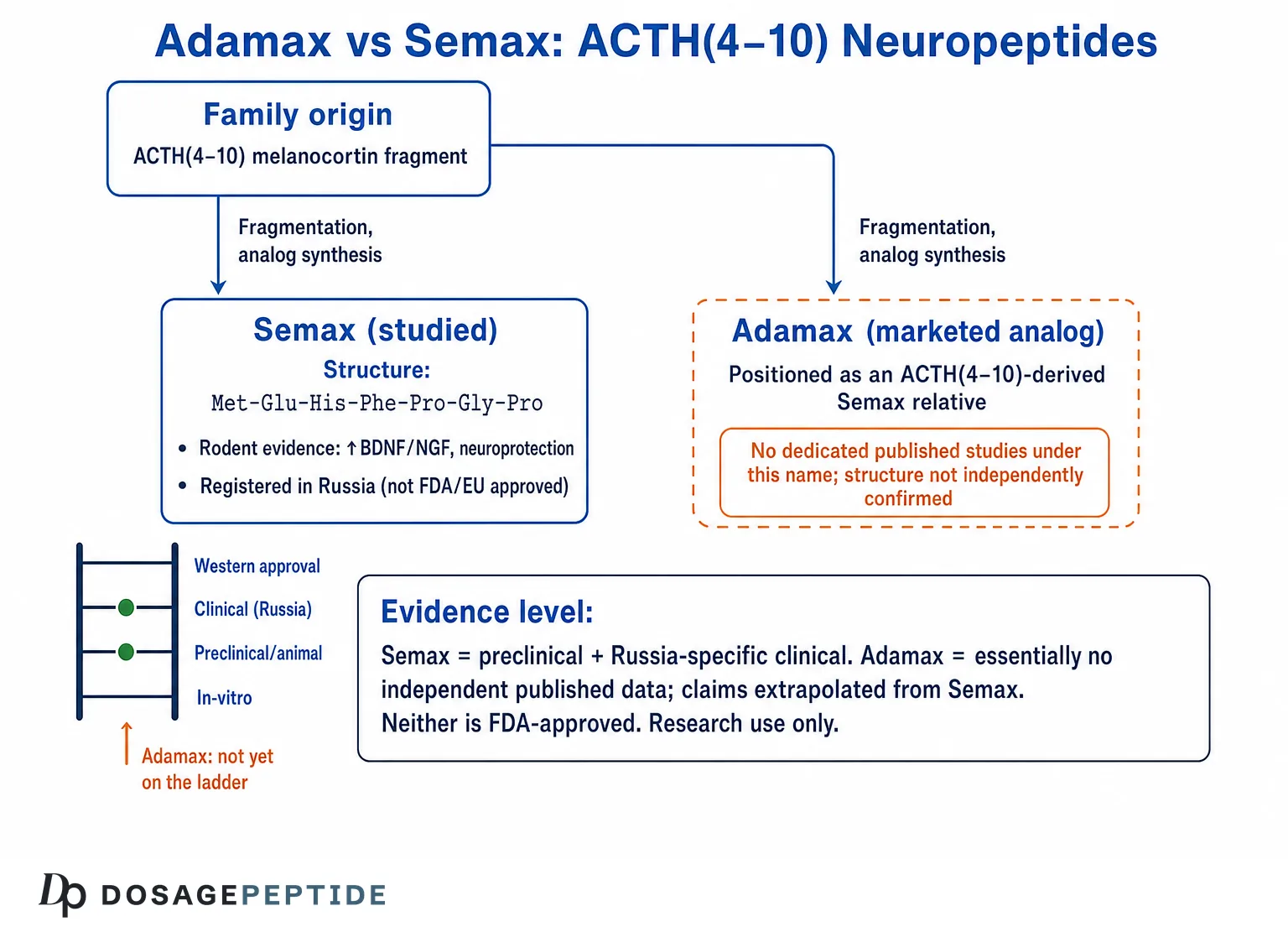
With the family science on the table, the “adamax vs semax” question becomes clearer. The positioning is essentially rhetorical: Adamax is presented as belonging to the same ACTH-derived melanocortin lineage, so that Semax’s credible neurotrophic research reflects onto it. Whether Adamax actually behaves like Semax is a separate, unanswered empirical question.
Vendor Claims and the “ACTH(4-10)” Framing
Vendor descriptions typically make three moves. First, they assign Adamax to the ACTH(4-10)/melanocortin family. Second, they imply parity with or superiority to Semax — “stronger,” “longer-acting,” or “enhanced” neurotrophic effect. Third, they cite (explicitly or by association) the Semax/ACTH(4-10) literature as if it validated Adamax. The first move is a categorical claim that would require a published sequence and characterization to verify. The second is a comparative pharmacodynamic/pharmacokinetic claim that would require head-to-head studies — which do not exist in the indexed literature. The third is the extrapolation error at the heart of this whole product category.
Adamax vs Semax: A Structured Comparison
| Attribute | Semax | Adamax (as marketed) |
|---|---|---|
| Claimed origin | ACTH(4-7) core + Pro-Gly-Pro tail (Met-Glu-His-Phe-Pro-Gly-Pro); documented sequence | Described as ACTH(4-10)-derived melanocortin analog; commercial-product sequence not established in mainstream databases |
| Development | Institute of Molecular Genetics, Russian Academy of Sciences; decades of study | No clear published development history under the Adamax name |
| Dedicated peer-reviewed studies | Numerous rodent studies + Russian clinical reports | Near-absent; no robust independent trials located |
| Proposed mechanism | BDNF/NGF upregulation, TrkB signaling, anti-inflammatory/vascular, monoaminergic modulation | Assumed identical to Semax family by association; not independently demonstrated |
| Regulatory status | Registered/marketed in Russia; NOT FDA/EU approved | Not approved anywhere; sold research-use-only |
| Human clinical data | Yes, but Russia-specific, often small/non-randomized | None located |
| Evidence tier (overall) | Preclinical strong + low-to-moderate clinical (Russia) | Marketing claims extrapolated from Semax; essentially uncharacterized independently |
What the Positioning Does and Doesn’t Tell You
The comparison makes the asymmetry obvious. Semax is a real, characterized, studied peptide with a defined structure and an actual (if regionally specific and methodologically uneven) clinical footprint. Adamax, at the level of the public scientific record, is a name attached to family-level assumptions. Being “in the ACTH(4-10) family” is a lineage statement, not evidence of equivalent potency, selectivity, pharmacokinetics, or safety. Even small structural differences between analogs can substantially change receptor engagement, metabolic stability, blood-brain-barrier penetration, and off-target activity — which is precisely why analogs must be studied individually rather than assumed to inherit a relative’s data. For a sense of how nuanced even a single well-studied peptide’s behavior can be under different conditions, see the discussion of how Semax may affect neural-circuit stability during cognitive load.
The point about “small structural differences” is not a rhetorical hedge; it is the core lesson of medicinal chemistry, and peptide pharmacology illustrates it vividly. A single amino-acid substitution, a change in chirality (swapping an L-residue for its D-enantiomer), an added or removed residue, or an alteration of the protective cap can shift a molecule from agonist to antagonist, multiply or abolish receptor affinity, change which receptor subtype is preferred, redirect metabolism, and reshape the pharmacokinetic curve. The melanocortin field is itself full of such examples, where engineered analogs of α-MSH show dramatically different receptor selectivity and stability than the parent. This is why regulators and journals require that each new analog be characterized on its own terms rather than credited with a relative’s profile. When a vendor implies that Adamax is “like Semax but stronger,” it is making precisely the kind of structure–activity claim that, in a rigorous setting, would demand comparative binding assays, functional readouts, and pharmacokinetic curves — none of which are in the public record. In the absence of a disclosed structure, one cannot even begin the structure–activity reasoning that would make “stronger” a testable statement rather than an adjective.
Current Evidence Level: What Actually Exists for Adamax?
This is the crux of the article and the section a careful reader should weigh most heavily. When we ask about the current evidence level, we must answer two different questions: what exists for Adamax specifically, and what exists for the family it borrows from.
Adamax-Specific Literature: A Near-Empty Set
Searches of PubMed, PMC, and clinical-trial registries for a neuropeptide called “Adamax” do not return a coherent body of dedicated pharmacology, toxicology, pharmacokinetic, or clinical studies. There is no located randomized controlled trial, no published human pharmacokinetic characterization, and no independent replication of any Adamax-specific efficacy claim. In evidence terms, Adamax sits at the lowest tier: an uncharacterized research chemical whose properties are asserted rather than demonstrated. It would be dishonest to present it as anything more, and this article will not fabricate a study to fill that gap — the absence is the finding.
The Semax Evidence That Gets Borrowed
By contrast, the Semax/ACTH(4-10) literature the marketing leans on is real and, for a niche peptide, reasonably substantial: rodent studies on BDNF/trkB regulation,[4] neurotrophin gene expression,[7] genome-wide transcriptomics in ischemia,[10] proteomic confirmation of neuroprotection,[11] and Russian clinical reports in stroke.[6] The critical logical point: this evidence supports statements about Semax, and about the ACTH(4-10) family as a research area. It does not transfer to Adamax without Adamax-specific data. Borrowing a relative’s CV is not the same as having your own.
Preclinical vs Clinical: Reading the Tiers Correctly
Even for Semax, it is worth being precise about tiers, because the same discipline should be applied to any Adamax claim:
- In-vitro / cellular — neuronal-culture and calcium-signaling studies. Informative about mechanism, not about whole-organism efficacy.
- Preclinical / animal — the bulk of the Semax neurotrophic and neuroprotective data. Rodent findings frequently fail to translate to humans, so these establish plausibility, not proof of human benefit.
- Clinical (Russia-specific) — real human data for Semax, but often small, non-randomized, or unblinded, and largely outside the Western regulatory review process.
- Western regulatory approval — absent for both Semax and Adamax.
Placing Adamax on this ladder, it does not yet reach even the first rung with dedicated, published evidence. That is not a claim that Adamax cannot work; it is a statement that no one has publicly shown that it does.
What Would It Take to Validate Adamax-Specific Claims?
A useful way to expose the evidence gap is to spell out the research that would be required to justify the marketing. None of the following steps appear to have been publicly completed for Adamax.
Structural Characterization and Analytical Purity
Step one is knowing exactly what the molecule is: a defined amino-acid sequence, confirmed by mass spectrometry and sequencing, with analytical purity established by HPLC. Without a locked-down structure and purity profile, every downstream claim is untethered. For a research chemical, batch-to-batch identity and purity are not guaranteed, which is one reason RUO materials are unsuitable for anything but bench characterization.
Pharmacokinetics and Dose-Finding
Next comes pharmacokinetics: how the peptide is absorbed (particularly intranasally, the route used for Semax), whether and how it reaches the CNS, its stability and half-life, and its metabolites. Dose-finding studies in appropriate models would establish an exposure–response relationship. Vendor “protocols” that quote milligram vials and reconstitution volumes describe handling conventions, not validated dosing — and should never be read as clinical guidance.
Mechanistic and Efficacy Studies With Independent Replication
Then the mechanistic and efficacy work that Semax has and Adamax lacks: does Adamax actually raise BDNF/NGF, engage TrkB, or reproduce the anti-inflammatory/vascular transcriptomic signature? Critically, any positive finding would need independent replication by groups without a commercial stake, published in indexed, peer-reviewed venues. Until that exists, “Adamax works like Semax” remains a hypothesis, and a largely untested one.
Toxicology and the Regulatory Ladder
Even a molecule that passed every step above would still sit far from human use. The path a genuine drug candidate follows — and that Adamax has not entered under its own name — runs through formal toxicology (acute and repeat-dose studies, genotoxicity, and, where relevant, reproductive and carcinogenicity assessment), manufacture under good manufacturing practice with defined impurity limits, and then, only if a regulator agrees the preclinical package justifies it, phased human trials beginning with small first-in-human safety studies. Each rung exists to catch a specific failure mode: toxicology catches organ and genetic harms invisible in an efficacy assay; GMP catches the batch-to-batch variability that makes a research chemical unsuitable for administration; controlled trials catch the placebo effects, dropout patterns, and rare adverse events that uncontrolled case series miss. Describing where Adamax sits on this ladder is simple: it is not on it. There is no public evidence of formal toxicology, no regulatory filing, and no registered clinical trial under the Adamax name, which is why every honest statement about it has to remain at the level of “uncharacterized” rather than “early but promising.”
How Does Adamax Compare With Other Nootropic Peptides Like Selank?
Adamax is often shelved alongside other Russian-lineage research peptides, especially Selank, so a brief comparison clarifies where honest evidence sits across the category.
Selank: A Tuftsin-Derived Anxiolytic Analog
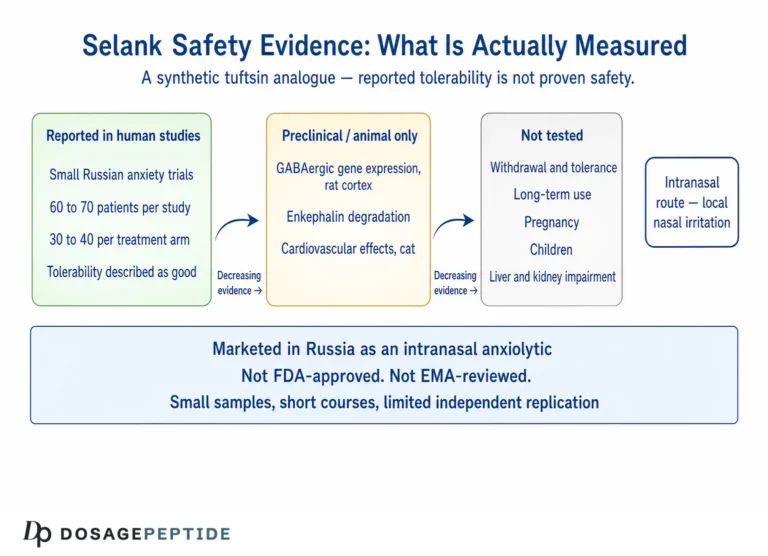
Selank (Thr-Lys-Pro-Arg-Pro-Gly-Pro) is a synthetic heptapeptide derived from the immune peptide tuftsin, again stabilized with a C-terminal Pro-Gly-Pro tail — the same engineering motif seen in Semax. It is developed in Russia as an anxiolytic/nootropic and, like Semax, is registered there but not FDA/EU approved. Preclinical work reports GABAergic and BDNF-related effects: transcriptomic studies show Selank alters expression of genes involved in GABAergic neurotransmission,[13] and rodent studies indicate it modulates hippocampal and cortical BDNF, including protection against ethanol-induced memory impairment.[14] A fuller treatment is available in the explainer on what Selank is as a nootropic peptide for anxiety and cognition.
The Pattern — and Where Adamax Breaks It
Selank and Semax share a recognizable pattern: a naturally derived bioactive core, a PGP stabilizing tail, Russian development and national registration, a preclinical evidence base centered on neurotrophins/neurotransmitters, and no Western approval. Adamax is marketed as if it fits this pattern, but it breaks it in the most important place: the dedicated evidence base. Selank and Semax each have their own studies; Adamax, in the public record, does not. That difference is the entire point. Belonging to the same conceptual category as evidence-backed peptides does not confer their evidence.
Practical Research Considerations and Handling Caveats
For completeness — and strictly within a research-use-only, non-clinical framing — a few practical points recur around peptides in this class. None of this should be read as endorsement of human use.
Reconstitution and Storage Conventions
Lyophilized research peptides are typically reconstituted with bacteriostatic or sterile water, kept cold, and protected from light and repeated freeze-thaw cycles to limit degradation. The arithmetic of concentration (mass per vial divided by diluent volume) is generic laboratory practice, and general references such as the peptide reconstitution guide and the reconstitution calculator illustrate the math in the abstract. Applying that math to Adamax presupposes a characterized, pure material — which, as established above, is not guaranteed for an RUO product with no published identity standard.
Sourcing, Purity, and the RUO Boundary
Because Adamax is sold as a research chemical, there is no regulatory assurance of identity, purity, sterility, or endotoxin content. Independent third-party analytical testing (HPLC, mass spectrometry) is the only way to know what is actually in a given vial, and even then it confirms only that batch. The RUO label is a legal and scientific boundary, not a formality: these materials are for laboratory investigation, not administration. Any framing that quietly treats a vendor “protocol” as a human dosing regimen has crossed a line the evidence does not support.
Limitations & Open Questions
The limitations here are unusually severe, and they define the responsible reading of the entire topic.
Identity Ambiguity
The most basic limitation is that “Adamax” lacks a clearly published, independently verified structure in mainstream scientific databases. Without that anchor, discussions of its mechanism are necessarily speculative, and comparisons to Semax rest on assumed rather than confirmed similarity. A named product is not the same as a characterized molecule.
Extrapolation Risk
The central intellectual hazard is extrapolation: importing Semax’s (and the melanocortin family’s) rodent and Russian-clinical findings and quietly relabeling them as Adamax data. Every mechanistic and efficacy citation in this article is, by design, for Semax, PGP, the melanocortin system, or Selank — not for Adamax. Readers should treat any source that appears to describe “Adamax research” but actually cites Semax studies as an example of this error, not as validation.
Evidence Quality Even Within the Family
A secondary limitation is that even the borrowed evidence has ceilings. Rodent neurotrophic effects translate to human cognition unreliably; the Russian clinical literature on Semax is often small, non-randomized, and outside Western peer-review norms; and preclinical neuroprotection in acute ischemia models does not establish everyday nootropic benefit in healthy humans. So even the strongest available data supports cautious, mechanism-level statements — not confident efficacy claims — and it does so for Semax, not Adamax.
Safety and Regulatory Open Questions
There is no published toxicology, no long-term safety data, and no regulatory review for Adamax. Its purity and consistency are unverified. Its interactions, contraindications, and dose–response profile are unknown. These are not minor gaps to be filled in later — they are the foundational data that would normally precede any efficacy discussion at all.
Open Research Questions
- What is the exact, independently confirmed amino-acid sequence of the commercial “Adamax” peptide?
- Does Adamax engage melanocortin receptors or the neurotrophin/TrkB axis in any controlled model?
- Does it reproduce — or diverge from — Semax’s BDNF/NGF and anti-inflammatory signatures?
- What are its pharmacokinetics, particularly by the intranasal route used for related peptides?
- Is any efficacy claim reproducible by independent, non-commercial laboratories in peer-reviewed venues?
Until these are answered, the accurate one-line summary is: Adamax is a research-use-only peptide marketed as an ACTH(4-10)-derived Semax analog, whose properties are inferred from the melanocortin/Semax family rather than demonstrated for Adamax itself.
Related dosing reference: For the reconstitution math and reported dosing figures, see our Adamax dosage & reconstitution reference.
Frequently Asked Questions
What is Adamax in simple terms?
Adamax is a synthetic research-use-only peptide marketed as an ACTH(4-10)-derived neuropeptide in the melanocortin family, positioned as a relative of Semax and promoted for neurotrophic and nootropic research. In practical evidence terms, it is a poorly characterized compound: mainstream scientific databases contain essentially no dedicated Adamax studies, so its claimed properties are borrowed by association from the better-studied Semax and ACTH(4-10) literature rather than demonstrated for Adamax itself.
Is Adamax the same as Semax?
No. Semax is a defined heptapeptide (Met-Glu-His-Phe-Pro-Gly-Pro) with a documented structure, decades of rodent research, and national registration in Russia. Adamax is a separately marketed product placed in the same ACTH(4-10) family, but without an independently verified structure or dedicated published studies in the public record. They are described as relatives, but Adamax has not been shown to share Semax’s pharmacology, potency, or safety profile.
Is Adamax FDA-approved or safe for human use?
No. Adamax is not approved by the FDA or any Western regulator and is sold strictly as a research-use-only material, meaning it is not manufactured or tested to pharmaceutical standards and is not intended for human administration. There is no published toxicology, pharmacokinetic, or clinical safety data for Adamax specifically, so no claim about its human safety can be responsibly made.
What does the actual research on Adamax show?
Independent, peer-reviewed research specifically on Adamax is close to non-existent in PubMed, PMC, and clinical-trial registries. The studies typically cited alongside Adamax are about Semax, its Pro-Gly-Pro fragment, or the melanocortin/ACTH(4-10) system. Those findings support statements about Semax and the family, not about Adamax, which remains uncharacterized in the public scientific literature.
How is Adamax supposed to work mechanistically?
The proposed mechanisms are inherited from the Semax/ACTH(4-10) family: upregulation of neurotrophins such as BDNF and NGF, modulation of Trk-receptor signaling, anti-inflammatory and vascular-protective effects during ischemia, and possible melanocortin-receptor engagement. These mechanisms are documented for Semax in rodents, but there is no published evidence confirming that Adamax engages any of them.
Why is there so little information on Adamax?
Because it appears to be a vendor-introduced research chemical rather than a formally developed and studied pharmaceutical. Unlike Semax and Selank, which were developed at a Russian academic institute and generated dozens of publications, Adamax has no clear published development history under that name. The scarcity of information is itself the key finding: claims outrun evidence.
Can I use Semax research to judge Adamax?
Only very cautiously, and never as proof. Semax data establishes what the ACTH(4-10) family can do, which makes Adamax’s claims biologically plausible in principle. But even small structural differences between peptide analogs can change receptor binding, stability, brain penetration, and off-target effects, so each analog must be studied on its own. Using Semax data to assert Adamax efficacy is an extrapolation error.
How does Adamax compare to Selank?
Selank is a tuftsin-derived, PGP-stabilized anxiolytic/nootropic peptide with its own preclinical literature on GABAergic and BDNF-related effects and Russian registration. Like Semax, it has dedicated studies; Adamax does not. All three are marketed in the same nootropic-peptide category, but Selank and Semax have individual evidence bases, whereas Adamax’s profile is assumed from the family rather than independently demonstrated.
Where can I learn more about the peptides Adamax is compared to?
The most productive path is to study the compounds that actually have evidence — Semax and Selank — and the melanocortin/ACTH(4-10) system they come from. This site’s explainers on Semax’s ACTH-related pathways and on Selank, plus a research glossary of terms like BDNF, TrkB, and melanocortin receptors, provide grounded background that makes it easier to see exactly where Adamax’s claims exceed its documentation.
References
- Adan RAH, Gispen WH. Melanocortins and the brain: from effects via receptors to drug targets. European Journal of Pharmacology. 2000;405(1–3):13–24. PMID 11033310. https://www.sciencedirect.com/science/article/abs/pii/S0014299900005379
- Gebrie A. The melanocortin receptor signaling system and its role in neuroprotection against neurodegeneration: Therapeutic insights. Annals of the New York Academy of Sciences. 2023;1528(1):40–60. PMID 37526975. https://nyaspubs.onlinelibrary.wiley.com/doi/10.1111/nyas.15048
- Montero-Meléndez T, Gobbetti T, Cooray SN, et al. Melanocortin receptor agonist ACTH(1–39) protects rat forebrain neurons from apoptotic, excitotoxic and inflammation-related damage. Experimental Neurology. 2015;273:198–204. PMID 26300474. https://www.sciencedirect.com/science/article/abs/pii/S001448861530073X
- Dolotov OV, Karpenko EA, Inozemtseva LS, et al. Semax, an analog of ACTH(4-10) with cognitive effects, regulates BDNF and trkB expression in the rat hippocampus. Brain Research. 2006;1117(1):54–60. PMID 16996037. https://pubmed.ncbi.nlm.nih.gov/16996037/
- Shadrina M, Kolomin T, Agapova T, et al. Semax and Pro-Gly-Pro activate the transcription of neurotrophins and their receptor genes after cerebral ischemia. Cellular and Molecular Neurobiology. 2010;30(1):71–79. PMID 19633950. https://pubmed.ncbi.nlm.nih.gov/19633950/
- Gusev EI, Martynov MY, Kostenko EV, et al. The efficacy of semax in the treatment of patients at different stages of ischemic stroke. Zhurnal Nevrologii i Psikhiatrii im. S.S. Korsakova. 2018;118(3. Vyp. 2):61–68. PMID 29798983. https://pubmed.ncbi.nlm.nih.gov/29798983/
- Agapova TY, Agniullin YV, Shadrina MI, et al. Neurotrophin gene expression in rat brain under the action of Semax, an analogue of ACTH(4–10). Neuroscience Letters. 2007;417(2):201–205. https://www.sciencedirect.com/science/article/abs/pii/S0304394007002108
- Stavchansky VV, Tvorogova TV, Botsina AY, et al. Effect of semax and its C-terminal peptide PGP on the expression of neurotrophins and their receptors in the rat brain during incomplete global ischemia. Molecular Biology (Moscow). 2011;45(5):894–900. https://link.springer.com/article/10.1134/S0026893311050128
- Dmitrieva VG, Dergunova LV, Povarova OV, Skvortsova VI, Limborskaya SA, Myasoedov NF. The effect of semax and the C-terminal peptide PGP on the expression of growth factor genes and receptors in rats under conditions of experimental cerebral ischemia. Doklady Biochemistry and Biophysics. 2008;422:261–264. PMID 19024553. https://pubmed.ncbi.nlm.nih.gov/19024553/
- Medvedeva EV, Dmitrieva VG, Povarova OV, et al. The peptide semax affects the expression of genes related to the immune and vascular systems in rat brain focal ischemia: genome-wide transcriptional analysis. BMC Genomics. 2014;15:228. PMC3987924. https://pmc.ncbi.nlm.nih.gov/articles/PMC3987924/
- Sudarkina OY, Filippenkov IB, Stavchansky VV, et al. Brain protein expression profile confirms the protective effect of the ACTH(4–7)PGP peptide (Semax) in a rat model of cerebral ischemia–reperfusion. International Journal of Molecular Sciences. 2021;22(12):6179. PMID 34201112. PMC8226508. https://pmc.ncbi.nlm.nih.gov/articles/PMC8226508/
- Kolbaev SN, Sharonova IN, Skrebitsky VG. The effect of peptide Semax, an ACTH(4-10) analogue, on intracellular calcium dynamics in rat brain neurons. Bulletin of Experimental Biology and Medicine. 2025;179(3):416–420. https://link.springer.com/article/10.1007/s10517-025-06501-z
- Volkova A, Shadrina M, Kolomin T, et al. Selank administration affects the expression of some genes involved in GABAergic neurotransmission. Frontiers in Pharmacology. 2016;7:31. PMC4757669. https://pmc.ncbi.nlm.nih.gov/articles/PMC4757669/
- Kozlovskaya MM, Kozlovskii II, et al. Selank, peptide analogue of tuftsin, protects against ethanol-induced memory impairment by regulating BDNF content in the hippocampus and prefrontal cortex in rats. Bulletin of Experimental Biology and Medicine. 2019;167(5):641–644. PMID 31625062. https://pubmed.ncbi.nlm.nih.gov/31625062/
Research-Use-Only Disclaimer
This article is provided for scientific, educational, and informational purposes only and describes an independent review of the published literature. Adamax is not an approved drug and is not manufactured, labeled, or tested for human or veterinary use; it is discussed here strictly as a research-use-only material. Nothing above is medical advice, a treatment recommendation, a dosing protocol, or a claim that Adamax (or any peptide discussed) diagnoses, treats, cures, or prevents any disease. The evidence cited pertains to Semax, its Pro-Gly-Pro fragment, the broader melanocortin/ACTH(4-10) system, and Selank — not to Adamax, for which independent published evidence is near-absent. Readers should not infer human efficacy or safety from preclinical, animal, in-vitro, or regionally specific clinical data. Consult qualified professionals and applicable regulations before conducting any laboratory research.