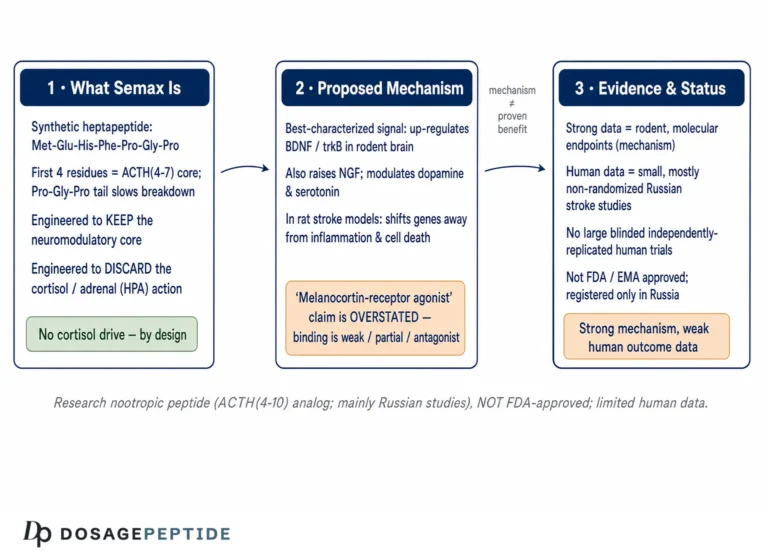
The question at the top of this page — how Semax might affect neural circuit stability during cognitive load — is phrased in the confident language of systems neuroscience, and that phrasing quietly smuggles in an assumption worth dragging into the open before we go any further. It presumes that there is an established body of work showing that Semax does something measurable to the way brain circuits behave when a person or animal is working hard: holding items in working memory, sustaining attention, resolving interference. There is not. No study has directly recorded the stability of a neural circuit — its excitation–inhibition balance, the persistence of its working-memory activity, the fidelity of its oscillations — in a subject given Semax and then placed under a graded cognitive load. That specific experiment, as of mid-2026, has not been published.
So this article does not affirm the premise. It treats it as an open, genuinely interesting research question and asks a narrower, more honest version of it: given what Semax is actually known to do at the molecular and neurochemical level, is there a mechanistically plausible bridge to the idea of “circuit stability under load,” and how far does the real evidence carry that bridge before it runs out? Semax is a synthetic heptapeptide developed in Russia, an analog of a fragment of adrenocorticotropic hormone, and it is registered in the Russian Federation as a nootropic and neuroprotective medicine.1 It is not approved by the U.S. Food and Drug Administration, the European Medicines Agency, or any comparable Western regulator for any indication, and almost the entire evidence base is preclinical (rodent) or comes from Russian-language clinical studies of stroke and cerebrovascular disease rather than from studies of healthy cognition under load.110
This piece is written for researchers and scientifically literate readers who want an honest map: what Semax is, what “circuit stability under cognitive load” even means as a construct, the neurotrophic and neurochemical mechanisms that could in principle touch that construct, what the human and animal data genuinely show, where the inferential leaps are, and what the compound’s regulatory and safety status actually is. Throughout, the discipline is the same: never let a plausible mechanism masquerade as a demonstrated effect.
What Semax Is and Where It Came From
Semax is a synthetic heptapeptide with the sequence Met-Glu-His-Phe-Pro-Gly-Pro. Structurally it is built from the ACTH(4–7) fragment of adrenocorticotropic hormone — the Met-Glu-His-Phe core that carries much of that hormone’s non-hormonal, behaviorally active signal — extended at the C-terminus with the tripeptide Pro-Gly-Pro.2 That is why the literature refers to it interchangeably as an ACTH(4–10) analog and, more precisely, as ACTH(4–7)PGP. The Pro-Gly-Pro tail is not decorative. Free ACTH fragments are torn apart in minutes by peptidases; the proline-rich extension shields the biologically active core from rapid enzymatic cleavage and, as we will see, itself appears to carry a portion of the molecule’s activity.8
The compound was developed at the Institute of Molecular Genetics of the Russian Academy of Sciences beginning in the 1980s, growing out of a longstanding Soviet and Russian research program into the behavioral effects of ACTH-derived peptides. The design goal was to keep the memory- and attention-related effects that ACTH fragments were reported to have while stripping away the corticotropic, hormone-releasing activity of the parent molecule — that is, a peptide that acts on the brain without turning on the adrenal stress axis. Semax was subsequently registered in Russia and appears on the Russian List of Vital and Essential Medicines, used clinically as an intranasal preparation for ischemic stroke, transient ischemic attacks, cognitive disorders, and optic-nerve conditions.110 It is important to state plainly that Russian registration is a real regulatory event but is not equivalent to FDA or EMA approval, and the pivotal-trial standard used in those latter systems has not been met for Semax in any indication.
A habit that keeps thinking clear about this molecule is to hold three levels apart. First, the parent hormone family: ACTH and the melanocortins, which act on melanocortin receptors and have broad, well-characterized endocrine and central effects. Second, the active fragment: the ACTH(4–7) core that carries neurotropic activity uncoupled from steroidogenesis. Third, the engineered peptide: Semax itself, a stabilized fragment whose measured effects — on neurotrophins, on monoamines, on ischemic tissue — are the only things we are actually entitled to reason from. Popular writing routinely collapses these levels, borrowing the reputation of “ACTH affects the brain” or “peptides boost BDNF” to imply far more specific claims about cognition than the data on Semax support. Keeping the levels distinct is the single most useful discipline for this topic. For readers new to the vocabulary of peptide pharmacology, the site’s peptide glossary defines many of the terms used below.
What “Neural Circuit Stability During Cognitive Load” Actually Means
Before asking whether Semax touches it, we should be precise about the construct, because it is easy to wave at “circuit stability” without pinning down what would be measured. In systems neuroscience, a neural circuit is a population of interconnected neurons whose coordinated activity implements a function — for instance, the recurrent networks of prefrontal cortex that maintain a representation “online” during a working-memory delay. Stability refers to that circuit’s ability to maintain reliable, appropriately bounded activity rather than drifting into one of two failure modes: runaway excitation (which at the extreme becomes excitotoxic) or collapse of the signal into noise.
Cognitive load — the demand imposed by holding more items, attending longer, or filtering more distraction — stresses this stability in concrete, physiological ways. Sustaining persistent activity is metabolically expensive and depends on a finely tuned balance between glutamatergic excitation and GABAergic inhibition (the “E/I balance”). It relies on adequate energy supply and calcium handling, because dysregulated intracellular calcium both degrades signaling and, if severe, triggers cell-damage cascades. And over longer timescales it depends on synaptic homeostasis: the capacity of synapses to strengthen where learning demands it while scaling globally to avoid saturating the network. When people speak loosely of a circuit becoming “unstable under load,” they usually mean some combination of E/I imbalance, calcium dysregulation, metabolic shortfall, and failure of homeostatic scaling.
It is worth dwelling on one nuance that popular writing tends to flatten: stability is not the same as excitability. A common misreading of “nootropic” claims is that a good cognitive-enhancer simply makes neurons fire more, as though more activity were always better. The opposite is closer to the truth. A circuit under heavy load is at risk precisely because its activity is being pushed toward the edges of its dynamic range, and what protects performance is the network’s ability to hold the line — to keep excitation reined in by proportionate inhibition, to prevent the representation from either fading or running away. Stability, in this sense, is a regulatory property, not a level of arousal. That distinction matters for Semax because its most robust documented actions (neurotrophic support of inhibitory interneurons, anti-inflammatory and vascular effects in stressed tissue) are more naturally read as regulatory or protective than as straightforwardly excitatory. If Semax touches circuit stability at all, the biologically plausible story is one of buffering and homeostasis rather than stimulation — a subtle but important reframing of what one would even be looking for.
Here is the honest framing for what follows. Semax has documented actions on several of the substrates of circuit stability — it modulates the BDNF/TrkB system that governs synaptic plasticity and homeostasis, it shifts monoaminergic tone that shapes prefrontal signal-to-noise, it changes the expression of genes governing inflammation and vascular tone in stressed tissue, and there is early work on how it affects neuronal calcium dynamics.1349 What it does not have is a study that closes the loop: administer Semax, impose a titrated cognitive load, and directly measure a circuit-stability readout (persistent-activity fidelity, E/I markers, task-related oscillatory dynamics) against placebo. The bridge from “affects the substrates” to “stabilizes the circuit under load” is therefore built entirely of mechanistic inference, and inference is not evidence. The sections below lay the planks of that bridge one at a time and, crucially, mark where each one ends.
The BDNF/TrkB Axis: the Strongest Mechanistic Plank
If any single mechanism could connect Semax to circuit stability, it is the effect on brain-derived neurotrophic factor (BDNF) and its receptor TrkB. This is also the best-characterized action of the peptide, so it deserves the most careful handling.
The foundational work here is a 2006 study by Dolotov and colleagues, who showed that a single intranasal application of Semax to rats altered the hippocampal BDNF/TrkB system in a coordinated way. They reported a maximal roughly 1.4-fold increase in BDNF protein, an approximately 1.6-fold increase in TrkB tyrosine phosphorylation (a direct readout of receptor activation), and larger increases at the transcript level — on the order of a threefold rise in exon-III BDNF mRNA and a twofold rise in TrkB mRNA.1 A companion paper in the Journal of Neurochemistry the same year showed that Semax binds specifically in the rat basal forebrain and rapidly increases BDNF protein there within about three hours of intranasal dosing at 50 and 250 µg/kg, providing protein-level confirmation in a second region.2
Why does this matter for stability? BDNF acting through TrkB is one of the central regulators of synaptic homeostasis and plasticity. It supports long-term potentiation, tunes the balance of excitatory and inhibitory synaptic strength (notably by supporting GABAergic interneuron function), promotes dendritic and synaptic maintenance, and contributes to the homeostatic scaling that keeps networks from saturating. A circuit with healthier BDNF/TrkB signaling is, in principle, better buffered against exactly the kinds of destabilization that load imposes. This is a genuine, mechanistically coherent argument, and it is the reason Semax is studied as a nootropic at all.
There is a further, often-overlooked reason BDNF is the natural place to anchor a circuit-stability argument: its role in supporting GABAergic inhibition. Much of the literature that lay readers encounter frames BDNF as a growth-and-plasticity signal — a molecule that makes synapses stronger and neurons survive. That is true, but for stability under load the more pertinent function is BDNF’s support of inhibitory interneurons, particularly the parvalbumin-expressing cells that pace fast cortical oscillations and enforce the inhibitory side of the E/I balance. A circuit that maintains its inhibitory scaffolding under demand is a circuit that resists the drift toward runaway excitation. If Semax’s modest, transient boost to BDNF/TrkB signaling preferentially reinforced that inhibitory machinery, it would map onto stability far more cleanly than a generic “more plasticity” story does. This is, to be clear, an inference from the general BDNF literature applied to Semax, not something the Semax studies themselves measured — but it is the version of the BDNF argument most worth testing, and it illustrates why sloppy “BDNF equals better brain” shorthand obscures the actually interesting hypothesis.
The honest caveats are equally important. First, magnitude: a 1.4-fold protein increase is a modest, physiological-range change, not a pharmacological surge, and it was measured in healthy rodent brain, not in a loaded human circuit. Second, timescale: these are acute changes lasting hours to a day or two, which speaks to a transient neuromodulatory nudge rather than a durable structural remodeling on the evidence available.12 Third, and most important, the entire inferential chain — more BDNF → healthier synaptic homeostasis → more stable circuits → better performance under cognitive load — is assembled from separate literatures. No experiment has traced that chain end-to-end for Semax. The BDNF plank is real and load-bearing as far as it goes, but it stops well short of the far bank. Readers exploring how other peptides are theorized to touch neurotrophic signaling for brain health can compare the analogous, similarly preliminary discussion around BPC-157 and nerve and brain health, where the same “plausible mechanism, thin human evidence” pattern recurs.
| Readout (rat, single intranasal dose) | Reported change vs control | What it indexes |
|---|---|---|
| Hippocampal BDNF protein | ~1.4-fold increase1 | Available neurotrophic support |
| TrkB tyrosine phosphorylation | ~1.6-fold increase1 | Actual receptor activation |
| Exon-III BDNF mRNA | ~3-fold increase1 | Activity-dependent transcription |
| TrkB mRNA | ~2-fold increase1 | Receptor supply |
| Basal-forebrain BDNF protein | Rapid rise within ~3 h2 | Regional generality of effect |
Monoaminergic Modulation and Prefrontal Signal-to-Noise
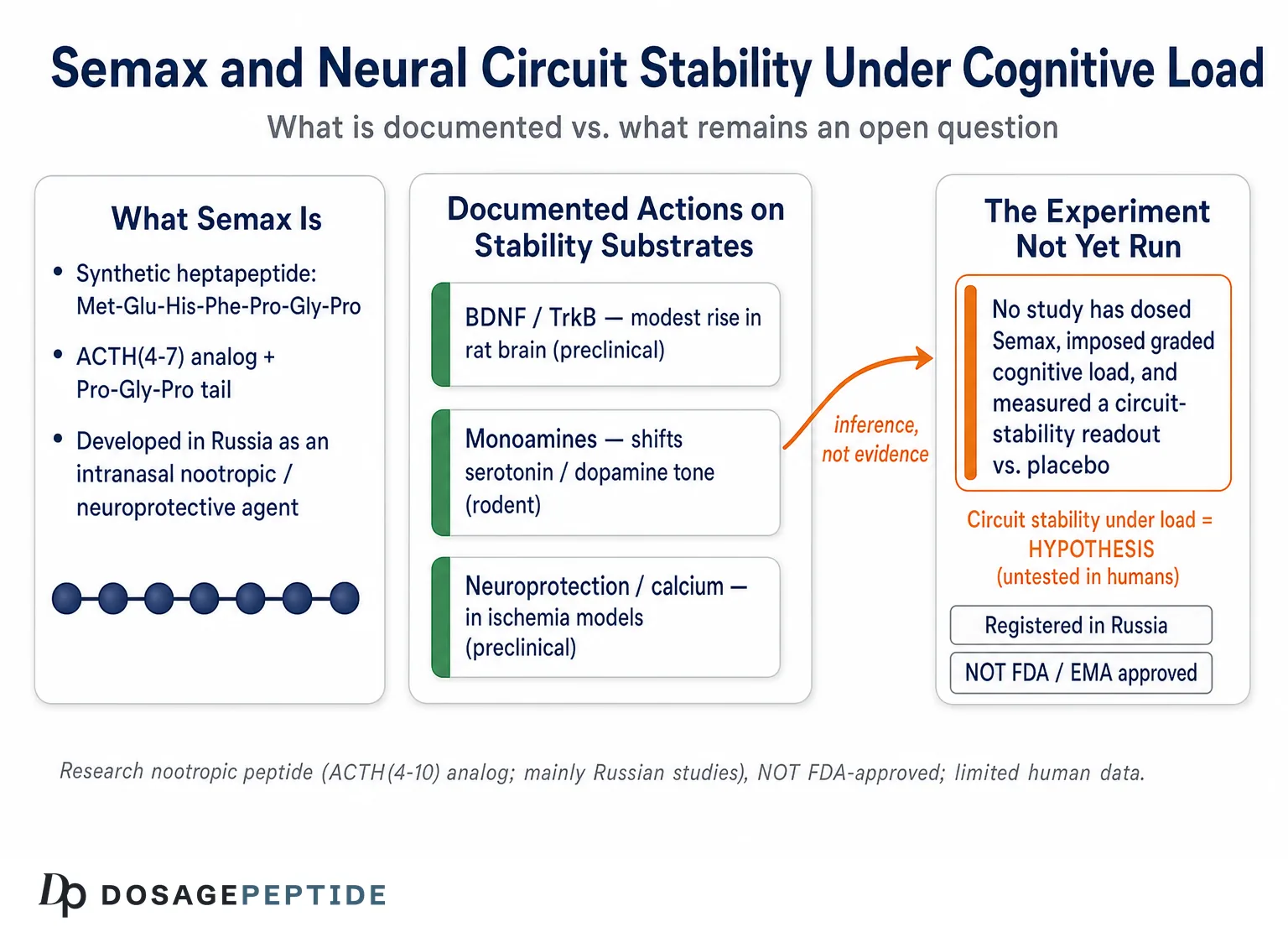
The second mechanistic plank concerns neurotransmitters, and it maps onto cognitive load more directly than BDNF does, because the moment-to-moment stability of prefrontal working-memory circuits is exquisitely sensitive to dopamine and, secondarily, serotonin.
A 2005 study by Eremin and colleagues in Neurochemical Research characterized Semax’s effects on monoaminergic systems in rodents and found measurable shifts in both dopaminergic and serotonergic activity.3 Among the reported findings, the tissue content of the serotonin metabolite 5-hydroxyindoleacetic acid (5-HIAA) in the striatum rose by roughly 25% two hours after administration, and the extracellular striatal level of 5-HIAA increased progressively, reaching on the order of 180% of baseline over one to four hours after a 0.15 mg/kg intraperitoneal dose.3 The paper interpreted these as evidence that Semax activates dopaminergic and serotonergic brain systems, a mechanism consistent with its reported effects on attention and motivation. One nuance in that paper deserves flagging, because popular summaries routinely blur it: the direct, Semax-alone changes were on the serotonergic side (the 5-HIAA measures above), whereas Semax on its own did not significantly shift baseline dopamine or its metabolites — the clearest dopaminergic signal emerged only when the peptide was given before d-amphetamine, whose dopamine-releasing and locomotor effects it then amplified. So the “activates dopamine” framing is really a statement about modulation of an already-stimulated system, not proof that Semax raises dopaminergic tone by itself, and that distinction matters for any inference about prefrontal signal-to-noise.
The relevance to circuit stability runs through the well-established “inverted-U” relationship between prefrontal dopamine and working-memory performance. Persistent activity in prefrontal networks — the physiological substrate of holding information online under load — depends on dopaminergic tone acting largely through D1-class receptors to sharpen the signal-to-noise ratio: adequate dopamine strengthens the tuned, task-relevant activity and suppresses noise, stabilizing the representation, whereas too little or too much degrades it. A compound that modestly raises monoaminergic tone could, on this model, shift a circuit toward the more stable part of that curve. Serotonergic modulation, meanwhile, is tied to impulse control, mood, and the flexibility with which circuits reconfigure between task states.
Again, the caveats matter as much as the mechanism. The Eremin data are neurochemical measurements in rodent brain regions, not recordings of circuit dynamics under load, and the striatum (where the largest effects were reported) is more central to reinforcement and motor gating than to prefrontal working memory per se. The inverted-U logic predicts that a monoaminergic nudge helps only if the starting point is suboptimal — the same nudge could be neutral or even destabilizing in an already well-tuned circuit, which is exactly the kind of dose- and state-dependence that nootropic marketing tends to ignore. So the monoamine plank supports the idea that Semax could bias prefrontal circuits toward stability under some conditions; it does not establish that it does, nor that the effect would be beneficial across individuals and loads. Selank, a structurally unrelated Russian regulatory peptide often discussed alongside Semax, is theorized to act on partly overlapping monoaminergic and GABAergic systems; the site’s overview of how Selank regulates behavior via central-nervous-system pathways is a useful comparison point for how similar claims are handled for a sibling compound.
Neuroprotection, Calcium Handling, and Stability Under Metabolic Stress
The third plank is the one where Semax has, paradoxically, its strongest experimental support — but it comes from a setting quite different from healthy cognition: cerebral ischemia. This matters for our question because ischemia is, in effect, the most extreme form of “load” a circuit can face, a metabolic and excitotoxic crisis in which E/I balance and calcium handling break down catastrophically. What stabilizes a circuit in that crisis is informative about the machinery Semax engages, even if the leap to ordinary cognitive effort is large.
Several converging studies map this. A genome-wide transcriptional analysis by Medvedeva and colleagues in a rat model of permanent middle-cerebral-artery occlusion found that Semax predominantly modulated the expression of genes tied to the immune and vascular systems — suppressing pro-inflammatory programs and supporting vascular and neurotransmitter-related genes in ischemic cortex.4 A separate study by Dmitrieva and colleagues showed that Semax (and, more broadly, its Pro-Gly-Pro fragment) activated the transcription of neurotrophins and their receptor genes — including Bdnf and the Trk-family receptors — selectively within ischemic tissue, at 3 and 24 hours after occlusion.5 And a proteomic study confirmed a protective shift in the brain protein-expression profile in a rat cerebral ischemia–reperfusion model treated with the peptide.6
More directly relevant to the machinery of stability, recent work has begun probing how Semax affects intracellular calcium dynamics in rat brain neurons.9 Because calcium is the common currency through which excitation is translated into both plasticity and, when dysregulated, damage, any modulation of neuronal calcium handling speaks to the excitation–stability interface. This is early, mechanistic work rather than a stability-under-load demonstration, but it is the kind of experiment that begins to connect Semax to the biophysics of circuit robustness.
The interpretive discipline here is to resist a tempting but illegitimate move: reasoning “Semax protects circuits during ischemia, therefore it stabilizes circuits during cognitive load.” The two states share some vocabulary (excitotoxicity, E/I balance, calcium) but differ enormously in degree and context. Neuroprotection in a lesion is about limiting catastrophic damage; stability under normal load is about optimizing ongoing computation in healthy tissue. A mechanism that rescues dying neurons need not sharpen a working-memory delay period, and evidence for the former is not evidence for the latter. The ischemia literature is best read as showing that Semax can engage inflammatory, vascular, neurotrophic, and calcium-related machinery in stressed brain tissue — a proof of biological activity that makes the circuit-stability hypothesis worth testing, not a substitute for testing it. This same distinction — between demonstrated neuroprotection in injury models and speculative benefit in healthy function — recurs across the neuroprotective-peptide field, as in discussions of NAD+ and neuronal preservation during stroke.
What the Human and Behavioral Data Actually Show
We now reach the part of the story most relevant to a claim about cognition under load, and it is also where the evidence thins the most for the specific question. It is worth separating three tiers of human-relevant data.
Rodent cognition. The animal behavioral literature reports that Semax improves performance on learning and memory tasks — for example, increasing conditioned-avoidance responses — and the authors of the BDNF/TrkB work explicitly linked those behavioral gains to modulation of the hippocampal neurotrophin system.1 This is the cleanest cognition-relevant signal, but it is in rodents and in tasks that are proxies for, not measures of, human cognitive-load performance.
Human clinical (disease) data. The substantial human evidence for Semax is in cerebrovascular disease. In one Russian clinical study, a 110-patient investigation of intranasal Semax across stages of ischemic stroke reported elevated plasma BDNF and improvements on the Barthel index and motor scales over a multi-month observation period.10 These are meaningful clinical outcomes, but they are recovery endpoints in stroke patients, generally from studies with methodological limitations relative to Western pivotal-trial standards (open-label or non-randomized designs, single-country reporting), and they say little about circuit stability under load in healthy brains.
Human cognitive-enhancement data. This is the weakest tier for our purposes. Secondary sources and older Russian reports describe Semax improving attention and short-term memory in healthy volunteers and producing EEG changes broadly resembling those of other neuroactive agents, with references to use by operators performing demanding tasks. But these reports are difficult to access as primary, peer-reviewed English-language sources; the specific numbers that circulate online (for example, particular percentage gains in attention over a fixed number of days) are not reliably traceable to a rigorous controlled trial and should be treated as unverified. Critically, none of this literature — even taken at face value — includes a study that manipulated cognitive load parametrically and measured a circuit-stability readout under Semax versus placebo. The construct at the heart of this article’s title has, in humans, essentially no direct data behind it.
A specific note on the EEG claims is warranted, because “Semax changes the EEG” is often cited as though it settled the circuit-stability question, and it does not. EEG changes are a coarse, scalp-level readout of aggregate cortical rhythms; a shift in spectral power or in an evoked potential tells you that cortical dynamics were altered, but not whether a circuit became more stable under load in the sense that matters here (maintained persistent activity, preserved E/I balance, reduced trial-to-trial variability during a demanding task). A drug that increases alpha power at rest, for instance, has not thereby been shown to protect a working-memory representation at high load. The older reports that Semax produces EEG changes “resembling those of other neuroactive agents” are, at most, evidence of central activity, and much of that material is secondary, non-English, or not clearly tied to a controlled task-based design. Treating a resting or loosely task-linked EEG signature as proof of load-dependent circuit stabilization is exactly the kind of over-reading this article is trying to avoid.
The fair synthesis is that Semax has a credible behavioral signal in rodents, a real but methodologically limited clinical signal in stroke, and only anecdotal or hard-to-verify signals in healthy human cognition — and that at no tier has the specific circuit-stability-under-load question been addressed. Anyone who tells you Semax is “proven” to stabilize neural circuits under cognitive demand is describing a hypothesis as if it were a finding.
Pharmacokinetics: Why a Two-Minute Peptide Can Have Hours-Long Effects
A recurring puzzle with Semax — and one that bears directly on whether it could plausibly modulate circuits across the duration of a demanding task — is the mismatch between its extremely short residence in the body and its reportedly longer functional effects. Understanding this reconciles what would otherwise look like an inconsistency.
In plasma, Semax is degraded within minutes; pharmacokinetic work describes a very short half-life, on the order of a few minutes, driven by aminopeptidases and carboxypeptidases.8 Degradation studies in the presence of rat basal-forebrain cell cultures and plasma membranes detailed how rapidly various enzymes cleave the peptide, with the Pro-Gly-Pro tripeptide accumulating as a prevailing fragment.8 Yet the downstream biological effects — neurotrophin transcription, receptor activation, monoaminergic shifts — unfold over hours. The resolution has three parts. First, intranasal delivery, the route used clinically and in much of the research, allows a fraction of the dose to reach the brain relatively directly along olfactory and trigeminal pathways, and tracer studies show peak brain uptake within roughly half an hour of intranasal dosing.7 Second, the trigger-and-cascade nature of the mechanism means the peptide need not persist: a brief receptor and signaling event can launch transcriptional programs (BDNF, TrkB) that continue for many hours after the peptide itself is gone.12 Third, the Pro-Gly-Pro metabolite is not inert — the ischemia gene-expression work indicates PGP itself influences neurotrophin-related transcription — so degradation partly hands the baton to an active fragment rather than simply ending the signal.5
For the circuit-stability question this has a specific implication and a specific limit. The implication is that a single dose could, in principle, exert a modulatory influence spanning the timescale of an extended cognitive task, because the relevant effects are downstream transcriptional and neurochemical states, not the fleeting presence of the peptide. The limit is that a rapidly cleared peptide with modest, physiological-range downstream effects is a poor candidate for the kind of strong, tightly time-locked circuit control that a rigorous stability-under-load claim would require — and, again, that the entire kinetic story has been worked out in rodents and in vitro, not in loaded human circuits. Researchers documenting how such peptides are prepared and stored for study can consult the general peptide reconstitution guide for standard handling practice; it is an educational reference, not a usage recommendation.
Putting the Planks Together: a Structured Honesty Table
Because the temptation in this topic is to let a stack of plausible mechanisms create the impression of a proven effect, it helps to lay each mechanistic claim beside the actual evidence tier and the gap that remains. The table below is deliberately structured to make the inferential distance visible.
| Mechanistic claim | Best evidence | Evidence tier | Gap to “stabilizes circuits under load” |
|---|---|---|---|
| Raises BDNF / activates TrkB | Dolotov 2006 (rat hippocampus, basal forebrain)12 | Preclinical, direct | No link measured to circuit dynamics or load |
| Modulates dopamine / serotonin | Eremin 2005 (rat neurochemistry)3 | Preclinical, direct | Striatal focus; no prefrontal load recording |
| Neuroprotective / anti-inflammatory in ischemia | Medvedeva 2014; Dmitrieva; IJMS 2021456 | Preclinical, strong (injury model) | Injury ≠ healthy load; different regime |
| Affects neuronal calcium dynamics | Bull. Exp. Biol. Med. 20259 | Preclinical, early | Mechanistic only; no behavioral link |
| Improves attention / memory | Rodent tasks; limited Russian clinical110 | Mixed; disease-focused in humans | No load-graded circuit-stability endpoint |
| Stabilizes neural circuits under cognitive load | None specific | Hypothesis | This is the open question |
The shape of the table is the whole message. Every row above the last is real, and several are genuinely solid preclinical science. But each stops at a different, non-trivial distance from the title’s claim, and the distances do not add up to arrival — stacking four incomplete bridges does not make one complete bridge. The bottom row is where the honest answer lives: the circuit-stability-under-load hypothesis is plausible, motivated, and untested.
How Semax Compares With Other Cognitive-Modulator Approaches
It clarifies Semax’s position to set it beside other strategies that have been proposed or studied for supporting cognition and neural function, not because they are interchangeable but because the comparison exposes where Semax’s evidence is unusually thin for the specific claim at issue.
| Approach | Proposed route to circuit stability | Human evidence for cognition-under-load |
|---|---|---|
| Semax | BDNF/TrkB, monoamines, neuroprotection | None directly; disease (stroke) data + anecdote |
| Classical stimulants (e.g., methylphenidate) | Raise prefrontal dopamine/noradrenaline (inverted-U) | Extensive controlled data; state-dependent effects |
| Physical exercise | Endogenous BDNF, vascular and metabolic support | Robust human evidence for cognition and BDNF |
| Sleep and cognitive training | Synaptic homeostasis; circuit-specific tuning | Strong; foundational for stable performance |
| Selank (sibling Russian peptide) | Monoaminergic/GABAergic modulation, anxiolytic | Limited, mostly Russian; not load-specific |
Two honest lessons come out of this comparison. First, the interventions with the strongest human evidence for supporting stable cognition under demand are unglamorous and endogenous — exercise, sleep, and targeted training reliably raise BDNF and tune circuits, and they do so with a depth of controlled human data that no research peptide currently matches. Second, even the pharmacological comparator with the clearest mechanism—dopaminergic stimulants—teaches the inverted-U lesson that “more neuromodulation” is not monotonically better; benefit depends on baseline state, dose, and the specific circuit. Semax sits in a distinct niche: a peptide with real preclinical mechanistic activity relevant to the substrates of stability, a legitimate clinical track record in a different problem (stroke), and no direct human data for the cognitive-load claim. That is neither a dismissal nor an endorsement; it is a description of where the evidence actually is. For a compound explored specifically for age-related cognitive decline through a different (growth-hormone-axis) mechanism, the discussion of Sermorelin and cognitive function in neurodegeneration offers a parallel case of measured, evidence-bounded framing.
Research Models and the Experiment That Has Not Been Run
Understanding how Semax has been studied clarifies exactly why the circuit-stability question remains open, and what it would take to close it. The existing methodology falls into three buckets, none of which was designed to answer our question.
Molecular and cellular. Immunoblotting and receptor-phosphorylation assays quantified BDNF and TrkB responses; binding studies localized specific interaction sites in basal forebrain; transcriptomic and proteomic screens mapped gene- and protein-expression changes, especially in ischemia; and emerging calcium-imaging work probes neuronal excitability.12469 These are powerful for establishing that the peptide is biologically active and for identifying pathways, but they operate below the level of circuits and say nothing about behavior under load.
Whole-animal neurochemistry and behavior. Microdialysis and tissue assays tracked monoamine turnover; standard learning-and-memory paradigms (such as conditioned avoidance) indexed cognition.13 These get closer to function but use rodent tasks that are, at best, distant proxies for graded human cognitive load, and they do not record circuit-level stability metrics.
Clinical. The human studies are overwhelmingly in stroke and cerebrovascular disease, with clinical-recovery endpoints and biomarker (plasma BDNF) measures, generally under designs weaker than Western pivotal standards.10 They neither enroll healthy subjects under cognitive load nor measure circuit dynamics.
The experiment that would actually address the title does not exist, and it is instructive to specify it. One would need a controlled human study — ideally randomized, double-blind, placebo-controlled, crossover — in which participants perform a task with parametrically varied cognitive load (an n-back or delayed-match-to-sample with graded difficulty) while a circuit-stability readout is recorded: task-related EEG/MEG oscillatory dynamics and their trial-to-trial variability, or fMRI measures of persistent-activity fidelity, ideally complemented by markers relatable to E/I balance. Only such a design could convert the current stack of plausible mechanisms into an actual answer. Until it is run, the responsible position is that Semax’s effect on neural circuit stability during cognitive load is unknown. Researchers tracking whether that literature evolves should watch for new primary publications indexed in PubMed and the major neuroscience journals, rather than relying on secondary summaries or vendor material, since it is precisely at that primary-source layer that the load-graded circuit experiment would first appear.
Safety, Tolerability, and What the Data Do Not Cover
Semax’s safety profile is often described as favorable, and within the bounds of what has been studied that description is broadly fair — but the bounds are narrower than the confident language online implies, and short-term tolerability is not a blanket safety guarantee.
In its clinical use in Russia, intranasal Semax has generally been reported to be well tolerated over the durations studied, without the endocrine activation of the parent ACTH molecule — a consequence of the design goal of separating neurotropic activity from corticotropic activity.1 The stroke study noted above tracked patients over months without reporting the kind of safety signals that would halt use.10 Reported adverse effects tend to be mild and local (for example, nasal irritation with the intranasal route). This is a reasonable baseline.
The caveats, however, are substantial and specific to the population and context implied by a “cognitive-load” framing — that is, healthy people seeking enhancement:
- Population mismatch. Safety was largely characterized in stroke and cerebrovascular patients under medical supervision, not in healthy individuals taking the peptide for enhancement over long periods. The relevant long-term safety data for that use simply do not exist.
- Duration. Clinical courses were finite (days to weeks, sometimes repeated). Chronic, self-directed use is uncharacterized.
- Immunogenicity and characterization. Regulatory reviewers of peptide compounding have specifically flagged inadequate physicochemical characterization and unassessed immunogenicity risk as reasons for caution with peptides in this class.11
- Product quality. Material sold outside regulated channels as “research chemical” varies in purity, and impurities or mislabeling are real, sourcing-dependent hazards independent of the molecule’s intrinsic profile.
- Mechanistic double-edge. The very inverted-U logic that makes a monoaminergic or neurotrophic nudge potentially helpful also means it could be neutral or counterproductive depending on baseline state — a reminder that “active” is not synonymous with “beneficial.”
The measured reading is that Semax has not thrown up major short-term safety signals in the supervised, disease-focused settings where it has been used, and that its design avoids some ACTH-related endocrine concerns — but that this provides little assurance about long-term enhancement use in healthy people, and none at all about efficacy for the cognitive-load claim. Absence of demonstrated harm and absence of demonstrated benefit coexist here.
Regulatory Status
Semax’s regulatory picture is layered and frequently misrepresented, so precision is worth the space.
Registered in Russia, not in the West. Semax is a registered medicine in the Russian Federation and appears on its List of Vital and Essential Medicines, used as an intranasal preparation for ischemic stroke, transient ischemic attack, cognitive impairment, and certain optic-nerve conditions.110 It has no marketing authorization from the FDA, the EMA, or comparable regulators, and it has not been through the pivotal randomized-controlled-trial process those agencies require. Russian registration is a genuine regulatory status but is not interchangeable with FDA/EMA approval, and it does not certify efficacy for cognitive enhancement in healthy people.
U.S. compounding review. In the United States, Semax has been among the peptide substances examined by the FDA’s Pharmacy Compounding Advisory Committee for possible inclusion on the Section 503A list of bulk drug substances that may be used in compounding. Semax free base and Semax acetate were proposed for consideration (nominated for uses such as cerebral ischemia), and the FDA’s briefing materials for the relevant review recommended against adding the peptides, citing inadequate characterization, little or no human evidence of effectiveness for the proposed routes, and insufficient human safety data including unassessed immunogenicity.1112 These are advisory-committee proceedings rather than final rules, but they signal clear regulatory caution and underscore that Semax has no settled, sanctioned place in the U.S. compounding framework.
The synthesis is straightforward and should temper any strong claim: Semax is an approved medicine in one country for cerebrovascular and cognitive-disorder indications, an investigational or unapproved substance everywhere else, and it carries no regulatory recognition anywhere for the specific proposition that it stabilizes neural circuits under cognitive load in healthy brains. Any legitimate pursuit of that proposition belongs in properly designed and authorized research, not in informal or off-label use.
Frequently Asked Questions
Does Semax stabilize neural circuits during cognitive load?
There is no direct evidence that it does. No published study has administered Semax, imposed a graded cognitive load, and measured a circuit-stability readout (such as working-memory persistent-activity fidelity or E/I-related dynamics) against placebo. What exists is preclinical evidence that Semax modulates several substrates of circuit stability — the BDNF/TrkB system, monoaminergic tone, and neuroprotective and calcium-related machinery.139 Reasoning from those substrates to the specific claim is a plausible hypothesis, not a demonstrated fact.
What is the strongest thing Semax is actually shown to do?
The best-characterized action is on neurotrophins: a single dose increases BDNF protein and TrkB receptor activation and transcription in rat hippocampus and basal forebrain.12 The strongest disease-relevant evidence is neuroprotective activity in rodent cerebral-ischemia models, where Semax modulates inflammatory, vascular, and neurotrophic gene and protein expression.456
Is Semax FDA-approved?
No. Semax is a registered medicine in Russia (on its List of Vital and Essential Medicines) for stroke and cognitive-disorder indications, but it is not approved by the FDA, EMA, or other Western regulators.1 In the United States it was reviewed for the 503A compounding bulks list, and FDA briefing materials recommended against inclusion, citing insufficient characterization, effectiveness, and safety data.1112
Why do people say Semax “boosts BDNF,” and does that mean better cognition?
The BDNF claim is well founded at the preclinical level — Semax reliably raises BDNF and activates TrkB in rodent brain.12 But raising BDNF is not the same as improving cognition under load. BDNF supports synaptic plasticity and homeostasis, which are substrates of good cognition, yet the increases seen are modest and physiological-range, measured in healthy rodent tissue, and no study connects them to a human cognitive-load outcome. Exercise and sleep raise BDNF too, with far stronger human evidence for actual cognitive benefit.
How can a peptide with a two-minute half-life have lasting effects?
Semax is cleared from plasma within minutes, but its effects are downstream cascades, not the peptide’s presence.8 A brief signaling event can launch transcriptional programs (BDNF, TrkB) lasting hours, intranasal delivery routes some drug relatively directly to the brain, and the Pro-Gly-Pro breakdown fragment is itself biologically active on neurotrophin-related transcription.57 So short residence and longer functional effects are consistent.
Is Semax the same as ACTH or a steroid?
No. Semax is a fragment-derived analog — ACTH(4–7) extended with Pro-Gly-Pro — deliberately engineered to keep neurotropic activity while removing the corticotropic (adrenal-stimulating, steroid-releasing) action of full ACTH.1 It is not a corticosteroid and, by design, does not activate the endocrine stress axis the way the parent hormone does.
Is Semax safe for healthy people to use for focus?
Its safety has mainly been characterized in supervised clinical use in stroke and cerebrovascular patients over finite courses, where it was generally well tolerated.110 That does not establish safety for long-term, self-directed use in healthy individuals for enhancement, which is uncharacterized; regulators have specifically flagged unassessed immunogenicity and inadequate characterization for peptides in this class.11 It is not an approved enhancement product, and no efficacy for that use has been demonstrated.
What experiment would actually answer this article’s question?
A randomized, double-blind, placebo-controlled (ideally crossover) human study in which participants perform a task with parametrically graded cognitive load while a circuit-stability readout is recorded — task-related EEG/MEG oscillatory dynamics and their variability, or fMRI persistent-activity measures, with markers relatable to excitation–inhibition balance. No such study has been published, which is why the question remains genuinely open.
References
- Dolotov OV, Karpenko EA, Inozemtseva LS, et al. Semax, an analog of ACTH(4–10) with cognitive effects, regulates BDNF and trkB expression in the rat hippocampus. Brain Res. 2006;1117(1):54-60. PMID: 16996037. https://pubmed.ncbi.nlm.nih.gov/16996037/
- Dolotov OV, Karpenko EA, Seredenina TS, et al. Semax, an analogue of adrenocorticotropin (4–10), binds specifically and increases levels of brain-derived neurotrophic factor protein in rat basal forebrain. J Neurochem. 2006;97(Suppl 1):82-86. doi:10.1111/j.1471-4159.2006.03658.x. https://onlinelibrary.wiley.com/doi/abs/10.1111/j.1471-4159.2006.03658.x
- Eremin KO, Kudrin VS, Saransaari P, et al. Semax, an ACTH(4–10) analogue with nootropic properties, activates dopaminergic and serotoninergic brain systems in rodents. Neurochem Res. 2005;30(12):1493-1500. PMID: 16362768. https://pubmed.ncbi.nlm.nih.gov/16362768/
- Medvedeva EV, Dmitrieva VG, Povarova OV, et al. The peptide semax affects the expression of genes related to the immune and vascular systems in rat brain focal ischemia: genome-wide transcriptional analysis. BMC Genomics. 2014;15:228. PMID: 24628993. PMCID: PMC3987924. https://pmc.ncbi.nlm.nih.gov/articles/PMC3987924/
- Dmitrieva VG, Povarova OV, Skvortsova VI, et al. Semax and Pro-Gly-Pro activate the transcription of neurotrophins and their receptor genes after cerebral ischemia. Cell Mol Neurobiol. 2010;30(1):71-79. PMID: 19633950. PMCID: PMC11498467. https://pmc.ncbi.nlm.nih.gov/articles/PMC11498467/
- Medvedeva EV, Dmitrieva VG, Limborska SA, et al. Brain protein expression profile confirms the protective effect of the ACTH(4–7)PGP peptide (Semax) in a rat model of cerebral ischemia–reperfusion. Int J Mol Sci. 2021;22(12):6179. PMCID: PMC8226508. https://www.ncbi.nlm.nih.gov/pmc/articles/PMC8226508/
- Shevchenko KV, Nagaev IY, Andreeva LA, et al. Kinetics of Semax penetration into the brain and blood of rats after its intranasal administration. Russ J Bioorg Chem. 2006;32(1):57-63. doi:10.1134/S1068162006010055. https://link.springer.com/article/10.1134/s1068162006010055
- Zolotarev YuA, Dolotov OV, Inozemtseva LS, et al. Degradation of the ACTH(4–10) analog Semax in the presence of rat basal forebrain cell cultures and plasma membranes. Amino Acids. 2006;30(4):403-408. doi:10.1007/s00726-006-0328-8. https://link.springer.com/article/10.1007/s00726-006-0328-8
- The effect of peptide Semax, an ACTH(4–10) analogue, on intracellular calcium dynamics in rat brain neurons. Bull Exp Biol Med. 2025. doi:10.1007/s10517-025-06501-z. https://link.springer.com/article/10.1007/s10517-025-06501-z
- Gusev EI, Martynov MY, Kostenko EV, et al. The efficacy of Semax in the treatment of patients at different stages of ischemic stroke. Zh Nevrol Psikhiatr Im S S Korsakova. 2018;118(3-2):61-68. https://www.researchgate.net/publication/325375504
- Brennan Z. FDA considers adding a dozen peptides to its bulk drug compounding list (Pharmacy Compounding Advisory Committee review; recommendations against inclusion). Regulatory Affairs Professionals Society (RAPS). 2026. https://www.raps.org/resource/fda-considers-adding-a-dozen-peptides-to-its-bulk-drug-compounding-list.html
- U.S. Food and Drug Administration. Meeting of the Pharmacy Compounding Advisory Committee, July 23–24, 2026 (materials on peptide bulk drug substances, including Semax). https://www.fda.gov/advisory-committees/advisory-committee-calendar/july-23-24-2026-meeting-pharmacy-compounding-advisory-committee-07232026
Educational and research-use disclaimer: This article is provided solely for scientific and educational purposes. Semax is a research and investigational peptide that is not approved by the U.S. Food and Drug Administration, the European Medicines Agency, or any comparable regulator for the treatment, cure, prevention, or enhancement of any condition, and it has not been shown in controlled human studies to stabilize neural circuits or improve cognition under load; it is registered as a medicine only in the Russian Federation for specific cerebrovascular and cognitive-disorder indications. Nothing here is medical advice or a recommendation for human use. Any legitimate investigation of this compound should occur within properly authorized preclinical or clinical research under appropriate oversight. Readers should consult qualified professionals and applicable regulations before making any decisions.