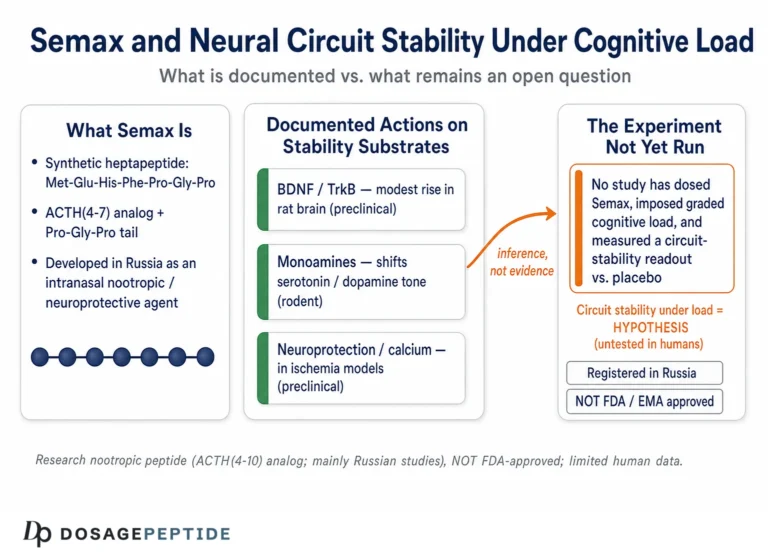
The question in this article’s title carries a quiet assumption that deserves to be unpacked before we chase the mechanism. “Enhance neural resilience” presumes two things at once: that Semax reliably does something protective to nervous tissue, and that whatever it does can be traced cleanly through the adrenocorticotropic-hormone (ACTH) pathways from which the molecule was derived. Both propositions are partly supported and partly aspirational. Semax is a synthetic heptapeptide built from a fragment of ACTH, and there is a genuine, decades-deep body of Russian preclinical work linking it to brain-derived neurotrophic factor, anti-inflammatory gene programs, and recovery after experimental ischemia.1 But the phrase “ACTH-related pathways” is doing a lot of quiet work, because the entire point of Semax’s design was to keep the neurotrophic half of ACTH biology while amputating the hormonal, cortisol-driving half. So the honest version of the question is narrower and more interesting: which parts of ACTH’s signaling repertoire does Semax actually engage, which did it discard on purpose, and how strong is the evidence that the engaged parts translate into anything a neuroscientist would recognize as “resilience”?
This piece treats the premise as an open research question rather than a settled fact. Semax is not approved by the U.S. Food and Drug Administration or the European Medicines Agency for any indication. It is a registered drug in Russia, used clinically for ischemic stroke and cognitive complaints, but that regulatory history rests on a literature that is overwhelmingly preclinical, largely single-country, and thin on the large, blinded, multicenter trials that Western regulators require before they will let a compound claim it protects the brain. When we say Semax “enhances neural resilience,” we are compressing a stack of rodent gene-expression studies, a handful of small human trials, and a good deal of mechanistic inference into three words. The job here is to decompress that stack honestly.
One more framing point is worth making at the outset. The word “resilience” has migrated from engineering and ecology into neuroscience, where it usefully names a system’s capacity to absorb a shock and recover function rather than any single molecule or pathway. That breadth is precisely what makes it slippery in marketing copy: almost any effect on the brain can be relabeled as “supporting resilience.” To keep the term accountable, this article insists on asking, for each claimed effect, resilience against what, measured how, and demonstrated in which species? A rise in a neurotrophin transcript, a shift in a serotonin metabolite, and a smaller infarct in a rat are three very different kinds of evidence, and only the last speaks even indirectly to the outcome most readers care about. Keeping those categories separate is the discipline that prevents an interesting molecule from being oversold.
The path runs from the top down: what the molecule is, how it relates to the melanocortin family that ACTH belongs to, whether it actually talks to melanocortin receptors, what its best-characterized downstream signature (the BDNF/trkB system) really shows, how monoamines and the anti-inflammatory transcriptome fit in, what the ischemia and human data do and do not establish, and finally where the evidence gaps sit. Throughout, the guiding discipline is to distinguish a demonstrated molecular effect in a rat from a demonstrated clinical benefit in a person — two things that the marketing literature around this peptide routinely blurs.
What Semax Is: An ACTH Fragment, Deliberately Rebuilt
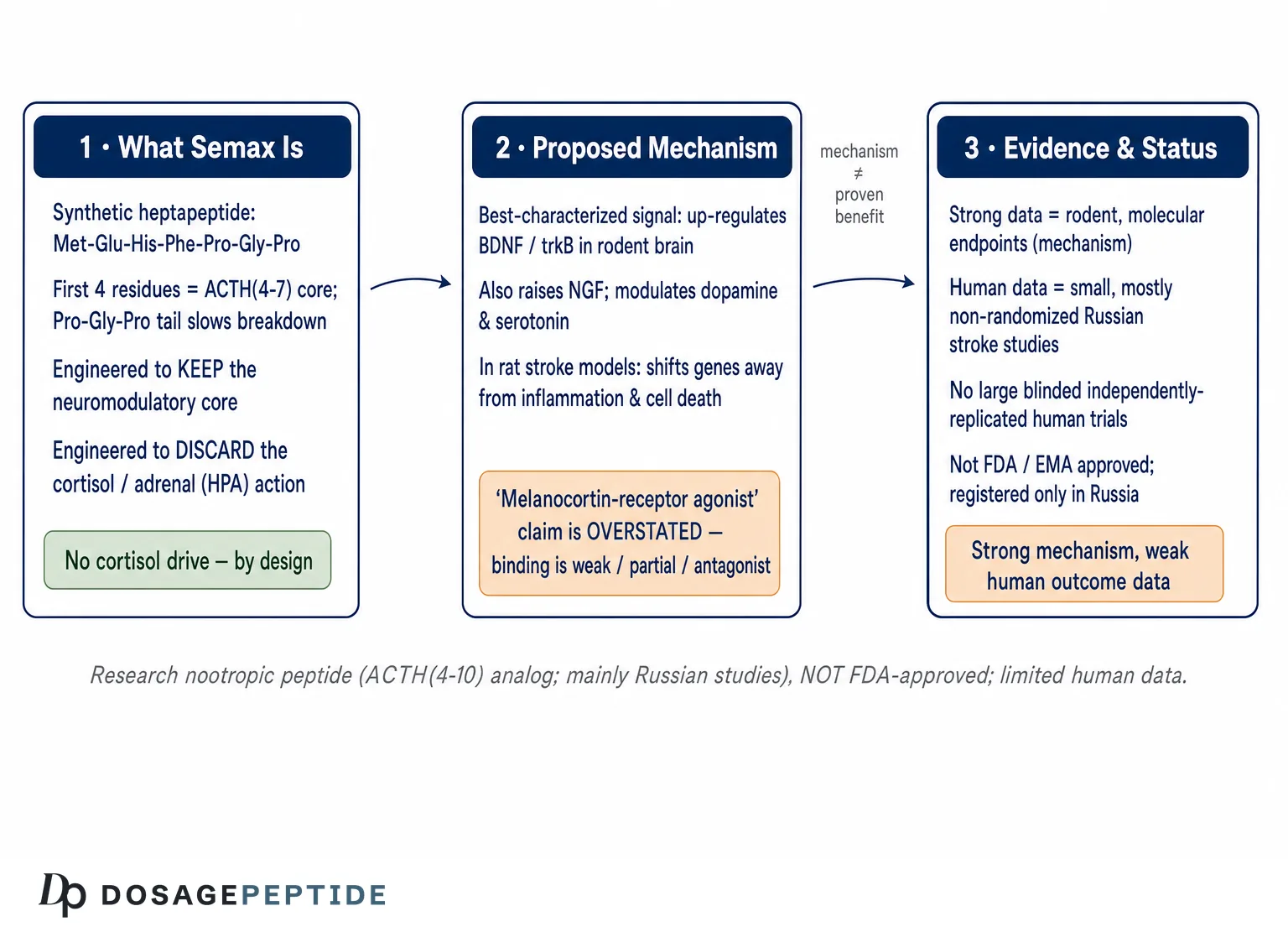
Semax is a synthetic heptapeptide with the sequence Met-Glu-His-Phe-Pro-Gly-Pro. The first four residues — Met-Glu-His-Phe — reproduce positions 4 through 7 of the ACTH molecule, which is why the compound is described interchangeably as an analog of ACTH(4–10) and, more precisely, as ACTH(4–7)PGP.1 The last three residues, Pro-Gly-Pro, are a biogenic tripeptide bolted onto the C-terminus. That addition is not decorative. Native peptide fragments of ACTH are degraded within minutes by peptidases in plasma and brain; the terminal Pro-Gly-Pro sharply slows that enzymatic clipping, extending the fragment’s functional half-life and letting a single intranasal dose exert measurable effects on brain gene expression for hours rather than seconds.4
To understand why anyone would build such a molecule, it helps to recall the parent. ACTH is a 39-amino-acid hormone released from the anterior pituitary whose defining job is to stimulate the adrenal cortex to make cortisol. That steroidogenic action lives in the full-length peptide and specifically requires regions beyond the 4–10 core. As early as the 1970s, work in the tradition of David de Wied established that the N-terminal ACTH(4–10) fragment retained striking effects on learning, memory, attention, and adaptive behavior while being essentially devoid of corticotropic (cortisol-releasing) activity.2 In other words, ACTH turned out to be two things wearing one coat: an endocrine hormone that mobilizes the stress axis, and a neuromodulatory peptide that tunes brain function. The 4–10 fragment isolated the second identity from the first.
Semax is the pharmacological refinement of that insight. Its designers at the Institute of Molecular Genetics of the Russian Academy of Sciences took the behaviorally active core, trimmed it to the 4–7 sequence, and stabilized it with Pro-Gly-Pro. The result is a compound that, by construction, cannot drive the adrenal axis the way ACTH does but can still reach the brain — conveniently, through the nasal mucosa — and modulate neuronal gene expression.1 This is the single most important fact for reading the title’s phrase “ACTH-related pathways” correctly. Semax is related to ACTH the way a stripped-down engine block is related to the original car: it keeps a specific subsystem and deliberately leaves the rest on the workshop floor.
A useful mental model is to separate three layers that popular writing tends to collapse. There is the parent hormone (full-length ACTH, an endocrine signal to the adrenal gland). There is the behaviorally active fragment (ACTH(4–10), the neuromodulatory core discovered to work without cortisol release). And there is the engineered drug (Semax, a stabilized 4–7 version tuned for brain delivery and duration). Each step narrows the biology and moves further from classical hormone action toward something closer to a neuromodulator or, in the loosest sense, a nootropic research compound. When a vendor page says Semax “works through the ACTH system,” the accurate translation is that it engages a sliver of that system — the neurotrophic and neuromodulatory sliver — and specifically not the hormonal cascade most people first associate with the letters ACTH.
The Melanocortin Connection — and Why It Is Not the Whole Story
ACTH is a member of the melanocortin family, a group of peptides cleaved from the precursor protein pro-opiomelanocortin (POMC) that also includes the melanocyte-stimulating hormones (α-, β-, and γ-MSH). These peptides act on five G-protein-coupled melanocortin receptors, MC1R through MC5R, which are distributed across skin, adrenal, immune, and — importantly for this discussion — neural tissue. Within the brain, MC1R, MC3R, and MC4R are expressed on neurons, glia, and endothelial cells, and a substantial literature argues that melanocortin signaling through these receptors can be neuroprotective: reducing excitotoxic neuronal death, dampening neuroinflammation, and supporting recovery after ischemic or traumatic insult.2
Here is where the ACTH(4–7) sequence becomes intriguing, because it overlaps the “message” core shared by melanocortins — the His-Phe-Arg-Trp motif and its neighbors that mediate receptor binding. Semax’s N-terminal Met-Glu-His-Phe abuts that conserved region, which is the mechanistic seed for the recurring claim that Semax is a “melanocortin” acting through MC receptors to deliver melanocortin-style neuroprotection. It is a tidy story, and it is partly plausible: if a fragment sits close to the melanocortin pharmacophore and produces effects reminiscent of melanocortin neuroprotection, receptor engagement is a natural hypothesis.
But the direct receptor evidence is more ambiguous than the tidy story admits, and this is a place where honesty matters. Classical pharmacology of ACTH(4–10)-type fragments at melanocortin receptors found that several such analogs behave as weak partial agonists or even antagonists rather than potent activators. In cell-based assays measuring cyclic-AMP responses at cloned melanocortin receptors, modified ACTH(4–10) peptides — including proline-substituted variants structurally reminiscent of the Semax scaffold — antagonized the cAMP-inducing effect of α-MSH at MC3, MC4, and MC5 receptors rather than switching them robustly on.3 The practical implication is that Semax cannot be assumed to be a straightforward MC4R agonist mimicking α-MSH. Its relationship to the receptors it superficially resembles may be low-affinity, biased, or antagonistic depending on the receptor subtype and readout, and much of the confident “binds MC4R” language circulating online is extrapolation rather than measurement.
This nuance reframes the mechanism question. If Semax does not owe its brain effects primarily to canonical melanocortin-receptor agonism, then how does an ACTH-derived fragment change neuronal gene expression so reliably? The most defensible current answer is that Semax acts through mechanisms that are only loosely “melanocortin” in the receptor sense — engaging neurotrophic signaling cascades, monoamine systems, and inflammatory gene programs by routes that are not fully mapped and may not require high-affinity MC-receptor binding at all. In short, Semax is melanocortin-derived by sequence and melanocortin-adjacent in some of its effects, but calling it a melanocortin-receptor drug overstates what the binding data actually support. Readers interested in how another Russian-developed regulatory peptide navigates a similarly indirect central mechanism may find the discussion of how Selank regulates behavior via central nervous system pathways a useful companion, since both compounds share a design philosophy of stabilized short peptides acting on brain systems without classical hormone-receptor lock-and-key.
The BDNF/trkB Axis: Semax’s Best-Characterized Molecular Signature
If there is a single pathway that carries the mechanistic weight behind the “neural resilience” claim, it is the brain-derived neurotrophic factor (BDNF) system and its receptor, tropomyosin receptor kinase B (trkB, encoded by Ntrk2). BDNF is arguably the central molecule of activity-dependent neuroplasticity: it supports neuronal survival, promotes the growth and stabilization of synapses, underpins long-term potentiation, and is repeatedly implicated in learning, memory, mood regulation, and recovery from brain injury. A compound that durably raises BDNF signaling has, at least in principle, a coherent route to something worth calling resilience.
The cleanest single demonstration comes from a 2006 study in which a single administration of Semax to rats produced, in the hippocampus, a maximal 1.4-fold increase in BDNF protein, a 1.6-fold increase in trkB tyrosine phosphorylation (a direct readout of receptor activation), roughly a 3-fold increase in exon-III BDNF messenger RNA, and about a 2-fold increase in trkB mRNA.1 That is a meaningful result because it does not merely show more of a transcript; it shows that the transcript rises, the protein rises, and the receptor is actually being switched on, tying the molecular change to functional signaling. The authors interpreted Semax’s cognitive effects as, in part, a consequence of modulating the hippocampal BDNF/trkB system — the same system that gymnasium of learning-and-memory research keeps returning to.
Subsequent work broadened the picture in two directions. First, Semax turned out not to be BDNF-specific: intranasal administration increased the expression of both BDNF and nerve growth factor (NGF) genes, with region-specific patterns across hippocampus, frontal cortex, brainstem, and cerebellum.5 Simultaneously up-regulating two distinct neurotrophins is relatively unusual and is one of the more genuinely interesting features of the compound’s profile. Second, the kinetics were characterized: comparisons of the temporal dynamics of NGF and BDNF expression across hippocampus, frontal cortex, and retina showed that the changes are rapid, transient, and region- and neurotrophin-specific rather than a uniform, sustained flood.4 This temporal texture matters because it argues against a crude “Semax equals permanently high BDNF” caricature and toward a model in which the peptide nudges an endogenous, self-limiting neurotrophic program.
It is worth pausing on why the BDNF finding is more persuasive than a bare “gene went up” headline. Transcriptomic and even proteomic increases can be biologically inert if the resulting protein never engages its receptor. The 2006 work closed that loop by measuring trkB tyrosine phosphorylation directly, which is the molecular fingerprint of a ligand actually docking and triggering the receptor kinase.1 When mRNA, protein, and receptor activation all move in the same direction after a single dose, the chain of causation — peptide in, neurotrophic signaling out — is unusually well supported for a compound in this category. That methodological completeness is a genuine strength of the Semax literature and distinguishes it from the many nootropic candidates whose “raises BDNF” claims rest on a single downstream transcript in a cell line. What the finding does not establish is durability or translation: the effect is transient, measured in healthy animals, and at a magnitude comparable to normal physiological fluctuation rather than a supraphysiological surge.
Downstream of trkB activation lie the canonical survival and plasticity cascades — the MAPK/ERK pathway, the PI3K/Akt pathway, and phospholipase C-γ signaling — that collectively promote neuronal survival, dendritic and synaptic growth, and resistance to apoptotic and excitotoxic stress. It is through these well-mapped effectors that a rise in BDNF/trkB signaling is plausibly converted into cellular resilience. The important caveat is that most of the direct Semax data document the upstream events (neurotrophin and receptor expression, receptor phosphorylation) more thoroughly than they document sustained activation of each downstream effector after Semax specifically; the downstream cascade is well established for BDNF in general and reasonably inferred for Semax, but inference is not the same as measurement. The honest summary is that the BDNF/trkB link is Semax’s strongest and most reproducible molecular signature, and it is a biologically sensible bridge to neuroprotection — while acknowledging that a 1.4-fold protein change in a healthy rat hippocampus is a modest, endogenous-scale effect, not a pharmacological override.
Beyond Neurotrophins: Monoamines, Angiogenesis, and the Anti-Inflammatory Transcriptome
Neural resilience is not a single pathway, and Semax’s effects extend past the neurotrophins into at least three other systems that plausibly contribute.
Monoamine modulation. Semax influences the brain’s dopaminergic and serotonergic systems. In rodent studies it modulated serotonergic and dopaminergic signaling in regions tied to attention, motivation, and mood — raising striatal 5-hydroxyindoleacetic acid, the principal serotonin metabolite, by roughly a quarter, while, notably, the peptide on its own did not raise resting dopamine levels but sharply amplified the dopamine release and locomotor response evoked by amphetamine.6 The precise reading matters: the serotonin-metabolite change is a direct effect, whereas the dopaminergic action is better described as a potentiation of an already-triggered response than as a standalone dopamine surge. This monoaminergic arm is the most likely explanation for the acute “alertness” and attention effects that human users and small Russian studies report, and it operates on a faster timescale than the transcriptional neurotrophin changes. It also cautions against attributing everything Semax does to BDNF: some of the acute cognitive coloring is probably neurotransmitter modulation, not plasticity.
Angiogenesis and vascular support. Neural tissue does not survive without perfusion, and part of the ischemia story involves the vasculature. Semax has been reported to modulate vascular endothelial growth factor (VEGF-A) expression in cortex and hippocampus, and related work on melanocortin derivatives in cerebral ischemia has described induced vascularization and neuroglial proliferation in the injured brain.12 A compound that supports both neurotrophic signaling and angiogenic/glial responses has a broader, more “systems-level” route to protecting a threatened region than a purely neuron-intrinsic effect would.
The anti-inflammatory transcriptome. The most impressive modern mechanistic work on Semax uses genome-wide transcriptomics in a rat model of ischemia-reperfusion. Using RNA sequencing after transient middle cerebral artery occlusion, investigators found that ischemia induces a large program of pro-inflammatory and cell-death-associated genes, and that Semax administration suppresses the induction of many of these transcripts while promoting recovery-associated genes.8 A companion analysis at the protein-expression level confirmed that this transcriptional signature is echoed in the proteome, strengthening the case that the gene changes are functionally real rather than transcriptional noise.9 A further study specifically documented Semax’s suppression of mRNAs encoding pro-inflammatory mediators induced by reversible brain ischemia.10 And work on Semax together with its Pro-Gly-Pro constituent showed activation of the transcription of neurotrophins and their receptor genes after cerebral ischemia, tying the anti-inflammatory and neurotrophic arms into one coherent post-ischemic response.7
There is also a conceptual reason the transcriptomic approach is more informative than earlier single-gene studies. Ischemia-reperfusion injury is not one lesion but a cascade — excitotoxic glutamate release, calcium overload, oxidative stress, microglial activation, cytokine surges, and delayed apoptosis unfolding over hours to days. A neuroprotectant that touched only one node of that cascade would be easy to overwhelm. RNA-sequencing lets investigators ask whether Semax nudges the whole program rather than a single gene, and the answer in these studies is that it dampens a broad swath of the inflammatory and death-associated response while sustaining recovery-linked transcription.810 A network-level effect is more plausibly robust than a single-target one, which is part of why this body of work is the most credible mechanistic case Semax has. The counterweight, again, is that a favorable transcriptional state at twenty-four hours in a rat is several inferential steps removed from a better functional outcome in a person weeks later, and those steps are exactly where neuroprotection candidates have historically collapsed.
The convergence here is genuinely notable: across independent studies, the same picture recurs — Semax pushes the injured brain’s gene-expression state away from inflammation and cell death and toward neurotrophic support and recovery. That is exactly the multi-pronged profile one would want from a “resilience” agent. The persistent limitation, which no amount of transcriptomic elegance erases, is that this is rat brain under experimental occlusion, measured at the level of molecules and, at best, histology — not human clinical outcome. The following table organizes the principal pathways and the honest evidence level attached to each.
| Pathway / system | Reported Semax effect | Evidence level |
|---|---|---|
| BDNF / trkB signaling | ↑ BDNF protein and mRNA, ↑ trkB phosphorylation in hippocampus1 | Reproduced rodent molecular data; strongest signature |
| NGF and multi-neurotrophin | ↑ NGF and BDNF genes, region- and time-specific45 | Rodent gene-expression studies |
| Dopamine / serotonin | ↑ monoamine turnover and metabolites (attention/mood)6 | Rodent neurochemistry; likely basis of acute effects |
| VEGF / angiogenesis / glia | Modulated VEGF-A; vascularization and neuroglial proliferation12 | Rodent ischemia models |
| Anti-inflammatory transcriptome | Suppresses pro-inflammatory and cell-death genes post-ischemia810 | Rodent RNA-seq + proteomics; convergent |
| Melanocortin (MC) receptors | Sequence overlap; weak/partial or antagonist behavior in vitro3 | Ambiguous; not a proven agonist route |
| Adrenal steroidogenesis (cortisol) | Absent by design — the discarded ACTH function2 | Established rationale, not an effect |
From Molecules to “Neural Resilience”: The Ischemia Evidence
“Neural resilience” is a marketing-friendly phrase, so it is worth pinning down what it could mean and where Semax actually meets that bar. Broadly, resilience could mean (a) protecting neurons from acute injury such as ischemia or excitotoxicity, (b) supporting adaptive plasticity and cognition under load, or (c) slowing chronic degenerative decline. Semax’s evidence is strongest for the first, moderate and mostly indirect for the second, and essentially absent for the third.
The acute-injury case rests on the ischemia work described above, and its internal logic is coherent. In experimental stroke, a core of tissue dies quickly, but a surrounding penumbra remains salvageable for a window of time, its fate decided by the balance between excitotoxicity, inflammation, and cell death on one side and neurotrophic and vascular support on the other. Semax, in rodent occlusion models, appears to tilt that balance favorably: it suppresses the pro-inflammatory and apoptotic gene programs, sustains neurotrophin and receptor expression, and supports vascular and glial responses.789 This is a textbook description of penumbral neuroprotection, and it is the mechanistic heart of why Semax was developed and registered in Russia as a stroke adjunct. It is genuinely one of the better-worked-out mechanistic stories among the “research peptides” that circulate in nootropic communities.
The honest tension is between the richness of the mechanistic story and the thinness of the outcome data. The history of neuroprotection in stroke is a graveyard of compounds that dazzled in rodent models — reducing infarct volume, quieting inflammation, raising trophic factors — and then failed to improve patient outcomes in rigorous human trials. NXY-059, various glutamate antagonists, free-radical scavengers, and many others each looked convincing preclinically and did not survive contact with large blinded studies. That track record is the single most important piece of context for reading Semax’s ischemia literature, and it is precisely the context that enthusiast summaries omit. A convergent, elegant rodent mechanism raises the prior that a compound might help; it does not establish that it does. Readers exploring how a different molecule’s stroke-neuroprotection claims have been scrutinized against the same skeptical standard may find the analysis of the scientific evidence on NAD+ and preserving neurons during stroke a useful parallel in evidence-grading discipline.
For the plasticity-and-cognition sense of resilience, the bridge is the BDNF/NGF and monoamine data plus the behavioral rodent literature on learning and attention. It is plausible and mechanistically supported that Semax nudges plasticity substrates, but the leap from “raises hippocampal BDNF 1.4-fold in a rat” to “makes a human brain more resilient to cognitive stressors” is large and only partly bridged by small human studies. For the chronic-degeneration sense — Alzheimer’s, Parkinson’s, age-related decline — there is essentially no controlled Semax outcome evidence, however tempting the melanocortin-and-amyloid literature makes the extrapolation. Anyone reasoning about age-related cognitive decline should treat Semax as untested there and look to how better-studied axes are being investigated, such as the discussion of whether sermorelin supports cognitive function in age-related neurodegeneration, which illustrates how cautiously even more mainstream compounds must be framed for that indication.
Human Evidence: What the Russian Clinical Record Shows — and Doesn’t
Semax’s clinical footprint is almost entirely Russian, and it is real but modest. The compound is registered in Russia and has been used in acute-neurology settings for ischemic stroke, typically as an intranasal solution given in short courses. The most cited clinical work reports that in patients across stages of ischemic stroke, Semax elevated plasma BDNF and was associated with improvements on functional and motor scales such as the Barthel index and Medical Research Council motor grading over a multi-month observation period.11 Earlier clinical and electrophysiological studies described favorable shifts in inflammatory markers and clinical course in stroke patients receiving Semax alongside standard care.
Two things must be said about this record simultaneously, and holding both is the whole point. First, it is not nothing: there are human data, in relevant patients, showing biologically plausible changes (rising BDNF) alongside clinical scale improvements, and the mechanistic backstory is unusually coherent for a compound in this category. Second, it falls well short of what would justify a confident efficacy claim by contemporary evidence standards. The studies are generally small, frequently open-label or non-randomized, single-country, and not replicated by independent groups outside Russia. Effect sizes, blinding, allocation concealment, pre-registration, and independent replication — the machinery that separates a suggestive result from an established one — are largely absent from the public English-language record. The absence of large, blinded, multicenter trials is not a technicality; it is the exact gap that has repeatedly turned promising stroke neuroprotectants into cautionary tales.
For cognition in healthy people — the use case that drives most nootropic interest — the human evidence is even thinner: small Russian studies in students, operators, and stressed cohorts report preserved or improved attention and working memory, but these are not the kind of trials that would support a general claim that Semax reliably enhances cognition in healthy adults. Reports of good short-term tolerability (mild nasal irritation being the most common complaint) are reassuring as far as they go, but short-term tolerability in small samples is not the same as a characterized long-term safety profile, and it says nothing about efficacy. The reasonable reading is that Semax is a compound with a suggestive but immature human evidence base, whose regulatory acceptance in one country reflects a different evidentiary tradition rather than the weight of globally accepted pivotal trials.
Semax Versus Its Own Origin: A Structured Comparison
Because the title foregrounds “ACTH-related pathways,” the most illuminating comparison is between Semax and the ACTH biology it was carved from. Placing them side by side clarifies exactly which pathways Semax keeps, discards, or modifies — and where the resilience claim can and cannot lean on the ACTH heritage.
| Feature | Full-length ACTH | ACTH(4–10) fragment | Semax (ACTH(4–7)PGP) |
|---|---|---|---|
| Primary classical role | Stimulates adrenal cortisol release | Behavioral/neuromodulatory; minimal steroidogenic2 | Neuromodulatory only; no adrenal drive by design1 |
| Cortisol / HPA activation | Yes (defining action) | Largely absent | Absent (the discarded arm) |
| Metabolic stability | Regulated hormone | Rapidly degraded by peptidases | Stabilized by C-terminal Pro-Gly-Pro4 |
| Melanocortin-receptor action | Agonist across MC subtypes | Weak/partial; some antagonism3 | Ambiguous; not a proven MC agonist3 |
| BDNF / neurotrophin effect | Present within broader hormone action | Retained behavioral effects | ↑ BDNF/NGF, trkB activation (best-characterized)14 |
| Delivery for CNS effect | Systemic hormone | Experimental | Intranasal, brain-directed |
| Regulatory status | Endogenous hormone / diagnostic use | Research fragment | Registered in Russia; not FDA/EMA approved |
The table makes the design logic vivid. Semax is ACTH with the hormonal engine removed, the neuromodulatory core preserved, the molecule stabilized for duration, and delivery re-routed to the brain. Every column labeled “absent by design” is a deliberate subtraction, and every column labeled “retained” or “best-characterized” is what the resilience hypothesis actually rests on. Critically, the melanocortin-receptor row is the one most often overstated: the compound’s heritage is melanocortin, but its receptor pharmacology is not the clean agonism the family name implies. This is why the most defensible mechanistic account leans on neurotrophic and anti-inflammatory gene programs rather than on a simple “Semax activates MC4R” narrative. For readers building vocabulary around these distinctions, the site’s peptide research glossary defines terms like melanocortin, neurotrophin, and trkB in a reference format.
Research Models and Methodology
The strength of any “neural resilience” claim is only as good as the models used to test it, so it is worth being explicit about how Semax has been studied — and how it has not. The literature falls into four tiers.
In vitro and cellular work. Foundational receptor pharmacology used cell lines expressing cloned melanocortin receptors with cyclic-AMP readouts to classify ACTH-fragment analogs as agonists or antagonists — the source of the caution about Semax’s ambiguous MC-receptor behavior.3 More recent cellular work has examined ACTH/MSH N-terminal fragment analogs in primary rat neuronal cultures, measuring effects on neurotrophic factors such as BDNF and VEGF and on anxiety- and pain-related readouts, providing a controlled setting to link sequence to neurotrophic output.13 These assays are well suited to mechanism but say nothing about clinical benefit.
Rodent molecular and gene-expression studies. The bulk of Semax’s mechanistic credibility comes from rat work: single-dose intranasal administration followed by measurement of neurotrophin protein, mRNA, and receptor phosphorylation in specific brain regions;1 comparative time-course studies of NGF and BDNF across hippocampus, cortex, and retina;5 and neurochemical studies of dopamine and serotonin turnover.6 These are methodologically sound for what they measure, but they are healthy-animal, molecular-endpoint studies — they establish that Semax changes brain biochemistry, not that it changes disease outcomes.
Rodent injury models. The most outcome-relevant preclinical work uses transient middle cerebral artery occlusion (tMCAO) to model ischemic stroke, with RNA-sequencing and proteomic profiling of Semax-treated versus saline-treated brains.89 This is the gold-standard model class for stroke neuroprotection and is where Semax’s convergent anti-inflammatory/neurotrophic signature is most persuasive. Even so, tMCAO in young healthy rodents notoriously over-predicts human benefit, which is exactly why the field now demands functional endpoints, aged and comorbid animals, and independent multi-lab replication before trusting a neuroprotectant.
Human trials. The clinical methodology is the weakest tier: predominantly small, open-label or non-randomized Russian studies with functional-scale and biomarker endpoints in stroke, plus small cognitive studies in stressed cohorts.11 None approach the scale, blinding, and independent replication of a modern pivotal program. The methodological bottom line is that Semax’s evidence architecture is inverted relative to what regulators want: it is strongest exactly where it matters least for proving human benefit (rodent molecules) and weakest where it matters most (large blinded human outcomes). Anyone handling the compound for laboratory purposes should also consult general practice such as the peptide reconstitution guide, recognizing that meticulous handling preserves whatever activity the molecule has without adding a shred of efficacy evidence.
Safety, Handling, and Regulatory Status
On short-term safety, the available picture is relatively reassuring but shallow. In its Russian clinical use and in small studies, intranasal Semax has generally been well tolerated, with the most commonly reported issues being mild, transient local nasal irritation and occasional headache; serious adverse events are not prominent in the reported record, and no withdrawal or tolerance syndrome is described.11 The design rationale reinforces this: because Semax was engineered to lack the adrenal-stimulating activity of ACTH, it does not carry the cortisol-related endocrine liabilities that would accompany a corticotropic peptide.2 That is a real advantage of the “subtract the hormone, keep the neuromodulator” strategy.
Several caveats temper this. The safety data are short-term, in relatively small samples, and largely from one clinical tradition; long-term safety of repeated use — the pattern most nootropic users are actually interested in — is not well characterized, and the potential for tolerance with chronic administration has not been systematically studied. Detailed human pharmacokinetics (absorption fraction across the nasal mucosa, distribution, metabolism, elimination) remain incompletely mapped in the public literature. And a large share of the material sold outside regulated channels is “research chemical” of uncertain purity and provenance, where mislabeling, under-dosing, endotoxin, and contamination are real risks that have nothing to do with the molecule’s intrinsic profile and everything to do with sourcing.
Regulatory status is where the honesty directive bites hardest. Semax is not approved by the FDA, the EMA, or any comparable major Western regulator for stroke, cognition, or any other indication. Its approved status exists in Russia (and it appears on that country’s essential-medicines listings), which reflects a national regulatory decision built on the largely domestic evidence base described above — not a globally accepted demonstration of efficacy. For a reader in the United States or Europe, the practical meaning is unambiguous: Semax is an investigational, not-approved substance; it is not a medicine one can regard as validated for “enhancing neural resilience,” and any use outside a properly authorized research setting falls outside the framework that protects patients. Its handling parameters are cataloged for educational reference alongside other compounds in the site’s central dosage index, which is organized for research documentation rather than as guidance for human use.
Limitations and the Honest Verdict on the Premise
Returning to the title’s question — how does Semax influence ACTH-related pathways to enhance neural resilience? — the layered answer is now visible, and so are its limits.
What is reasonably established. Semax is a stabilized fragment of ACTH that keeps the neuromodulatory biology of the ACTH(4–10) core and discards the cortisol-driving hormonal action. Its best-characterized molecular effect is up-regulation of the BDNF/NGF neurotrophin system and activation of trkB signaling in rodent brain, alongside modulation of dopamine and serotonin and, in ischemia models, a convergent suppression of pro-inflammatory and cell-death gene programs with support for neurotrophic and vascular recovery.168 Mechanistically, this is a coherent and even elegant basis for a neuroprotective hypothesis.
What is uncertain or overstated. The “melanocortin-receptor agonist” framing is not well supported; Semax’s behavior at MC receptors appears weak, partial, or antagonistic rather than robustly activating, so the mechanism likely runs through incompletely mapped routes rather than clean receptor agonism.3 The magnitude of the molecular effects (for example, a 1.4-fold BDNF protein change in healthy rats) is modest and endogenous-scale, not a pharmacological override.
What is largely absent. The decisive evidence — large, blinded, independently replicated human trials showing that Semax improves clinically meaningful outcomes — does not exist in the public international literature. The stroke data are small, mostly non-randomized, and single-country; the cognition-in-healthy-people data are thinner still; and there is essentially no controlled evidence in chronic neurodegeneration despite frequent extrapolation from melanocortin biology.11 Given the field’s long history of neuroprotectants that shone in rodents and failed in patients, this gap is not a formality to be waved away with mechanism talk.
So the honest verdict is a qualified one. Semax plausibly influences ACTH-derived neurotrophic and anti-inflammatory pathways in ways that could support neural resilience, and it does so through a genuinely interesting, well-worked-out preclinical mechanism. But “could support” is not “has been shown to enhance,” and the title’s confident phrasing outruns the evidence. The responsible framing is that Semax is an investigational, non-FDA-approved peptide with a suggestive mechanistic story and an immature outcome literature — a legitimate object of research curiosity, not a validated tool for protecting the human brain. For those tracking how the broader peptide-neuroscience literature evolves on questions like this, comparisons with other neuro-directed compounds, such as the discussion of whether BPC-157 can help heal nerves and boost brain health, illustrate how consistently the same “strong mechanism, weak outcome data” pattern recurs across this class.
Frequently Asked Questions
Is Semax actually an ACTH hormone, and will it raise cortisol?
No. Semax is a synthetic fragment derived from the ACTH(4–7) region, stabilized with a Pro-Gly-Pro tail. It was specifically engineered to keep the neuromodulatory, behavior-and-plasticity effects of the ACTH(4–10) core while discarding the corticotropic action — the part of ACTH that stimulates the adrenal gland to release cortisol.12 That dissociation between neurotrophic and hormonal activity, first established in the classic ACTH-fragment literature, is the entire design premise. So Semax is ACTH-derived, but it is not expected to drive the stress hormone axis the way the full hormone does.
Does Semax work by activating melanocortin (MC4R) receptors?
This is commonly claimed but not well supported. Although Semax’s sequence overlaps the melanocortin family’s core, cell-based pharmacology of ACTH(4–10)-type analogs — including proline-modified variants resembling the Semax scaffold — shows weak, partial, or even antagonist behavior at MC3/MC4/MC5 receptors rather than robust agonism.3 The most defensible view is that Semax is melanocortin-derived by sequence but does not owe its brain effects primarily to clean MC-receptor activation; its mechanism likely runs through neurotrophic and anti-inflammatory gene programs by routes that are not fully mapped.
What is the strongest evidence for how Semax affects the brain?
The best-characterized signature is up-regulation of the BDNF/trkB system. A single dose in rats increased hippocampal BDNF protein and mRNA and raised trkB receptor phosphorylation, indicating actual receptor activation rather than just more transcript.1 Semax also raises NGF, modulates dopamine and serotonin, and, in ischemia models, shifts brain gene expression away from inflammation and cell death toward recovery.468 These are rodent, molecular-level findings — strong for mechanism, not proof of clinical benefit.
Has Semax been proven to protect the brain in humans?
Not to the standard Western regulators require. There are small, mostly Russian clinical studies in ischemic stroke reporting rising plasma BDNF and improvements on functional scales,11 but they are generally small, frequently non-randomized or open-label, single-country, and not independently replicated. Given that many stroke neuroprotectants succeeded in rodents and then failed in large blinded human trials, this evidence should be read as suggestive, not conclusive.
Is Semax approved by the FDA?
No. Semax is not approved by the FDA, the EMA, or comparable major regulators for any use. It is a registered drug in Russia, used there for ischemic stroke and cognitive complaints, but that reflects a national regulatory decision built on a largely domestic evidence base — not a globally accepted demonstration of efficacy. Outside authorized research, it should be regarded as an investigational, non-approved substance.
What does “neural resilience” realistically mean for Semax?
The term is strongest for acute neuroprotection in experimental ischemia, where Semax’s anti-inflammatory and neurotrophic gene effects give it a coherent mechanistic rationale.78 It is weaker and more indirect for cognition-under-load in healthy people, and essentially untested in chronic neurodegeneration such as Alzheimer’s or Parkinson’s disease. Claims that Semax broadly “enhances neural resilience” overreach the data, which are mostly preclinical.
How is Semax typically administered in studies?
In the Russian research and clinical tradition it is most often given intranasally, which allows brain-directed delivery of the stabilized peptide; short treatment courses are typical in the stroke setting.11 The Pro-Gly-Pro tail extends the fragment’s functional half-life enough that a single dose can influence brain gene expression for hours.4 None of this constitutes a dosing recommendation; it describes how the compound has been studied.
Is Semax safe?
Short-term tolerability in the available (mostly small, Russian) studies appears generally good, with mild transient nasal irritation and occasional headache the most common complaints, and no cortisol-related endocrine liability by design.211 However, long-term safety, tolerance potential, and detailed human pharmacokinetics are not well characterized, and unregulated “research chemical” material carries purity and contamination risks independent of the molecule itself. Reassuring short-term tolerability is not the same as established long-term safety, and it says nothing about efficacy.
How does Semax compare with other cognitive or neuroprotective peptides?
Semax shares a design lineage with other stabilized short peptides that act centrally, such as the anxiolytic Selank, and its “strong preclinical mechanism, thin human outcome data” profile is a pattern common across the research-peptide field. The distinctive features are its ACTH origin, its dual BDNF/NGF up-regulation, and its unusually detailed transcriptomic ischemia literature.18 What it lacks — like most compounds in this category — is large, blinded, independently replicated human evidence.
References
- Dolotov OV, Karpenko EA, Inozemtseva LS, et al. Semax, an analog of ACTH(4-10) with cognitive effects, regulates BDNF and trkB expression in the rat hippocampus. Brain Res. 2006;1117(1):54-60. PMID: 16996037. https://pubmed.ncbi.nlm.nih.gov/16996037/
- Catania A. Neuroprotective actions of melanocortins: a therapeutic opportunity. Trends Neurosci. 2008;31(7):353-360. PMID: 18550183. https://pubmed.ncbi.nlm.nih.gov/18550183/
- Adan RA, Oosterom J, Ludvigsdottir G, et al. Identification of antagonists for melanocortin MC3, MC4 and MC5 receptors. Eur J Pharmacol. 1994;269(3):331-337. PMID: 7895772. https://pubmed.ncbi.nlm.nih.gov/7895772/
- Shadrina M, Kolomin T, Agapova T, et al. Comparison of the temporary dynamics of NGF and BDNF gene expression in rat hippocampus, frontal cortex, and retina under Semax action. J Mol Neurosci. 2010;41(1):30-35. DOI: 10.1007/s12031-009-9270-z. https://link.springer.com/article/10.1007/s12031-009-9270-z
- Dolotov OV, Seredenina TS, Levitskaya NG, et al. Neurotrophin gene expression in rat brain under the action of Semax, an analogue of ACTH4-10. Neurosci Lett. 2006;411(1):46-49. PMID: 17353092. https://pubmed.ncbi.nlm.nih.gov/17353092/
- Eremin KO, Kudrin VS, Saransaari P, et al. Semax, an ACTH(4-10) analogue with nootropic properties, activates dopaminergic and serotoninergic brain systems in rodents. Neurochem Res. 2005;30(12):1493-1500. PMID: 15088389. https://pubmed.ncbi.nlm.nih.gov/15088389/
- Dmitrieva VG, Povarova OV, Skvortsova VI, et al. Semax and Pro-Gly-Pro activate the transcription of neurotrophins and their receptor genes after cerebral ischemia. Cell Mol Neurobiol. 2010;30(1):71-79. PMID: 19633950; PMCID: PMC11498467. https://pmc.ncbi.nlm.nih.gov/articles/PMC11498467/
- Filippenkov IB, Stavchansky VV, Denisova AE, et al. Novel insights into the protective properties of ACTH(4-7)PGP (Semax) peptide at the transcriptome level following cerebral ischaemia-reperfusion in rats. Genes (Basel). 2020;11(6):681. PMCID: PMC7350263. https://pmc.ncbi.nlm.nih.gov/articles/PMC7350263/
- Sudarkina OYu, Filippenkov IB, Stavchansky VV, et al. Brain protein expression profile confirms the protective effect of the ACTH(4-7)PGP peptide (Semax) in a rat model of cerebral ischemia-reperfusion. Int J Mol Sci. 2021;22(12):6179. PMID: 34201112; PMCID: PMC8226508. https://pmc.ncbi.nlm.nih.gov/articles/PMC8226508/
- Dergunova LV, Filippenkov IB, Stavchansky VV, et al. The peptide drug ACTH(4-7)PGP (Semax) suppresses mRNA transcripts encoding proinflammatory mediators induced by reversible ischemia of the rat brain. Mol Biol (Mosk). 2021;55(3):402-411. PMID: 34097675. DOI: 10.1134/S0026893321010040. https://link.springer.com/article/10.1134/S0026893321010040
- Gusev EI, Martynov MY, Kostenko EV, et al. The efficacy of semax in the treatment of patients at different stages of ischemic stroke. Zh Nevrol Psikhiatr Im S S Korsakova. 2018;118(3.2):61-68. PMID: 29798983. https://pubmed.ncbi.nlm.nih.gov/29798983/
- Stavchansky VV, Filippenkov IB, Dergunova LV, et al. Melanocortin derivatives induced vascularization and neuroglial proliferation in the rat brain under conditions of cerebral ischemia. Curr Issues Mol Biol. 2024;46(3):2071-2092. PMCID: PMC10969580. https://pmc.ncbi.nlm.nih.gov/articles/PMC10969580/
- Levitskaya NG, Glazova NYu, Sebentsova EA, et al. The effect of ACTH/MSH N-terminal fragment analogs on the anxiety level, pain sensitivity and levels of neurotrophic factors BDNF and VEGF in primary neuronal cultures of rats. J Evol Biochem Physiol. 2024;60(5):1867-1881. DOI: 10.1134/S0022093024050326. https://link.springer.com/article/10.1134/S0022093024050326
Educational and research-use disclaimer: This article is provided solely for scientific and educational purposes. Semax (ACTH(4-7)PGP) is not approved by the U.S. Food and Drug Administration, the European Medicines Agency, or any comparable Western regulator for the treatment, cure, or prevention of stroke, cognitive impairment, neurodegeneration, or any other disease; it is a registered medicine only in the Russian Federation, supported by a largely preclinical and single-country evidence base. Its purported ability to “enhance neural resilience” remains an open research question rather than an established clinical fact. Nothing here is medical advice or a recommendation for human use. Any legitimate investigation of this compound should occur within properly authorized preclinical or clinical research under appropriate oversight, and readers should consult qualified professionals and applicable regulations before making any decisions.