Few molecules in muscle-growth research generate as much curiosity — or as much overstatement — as follistatin-344, an isoform of a naturally occurring glycoprotein that binds and neutralizes myostatin, the body’s built-in brake on skeletal muscle size. This article examines the central research question that keeps drawing scientists and lay readers alike back to the compound: if follistatin can silence myostatin, and myostatin normally limits how much muscle an animal builds, does injectable recombinant follistatin-344 actually grow human muscle — and what does the published evidence really say versus what the internet claims? The honest answer is more nuanced, and far more interesting, than the headlines suggest. Follistatin-344 is not an approved drug; it is a research-grade material studied in laboratory and animal models, and the dramatic hypertrophy stories almost always trace back to genetics or gene therapy rather than to a vial of peptide. Throughout, the aim is to separate three things that are constantly and carelessly blurred together in fitness discourse: rigorous biology, dramatic animal results, and the marketing claims attached to an unregulated injectable.
What Is Follistatin-344, and Why Do Researchers Study It?
Follistatin is a single-chain, cysteine-rich glycoprotein first identified in the 1980s as a factor in ovarian follicular fluid that suppressed the release of follicle-stimulating hormone (hence the name). It was later recognized as a high-affinity binding protein for activins and, crucially for the muscle field, for myostatin (also called GDF-8), a member of the transforming growth factor-beta (TGF-β) superfamily that acts as a negative regulator of skeletal muscle mass.[3] A pivotal early step in that recognition came when biochemists purified an activin-binding protein from ovarian tissue and found it was identical to follistatin, establishing that the same molecule that restrains FSH release also sequesters activin-family ligands.[14] Because myostatin restrains muscle growth, a molecule that mops up myostatin — like follistatin — became an obvious object of study for anyone interested in muscle wasting, dystrophy, sarcopenia, or hypertrophy.
The “-344” refers to a specific processed form of human follistatin containing 344 amino acids, generated by alternative splicing and proteolytic processing of the FST gene. It is one of several isoforms — the others most often discussed are follistatin-288 (FS288) and follistatin-315 (FS315), with FS334 appearing in some naming conventions — that differ mainly in their affinity for cell-surface heparan sulfate proteoglycans and, consequently, in how they distribute in tissue.[7] The FS344 designation was specifically chosen in landmark gene-therapy work precisely because its distribution profile was thought to favor skeletal muscle while minimizing binding to off-target cells.[9]
Researchers study follistatin-344 for three overlapping reasons. First, it is a clean pharmacological tool for probing the myostatin/activin signaling axis. Second, it sits at the center of a genuine translational story — human gene-therapy trials for muscular dystrophies used the FS344 transgene. Third, and least rigorously, it circulates in the fitness and “research chemical” ecosystem as an injectable peptide marketed to laboratories, where claims frequently outrun the data. Distinguishing these three contexts is the single most important thing a reader can do, and it is the organizing principle of this article. For a compact primer on the vocabulary used throughout — isoforms, propeptides, activin receptors — the peptide research glossary is a useful companion reference.
Research Context: Where Does Follistatin Fit in Muscle Biology?
To understand why follistatin-344 attracts so much attention, you have to start with myostatin itself. In 1997, McPherron, Lawler, and Lee reported that mice engineered to lack a functional myostatin gene developed roughly two to three times the normal skeletal muscle mass, driven by both hyperplasia (more fibers) and hypertrophy (larger fibers).[1] The same year, an 11-base-pair deletion in the bovine myostatin gene was shown to underlie the “double-muscled” phenotype of Belgian Blue cattle, a breed prized for exactly this exaggerated musculature; related but distinct loss-of-function myostatin mutations were subsequently described in other double-muscled breeds such as Piedmontese.[2] These findings established myostatin as a bona fide, evolutionarily conserved negative regulator of muscle mass across species.
The story then extended to humans. In 2004, Schuelke and colleagues described a child with a loss-of-function mutation in the myostatin gene who displayed unusually prominent musculature and increased strength from infancy, with no reported cardiac or other pathology at the time of the report.[5] This case is frequently cited — and frequently misused — as proof that blocking myostatin in humans is both effective and safe. It demonstrates that congenital, lifelong absence of myostatin can produce a muscular phenotype in a person; it does not demonstrate that injecting a myostatin-binding protein into an adult reproduces that outcome, nor that doing so is harmless.
Follistatin enters this picture as one of nature’s own myostatin inhibitors. Rather than delete the myostatin gene, follistatin binds the mature, active myostatin protein and prevents it from engaging its receptor. That makes follistatin a candidate “drug-like” approach to the same target that genetics validated. This is the intellectual lineage behind every follistatin-344 discussion: myostatin limits muscle, follistatin neutralizes myostatin, therefore follistatin — in principle — de-represses muscle growth. The gap between “in principle” and “demonstrated in humans with an injectable peptide” is where most of the misinformation lives, and it is a gap this article keeps in constant view. It is worth stating plainly at the outset that the existence of a validated biological target is not the same as the existence of a validated drug; the history of medicine is full of airtight targets that resisted every attempt to drug them safely and effectively, and the myostatin axis, as later sections show, has turned out to be one of the harder ones to translate.
How Does Follistatin-344 Work? The Myostatin and Activin Mechanism
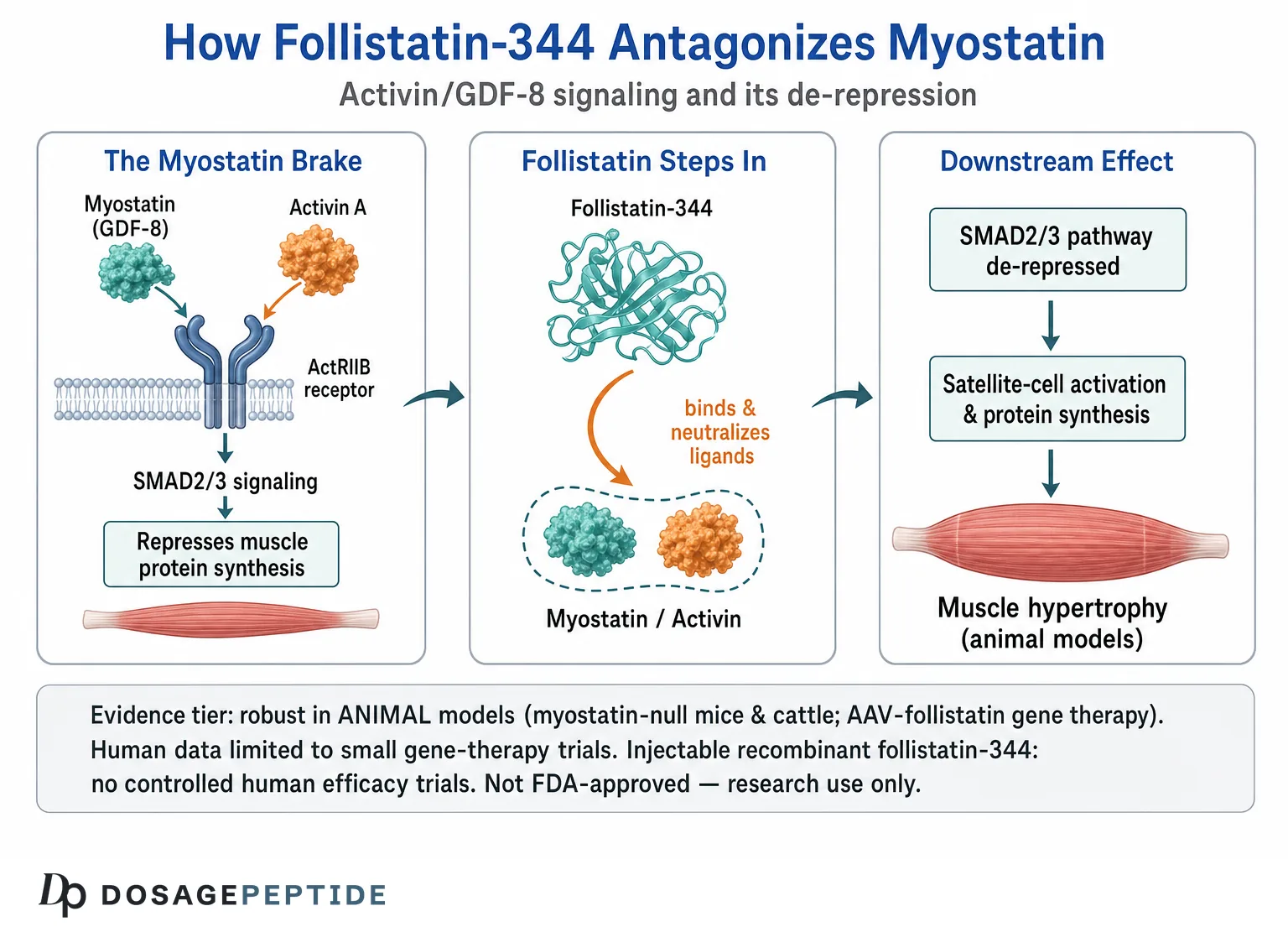
The follistatin 344 mechanism is best understood as antagonism at the top of a well-mapped intracellular signaling cascade. Getting the mechanism right matters, because it explains both why the molecule is biologically potent and why its effects are harder to control than a simple “muscle switch” framing implies.
The TGF-β/activin receptor and the SMAD2/3 axis
Myostatin and activin A are secreted ligands of the TGF-β superfamily. In the canonical pathway, mature myostatin binds primarily to the activin type II receptors ActRIIB and, with lower affinity, ActRIIA on the muscle-cell surface.[3] Ligand binding recruits and phosphorylates a type I receptor (ALK4/ALK5), which in turn phosphorylates the intracellular signaling proteins SMAD2 and SMAD3. Phosphorylated SMAD2/3 partner with SMAD4, translocate to the nucleus, and alter transcription in a way that restrains muscle growth — suppressing myogenic differentiation programs and promoting the activity of atrophy-associated genes. In short, active myostatin keeps the muscle-building machinery down-regulated.
Follistatin works upstream of this entire cascade. It is a secreted antagonist that binds mature myostatin (and activin) in the extracellular space with high affinity, sequestering the ligand before it can reach ActRIIB. With the ligand neutralized, receptor activation falls, SMAD2/3 phosphorylation drops, and the transcriptional brake on muscle growth is released — a process often described as “de-repression” of the anabolic program.[6] This is fundamentally different from directly stimulating a growth receptor: follistatin does not push the accelerator so much as it disables one of the brakes.
Latent complex, activation, and receptor competition
An important subtlety is that myostatin does not circulate in a fully active state. Like several TGF-β ligands, myostatin is secreted as a latent complex in which the mature, receptor-binding C-terminal dimer remains non-covalently associated with its own N-terminal propeptide; the ligand only becomes signaling-competent once that propeptide is cleaved or displaced.[4] This latency is biologically consequential, because it means the amount of active myostatin at the muscle surface at any moment is set by a dynamic balance of production, proteolytic activation, and the buffering capacity of endogenous binding proteins — of which follistatin is the most potent. Biochemical work purifying myostatin from mammalian cells confirmed that the active species is a disulfide-linked C-terminal dimer capable of binding ActRIIB, and that follistatin can inhibit that binding, while the propeptide itself does so only at higher concentrations.[3] A follistatin molecule therefore competes not only with the receptor for free ligand but also, functionally, with the entire latency-and-activation machinery that governs how much ligand is ever presented. This layered regulation is one reason a single bolus of exogenous inhibitor behaves so differently from a genetic condition that lowers the setpoint permanently.
Follistatin as a broad activin antagonist peptide
A critical and under-appreciated point is that follistatin is not a myostatin-only inhibitor. It is a promiscuous activin antagonist peptide that also binds activin A, activin B, and several bone morphogenetic proteins (BMPs) with varying affinities.[7] Activin A signals through the same ActRII receptors and SMAD2/3 pathway, and activin-driven signaling contributes to muscle wasting in several disease states. Blocking both myostatin and activin simultaneously may explain why follistatin has produced larger effects on muscle mass in some animal models than myostatin blockade alone. It also explains a safety consideration: because activins and BMPs have roles well beyond skeletal muscle — in the gonads, pituitary, liver, and vasculature — a broad antagonist has more opportunity for off-target biology than a narrowly specific one. In the careful comparison of recombinant follistatin isoforms, myostatin was in fact a more potent competitor for follistatin binding than BMP-6 or BMP-7, and the relative ability of each isoform to neutralize a given ligand tracked closely with how strongly that isoform associated with the cell surface.[7] Specificity, in other words, is not a fixed property of “follistatin” but varies by isoform and by local tissue context.
Anabolic partners: SMAD3, mTOR, and satellite cells
Follistatin-driven hypertrophy is not purely a matter of subtracting a negative signal. Work in cell and mouse models has shown that follistatin can drive muscle-fiber growth through mechanisms that depend on SMAD3 and the mTOR pathway and that are, at least in part, independent of myostatin itself — implicating additional ligands and downstream nodes in the hypertrophic response.[10] In those experiments, delivering a follistatin transgene markedly increased muscle mass and force-producing capacity alongside increased protein synthesis and mTOR activation, and blocking mTOR or deleting the downstream S6 kinases attenuated the effect; expressing a constitutively active form of SMAD3 largely prevented the follistatin-induced growth. This positions SMAD3 as a hinge that couples ligand antagonism at the cell surface to the Akt/mTOR/S6K protein-synthesis machinery inside the fiber. Reduced myostatin/activin tone also appears to influence satellite cells, the resident muscle stem cells that fuse into fibers to support growth and repair. The interplay between myostatin signaling and satellite-cell behavior is an active research area; readers interested in that layer can explore the dedicated overview of satellite cells and muscle regeneration in peptide research. The takeaway is that follistatin engages a network, not a single lever — which is part of why its net physiological effect is potent in models yet difficult to predict and control in a whole organism.
Follistatin vs Myostatin: What Is the Actual Relationship?
The phrase follistatin vs myostatin is slightly misleading, because the two are not competing drugs — they are a natural regulator and its natural antagonist locked in a physiological balance. Myostatin is produced largely by muscle tissue itself and circulates in a latent, propeptide-bound form that can be activated proteolytically; once active, it tonically suppresses muscle growth.[4] Follistatin is one of the endogenous molecules that keeps that suppression in check. In healthy tissue, the ratio of active myostatin/activin to available follistatin helps set the “operating point” for muscle mass.
An elegant demonstration of just how tightly linked they are came from transgenic mouse experiments in which follistatin was over-expressed specifically in skeletal muscle. Those mice developed dramatic increases in muscle mass comparable to what is seen in myostatin-knockout animals — strong evidence that follistatin’s muscle effect operates through the same axis that myostatin controls.[3] The reverse experiment is equally telling: systemic over-expression of myostatin in adult mice induced profound muscle and fat loss resembling cachexia, confirming that myostatin acts on adult tissue, not only during development.[4]
So the relationship is antagonistic and quantitative. More follistatin activity generally means less effective myostatin/activin signaling, which generally means a shift toward muscle accretion in the models studied. But two cautions follow immediately. First, follistatin also neutralizes activins, so it is a broader intervention than a pure anti-myostatin agent — the two are not interchangeable. Second, the impressive results come overwhelmingly from experiments that chronically raise follistatin levels via genetic engineering or gene transfer, producing sustained local expression. That is a very different exposure profile from a bolus injection of recombinant protein, which the body clears rapidly. The strength of the myostatin–follistatin relationship in biology is not in dispute; whether an injectable peptide can exploit it usefully in humans very much is.
What Do the -334, -344, and -288 Follistatin Isoforms Mean?
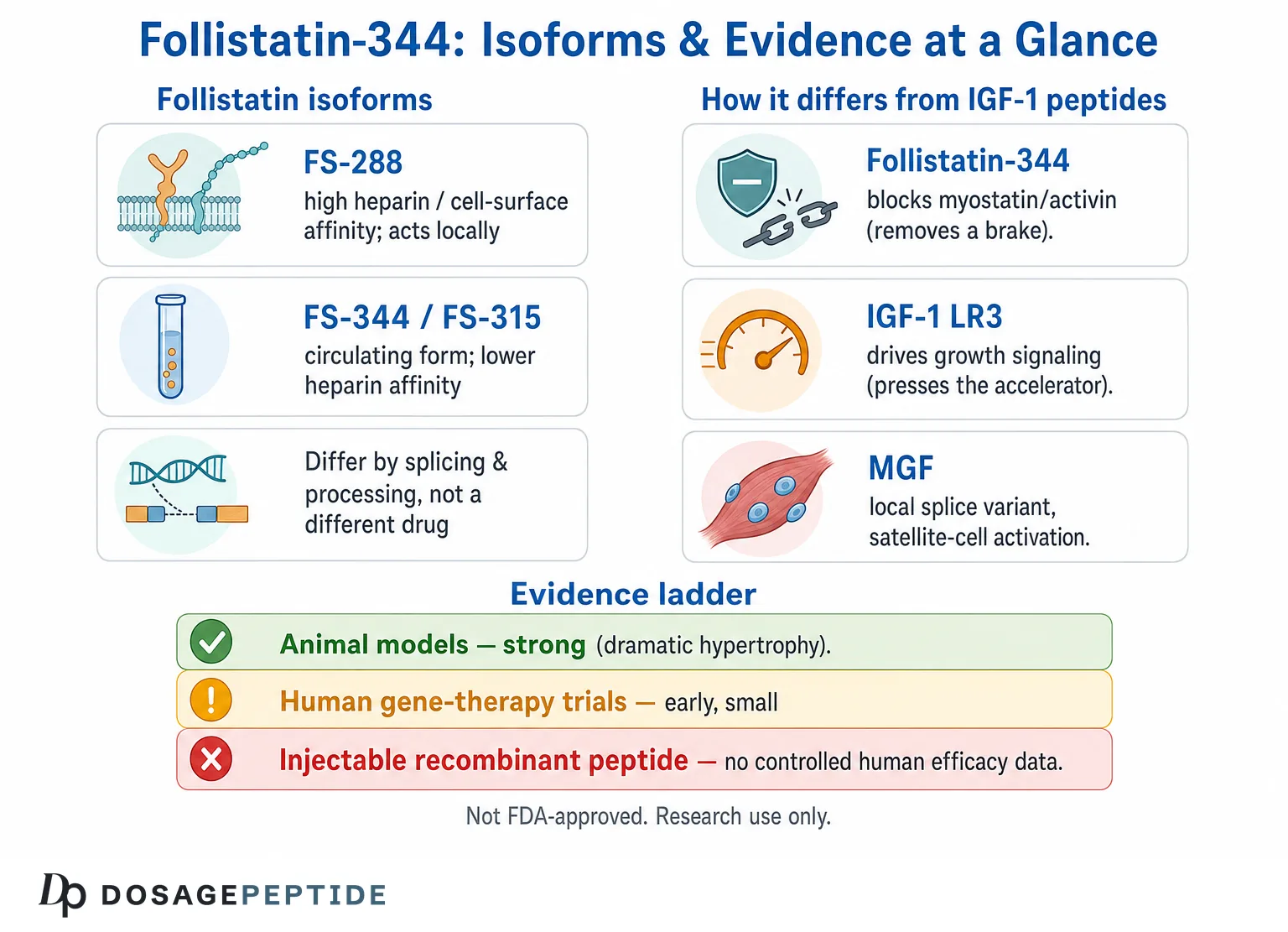
Confusion about follistatin isoforms is rampant, and vendors often use the numbers loosely. The isoforms arise from alternative splicing of the FST gene and subsequent processing, and the key functional difference between them is heparin- and cell-surface binding, which governs how the protein distributes and how long it lingers near its target.[7]
- Follistatin-288 (FS288): the shorter, more strongly heparin-binding form. Its high affinity for cell-surface heparan sulfate proteoglycans makes it “stickier” to tissue and, in several assays, the most potent form for local ligand neutralization — but that same property limits its systemic circulation.
- Follistatin-315 (FS315): the longer form with an acidic C-terminal tail that reduces heparin binding, making it the predominant circulating form with lower cell-surface retention.
- Follistatin-344 (FS344): the designation used for the specific alternatively spliced human construct deployed in gene-therapy programs. The number refers to the length of the encoded precursor (including its signal peptide); once processed, its mature product corresponds to the lower-heparin-affinity, more freely distributing isoform, which is precisely why investigators favored it — a distribution profile intended to act on skeletal muscle while minimizing binding to non-muscle cells and thereby reducing potential off-target effects.[9]
- Follistatin-334 (FS334): a related processed form sometimes referenced in isoform nomenclature; in practice it is far less studied than 288, 315, or the 344 gene-therapy construct, and much online material conflates it with FS344 or uses the two numbers interchangeably without justification.
The practical implication is that isoform choice is not cosmetic. Because heparin affinity determines whether a molecule stays local or circulates, the same nominal “follistatin” can behave very differently depending on the isoform. This matters enormously for anyone trying to reason about an injectable product: the muscle-selective behavior engineered into the FS344 transgene in gene therapy does not automatically transfer to a bolus of recombinant FS344 protein injected into tissue, where clearance kinetics, heparin binding, and enzymatic degradation all come into play. Numbers on a vial label describe a sequence, not a validated pharmacology. The follistatin-344 dosage protocol reference page catalogs how the material is typically handled in laboratory settings, but that handling information is not evidence of clinical effect.
What Does the Animal Muscle-Growth Research Actually Show?
This is where the follistatin muscle growth research is genuinely strong — and where it is also most often laundered into human claims it cannot support. The animal literature is robust, reproducible, and impressive. It is also, without exception, animal or genetic-engineering data.
Genetic knockouts and “double muscling”
The foundational observations are genetic. Myostatin-null mice roughly double their muscle mass;[1] double-muscled cattle carry natural loss-of-function myostatin mutations;[2] and analogous hyper-muscular phenotypes have been documented in dogs, sheep, and the single human case noted earlier.[5] These establish the target’s validity across mammals. But they describe the effect of never having functional myostatin, typically from conception — a lifelong genetic condition, not a drug effect. That distinction is not pedantry: an organism that develops without myostatin lays down a different number of muscle fibers during embryogenesis, an event that no adult intervention can reproduce. Post-developmental blockade can enlarge existing fibers, but it cannot rewind the fiber-number decision made in the womb, which is one reason knockout phenotypes represent an upper bound that pharmacology has never approached.
Follistatin over-expression and AAV gene transfer
Moving from “delete the ligand” to “add the antagonist,” researchers showed that muscle-specific transgenic follistatin over-expression drives hypertrophy on par with myostatin knockout.[3] The most translationally influential step was delivering the follistatin gene with a viral vector. Using adeno-associated virus (AAV) to carry a follistatin transgene into mouse muscle produced long-term, single-administration enhancement of muscle mass and strength — the vector turns the muscle itself into a sustained factory for the inhibitor.[8] Strikingly, that enhancement persisted for more than two years after a single administration and was achievable even when the vector was delivered to aged animals, and follistatin-based inhibitors delivered this way also ameliorated dystrophic pathology in disease-model mice, hinting at therapeutic potential in muscle-wasting conditions.[8]
The mechanistic point cannot be overstated: these results depend on continuous local production of follistatin from transduced cells, sustained for months to years. That exposure profile is the whole point of gene therapy and is categorically different from the pharmacokinetics of injecting a finite dose of recombinant protein. A useful way to see the distinction is to note that the gene-therapy strategy does not deliver follistatin at all — it delivers the instructions to make follistatin, converting the target tissue into a durable, self-replenishing source. An injected peptide, by contrast, delivers a fixed quantity of protein that begins to be cleared and degraded the moment it enters the tissue, with no mechanism to renew itself.
Nonhuman primate data
The pivotal preclinical bridge to humans was a primate study. When an AAV1 vector carrying the human FS344 isoform (AAV1-FS344) was injected into the quadriceps of cynomolgus macaques, it produced pronounced and durable increases in muscle size and strength, with no abnormal changes reported in major organs over long-term transgene expression.[9] This safety-and-efficacy signal in a nonhuman primate is what justified moving the FS344 gene-therapy construct into human trials. Note again what was administered: a virus delivering the follistatin gene, engineered for muscle-selective expression — not the injectable recombinant peptide sold to researchers. The macaque quadriceps became a long-term production site for the protein; a syringe of reconstituted peptide does nothing of the kind.
What Is the Human Evidence? Gene Therapy vs the Injectable Peptide
Here is the crux of the entire topic, and the single most important distinction for honest interpretation. There is human follistatin data — but it comes from AAV follistatin gene-therapy trials in patients with muscle-wasting diseases, and it does not come from injecting recombinant follistatin-344 protein for muscle building.
The Becker muscular dystrophy trial
In a phase 1/2a proof-of-principle trial, six patients with Becker muscular dystrophy received direct bilateral intramuscular quadriceps injections of AAV1.CMV.FS344 — the follistatin gene delivered by an AAV1 vector. Several participants showed improvement on the six-minute walk test (reported gains included 58 and 125 meters in the lower-dose cohort and 108 and 29 meters in the higher-dose cohort), while some participants showed no change; muscle biopsies showed reduced endomysial fibrosis, reduced central nucleation, and fiber hypertrophy, and no adverse effects were reported.[12] The investigators specifically chose the FS344 isoform to avoid binding to off-target sites — underscoring how deliberate the isoform selection was.
The sporadic inclusion body myositis trial
The same group extended the approach to sporadic inclusion body myositis (sIBM), a degenerative inflammatory myopathy. Six sIBM subjects received AAV1-delivered follistatin (FS344) into both quadriceps alongside an exercise regimen. Annualized six-minute walk performance improved by roughly +56 meters/year in treated subjects versus a decline of about −26 meters/year in a matched untreated comparison group (reported p = 0.01), with histology again showing decreased fibrosis and improved regeneration; benefit was clearest in more mildly affected, ambulatory patients, while those with more advanced muscle loss responded poorly.[13] A companion review from the same translational center situates these follistatin trials within a broader muscular-dystrophy gene-therapy program and notes that, across the group’s AAV muscle trials, an immune response directed against a transgene product was encountered in a separate study — a reminder that delivering foreign genetic material carries its own category of risk.[11]
Why this is not the same as injecting follistatin-344
Everything about these trials should be read carefully. They were small, early-phase studies in patients with specific muscle diseases, several participants did not respond, the improvements were modest and measured over months, and — most importantly — the intervention was gene therapy: a one-time viral delivery of the follistatin transgene that turns muscle cells into local, long-term producers of the protein. That is a fundamentally different pharmacological event from a researcher reconstituting a lyophilized vial of recombinant follistatin-344 and injecting a bolus. There are, to the best of the published record, no controlled human efficacy trials of injected recombinant follistatin-344 protein for building muscle in healthy people. Anyone who cites the Becker MD or sIBM results as evidence that the injectable peptide “works in humans” is conflating gene therapy with protein injection — two categories with entirely different exposure, distribution, and durability. Follistatin-344 sold as a research material is not an approved product and is intended for research use only.
The Broader Myostatin-Inhibition Drug Landscape: What Trials of Related Agents Reveal
Follistatin-344 does not exist in a vacuum. For roughly two decades, the pharmaceutical industry has pursued the myostatin/activin axis with purpose-built, GMP-manufactured molecules — anti-myostatin antibodies, myostatin-propeptide constructs, soluble activin-receptor “decoys,” and anti-receptor antibodies — precisely because the animal genetics were so compelling. The outcomes of those human programs are the most instructive backdrop for judging an unregulated research peptide, because they show what happens when the same target is engaged in people with well-characterized drugs, careful dosing, and rigorous endpoints. The short version: the human results have been considerably more modest, and considerably more mixed, than the animal data predicted.
Soluble receptor decoys and single-digit gains
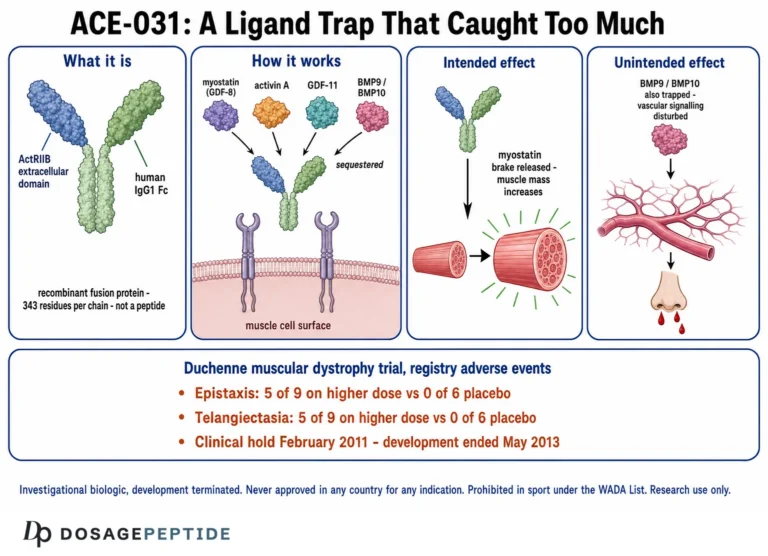
One representative agent, ACE-031, is a soluble form of the activin type II receptor (ActRIIB) fused to an antibody fragment; it functions as a “ligand trap,” binding myostatin and other negative regulators before they reach the muscle-cell receptor — mechanistically adjacent to what follistatin does. In a phase 1 single-ascending-dose study in 48 healthy postmenopausal women, ACE-031 produced statistically significant but modest gains: total lean body mass rose about 3.3% (p = 0.03 by DXA) and thigh muscle volume about 5.1% (p = 0.03 by MRI) at the highest dose by day 29, with a serum half-life of roughly 10 to 15 days.[15] This is one of the very few controlled datasets in which a myostatin-pathway agent was given to non-diseased humans specifically to change body composition — the exact scenario the follistatin-peptide narrative implies — and even a purpose-built biologic delivered single-digit percentage changes over a month, nowhere near the doubling seen in myostatin-null mice. No soluble activin-receptor trap of this kind has been approved for building muscle.
Anti-receptor antibodies: bimagrumab’s rise and fall
Bimagrumab, a fully human monoclonal antibody that blocks ActRII receptors, offers perhaps the clearest cautionary tale. An early pilot study in sporadic inclusion body myositis reported encouraging increases in thigh muscle volume and some functional gains, generating real optimism that ActRII blockade could treat a previously untreatable disease. But the definitive test — the RESILIENT phase 2b randomized, double-blind, placebo-controlled trial in 251 IBM participants across 38 sites — found that bimagrumab did not improve the six-minute walking distance versus placebo at 52 weeks (least-squares mean treatment difference of about 17.6 meters, p = 0.22 at the highest dose), despite measurably increasing muscle mass.[16] The antibody was generally safe, but on the outcome that mattered — function — it failed. The lesson transfers directly to follistatin: increasing muscle size, even with a precise pharmaceutical antibody, does not reliably translate into the functional benefits enthusiasts assume, and small early signals frequently evaporate in larger, better-controlled trials.
Set against this backdrop, claims for injectable recombinant follistatin-344 look weaker still. Industry took the same validated target, built molecules with known identity, purity, and pharmacokinetics, tested them in properly powered blinded trials — and produced results that ranged from modest to outright negative. An unregulated research peptide, injected as a bolus with poorly characterized kinetics and no efficacy trials of its own, is being asked to outperform programs that had every pharmaceutical advantage and still fell short of the animal promise. That is the honest frame in which any single-vendor claim about follistatin-344 should be read.
Current Evidence Level: How Strong Is the Case, Precisely?
Stating the evidence tier precisely is the whole point of an honest explainer, so here it is without hedging or inflation, target by target.
| Claim / context | Evidence tier | What the data actually support |
|---|---|---|
| Myostatin negatively regulates muscle mass | Established across species (genetic + physiological) | Strong, reproducible; validated in mice, cattle, and a human case |
| Follistatin antagonizes myostatin/activin via SMAD2/3 | Established mechanism | Well-characterized biochemistry and cell biology |
| Follistatin over-expression grows muscle | Preclinical / animal + gene-transfer | Robust in transgenic and AAV mouse and primate models |
| AAV-FS344 gene therapy in human muscle disease | Early-phase human trials (investigational) | Small phase 1/2a signals in BMD and sIBM; not approved |
| Related pharma myostatin/activin-pathway drugs in humans | Controlled human trials (mixed / often negative) | Modest body-composition gains; key functional trials failed; none approved for muscle building |
| Injected recombinant follistatin-344 builds muscle in healthy humans | No controlled human efficacy evidence | Not demonstrated; extrapolated from animal/gene-therapy data |
| Regulatory status of follistatin-344 peptide | Research-use-only; not FDA-approved | No approved indication for the injectable peptide |
To be explicit: follistatin-344 is not an FDA-approved drug for any indication. The FDA has not approved an injectable follistatin peptide for muscle growth, wasting, or performance. The only follistatin material that has reached human testing did so as an investigational AAV gene therapy in orphan muscle diseases — and those programs remain early-phase and unapproved. The biology of myostatin inhibition is real and well-supported; the animal hypertrophy data are dramatic and reproducible; but the specific proposition “inject recombinant follistatin-344 and grow muscle in a healthy adult” sits at the weakest evidence tier of all: mechanistic and animal plausibility with no controlled human efficacy trials. The broader lesson from adjacent drug programs sharpens this further — when the same target was engaged with pharmaceutical-grade molecules in blinded human trials, the effects were modest and the pivotal functional endpoints frequently were not met.[16] That is the accurate summary, and it should temper every claim you encounter to the contrary.
Pharmacokinetics: What Is Known About Half-Life and Bioavailability?
A central reason the injectable-peptide narrative is weak is pharmacokinetic. The impressive follistatin results in animals come from strategies that maintain sustained follistatin exposure — genetic over-expression or AAV gene transfer that produces the protein continuously inside muscle for months.[8] The properties that make follistatin biologically potent also make it poorly suited to bolus dosing.
Follistatin is a heparin-binding glycoprotein, and the more heparin-avid isoforms adhere tightly to cell-surface heparan sulfate proteoglycans, keeping them local rather than allowing broad systemic distribution.[7] Circulating follistatin is subject to rapid clearance, and as a protein it is vulnerable to proteolytic degradation. The systemic half-life and true bioavailability of injected recombinant follistatin-344 in humans are poorly characterized in the published literature — there is no well-established human PK dataset for the injectable peptide of the kind that exists for approved biologics. It is instructive that the engineered soluble-receptor drug ACE-031, deliberately built with an antibody-fragment fusion to prolong its residence time, achieved a half-life of only about 10 to 15 days and still produced merely single-digit percentage gains in muscle;[15] a native follistatin protein, with no such half-life engineering and a strong tendency to bind and be cleared, would be expected to persist far more briefly. In practical terms, this means a single injection is likely cleared quickly and may never achieve the sustained tissue exposure that drove hypertrophy in the gene-therapy models. Claims of specific dosing schedules producing specific muscle gains in humans are not backed by controlled pharmacokinetic or efficacy data. This uncertainty is not a minor footnote; it is arguably the decisive reason the animal-to-human extrapolation fails for the injectable format.
How Does Follistatin-344 Compare to Other Muscle-Research Peptides?
Follistatin-344 is frequently grouped with other compounds studied for muscle and recovery, but its mechanism sets it apart. It is a myostatin/activin antagonist — it removes a brake — whereas most of the other commonly researched muscle peptides are growth-factor agonists that push an accelerator. Understanding the contrast clarifies why they are studied for different questions.
| Compound | Primary research mechanism | Broad category of action |
|---|---|---|
| Follistatin-344 | Binds/neutralizes myostatin & activin; de-represses SMAD2/3 | Inhibitor of a negative regulator (“brake removal”) |
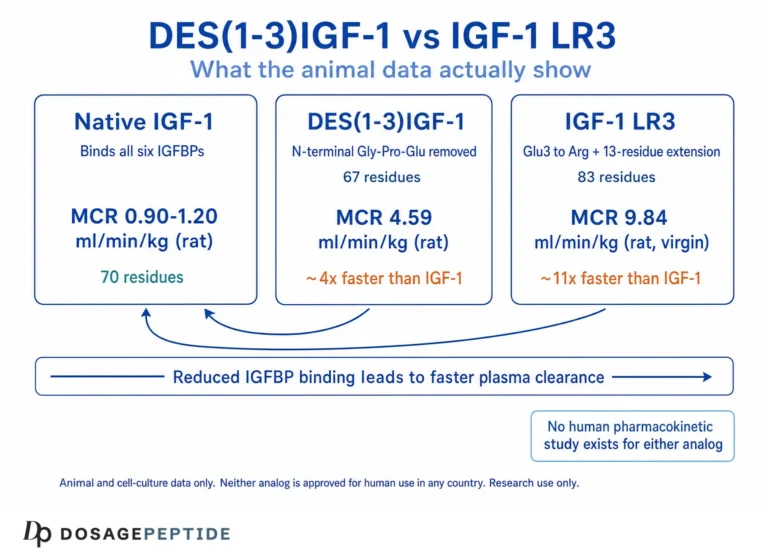
| IGF-1 LR3 | Long-acting IGF-1 analog activating IGF-1 receptor / PI3K-Akt-mTOR | Direct anabolic growth-factor agonist |
| MGF (mechano growth factor) | IGF-1 splice variant implicated in mechanical-load response and satellite-cell activation | Local growth-factor / repair signal |
Because these act through distinct pathways, researchers sometimes discuss them in combination models — but combining mechanisms also multiplies unknowns and risks, and none of these are approved muscle-building drugs. It is worth noting that the SMAD3/mTOR link identified for follistatin means it is not as mechanistically separate from the IGF-1 axis as the “brake vs accelerator” shorthand implies: both ultimately converge on the Akt/mTOR/S6K protein-synthesis machinery, which is one reason their effects in cell models can appear additive and their combined safety profile is even less characterized than either alone.[10] For deeper mechanistic explainers, see the reference articles on what IGF-1 LR3 is and how it is studied and what MGF (mechano growth factor) is, along with the head-to-head overview of MGF vs IGF-1 LR3 in muscle research. Laboratory handling references for the individual compounds are catalogued on the IGF-1 LR3 protocol page and the MGF protocol page. As with follistatin-344, those pages describe research handling — they are not endorsements of human use, and none of these agents has demonstrated muscle-building efficacy in controlled human trials in healthy subjects.
Limitations, Unknowns, and Safety Signals in the Research
An honest account of follistatin-344 has to foreground its limitations, because they are substantial and they cut directly against the marketing narrative.
The evidence gap is category-wide, not incremental
The most important limitation is not that human data are thin — it is that the human data that exist test a different intervention (AAV gene therapy) in a different population (patients with muscle-wasting disease) for a different endpoint (slowing functional decline) than the one implied by the fitness narrative (bolus-injecting a peptide to build muscle in a healthy adult).[12][13] No amount of animal data closes that gap; only controlled human trials of the injectable peptide could, and those do not exist.
Translational failure is the rule, not the exception, for this target
The broader pharmaceutical record is a sobering guide. Well-manufactured myostatin/activin-pathway drugs, tested in properly powered blinded trials, have repeatedly produced changes in muscle size that did not translate into the functional gains the animal work seemed to promise; the largest controlled trial of an ActRII-blocking antibody in a muscle-wasting disease failed its primary walking-distance endpoint despite increasing muscle mass.[16] If pharmaceutical-grade molecules with characterized pharmacology struggle here, a research peptide with none of those advantages cannot reasonably be assumed to succeed.
Broad target profile raises off-target concerns
Because follistatin antagonizes activins and some BMPs in addition to myostatin, and because those ligands function in the gonads, pituitary, liver, and blood vessels, a systemically active follistatin has more potential for off-target biology than a highly specific anti-myostatin antibody would.[7] Activin/follistatin balance is involved in reproductive and endocrine signaling, and perturbing it broadly is not a trivial intervention.
The cardiac and connective-tissue question
The single documented human myostatin-null case was reported without pathology at the time,[5] but a single case cannot establish long-term safety, and myostatin/activin signaling is present in cardiac and tendon tissue. Whether chronically suppressing this axis in adults affects the heart, tendon strength relative to rapidly enlarging muscle, or other systems over years is simply not answered by the existing literature. The broader review literature treats myostatin inhibition as a promising but still-unproven therapeutic strategy requiring careful long-term safety evaluation.[6] The concern that muscle can be induced to enlarge faster than tendons and connective tissue can adapt is a specific, mechanistically plausible worry that the human data neither confirm nor exclude.
Product-quality and identity unknowns
Research-grade follistatin-344 is not a regulated pharmaceutical. Purity, correct folding, glycosylation, endotoxin content, and even isoform identity can vary between sources, and there is no approval process guaranteeing that a given vial contains what its label claims. Combined with the poorly characterized pharmacokinetics, this means that even the theoretical mechanism cannot be reliably invoked for any particular product: an incorrectly folded, aggregated, or endotoxin-contaminated preparation may have no meaningful follistatin activity at all while still carrying injection risk. These are the reasons the compound is appropriately framed as research-use-only and why extrapolating the elegant biology into a personal protocol is unsupported.
Follistatin-344 Benefits: What Is Claimed vs. What Is Shown
Almost every benefit attached to follistatin-344 online is real in some model — just not in the one buyers assume. Here is the same list, sorted by what the evidence tier actually is.
| Claimed benefit | What the research actually supports | Evidence tier |
|---|---|---|
| Large increases in muscle mass | Real and dramatic in animals — and in humans only via AAV gene therapy, which makes the body produce follistatin continuously. Not demonstrated for an injected dose of the protein. | Animal + early-phase gene therapy |
| Fat loss / recomposition | Blocking the myostatin–activin pathway shifted body composition in animals, and antibody drugs in this class did raise lean mass in people. Function did not improve, and none of this involved injectable follistatin-344. | Animal + class read-across |
| Faster recovery, better strength | Not shown. The most rigorous test in this drug class — the RESILIENT trial of bimagrumab in 251 patients — added muscle without improving how far people could walk. | Contradicted in the class |
| Hair growth | Follistatin appears in hair-follicle biology research, which is where the marketing comes from. There is no human trial of follistatin-344 for hair. | Preclinical only |
| Anti-ageing, longevity | No human data of any kind. | None |
The single most useful thing to hold onto: the spectacular results come from continuous gene expression, not from a vial. A gene-therapy construct turns tissue into a follistatin factory for months. An injection delivers a finite amount of a protein whose human half-life has never been properly characterized. Those are not two doses of the same thing.
Follistatin-344 Side Effects and Known Risks
The honest headline is uncomfortable: there is no published human adverse-event dataset for injectable follistatin-344. Nobody can quote you a side-effect rate, because no trial has ever measured one. What exists instead is a set of mechanistic risks that follow directly from what the molecule does, plus the risks of unregulated supply.
- It is a broad blocker, not a precise one. Follistatin neutralizes activins as well as myostatin — and activin signalling regulates FSH release and reproductive endocrinology. A systemic follistatin load has an obvious route to hormonal off-target effects that has never been characterized in humans.
- The TGF-β family is tumour-suppressive in several tissues. Broadly antagonizing that pathway is a theoretical oncology concern that review authors consistently flag as a reason long-term safety evaluation is required before any therapeutic use.
- Muscle can outgrow its scaffolding. Myostatin and activin signalling operate in cardiac muscle and tendon, not just skeletal muscle. Rapid hypertrophy without matched tendon and cardiac adaptation is a plausible injury risk that no study has examined.
- The gene-therapy trials were not safety demonstrations. The follistatin constructs that reached humans did so in early-phase orphan-disease studies with a handful of participants each. Cohorts that small are designed to catch obvious acute problems, not uncommon or delayed ones.
- Supply is the risk nobody prices in. Research-grade follistatin-344 has no regulated manufacturing standard. Identity, purity, actual protein content, and endotoxin load are unverified, and non-sterile handling is its own hazard independent of the molecule.
Read together, this is not a compound with a “mild side-effect profile.” It is a compound with no measured side-effect profile — a different and less reassuring situation.
Is Follistatin-344 Legal or FDA-Approved?
No. Follistatin-344 has no FDA approval and no approved human indication anywhere. It is not a supplement, and it cannot legally be sold for human consumption; the vials sold online are labelled for laboratory research use only, which is the basis on which they are supplied. Follistatin gene therapy remains investigational in orphan muscle disease. Myostatin inhibition is also prohibited in competitive sport under the WADA list, and the surrounding drug class has been an anti-doping target for years.
Frequently Asked Questions
Is follistatin-344 FDA-approved for muscle growth?
No. Follistatin-344 is not approved by the FDA for muscle growth or any other indication. The only follistatin material to reach human testing did so as an investigational AAV gene therapy in orphan muscle diseases such as Becker muscular dystrophy and sporadic inclusion body myositis, and those programs remain early-phase and unapproved. The injectable recombinant peptide sold to laboratories is a research-use-only material, not an approved product.
Does follistatin-344 actually build muscle in humans?
There are no controlled human efficacy trials showing that injected recombinant follistatin-344 builds muscle in healthy people. The dramatic muscle-growth results come from animal models and from AAV gene therapy that delivers the follistatin gene for sustained local production — a fundamentally different intervention. Claiming proven human muscle-building efficacy for the injectable peptide misrepresents what the published evidence supports.
What is the difference between follistatin-344, follistatin-288, and follistatin-315?
They are isoforms of the same gene that differ mainly in heparin and cell-surface binding, which affects how they distribute. FS288 binds heparin strongly and stays local; FS315 circulates more; FS344 refers to the precursor length of the alternatively spliced construct chosen for gene therapy, whose mature product has a muscle-favoring, lower-off-target distribution profile. The differences are functionally meaningful, not just naming conventions.
How does follistatin differ from myostatin?
Myostatin (GDF-8) is a TGF-β ligand that suppresses muscle growth by signaling through activin type II receptors and SMAD2/3. Follistatin is a binding protein that neutralizes myostatin (and activins) before they reach the receptor, releasing the brake on muscle growth. They are a natural regulator and its natural antagonist, held in physiological balance rather than being competing drugs.
Why do the human gene-therapy results not prove the injectable peptide works?
The trials used AAV to deliver the follistatin gene, turning muscle cells into long-term producers of the protein — sustained exposure over months. Injecting a bolus of recombinant peptide produces a brief, rapidly cleared exposure with poorly characterized pharmacokinetics. The two differ in delivery, durability, and distribution, so the gene-therapy signals cannot be transferred to the injectable format.
What is known about follistatin-344’s half-life?
Very little is firmly established for the injectable peptide in humans. Follistatin is heparin-binding and subject to rapid clearance and proteolytic degradation, and no well-characterized human pharmacokinetic dataset exists for injected recombinant follistatin-344. Even purpose-engineered myostatin-pathway biologics designed for a long half-life reach only about 10 to 15 days while producing modest effects, so a native, unengineered follistatin protein would be expected to persist much more briefly. This uncertainty is a major reason the animal-to-human extrapolation for a bolus injection is considered weak.
Is follistatin-344 the same as myostatin inhibitor drugs in clinical trials?
Not exactly. Several pharmaceutical programs have tested myostatin- or activin-pathway inhibitors — antibodies, soluble receptor decoys, and gene therapies — for muscle-wasting conditions and body composition, with distinctly mixed results: some produced modest muscle-mass gains, while the largest controlled trial of an ActRII-blocking antibody in inclusion body myositis failed to improve walking distance versus placebo.[16] Follistatin-344 as a research peptide is related conceptually but is a distinct, unapproved material. Being in the same mechanistic family as investigational drugs does not make the research peptide safe, effective, or approved.
Have any myostatin- or activin-pathway drugs succeeded in large human trials?
Not in the decisive sense. A soluble activin-receptor decoy produced statistically significant but small gains (roughly 3–5%) in lean mass and thigh muscle volume in healthy postmenopausal women in an early-phase study,[15] but no agent in this class has been approved for building muscle, and pivotal functional trials such as the RESILIENT study of an anti-receptor antibody did not meet their primary endpoints.[16] The gap between muscle-size changes and real functional benefit has been the recurring obstacle for the entire target class.
Why is follistatin-344 described as research-use-only?
Because it has no approved human indication, no established human efficacy or safety data as an injectable, poorly characterized pharmacokinetics, and no regulated manufacturing standard guaranteeing identity and purity. Framing it as research-use-only reflects that its study belongs in laboratory and preclinical settings, not in self-administration, and this article makes no recommendation for human use.
References
- McPherron AC, Lawler AM, Lee SJ. Regulation of skeletal muscle mass in mice by a new TGF-beta superfamily member. Nature. 1997;387(6628):83–90. https://doi.org/10.1038/387083a0
- Grobet L, Martin LJ, Poncelet D, et al. A deletion in the bovine myostatin gene causes the double-muscled phenotype in cattle. Nat Genet. 1997;17(1):71–74. https://doi.org/10.1038/ng0997-71
- Lee SJ, McPherron AC. Regulation of myostatin activity and muscle growth. Proc Natl Acad Sci USA. 2001;98(16):9306–9311. https://doi.org/10.1073/pnas.151270098
- Zimmers TA, Davies MV, Koniaris LG, et al. Induction of cachexia in mice by systemically administered myostatin. Science. 2002;296(5572):1486–1488. https://doi.org/10.1126/science.1069525
- Schuelke M, Wagner KR, Stolz LE, et al. Myostatin mutation associated with gross muscle hypertrophy in a child. N Engl J Med. 2004;350(26):2682–2688. https://doi.org/10.1056/NEJMoa040933
- Lee SJ. Regulation of muscle mass by myostatin. Annu Rev Cell Dev Biol. 2004;20:61–86. https://doi.org/10.1146/annurev.cellbio.20.012103.135836
- Sidis Y, Mukherjee A, Keutmann H, et al. Biological activity of follistatin isoforms and follistatin-like-3 is dependent on differential cell surface binding and specificity for activin, myostatin, and bone morphogenetic proteins. Endocrinology. 2006;147(8):3586–3597. https://doi.org/10.1210/en.2006-0089
- Haidet AM, Rizo L, Handy C, et al. Long-term enhancement of skeletal muscle mass and strength by single gene administration of myostatin inhibitors. Proc Natl Acad Sci USA. 2008;105(11):4318–4322. https://doi.org/10.1073/pnas.0709144105
- Kota J, Handy CR, Haidet AM, et al. Follistatin gene delivery enhances muscle growth and strength in nonhuman primates. Sci Transl Med. 2009;1(6):6ra15. https://doi.org/10.1126/scitranslmed.3000112
- Winbanks CE, Weeks KL, Thomson RE, et al. Follistatin-mediated skeletal muscle hypertrophy is regulated by Smad3 and mTOR independently of myostatin. J Cell Biol. 2012;197(7):997–1008. https://doi.org/10.1083/jcb.201109091
- Mendell JR, Rodino-Klapac L, Sahenk Z, et al. Gene therapy for muscular dystrophy: lessons learned and path forward. Neurosci Lett. 2012;527(2):90–99. https://doi.org/10.1016/j.neulet.2012.04.078
- Mendell JR, Sahenk Z, Malik V, et al. A phase 1/2a follistatin gene therapy trial for Becker muscular dystrophy. Mol Ther. 2015;23(1):192–201. https://doi.org/10.1038/mt.2014.200
- Mendell JR, Sahenk Z, Al-Zaidy S, et al. Follistatin gene therapy for sporadic inclusion body myositis improves functional outcomes. Mol Ther. 2017;25(4):870–879. https://doi.org/10.1016/j.ymthe.2017.02.015
- Nakamura T, Takio K, Eto Y, et al. Activin-binding protein from rat ovary is follistatin. Science. 1990;247(4944):836–838. https://doi.org/10.1126/science.2106159
- Attie KM, Borgstein NG, Yang Y, et al. A single ascending-dose study of muscle regulator ACE-031 in healthy volunteers. Muscle Nerve. 2013;47(3):416–423. https://doi.org/10.1002/mus.23539
- Hanna MG, Badrising UA, Benveniste O, et al. Safety and efficacy of intravenous bimagrumab in inclusion body myositis (RESILIENT): a randomised, double-blind, placebo-controlled phase 2b trial. Lancet Neurol. 2019;18(9):834–844. https://doi.org/10.1016/S1474-4422(19)30200-5
Research-use-only disclaimer. This article is an educational overview intended for scientific and informational purposes only. It is not medical advice, and nothing here should be interpreted as a recommendation to obtain, administer, or self-administer follistatin-344 or any related compound. Follistatin-344 is not an FDA-approved drug and has no approved human indication; the findings described are drawn from laboratory, animal, and early-phase investigational gene-therapy research and do not establish safety or efficacy of any injectable peptide for muscle building in humans. Descriptions of research findings refer strictly to experimental and research-model settings. Consult a qualified, licensed healthcare professional for any health-related decision.