GHK-Cu reliably increases collagen production in cultured skin cells — that part of the evidence is strong and has been reproduced since 1988.3 In actual human skin the record is much thinner: a handful of small topical studies, several industry-associated, running eight to twelve weeks and reporting modest improvements in skin density, thickness and wrinkle measures.28 Both statements are true at once, and most writing about this molecule collapses into one or the other.
Three levels of claim get routinely blurred, so this article keeps them apart. What GHK-Cu does to isolated fibroblasts: well established. What a finished GHK-Cu cream does to a living face: supported by small studies with modest effect sizes, not by the large independent trials that anchor claims for retinoids. Whether it treats any skin disease: no — GHK-Cu is a cosmetic ingredient (INCI name copper tripeptide-1), not an approved drug, and it is not authorized to treat, cure or prevent any dermatological condition.
There is also a delivery problem that rarely gets mentioned: GHK-Cu is a charged 340-dalton copper complex, and the stratum corneum is built to keep exactly that kind of molecule out. Below: the mechanism, what the cell and human data each establish, how long the studies ran before measuring change, how GHK-Cu compares with established collagen-stimulating actives, and its safety and regulatory status.
What GHK-Cu Is and Where It Came From
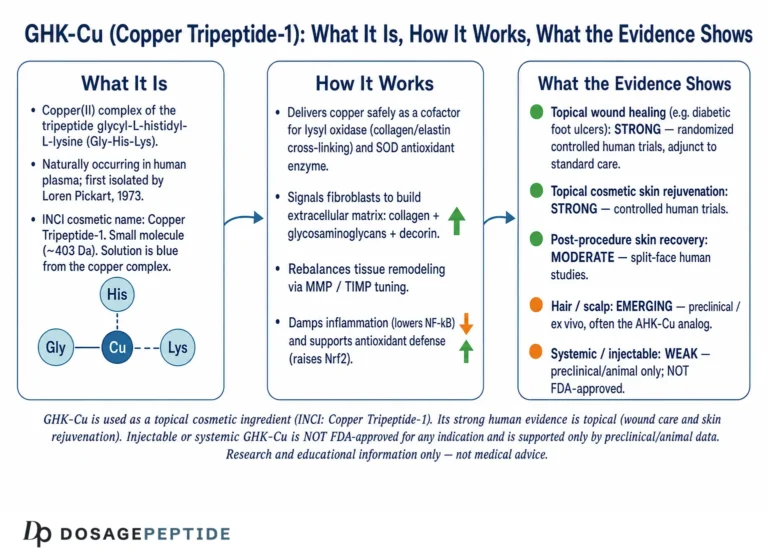
GHK is a tripeptide with the sequence glycyl-L-histidyl-L-lysine (Gly-His-Lys). It was discovered in 1973 by Loren Pickart, who identified an activity in human plasma that prolonged the survival of cultured normal liver cells taken from older animals, making them behave more like cells from younger donors.1 The active factor turned out to be this three-amino-acid peptide. From the outset, then, GHK entered the literature not as a cosmetic curiosity but as a putative endogenous signal associated with tissue maintenance — a molecule the body already makes.
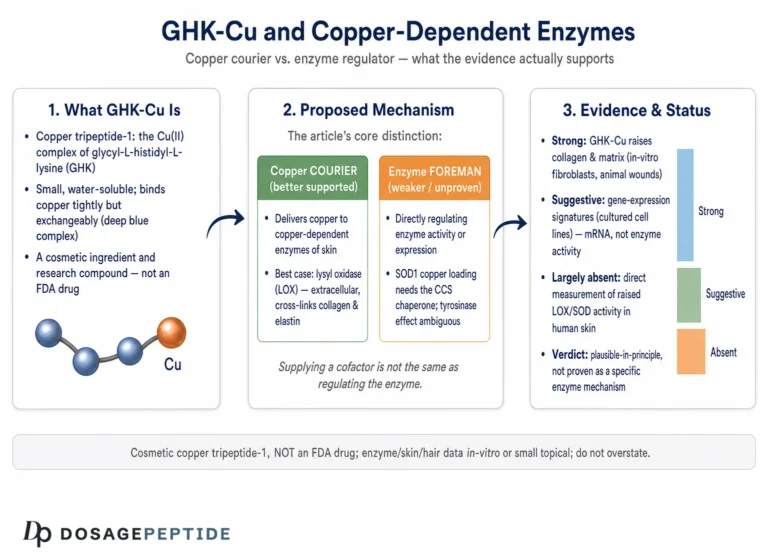
The “Cu” in GHK-Cu refers to copper(II). The histidine and terminal amine groups of GHK give it an unusually high affinity for copper ions, and the peptide readily forms a stable coordination complex with Cu²⁺. This is not a trivial detail. Much of the biology attributed to GHK depends on its ability to bind, carry, and deliver copper — a trace metal that is a required cofactor for enzymes central to skin, including lysyl oxidase (which cross-links collagen and elastin) and superoxide dismutase (an antioxidant enzyme). GHK is often described, accurately, as a copper-transport peptide: a shuttle that can pick copper up, move it, and hand it off to cells and enzymes.2 When people ask what GHK-Cu “does,” a large part of the honest answer is “it delivers bioavailable copper to tissue in a controlled way,” and several of its effects are difficult to disentangle from copper delivery itself.
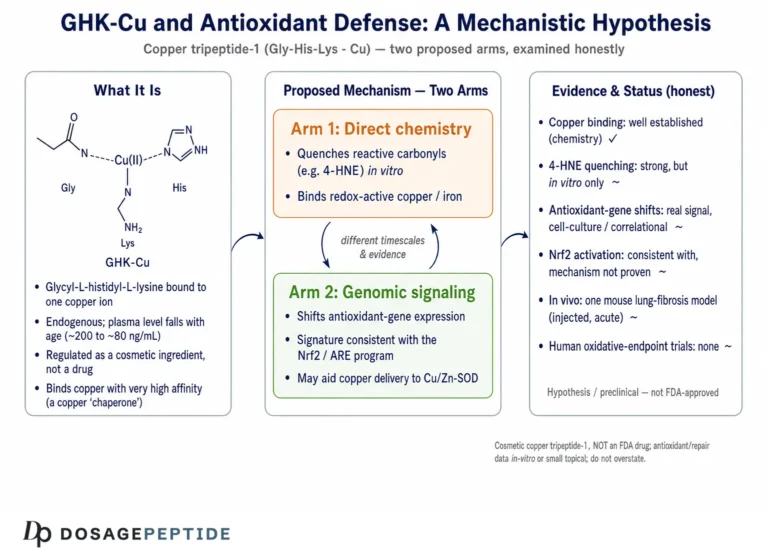
Two facts about GHK’s natural history are repeated throughout the literature and shape the anti-aging narrative. First, GHK circulates in human plasma at meaningful concentrations in early adulthood — on the order of 200 nanograms per milliliter around age 20. Second, that level falls substantially with age, dropping to roughly 80 ng/mL by the seventh decade.5 The intuitive story built on these numbers is seductive: young skin has abundant GHK and repairs itself well; aging skin loses GHK and repairs poorly; therefore replacing GHK should restore youthful repair. That syllogism is worth stating precisely because it is the emotional engine of the entire copper-peptide category — and because correlation between a declining plasma peptide and declining tissue function does not establish that topically applied GHK-Cu reverses skin aging in humans. It is a hypothesis, an attractive one, but the leap from “declines with age” to “replacing it rejuvenates skin” is exactly the kind of step that requires clinical, not correlational, proof.
It is worth pausing on the biological logic of an endogenous copper-carrier peptide, because it reframes what GHK-Cu “is.” Copper is indispensable to connective-tissue biology but dangerous when loose: free copper ions catalyze the generation of damaging free radicals. Evolution’s solution is to keep copper almost entirely protein-bound and to move it through dedicated carriers rather than as free ion. GHK fits neatly into that logic as a small, diffusible copper shuttle that can be released during tissue injury — where it may help coordinate the influx of copper, the recruitment of repair cells, and the switch from an inflammatory to a rebuilding phase. Under this reading, GHK-Cu is less an exotic “anti-aging peptide” than a fragment of the body’s ordinary wound-and-remodeling toolkit, which is precisely why so much of its most convincing data comes from repair contexts. This origin story also explains a persistent tension in the literature: a molecule optimized by biology for acute injury signaling is being repurposed for chronic cosmetic use on intact skin, two settings with very different barrier conditions and very different demands.
Structurally, GHK-Cu is small: the peptide alone has a molecular weight around 340 daltons, and the copper complex only modestly more. Its size, charge, and copper-binding chemistry all matter enormously for whether it can actually reach the living cells of the dermis when smeared on the skin surface — a problem we return to at length, because it is the single most common blind spot in enthusiastic accounts of the molecule. For now, the key identity points are these: GHK-Cu is a naturally occurring human copper-binding tripeptide, discovered in 1973, whose plasma levels decline with age, and which is used cosmetically under the INCI name copper tripeptide-1. It is not, and has never been, an approved pharmaceutical.
The Molecular Mechanism: Copper, Collagen, and Genome-Level Signaling
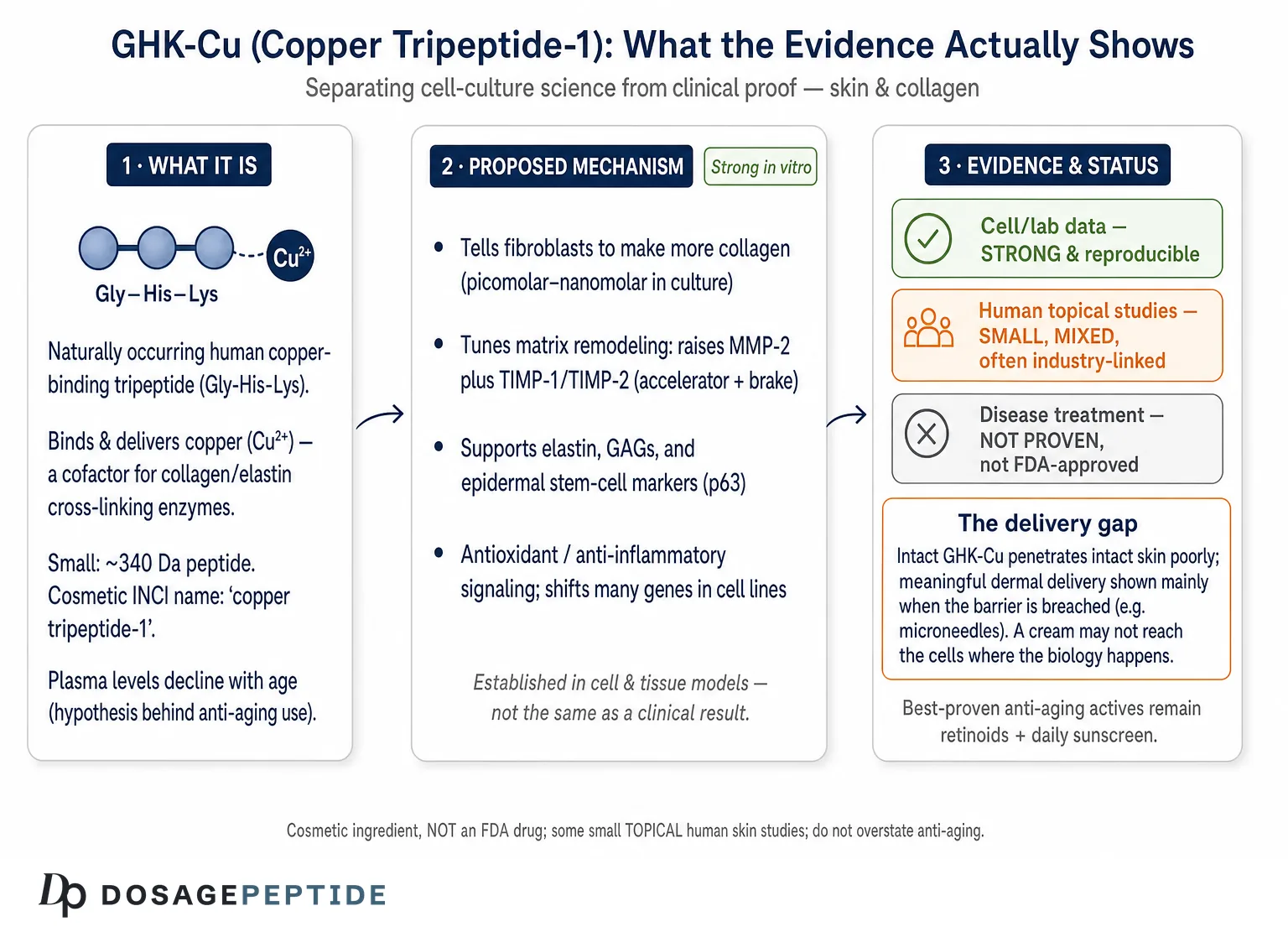
The mechanistic case for GHK-Cu in skin rests on several distinct but overlapping actions, most of them established in cell and tissue models. Understanding them individually is the best defense against the marketing tendency to blur them into a single vague claim of “rejuvenation.”
Stimulation of collagen synthesis. The foundational finding is that GHK-Cu directly increases collagen production by dermal fibroblasts. In a classic 1988 study, adding the tripeptide-copper complex to fibroblast cultures stimulated collagen synthesis, with the effect beginning at extraordinarily low concentrations (between 10⁻¹² and 10⁻¹¹ M) and peaking around 10⁻⁹ M — and critically, this occurred without any increase in cell number, meaning the peptide was upregulating the synthetic activity of existing cells rather than simply growing more of them.3 This picomolar-to-nanomolar potency is one of the most striking features of GHK-Cu and is cited in nearly every review. It suggests a genuine signaling function rather than a bulk nutritional effect.
Modulation of extracellular-matrix remodeling. Building new collagen is only half of tissue renewal; the other half is the controlled breakdown and reorganization of old matrix. GHK-Cu acts on both arms. It stimulates fibroblasts to express matrix metalloproteinase-2 (MMP-2), an enzyme that remodels the extracellular matrix, while simultaneously increasing the tissue inhibitors of metalloproteinases (TIMP-1 and TIMP-2) that restrain that remodeling.4 The picture that emerges is not of a one-way “build collagen” switch but of a remodeling regulator that raises both the accelerator and the brake — a profile more consistent with orchestrated tissue turnover than with crude collagen accumulation. Interestingly, in that work the MMP-2 stimulation was reproduced by copper ions alone but not by the copper-free peptide, again underscoring how much of GHK-Cu’s activity is copper-dependent.4
Support of dermal architecture beyond collagen. GHK-Cu has been reported to stimulate synthesis of other structural and matrix components — elastin, glycosaminoglycans, and proteoglycans such as decorin — that collectively determine skin’s elasticity, hydration, and mechanical resilience.2 Because copper is the cofactor for lysyl oxidase, the enzyme that cross-links both collagen and elastin into mature, load-bearing fibers, adequate copper delivery is mechanistically relevant to the quality, not just the quantity, of new matrix.
Effects on the epidermis and its stem-cell compartment. GHK-Cu is not solely a dermal actor. In keratinocyte and skin-equivalent models, copper-GHK increased keratinocyte proliferation and raised the expression of integrins and of p63, a transcription factor associated with the survival of basal epidermal stem cells.7 The authors interpreted this as evidence that copper-GHK may enhance the proliferative potential of the basal layer — relevant to epidermal renewal and, by extension, to the smoothness and barrier competence of the surface.
Antioxidant and anti-inflammatory signaling. GHK and its copper complex have been reported to scavenge reactive oxygen species, reduce inflammatory mediators, and support antioxidant defenses — actions that matter in photoaging, where ultraviolet-driven oxidative stress and chronic low-grade inflammation degrade the dermal matrix.2 Because so much visible skin aging is photoaging, an actor that dampens the oxidative-inflammatory arm of that process is at least mechanistically coherent with an anti-aging rationale.
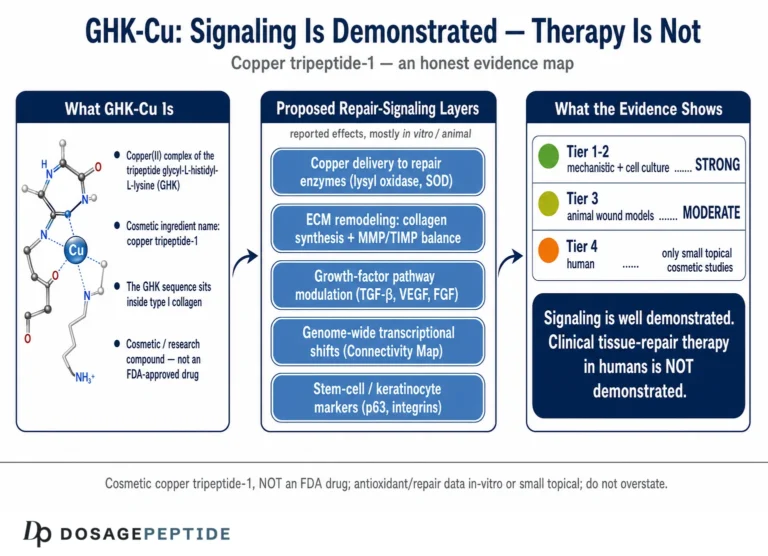
Genome-level modulation. The most ambitious mechanistic claims come from gene-expression profiling. Using the Broad Institute’s Connectivity Map, Pickart and colleagues reported that GHK shifts the expression of a very large number of human genes — on the order of hundreds to thousands, up- and down-regulated — in directions the authors characterize as broadly restorative, including genes involved in tissue remodeling, antioxidant response, DNA repair, and the resolution of inflammation.56 This is genuinely interesting systems-level data, and it is the backbone of the modern “GHK resets the skin genome” narrative. It also deserves a clear-eyed caveat: Connectivity Map signatures are generated by exposing cultured cell lines to a compound and reading transcriptional changes. They map potential biology; they do not demonstrate that a topically applied cosmetic delivers enough intact peptide to enough living cells in human skin to reproduce those signatures in vivo. The gene data expand the list of plausible mechanisms; they do not close the gap to clinical outcome.
| Mechanism | What GHK-Cu does in models | Evidence level |
|---|---|---|
| Collagen synthesis | Stimulates fibroblast collagen production at picomolar–nanomolar doses, independent of cell proliferation3 | Strong in vitro / ex vivo |
| Matrix remodeling | Raises MMP-2 plus TIMP-1/TIMP-2; balanced turnover rather than one-way4 | Strong in vitro |
| Copper delivery | Shuttles bioavailable Cu²⁺ to lysyl oxidase, SOD, and other cuproenzymes2 | Well characterized chemistry |
| Epidermal stem cells | Increases keratinocyte proliferation, integrins, p63 positivity7 | Cell / skin-equivalent models |
| Antioxidant / anti-inflammatory | Scavenges ROS, reduces inflammatory mediators2 | In vitro / mechanistic |
| Gene modulation | Shifts expression of hundreds–thousands of genes (Connectivity Map)56 | Cell-line transcriptomics; not proven in vivo |
The honest mechanistic summary is that GHK-Cu has an unusually rich and internally consistent story at the cell and tissue level: it delivers copper, tells fibroblasts to make matrix, tunes the enzymes that remodel it, supports the epidermal stem-cell compartment, and buffers oxidative-inflammatory stress. That is a lot of coherent biology for a three-amino-acid peptide. The decisive question — addressed in the next sections — is how much of this survives the journey from a fibroblast in a flask to a wrinkle on a living face.
Collagen Synthesis: What the Cell and Tissue Data Actually Establish
Because “collagen synthesis” is in the title of this article and in nearly every product claim, it deserves its own careful treatment. The in-vitro collagen data for GHK-Cu are, on their own terms, robust and reproducible, and they are the strongest scientific foundation the ingredient has.
The 1988 Maquart study established the core result: GHK-Cu stimulates collagen production by cultured human dermal fibroblasts, and it does so at concentrations low enough to imply a receptor-like or signaling mechanism rather than a nutritional one.3 Subsequent work extended the finding beyond collagen to the broader matrix — glycosaminoglycans, proteoglycans, and elastin — and connected it to the remodeling enzymes.4 More recent fibroblast work using modern molecular readouts confirmed that GHK-Cu increases collagen and elastin production while raising the ratio of TIMP to MMP expression, consistent with net matrix accumulation under the tested conditions.8 A separate study looked at a clinically relevant stressor — irradiated fibroblasts, a model for radiation-damaged or photodamaged skin — and found that copper tripeptide influenced fibroblast growth and the autocrine production of growth factors including basic fibroblast growth factor, transforming growth factor-β1, and vascular endothelial growth factor.9
Taken together, these studies justify a specific, bounded statement: GHK-Cu is a bona fide stimulator of collagen and extracellular-matrix synthesis in dermal fibroblasts. That is a real, well-supported biological property. Researchers exploring how copper peptides sit alongside other matrix-stimulating compounds will find related mechanistic discussion in the site’s overview of how peptide blends engage collagen-synthesis pathways, which situates GHK within the wider fibroblast-signaling literature.
What these studies do not establish is equally important. They do not demonstrate that a cosmetic cream raises collagen density in living human dermis to a degree that meaningfully changes skin appearance; that is a clinical endpoint requiring in-vivo measurement. They do not tell us how much intact GHK-Cu reaches fibroblasts through the epidermal barrier under real-world application. And they cannot, by their nature, distinguish a cosmetically visible improvement from a statistically detectable biochemical change. A fibroblast bathed directly in a controlled peptide concentration is a generous test system; skin is a hostile one. The gap between the two is where most overstatement lives, and it is why the in-vitro collagen data, however strong, are a beginning rather than a conclusion.
The Human Topical Evidence: Small, Suggestive, and Often Sponsored
Here the tone must shift from “strong” to “limited but real.” There are human topical studies of GHK-Cu, and it would be inaccurate to say the ingredient has “no clinical evidence.” But it would be equally inaccurate — and far more common — to present that evidence as though it were on par with the large, independent, vehicle-controlled trials that support tretinoin for photoaging. It is not. The human dataset is a scattering of small studies, several of them industry-associated, with modest effect sizes and, in the most rigorous objective comparison, some frankly null results.
The most frequently cited human data come from facial-cream studies associated with the copper-peptide industry, in which twice-daily application of a GHK-Cu cream over roughly twelve weeks was reported to improve skin density and thickness, reduce the appearance of fine lines, and improve appearance in photoaged skin, with biopsy data suggesting increased collagen in a majority of treated subjects.2 These are genuinely the results people mean when they say “clinical studies show copper peptides work.” The appropriate caveats are that such studies have typically been small, often presented in industry or non-independent contexts, and are vulnerable to the biases that dog cosmetic-efficacy research: unblinded or self-assessed endpoints, manufacturer sponsorship, and publication in venues without the scrutiny of a major dermatology journal. They are hypothesis-supporting, not definitive.
A more methodologically explicit example is a randomized, double-blind study of a GHK-Cu serum in women aged 40 to 65, applied over eight weeks, which reported reductions in wrinkle volume and depth relative to a control formulation, alongside the fibroblast gene-expression and collagen/elastin findings discussed earlier.8 This is a stronger design than an open-label industry poster, and it is fair to cite it as positive human evidence — while noting that it was still a small, single study with commercial involvement and cosmetic (not disease) endpoints.
The most instructive study for calibration is arguably the one with the most rigorous objective methodology and the least flattering result. In a trial examining GHK-Cu skin-care products after carbon-dioxide laser resurfacing, objective measures — erythema resolution and instrument-graded wrinkle improvement — showed no significant difference between the copper-peptide products and comparators; the one endpoint that did reach significance was subjective patient satisfaction.10 That dissociation — objective measures flat, subjective satisfaction up — is a textbook illustration of why cosmetic-efficacy claims demand blinded, instrumented endpoints, and why “users loved it” is not the same as “it worked.” An honest reader should weight this null objective result as heavily as the positive ones.
| Study type | Design & population | Reported outcome | Honest caveat |
|---|---|---|---|
| Industry facial-cream studies | ~12 wk, photoaged skin, small n; biopsy collagen2 | Improved density, fine lines; collagen up in majority | Small, often non-independent, sponsorship bias |
| GHK-Cu serum RCT8 | Randomized, double-blind, women 40–65, 8 wk | Reduced wrinkle volume/depth vs control | Single small study, commercial involvement, cosmetic endpoints |
| Post-CO₂-laser skincare10 | Objective + subjective endpoints after resurfacing | No objective difference; higher patient satisfaction only | Objective wrinkle/erythema measures were null |
| Fibroblast / gene studies3,4,8,9 | In vitro / ex vivo | Robust collagen, matrix, gene effects | Not a human clinical outcome |
The fair synthesis is this: topical GHK-Cu has some supportive human data for cosmetic improvements in photoaged skin, concentrated in small and frequently industry-linked studies, with at least one rigorous objective evaluation showing no benefit beyond patient satisfaction. That places it well above ingredients with zero human data, but well below the tier of actives whose anti-aging efficacy is established by large, independent, blinded trials. Anyone claiming GHK-Cu is “clinically proven” to reduce wrinkles is stretching a modest, mixed evidence base past what it can bear.
How Long Did the Studies Run Before Measuring Change?
“How long until I see results?” is the most common question asked about GHK-Cu, and it is worth answering precisely rather than confidently. No published trial of GHK-Cu has reported a week-by-week timeline of skin change. What the literature offers instead is the duration each study ran before it took its measurement — which tells you how long researchers thought they needed to wait, not what an individual should expect.
| Study type | Duration before measurement | What was measured |
|---|---|---|
| Fibroblast culture3 | Hours to days | Collagen synthesis in isolated cells |
| Randomized serum study, women aged 40–658 | 8 weeks | Wrinkle volume and depth vs control formulation |
| Facial cream studies, twice-daily application2 | ~12 weeks | Skin density, thickness, fine-line appearance, biopsy collagen |
Two things follow from this table. First, every human measurement of a skin-structure change was taken at eight weeks or later. No study measured at two or four weeks and reported a structural result, so claims about what happens in the first month are not drawn from the GHK-Cu literature. Second, the shortest positive human study ran eight weeks — which sets a floor on how long a research protocol would need to run before a null result meant anything.
The underlying biology is consistent with that. Dermal collagen turns over slowly, and any intervention that works by shifting the balance of synthesis and degradation is measuring a remodeling process rather than an immediate effect. That is a structural constraint on the timeline, not a promise about the outcome.
The honest summary: the studies that reported improvements ran eight to twelve weeks, they measured group averages rather than individual trajectories, several were industry-associated, and effect sizes were modest. Anyone quoting a specific week at which GHK-Cu “starts working” is extrapolating beyond what has been published.
The Delivery Problem: Can GHK-Cu Even Reach the Cells That Matter?
This section addresses the most under-discussed issue in the entire copper-peptide conversation, and it is a decisive one. Every impressive fibroblast result assumes the peptide reaches the fibroblast. In a culture dish, that is guaranteed. On intact human skin, it is anything but — and the barrier physics work against GHK-Cu specifically.
The stratum corneum, the skin’s outermost layer, is a formidable barrier to topically applied molecules. A widely used rule of thumb in dermatological pharmacology is the “500-dalton rule”: molecules much larger than roughly 500 Da penetrate intact skin poorly, and charged or highly hydrophilic molecules do worse still. GHK-Cu is small enough by mass (~340 Da for the peptide), which is often cited as reassuring. But it is also charged and copper-complexed — properties that impair passive diffusion through the lipid-rich corneum regardless of size. The question is empirical, and it has been studied.
In-vitro human skin penetration work found that a copper tripeptide’s transit depends heavily on skin layer and on whether the barrier is intact.11 More pointedly, a study of microneedle-mediated delivery reported that passive permeation of GHK-Cu across intact human skin was essentially negligible, and that meaningful amounts of peptide reached the dermal compartment only after microneedles physically breached the stratum corneum to create delivery channels.12 Read plainly, that finding is a challenge to the entire topical-cream premise: if intact skin admits almost no intact GHK-Cu, then the mechanism responsible for the fibroblast effects may be poorly engaged by an ordinary leave-on cosmetic, and whatever benefit such products confer might owe as much to the vehicle, to surface hydration, to any peptide fragments or free copper that do penetrate, or to compromised-barrier skin as to intact-peptide signaling in the dermis.
This is precisely why serious formulators invest in delivery strategies — liposomal encapsulation, penetration enhancers, microneedling, and other approaches — and why the analytical community has flagged that reliably measuring GHK-Cu skin permeation is itself an unsolved methodological problem. The practical implications are threefold. First, formulation and delivery may matter as much as the peptide’s intrinsic activity; two products at the same nominal concentration can differ enormously in how much active reaches living cells. Second, procedures that transiently breach the barrier (microneedling, post-laser skin) plausibly represent conditions under which GHK-Cu is most likely to act — which, ironically, is also the setting of the study that found no objective benefit.10 Third, the injectable and reconstituted forms of GHK-Cu circulating in research and grey-market contexts bypass the barrier entirely, which is a different pharmacology with its own, far less characterized, safety questions. Readers documenting how such material is handled will find general, non-prescriptive laboratory practice on the site’s peptide reconstitution guide.
None of this means topical GHK-Cu does nothing. It means that the confident chain of reasoning — “GHK-Cu stimulates collagen in fibroblasts, therefore a GHK-Cu cream builds collagen in your dermis” — has a large, poorly quantified gap in the middle at the point of delivery, and that honest accounts must flag it rather than paper over it.
Dosing, Concentration, and Formulation in Context
Because GHK-Cu is a cosmetic ingredient rather than a dosed drug, there is no established therapeutic dose, and this section is descriptive of formulation practice rather than a usage recommendation. Cosmetic products typically incorporate copper tripeptide-1 at concentrations in the low single-digit-percent range or below, often cited around 1–4% for serums, though the meaningful variable is not just the label percentage but how much intact, bioavailable peptide the formulation actually delivers past the barrier — which, as the previous section argued, is frequently unknown.
Several formulation realities are worth stating plainly. Copper’s blue-green color and its redox chemistry constrain how GHK-Cu can be combined; it is classically flagged as potentially incompatible in the same application step with strong direct antioxidants such as high-dose L-ascorbic acid (vitamin C), because of concerns that the two can interfere with each other’s stability or activity, and with strongly acidic exfoliants. Whether these incompatibilities are practically significant is debated, but they explain why copper peptides are often positioned in separate steps or separate products. Formulators also weigh copper’s pro-oxidant potential at higher concentrations: the same metal that supports antioxidant enzymes can, unbound and in excess, catalyze oxidative reactions, which is one reason controlled delivery via the peptide chelate — rather than free copper salts — is considered advantageous.
For grey-market lyophilized GHK-Cu sold as “research” powder, standard peptide handling applies: reconstitution with sterile or bacteriostatic water directed gently against the vial wall, gentle swirling rather than shaking, cool and dark storage, and avoidance of repeated freeze-thaw. But it bears emphasizing that meticulous handling of a research powder does not convert an unapproved cosmetic ingredient into a validated treatment, and reconstituted material intended for anything beyond in-vitro laboratory use carries sterility, purity, and regulatory concerns that have nothing to do with the molecule’s intrinsic biology. The broader catalog of how such compounds are documented for educational reference is organized on the site’s central dosage index.
How GHK-Cu Compares With Established Collagen-Stimulating Actives
Placing GHK-Cu beside the actives with the strongest anti-aging evidence clarifies where it genuinely stands. The comparison is not about picking a winner; it is about matching claim strength to evidence strength for each ingredient.
| Active | Primary anti-aging mechanism | Strength of human anti-aging evidence |
|---|---|---|
| Tretinoin / retinoids | Retinoic-acid-receptor signaling; upregulates collagen, normalizes epidermal turnover | Strong: multiple large, independent, blinded photoaging RCTs |
| L-ascorbic acid (vitamin C) | Cofactor for collagen hydroxylation; antioxidant | Moderate: several controlled human studies |
| Sunscreen (photoprotection) | Prevents UV-driven matrix degradation | Strong: prevention of photoaging demonstrated in RCTs |
| Matrikine peptides (e.g. palmitoyl pentapeptides) | Signal fibroblasts to produce matrix | Limited–moderate: mostly small / sponsored studies |
| GHK-Cu (copper tripeptide-1) | Copper delivery; fibroblast collagen/matrix stimulation; remodeling & gene modulation3,4,5 | Limited: strong in vitro, small & mixed human topical data2,8,10 |
The pattern is clear and worth stating without spin. Retinoids and photoprotection sit at the top of the evidence hierarchy for visible anti-aging because their benefits have been shown repeatedly in large, independent, blinded human trials. GHK-Cu sits in the same broad tier as other cosmetic peptides: mechanistically compelling, backed by strong laboratory science, and supported by small and often industry-linked human studies rather than by the definitive trials that anchor retinoid claims. That does not make GHK-Cu a fraud — its cell biology is more thoroughly characterized than most peptides in the category — but it does mean that a rational skincare regimen built for evidence would place a retinoid and daily sunscreen at the foundation, with GHK-Cu as a scientifically interesting, generally well-tolerated adjunct rather than a substitute.
It is also worth noting where GHK-Cu’s evidence is comparatively deeper than in skin: chronic wound healing. GHK-Cu’s origins and much of its most convincing tissue-repair data come from wound and regenerative contexts, and readers interested in that adjacent literature can explore whether GHK-Cu could improve outcomes in chronic non-healing wounds. The molecule has also been studied for effects on hair follicles: in an in-vitro study of human hair-follicle biology, the tripeptide-copper complex influenced dermal papilla cell proliferation and follicle-relevant activity13 — discussed in the site’s coverage of how GHK-Cu affects hair-follicle stem cells and hair growth. These adjacent applications share GHK-Cu’s core matrix-and-repair biology, but each has its own, separate evidence base and should not be used to inflate the specific claim about facial wrinkles. The recurring theme across skin, wound, and hair research is the same — GHK-Cu is a copper-delivering, matrix-stimulating signal — but the strength of the clinical evidence differs markedly by application, and a strong wound-healing or follicle result cannot be transferred wholesale to a wrinkle claim.
Safety and Tolerability
On safety, GHK-Cu’s topical cosmetic record is reassuring in the limited, short-term sense that matters for a leave-on skincare ingredient — with the standard caveat that “well tolerated in cosmetic use” is a much narrower claim than “safe for any use, indefinitely, in any form.”
Applied topically at cosmetic concentrations, copper tripeptide-1 is generally well tolerated, and it has a long history of use in commercial skincare without signals of serious harm. The most commonly reported issues are the ordinary ones for any active topical: local irritation, redness, or stinging in sensitive individuals, and the possibility of allergic contact reactions in a minority of users, as with many cosmetic ingredients. Copper itself is an essential trace element, and the peptide-chelated form is designed to deliver it in a controlled, buffered way rather than as a free, potentially pro-oxidant ion.
Several caveats keep this from being an unqualified “safe”:
- Concentration and pro-oxidant potential. Copper’s redox chemistry means that at sufficiently high, poorly buffered concentrations it can catalyze oxidative reactions rather than suppress them. Controlled, chelated delivery mitigates this, but it is a reason product concentration and formulation quality matter.
- Combination effects. Layering GHK-Cu directly with strong actives such as high-dose vitamin C or potent acids in the same step raises stability and irritation questions and is commonly avoided by formulators.
- Injectable and reconstituted forms. Any use beyond topical cosmetic application — injected or systemically administered GHK-Cu — is essentially uncharacterized for safety in controlled human trials, introduces copper-loading and sterility concerns, and falls entirely outside the ingredient’s evidence base and regulatory status.
- Product quality. Grey-market “research” GHK-Cu varies in purity and copper content; impurities and mislabeling are sourcing risks unrelated to the molecule itself.
- Population data gaps. Long-term safety, safety in pregnancy or lactation, and safety in compromised-barrier skin over extended periods are not well characterized.
The reasonable reading is that topical GHK-Cu at cosmetic concentrations has a benign short-term tolerability profile in the general population, consistent with its long commercial history, while any non-topical use sits outside that reassurance and lacks the human safety data to support it. A clean tolerability profile, moreover, is a statement about harm, not about efficacy — the two are independent, and GHK-Cu being gentle says nothing about whether it visibly reduces wrinkles.
Regulatory Status: Cosmetic Ingredient, Not a Drug
The regulatory picture is the clearest part of the entire discussion, and it is frequently misrepresented in marketing, so precision matters.
GHK-Cu is a cosmetic ingredient, not an approved drug. In the United States, it is used under the INCI designation copper tripeptide-1 as a cosmetic ingredient. Under U.S. law, cosmetics are products intended to cleanse or beautify and are not permitted to make claims to treat, cure, prevent, or alter the structure or function of the body in a way that would make them drugs; a product that credibly claimed to “rebuild collagen” or “treat” aging as a disease would be making a drug claim and would require the corresponding evidence and approval, which GHK-Cu does not have for any indication. The Food and Drug Administration has not approved GHK-Cu as a drug for wrinkles, skin aging, wound healing, or anything else. This is the central regulatory fact: whatever the mechanistic and cosmetic evidence, GHK-Cu carries no drug approval and no sanctioned therapeutic claim.
Cosmetic regulation is about safety and labeling, not efficacy. A crucial point that marketing exploits: the fact that copper tripeptide-1 is permitted in cosmetics speaks to its acceptability as a reasonably safe cosmetic ingredient, not to any proven anti-aging efficacy. Cosmetic ingredients do not undergo the efficacy review that drugs do. “Used in cosmetics” and “proven to work” are entirely different statements, and conflating them is one of the most common errors in copper-peptide promotion.
Injectable and compounded forms occupy a grey zone. GHK-Cu sold as lyophilized powder “for research use only,” and any injectable preparation, are not FDA-approved drugs, are not established cosmetic uses, and exist in a poorly regulated space. Peptide compounding more broadly has drawn increasing regulatory scrutiny, and copper peptides used by injection have no approved status. Nothing about a cosmetic ingredient’s acceptability translates into approval for injection.
The regulatory synthesis is straightforward: GHK-Cu is a legitimately marketed cosmetic ingredient with a decades-long history, and it is not an FDA-approved drug for skin aging or any medical condition. Its cosmetic status is a statement about safety and category, not a stamp of proven efficacy, and any claim that it “treats” a skin disease crosses a regulatory line the evidence does not support.
Limitations and the Honest Bottom Line
Pulling the threads together, the limitations that bear on the article’s title question are specific and, importantly, they cluster at the translational boundary rather than in the underlying biology.
The in-vitro–to-in-vivo gap. GHK-Cu’s collagen and matrix effects are well established in fibroblasts and tissue models but only modestly and unevenly demonstrated in living human skin. The strongest science is one step removed from the clinical claim.
The delivery bottleneck. Evidence that intact GHK-Cu penetrates intact skin poorly — with meaningful dermal delivery shown mainly after the barrier is physically breached — undercuts the assumption that a leave-on cream reliably engages the mechanisms measured in culture.1112
Small and non-independent human trials. The supportive human topical studies are small, often industry-associated, and use cosmetic endpoints; the most rigorous objective evaluation found no benefit beyond patient satisfaction.2,8,10 This is limited, mixed evidence, not proof.
Effect-size and comparator context. Even where positive, reported cosmetic improvements are modest, and GHK-Cu has not been shown to match, let alone exceed, the anti-aging benefit of retinoids and photoprotection in head-to-head, independent trials.
Product variability. Because outcomes depend heavily on formulation and delivery, results with one GHK-Cu product cannot be generalized to another at the same nominal concentration.
The honest bottom line, then, is neither the marketing version (“clinically proven to erase wrinkles and rebuild collagen”) nor a dismissive one (“copper peptides do nothing”). It is this: GHK-Cu is a naturally occurring human copper-binding tripeptide with genuinely strong, reproducible laboratory evidence that it stimulates collagen and extracellular-matrix synthesis, modulates tissue remodeling, supports epidermal renewal, and shifts gene expression in restorative directions — and with limited, mixed, mostly small human data suggesting modest cosmetic improvements in photoaged skin, tempered by a serious and often-ignored question about whether topical delivery reaches the cells where that biology occurs. It is a scientifically interesting, generally well-tolerated cosmetic ingredient, not an FDA-approved treatment, and its evidence for visible anti-aging sits below that of the field’s best-proven actives. For readers who want to follow how this evidence base evolves, adjacent explorations such as whether peptide blends stimulate fibroblast activity to enhance dermal elasticity track the same underlying questions across related compounds.
For the body’s endogenous antioxidant tripeptide and the honest evidence behind its skin claims, see What Is Glutathione?
Wondering whether the needle beats the cream? See our route-by-route breakdown of GHK-Cu injectable vs topical for skin and why the human skin evidence is overwhelmingly topical.
Frequently Asked Questions
Does GHK-Cu actually stimulate collagen synthesis?
In laboratory models, yes — robustly. GHK-Cu stimulates collagen production by cultured human dermal fibroblasts at very low (picomolar to nanomolar) concentrations, without simply increasing cell numbers, and it also supports elastin, glycosaminoglycans, and matrix remodeling enzymes.34 The important qualifier is that this is established in cells and tissue models. Whether a topical cosmetic delivers enough intact peptide through the skin barrier to reproduce that collagen-building effect in your living dermis is far less certain, and human data on that clinical endpoint are limited and mixed.
Will a GHK-Cu cream reduce my wrinkles?
It might produce modest improvement, but the evidence is not strong enough to promise it. Small and often industry-associated human studies have reported reductions in fine lines and improvements in skin density and firmness, and one randomized double-blind serum study reported reduced wrinkle volume and depth.28 But the most rigorous objective evaluation, after laser resurfacing, found no measurable wrinkle or redness benefit beyond higher patient satisfaction.10 Realistically, GHK-Cu is a plausible adjunct for photoaged skin, not a proven wrinkle eraser, and it does not match the evidence base of retinoids.
Is GHK-Cu FDA-approved for skin aging?
No. GHK-Cu is used as a cosmetic ingredient under the INCI name copper tripeptide-1. It is not an FDA-approved drug for wrinkles, skin aging, wound healing, or any other condition. Being permitted in cosmetics reflects acceptability as a reasonably safe ingredient, not proven efficacy, and any claim that it treats a skin disease would be an unapproved drug claim.
Why does GHK-Cu decline as we age, and does replacing it reverse aging?
Plasma GHK falls from roughly 200 ng/mL around age 20 to about 80 ng/mL by age 60, and this decline parallels reduced regenerative capacity.5 That correlation is the basis of the anti-aging rationale, but it does not prove that topically replacing GHK reverses skin aging in humans. A declining endogenous peptide and a rejuvenating topical treatment are separate claims; only controlled clinical outcomes can bridge them, and those remain limited.
Can GHK-Cu even penetrate the skin?
This is the crux of the honest debate. Studies indicate that intact GHK-Cu penetrates intact human skin poorly, and that meaningful delivery to the dermis has been shown mainly when the barrier is physically breached, for example by microneedles.1112 This means formulation and delivery technology matter greatly, and it introduces real uncertainty about how much of the peptide’s laboratory-demonstrated biology an ordinary leave-on cream actually engages.
How does GHK-Cu compare with retinol or vitamin C?
For visible anti-aging, retinoids have the strongest human evidence, supported by multiple large, independent, blinded trials; daily sunscreen is likewise well proven for preventing photoaging. GHK-Cu sits in the same tier as other cosmetic peptides: strong laboratory science but small, mixed human data. A sensible evidence-based regimen uses a retinoid and sunscreen as the foundation, with GHK-Cu as a well-tolerated, scientifically interesting adjunct rather than a replacement.
Is GHK-Cu safe to use on skin?
Topical GHK-Cu at cosmetic concentrations is generally well tolerated, with a long commercial history; the main issues are occasional irritation or, rarely, allergic contact reactions. It is commonly separated from strong vitamin C or acids to avoid stability and irritation concerns. Injectable or reconstituted “research” GHK-Cu, however, is not an established or approved use, lacks controlled human safety data, and raises copper-loading and sterility concerns.
What is the single strongest piece of evidence for GHK-Cu?
The most solid finding is its potent, reproducible stimulation of collagen and extracellular-matrix synthesis in dermal fibroblasts at extraordinarily low concentrations, first shown in 1988 and confirmed repeatedly since.3 Its clearest weakness, by contrast, is the gap between that cell-level potency and demonstrated clinical benefit in intact human skin.
Is injectable GHK-Cu better than topical?
There is no good human evidence to support that claim. Injection bypasses the skin-penetration barrier, but it also bypasses the entire cosmetic evidence and safety framework, is not an approved use, and is essentially uncharacterized in controlled human trials for skin aging. Bypassing a delivery problem is not the same as demonstrating benefit or safety, and the risks of unregulated injectable copper peptides are real.
How long does GHK-Cu take to show a measurable change?
No published study reports a week-by-week timeline. The human topical studies that reported improvements measured them at eight weeks (wrinkle volume and depth) and around twelve weeks (skin density, thickness and biopsy collagen), so eight weeks is the earliest point at which any structural change has been formally measured. That is the duration of the research, not a prediction for an individual, and effect sizes in those studies were modest.
References
- Pickart L, Thaler MM. Tripeptide in human serum which prolongs survival of normal liver cells and stimulates growth in neoplastic liver. Nat New Biol. 1973;243(124):85-87. PMID: 4349963. https://pubmed.ncbi.nlm.nih.gov/4349963/
- Pickart L. The human tri-peptide GHK and tissue remodeling. J Biomater Sci Polym Ed. 2008;19(8):969-988. PMID: 18644225. https://pubmed.ncbi.nlm.nih.gov/18644225/
- Maquart FX, Pickart L, Laurent M, Gillery P, Monboisse JC, Borel JP. Stimulation of collagen synthesis in fibroblast cultures by the tripeptide-copper complex glycyl-L-histidyl-L-lysine-Cu2+. FEBS Lett. 1988;238(2):343-346. PMID: 3169264. https://pubmed.ncbi.nlm.nih.gov/3169264/
- Siméon A, Emonard H, Hornebeck W, Maquart FX. The tripeptide-copper complex glycyl-L-histidyl-L-lysine-Cu2+ stimulates matrix metalloproteinase-2 expression by fibroblast cultures. Life Sci. 2000;67(18):2257-2265. PMID: 11045606. https://pubmed.ncbi.nlm.nih.gov/11045606/
- Pickart L, Vasquez-Soltero JM, Margolina A. GHK Peptide as a Natural Modulator of Multiple Cellular Pathways in Skin Regeneration. Biomed Res Int. 2015;2015:648108. PMCID: PMC4508379. https://pmc.ncbi.nlm.nih.gov/articles/PMC4508379/
- Pickart L, Margolina A. Regenerative and Protective Actions of the GHK-Cu Peptide in the Light of the New Gene Data. Int J Mol Sci. 2018;19(7):1987. PMID: 29986520; PMCID: PMC6073405. https://pmc.ncbi.nlm.nih.gov/articles/PMC6073405/
- Kang YA, Choi HR, Na JI, Huh CH, Kim MJ, Youn SW, et al. Copper-GHK increases integrin expression and p63 positivity by keratinocytes. Arch Dermatol Res. 2009;301(4):301-306. PMID: 19319546. https://pubmed.ncbi.nlm.nih.gov/19319546/
- Badenhorst T, Svirskis D, Merrilees M, Bolke L, Wu Z. Effects of GHK-Cu on MMP and TIMP Expression, Collagen and Elastin Production, and Facial Wrinkle Parameters. J Aging Sci. 2016;4(3):166. doi:10.4172/2329-8847.1000166. https://www.walshmedicalmedia.com/open-access/effects-of-ghkcu-on-mmp-and-timp-expression-collagen-and-elastin-production-and-facial-wrinkle-parameters-2329-8847-1000166.pdf
- Pollard JD, Quan S, Kang T, Koch RJ. Effects of copper tripeptide on the growth and expression of growth factors by normal and irradiated fibroblasts. Arch Facial Plast Surg. 2005;7(1):27-31. PMID: 15655171. https://pubmed.ncbi.nlm.nih.gov/15655171/
- Miller TR, Wagner JD, Baack BR, Eisbach KJ. Effects of topical copper tripeptide complex on CO2 laser-resurfaced skin. Arch Facial Plast Surg. 2006;8(4):252-259. doi:10.1001/archfaci.8.4.252. https://journals.sagepub.com/doi/10.1001/archfaci.8.4.252
- Hostynek JJ, Dreher F, Maibach HI. Human skin penetration of a copper tripeptide in vitro as a function of skin layer. Inflamm Res. 2011;60(1):79-86. PMCID: PMC3016279. https://pmc.ncbi.nlm.nih.gov/articles/PMC3016279/
- Li H, Low YSJ, Chong HP, Zin MT, Lee CY, Li B, Leolukman M, Kang L. Microneedle-Mediated Delivery of Copper Peptide Through Skin. Pharm Res. 2015;32(8):2678-2689. PMID: 25693481. doi:10.1007/s11095-015-1652-z. https://link.springer.com/article/10.1007/s11095-015-1652-z
- Pyo HK, Yoo HG, Won CH, Lee SH, Kang YJ, Eun HC, et al. The effect of tripeptide-copper complex on human hair growth in vitro. Arch Pharm Res. 2007;30(7):834-839. doi:10.1007/BF02978833. https://link.springer.com/article/10.1007/BF02978833
Educational and research-use disclaimer: This article is provided solely for scientific and educational purposes. GHK-Cu (copper tripeptide-1) is a cosmetic ingredient and is not approved by the FDA, EMA, or any comparable regulator for the treatment, cure, or prevention of skin aging, wrinkles, wound healing, or any other disease or medical condition. The laboratory evidence for its effects on collagen and matrix synthesis is strong, but human clinical evidence for visible anti-aging benefit is limited, small in scale, often industry-associated, and mixed, and questions remain about topical skin penetration. Nothing here is medical advice, a treatment recommendation, or an endorsement of any injectable or non-cosmetic use, which is neither approved nor supported by controlled human data. Readers should consult qualified professionals and applicable regulations before making any decisions.