GHK-Cu is not an approved treatment for chronic wounds anywhere, and the human evidence is thin. Almost everything known about it comes from cell cultures and rodent models, and even there the results are mixed rather than uniformly positive. What keeps the peptide in the conversation is its biology: fifty years of research link the copper-bound tripeptide to collagen production, angiogenesis, and a shift in gene expression toward repair — the exact processes that stall in a diabetic foot ulcer or a venous leg ulcer. This page separates the two things: the mechanism that makes GHK-Cu interesting, and the evidence level that keeps it out of wound care.
Here is the honest framing up front. GHK-Cu is not an approved drug for chronic wounds anywhere. In the United States it is regulated as a cosmetic ingredient (listed on labels as “copper tripeptide-1”), not as a medicine, and no regulator has cleared it to treat, cure, or prevent any wound-related disease.1 The bulk of the wound-healing literature is preclinical — cell cultures and rodent models — and even within that literature the results are mixed rather than uniformly positive. There is no body of large, rigorous, randomized human trials showing that GHK-Cu closes chronic ulcers faster than good standard care. So the accurate way to state the situation is not “GHK-Cu improves outcomes in chronic wounds” but rather “GHK-Cu is a biologically interesting molecule whose relevance to chronic wounds remains an open research question.”
This article walks through what GHK-Cu actually is, the mechanisms researchers have proposed, what the evidence does and does not support, how it compares to other approaches, how it is studied in the laboratory, what is known about its safety and handling, and where the regulatory lines sit. The goal is education, not endorsement. Throughout, the aim is to describe the science at the correct level of confidence — neither dismissing a genuinely intriguing compound nor inflating a preclinical signal into a therapy it has not earned the right to be called.
What GHK-Cu Is and Where It Came From
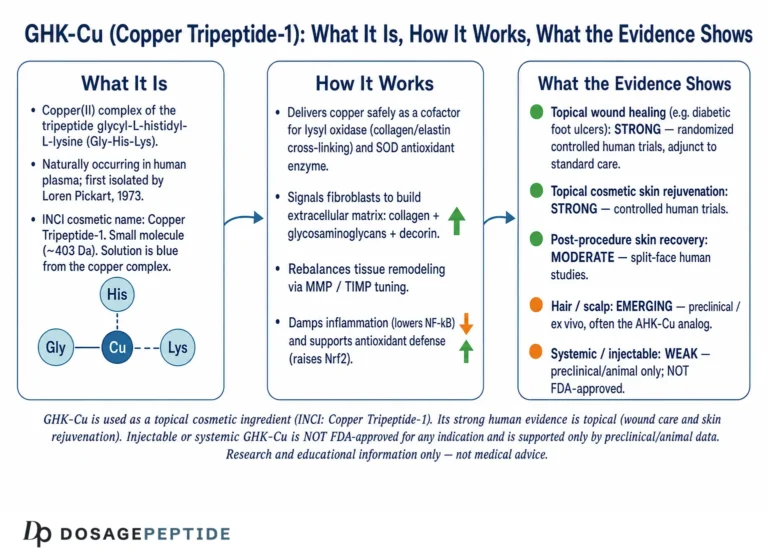
GHK is a naturally occurring human tripeptide composed of three amino acids in sequence: glycine, L-histidine, and L-lysine (hence GHK). It was first described in 1973 by biochemist Loren Pickart, who was studying why blood plasma from young donors could make liver tissue from older donors behave more like young tissue in culture. Working to isolate the responsible factor from human serum albumin, he identified a small peptide that increased the survival of normal liver cells and stimulated growth in hepatoma cells — the activity that would come to be attributed to GHK.2 Because the peptide’s sequence resembled the copper-binding sites of albumin, Pickart proposed early on that it might act by chelating and shuttling a metal — specifically copper(II).3
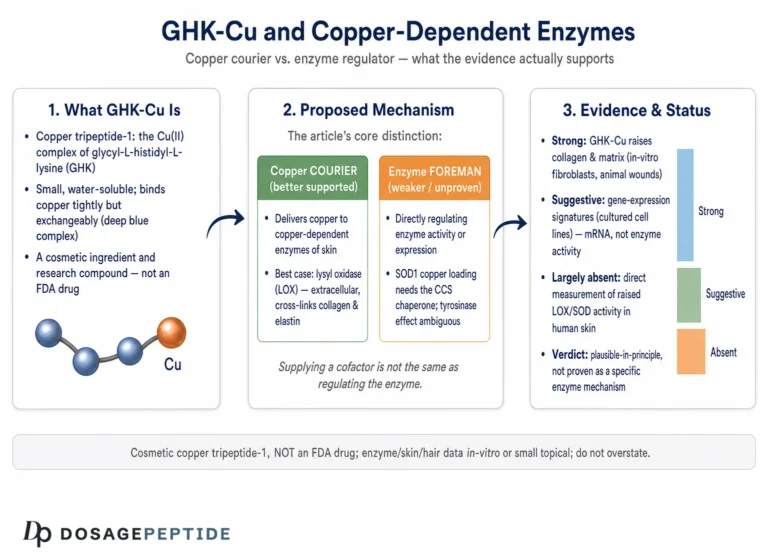
That prediction defined the molecule’s identity. GHK binds copper(II) with high affinity, and the resulting complex — GHK-Cu — is the form most of the biology is attributed to. In the complex, the copper ion is coordinated by the imidazole nitrogen of histidine, the alpha-amino nitrogen of glycine, and the deprotonated amide nitrogen linking glycine and histidine, with contributions that allow copper to be held in a form that can be delivered into tissue without the toxicity of free copper ions.3 This “copper carrier” concept is central: many of GHK’s downstream effects are thought to depend on getting copper — a required cofactor for enzymes such as lysyl oxidase (collagen and elastin cross-linking) and superoxide dismutase (antioxidant defense) — to where it is needed.
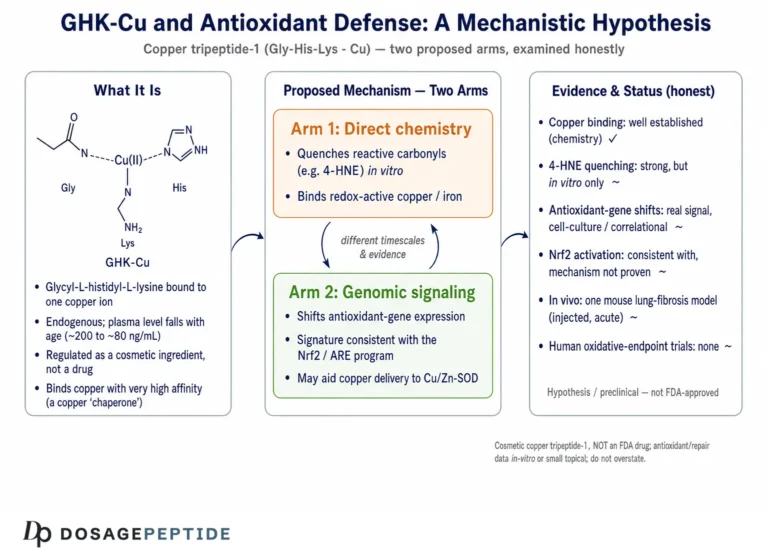
A frequently cited feature of GHK is that its concentration in human plasma declines with age. Reviews report levels of roughly 200 ng/mL around age 20, falling to about 80 ng/mL by age 60.3 This age-related decline is often invoked to motivate the idea that supplementing GHK might restore a more youthful repair capacity. It is an appealing narrative, but it is worth flagging as correlation, not proof: a decline in a circulating peptide alongside declining regenerative capacity does not establish that the peptide is a limiting factor, nor that adding it back fixes anything. It is a hypothesis-generating observation.
It is also useful to place GHK within the broader family of copper-binding biomolecules, because that context explains why the “copper carrier” idea is taken seriously rather than dismissed as marketing. Copper is a tightly regulated trace metal in the body precisely because it is a double-edged tool: essential as a catalytic cofactor, yet dangerous when free, because uncoordinated copper participates in Fenton-type chemistry that generates hydroxyl radicals and damages lipids, proteins, and DNA. Living systems solve this by never leaving copper unchaperoned — it is passed hand-to-hand among dedicated transport proteins and chelators. GHK’s proposed role fits that logic: a small peptide that holds copper in a redox-buffered geometry and can hand it off to tissue is doing, in miniature, what larger copper-transport proteins do. Whether the amount of copper GHK delivers is physiologically meaningful in a wound, as opposed to marginal against the body’s existing copper pools, is a separate quantitative question that the wound literature has not cleanly answered.
Structurally, GHK-Cu is small (the peptide’s molecular weight is about 340 daltons), water-soluble, and characteristically blue in solution because of the copper. Over five decades it has been studied across skin, nerve, bone, lung, gut, and blood-vessel tissue, and it is best known commercially as an anti-aging skincare active where it appears in serums and creams as copper tripeptide-1.4 That cosmetic ubiquity is important context: much of the human “experience” with GHK-Cu is topical, low-concentration, and aimed at skin appearance rather than at treating a medical wound. For readers who want an orientation to the compound’s basic profile, DosagePeptide maintains a general explainer on what GHK-Cu is, its proposed mechanisms and risks. None of this history, however, converts GHK-Cu into a chronic-wound therapy; it establishes it as a well-characterized, biologically active molecule with a specific chemistry and a long observational record.
The Proposed Molecular Mechanism
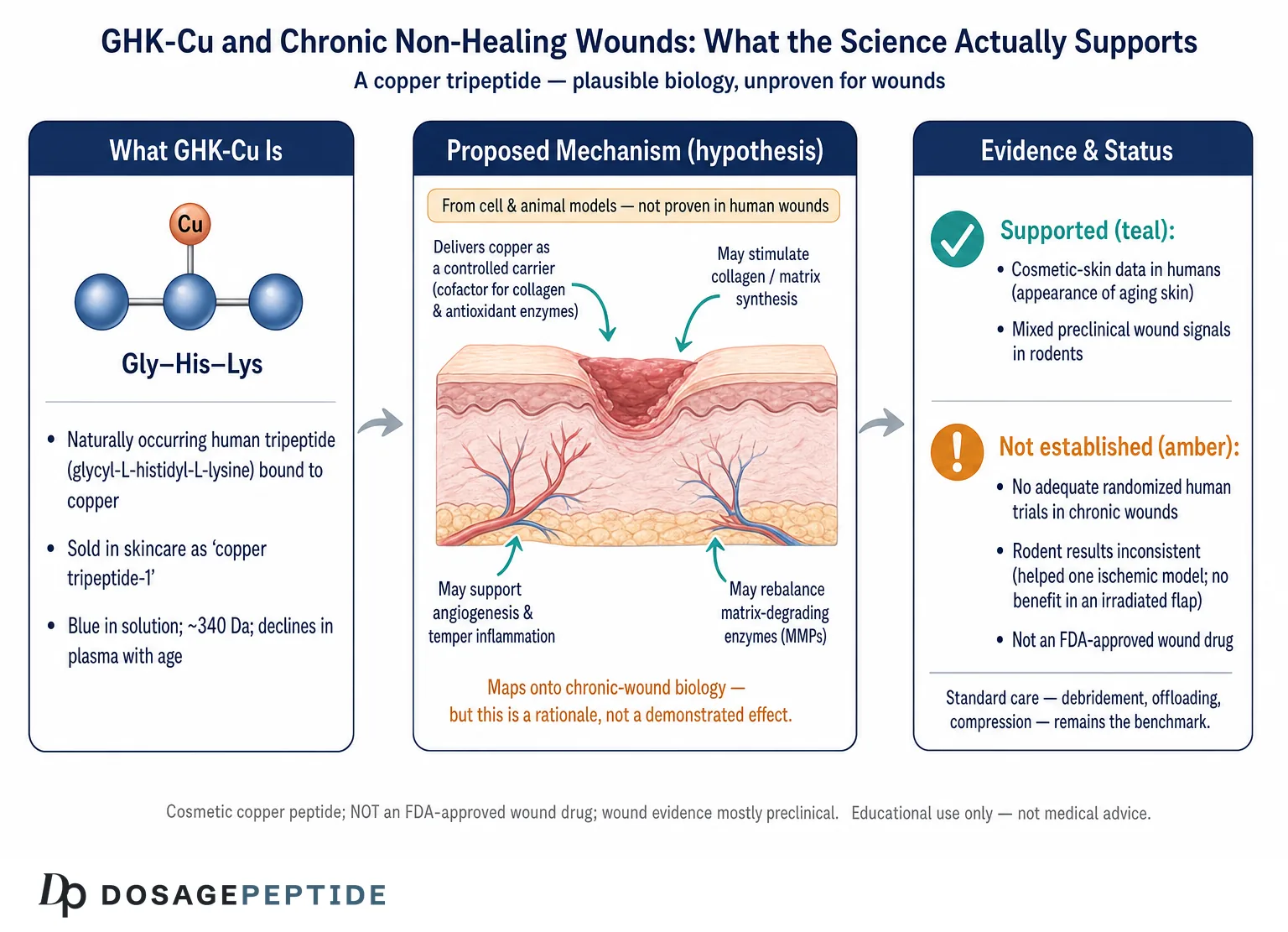
The reason GHK-Cu attracts attention in wound biology is that, in laboratory systems, it appears to touch several of the processes that go wrong in chronic wounds at once. It is useful to organize the proposed mechanism into a few themes, while remembering that most of this evidence comes from cell culture and animal tissue rather than from human ulcers.
Copper delivery and enzyme cofactor supply. The most concrete mechanistic claim is that GHK-Cu delivers copper into cells in a controlled way. Copper is an obligatory cofactor for lysyl oxidase, the enzyme that cross-links collagen and elastin into mature, load-bearing extracellular matrix, and for superoxide dismutase, a front-line antioxidant enzyme.3 Supplying copper as a peptide complex, rather than as a free ion, is proposed to support these enzymes while avoiding the pro-oxidant damage free copper can cause.
Extracellular-matrix synthesis and remodeling. In fibroblast cultures and animal skin, GHK and GHK-Cu have been reported to stimulate synthesis of collagen, elastin, glycosaminoglycans (including dermatan sulfate and chondroitin sulfate), and the small proteoglycan decorin, while modulating matrix metalloproteinases (MMPs) and their tissue inhibitors (TIMP-1 and TIMP-2).4 Because chronic wounds are characterized by excessive MMP activity that degrades matrix faster than it can be rebuilt, a molecule that both promotes matrix synthesis and rebalances protease activity is mechanistically interesting for that setting.
Angiogenesis and cell recruitment. GHK has been described as attracting immune and endothelial cells to injury sites and promoting new blood-vessel formation, in part associated with vascular endothelial growth factor (VEGF) signaling in some models.4 Adequate blood supply is a rate-limiting factor in ischemic, non-healing wounds, so pro-angiogenic activity is a plausible point of relevance — though, as the evidence section will show, this effect is not observed in every model.
Anti-inflammatory and antioxidant signaling. Chronic wounds are stuck in a prolonged inflammatory phase. GHK-Cu has been reported to modulate inflammatory signaling and to influence antioxidant gene expression, potentially reducing the oxidative and inflammatory load that keeps wounds from progressing to the proliferative phase.5,9
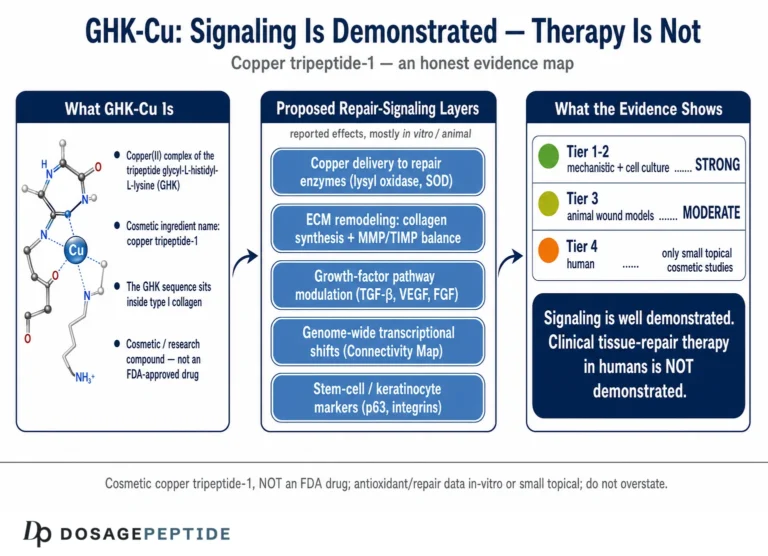
Broad gene-expression modulation. The most striking — and most easily over-read — mechanistic claim comes from gene-profiling work. Using the Broad Institute’s Connectivity Map, Pickart and colleagues reported that GHK could shift the expression of a very large number of human genes (frequently quoted as being able to up- or down-regulate on the order of thousands of genes), including genes in DNA-repair and TGF-beta pathways, moving expression patterns toward what the authors described as a healthier or younger profile.6 This is genuinely interesting, but it deserves a caution: a molecule that appears to nudge thousands of genes in a screening database is not necessarily a precise therapeutic; broad transcriptional effects can be a signal of pleiotropy, off-target activity, or assay artifact as easily as of designed benefit. The mechanistic picture, in short, is rich and internally consistent with wound biology, but it is a set of plausible hypotheses assembled largely from reductionist models — not a demonstrated chain of cause and effect in a human ulcer.
What the Wound-Healing Evidence Actually Shows
This is the section that matters most, and the honest summary is: the wound-specific evidence for GHK-Cu is predominantly preclinical, of modest scale, and inconsistent. There are encouraging animal results, there are null animal results, and there is no persuasive body of controlled human trials in chronic wounds. Both sides of that ledger deserve to be shown.
On the encouraging side, one of the more rigorous animal studies is Canapp and colleagues (2003), who tested a 2% GHK-Cu topical gel (a commercial formulation) on full-thickness ischemic wounds in 24 male Sprague-Dawley rats, comparing it against the gel vehicle and against untreated controls. The treated wounds showed meaningfully greater area reduction over the study period than vehicle or untreated wounds, and the authors concluded that topical tripeptide-copper complex accelerated healing in this ischemic open-wound model.7 An ischemic model is relevant here because poor perfusion is a defining feature of many chronic human wounds. Broader reviews collate additional preclinical reports of GHK improving diabetic and ischemic wounds in rodents, reducing TNF-alpha, and stimulating collagen synthesis across several species.3,4
On the cautionary side is Parker and colleagues (2013), who tested a topical GHK-Cu gel in an irradiated rat flap model — a model chosen to mimic the impaired healing seen in previously irradiated tissue, which is itself a form of chronic healing failure. In this study, GHK-Cu-treated flaps showed no improvement: there was no difference in flap ischemia, no difference in blood-vessel number or luminal area, and no difference in VEGF expression compared with controls.8 This is an important counterweight. It demonstrates that GHK-Cu’s pro-angiogenic and pro-healing effects, real as they appear in some systems, are context-dependent and do not translate to every impaired-healing model — a pattern that should temper any expectation of a universal wound benefit.
| Study | Model | Design | Outcome for GHK-Cu |
|---|---|---|---|
| Canapp et al., 20037 | Rat full-thickness ischemic open wounds (n = 24) | 2% topical GHK-Cu gel vs vehicle vs untreated | Greater wound-area reduction; accelerated healing reported |
| Parker et al., 20138 | Irradiated dorsal rat flap | Topical GHK-Cu gel vs control ointment | No difference in ischemia, vessel number/area, or VEGF |
| Pickart reviews3,4 | Multiple cell and animal systems | Narrative and mechanistic reviews | Collated preclinical signals; not controlled clinical evidence |
It is also instructive to look at what the positive rodent studies did and did not measure. The Canapp ischemic-wound study reported greater wound-area reduction, which is a meaningful surrogate, but wound-area reduction over a short window in a young, otherwise-healthy rat is a very different endpoint from durable, complete closure of a chronic ulcer in a patient with poorly controlled diabetes, arterial disease, or venous hypertension. A surrogate that moves in the right direction is a reason to keep investigating, not a demonstration of clinical benefit. Similarly, reductions in inflammatory markers such as TNF-alpha in rodent wounds are consistent with GHK-Cu’s proposed anti-inflammatory mechanism, but reduced cytokine levels are a mechanistic readout, not a patient outcome. The gap between “the molecule does biologically sensible things in a wound model” and “the molecule helps people heal” is the entire distance that clinical trials exist to cross, and for GHK-Cu in chronic wounds that distance has not been crossed.
A further honesty point concerns the age and provenance of the strongest wound-relevant studies. The most rigorous positive wound study frequently cited is now more than two decades old and was conducted in animals; the most rigorous negative one is over a decade old.7,8 Despite fifty years of GHK research and intense commercial interest, the field has not produced the obvious next step — a well-controlled human chronic-wound trial — which is itself informative. When a compound is inexpensive, off-patent in its base form, widely available, and mechanistically attractive, the absence of definitive human wound trials after decades suggests either that the effect is not robust enough to have driven such trials, or that commercial incentives point toward cosmetics rather than the expensive, highly regulated wound-drug pathway. Either way, the reader should not mistake longevity of interest for depth of proof.
What about human data? The strongest human evidence for GHK-Cu is in cosmetic dermatology, not wound care. Placebo-controlled facial-skin studies have reported improvements in skin density, thickness, elasticity, and appearance of photodamage with GHK-Cu creams.4 These are real, but they are trials of skin cosmetic endpoints in intact aging skin — not trials of ulcer closure in chronic-wound patients. Extrapolating from “improves the look of aging facial skin” to “heals a diabetic foot ulcer” is exactly the kind of leap this article is written to avoid. Readers should also be wary of specific-sounding claims that circulate online — for example precise percentages of “complete healing” in named diabetic-ulcer trials — that do not trace back to identifiable, peer-reviewed primary studies. Where a striking number cannot be located in the primary literature, the responsible assumption is that it is unverified. The bottom line: the evidence base supports GHK-Cu as a biologically active molecule with genuine but inconsistent preclinical wound signals and good cosmetic-skin data, and it does not support any claim that GHK-Cu is an effective treatment for chronic non-healing wounds in humans.
How GHK-Cu Compares With Other Approaches
Placing GHK-Cu next to the actual standard of care for chronic wounds is clarifying, because it shows how far a preclinical candidate sits from established therapy. The foundation of chronic-wound management is not any single molecule; it is a systematic program: sharp debridement of nonviable tissue, infection control, moisture-balanced dressings, offloading pressure (for diabetic foot ulcers), and compression (for venous leg ulcers), all layered on top of treating the underlying cause — glycemic control, revascularization, edema management. These interventions are supported by decades of controlled evidence and remain the benchmark any new agent must beat.
Within advanced therapies, several products carry regulatory clearance that GHK-Cu does not. Recombinant human platelet-derived growth factor (becaplermin) is an approved topical for diabetic foot ulcers. Bioengineered skin substitutes and cellular/tissue-based products, and dehydrated human amnion/chorion membrane allografts, have randomized data in diabetic and venous ulcers. Negative-pressure wound therapy and, in selected cases, hyperbaric oxygen have evidence in specific indications. The point of listing these is not to review them but to mark the contrast: they have cleared regulatory bars for wound indications through controlled trials, whereas GHK-Cu has not been approved for — and has not been adequately tested in — chronic wounds.
It is also worth comparing GHK-Cu to other peptides discussed in the same online spaces. GHK-Cu is frequently mentioned alongside compounds such as BPC-157 and thymosin beta-4 in “tissue repair” conversations. All of these share the same fundamental status for wound care: interesting preclinical profiles, enthusiastic marketing, and an absence of the large controlled human wound trials that would justify clinical use. Grouping GHK-Cu with approved wound therapies would be a category error; grouping it with other early-stage, research-only peptides is accurate.
| Approach | Evidence maturity for chronic wounds | Regulatory status (wound indication) |
|---|---|---|
| Debridement, offloading, compression, moisture balance | Extensive controlled evidence; standard of care | Established practice standards |
| Becaplermin (PDGF), skin substitutes, amnion/chorion allografts | Randomized human trials in specific ulcer types | Approved / cleared for defined indications |
| Negative-pressure and hyperbaric oxygen therapy | Controlled evidence in selected indications | Cleared devices/therapies for defined uses |
| GHK-Cu (copper tripeptide) | Preclinical + cosmetic-skin data; no adequate chronic-wound trials | Cosmetic ingredient; not approved as a wound drug1 |
| Other repair peptides (e.g., BPC-157, TB-500) | Preclinical; research-only | Not approved for wound care |
A fair comparison, then, positions GHK-Cu as a candidate molecule of scientific interest rather than a competitor to established therapy. If a patient with a chronic wound is choosing between “GHK-Cu” and “evidence-based wound care,” that framing is itself the error — the two are not on the same evidentiary footing, and the standard-care program is the one with the track record. GHK-Cu’s most honest current role is as a subject of research that might, or might not, earn a place in that program after proper testing.
Research Models and Methodology
Understanding how GHK-Cu is studied explains why its evidence is at the level it is, and helps a reader judge new claims critically. The wound-healing literature on GHK-Cu spans a hierarchy of models, each with characteristic strengths and blind spots.
In vitro cell systems. The foundational work uses cultured cells — dermal fibroblasts, keratinocytes, endothelial cells — to measure endpoints like collagen production, proliferation, migration in scratch assays, and expression of matrix and antioxidant genes. These systems are precise and mechanistically informative, and they are where the gene-expression profiling (for example, Connectivity Map analyses) is performed.6 Their limitation is obvious: a monolayer of cells in a dish lacks blood supply, immune complexity, bacterial burden, and the systemic disease (diabetes, venous hypertension) that defines a real chronic wound. Positive in vitro results establish plausibility, not efficacy.
Animal wound models. The next tier uses rodents and larger animals. Researchers create standardized wounds — excisional, incisional, ischemic flaps, or pedicle models — and apply GHK-Cu topically or by injection, then measure wound-area closure, histology, vessel density (often by immunostaining for markers such as caveolin-1 or CD31), and cytokine levels. The Canapp ischemic-wound study and the Parker irradiated-flap study are both of this type, and their divergent results illustrate how much the chosen model matters.7,8 Two methodological cautions apply broadly to this literature: healthy young rodents heal far better than diseased humans, so even a genuine effect can look larger in animals than it would clinically; and models that specifically impair healing (irradiation, induced diabetes, ischemia) are more relevant to chronic wounds but are also where GHK-Cu’s effects have been less consistent.
Human studies. The human GHK-Cu literature is dominated by cosmetic-dermatology trials with endpoints like skin firmness, wrinkle appearance, and dermal thickness, typically using topical creams over several weeks in intact skin.4 These are legitimate clinical studies, but their endpoints and their population (aging but healthy skin) do not answer the chronic-wound question. The specific study that this article’s title points toward — an adequately powered, randomized, controlled trial of GHK-Cu versus standard care for closure of chronic ulcers — is, to a close reading of the primary literature, not established. That absence is the single most important methodological fact in the whole topic.
A recurring methodological weakness across the GHK-Cu wound literature deserves special mention: heterogeneity of the test material itself. Studies have used different forms — the copper complex versus the free peptide — at different concentrations, in different vehicles (gels, ointments, collagen dressings), applied at different frequencies, in different wound models. This variability makes it hard to pool results or to identify a consistent dose-response relationship, which is one of the classic prerequisites for believing an effect is real. When a compound helps in one formulation and model but not another, it can mean the effect is genuinely context-dependent, or that formulation and delivery, rather than the peptide, are driving the differences. Without standardized preparations and head-to-head comparisons, the literature remains a collection of individual observations rather than a coherent, replicated body of evidence. Robust therapeutics usually announce themselves through convergent results across independent laboratories using varied methods; GHK-Cu’s wound data do not yet show that convergence, and the honest interpretation is that the signal, where present, is neither large nor consistent enough to have forced the field toward definitive human testing.
For a reader evaluating any GHK-Cu wound claim, a short checklist helps: What model was used — dish, healthy animal, impaired-healing animal, or human? Was there a proper control and randomization? Was the endpoint a hard outcome (complete wound closure) or a surrogate (a gene expression change, a percentage area reduction at an interim timepoint)? And can the specific numbers be traced to a named, peer-reviewed publication? Applying that checklist quickly separates the grounded claims from the marketing.
Safety and Tolerability Signals
Safety discussion for GHK-Cu has to be split by route and context, because the reassuring data come almost entirely from one corner — topical cosmetic use — and cannot be assumed to extend to others.
Topical use. As a cosmetic ingredient (copper tripeptide-1) applied to intact skin at low concentrations, GHK-Cu has a long record of general tolerability, and reviews note that no significant safety problems arose during its use as a skin cosmetic or in the skin studies conducted to date.4 The most commonly discussed topical issues are local: irritation, redness, or contact sensitization in susceptible individuals, and the practical caution that copper peptides and certain other actives (for instance, high-strength direct acids or high-dose vitamin C) are sometimes advised not to be layered simultaneously for formulation-stability reasons rather than safety per se. Copper itself is a reminder that “natural” is not “harmless” — free copper is pro-oxidant and, in excess, toxic; the peptide-complexed form is precisely what is meant to avoid that, but it underscores why dose and formulation matter.
Broken-skin and wound application. Applying anything to an open chronic wound is a different risk situation than applying it to intact skin. The barrier is gone, absorption is higher and less predictable, and the wound may be colonized or infected. The favorable cosmetic safety record does not automatically transfer to open wounds, and rigorous safety data specifically in chronic human wounds are lacking. This is a genuine evidence gap, not a reassurance.
Injectable and systemic use. A substantial share of the online conversation involves reconstituted GHK-Cu intended for injection, often in the context of research-chemical purchases. This is the least-supported and most caution-worthy route. There is no established human safety profile for injected GHK-Cu for wound indications, product purity and sterility from research-chemical suppliers are unverified, and regulators have flagged concerns in the compounding space. Because copper delivery is central to the molecule’s action, questions about copper handling, cumulative exposure, and interactions in people with systemic disease are legitimate and largely unanswered for parenteral use. The prudent reading is that GHK-Cu’s safety is reasonably characterized only for topical cosmetic use on intact skin, and is essentially uncharacterized for the wound and systemic uses that would be relevant to treating chronic ulcers. Anyone with an actual non-healing wound should be under the care of a clinician using evidence-based wound management, not self-treating with a research compound.
Handling and Reconstitution in a Research Context
Because GHK-Cu is widely sold as a lyophilized (freeze-dried) powder for laboratory research, questions about reconstitution and storage come up constantly. The following is general laboratory-handling information for research settings only; it is not medical guidance, not a protocol for human use, and not an endorsement of self-administration for any wound.
In a research context, lyophilized peptides such as GHK-Cu are typically reconstituted with sterile or bacteriostatic water added slowly down the side of the vial rather than directly onto the powder, then allowed to dissolve without vigorous shaking, since agitation can shear peptide bonds. GHK-Cu solutions are characteristically blue owing to the coordinated copper, which is a useful visual cue that the complex is intact. After reconstitution, peptide solutions are generally kept refrigerated at approximately 2–8 °C, protected from light, and lyophilized powder is stored frozen for longer-term stability. These are standard peptide-handling practices; GHK-Cu is not exotic in this respect. DosagePeptide publishes reference material on the compound’s laboratory profile, including vial-size specific pages for GHK-Cu 100 mg and GHK-Cu 50 mg preparations, plus a general peptide dosage reference index for reconstitution mathematics.
Two research-context cautions are worth stating plainly. First, concentration figures and “protocols” quoted for GHK-Cu — whether topical percentages or reconstituted injectable amounts — are drawn from laboratory and preclinical settings and from anecdote, and they should not be read as validated human dosing for wounds, because no such validated dosing exists. GHK-Cu is also sometimes encountered as a component of multi-peptide research blends; DosagePeptide describes one such combination on its KLOW blend reference page and a companion KLOW handling guide, again strictly as research-education reference material. Second, product identity and purity from the research-chemical market are not guaranteed; sterility, actual peptide content, endotoxin levels, and copper stoichiometry can vary, which is one more reason handling information should never be mistaken for a green light to use these materials on a person or a wound. The appropriate frame for this entire section is that GHK-Cu is a laboratory reagent whose careful handling is a matter of preserving the molecule for study — not a bridge to clinical application.
Chronic Non-Healing Wounds: Why They Are Hard and Where GHK-Cu Might Fit
To evaluate GHK-Cu’s plausibility for chronic wounds fairly, it helps to understand why these wounds stall in the first place. Normal healing proceeds through overlapping phases: hemostasis, inflammation, proliferation (with angiogenesis, fibroblast activity, and matrix deposition), and remodeling. A chronic wound is one where this sequence derails — typically getting stuck in a self-perpetuating inflammatory state. The molecular signature of that stalled state includes elevated pro-inflammatory cytokines, excessive matrix metalloproteinase activity that degrades new matrix and growth factors faster than they can accumulate, high oxidative stress, senescent and poorly responsive fibroblasts, impaired angiogenesis, and often persistent bacterial biofilm. Underlying diseases — diabetes with its neuropathy and microvascular damage, venous hypertension, sustained pressure, arterial insufficiency — keep re-injuring the tissue or starving it of the perfusion it needs.
Set against that pathophysiology, one can see exactly why GHK-Cu keeps coming up: on paper, its reported activities map onto several of the failure points. If GHK-Cu genuinely tempers excess inflammation, rebalances MMP-versus-TIMP activity, supports antioxidant enzymes through controlled copper delivery, stimulates matrix synthesis, and promotes angiogenesis, then it is touching the very levers that are broken in a chronic wound.3,4,5 That mechanistic congruence is the honest core of the “could it help?” question — it is a reasonable hypothesis, not wishful thinking.
But mechanistic congruence is where enthusiasm has to meet discipline. The history of chronic-wound therapeutics is littered with agents that looked perfect on the mechanism whiteboard — growth factors, cytokines, matrix modulators — and then underperformed or failed outright in rigorous human trials, because a chronic wound is a systems problem embedded in a diseased patient, not a single missing molecule. GHK-Cu’s own preclinical record already shows this fragility: it accelerated healing in one ischemic rodent model yet produced no benefit whatsoever in an irradiated-flap model of impaired healing.7,8 A molecule that is context-dependent in rats is unlikely to be a universal fix in humans.
There is also a specificity problem that any serious chronic-wound program has to confront: chronic wounds are not one disease. A neuropathic diabetic foot ulcer, a venous leg ulcer driven by ambulatory venous hypertension, an arterial ulcer from inadequate inflow, and a pressure injury over a bony prominence share the label “non-healing” but differ profoundly in their dominant pathology. A pro-angiogenic, matrix-supporting molecule might, in principle, matter most where perfusion and matrix turnover are the bottleneck, and matter not at all where the limiting problem is unrelieved pressure or an uncorrected arterial blockage that no topical agent can fix. The divergent rodent results already hint at this conditionality — benefit in a straightforward ischemic wound, none in a radiation-damaged flap.7,8 Any honest research program would therefore need to specify which wound type, in which patients, at what stage, before “does GHK-Cu help chronic wounds?” even becomes a well-posed question. Treating chronic wounds as a monolith is one of the ways enthusiasm outruns evidence.
The fair conclusion for this central question is therefore conditional and modest. GHK-Cu is a scientifically reasonable candidate to investigate for chronic wounds because its proposed biology aligns with chronic-wound pathophysiology. It is not a demonstrated treatment, because the decisive evidence — adequately powered, randomized, controlled human trials measuring real wound closure against standard care — has not been produced. “Could GHK-Cu improve outcomes in chronic non-healing wounds?” is best answered: it is biologically plausible and worth studying, and it remains unproven, and it should not be used as a wound therapy outside of legitimate research until that changes.
Limitations and the Human-Evidence Gap
It is worth consolidating the limitations, because they are the load-bearing part of an honest assessment and are easy to lose amid mechanistic enthusiasm.
The evidence is mostly preclinical. The strongest wound-specific data are cell-culture and animal studies. Animal healing does not reliably predict human chronic-wound outcomes, and the models most relevant to chronic wounds (impaired-healing models) are where GHK-Cu has been least consistent.7,8
The human data are off-target. The best human evidence is cosmetic — improvements in the appearance and biophysical properties of aging but intact facial skin.4 These studies do not measure ulcer healing and cannot be substituted for it. Effects on wrinkle appearance say nothing definitive about closing a diabetic foot ulcer.
Trial quality and scale are absent for the wound question. There is no persuasive body of large, randomized, controlled trials testing GHK-Cu against standard wound care for hard endpoints in chronic-wound patients. Without that, any efficacy claim for wounds is, at best, extrapolation and, at worst, marketing.
Unverifiable claims circulate widely. A recurring problem in this topic is confidently stated statistics — specific percentages of complete healing, precise reductions in inflammatory markers in named “phase II trials” — that cannot be traced to identifiable peer-reviewed primary sources. Some of the numbers that surface in web summaries appear to be fabricated or garbled. A claim that cannot be located in the primary literature should be treated as unverified, and this article has deliberately declined to repeat such figures.
Safety outside topical cosmetic use is uncharacterized. The reassuring safety record applies to low-concentration topical use on intact skin, not to application on open wounds and not to injection.4 Product purity from the research-chemical market is unverified. These gaps are safety-relevant, not merely academic.
Publication and source bias. Much of the accessible GHK-Cu literature and review writing is closely associated with a small number of long-standing proponents and with commercial interests (cosmetics and research-chemical vendors). That does not invalidate the underlying science, but it argues for weighting independent, adversarial replication heavily — and independent replication in the chronic-wound setting is exactly what is missing. Taken together, these limitations do not say “GHK-Cu does nothing.” They say the responsible position is uncertainty: a biologically active molecule with a plausible rationale and a genuine but immature and inconsistent evidence base, whose value for chronic wounds is unknown pending proper human testing.
Regulatory Status
The regulatory picture reinforces everything above and is important for readers to understand precisely, because the label under which GHK-Cu is legally sold is often mistaken for evidence of medical approval.
In the United States, GHK-Cu is marketed principally as a cosmetic ingredient, appearing on product labels under its International Nomenclature of Cosmetic Ingredients (INCI) name, copper tripeptide-1. Cosmetics are regulated differently from drugs: the U.S. Food and Drug Administration does not pre-approve cosmetic products or their ingredients before they reach the market, and a cosmetic may only make claims about appearance and cleansing — not claims to treat, cure, or prevent disease.1 The moment a product is marketed as healing wounds or treating a medical condition, it is, by definition, being marketed as a drug and would require the corresponding approvals — which GHK-Cu does not have for any wound indication. In other words, the existence of GHK-Cu in thousands of legally sold skincare products is a statement about cosmetic regulation, not evidence that it works as a medicine.
GHK-Cu is not an FDA-approved drug for chronic wounds, diabetic foot ulcers, venous ulcers, pressure injuries, or any other medical wound indication. It has not gone through the drug-approval pathway for those uses. Separately, GHK-Cu sold as a lyophilized powder for injection is typically offered under “research use only” or “not for human consumption” labeling, which places it outside the framework that governs approved medicines and outside any assurance of pharmaceutical-grade purity, sterility, or manufacturing quality. Regulators have also raised concerns about certain peptide ingredients in the compounding space, adding another layer of caution to non-topical use.
Internationally, the general pattern is similar: copper tripeptide is broadly permitted as a cosmetic ingredient in major markets, while remaining unapproved as a wound-healing drug. Cosmetic ingredient review bodies have assessed copper peptides for cosmetic safety at typical use levels, but a cosmetic-safety assessment is not a determination of medical efficacy, and it does not authorize wound-treatment claims. The regulatory bottom line is therefore clean and worth stating without hedging: GHK-Cu is a cosmetic ingredient and a research chemical, not an approved wound therapy. Any presentation of it as an established treatment for non-healing wounds misrepresents both the science and its legal status. For a patient or clinician, the practical implication is simple: the regulatory record offers no shortcut around the missing efficacy data, and the correct place for GHK-Cu in chronic-wound care today is inside a properly designed study, not inside a treatment plan.
Frequently Asked Questions
Is GHK-Cu an approved treatment for chronic non-healing wounds?
No. GHK-Cu is not approved by the FDA or, to the best available knowledge, by other major regulators as a drug for chronic wounds, diabetic foot ulcers, venous ulcers, or any medical wound indication. It is regulated primarily as a cosmetic ingredient (copper tripeptide-1) and is also sold as a research chemical.1 Its relevance to chronic wounds is a research question, not an established therapy.
What does the wound-healing evidence for GHK-Cu actually show?
The wound-specific evidence is mostly preclinical and mixed. In one rat ischemic-wound study, a 2% topical GHK-Cu gel accelerated healing;7 in an irradiated rat flap model, GHK-Cu showed no benefit on ischemia, blood-vessel measures, or VEGF.8 The best human data are for cosmetic skin endpoints, not ulcer closure.4 There is no adequate body of randomized human trials in chronic wounds.
How is GHK-Cu thought to work?
Proposed mechanisms include controlled delivery of copper (a cofactor for collagen-cross-linking and antioxidant enzymes), stimulation of extracellular-matrix synthesis, rebalancing of matrix-degrading enzymes, promotion of angiogenesis, modulation of inflammation, and broad shifts in gene expression seen in profiling studies.3,4,6 These are plausible and map onto chronic-wound biology, but they are derived largely from cell and animal models, not from proven activity in human wounds.
Is GHK-Cu the same as the copper peptides in my skincare?
Yes — the copper peptide in many serums and creams, listed as copper tripeptide-1, is GHK-Cu. That cosmetic use is where its human tolerability record and its clinical skin data come from.4 Cosmetic skin benefits, however, are a different question from healing a chronic medical wound, and one should not be used to infer the other.
Is injecting GHK-Cu safe?
Injectable GHK-Cu has no established human safety profile for wound or systemic use, is typically sold as a research chemical with unverified purity and sterility, and falls outside approved-medicine frameworks. The reassuring safety record applies to low-concentration topical use on intact skin, not to injection or to application on open wounds.4 Anyone with a non-healing wound should work with a clinician using evidence-based care rather than self-administer a research compound.
Can GHK-Cu replace standard wound care?
No. Standard chronic-wound care — debridement, infection control, offloading or compression, moisture balance, and treatment of the underlying disease — is supported by extensive controlled evidence and remains the benchmark. Several advanced therapies (for example, becaplermin and tissue-based products) also have randomized human data. GHK-Cu has neither approval nor adequate trials for wounds and should not be positioned as a substitute for evidence-based care.
Where can I read more about GHK-Cu as a research compound?
DosagePeptide maintains research-education reference material, including a general GHK-Cu overview and laboratory-handling references. These resources are educational and describe the compound in a research context; they are not medical advice and do not recommend using GHK-Cu to treat any wound or condition.
References
- U.S. Food and Drug Administration. “FDA Authority Over Cosmetics: How Cosmetics Are Not FDA-Approved, but Are FDA-Regulated.” fda.gov (accessed 2026).
- Pickart L, Thayer L, Thaler MM. A synthetic tripeptide which increases survival of normal liver cells, and stimulates growth in hepatoma cells. Biochemical and Biophysical Research Communications. 1973;54(2):562–566. PMID 4356974. sciencedirect.com.
- Pickart L, Margolina A. Regenerative and Protective Actions of the GHK-Cu Peptide in the Light of the New Gene Data. International Journal of Molecular Sciences. 2018;19(7):1987. doi:10.3390/ijms19071987. PMID 29986520. pubmed.ncbi.nlm.nih.gov/29986520.
- Pickart L, Vasquez-Soltero JM, Margolina A. GHK Peptide as a Natural Modulator of Multiple Cellular Pathways in Skin Regeneration. BioMed Research International. 2015;2015:648108. PMC4508379.
- Pickart L, Vasquez-Soltero JM, Margolina A. GHK-Cu may Prevent Oxidative Stress in Skin by Regulating Copper and Modifying Expression of Numerous Antioxidant Genes. Cosmetics. 2015;2(2):236–247. researchgate.net.
- Pickart L, Vasquez-Soltero JM, Margolina A. The Effect of the Human Peptide GHK on Gene Expression Relevant to Nervous System Function and Cognitive Decline. Brain Sciences. 2017;7(2):20. doi:10.3390/brainsci7020020. PMID 28212278. PMC5332963.
- Canapp SO Jr, Farese JP, Schultz GS, et al. The effect of topical tripeptide-copper complex on healing of ischemic open wounds. Veterinary Surgery. 2003;32(6):515–523. doi:10.1111/j.1532-950X.2003.00515.x. PMID 14648529. onlinelibrary.wiley.com.
- Parker NP, Ardeshirpour F, Schmechel SC, Lassig AAD. Effects of Topical Copper Tripeptide Complex on Wound Healing in an Irradiated Rat Model. Otolaryngology–Head and Neck Surgery. 2013;149(3):384–389. PMID 23744835. pubmed.ncbi.nlm.nih.gov/23744835.
- Pickart L, Margolina A. The Human Tripeptide GHK-Cu in Prevention of Oxidative Stress and Degenerative Conditions of Aging: Implications for Cognitive Health. Oxidative Medicine and Cellular Longevity. 2012;2012:324832. onlinelibrary.wiley.com.
Educational and research-use disclaimer: This article is provided for scientific and educational purposes only. It is not medical advice and does not recommend, endorse, or provide instructions for using GHK-Cu to prevent, treat, cure, or manage any wound or medical condition. GHK-Cu is not an FDA-approved drug for wound healing; it is regulated as a cosmetic ingredient and sold elsewhere as a research chemical. The wound-healing evidence discussed here is predominantly preclinical, inconsistent, and not a basis for clinical use. Anyone with a chronic or non-healing wound should seek care from a qualified healthcare professional using evidence-based wound management. Nothing here should be interpreted as encouragement to self-administer GHK-Cu by any route.