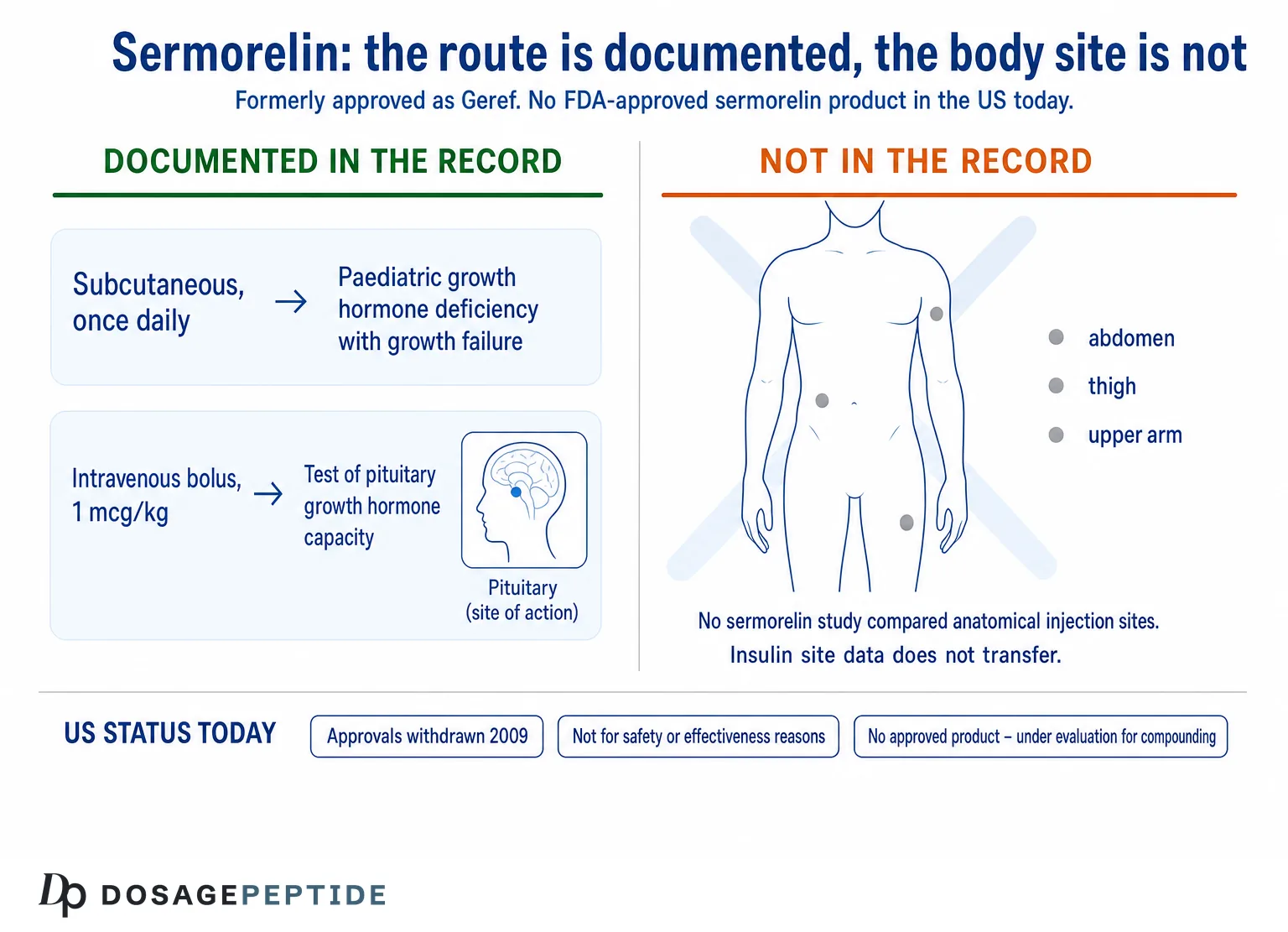
The short answer: sermorelin was given subcutaneously — once daily, at bedtime — when it was an approved US drug, and the subcutaneous sites used for it are the ordinary ones: the abdomen away from the navel, the outer upper thigh and the back of the upper arm, rotated between doses. That much is settled. What is not settled is whether any of those sites is better than the others: no published sermorelin study compared anatomical sites, and the trials that established the drug simply wrote “s.c.” and moved on.
So the site advice you find online is convention borrowed from insulin practice, not evidence generated with this molecule. The route, by contrast, is real and documented: subcutaneous injection for idiopathic growth hormone deficiency in children with growth failure, and a single intravenous bolus of 1 mcg/kg to evaluate the pituitary’s capacity to produce growth hormone.[1][8] This page reviews what the approved-labelling era and the published literature actually recorded, and separates it from what has been added since. For the numbers that accompanied those routes, see our sermorelin 5 mg vial dosage reference.
Which routes does the sermorelin record actually document?
| Route | Where it was documented | Population studied | Evidence tier |
|---|---|---|---|
| Subcutaneous, once daily at bedtime (30 mcg/kg) | Geref International Study Group multicentre open-label trial[7] | 110 previously untreated prepubertal GH-deficient children | Trial supporting a formerly FDA-approved product (Geref, approval since withdrawn) |
| Intravenous bolus, 1 mcg/kg | GH-stimulation testing literature and the FDA-funded review of nominated substances[8][6] | Children and adults undergoing diagnostic testing | Diagnostic route of a formerly FDA-approved product |
| Intravenous, combined with intravenous arginine | GHRH + arginine test validation studies[12] | 54 hypopituitary adults, 326 healthy adults | Published diagnostic protocol; the report names the agent “GHRH”, not the Geref product. Test agent, not a therapy |
| Subcutaneous, twice daily (15 mcg/kg per dose) | Multicentre study in radiation-induced GH deficiency[9] | 9 prepubertal children | Small open-label trial |
| Subcutaneous, once daily (30 mcg/kg), 12–24 months | Venezuelan Collaborative Study Group[10] | 16 prepubertal GH-deficient children | Small open-label trial; anti-GHRH antibodies detected |
| Subcutaneous, twice daily (0.5 mg or 1 mg), 14 days | National Institute on Aging study in older men[11] | 10 healthy men, mean age 68 | Small physiology study; never an approved indication |
| Intramuscular | No sermorelin study located | — | No evidence |
| Oral, sublingual, transdermal | No approved sermorelin product used these routes | — | No evidence for the injectable peptide |
| A specific body site (abdomen / thigh / arm) | Never compared in any published sermorelin study | — | No evidence — convention only |
What did the approved sermorelin label actually cover?
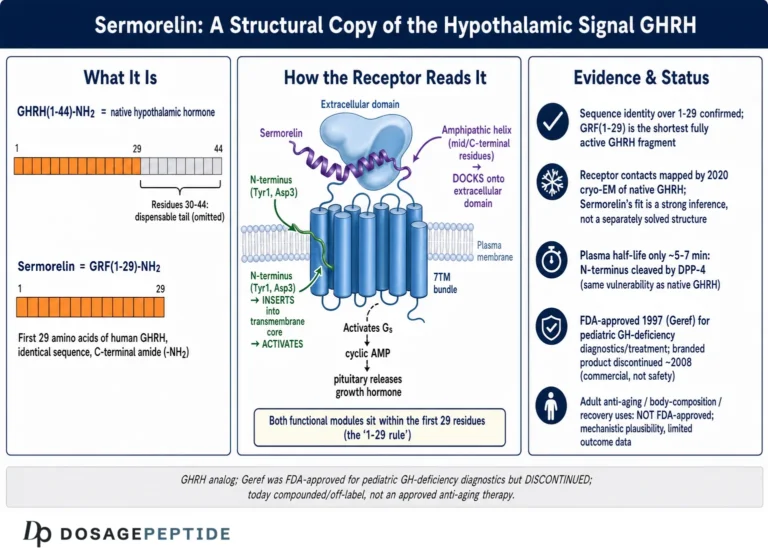
Sermorelin acetate reached the US market as Geref, sponsored by Serono and later EMD Serono, under two separate applications. NDA 19-863, covering a 0.05 mg base per ampoule presentation, was approved on 28 December 1990. NDA 20-443, covering 0.5 mg and 1.0 mg base per vial, was approved on 26 September 1997.[1] The Drugs@FDA record for NDA 20-443 shows both its strengths as Discontinued, annotated with the Federal Register determination.[2]
The two applications carried two different indications, which is why sermorelin has two documented routes rather than one. FDA’s own Federal Register notice records that the 0.5 mg and 1.0 mg vials were indicated for treating idiopathic growth hormone deficiency in children with growth failure, and the 0.05 mg ampoule for evaluating the pituitary gland’s capacity to produce growth hormone.[1] Treatment strengths, diagnostic strength — and neither indication was ever an adult one.
The pivotal treatment evidence is the Geref International Study Group trial published in 1996. One hundred and ten previously untreated prepubertal GH-deficient children received 30 mcg/kg of GHRH-(1-29) per day, subcutaneously, at bedtime, for up to one year; 86 were evaluable for efficacy. Mean height velocity rose from 4.1 ± 0.9 cm/yr at baseline to 8.0 ± 1.5 cm/yr at six months and 7.2 ± 1.3 cm/yr at twelve months, with 74% classed as good responders at six months and no disproportionate skeletal maturation — the ratio of the change in bone age to height age was not significantly different from unity at twelve months (1.04 ± 0.58; P = 0.63).[7] A 1999 review of the whole sermorelin dataset called the treatment evidence “limited data” supporting once-daily subcutaneous 30 mcg/kg at bedtime in some prepubertal children with idiopathic GH deficiency — a deliberately narrow claim, worth remembering when sermorelin is marketed today for adults.[8]
What the label era did not establish is anything about where on the body those injections went. The trial reports state route and timing. They do not state the site, they do not report a rotation schedule, and no sermorelin study we could find randomised patients to one anatomical region versus another.
Was sermorelin withdrawn because it was unsafe?
No, and this is the single most important regulatory fact on this page because it is so often reported wrongly. EMD Serono notified FDA that it was discontinuing the 0.05 mg presentation in July 2008 and the 0.5/1.0 mg presentations in December 2008, and FDA withdrew approval of both applications effective 18 June 2009 at the company’s own request. Following a citizen petition (Docket No. FDA-2012-P-1071), FDA published a determination in the Federal Register on 4 March 2013 that the Geref products were not withdrawn from sale for reasons of safety or effectiveness. FDA did not simply take the petitioner’s word for it: the notice records that the agency reviewed its own files on the withdrawal and independently evaluated relevant literature and data for possible postmarketing adverse events before reaching that determination.[1]
The corroborating check is 21 CFR 216.24, FDA’s codified list of drug products withdrawn or removed from the market because they were found unsafe or ineffective. Sermorelin does not appear on it.[3] An FDA-funded review prepared by the University of Maryland Center of Excellence in Regulatory Science and Innovation reached the same conclusion, and recorded one interviewed subject-matter expert’s speculation that Serono did not want a growth hormone releaser competing with its own growth hormone product — an opinion volunteered in an interview, not a finding. Only four experts discussed sermorelin in that review, and no survey respondents did.[6]
“Not withdrawn for safety reasons” is a much weaker statement than “proven safe for the uses people now buy it for.” It means the approved paediatric indication was never invalidated. It says nothing about adult anti-aging use, which was never an approved indication. If you are weighing sermorelin against other growth hormone secretagogues on that basis, our comparisons of sermorelin versus ipamorelin and tesamorelin versus sermorelin set out how differently their evidence bases are built — tesamorelin, unlike sermorelin, still holds an active FDA approval for a specific indication.
Why is there no data on which body site to use?
Because nobody generated it. Site-specific absorption is well characterised for exactly one class of subcutaneous drug — insulin — and the temptation to transplant those findings onto every peptide is the most common error in this topic. In a randomised crossover trial in 22 people with type 1 diabetes, regular insulin injected in the abdomen produced a peak postprandial glucose increment 29% lower (P < 0.001) and a peak free-insulin increment 38% higher (P = 0.017) than the same dose injected in the thigh; the authors concluded that switching from abdomen to thigh was equivalent to reducing the dose.[14] That is a well-run study about a 51-amino-acid hormone with its own formulation and absorption behaviour. Sermorelin is a 29-amino-acid peptide with entirely different physical chemistry, and there is no basis for assuming the abdomen-versus-thigh ratio transfers to it.
A 2014 review of subcutaneous absorption of biotherapeutics makes the underlying point plainly: absorption is slow and mostly incomplete, transport through the subcutis to blood or lymphatic capillaries is a major and poorly understood determinant, and presystemic catabolism “is little understood.”[15] When the general mechanism is that uncertain and molecule-specific data are absent, the correct answer to “which site is best for sermorelin” is that nobody has measured it. Our broader overview of where injectable peptides were administered in research reaches the same conclusion across this compound class.
Does the site question even matter for a peptide like sermorelin?
It has no experimental answer, but the pharmacology hints at why timing may matter more than geography.
The best available evidence that hGRF(1-29) is short-lived is indirect and non-human. Three maleimido derivatives of hGRF(1-29) conjugated to albumin showed enhanced in vitro stability against dipeptidylpeptidase-IV compared with unmodified hGRF(1-29), and the best conjugate produced a fourfold greater GH area under the curve over two hours than hGRF(1-29) after subcutaneous dosing in rats.[13] That is an in vitro and rodent result — it says nothing directly about human clearance. What the human record does show is that every treatment protocol put the dose at bedtime.[7] The rationale usually offered for that — that the growth hormone pathway is most active at night — appears in the FDA-funded review only as an interviewed expert’s explanation, not as a tested comparison of dosing times.[6] If a compound is built around a short, sharply timed pulse, small regional differences in absorption rate are plausibly second-order next to when the dose is given — but that is a hypothesis about mechanism, not a measured finding. No published study has compared growth hormone response after sermorelin injected at different body sites.
What did the trials report about repeated subcutaneous dosing?
Two things stand out from the treatment studies, and neither is about anatomy. The first is tolerability. The Geref International Study Group trial reported no adverse changes in general biochemical or hormonal analyses, no change in fasting glucose, no excessive generation of IGF-I, and concluded that GHRH was well tolerated over the year.[7] That is a clean signal for a daily-injection product, though it comes from 110 children over twelve months, not from adults over years. Our page on what the sermorelin safety record does and does not contain goes through the reported events in more detail.
The second is immunogenicity, which is the closest thing in this literature to a genuinely injection-related finding. In the Venezuelan collaborative study of 16 prepubertal GH-deficient children given 30 mcg/kg once daily subcutaneously, anti-GHRH antibodies were detected in 4 of 11 responders at six months and 6 of 11 at twelve months, and in 2 of 5 non-responders at six months. The authors reported that these antibodies did not appear to interfere with growth.[10] A repeated subcutaneous peptide generating measurable antibodies in most of the responders still on treatment at twelve months is a real observation about chronic subcutaneous dosing — and the kind of finding no forum discussion of injection sites mentions. Note the denominators: 11 of the 16 children continued past six months, so this is a handful of patients, not a population estimate.
A separate multicentre study in children with radiation-induced GH deficiency used a different schedule entirely: 15 mcg/kg twice daily subcutaneously for one year in 9 prepubertal children, after which all were switched to growth hormone.[9] That once-daily, twice-daily and three-divided-dose subcutaneous schedules all appear in the record — the 1999 review also describes continuous infusion and three divided doses per day — is itself informative: no single schedule had been settled on when the product left the market.[8]
What about the intravenous diagnostic route?
The diagnostic use is the better-characterised half of the sermorelin record, and it used a route no one self-administers. The FDA-funded review identified 279 patients who received sermorelin acetate intravenously at 1 mcg/kg, once or twice, as a growth hormone deficiency diagnostic. Read that number carefully: it comes from only two studies that met the review’s narrow inclusion criteria, which deliberately excluded the 47 studies using Geref as a branded product. It is not a count of everyone ever given sermorelin intravenously.[6] The most durable of these protocols pairs intravenous GHRH with intravenous arginine. In a study of 54 adults with hypopituitarism and 326 healthy adults, peak GH responses to the arginine + GHRH test ranged from 0.1 to 9.5 mcg/l in the hypopituitary group and 16.1 to 119 mcg/l in normal subjects — clearly separated ranges — and unlike the alternatives tested in the same study, it remained reliable across the adult lifespan.[12]
Note what that route implies. Intravenous administration bypasses subcutaneous absorption entirely, which is why the diagnostic test could be standardised at all — and why the treatment data, which inherit every absorption uncertainty described above, are the noisier half of the record.
What is sermorelin’s US status today?
There is no FDA-approved sermorelin product in the United States. The FDA-funded review stated flatly that sermorelin acetate is not available as an approved product in the nominated dosage form and route, has no current USP monograph, and is not listed in any of the national medical registries searched.[6] In practice it reaches people through compounding, and its position in FDA’s compounding framework is worth stating precisely.
| FDA compounding record | What it says about sermorelin | Document version checked |
|---|---|---|
| 21 CFR 216.24 — products withdrawn for safety or effectiveness | Sermorelin is not listed | Current eCFR[3] |
| 503A interim categories 1, 2 and 3 | Sermorelin does not appear in any of the three categories | Updated 14 May 2026[4] |
| 503B interim categories | “Sermorelin Acetate” appears in Category 1, bulk drug substances under evaluation, flagged as a component of FDA-approved drugs | Updated 21 March 2025[5] |
For context: on the 503A list version we checked, Category 2 — substances for which FDA has identified significant safety risks — contained ibutamoren mesylate and kisspeptin-10, among others.[4] Sermorelin is not among them. That absence is meaningful, but it is not an endorsement, and “under evaluation” is not “approved.” These interim lists are revised; the dates above are the versions we read.
One consequence of the withdrawal is that the sermorelin obtainable today is not the sermorelin the trials used. Geref was manufactured to an approved NDA specification; compounded and research-grade material is not that product, whatever the vial says. Our reference pages for the 5 mg sermorelin vial and the 10 mg sermorelin vial set out what the published human dosing looked like in the studies above, alongside that caveat. If you have encountered non-injectable sermorelin marketing, our review of oral and sublingual sermorelin claims covers why none of the human evidence used those routes.
The evidence gap, stated plainly
Sermorelin has more human route evidence than almost anything else in this library, and still cannot answer the question most people are asking. What exists: an intravenous diagnostic route used in hundreds of patients, and a subcutaneous once-daily-at-bedtime treatment route studied in roughly a hundred GH-deficient children over one year, plus smaller trials using twice-daily and divided-dose subcutaneous schedules. What does not exist: any comparison of injection sites, any pharmacokinetic study of sermorelin absorption from different body regions, any intramuscular data, any oral or transdermal data, and any adequately powered trial of subcutaneous sermorelin for the adult uses it is now sold for.
The gap between “we know the route” and “we know the site” is where almost all sermorelin injection-site content lives, and it is filled with insulin conventions and vendor copy. We would rather say the measurement was never made.
Which sites are used, and why rotation is the only site rule with a basis
Sermorelin’s approved label specified a route, not a body map. The sites that get named — abdomen, outer thigh, back of the upper arm — are the standard subcutaneous sites shared by every subcutaneous product, chosen because those areas hold a reliable layer of soft tissue over muscle. Common practice is to stay clear of the area immediately around the navel and to use the top-outer part of the thigh rather than the inner thigh, where tissue is thinner and more sensitive.
One piece of site guidance does have a real basis, and it is not about efficacy: rotation. Repeatedly injecting the same spot causes local tissue changes — irritation, hardening, and with long-term repetition, lipodystrophy, the visible change in fat distribution documented across decades of insulin use. Rotating between sites, and between spots within a site, is the standard response to that. It is a tissue-preservation practice, and it applies to any repeated subcutaneous injection regardless of what is in the syringe.
What no source can tell you honestly is whether abdomen outperforms thigh for sermorelin specifically. Absorption differences between subcutaneous sites are real for some molecules and negligible for others, and the comparison was never run for this one. Anyone stating that a particular site produces a stronger growth hormone pulse is describing an assumption, not a measurement.
Frequently Asked Questions
Was sermorelin ever FDA-approved?
Yes. Sermorelin acetate was approved as Geref under two applications: NDA 19-863 for a 0.05 mg base per ampoule presentation approved on 28 December 1990, and NDA 20-443 for 0.5 mg and 1.0 mg base per vial approved on 26 September 1997, both held by EMD Serono. The vial strengths were indicated for idiopathic growth hormone deficiency in children with growth failure and the ampoule for evaluating pituitary growth hormone capacity. Both are now discontinued, and FDA withdrew the approvals effective 18 June 2009 at the sponsor’s request.
Was sermorelin taken off the market for safety reasons?
No. FDA published a determination in the Federal Register on 4 March 2013, under Docket No. FDA-2012-P-1071, that the Geref products were not withdrawn from sale for reasons of safety or effectiveness. The notice records that FDA reviewed its own files and independently evaluated relevant literature and postmarketing adverse event data before reaching that conclusion. Sermorelin also does not appear in 21 CFR 216.24, the codified list of products withdrawn because they were found unsafe or ineffective.
Which route did the approved treatment use?
Subcutaneous injection. The pivotal Geref International Study Group trial gave 30 mcg/kg of GHRH-(1-29) per day subcutaneously at bedtime to 110 previously untreated prepubertal growth hormone deficient children for up to one year. A separate multicentre trial used 15 mcg/kg subcutaneously twice daily. Every treatment protocol in the published record is subcutaneous; none is intramuscular, oral or transdermal.
Why was sermorelin also given intravenously?
Because its other approved use was diagnostic, not therapeutic. A single intravenous bolus of 1 mcg/kg was used to provoke growth hormone release and assess pituitary responsiveness. An FDA-funded review counted 279 patients in its included studies who received sermorelin intravenously at that dose. The intravenous route bypasses subcutaneous absorption, which is what allowed the test to be standardised.
Is the abdomen better than the thigh for sermorelin?
Nobody knows, because it has never been tested with this molecule. The abdomen-versus-thigh finding people cite comes from insulin research: a crossover trial in 22 people with type 1 diabetes found abdominal injection produced a substantially larger glucose-lowering effect than thigh injection. That is an insulin result. No published sermorelin study compared anatomical injection sites, measured regional absorption, or reported which site participants used.
Did the sermorelin trials use a site rotation schedule?
The published trial reports we reviewed state the route, the dose and the timing, but do not report anatomical sites or a rotation schedule for sermorelin specifically. Site rotation is a well-established principle in insulin therapy, developed around lipohypertrophy risk with daily insulin. Whether and how it applies to sermorelin was not studied, and we are not going to extrapolate it here.
What did the studies find about repeated subcutaneous injection?
The clearest injection-related finding is immunogenicity. In a Venezuelan collaborative study of 16 prepubertal growth hormone deficient children on 30 mcg/kg once daily subcutaneously, anti-GHRH antibodies were detected in 4 of 11 responders at six months and 6 of 11 at twelve months; the authors reported these did not appear to interfere with growth. The larger 110-child trial reported that GHRH was generally well tolerated with no adverse biochemical or hormonal changes over one year.
Can I still get the sermorelin the trials used?
No. Geref was discontinued and its approvals withdrawn in 2009, and an FDA-funded review confirmed there is no approved sermorelin product in the US, no current USP monograph, and no listing in the national medical registries searched. Material available today comes from compounding or research-chemical supply and is not the manufactured product the published trials evaluated, whatever the vial label says.
Which subcutaneous sites are used for sermorelin?
The standard subcutaneous sites: the abdomen away from the immediate area around the navel, the top-outer thigh, and the back of the upper arm. These are the same sites used for any subcutaneous injection, chosen for their soft-tissue layer. No sermorelin study compared them, so none is established as better for this peptide — the site list reflects anatomy and general practice, not sermorelin evidence.
Why does site rotation matter?
Repeated injection into the same spot causes local tissue irritation and hardening, and over long periods lipodystrophy — a visible change in fat distribution at the site, documented extensively in long-term insulin use. Rotating between sites and between spots within a site is the standard way to avoid it. This is the one piece of site guidance with a genuine basis, and it concerns tissue, not effectiveness.
Does the injection site change how well sermorelin works?
Unknown. Absorption can differ between subcutaneous sites for some molecules, but no published sermorelin study compared abdomen, thigh and arm, so there is no measured answer for this peptide. Claims that one site produces a stronger growth hormone response are extrapolation. The approved-era trials recorded the route and the timing — once daily at bedtime — and nothing about anatomical site.
Why was bedtime dosing used?
The pivotal trials gave sermorelin once daily at bedtime, aligning administration with the body’s largest natural growth hormone pulse, which occurs during early slow-wave sleep. That timing reflects the trial protocols as written. The studies did not run a head-to-head comparison of bedtime against other times of day, so the timing is documented practice from the approved era rather than a proven optimum.
References
- Food and Drug Administration. Determination That GEREF (Sermorelin Acetate) Injection, 0.5 Milligrams Base/Vial and 1.0 Milligrams Base/Vial, and GEREF (Sermorelin Acetate) Injection, 0.05 Milligrams Base/Amp, Were Not Withdrawn From Sale for Reasons of Safety or Effectiveness. Federal Register. 2013;78(42):14095–14096. Docket No. FDA-2012-P-1071. govinfo FR-2013-03-04
- Food and Drug Administration. Drugs@FDA application overview, GEREF (sermorelin acetate), NDA 020443 — marketing status and Federal Register determination annotation. Drugs@FDA NDA 020443
- 21 CFR 216.24. Drug products withdrawn or removed from the market for reasons of safety or effectiveness. Code of Federal Regulations. eCFR 21 CFR 216.24
- Food and Drug Administration. Bulk Drug Substances Nominated for Use in Compounding Under Section 503A of the Federal Food, Drug, and Cosmetic Act. Updated 14 May 2026. FDA 503A category lists
- Food and Drug Administration. Bulk Drug Substances Nominated for Use in Compounding Under Section 503B of the Federal Food, Drug, and Cosmetic Act. Updated 21 March 2025. FDA 503B category lists
- Gianturco SL, Pavlech LL, Storm KD, Yoon S, Yuen MV, Mattingly AN. Sermorelin acetate: Summary Report. University of Maryland Center of Excellence in Regulatory Science and Innovation (M-CERSI), prepared for the U.S. Food and Drug Administration under grant 5U01FD005946. December 2020. M-CERSI sermorelin acetate summary report
- Thorner M, Rochiccioli P, Colle M, Lanes R, Grunt J, Galazka A, et al. Once daily subcutaneous growth hormone-releasing hormone therapy accelerates growth in growth hormone-deficient children during the first year of therapy. Geref International Study Group. J Clin Endocrinol Metab. 1996;81(3):1189–96. PubMed 8772599
- Prakash A, Goa KL. Sermorelin: a review of its use in the diagnosis and treatment of children with idiopathic growth hormone deficiency. BioDrugs. 1999;12(2):139–57. PubMed 18031173
- Ogilvy-Stuart AL, Stirling HF, Kelnar CJ, Savage MO, et al. Treatment of radiation-induced growth hormone deficiency with growth hormone-releasing hormone. Clin Endocrinol (Oxf). 1997;46(5):571–8. PubMed 9231053
- Lanes R, Carrillo E. Long-term therapy with a single daily subcutaneous dose of growth hormone releasing hormone (1-29) in prepubertal growth hormone deficient children. Venezuelan Collaborative Study Group. J Pediatr Endocrinol. 1994;7(4):303–8. PubMed 7735367
- Corpas E, Harman SM, Piñeyro MA, Roberson R, Blackman MR. Growth hormone (GH)-releasing hormone-(1-29) twice daily reverses the decreased GH and insulin-like growth factor-I levels in old men. J Clin Endocrinol Metab. 1992;75(2):530–5. PubMed 1379256
- Ghigo E, Aimaretti G, Gianotti L, Bellone J, Arvat E, Camanni F. New approach to the diagnosis of growth hormone deficiency in adults. Eur J Endocrinol. 1996;134(3):352–6. PubMed 8616534
- Jetté L, Léger R, Thibaudeau K, Benquet C, Robitaille M, Pellerin I, et al. Human growth hormone-releasing factor (hGRF)1-29-albumin bioconjugates activate the GRF receptor on the anterior pituitary in rats: identification of CJC-1295 as a long-lasting GRF analog. Endocrinology. 2005;146(7):3052–8. PubMed 15817669
- Bantle JP, Neal L, Frankamp LM. Effects of the anatomical region used for insulin injections on glycemia in type I diabetes subjects. Diabetes Care. 1993;16(12):1592–7. PubMed 8299455
- Richter WF, Jacobsen B. Subcutaneous absorption of biotherapeutics: knowns and unknowns. Drug Metab Dispos. 2014;42(11):1881–9. PubMed 25100673
Research use only. This article is an educational review of published research and regulatory records concerning sermorelin acetate. There is no FDA-approved sermorelin product in the United States today. Sermorelin acetate was approved as Geref for idiopathic growth hormone deficiency in children with growth failure and, at a separate strength, for evaluating pituitary growth hormone capacity; both approvals were withdrawn effective 18 June 2009 at the sponsor’s request, and FDA determined the withdrawal was not for reasons of safety or effectiveness. Its only current regulatory position is as a bulk drug substance under evaluation in Category 1 of FDA’s interim 503B list — under evaluation is not approved. Sermorelin has never been approved for adult anti-aging, body composition or performance use, and no adequately powered trial has tested it for those uses. Nothing here is a dosing recommendation, an injection instruction, or medical advice, and research-grade or compounded material is not equivalent to the manufactured product used in the studies cited above.