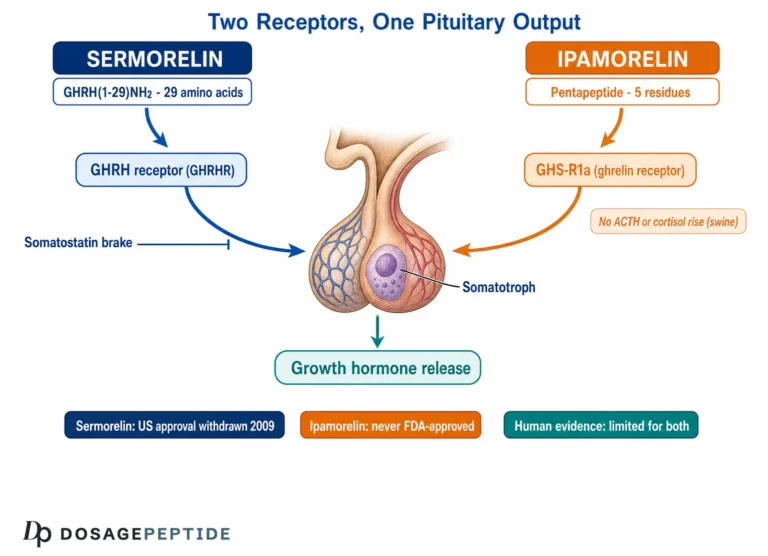
- Different receptors. CJC-1295 is a GHRH analogue acting at the GHRH receptor. Ipamorelin acts at the ghrelin receptor (GHSR-1a).
- Different durations. CJC-1295 with DAC has a published human half-life of 5.8–8.1 days and raises GH for days. Ipamorelin has a terminal half-life of roughly 2 hours and produces one discrete GH episode.
- “CJC-1295” means two different products. With DAC, and without DAC (modified GRF 1-29) — only the DAC form has published human half-life data.
- That is why they are sold as a blend rather than as competitors: the two signals are additive, not interchangeable.
- Neither is FDA-approved for any indication. The human record for both is thin, and Ipamorelin’s clinical development was discontinued.
The most useful answer to “CJC-1295 vs Ipamorelin” is that the comparison is built on a false premise. These two research peptides do not compete for the same target: CJC-1295 is a growth hormone-releasing hormone (GHRH) analogue acting at the GHRH receptor on the pituitary somatotroph, while Ipamorelin is a growth hormone secretagogue acting at a different receptor entirely, the ghrelin receptor GHSR-1a. That is why they are so often supplied together in a single research blend rather than as alternatives — and neither is an FDA-approved drug for any indication.
CJC-1295 vs Ipamorelin at a glance
Note first that “CJC-1295” is ambiguous in vendor usage: it refers to two chemically different products. The table separates all three entities involved.
| Property | CJC-1295 with DAC | CJC-1295 without DAC (modified GRF 1-29) | Ipamorelin |
|---|---|---|---|
| Class | GHRH analogue | GHRH analogue | Growth hormone secretagogue / GHRP |
| Receptor | GHRH receptor (GHRH-R) | GHRH receptor (GHRH-R) | Ghrelin receptor (GHSR-1a) |
| Chemistry | Tetrasubstituted hGRF(1-29) plus a maleimide group that binds albumin[4] | Same tetrasubstituted hGRF(1-29) backbone, no albumin-binding element | Pentapeptide, Aib-His-D-2-Nal-D-Phe-Lys-NH2[3] |
| Published human half-life | 5.8-8.1 days[5] | None published | ~2 h terminal half-life (IV)[7] |
| Effect on the GH pattern | Days-long elevation of GH and IGF-I[5]; pulses preserved, trough GH raised[6] | Short-acting by design; duration in humans not characterised | Single discrete GH episode, peak ~0.67 h, then exponential decline[7] |
| Human trial record | Randomised ascending-dose trials in healthy adults[5]; phase 2 trial in HIV visceral obesity terminated[9] | No published human trial under this name | Dose-escalation PK/PD in healthy men[7]; phase 2 trial missed its endpoint in postoperative ileus[8] |
| Regulatory status | Not FDA-approved | Not FDA-approved | Not FDA-approved |
| Anti-doping status | Prohibited at all times (WADA S2, GH-releasing factors) | Prohibited at all times (WADA S2, GH-releasing factors) | Prohibited at all times (WADA S2, GH secretagogues) |
| Why it appears in blends | Supplies the GHRH-receptor arm | Supplies the GHRH-receptor arm | Supplies the ghrelin-receptor arm |
Why they are not really alternatives
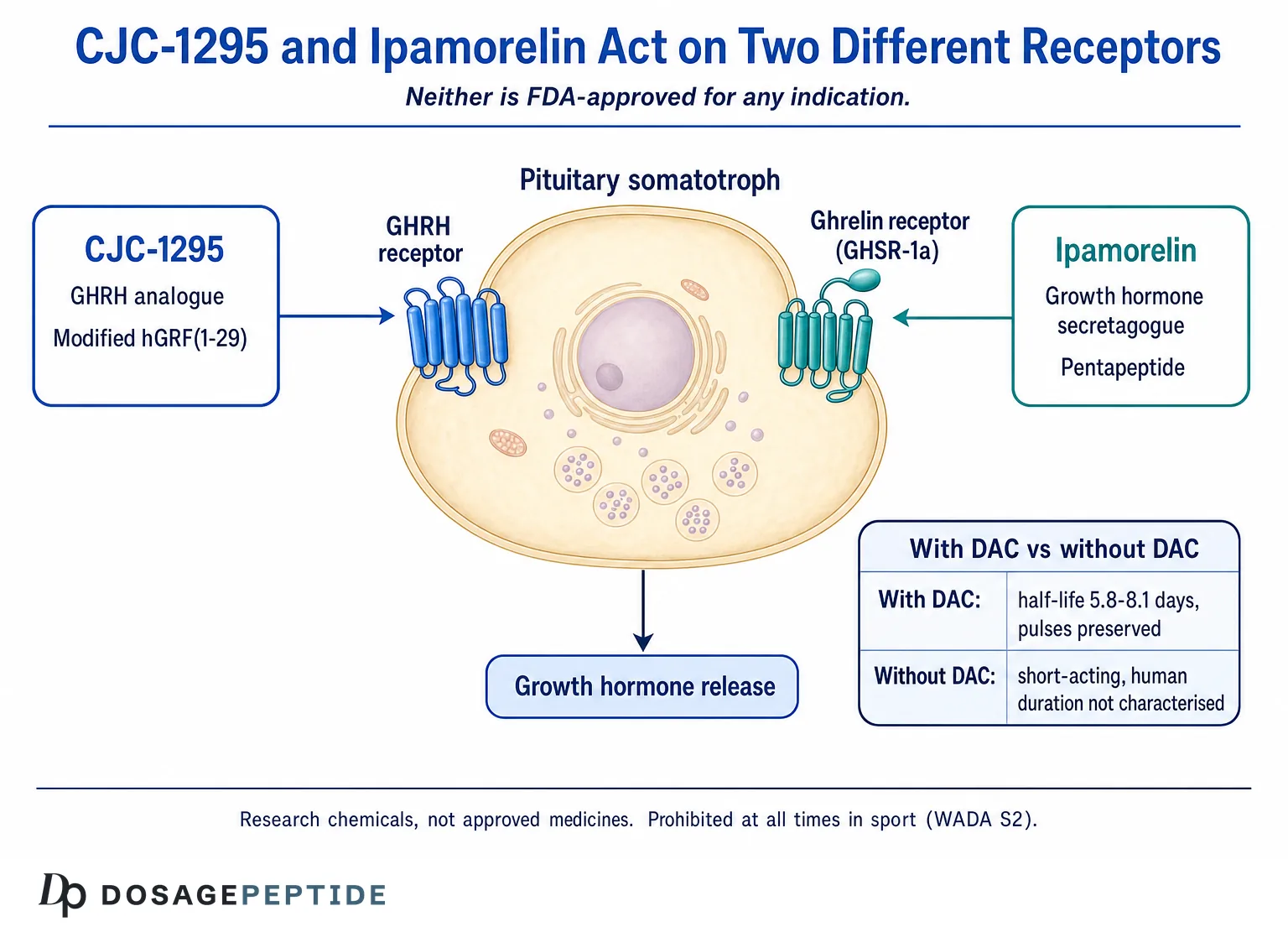
A somatotroph — the GH-producing cell of the anterior pituitary — carries more than one receptor that can trigger GH release. The GHRH receptor was cloned in 1992: a seven-transmembrane G protein-coupled receptor related to the secretin and VIP receptors, expressed predominantly in the anterior pituitary and coupled to cAMP production[1]. Four years later a separate G protein-coupled receptor was cloned from pituitary and hypothalamus and identified as the target of the synthetic secretagogues[2]. Its endogenous ligand was identified in 1999 as ghrelin — hence the name ghrelin receptor.
So the honest structure of the comparison is not “which one is better” but “which arm of a two-arm system does each one touch”. They are not substitutes, and any page ranking them head-to-head on potency is comparing quantities never measured on the same axis. For the same distinction with a different GHRH analogue, our comparison of Sermorelin and Ipamorelin covers the identical receptor logic with a compound that does have an approval history.
GHRH vs GHRP: what the class distinction actually means
What a GHRH analogue does
GHRH is the hypothalamic releasing factor for GH, and it works inside an existing rhythm rather than replacing it. Human GH secretion is pulsatile, and the classical model — from frequent-sampling studies in normal subjects — is that bursts are timed by a fall in tonic hypothalamic somatostatin, with GHRH setting the size of the burst then permitted[10]. The GHRH arm therefore modulates the amplitude of pulses already being generated, constrained by somatostatin tone at the moment of administration.
What a GHRP or secretagogue does
Growth hormone-releasing peptides act through the ghrelin receptor, not the GHRH receptor. In the pharmacological characterisation of Ipamorelin, GHRH antagonists did not block its action while GHRP antagonists did, placing it on the GHRP-like receptor pathway[3]. A review of the authors’ own human work with the prototype hexapeptide GHRP-6 reported that it stimulates GH secretion independently of GHRH receptors, acts at both hypothalamic and pituitary levels, and may act to functionally antagonise somatostatin[10]. That last property is why the two arms are complementary rather than redundant: one pushes the accelerator, the other lifts part of the brake. For background on the class, see our overview of what a growth hormone-releasing peptide is.
One caveat: most human GHRP data comes from GHRP-6 and GHRP-2, not Ipamorelin. Class membership is not the same as having been studied.
CJC-1295: the DAC question is the whole question
CJC-1295 with DAC
The molecule described in the primary literature as CJC-1295 is a tetrasubstituted human GRF(1-29) carrying a maleimidopropionamide derivative of lysine at the C-terminus. That reactive group bioconjugates in vivo to the free thiol on Cys34 of serum albumin, and the conjugate resists dipeptidyl peptidase-IV. In rats it stayed detectable in plasma beyond 72 hours and produced roughly a four-fold increase in GH area under the curve over two hours versus unmodified hGRF(1-29)[4]. DAC — drug affinity complex — is that albumin-binding element: part of the molecule, not an additive.
CJC-1295 without DAC is modified GRF (1-29)
Remove the albumin-binding lysine derivative and what remains is the tetrasubstituted GRF(1-29) backbone — the substance sold as “modified GRF (1-29)”, “MOD GRF (1-29)” and “CJC-1295 no DAC”. The substitutions still resist enzymatic degradation, but nothing anchors the peptide to albumin, so the long circulating life disappears. This is the most consequential fact on this page: two vials labelled “CJC-1295” can contain compounds with fundamentally different durations of action. Our explainer on what CJC-1295 DAC and no-DAC actually are works through the naming.
Be careful with half-life figures circulating online. The 5.8-8.1 day estimate is a human measurement, and it applies to the DAC form only[5]. We could not identify any published human pharmacokinetic study of the non-DAC form under any of its names. Short duration is a reasonable inference from the chemistry, but it is an inference, not a measured value.
Sustained elevation changes the baseline, not the pulse
This is the substance behind the DAC debate, and it is more than a dosing-frequency convenience. In the published ascending-dose work, a single subcutaneous injection raised mean plasma GH two- to ten-fold for six days or more and mean IGF-I 1.5- to three-fold for nine to eleven days; after repeated dosing, mean IGF-I stayed above baseline for up to 28 days[5].
A separate study asked the more precise question — what happens to the shape of the rhythm — and the answer is not the one usually repeated online. With 20-minute sampling over an overnight 12-hour period in healthy men, one week after a single injection, GH pulsatility was preserved: pulse frequency and magnitude were unaltered, while basal (trough) GH rose roughly seven-fold, mean GH by 46% and IGF-I by 45%[6]. The change is to the baseline the pulses sit on, not the pulses themselves — a real difference from a short-acting GHRH analogue, but not the abolition of pulsatility it is often called. Practical framing of the two forms is in our CJC-1295 DAC and no-DAC protocol notes, and tolerability signals on our CJC-1295 side effects reference.
Ipamorelin: what has been characterised, and what was tried in humans
Ipamorelin is a pentapeptide first described in 1998. In rat pituitary cells it released GH with potency and efficacy similar to GHRP-6, and in swine it did not raise ACTH or cortisol above levels seen after GHRH stimulation, even at doses more than 200-fold above the ED50 for GH release[3]. That work is preclinical: rat cells, anaesthetised rats and conscious swine.
Ipamorelin did reach humans. A dose-escalation study in healthy male volunteers, with 15-minute intravenous infusions across five dose levels, found dose-proportional pharmacokinetics, a terminal half-life of about two hours, and a GH response consisting of a single release episode peaking around 0.67 hours then declining exponentially at every dose[7]. Development then moved to gastrointestinal motility rather than growth hormone. A multicentre, double-blind, placebo-controlled phase 2 trial gave intravenous ipamorelin twice daily for up to seven days after bowel resection: median time to first tolerated solid meal was 25.3 hours versus 32.6 with placebo, p = 0.15, with no significant difference on the key or secondary endpoints, though the drug was well tolerated[8]. Ipamorelin was not approved. Our Ipamorelin 10 mg vial reference page covers the single-compound handling side.
How strong is the evidence for each?
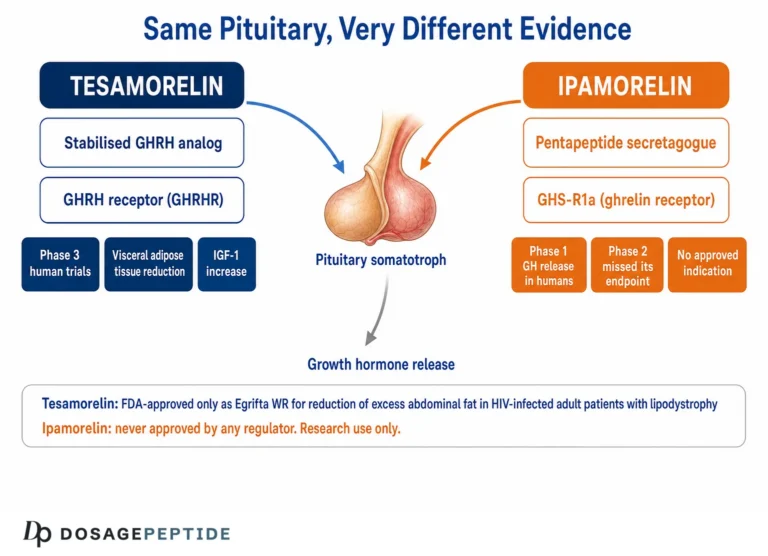
Stated precisely: neither CJC-1295 in any form nor Ipamorelin is FDA-approved for any indication, and both are research-chemical material when supplied by peptide vendors. An approved GHRH analogue does exist, which sharpens the contrast: tesamorelin, marketed as EGRIFTA WR, is approved for reduction of excess abdominal fat in HIV-infected adults with lipodystrophy[15]. CJC-1295 has no such record. Its published human data comprise two randomised, placebo-controlled, double-blind ascending-dose trials of 28 and 49 days in healthy adults aged 21 to 61, which reported no serious adverse reactions and concluded only that the data “support the potential utility” of the compound[5], plus the pulsatility study above[6].
Development also went further than phase 1, and did not simply fade out — a point most comparison pages omit. A multicentre, randomised, placebo-controlled, double-blind phase 2 trial of CJC-1295 in HIV-associated visceral obesity, run by ConjuChem, was terminated in 2006 after a participant died[9]. Two things belong together here. The cause of death and its relationship to the study drug were reported at the time as under investigation, and no causal link was ever established publicly; equally, the results were never published and the programme ended there. Anyone told the human safety record is simply “no serious adverse reactions” has half the story.
One further status applies regardless of FDA. Both compounds are named on the WADA Prohibited List under section S2 — CJC-1295 among the growth hormone-releasing factors, Ipamorelin among the growth hormone secretagogues — and S2 substances are prohibited at all times, in and out of competition[14]. For anyone subject to anti-doping testing, that is the operative rule, not the approval status.
On the Ipamorelin side, US regulatory attention has been about compounding rather than approval. In October 2024, FDA’s Pharmacy Compounding Advisory Committee reviewed ipamorelin acetate and ipamorelin free base for the 503A bulk drug substances list, with growth hormone deficiency and postoperative ileus as the uses evaluated. FDA’s position was that neither should be included, and the committee agreed: on each form the vote was 0 in favour, 12 against, 1 abstention, members citing a lack of information supporting safety and efficacy[13]. As of August 2026, ipamorelin has not been added to that list. Being nominated as a compounding bulk substance is not an approval, and being voted off that list is a further step away from one.
Why are they supplied together as a blend?
The rationale is genuine and predates both compounds. In 1990, healthy men given a GHRP hexapeptide together with GHRH showed synergistic — not merely additive — GH release; peak serum GH after GHRP alone rose from 7.6 to 68.7 µg/L across the dose range[11]. The combination became strong enough to be used diagnostically: a multicentre study of the GHRH plus GHRP-6 test in 125 adults with organic pituitary disease and 125 healthy controls reported a mean GH peak of 59.2 µg/L in controls, versus 14.3 µg/L in the 27 controls who also underwent an insulin tolerance test[12]. Two receptors, two mechanisms, one output — that is the logic of the blend, and our CJC-1295 no-DAC and Ipamorelin blend reference covers handling of the combined vial.
Now the gap most pages skip. Everything above measures GH release under controlled conditions, at specific doses, over minutes to hours. None of it shows that a research-grade blend of CJC-1295 and Ipamorelin produces any downstream outcome. That two pathways combine to release more GH is a mechanistic finding; that this changes body composition, recovery or sleep would be an outcome finding, and no such trial exists. Conflating the two is the most common error in this literature.
What is still genuinely unknown
- Long-term safety. The longest published human exposure to CJC-1295 was 49 days[5]; the one phase 2 programme that ran longer was terminated and never reported[9]. Nothing long-term exists for either compound, and nothing at all for the combination.
- Sustained IGF-I elevation. The DAC form kept mean IGF-I above baseline for up to 28 days after repeated dosing[5]. What that does over months has not been studied for this compound.
- No outcome data outside a trial. Material used outside a controlled protocol generates no measured outcomes — not safety, not efficacy, not even identity or purity of what is in the vial.
- Ipamorelin human GH data are shallow. One PK/PD study in healthy males[7], and one phase 2 trial that missed its endpoint in a non-endocrine indication[8].
What about amounts and reconstitution?
This page deliberately contains no dosing quantities. Reconstitution volumes, unit conversion and vial arithmetic belong on a protocol page, not in a mechanistic comparison — mixing the two is how “how do these differ” turns into “how much should I use”. For the combined vial, use the blend protocol page linked above.
Frequently Asked Questions
Is CJC-1295 or Ipamorelin better?
Neither, because they are not alternatives. CJC-1295 acts at the GHRH receptor and Ipamorelin at the ghrelin receptor GHSR-1a — different arms of the same regulatory system, which is why research supply pairs them rather than pitting them against each other. Any ranking of one over the other compares measurements never taken on a shared scale.
What is the difference between GHRH and GHRP?
A GHRH analogue binds the GHRH receptor, a secretin-family G protein-coupled receptor expressed predominantly in the anterior pituitary, and modulates the size of GH pulses the hypothalamus already generates. A GHRP acts through the ghrelin receptor, cloned independently in 1996, and in human work has been described as acting at both hypothalamic and pituitary levels and as functionally opposing somatostatin.
Is CJC-1295 without DAC the same as modified GRF (1-29)?
Yes. “CJC-1295 no DAC”, “MOD GRF (1-29)” and “modified GRF (1-29)” all denote the tetrasubstituted GRF(1-29) backbone without the albumin-binding maleimide group. The DAC element is what makes CJC-1295 long-acting; strip it and you have a short-acting GHRH analogue that happens to share part of a name with a long-acting one.
How long does CJC-1295 stay active?
For the DAC form, the published human estimate is a half-life of 5.8 to 8.1 days, with GH elevated for six days or more and IGF-I for nine to eleven days after a single subcutaneous dose. For the non-DAC form there is no published human pharmacokinetic study, so any half-life figure quoted for it online is an estimate, not a measurement.
Does CJC-1295 with DAC stop GH from being pulsatile?
No, and this is a common misstatement. In the only published human pulsatility study, GH pulse frequency and amplitude were unaltered one week after a single injection. What rose sharply was the trough between pulses — roughly seven-fold — carrying mean GH up 46% and IGF-I 45%. The rhythm is retained; the baseline it sits on is lifted.
Has Ipamorelin ever been tested in humans?
Yes, and it did not become an approved drug. A dose-escalation study in healthy male volunteers characterised its pharmacokinetics and GH response, and a multicentre, double-blind, placebo-controlled phase 2 trial tested it for postoperative ileus after bowel resection. That trial found no significant difference from placebo on its key or secondary endpoints, although it was well tolerated.
Is the CJC-1295 and Ipamorelin combination proven to work?
The synergy is documented at the level of GH release: combining a GHRH analogue with a GHRP produces more GH than either alone, and the GHRH plus GHRP-6 combination is validated as a diagnostic stimulus for GH deficiency. That is a mechanistic result. No trial has tested the specific CJC-1295 plus Ipamorelin blend for any clinical outcome, so nothing about outcomes can honestly be claimed.
Is either compound FDA-approved, and are they banned in sport?
Neither CJC-1295, in DAC or non-DAC form, nor Ipamorelin is FDA-approved for any indication. An approved GHRH-analogue drug does exist — tesamorelin, for excess abdominal fat in HIV-infected adults with lipodystrophy — but it is a different molecule with its own trial programme. Ipamorelin was voted against for the 503A compounding list in 2024, and both compounds are prohibited at all times under WADA section S2.
References
- Mayo KE. Molecular cloning and expression of a pituitary-specific receptor for growth hormone-releasing hormone. Mol Endocrinol. 1992;6(10):1734-44. https://pubmed.ncbi.nlm.nih.gov/1333056/
- Howard AD, Feighner SD, Cully DF, et al. A receptor in pituitary and hypothalamus that functions in growth hormone release. Science. 1996;273(5277):974-7. https://pubmed.ncbi.nlm.nih.gov/8688086/
- Raun K, Hansen BS, Johansen NL, et al. Ipamorelin, the first selective growth hormone secretagogue. Eur J Endocrinol. 1998;139(5):552-61. https://pubmed.ncbi.nlm.nih.gov/9849822/
- Jetté L, Léger R, Thibaudeau K, et al. Human growth hormone-releasing factor (hGRF)1-29-albumin bioconjugates activate the GRF receptor on the anterior pituitary in rats: identification of CJC-1295 as a long-lasting GRF analog. Endocrinology. 2005;146(7):3052-8. https://pubmed.ncbi.nlm.nih.gov/15817669/
- Teichman SL, Neale A, Lawrence B, Gagnon C, Castaigne JP, Frohman LA. Prolonged stimulation of growth hormone (GH) and insulin-like growth factor I secretion by CJC-1295, a long-acting analog of GH-releasing hormone, in healthy adults. J Clin Endocrinol Metab. 2006;91(3):799-805. https://pubmed.ncbi.nlm.nih.gov/16352683/
- Ionescu M, Frohman LA. Pulsatile secretion of growth hormone (GH) persists during continuous stimulation by CJC-1295, a long-acting GH-releasing hormone analog. J Clin Endocrinol Metab. 2006;91(12):4792-7. https://pubmed.ncbi.nlm.nih.gov/17018654/
- Gobburu JV, Agersø H, Jusko WJ, Ynddal L. Pharmacokinetic-pharmacodynamic modeling of ipamorelin, a growth hormone releasing peptide, in human volunteers. Pharm Res. 1999;16(9):1412-6. https://pubmed.ncbi.nlm.nih.gov/10496658/
- Beck DE, Sweeney WB, McCarter MD; Ipamorelin 201 Study Group. Prospective, randomized, controlled, proof-of-concept study of the ghrelin mimetic ipamorelin for the management of postoperative ileus in bowel resection patients (ClinicalTrials.gov NCT00672074). Int J Colorectal Dis. 2014;29(12):1527-34. https://pubmed.ncbi.nlm.nih.gov/25331030/
- ClinicalTrials.gov. A Multicenter, Randomized, Placebo-Controlled, Double-Blind, Phase 2 Study to Evaluate the Efficacy and Safety of CJC 1295 Administered for 12 Weeks in HIV Infected Patients With HIV Associated Visceral Obesity (NCT00267527) — sponsor ConjuChem; study status: Terminated. https://clinicaltrials.gov/study/NCT00267527 — contemporaneous report of the halt and participant death: aidsmap (NAM), July 2006, https://www.aidsmap.com/news/jul-2006/lipodystrophy-study-halted-after-patient-death
- Thorner MO, Vance ML, Hartman ML, et al. Physiological role of somatostatin on growth hormone regulation in humans. Metabolism. 1990;39(9 Suppl 2):40-2. (Review) https://pubmed.ncbi.nlm.nih.gov/1976218/
- Bowers CY, Reynolds GA, Durham D, Barrera CM, Pezzoli SS, Thorner MO. Growth hormone (GH)-releasing peptide stimulates GH release in normal men and acts synergistically with GH-releasing hormone. J Clin Endocrinol Metab. 1990;70(4):975-82. https://pubmed.ncbi.nlm.nih.gov/2108187/
- Popovic V, Leal A, Micic D, et al. GH-releasing hormone and GH-releasing peptide-6 for diagnostic testing in GH-deficient adults. Lancet. 2000;356(9236):1137-42. https://pubmed.ncbi.nlm.nih.gov/11030292/
- U.S. Food and Drug Administration. Final Summary Minutes of the Pharmacy Compounding Advisory Committee Meeting, October 29, 2024. https://www.fda.gov/media/185412/download
- World Anti-Doping Agency. The Prohibited List — S2. Peptide Hormones, Growth Factors, Related Substances and Mimetics. https://www.wada-ama.org/en/prohibited-list
- DailyMed (U.S. National Library of Medicine). EGRIFTA WR (tesamorelin) for injection — prescribing information. https://dailymed.nlm.nih.gov/dailymed/drugInfo.cfm?setid=839334d3-8c1d-4c26-9036-2ab524a6ea75
This article is provided for research and educational reference only. CJC-1295 and Ipamorelin are research chemicals, not approved medicines, and nothing here is a recommendation, protocol, or endorsement for human or veterinary use. Nothing on this page is medical advice.