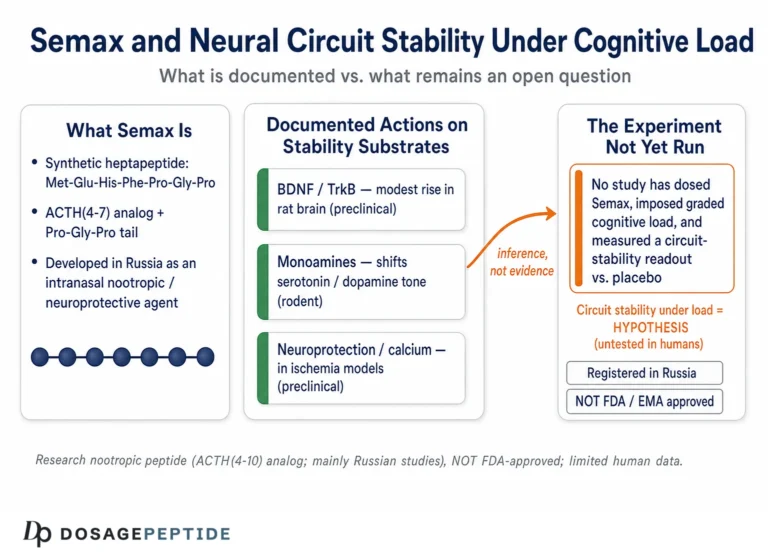
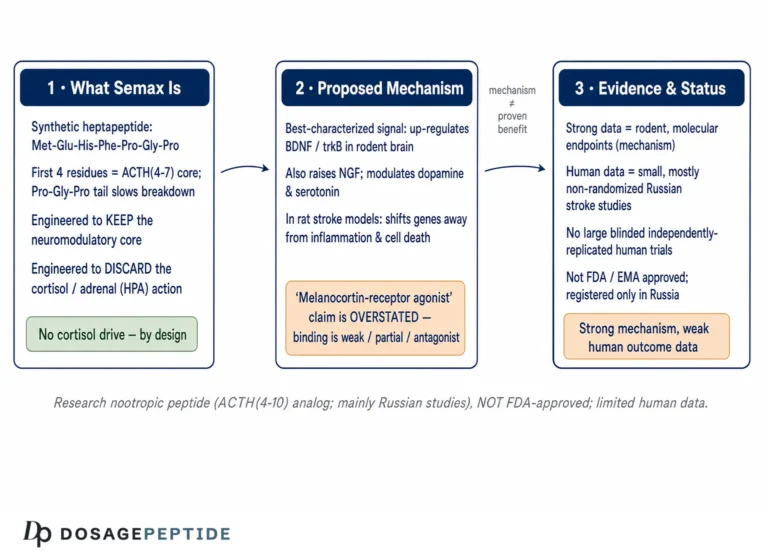
Semax (Met-Glu-His-Phe-Pro-Gly-Pro) is one of the few research peptides where the dosing question has a real, documented anchor — and also one where that anchor is routinely misrepresented. Anyone searching for a semax dosage figure is usually holding a lyophilised 5 mg or 10 mg vial, while every published human number comes from a registered Russian intranasal solution described as a percentage, not from a vial and a syringe. This article reconstructs the arithmetic that connects those two worlds, states precisely what tier of evidence supports each number, and is explicit about where the published record simply runs out — most importantly for the subcutaneous route, which has almost no human dosing literature at all.
Research Context: What Semax Is and Where It Came From
Semax is a synthetic heptapeptide with the sequence Met-Glu-His-Phe-Pro-Gly-Pro (single-letter: MEHFPGP), molecular formula C37H51N9O10S and a molecular weight of approximately 813.9 Da[1]. Structurally it is the ACTH(4-7) fragment of adrenocorticotropic hormone — Met-Glu-His-Phe — extended at the C-terminus with the tripeptide Pro-Gly-Pro. It is therefore usually described in the literature as an analogue of the ACTH(4-10) fragment, and the two descriptions (ACTH(4-7)-PGP and “ACTH(4-10) analogue”) refer to the same molecule. The registered Russian product labelling uses the ACTH(4-10) formulation[2].
The compound emerged from Soviet and then Russian neuropeptide research programmes, principally at the Institute of Molecular Genetics of the Russian Academy of Sciences (now within the National Research Centre “Kurchatov Institute”), and the name of N. F. Myasoedov appears on a large fraction of the primary literature spanning three decades. That single-lineage provenance matters for how the evidence should be weighted, and it is addressed directly in the sections on evidence level and limitations below rather than left implicit.
The Pro-Gly-Pro extension and why it exists
The reason the molecule is not simply ACTH(4-7) is pharmacokinetic. Short native peptide fragments are degraded rapidly by aminopeptidases and other proteases, which limits how long an unmodified fragment can act. Reference[4] characterises Semax in its opening line as an ACTH(4-10) fragment analogue with prolonged neurotropic activity. The attribution of that prolongation specifically to the C-terminal Pro-Gly-Pro extension — the standard mechanistic account repeated throughout the field — is not established by the source cited here, and this article will not pretend otherwise. It is a widely held, chemically reasonable account (proline-rich C-termini are a well-known general strategy for resisting exopeptidase cleavage), but the reader should file it as the field’s working explanation rather than as a demonstrated result.
Two related caveats belong here, because they are where secondary Semax content characteristically inflates.
First, figures such as “a 20–24 hour half-life” circulate widely on vendor and aggregator pages. That specific number is not something this article will assert, because it could not be traced to a primary source stating it. What the accessible literature supports is the qualitative claim — prolonged neurotropic activity relative to the bare fragment — not a precise half-life figure. Where a number cannot be sourced, this article says so rather than repeating it.
Second, the published stability work on Semax that is indexed in the international literature concerns proteolytic stability in biological media — how the peptide resists enzymatic degradation in serum, plasma or tissue homogenate — and, in the most frequently cited case, examines an acetylated derivative rather than unmodified Semax. That is a different question from the one a researcher holding a vial actually has, which is chemical stability in bacteriostatic water in a refrigerator over weeks. The two are routinely conflated. They should not be.
The non-corticotropic point, which is real and important
Because Semax is derived from ACTH, a reasonable first assumption is that it stimulates the adrenal cortex and raises cortisol. The literature consistently says it does not. The ACTH(4-10) region carries the behavioural and attentional activity of adrenocorticotropin without the steroidogenic activity, which resides in a different portion of the parent hormone.
The evidence tier here needs stating carefully, because this claim is usually presented with more force than its sources carry. The registered Russian product labelling describes Semax as a synthetic ACTH(4-10) analogue “completely devoid of hormonal activity”[2], and a 2024 study in the European Journal of Pharmacology classifies both Semax and Melanotan II as “noncorticotropic synthetic analogs of the ACTH(4-10) fragment”[5]. Both are descriptive characterisations rather than measurements: no study in this reference set assayed cortisol or adrenal steroidogenesis after Semax administration. The claim rests on the pharmacology of the parent hormone — steroidogenic activity resides outside the 4-10 region — and on consistent, unchallenged description in the primary literature and in an approved product label. That is a reasonable position to hold, but it is held by convention and by structural inference, not by a direct experiment cited here.
It is worth stating precisely all the same, because it is frequently garbled in both directions: into “Semax is a corticosteroid” or into “Semax boosts ACTH”. Neither is what the literature says.
Readers approaching Semax through its relationship to the melanocortin system may also want the adjacent comparison work on how Adamax and other ACTH-derived neuropeptides differ from Semax in the research literature, and the deeper treatment of how Semax influences ACTH-related pathways in experimental models.
What Is the Regulatory Status of Semax?
This is the section that determines how every dosing number below should be read, so it is placed before the numbers rather than after them.
The precise tier
- Semax is not FDA-approved. There is no US marketing authorisation for Semax for any indication. It is not an approved drug and it is not a lawful dietary supplement ingredient.
- Semax is not EMA-approved. There is no European centralised marketing authorisation, and no EMA assessment report exists to consult.
- Semax is a registered medicine in Russia (and has been used in some post-Soviet states). Two strengths are marketed as nasal drops: a 0.1% solution[2] and a 1% solution[3], both manufactured by Peptogen INPC, both prescription-only, and both supplied in 3 mL dropper bottles. The primary literature refers to this clinical use directly and routinely — describing Semax as a peptide that “is successfully used for acute stroke therapy”[6] and as “a synthetic melanocortin derivative that is used in the treatment of ischemic stroke”[7].
- Everything sold as a lyophilised 5 mg or 10 mg “Semax” vial in the Western research-chemical market is not the registered product. It is a research chemical of independently variable purity, identity, and sterility, in a presentation the registered product does not use.
The honest one-sentence version: Semax is registered in Russia, not FDA- or EMA-approved; the clinical evidence base is largely Russian-language, frequently small, and has not been independently replicated to Western regulatory standards.
What the registered strengths are actually indicated for
Because the entire dosing discussion below is built on the registered product, it is worth setting out what that product’s labelling says rather than paraphrasing it loosely. The two strengths carry different indication sets, and conflating them is a common source of error.
The 0.1% strength is labelled for intellectual-mnestic disorders arising from cerebrovascular disease, recovery after stroke, dyscirculatory encephalopathy, transient ischaemic attacks, recovery following head trauma, neurosurgery and anaesthesia, neurotic disorders, adaptation under extreme conditions, prevention of mental fatigue, optic nerve atrophy and optic neuritis, and minimal brain dysfunction in children aged seven and older[2]. The 1% strength carries a single, much narrower registered indication: ischaemic stroke in the acute period[3].
Two things follow that are worth holding onto. First, this is a broad indication list by Western regulatory standards — “adaptation under extreme conditions” and “prevention of mental fatigue” are not indications any FDA- or EMA-approved neurological drug carries, and their presence on a label is a fact about the registering system as much as about the molecule. A registered indication is a regulatory decision made under a particular evidentiary standard; it is not itself evidence of efficacy, and it does not transfer across jurisdictions. Second, the indication list is the closest thing that exists to an official statement of what Semax is for — and none of the entries is “cognitive enhancement in healthy adults”, which is what most people searching for a Semax dose actually have in mind.
A single verifiable fact that frames everything
A search of ClinicalTrials.gov — the NIH registry of interventional studies — for Semax as an intervention returns zero registered trials[8]. Not zero completed trials; zero registered trials of any status, at the time of writing. Whatever one concludes about Semax, this is the single most informative data point about its evidentiary position: a compound registered as a medicine in one jurisdiction since the 1990s has generated no registered trial activity in the international registry that the FDA, EMA, and ICMJE journals treat as the baseline for trial transparency.
This is not proof that Semax does not work. Registration on ClinicalTrials.gov is a regulatory and publishing convention, and a drug developed entirely inside a domestic Russian framework in the 1990s had no procedural reason to appear there. Registries are also a relatively recent institution: prospective registration only became an ICMJE publication condition in 2005, by which time the pivotal Semax work was already eight years old. But the consequence stands regardless of the reason. Anyone who claims Semax is “clinically proven” is claiming something that cannot be checked in the way clinical claims are normally checked — no protocol to compare against the published report, no way to detect selective outcome reporting, no denominator for how many studies were run.
Mechanisms Studied: What the Preclinical Work Actually Shows
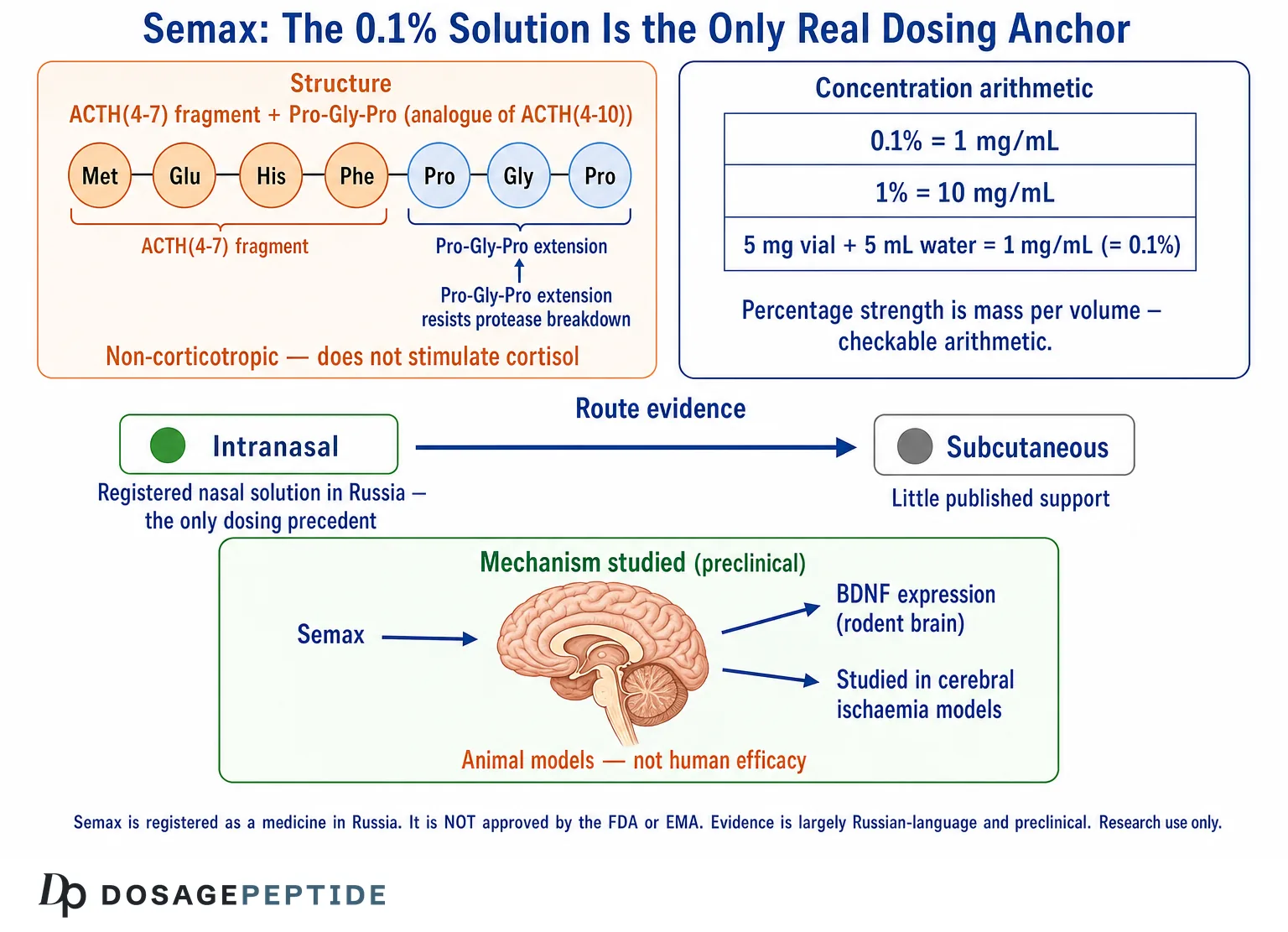
The mechanistic literature on Semax is genuinely substantial, and it is also almost entirely preclinical. This is worth separating cleanly from the clinical question. Rodent and cell-culture work can establish that a molecule engages a biological system; it cannot establish that engagement produces a clinical benefit in humans.
Neurotrophin induction and receptor binding
The most-replicated mechanistic finding is that Semax raises brain-derived neurotrophic factor. A 2006 study in the Journal of Neurochemistry is the cleanest example: intranasal Semax at 50 and 250 µg/kg body weight in rats produced a rapid increase in BDNF protein in the basal forebrain at 3 hours, but not in the cerebellum — a regionally specific effect rather than a global one. The same study characterised specific, reversible, calcium-dependent binding of tritium-labelled Semax to basal forebrain cell membranes, with a dissociation constant KD of 2.4 ± 1.0 nM and a Bmax of 33.5 ± 7.9 fmol/mg protein[9]. A nanomolar KD is a real binding affinity, not an artefact, and it is the strongest single piece of mechanistic evidence in the Semax file.
The ischaemia transcription work, reported precisely
Downstream of the binding work, a study in a permanent middle cerebral artery occlusion (pMCAO) model examined transcription of neurotrophins and their receptors in rat cortex after treatment with either Semax or the PGP tripeptide alone. The results are more specific than they are usually reported. Semax enhanced transcription of Bdnf, TrkC and TrkA at 3 hours after occlusion, and of Nt-3 and Ngf at 24 hours, with Ngf still enhanced at 72 hours. PGP alone enhanced Bdnf and TrkC at 3 hours, and Ngf, TrkB, TrkC and TrkA at 24 hours[6].
The commonly repeated summary “Semax activates Bdnf, Ngf and TrkB after ischaemia” is wrong on the third gene. That trio comes from the same paper’s one-line description of earlier work in intact rat hippocampus, not from the pMCAO experiment; in the ischaemia model, TrkB was enhanced by PGP, not by Semax. This is a small error with a large lesson: the drift happens when a summary sentence in an abstract’s background is mistaken for the abstract’s result.
That the PGP tripeptide alone reproduces part of the effect is worth noting — though the authors qualify it directly, reporting that Semax selectively affected transcription of neurotrophins and their receptors in the ischaemic rat cortex, whereas the influence of PGP was “mainly unspecific”[6]. The “tail” added for stability is not pharmacologically inert, but the authors do not claim it is doing the same job as the whole molecule, and neither should anyone citing them.
Transcriptomic and anti-inflammatory work in ischaemia models
The most methodologically modern strand is genome-wide. A 2014 BMC Genomics study performed genome-wide transcriptional analysis of Semax effects in ischaemic rat brain cortex at 3 and 24 hours after permanent MCAO, finding predominant effects on immune- and vascular-system gene expression[10]. In the transient MCAO (ischaemia-reperfusion) model, genome-wide RNA-Seq analysis reported that Semax suppressed inflammatory gene expression and activated neurotransmitter gene expression, and a 2021 International Journal of Molecular Sciences paper extended the picture to the protein level: at 24 hours after tMCAO, active CREB was upregulated in subcortical structures including the focus of ischaemic damage, MMP-9 and c-Fos were downregulated in the adjacent frontoparietal cortex, and active JNK was downregulated in both tissues under Semax[7].
That is a coherent mechanistic story — inflammation and cell-death signalling down, a recovery-associated transcription factor up — and it is entirely in rats, entirely in surgical ischaemia models, and entirely from one institutional lineage. Coherence is not replication.
Behavioural and monoaminergic work
Chronic intranasal administration in white rats at 0.05 mg/kg daily for 10 or 14 days produced anxiolytic and antidepressant-like effects without altering exploratory activity in a non-stressogenic environment; the authors attributed these effects to activation of the brain serotonergic system together with increased hippocampal BDNF expression[15]. Note the structure of that claim: the behavioural finding is a result, the serotonergic-plus-BDNF explanation is the authors’ interpretation offered in the same breath. A 2024 chronic unpredictable stress study reported antidepressant-like and antistress effects in male rats given 60 nmol/kg intraperitoneally[5]. Both are animal models of affective behaviour, which are notoriously weak predictors of human antidepressant efficacy; the appropriate reading is “the molecule is behaviourally active in rodents”, not “Semax has antidepressant effects”.
For a broader treatment of the circuit-level questions this raises, see the discussion of how Semax might affect neural circuit stability under cognitive load.
The 0.1% and 1% Solutions: The Only Real Dosing Anchor
The registered Russian product is a nasal solution described by percentage concentration. Converting that to mg/mL is straightforward arithmetic, and it is the bridge between the clinical literature and a vial of powder.
Percentage concentration in pharmaceutical solutions conventionally means weight/volume: X% w/v = X grams per 100 mL. The labelling confirms this reading directly, stating 1 mg per 1 mL for the 0.1% strength[2] and 10 mg per 1 mL for the 1% strength[3].
| Stated strength | Arithmetic | Concentration (mg/mL) | Concentration (mcg/mL) | Peptide in a 3 mL bottle |
|---|---|---|---|---|
| 0.1% | 0.1 g per 100 mL = 100 mg per 100 mL | 1 mg/mL | 1,000 mcg/mL | 3 mg |
| 1% | 1 g per 100 mL = 1,000 mg per 100 mL | 10 mg/mL | 10,000 mcg/mL | 30 mg |
So the 1% solution is exactly ten times the concentration of the 0.1% solution. This single conversion resolves most of the confusion in circulating Semax dosing content, where percentage figures and mg figures are mixed without reconciliation. It also makes the scale of the strengths concrete: an entire 3 mL bottle of the 0.1% product contains 3 mg of peptide — less than a third of what a single research-chemical 10 mg vial claims to hold.
On per-drop figures
The “about 50 mcg per drop” figure that circulates on aggregator pages is, unusually, traceable — but only to the registered product’s own labelling, and only for the registered product’s own dropper. The labelling for the 0.1% solution states that one drop contains 50 mcg of active substance[2], and the labelling for the 1% solution states a drop volume of 0.05 mL containing 500 mcg[3]. Those two statements are internally consistent: 0.05 mL (50 µL) of a 1 mg/mL solution is 50 mcg, and 50 µL of a 10 mg/mL solution is 500 mcg. The drop is the same size; only the concentration changes.
The important qualification is what that number is a property of. It is a specification of the dropper supplied with the registered product, not a property of Semax solutions in general. Droplet volume is determined by the geometry and surface characteristics of the dispensing tip, the viscosity and surface tension of the liquid, and the angle at which it is held. A reconstituted research vial fitted with an arbitrary dropper has no established drop volume, and transferring “50 mcg per drop” to it is an assumption dressed as a measurement. The percentage-to-mg/mL conversion above is arithmetic and holds universally. The per-drop figure holds for one specific manufactured device, and that distinction is the single most common place where Semax dosing content silently invents precision.
Semax Dosage: What the Published Research and the Label Document
Below is what published human studies and the registered labelling actually specify. This is a description of research protocols and approved-product labelling, not a recommendation, and every row carries its citation so the claim can be checked.
| Source | Population | Amount | Route | Frequency / duration | Reference |
|---|---|---|---|---|---|
| Registered 1% labelling | Acute ischaemic stroke (registered indication) | 2–3 drops per nostril (moderate); 3–4 drops per nostril (severe). 1 drop = 0.05 mL = 500 mcg | Intranasal | 3–4 times daily (moderate); 4–5 times daily (severe); 10 days | [3] |
| Registered 0.1% labelling | Cognitive/cerebrovascular indications, optic nerve pathology, others | 2–3 drops per nostril per administration. 1 drop = 50 mcg | Intranasal | Varies by indication | [2] |
| Gusev et al., 1997 | 30 patients, acute hemispheric ischaemic stroke (vs 80 conventional-therapy controls) | 12 mg/day (moderate strokes); 18 mg/day (severe strokes) | Intranasal | 5-day course (moderate); 10-day course (severe) | [11] |
| Gusev, Martynov, Kostenko et al., 2018 | 110 post-ischaemic-stroke patients in rehabilitation | 6,000 mcg/day (= 6 mg/day) | Not specified in abstract | Two 10-day courses separated by a 20-day interval | [12] |
| Lebedeva et al., 2018 (resting-state fMRI) | 24 healthy volunteers (14 Semax, 10 placebo), mean age 43.9 ± 9.5 | 1% solution (= 10 mg/mL); total dose not stated in abstract | Intranasal | Single administration; imaging at baseline, 5 min, 20 min | [13] |
| Panikratova et al., 2020 (functional connectomics) | 52 healthy participants (Semax, Selank, or placebo) | Not stated in abstract | “Injection” — subtype not specified in abstract | Single administration; imaging before, 5 min, 20 min | [14] |
The label and the 1997 trial reconcile — which is a genuine check
One useful piece of internal validation is available here, and it is worth doing explicitly because it is checkable. The 1% labelling describes, for moderate strokes, 2–3 drops per nostril, 3–4 times daily[3]. Taking the upper end: 3 drops × 2 nostrils = 6 drops per administration; 6 × 500 mcg = 3,000 mcg per administration; 3,000 mcg × 4 administrations = 12,000 mcg = 12 mg/day. That is exactly the moderate-stroke figure reported in the 1997 clinical study[11]. For severe strokes the label’s 3–4 drops per nostril, 4–5 times daily spans roughly 12–20 mg/day, within which the study’s 18 mg/day sits comfortably.
This tells us the labelling and the pivotal trial describe the same regimen, which is reassuring about the internal consistency of the Russian record. It tells us nothing about whether that regimen works, and it does not make the trial larger or better controlled than it was.
Reading this table honestly
Several things deserve emphasis, because they are systematically obscured in secondary content:
The famous stroke trial is smaller and older than usually claimed. The Gusev/Skvortsova acute stroke study that generates the 12 mg and 18 mg figures enrolled 30 Semax-treated patients against 80 controls, and was published in 1997[11]. It is routinely described online as a ~200-patient multicentre trial from 2001. It was not. PubMed types it as a controlled clinical trial rather than a randomised controlled trial, the study is Russian-language, and no independent replication exists.
These are acute stroke doses, in hospital, for days. The 12–18 mg/day figures come from patients with acute cerebral infarction receiving combined intensive therapy. They are not general-purpose doses, they were not studied in healthy people, and treating them as a template for anything else is an extrapolation the source does not support.
The 2018 study’s 6,000 mcg/day is not the same thing as the 1997 study’s 12 mg/day. Different population (rehabilitation, not acute), different design, and half the daily amount. The abstract does not state which concentration was used, which means the volume administered cannot be derived from it. If it were the 1% solution, 6 mg/day would be 0.6 mL/day; if the 0.1% solution, 6 mL/day — an implausible nasal volume, given that the entire registered 0.1% bottle holds 3 mL. The 1% strength is the more likely reading, but this article will not assert it as fact, because the source does not.
There is no established human dose for cognitive enhancement in healthy people. None of the above is a cognitive-enhancement protocol. The two healthy-volunteer studies that exist are neuroimaging studies with n=24 and n=52 measuring functional connectivity changes over 5–20 minutes[13][14] — they report that something measurable happens to brain networks, not that cognition improves, and neither was designed to establish a dose.
Preclinical dose ranges, for context only
Rodent work clusters at far lower per-kilogram amounts than the human clinical figures. Intranasal Semax at 50 and 250 µg/kg raised basal forebrain BDNF[9]; chronic intranasal work used 0.05 mg/kg (50 µg/kg) daily for 10–14 days[15]; the 2024 chronic-stress study used 60 nmol/kg intraperitoneally, which at 813.9 g/mol works out to roughly 49 µg/kg[5]. By contrast, 12 mg/day in a 70 kg adult is about 171 µg/kg/day. Interspecies dose translation is not a matter of matching mg/kg — allometric scaling, differing nasal anatomy and surface area, differing mucociliary clearance rates, and differing disease context all intervene — so this comparison is offered as orientation, not as a conversion.
Semax 5mg and 10mg Reconstitution: The Arithmetic
The two vial sizes most commonly encountered in the research-supply market are 5 mg and 10 mg; our reference pages break each down individually — the Semax 5 mg vial dosage protocol and the Semax 10 mg vial dosage protocol — and the tables below reproduce that arithmetic in full so it can be checked independently. Note throughout that this is unit-conversion arithmetic describing what a given dilution contains; it is not a recommendation that any quantity be administered, and the route with an actual evidentiary precedent is intranasal, not injection.
A lyophilised vial contains a stated mass of peptide. Adding a volume of bacteriostatic water produces a concentration. That concentration, divided across a U-100 insulin syringe’s 100 units per millilitre, gives a mass per unit. The arithmetic is fully checkable:
- Concentration (mg/mL) = vial mass (mg) ÷ water added (mL)
- Per unit (mcg) = concentration (mg/mL) ÷ 100 units × 1,000 mcg/mg = concentration (mg/mL) × 10
Worked once, explicitly: a 5 mg vial with 2 mL of water gives 5 ÷ 2 = 2.5 mg/mL. One unit is 1/100 of a millilitre, so one unit holds 2.5 ÷ 100 = 0.025 mg = 25 mcg. The shortcut — multiply mg/mL by 10 to get mcg per unit — follows directly and is used for every row below.
Semax 5mg vial reconstitution
| Bacteriostatic water added | Concentration | Per U-100 unit | Equivalent % strength |
|---|---|---|---|
| 1 mL | 5 mg/mL | 50 mcg | 0.5% |
| 1.5 mL | 3.33 mg/mL | ≈33.3 mcg | ≈0.33% |
| 2 mL | 2.5 mg/mL | 25 mcg | 0.25% |
| 2.5 mL | 2 mg/mL | 20 mcg | 0.2% |
| 5 mL | 1 mg/mL | 10 mcg | 0.1% — matches the registered nasal strength[2] |
Semax 10mg vial reconstitution
| Bacteriostatic water added | Concentration | Per U-100 unit | Equivalent % strength |
|---|---|---|---|
| 1 mL | 10 mg/mL | 100 mcg | 1% — matches the higher registered strength[3] |
| 2 mL | 5 mg/mL | 50 mcg | 0.5% |
| 2.5 mL | 4 mg/mL | 40 mcg | 0.4% |
| 5 mL | 2 mg/mL | 20 mcg | 0.2% |
| 10 mL | 1 mg/mL | 10 mcg | 0.1%[2] |
The vial-capacity problem nobody mentions
Notice what the two “0.1%” rows require: 5 mL of water into a 5 mg vial, or 10 mL into a 10 mg vial. Typical lyophilisation vials used for research peptides hold 2–3 mL of total volume. Neither of those additions physically fits. A great deal of Semax content blithely describes adding 5 mL to a 5 mg vial without noticing that the vial cannot hold it.
The consequences are worth stating plainly. Reproducing the registered 0.1% strength from a small vial requires either transferring to a larger sterile container — which introduces a sterility and accuracy problem of its own — or accepting a higher concentration and adjusting the volume administered accordingly. Reproducing the 1% strength, by contrast, is trivial: 10 mg vial + 1 mL = 10 mg/mL = 1%, and 1 mL fits comfortably. This is a real constraint that follows from the arithmetic, and it is covered in more general form in our peptide reconstitution guide. The reconstitution dosage calculator will run these conversions for any vial size and water volume.
Converting a target amount into syringe units
| Target amount | At 100 mcg/unit | At 50 mcg/unit | At 25 mcg/unit | At 10 mcg/unit |
|---|---|---|---|---|
| 100 mcg | 1 unit | 2 units | 4 units | 10 units |
| 200 mcg | 2 units | 4 units | 8 units | 20 units |
| 300 mcg | 3 units | 6 units | 12 units | 30 units |
| 400 mcg | 4 units | 8 units | 16 units | 40 units |
| 600 mcg | 6 units | 12 units | 24 units | 60 units |
| 750 mcg | 7.5 units | 15 units | 30 units | 75 units |
| 1,000 mcg (1 mg) | 10 units | 20 units | 40 units | 100 units |
Note the measurement-error trade-off embedded in this table. At 100 mcg/unit, a 100 mcg target is one single unit — and a half-unit misread is a 50% error. At 10 mcg/unit the same target is 10 units, where a half-unit misread is a 5% error. More dilute preparations are more accurately measurable; they also consume vial volume faster and, per the capacity constraint above, may not fit. Our guide to reading insulin syringe units for peptides covers this trade-off in general.
It is also worth stating that the “5 mg” on a research-chemical vial label is an unverified claim. Fill accuracy, actual peptide content versus gross mass including counter-ions and residual solvent, and purity are all assumptions. Peptide content by mass is frequently well below the labelled figure once trifluoroacetate counter-ions and water of hydration are accounted for, and that discrepancy is invisible without a certificate of analysis and, ideally, independent testing. Every number in these tables is arithmetically correct conditional on the label being accurate, and that condition is not established for unregulated material.
Storage and stability of Semax
Lyophilised peptide stored cold and dry is the stable form; peptide in aqueous solution is the unstable form. Standard laboratory handling for lyophilised research peptides is: refrigeration for reconstituted material, freezer storage for long-term lyophilised material, protection from light and from repeated freeze-thaw cycles, and bacteriostatic water rather than sterile water where a preservative is wanted for multi-draw use. Our guide to storing peptides before and after reconstitution covers the general principles, and none of it is Semax-specific.
What is worth saying specifically about Semax is that no peer-reviewed stability study of reconstituted research-grade Semax under domestic storage conditions was identified for this review. The Semax stability literature that is accessible concerns proteolytic stability in biological media — how the peptide resists enzymatic degradation in serum or tissue — which is a different question from chemical stability in a vial of bacteriostatic water in a refrigerator over weeks. Protease resistance in vivo says nothing about hydrolysis, oxidation, or aggregation in storage; the two failure modes are unrelated.
Two structural features of the molecule are worth noting as chemically-motivated inferences rather than documented findings. Semax carries a methionine at position 1, and methionine is among the more oxidation-prone residues, susceptible to conversion to the sulfoxide on exposure to dissolved oxygen, light, or trace metals — a reason for caution about long-held reconstituted solutions. It also carries a histidine at position 3, and histidine-adjacent sequences are associated with metal-catalysed oxidation. Neither observation has been demonstrated to matter for Semax specifically in any study located here, and both should be read as reasons to be conservative rather than as established degradation pathways.
By comparison, the registered product is a manufactured solution with a defined formulation, a manufacturer-established shelf life, and quality-control release testing behind it. A reconstituted research vial has none of those. Any “use within X days” figure attached to reconstituted Semax is a convention borrowed from general peptide practice, not a Semax-specific finding, and it should not be presented as one.
Intranasal vs Subcutaneous: The Routes Are Not Equivalent
This is where the search intent and the evidence diverge most sharply, so it deserves an unhedged answer: the intranasal route is the only one with a genuine human dosing precedent, and the asymmetry is not close.
What supports intranasal
The registered Russian product is a nasal solution in both strengths[2][3]. Every human study cited above that specifies a route specifies intranasal[11][13]. The canonical rodent mechanistic work — the BDNF induction that constitutes Semax’s central mechanistic claim — used intranasal administration[9], as did the chronic behavioural work[15]. The rationale is nose-to-brain delivery: a route that may bypass the blood-brain barrier for a peptide that would otherwise cross it poorly.
What supports subcutaneous
Very little, and this needs to be said clearly rather than softened. There is no published human dosing study of subcutaneous Semax that this review could identify. The parenteral evidence is preclinical and mostly intraperitoneal — the 2024 chronic-stress study used daily IP injections at 60 nmol/kg[5] — and the 2020 healthy-volunteer connectivity study describes “injection” without the abstract specifying subcutaneous[14]. Intraperitoneal is a rodent laboratory route with no human equivalent; it is not a proxy for subcutaneous, and treating it as one manufactures evidence that does not exist.
The route comparison that actually matters
One rodent study directly compared routes and found something that should give pause to anyone assuming injection is simply “stronger”. Comparing intraperitoneal and intranasal Semax on learning and pain sensitivity in rats, the authors reported that intranasal Semax was more potent for learning improvement than intraperitoneal, while the analgesic effect present after intraperitoneal administration was absent after intranasal administration. They concluded that different mechanisms and brain structures underlie the two effects[4].
The implication is not that one route is better. It is that the routes produce qualitatively different effect profiles, not merely different intensities of the same effect. An mg-for-mg conversion between nasal and injected Semax is therefore not merely unsupported — the one study that examined the question directly suggests the premise of such a conversion is wrong. And note the comparison was intranasal against intraperitoneal, not against subcutaneous. Even this study, the closest thing to a route comparison that exists, does not speak to the subQ question.
| Intranasal | Subcutaneous (and parenteral generally) | |
|---|---|---|
| Registered product uses it | Yes — 0.1% and 1% nasal solutions[2][3] | No |
| Human dosing studies | Yes — 12–18 mg/day, acute stroke[11] | None identified. One healthy-volunteer imaging study reports “injection” without specifying the subtype[14] |
| Preclinical mechanistic work | Yes — BDNF induction, receptor binding, chronic behaviour[9][15] | No subcutaneous preclinical work identified. The parenteral rodent work is intraperitoneal[5], a laboratory route with no human equivalent |
| Direct route comparison | More potent for learning than the compared parenteral route[4] | No subcutaneous comparison exists. The one direct comparison used intraperitoneal: the analgesic effect seen after IP was absent intranasally, indicating different effect profiles rather than different strengths[4]. IP is not a proxy for subQ |
| Evidence tier | Registered-product precedent + preclinical | Extrapolation only — no tier applies |
For general anatomical background on parenteral peptide administration, see our guide on injection sites used in peptide research protocols — with the caveat that its applicability to Semax specifically is exactly what the table above puts in question.
What Does a Semax Protocol Look Like in the Published Literature?
“Semax protocol” as a search term implies a standardised regimen. What the literature contains is a small number of study-specific regimens and one product label, each tied to a clinical population.
The structural feature common to the documented regimens is that they are short courses, not continuous use. The 1997 acute stroke study used 5-day courses for moderate strokes and 10-day courses for severe strokes[11]. The registered 1% labelling specifies a 10-day course for acute ischaemic stroke[3]. The 2018 rehabilitation study used a “standard regimen” of two 10-day courses at 6,000 mcg/day separated by a 20-day interval[12]. The chronic rodent work ran 10–14 consecutive days[15]. Nothing in the published record documents indefinite daily use, and nothing establishes what happens beyond the studied windows.
There is also no published rationale for the “cycling” schedules that appear in community protocols. The 20-day interval in the 2018 study is a feature of that trial’s design; treating it as evidence for a general cycling principle is reading intent into a protocol detail. This is a common failure mode in peptide content generally: an arbitrary design choice in one small study becomes, through repetition across a dozen secondary pages, a “standard” that no one ever established.
Frequency within a day, at least for the registered stroke regimen, is one of the few things the record does specify — 3–4 administrations daily for moderate strokes, 4–5 for severe[3] — and the reason is volumetric as much as pharmacological. Twelve milligrams per day of a 1% solution is 1.2 mL, which is far more than a nasal cavity accommodates at once; it has to be divided. Outside that single indication, per-administration schedules are not documented, and anyone reporting one for the other studies is reporting something the accessible sources do not contain. Researchers examining multi-compound designs should note that combining research compounds compounds every uncertainty described here rather than averaging it away.
Current Evidence Level: Grading What Exists
Assembling the tiers explicitly:
| Claim | Actual evidence tier |
|---|---|
| Semax binds specific sites in rat basal forebrain (KD ≈ 2.4 nM) | Preclinical, in vitro binding — well characterised, single study[9] |
| Semax raises BDNF in rodent brain | Preclinical, animal — reproduced across multiple studies, but all from the same institutional lineage (Institute of Molecular Genetics, RAS); not independently replicated[9][6] |
| Semax modulates inflammatory gene expression after cerebral ischaemia | Preclinical, animal — genome-wide transcriptomics[10] plus targeted protein-level confirmation of MMP-9, c-Fos, JNK and CREB[7] |
| Semax is non-corticotropic (does not stimulate cortisol) | Consistently stated in the primary literature and in the registered product labelling; mechanistically plausible (steroidogenic activity resides outside the ACTH(4-10) region). No direct cortisol or adrenal steroidogenesis assay identified in this review[5][2] |
| Semax alters resting-state brain network connectivity in humans | Human, small (n=24; n=52), imaging endpoints, no clinical outcome[13][14] |
| Semax improves outcomes in acute ischaemic stroke | Registered indication in Russia[3]; supporting human trial small (n=30 vs 80 controls), Russian-language, not randomised in the modern sense, not independently replicated, absent from ClinicalTrials.gov[11][8] |
| Semax has antidepressant-like activity | Preclinical, animal only — rodent behavioural models[5][15] |
| PGP extension causes the prolonged activity | Standard mechanistic account, not demonstrated by any source cited here. What is sourced is that Semax is characterised as a fragment analogue with prolonged neurotropic activity[4] |
| Semax half-life is 20–24 hours | Not sourceable. No primary source stating this figure was located for this review |
| Semax enhances cognition in healthy adults | Not established. No adequately powered study identified; not a registered indication of either strength |
| Any subcutaneous Semax dose | No human evidence identified |
The overall shape: a mechanistically well-characterised molecule with a real binding site, a reproducible neurotrophic signal in rodents, a plausible ischaemia mechanism, a genuine regulatory registration in one country — and a human efficacy evidence base that is thin, old, geographically concentrated, and unverifiable by the usual means. Both halves of that sentence are true simultaneously, and content that presents only one half is not describing Semax accurately.
Limitations: What the Evidence Does Not Establish
Stated without hedging:
It does not establish that Semax is a nootropic in healthy people. The healthy-volunteer literature consists of two small neuroimaging studies measuring functional connectivity over minutes[13][14]. Connectivity changes are a signal that the molecule does something; they are not cognitive benefit. No adequately powered randomised trial of Semax on cognitive performance in healthy adults was identified, and no registered indication of either strength names healthy cognitive enhancement.
It does not establish a subcutaneous dose. There is no human subcutaneous dosing study. Any subQ number in circulation is extrapolation, and the one rodent study that compared routes directly suggests that route-to-route extrapolation is conceptually unsound for this compound[4].
It does not establish long-term safety. Documented exposure windows are 5–10 day courses[11][3], or two such courses separated by an interval[12]. Nothing in the accessible human literature addresses months or years of use. Reports of good tolerability come from supervised clinical settings in specific patient populations, over exposure windows that the abstracts do not always state — and where an abstract does not state the duration, the window over which tolerability was assessed cannot be determined from the accessible record at all.
It does not establish independence. A large share of the primary literature originates from a single institutional lineage, with one senior author recurring across three decades of it. This is not an accusation of misconduct; it is a structural feature of the evidence base, and independent replication is precisely the mechanism by which single-lineage findings become reliable. Where this article’s evidence table says a finding is “reproduced across multiple studies”, that phrasing is deliberate and should not be read as “replicated across independent groups”, because in most cases it is not.
It does not establish publication-bias resistance. Many key clinical papers are Russian-language, in journals with limited international indexing, and the underlying trials do not appear in the international registry that exists specifically to make selective publication detectable[8]. There is no way, from outside, to know how many Semax studies were conducted and not published.
It does not transfer from the registered product to a research vial. Every human number in this article describes a manufactured, quality-controlled pharmaceutical solution dispensed through a specified device under prescription. A research-chemical vial is not that product, and the arithmetic connecting them assumes a label accuracy that is not independently verified.
Immune-modulating effects are reported and under-discussed. The genome-wide work found predominant effects on immune- and vascular-system gene expression in ischaemic brain[10], and the protein-level work found suppression of inflammatory and cell-death signalling[7]. In an ischaemia context this is framed as beneficial anti-inflammatory action. Whether the same activity is benign in a non-ischaemic organism over extended exposure is a question the literature has not asked, let alone answered — and the absence of a finding is not a finding of absence.
Frequently Asked Questions
What is the standard Semax dosage?
There is no standard dosage in the sense the question implies. The documented human amounts come from the registered Russian labelling and from Russian clinical studies in specific patient populations: 12 mg/day intranasally for moderate acute ischaemic strokes and 18 mg/day for severe strokes over 5- and 10-day courses[11], and 6,000 mcg/day in post-stroke rehabilitation[12]. These are hospital protocols for cerebral infarction, not general-purpose doses, and no comparable figure exists for healthy individuals.
What concentrations result from reconstituting a 5 mg Semax vial?
It depends on the concentration being targeted, and the arithmetic is fixed: 5 mg ÷ volume in mL = mg/mL, then × 10 = mcg per U-100 unit. 1 mL gives 5 mg/mL (50 mcg/unit); 2 mL gives 2.5 mg/mL (25 mcg/unit); 5 mL gives 1 mg/mL (10 mcg/unit), which matches the registered 0.1% nasal strength[2]. Note that 5 mL exceeds the capacity of most 2–3 mL peptide vials, so that last option is often not physically achievable in the vial supplied.
What volume reconstitutes a 10 mg vial to the 1% concentration?
1 mL. 10 mg ÷ 1 mL = 10 mg/mL, and 1% w/v is by definition 1 g per 100 mL = 10 mg/mL — the two are identical[3]. This is the cleanest arithmetic correspondence between a research vial and a registered Semax strength, and 1 mL fits a standard vial, unlike the 0.1% equivalent, which would require 10 mL for a 10 mg vial. Concentration matching is not product matching: purity, sterility and fill accuracy remain unverified.
Is Semax better intranasally or subcutaneously?
The intranasal route has the entire human dosing precedent and the registered product; the subcutaneous route has no identified human dosing study. Beyond that asymmetry, a rodent study comparing routes found intranasal more potent for learning while an analgesic effect present after intraperitoneal injection was absent intranasally[4]. The routes appear to produce different effect profiles rather than different strengths of the same effect, which means no mg-for-mg conversion between them is defensible.
Does Semax raise cortisol because it comes from ACTH?
The literature consistently says no. Semax derives from the ACTH(4-7) region, which is described as carrying the parent hormone’s behavioural activity but not its steroidogenic activity. The registered labelling describes Semax as completely devoid of hormonal activity[2] and a 2024 study classifies it among “noncorticotropic” ACTH(4-10) analogues[5]. Both are descriptions rather than cortisol measurements; no direct steroidogenesis assay was identified in this review.
Is Semax FDA-approved?
No. Semax has no FDA approval for any indication and no EMA authorisation. It is a prescription medicine registered in Russia, marketed as 0.1% and 1% intranasal solutions. The 0.1% strength carries indications around cerebrovascular and cognitive conditions and optic nerve pathology[2]; the 1% strength is registered for acute ischaemic stroke[3]. Registration in one national system is not equivalent to FDA or EMA approval.
How many clinical trials of Semax are registered?
A ClinicalTrials.gov search for Semax as an intervention returns zero registered trials of any status[8]. The Russian clinical studies that exist predate or sit outside that registry system, which means they cannot be checked for selective reporting, protocol deviation, or unpublished negative results in the way registered trials can. This is the single most useful fact for calibrating any claim that Semax is “clinically proven”.
What does the research say about Semax and BDNF?
This is Semax’s best-supported mechanistic claim. Intranasal Semax at 50 and 250 µg/kg raised BDNF protein in rat basal forebrain within 3 hours, regionally rather than globally, alongside specific nanomolar-affinity binding to basal forebrain membranes[9]. After permanent middle cerebral artery occlusion, Semax enhanced Bdnf, TrkC and TrkA transcription at 3 hours and Nt-3 and Ngf at 24 hours[6]. All animal data; a rodent BDNF signal is not a human cognitive outcome.
Why does 0.1% Semax equal 1 mg/mL?
Because percentage strength in pharmaceutical solutions is weight/volume: 0.1% means 0.1 g of peptide per 100 mL, which is 100 mg per 100 mL, which is 1 mg per mL. The registered labelling states 1 mg/mL for the 0.1% strength directly[2], confirming the w/v reading. The 1% strength is ten times that, 10 mg/mL[3]. This conversion is the bridge between percentage-based clinical literature and mg-based vial arithmetic.
References
- PubChem: Semax (CID 9811102) — molecular formula C37H51N9O10S, molecular weight 813.9 g/mol. National Center for Biotechnology Information.
- Semax (Семакс) nasal drops 0.1% — registered product labelling (instruction for medical use), Peptogen INPC, Russia. Vidal drug reference. (States 1 mg/mL; 50 mcg per drop; ACTH(4-10) analogue “completely devoid of hormonal activity”; registered indication list.)
- Semax (Семакс®) nasal drops 1% — registered product labelling (instruction for medical use), Peptogen INPC, Russia. RLS (Registry of Medicines of Russia) encyclopedia. (States 10 mg/mL; drop volume 0.05 mL = 500 mcg; registered indication: ischaemic stroke, acute period; 10-day course.)
- Manchenko DM, Glazova NYu, Levitskaya NG, Andreeva LA, Kamensky AA, Myasoedov NF. Nootropic and analgesic effects of Semax following different routes of administration. Ross Fiziol Zh Im I M Sechenova. 2010;96(10):1014-23. PMID: 21268834.
- Inozemtseva LS, Yatsenko KA, Glazova NYu, et al. Antidepressant-like and antistress effects of the ACTH(4-10) synthetic analogs Semax and Melanotan II on male rats in a model of chronic unpredictable stress. Eur J Pharmacol. 2024;984:177068. doi:10.1016/j.ejphar.2024.177068.
- Dmitrieva VG, Povarova OV, Skvortsova VI, Limborska SA, Myasoedov NF, Dergunova LV. Semax and Pro-Gly-Pro activate the transcription of neurotrophins and their receptor genes after cerebral ischemia. Cell Mol Neurobiol. 2010;30(1):71-9. PMID: 19633950. doi:10.1007/s10571-009-9432-0.
- Sudarkina OY, Filippenkov IB, Stavchansky VV, Denisova AE, et al. Brain Protein Expression Profile Confirms the Protective Effect of the ACTH(4-7)PGP Peptide (Semax) in a Rat Model of Cerebral Ischemia-Reperfusion. Int J Mol Sci. 2021;22(12):6179. PMID: 34201112. doi:10.3390/ijms22126179.
- ClinicalTrials.gov — search for Semax as intervention (zero registered studies). US National Library of Medicine.
- Dolotov OV, Karpenko EA, Seredenina TS, et al. Semax, an analogue of adrenocorticotropin (4-10), binds specifically and increases levels of brain-derived neurotrophic factor protein in rat basal forebrain. J Neurochem. 2006;97 Suppl 1:82-6. doi:10.1111/j.1471-4159.2006.03658.x.
- Medvedeva EV, Dmitrieva VG, Povarova OV, et al. The peptide semax affects the expression of genes related to the immune and vascular systems in rat brain focal ischemia: genome-wide transcriptional analysis. BMC Genomics. 2014;15:228. PMID: 24661604.
- Gusev EI, Skvortsova VI, Miasoedov NF, Nezavibat’ko VN, Zhuravleva EIu, Vanichkin AV. Effectiveness of semax in acute period of hemispheric ischemic stroke (a clinical and electrophysiological study). Zh Nevrol Psikhiatr Im S S Korsakova. 1997;97(6):26-34. PMID: 11517472.
- Gusev EI, Martynov MYu, Kostenko EV, Petrova LV, Bobyreva SN. The efficacy of semax in the treatment of patients at different stages of ischemic stroke. Zh Nevrol Psikhiatr Im S S Korsakova. 2018;118(3. Vyp. 2):61-68. doi:10.17116/jnevro20181183261-68.
- Lebedeva IS, Panikratova YR, Sokolov OYu, et al. Effects of Semax on the Default Mode Network of the Brain. Bull Exp Biol Med. 2018;165(5):653-656. PMID: 30225715.
- Panikratova YaR, Lebedeva IS, Sokolov OYu, Rumshiskaya AD, Kupriyanov DA, Kost NV, Myasoedov NF. Functional Connectomic Approach to Studying Selank and Semax Effects. Dokl Biol Sci. 2020;490(1):9-11. PMID: 32342318. doi:10.1134/S001249662001007X.
- Vilenskii DA, Levitskaya NG, Andreeva LA, Alfeeva LYu, Kamensky AA, Myasoedov NF. Effects of chronic Semax administration on exploratory activity and emotional reaction in white rats. Ross Fiziol Zh Im I M Sechenova. 2007;93(6):661-9. PMID: 17850024.
Research use only. This article is an educational summary of published literature and registered-product labelling, compiled for laboratory research reference. Semax is not approved by the FDA or EMA for any indication, is not a dietary supplement, and is not authorised for human use in the United States or the European Union. Nothing here is a dosing recommendation, a treatment protocol, or medical advice, and no statement here should be read as suggesting that Semax treats, cures, prevents, or mitigates any disease. The dosing figures described are descriptions of what published research protocols and registered-product labelling report, presented so that the underlying arithmetic and sources can be independently verified — not instructions to any reader. Dosagepeptide.com is an independent reference library and does not sell peptides. Anyone with questions about a medical condition should consult a qualified healthcare professional.