There is no published human safety dataset for exogenously administered MOTS-c. No completed clinical trial has reported adverse events, the FDA Adverse Event Reporting System held no case report as of March 2025, and no nonclinical toxicology study — acute, repeat-dose, genotoxicity, reproductive or carcinogenicity — was submitted to or identified by FDA in its 2026 evaluation. That is not a hedge; it is the finding. Any page that presents a tidy list of “MOTS-c side effects” is either extrapolating from rodent experiments, borrowing an adverse-event profile from an unrelated peptide, or reprinting anonymous anecdote.
What does the published record actually document?
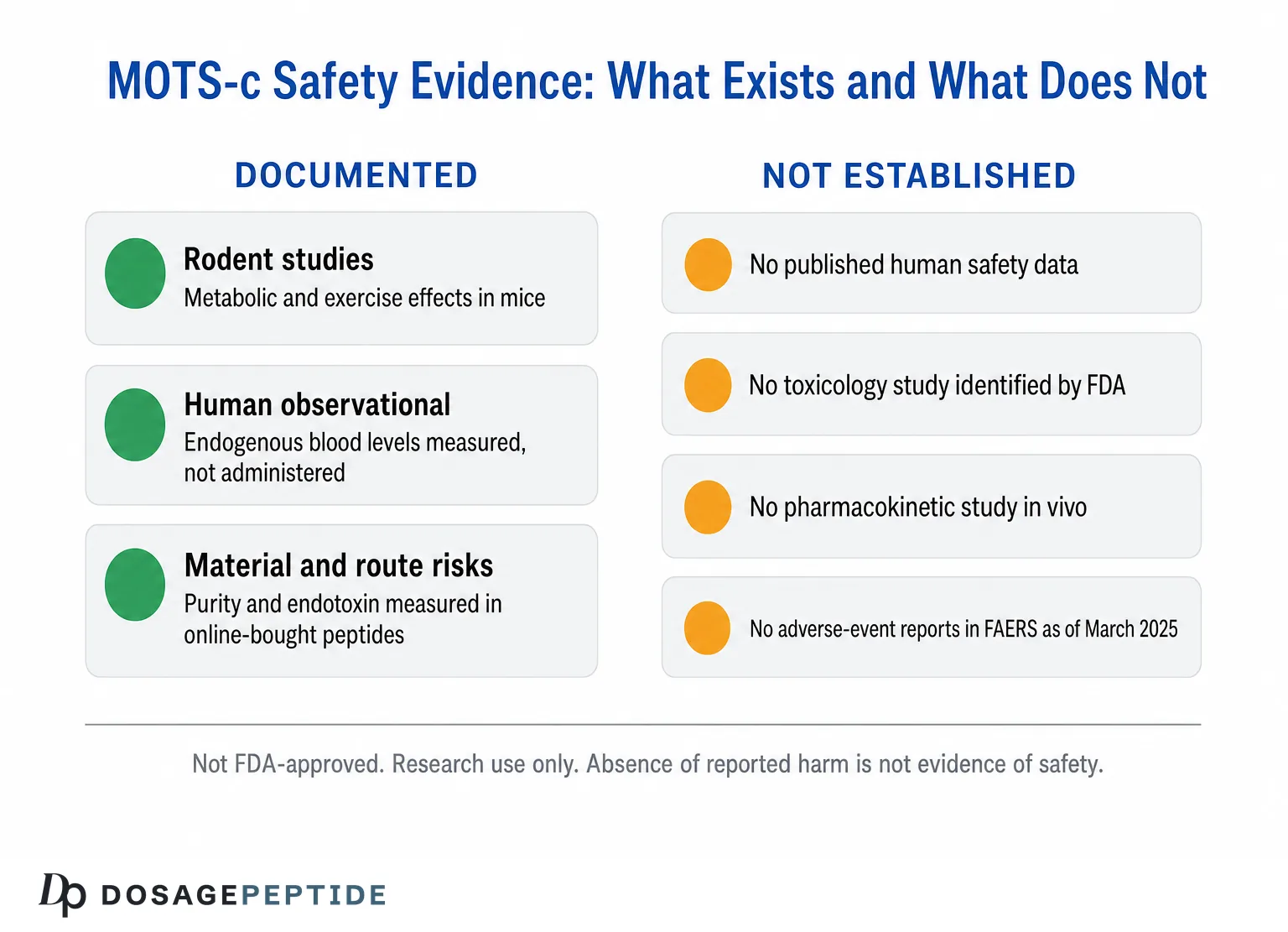
In May 2026 the U.S. Food and Drug Administration completed a formal evaluation of MOTS-c-related bulk drug substances for the section 503A compounding list. Its reviewers searched Drugs@FDA, Embase, PubMed, Web of Science, Pharmapendium, the National Toxicology Program, Cochrane, ClinicalTrials.gov and the FDA Adverse Event Reporting System (FAERS). Their conclusion is unusually direct for a regulatory document:[1]
“The nomination did not include, and FDA has not identified, any clinical studies or human exposure data for MOTS-c via any route of administration. Therefore, potential safety risks associated with the use of MOTS-c-related BDSs in humans are unknown.”
That finding is dated. FDA’s memo is dated 11 May 2026; a phase 2a interventional trial had been posted to ClinicalTrials.gov on 1 April 2026 and had begun dosing on 2 February 2026 (see below). FDA’s reviewers either searched before it posted or did not capture it. Nothing from that trial has been published, so the substance of FDA’s finding — no published human data — still holds.
Three specific absences sit underneath that sentence:
- No human exposure data in the record FDA reviewed. As of its May 2026 evaluation FDA had identified no phase 1 trial, case series or dose-escalation report by any route.[1] Human dosing has since begun in one registered trial (below), but nothing has been published.
- No nonclinical toxicology. FDA searched for and did not find acute toxicity, repeat-dose toxicity, genotoxicity, developmental and reproductive toxicity, or carcinogenicity studies of MOTS-c free base or MOTS-c acetate. The rodent literature is pharmacology — experiments designed to show an effect, not experiments designed to find harm.[1]
- No in-vivo pharmacokinetics. No study has measured what happens to injected MOTS-c in a living body over time — not in humans, and not in animals.[1]
FAERS was queried twice, covering everything through 9 March 2025. Both searches retrieved zero reports.[1] As explained further down, that zero is close to uninformative — and FDA says so itself in a footnote.
Evidence tier for each commonly claimed MOTS-c effect
The table below separates what is claimed about MOTS-c from what the underlying evidence actually is. “Tier” is the strongest study design that supports the row — not the strength of the belief.
| Claimed or plausible effect | What the actual evidence is | Evidence tier |
|---|---|---|
| Improves insulin sensitivity | Hyperinsulinemic-euglycemic clamp in male CD-1 mice: ~30% higher glucose infusion rate on 5 mg/kg/day intraperitoneal MOTS-c[2] | Rodent, in vivo |
| Reduces body weight / fat | High-fat-fed mice on 0.5 mg/kg/day IP for 8 weeks weighed ~20% less than vehicle controls[2] | Rodent, in vivo |
| Lowers blood glucose | Diet-induced obese mice, 2.5 mg/kg IP twice daily for 3 days: ~50% reduction in blood glucose[1] | Rodent, in vivo |
| Improves physical performance / healthspan | Acute 5 mg/kg IP improved treadmill performance in 2-, 12- and 22-month-old CD-1 mice; separately, intermittent 15 mg/kg three times weekly begun at 23.5 months in male C57BL/6N mice raised median lifespan from 912 to 970 days[3] | Rodent, in vivo |
| Activates AMPK via the folate cycle | HEK-293 cells, 10 µM MOTS-c: downregulation of one-carbon metabolism enzymes, AICAR accumulation[2] | In vitro only |
| Regulates nuclear gene expression | Nuclear translocation under glucose restriction and oxidative stress, AMPK-dependent, in cell models[4] | In vitro only |
| “Levels drop with age, so restoring them helps” | Cross-sectional associations of endogenous circulating peptide; assay validity contested (see below)[5][6] | Human observational association |
| Injection-site reactions | No published human data. Plausible for any subcutaneous peptide, but never measured for MOTS-c | None |
| Hypoglycaemia | Mechanistically arguable from rodent glucose-lowering; never studied in humans; no dose-response curve exists in any species[1] | None (theoretical) |
| Anti-drug antibodies / immunogenicity | FDA states it cannot rule this out and that no immunogenicity or aggregation study exists[1] | None (regulator-flagged concern) |
| Organ toxicity, fertility effects, cancer risk | No acute, repeat-dose, genotoxicity, reproductive or carcinogenicity study identified by FDA[1] | None — never tested |
| Endotoxin, contaminants, wrong content in vials | Documented repeatedly for unregulated injectable peptides bought online[7] | Directly measured — the best-evidenced risk on this page |
Read the bottom two rows together. The risks with the weakest evidence are the ones about the molecule. The risk with the strongest evidence is about the material in the vial.
Has any human trial of injected MOTS-c ever been run?
As of August 2026, a search of ClinicalTrials.gov returns exactly one interventional study in which MOTS-c is administered to humans: NCT07505745, a phase 2a randomised, double-blind, placebo-controlled study in adults with prediabetes and overweight or obesity, sponsored by Hudson Biotech. It plans 120 participants on a fixed once-daily subcutaneous dose for 12 weeks. It began recruiting on 2 February 2026, with estimated primary completion on 14 February 2027. No results have been posted.[8]
Two details of that registration are worth noticing, because they tell you what the field itself considers unknown. Its co-primary endpoint is not efficacy alone but the incidence of treatment-emergent adverse events through 16 weeks. And one of its secondary endpoints is anti-drug antibody assessment.[8] It is a single-site study at Peking University Shenzhen Hospital in Shenzhen, China; the registry record does not disclose the dose, and it has not been updated since it was first posted on 1 April 2026. One registration is not a field. Those are the two questions this article says are open, and a sponsor is now spending a year measuring them for the first time.
There is no registered phase 1 trial of administered MOTS-c on ClinicalTrials.gov. Other registered studies that mention MOTS-c — in coronary artery disease and type 2 diabetes (NCT04027712), and in dialysed chronic kidney disease (NCT07438002) — measure the endogenous peptide as a biomarker. They do not give it to anyone. That distinction runs through the rest of this page.
What do the rodent and cell studies actually show?
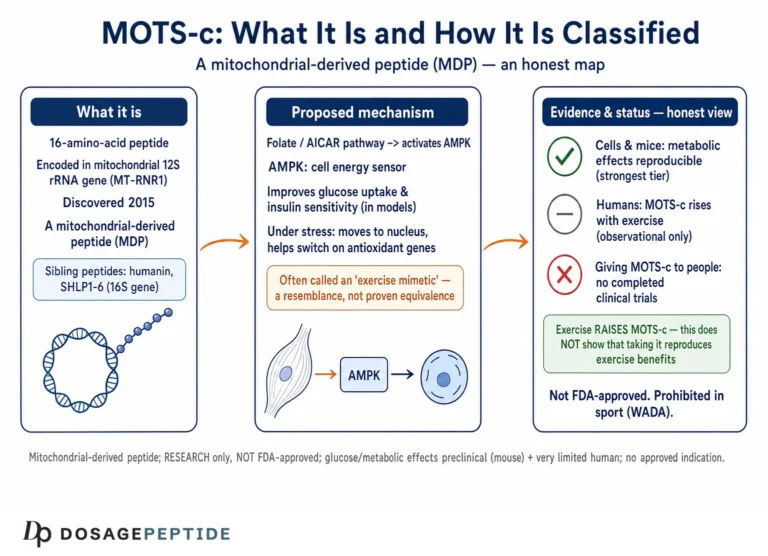
MOTS-c is a 16-amino-acid peptide (sequence MRWQEMGYIFYPRKLR) encoded by a short open reading frame inside the mitochondrial 12S rRNA gene, first described in 2015. If you want the full classification of where it sits among mitochondrial-derived peptides, that is covered separately in our reference entry on what MOTS-c is and how it is classified.
The AMPK and one-carbon metabolism mechanism
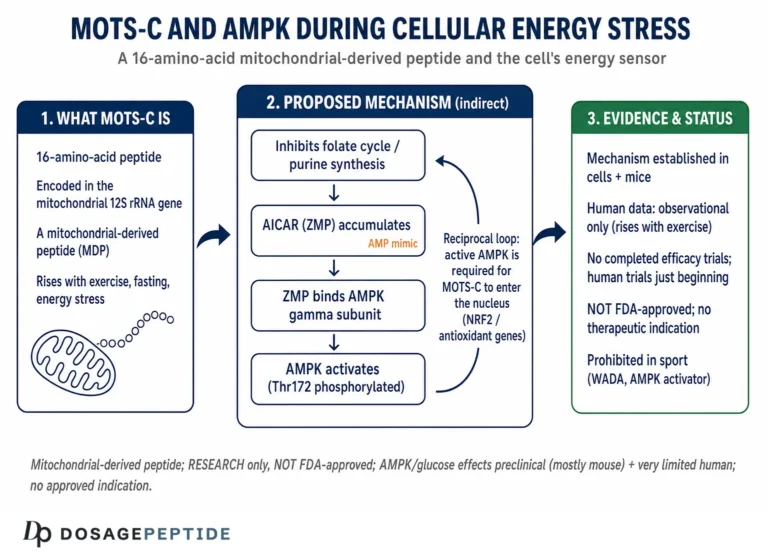
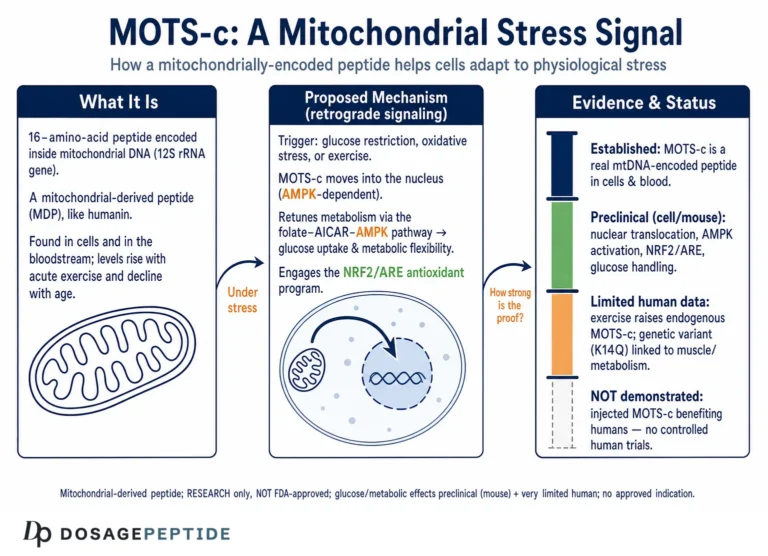
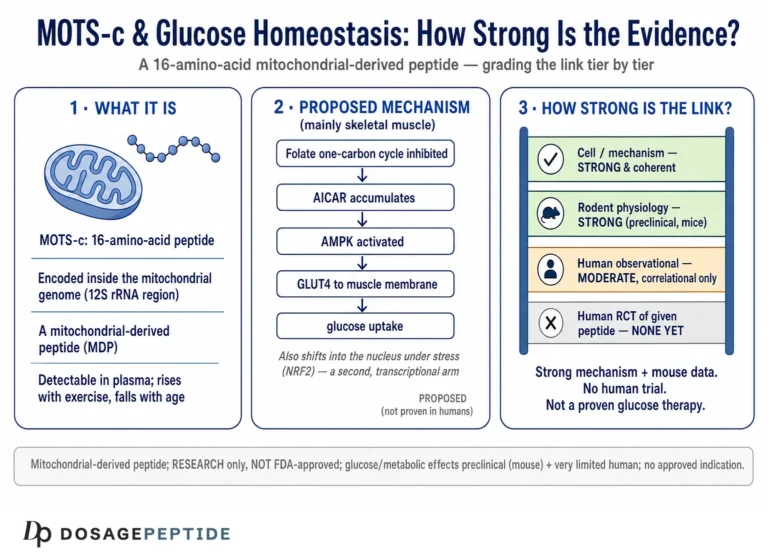
The originating work proposed that MOTS-c inhibits the folate cycle and the de novo purine biosynthesis tethered to it. Blocking that pathway causes the intermediate AICAR to accumulate, and AICAR is a well-characterised activator of AMP-activated protein kinase.[2] Subsequent work showed the peptide translocating to the nucleus under metabolic stress and interacting with antioxidant-response-element transcription factors including NRF2.[4] The pathway detail is developed further in our page on how MOTS-c regulates AMPK during cellular energy stress.
Why a mechanism is not a safety profile
FDA’s pharmacology reviewers made three criticisms of this literature that no amount of additional mechanism papers would fix:[1]
- Every in-vivo pharmacology study to date is in rodents.
- None of them assessed dose-response relationships in vivo.
- The molecular target of MOTS-c remains unknown. AMPK signalling appears to be involved, but the receptor or binding partner through which the peptide acts has not been identified.
Reading the doses across the studies FDA summarises — 0.5, 2.5, 5 and 15 mg/kg — no systematic curve emerges, which means there is no basis for identifying a threshold above which effects become harmful.
The third point is the load-bearing one for safety. As FDA puts it, because the target is unknown, “it is difficult to predict which organs might be targeted and affected by MOTS-c.”[1] Ordinary drug safety reasoning starts from a target: you know the receptor, you know where it is expressed, you know which tissues to watch. For MOTS-c that chain cannot be started. Nobody can currently say which organ to monitor, which is a different and larger problem than not yet having found a side effect.
One nuance is worth stating rather than hiding. A 2024 study reported that MOTS-c suppressed ovarian cancer growth in mice “without systemic toxicity” in vivo.[9] That is the closest thing in the literature to a tolerability observation, and it is a secondary remark in a mouse tumour experiment — not a toxicology study with histopathology, clinical chemistry and a no-observed-adverse-effect level.
What do human data on endogenous MOTS-c tell us — and what do they not?
There is a real human literature on MOTS-c. It measures the peptide your own mitochondria make. It does not involve giving anyone a synthetic version. Confusing the two is the single most common error on the topic, and it is worth being explicit: observing that a naturally occurring molecule tracks with health does not establish that injecting it is safe, effective, or even pharmacologically coherent.
The associations are messier than the marketing
A study of 125 Chinese adults without diabetes (cohort mean plasma MOTS-c 315 ± 27 pg/mL) found MOTS-c was elevated — not reduced — in the 26 participants with metabolic syndrome, with waist circumference the strongest correlate (p<0.0001) and liver fat a primary driver.[5] The authors interpreted this as a hormetic stress signal from a struggling liver. Whatever the interpretation, it points the opposite way from the popular “low MOTS-c causes metabolic disease, so top it up” story. The strength and direction of the metabolic evidence is examined in more depth in our page on how strongly the evidence links MOTS-c to glucose homeostasis.
Genetic work adds a further layer. An Asian-specific mitochondrial variant, m.1382A>C, produces a K14Q substitution in MOTS-c; a meta-analysis across three cohorts totalling 27,527 people found that men carrying the C-allele had a higher prevalence of type 2 diabetes.[10] An earlier hypothesis paper had linked the same variant to Japanese longevity.[11] Interesting genetics — and unambiguously about a peptide your cells encode, not about a vial.
An uncomfortable measurement problem
Much of the “MOTS-c declines with age” literature rests on commercial ELISA kits. When a WADA-accredited laboratory built a validated LC/MS assay for MOTS-c and compared it with a commercial ELISA in 20 healthy subjects, the ELISA-reported range of 45.9–218.5 ng/mL could not be confirmed by mass spectrometry, and the authors recorded “considerable differences” between methods.[6] That is a gap of roughly 150- to 700-fold from the picogram-per-millilitre values reported elsewhere.[5] Until the assays agree, quantitative claims about circulating MOTS-c should be treated as provisional, and any protocol built on “restoring youthful levels” is building on a number nobody has pinned down.
What are the open risk questions?
The following are open questions, not documented side effects. Each is stated because it is mechanistically or regulatorily reasonable to ask, and each is unanswered.
Glucose and AMPK signalling
Whether the glycaemic effect recorded in mice occurs in humans at all, at what exposure, and whether it could compound with insulin, sulfonylureas or GLP-1 receptor agonists is entirely unstudied. AMPK is also not a metabolism-only switch — it sits upstream of autophagy, protein synthesis and cell growth — so chronic pharmacological activation raises questions in tissues nobody has looked at.
Immunogenicity of an injected peptide
FDA devotes a full subsection to this. Peptides can elicit antibody responses, and the subcutaneous route is generally associated with greater immunogenicity than intravenous. Peptides also aggregate, and aggregates are a recognised immunogenicity risk factor.[1][12] FDA notes that aggregation has been demonstrated in species as short as two amino acids.[1] The particular concern with a peptide that has an endogenous counterpart is that neutralising antibodies could, in principle, cross-react with the body’s own version. FDA’s position is that no study exists to exclude any of this.[1][13]
Whether injected MOTS-c survives long enough to do anything
The only pharmacokinetic-adjacent study in the literature is in vitro. MOTS-c incubated in human whole blood at 37 °C was rapidly cleaved into shorter fragments — MOTS-c(2–16), (3–16), (4–16) and (5–16) were identified — and the hydrolysis did not require long incubation.[6] FDA drew the obvious inference: it remains to be determined whether administering MOTS-c to humans can generate pharmacologically active concentrations at all.[1] This cuts both ways for safety. Rapid degradation may limit systemic exposure — or it may mean that what circulates is a mixture of fragments whose activity and tolerability nobody has characterised.
Long-term pharmacological mitochondrial signalling
Every rodent experiment runs weeks to months in an animal with a roughly three-year lifespan. Nothing addresses years of exogenous mitochondrial-peptide signalling in a human, and no carcinogenicity study exists. The oncology literature is early and bidirectional — reduced tumour levels associated with worse prognosis in one setting, growth suppression when supplied in another.[9] A reason for humility, not a claim in either direction.
The risks that are actually documented: the material and the route
Here the evidence is stronger, and it is not about MOTS-c at all — it is about what happens when injectable peptides move through an unregulated supply chain. In a controlled test-purchase study of semaglutide bought from illegal online pharmacies, investigators found measured peptide purity of 7.7% to 14.37% against a labelled 99%, peptide content exceeding the stated amount by 28.56% to 38.69%, and detectable endotoxin in every sample (2.16–8.95 EU/mg).[7] Endotoxin injected subcutaneously causes fever, rigors and systemic inflammatory reactions independent of whatever the labelled molecule does.
FDA’s own characterisation review found the same class of gap for MOTS-c specifically: no USP or NF monograph exists; naming is inconsistent across suppliers to the point that free base and acetate salt are sold interchangeably under one common name; and quality-control attributes including impurities, aggregates, microbial bioburden and bacterial endotoxin levels were not found in the publicly available literature.[1] Research-grade lyophilised powder is not a finished sterile injectable product, and no certificate of analysis converts one into the other — our guide to reading a peptide COA, HPLC purity and mass-spec identity covers what those documents do and do not establish, and the reconstitution reference covers the sterility and handling variables that sit entirely outside any COA. The broader question of what “safe” can and cannot mean for this category is addressed in our page on whether peptides are safe.
The practical distinction: risk of the molecule is unquantified because nobody has studied it. Risk of the material and the route is measurable, has been measured for comparable products, and is bad.
Why “no reported side effects” is not evidence of safety
FAERS holds zero MOTS-c reports through March 2025.[1] Four structural reasons make that number close to meaningless:
- No reporting obligation. FDA notes in its own footnote that compounders operating under section 503A generally do not report adverse events to the agency, and that unless a report is submitted, FDA may simply not know.[1] Research-chemical vendors are further outside that system still.
- No trial monitoring. Adverse events in trials are found because someone is systematically looking — scheduled labs, symptom diaries, adjudication. With no completed trial, no one has ever looked.
- No denominator. Nobody knows how many people have used MOTS-c, at what doses, for how long. Without a denominator, an absence of reports has no rate attached to it.
- Severe reporting bias. Someone who bought an unapproved peptide online and felt unwell is not a well-motivated reporter to a federal database, and a clinician may never learn what was taken.
The honest formulation is: no harms have been documented because no system capable of documenting them has been pointed at this molecule. That is a statement about surveillance, not about the compound.
What is the regulatory status of MOTS-c?
MOTS-c is not an approved drug anywhere. It is not a component of any FDA-approved product, has no USP or NF monograph, and appears in no European Pharmacopoeia or Japanese Pharmacopoeia listing; the European Medicines Agency lists no authorised product containing it.[1]
On the compounding question, FDA’s reviewers proposed not adding MOTS-c free base or MOTS-c acetate to the 503A Bulks List, on the grounds that the substances are not well characterised, have unknown use in compounding, have no nonclinical data to inform safety, and have no clinical studies of safety or effectiveness in humans.[1] At the Pharmacy Compounding Advisory Committee meeting of 23–24 July 2026, the committee voted against that recommendation and included MOTS-c among six peptides it recommended for the list.[14] Advisory committee votes are recommendations and are not binding on FDA; final rulemaking has not concluded. An advisory vote is not an approval, and it did not generate any new safety data — the evidence base described on this page is unchanged by it.
Separately, MOTS-c is named explicitly in the World Anti-Doping Agency 2026 Prohibited List under S4.4.1, activators of AMP-activated protein kinase, prohibited at all times, in and out of competition, as a non-Specified Substance.[15] Tested athletes should treat any exposure as a sanctionable finding.
For completeness, the vial and quantity conventions used across the research literature and by suppliers are documented in our MOTS-c 10 mg vial reference. That page describes what is reported in research contexts; it is not a human protocol, and nothing on this page should be read as one.
The bottom line
MOTS-c is a research chemical. It is not approved for human therapeutic use in any jurisdiction. Its rodent pharmacology is genuinely interesting, its molecular target is unidentified, its in-vivo pharmacokinetics have never been measured in any species, and its published human safety profile does not exist — not as “mild”, not as “well tolerated”, but as an empty set. The first dataset capable of changing that is due no earlier than 2027. Until then, anyone writing a MOTS-c side-effect list is writing fiction, and the most defensible thing that can be said about the safety of injecting it is that nobody knows.
Frequently Asked Questions
Does MOTS-c have any proven side effects?
None have ever been documented — and that is a statement about missing surveillance, not about the compound. There is no published human safety dataset for administered MOTS-c, no completed clinical trial reporting adverse events, and no adverse-event reports in the FDA Adverse Event Reporting System through March 2025. FDA also found no acute, repeat-dose, genotoxicity, reproductive or carcinogenicity studies in animals. Lists of “MOTS-c side effects” circulating online are extrapolations from rodent pharmacology, borrowings from other peptides, or unverified anecdote.
Is MOTS-c safe?
Unknown, in the literal sense. FDA’s 2026 review states that potential safety risks of MOTS-c in humans are unknown because no clinical studies or human exposure data exist for any route of administration. That is different from “safe” and different from “dangerous”. The one safety-relevant claim with hard evidence behind it concerns the unregulated supply chain rather than the molecule itself.
Has MOTS-c been tested in humans?
One interventional trial is currently registered: NCT07505745, a phase 2a placebo-controlled study of subcutaneous MOTS-c in 120 adults with prediabetes and overweight or obesity, which began dosing in February 2026 with estimated primary completion in February 2027. It is a single site in Shenzhen, China, and no results have been posted. Other registered studies mentioning MOTS-c measure the naturally occurring peptide as a biomarker rather than administering it.
Why do so many articles list specific MOTS-c side effects?
Because a page answering a safety question with “no data exist” is harder to monetise than a page listing fatigue, injection-site redness and nausea. Those items are generic to subcutaneous injection of anything and have never been measured for MOTS-c. The absence of a documented profile is the actual answer to the question, and it is a more useful answer than an invented list.
Does MOTS-c cause low blood sugar?
Not documented in humans. The rodent result in the evidence table above makes a glycaemic effect mechanistically plausible. But no dose-response relationship has been established in any species, no human exposure has been characterised, and no interaction study with glucose-lowering medication has been conducted. It is an open question, not a documented adverse effect.
Can MOTS-c trigger an immune reaction?
No study has assessed immunogenicity or aggregation of MOTS-c, and FDA states it cannot rule the risk out. Peptides can provoke antibody responses; subcutaneous administration is generally more immunogenic than intravenous; and peptide aggregates are a recognised immunogenicity risk factor. The current phase 2a trial includes anti-drug antibody assessment as a secondary endpoint, which indicates the question is regarded as genuinely open.
Is research-grade MOTS-c the same as pharmaceutical MOTS-c?
No, and no pharmaceutical MOTS-c product exists. There is no USP or NF monograph, and FDA found that naming is inconsistent enough across suppliers that free base and acetate salt are sold under the same common name. Publicly available literature contained no quality data on impurities, aggregates, microbial bioburden or bacterial endotoxin. Comparable unregulated injectable peptides bought online have measured well below labelled purity and contained endotoxin.
Is MOTS-c banned in sport?
Yes. MOTS-c is named explicitly in the World Anti-Doping Agency 2026 Prohibited List under section S4.4.1, activators of AMP-activated protein kinase, alongside AICAR. It is prohibited at all times, both in and out of competition, and is classified as a non-Specified Substance. A validated plasma detection method for doping control has been published.
Did FDA approve MOTS-c in 2026?
No. In July 2026 an FDA advisory committee recommended including MOTS-c on the 503A list of bulk substances usable in pharmacy compounding — against FDA reviewers’ own proposal to exclude it. Advisory votes are non-binding recommendations, rulemaking has not concluded, and inclusion on a compounding bulks list is not drug approval. No new safety or efficacy data were generated by that process.
References
- U.S. Food and Drug Administration. FDA Briefing Document, Pharmacy Compounding Advisory Committee: Evaluation of MOTS-c-Related Bulk Drug Substances (MOTS-c free base and MOTS-c acetate) for Inclusion on the 503A Bulk Drug Substances List. 23–24 July 2026. https://www.fda.gov/media/193347/download
- Lee C, Zeng J, Drew BG, et al. The mitochondrial-derived peptide MOTS-c promotes metabolic homeostasis and reduces obesity and insulin resistance. Cell Metab. 2015;21(3):443–454. https://pubmed.ncbi.nlm.nih.gov/25738459/
- Reynolds JC, Lai RW, Woodhead JST, et al. MOTS-c is an exercise-induced mitochondrial-encoded regulator of age-dependent physical decline and muscle homeostasis. Nat Commun. 2021;12(1):470. https://pubmed.ncbi.nlm.nih.gov/33473109/
- Kim KH, Son JM, Benayoun BA, Lee C. The mitochondrial-encoded peptide MOTS-c translocates to the nucleus to regulate nuclear gene expression in response to metabolic stress. Cell Metab. 2018;28(3):516–524. https://pubmed.ncbi.nlm.nih.gov/29983246/
- Sequeira IR, Woodhead JST, Chan A, et al. Plasma mitochondrial derived peptides MOTS-c and SHLP2 positively associate with android and liver fat in people without diabetes. Biochim Biophys Acta Gen Subj. 2021;1865(11):129991. https://pubmed.ncbi.nlm.nih.gov/34419510/
- Knoop A, Thomas A, Thevis M. Development of a mass spectrometry based detection method for the mitochondrion-derived peptide MOTS-c in plasma samples for doping control purposes. Rapid Commun Mass Spectrom. 2019;33(4):371–380. https://pubmed.ncbi.nlm.nih.gov/30394592/
- Ashraf AR, Mackey TK, Vida RG, et al. Multifactor quality and safety analysis of semaglutide products sold by online sellers without a prescription. J Med Internet Res. 2024;26:e65440. https://pubmed.ncbi.nlm.nih.gov/39509151/
- ClinicalTrials.gov. A Phase 2a, Randomized, Double-blind, Placebo-controlled Study to Evaluate the Efficacy, Safety, and Pharmacodynamics of MOTS-c (a Mitochondrial-Derived Peptide) in Adults With Prediabetes and Overweight/Obesity. NCT07505745. Hudson Biotech; recruiting; accessed August 2026. https://clinicaltrials.gov/study/NCT07505745
- Yin Y, Li Y, Ma B, et al. Mitochondrial-derived peptide MOTS-c suppresses ovarian cancer progression by attenuating USP7-mediated LARS1 deubiquitination. Adv Sci. 2024;11(43):e2405620. https://pubmed.ncbi.nlm.nih.gov/39321430/
- Zempo H, Kim SJ, Fuku N, et al. A pro-diabetogenic mtDNA polymorphism in the mitochondrial-derived peptide, MOTS-c. Aging (Albany NY). 2021;13(2):1692–1717. https://pubmed.ncbi.nlm.nih.gov/33468709/
- Fuku N, Pareja-Galeano H, Zempo H, et al. The mitochondrial-derived peptide MOTS-c: a player in exceptional longevity? Aging Cell. 2015;14(6):921–923. https://pubmed.ncbi.nlm.nih.gov/26289118/
- Zapadka KL, Becher FJ, Gomes dos Santos AL, Jackson SE. Factors affecting the physical stability (aggregation) of peptide therapeutics. Interface Focus. 2017;7(6):20170030. https://pubmed.ncbi.nlm.nih.gov/29147559/
- U.S. Food and Drug Administration. Guidance for Industry: Immunogenicity Assessment for Therapeutic Protein Products. August 2014. https://www.fda.gov/media/85017/download
- National Community Pharmacists Association. FDA advisory committee nominates six peptides for pharmacies to compound. 31 July 2026. https://ncpa.org/newsroom/qam/2026/07/31/fda-advisory-committee-nominates-six-peptides-pharmacies-compound
- World Anti-Doping Agency. The 2026 Prohibited List, section S4.4.1 (Metabolic Modulators — activators of AMPK). Effective 1 January 2026. https://www.wada-ama.org/sites/default/files/2025-09/2026list_en_final_clean_september_2025.pdf
Research use only. MOTS-c is an investigational compound with no approved human therapeutic use in any jurisdiction. This page is an independent summary of the published scientific and regulatory record, compiled for laboratory reference and educational purposes. It is not medical advice, not a dosing protocol, and not a recommendation to administer MOTS-c to humans or animals. Dosage Peptide does not sell peptides and has no clinical relationship with any reader.