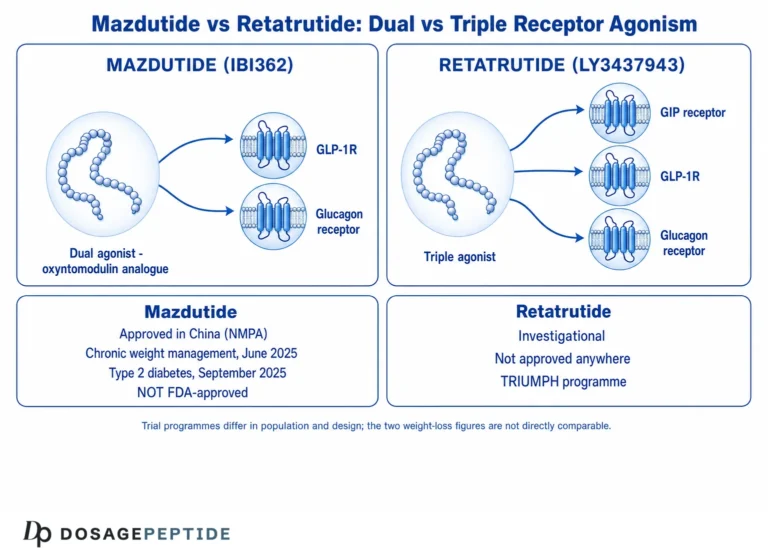
Mazdutide is a once-weekly injectable that activates two receptors at once — GLP-1 and glucagon — which is what sets it apart from single-target drugs such as semaglutide. In phase 3 trials in Chinese adults with overweight or obesity it produced clinically meaningful weight loss against placebo, and China’s NMPA approved it for chronic weight management on 27 June 2025, followed by an approval for glycaemic control in type 2 diabetes on 19 September 2025. It is not approved by the FDA or the EMA. The most common side effects in the trials were gastrointestinal — nausea, diarrhoea and vomiting — mostly mild to moderate, and concentrated during dose escalation. Below: how the dual mechanism works, the trial results in numbers, the side-effect profile, and where its regulatory status stands today.
The reason mazdutide attracts so much attention is conceptual as much as clinical. Where the first generation of blockbuster obesity and diabetes drugs (such as semaglutide) act on a single incretin receptor, and the second generation (such as tirzepatide) engage two incretin receptors, mazdutide takes a different combinatorial route: it pairs the appetite-suppressing, insulin-sensitizing actions of GLP-1 with the energy-expenditure and hepatic-metabolism effects of glucagon. That pairing is theoretically attractive for both body-weight reduction and liver-fat clearance, but it also introduces distinctive pharmacological questions that only carefully controlled trials can answer.411
This article is an evidence-cautious, education-first explainer written for readers who want to understand what mazdutide actually is, what the primary literature shows, and — just as importantly — what it does not yet show. Mazdutide is not approved by the U.S. Food and Drug Administration (FDA) or the European Medicines Agency (EMA). As of mid-2026 its only marketing authorization is from China’s National Medical Products Administration (NMPA), granted in June 2025 for chronic weight management. Everything below is provided for research and educational purposes only and is not medical advice, dosing guidance, or an endorsement of any use in humans.5
What Mazdutide Is and Where It Came From
Mazdutide is a synthetic peptide agonist designed around the biology of oxyntomodulin, a 37-amino-acid hormone released from the L-cells of the gut after eating. Oxyntomodulin is naturally a “dual” molecule: it activates both the GLP-1 receptor and the glucagon receptor, though with modest potency and a very short half-life that make the native hormone impractical as a drug. Medicinal chemists have therefore tried to re-engineer oxyntomodulin’s dual-receptor pharmacology into a stabilized, long-acting analog, and mazdutide is one product of that effort.111
The molecule carries structural modifications — including a fatty-acid chain that promotes binding to albumin — that extend its circulating half-life enough to support once-weekly subcutaneous administration. This “lipidation” strategy is the same broad approach used in several other long-acting peptide therapeutics, and it is central to why a naturally fleeting gut signal can be converted into a weekly injectable candidate.3
On the development side, the compound originated in Eli Lilly’s pipeline (hence the Lilly code LY3305677) and was licensed to Innovent Biologics, a Chinese biopharmaceutical company, which has driven its clinical development under the internal designation IBI362 and the international nonproprietary name mazdutide. The clinical program has been overwhelmingly China-based, with lead investigators such as Professor Linong Ji of Peking University People’s Hospital appearing on the pivotal publications. This geographic concentration matters for interpretation: most efficacy and safety data derive from Chinese adult populations, and extrapolation to other ancestries, body types, and healthcare settings has not been established in large trials.13
Two therapeutic directions have been pursued in parallel. The first is chronic weight management in people with overweight or obesity, which produced the first approval. The second is glycemic control in type 2 diabetes, for which a separate new drug application has been accepted for review by the NMPA. Both indications flow from the same core pharmacology but rest on different trial programs, so they should be evaluated separately rather than assumed to be interchangeable.58
It is worth being precise about naming, because the peptide-research audience frequently encounters the same molecule under several labels. “Mazdutide,” “IBI362,” and “LY3305677” all refer to the same compound. It should not be confused with the incretin single- and triple-agonists it is often compared against — semaglutide (GLP-1 only), tirzepatide (GLP-1/GIP), or retatrutide (GLP-1/GIP/glucagon triple agonist) — nor with survodutide, which is a different GLP-1/glucagon dual agonist developed by another company. These distinctions are covered in the comparison section below and in the related protocol pages linked throughout, including the semaglutide dosage protocol and the retatrutide dosage protocol.11
Molecular Mechanism: Dual GLP-1 and Glucagon Receptor Agonism

To understand mazdutide, it helps to separate the two arms of its action and then consider why combining them is thought to be advantageous. Both the GLP-1 receptor and the glucagon receptor are G-protein-coupled receptors, and both are relevant to how the body manages energy, glucose, and fat — but they push metabolism in partly different directions.11
The GLP-1 receptor arm is the more familiar of the two. Activating GLP-1 receptors enhances glucose-dependent insulin secretion from pancreatic beta cells, suppresses inappropriate glucagon release after meals, slows gastric emptying, and — through actions in the brain — reduces appetite and food intake. These are the mechanisms that underlie the weight loss and glucose-lowering seen with pure GLP-1 receptor agonists. In mazdutide, this arm is expected to contribute most of the appetite suppression and much of the glycemic benefit.411
The glucagon receptor arm is what makes mazdutide conceptually distinct from GLP-1-only drugs. Glucagon is classically thought of as a hormone that raises blood glucose, which sounds counterproductive for a diabetes or obesity agent. But glucagon also increases energy expenditure, promotes lipolysis (fat breakdown) and fatty-acid oxidation, and reduces hepatic fat accumulation. The therapeutic hypothesis is that the glucose-raising tendency of glucagon receptor activation is offset by the strong glucose-lowering and insulinotropic effects of the co-administered GLP-1 activity, leaving a net metabolic profile that combines appetite suppression with higher calorie burning and improved liver-fat handling.11
This is why mazdutide’s mechanism is often summarized as achieving weight loss through two complementary levers: reducing energy intake (mostly GLP-1-driven) while increasing energy expenditure and fat mobilization (glucagon-driven). In principle, engaging energy expenditure is a lever that pure GLP-1 agonists do not pull, which is one reason researchers are interested in whether dual agonists can deliver additional benefits on body composition and hepatic fat beyond appetite suppression alone.4
| Receptor arm | Principal reported effects | Intended metabolic contribution |
|---|---|---|
| GLP-1 receptor | Glucose-dependent insulin secretion, post-meal glucagon suppression, slowed gastric emptying, reduced appetite | Lower food intake and improved glycemic control |
| Glucagon (GCG) receptor | Increased energy expenditure, lipolysis and fatty-acid oxidation, reduced hepatic fat | Higher calorie burning and liver-fat reduction |
It is also worth understanding why pharmacologists reached for glucagon specifically, rather than simply increasing the dose of a GLP-1-only drug. Appetite suppression has a practical ceiling: beyond a certain point, pushing GLP-1 activity higher mainly amplifies gastrointestinal side effects rather than adding proportionate weight loss, and it does nothing to raise the body’s energy expenditure. Glucagon offers a fundamentally different mechanism — it works on the “output” side of the energy-balance equation by increasing how many calories are burned and how much fat is oxidized, particularly in the liver. Combining an “intake-reducing” signal with an “expenditure-increasing” signal is therefore a way to attack body weight from two directions at once, which is the central rationale that distinguishes dual GLP-1/glucagon agonists from their single-receptor predecessors.411
The liver deserves special mention because it is where the glucagon arm is thought to be most consequential. Glucagon receptors are densely expressed in hepatic tissue, and their activation promotes the mobilization and oxidation of stored fat. In practical trial terms, this is why mazdutide’s obesity studies specifically measured hepatic fat content by imaging in participants who began with elevated liver fat, and why large relative reductions in liver fat were reported. Non-alcoholic fatty liver disease (now often termed metabolic dysfunction-associated steatotic liver disease) frequently accompanies obesity and type 2 diabetes, so a mechanism that directly targets hepatic fat is of considerable research interest — though, again, imaging changes are surrogate findings that do not by themselves establish improvement in clinical liver outcomes.4
A critical caveat is that the balance of activity between the two receptors — the so-called agonist ratio — is a defining design parameter for any dual agonist, and small differences in that ratio can produce meaningfully different clinical profiles. Too much glucagon activity relative to GLP-1 could, in theory, worsen glycemia or increase heart rate; too little could waste the differentiating benefit. The published human data (discussed next) are the only reliable way to judge how mazdutide’s particular ratio actually behaves in people, and they should be weighted far more heavily than mechanistic reasoning or preclinical modeling.11
The Clinical Evidence Base: What the Trials Actually Show
Mazdutide has an unusually well-documented early clinical program for a peptide of its class, progressing through phase 1, phase 2, and multiple phase 3 trials, with several results published in peer-reviewed journals rather than only in press releases. That is a genuine strength relative to many “research peptides” for which independent data are thin. The honest framing, however, is that the evidence is concentrated in Chinese adult populations, relatively recent, and still accumulating, and that it establishes efficacy for specific approved and investigational indications rather than any general-purpose benefit.13
Phase 1b (obesity, higher doses). An early randomized, placebo-controlled, multiple-ascending-dose phase 1b trial (NCT04440345) in Chinese adults with overweight or obesity, published in eClinicalMedicine in 2022, tested two escalation cohorts. In the 9 mg cohort (escalated 3→6→9 mg over 12 weeks), mean body-weight change was approximately −11.7% versus −1.8% for placebo; in the 10 mg cohort (2.5→5→7.5→10 mg over 16 weeks), it was about −9.5% versus −3.3%. The trial was small (24 participants) but signaled dose-related weight loss with predominantly mild-to-moderate gastrointestinal side effects.1
Phase 2 (obesity). A larger phase 2 randomized controlled trial (NCT04904913), published in Nature Communications in 2023 with 248 participants, compared once-weekly mazdutide 3 mg, 4.5 mg, and 6 mg against placebo. At 24 weeks, mean body-weight change from baseline was −6.7% (3 mg), −10.4% (4.5 mg), and −11.3% (6 mg) versus +1.0% for placebo. The proportion achieving at least 5% weight loss reached roughly 80% in the higher-dose arms, and metabolic co-benefits (waist circumference, blood pressure, lipids, transaminases, serum uric acid) were reported. This trial is the backbone of the dose selection that carried forward into phase 3.3
Phase 1b (type 2 diabetes). In parallel with the obesity work, an early phase 1b randomized controlled trial evaluated IBI362 (LY3305677) in Chinese patients with type 2 diabetes, examining glucose-lowering and body-weight effects along with the safety and pharmacokinetic behavior needed to justify the later diabetes program. This diabetes-focused early trial matters because it established that the same molecule could engage glycemic endpoints — not only weight — and it helped define the tolerability and dose-escalation approach that recurs throughout the later studies. As with all phase 1b work, sample sizes were small and the purpose was signal-finding and safety characterization rather than definitive efficacy.2
GLORY-1 (phase 3, obesity). The pivotal phase 3 obesity trial GLORY-1 (NCT05607680) randomized Chinese adults with overweight or obesity to mazdutide 4 mg, 6 mg, or placebo. At week 48, reported mean body-weight reductions were about −12.0% (4 mg) and −14.8% (6 mg) versus −0.5% for placebo, with roughly 37% (4 mg) and 51% (6 mg) of participants losing at least 15% of body weight. GLORY-1 also reported substantial reductions in waist circumference and, in participants with elevated baseline liver fat, large relative reductions in hepatic fat content. These results underpinned the NMPA approval.45
Importantly for how much weight these numbers should carry, GLORY-1 is no longer known only from a conference presentation or a sponsor press release: its full results were subsequently published in a leading peer-reviewed general-medical journal, the New England Journal of Medicine, under the title “Once-Weekly Mazdutide in Chinese Adults with Obesity or Overweight.” Peer-reviewed publication in a journal of that stature means the methodology, statistical handling, and adverse-event accounting were subject to external editorial and reviewer scrutiny rather than only sponsor framing. This does not remove the trial’s structural limitations — it was still sponsor-run and still enrolled a Chinese-only population — but it does move the headline efficacy figures from the weaker tier of evidence (press-release claims) into the stronger tier of a fully reported, independently reviewed manuscript, which is the appropriate standard for citing specific percentage outcomes.4
GLORY-2 (phase 3, higher dose 9 mg). A subsequent higher-dose phase 3 trial, GLORY-2 (NCT06164873), tested mazdutide 9 mg over a 60-week double-blind period in 462 Chinese adults with obesity (about 16% with type 2 diabetes). Reported results included a mean weight reduction of roughly 18.6% at week 60 versus about 3.0% for placebo, with around 44% of participants achieving at least 20% weight loss; among participants without type 2 diabetes, mean reduction was about 20.1%. The full results were published as a randomized clinical trial report, and a supplementary application for the 9 mg dose was accepted for NMPA review.67
DREAMS-3 (phase 3, type 2 diabetes, head-to-head). In the diabetes program, the DREAMS-3 trial compared mazdutide directly against semaglutide in Chinese patients with type 2 diabetes and obesity — reportedly the first phase 3 head-to-head of a GLP-1/glucagon dual agonist against a GLP-1-only agent. On the composite primary endpoint (proportion achieving HbA1c < 7.0% and at least 10% weight loss at week 32), mazdutide was reported superior (about 48% vs 21%), with numerically greater mean HbA1c reduction and weight loss. Two phase 3 diabetes results were subsequently published back-to-back in Nature.89
| Trial (registry) | Phase / population | Key reported weight or glycemic result |
|---|---|---|
| Phase 1b (NCT04440345) | 1b / obesity, higher doses | ~−11.7% (9 mg, 12 wk) vs ~−1.8% placebo1 |
| Phase 2 (NCT04904913) | 2 / obesity | ~−11.3% (6 mg, 24 wk) vs +1.0% placebo3 |
| GLORY-1 (NCT05607680) | 3 / obesity | ~−14.8% (6 mg, 48 wk) vs ~−0.5% placebo4 |
| GLORY-2 (NCT06164873) | 3 / obesity, 9 mg | ~−18.6% (9 mg, 60 wk) vs ~−3.0% placebo6 |
| DREAMS-3 | 3 / T2D vs semaglutide | Composite endpoint ~48% vs ~21%8 |
One further point of nuance is worth drawing out about how these numbers should be read side by side. It is tempting to line up the phase 1b, phase 2, GLORY-1, and GLORY-2 figures and conclude that mazdutide’s efficacy simply climbs with dose and duration. The trend is real, but the trials differ in their populations, escalation schedules, treatment lengths, and analytic conventions (for example, whether results are reported for all randomized participants or only those who completed treatment, and how missing data are handled). These design differences can shift a headline percentage by several points, so cross-trial comparisons are best treated as broadly directional rather than precisely additive. The disciplined reading is that higher doses and longer exposure produced larger weight loss within each study’s own design, and that the largest reported effects (around 18–20% at 9 mg over 60 weeks) came at the cost of higher gastrointestinal event rates.36
Taken together, these trials describe a consistent, dose-related weight-loss signal and meaningful cardiometabolic changes in the studied populations. The appropriate level of confidence is “well-supported for the specific Chinese obesity and diabetes indications studied, and newly approved in one jurisdiction” — not “broadly proven” for global populations, long-term safety, or any off-label objective.5
How Mazdutide Compares With Related Compounds
Mazdutide sits within a crowded and rapidly evolving class of incretin-based agents, and understanding its place requires distinguishing which receptors each molecule engages. The number and combination of receptor targets is the single most useful lens for comparison, because it predicts much about the expected balance of appetite suppression, glucose control, energy expenditure, and side-effect profile.11
| Compound | Receptor targets | Approval status (mid-2026) |
|---|---|---|
| Semaglutide | GLP-1 only | FDA/EMA approved (diabetes, obesity) |
| Tirzepatide | GLP-1 + GIP (dual) | FDA/EMA approved (diabetes, obesity) |
| Mazdutide | GLP-1 + glucagon (dual) | NMPA-approved (China, obesity); investigational elsewhere |
| Survodutide | GLP-1 + glucagon (dual) | Investigational |
| Retatrutide | GLP-1 + GIP + glucagon (triple) | Investigational |
| Cagrilintide | Amylin (often paired with semaglutide) | Investigational |
Versus semaglutide (GLP-1 only). The clearest contrast is mechanistic: semaglutide relies solely on GLP-1 receptor activation, whereas mazdutide adds glucagon receptor activity intended to boost energy expenditure and liver-fat clearance. In the DREAMS-3 head-to-head in Chinese patients with type 2 diabetes and obesity, mazdutide was reported to outperform semaglutide on a composite glycemic-plus-weight endpoint. However, one head-to-head trial in one population is not the same as broad superiority, and semaglutide carries far more long-term, cross-population safety and cardiovascular-outcome data. The GLP-1-only comparator, semaglutide, is covered in its own protocol page linked above.8
Versus tirzepatide (GLP-1/GIP). Tirzepatide is also a dual agonist, but its second target is GIP rather than glucagon. Both mazdutide and tirzepatide therefore engage GLP-1 plus one additional pathway, yet the biology of that additional pathway differs substantially — GIP versus glucagon — so their body-composition and hepatic effects may not be interchangeable. Tirzepatide has the advantage of FDA/EMA approval and large multinational trials. A dedicated overview is available on the tirzepatide protocol page.
Versus retatrutide (GLP-1/GIP/glucagon). Retatrutide is a step further, a triple agonist that combines both of mazdutide’s targets (GLP-1 and glucagon) with GIP. Conceptually, retatrutide can be viewed as adding the GIP arm on top of a dual GLP-1/glucagon backbone. It remains investigational, but its early data have drawn attention for large weight-loss magnitudes. The retatrutide protocol page covers that triple-agonist context in more depth.
Versus survodutide (GLP-1/glucagon). Survodutide is mazdutide’s closest mechanistic sibling — another GLP-1/glucagon dual agonist — but developed by a different company and with a different molecular design and agonist ratio. Because two GLP-1/glucagon dual agonists can differ meaningfully in their receptor-activity balance, survodutide and mazdutide should not be assumed to behave identically. Direct head-to-head data between them are not available.11
Versus amylin-based agents (cagrilintide). Amylin analogs like cagrilintide act through a different hormone system entirely and are often studied in combination with a GLP-1 agonist. They are included here only to clarify that not every next-generation obesity candidate is an incretin dual/triple agonist; the cagrilintide protocol page and the cagrilintide + semaglutide blend page illustrate that alternative approach. The broader landscape can be browsed from the site’s peptide dosage index.
Research Models and Trial Methodology
Because mazdutide’s credibility rests on how it was studied rather than on marketing claims, it is worth examining the methodology behind the headline numbers. The mazdutide program has generally used the design features that regulators expect for metabolic drugs, which is part of why the data are taken seriously.36
Randomization and blinding. The pivotal trials (phase 2, GLORY-1, GLORY-2, DREAMS-3) were randomized and, for the placebo-controlled studies, double-blind. Randomization reduces selection bias, and blinding reduces the risk that expectation drives self-reported outcomes such as appetite or that assessors interpret results favorably. In obesity trials this matters, because weight is influenced by behavior that can shift when participants know their treatment assignment.3
Comparator choice. Early trials used placebo comparators, which is appropriate for establishing whether a drug works at all. The more demanding test — used in DREAMS-3 — is an active comparator (semaglutide), which asks not “does it work?” but “does it work better than an established option?” Active-comparator trials are more informative for clinical positioning, and their inclusion in mazdutide’s program strengthens the evidence base, while still being limited to the specific population studied.8
Endpoints. The trials used clinically meaningful, pre-specified endpoints: percentage change in body weight, categorical responder thresholds (for example, the proportion achieving at least 5%, 10%, 15%, or 20% weight loss), HbA1c for diabetes, and secondary cardiometabolic measures such as waist circumference, blood pressure, lipids, and serum uric acid. Some trials also quantified hepatic fat using imaging in participants with elevated baseline liver fat. Reporting categorical responder rates alongside mean changes is good practice, because a mean can obscure how many individuals reach a clinically relevant threshold.46
Dose escalation. Consistent with the class, mazdutide was administered using gradual dose escalation rather than starting at the target dose. Escalation is a methodological necessity for GLP-1/glucagon agents because it mitigates the gastrointestinal side effects that are most intense at initiation. This means efficacy figures reflect a titration period, and the reported outcomes correspond to specific escalation schedules and treatment durations that should not be detached from the numbers.1
Duration. Trial durations ranged from around 12–16 weeks in early studies to 48 and 60 weeks in the pivotal obesity trials. Longer durations are important for a chronic-use drug because weight and metabolic parameters can continue changing for many months, and because durability and late-emerging safety signals cannot be judged from short studies. Even 60 weeks, however, is short relative to the years of real-world use a chronic weight-management drug may ultimately see.6
Intention-to-treat and estimands. A more technical but important methodological consideration is how each trial defined its analysis population and handled participants who stopped treatment or rescue-medicated. Modern metabolic trials distinguish between a “treatment-policy” view (what happens to everyone assigned to a drug, regardless of adherence) and an “efficacy” view (what happens among those who take the drug as intended). These two framings can produce different weight-loss numbers from the same trial, and reputable reports specify which they are presenting. When comparing mazdutide figures against those of other compounds, aligning the analytic framing is essential; otherwise one can inadvertently compare an optimistic per-protocol number for one drug against a more conservative treatment-policy number for another.6
Population generalizability. The most consequential methodological limitation is not internal design but external validity: the pivotal trials enrolled Chinese adults. Baseline body-mass-index thresholds, dietary patterns, genetics, and comorbidity profiles can differ across populations, so efficacy and safety observed in these trials may not translate directly elsewhere. This is a limitation of scope, not of rigor, and it is one reason global regulators typically require their own or multinational data before approval.5
Safety and Tolerability
Across mazdutide’s trials, the safety picture is broadly consistent with what is expected from the GLP-1/glucagon agonist class, and it is dominated by gastrointestinal (GI) adverse events. In the published studies, most treatment-emergent adverse events were mild to moderate in severity, and serious adverse events were relatively uncommon in the early trials — but tolerability is nonetheless a central practical issue, and the reported event rates are not trivial.13
The most frequently reported adverse events include nausea, vomiting, diarrhea, decreased appetite, and abdominal distension, along with some upper respiratory and urinary tract infections in certain cohorts. These GI effects are generally most pronounced during dose escalation and tend to attenuate over time, which is precisely why gradual titration is built into the dosing approach. In the GLORY-2 trial of the higher 9 mg dose, the reported incidences of vomiting, nausea, and diarrhea in the mazdutide arm were substantial relative to placebo — a reminder that pushing to higher doses for greater weight loss comes with a tolerability cost.16
| Adverse event category | Typical pattern reported |
|---|---|
| Gastrointestinal (nausea, vomiting, diarrhea, decreased appetite, abdominal distension) | Most common; dose-related; usually mild-to-moderate; more intense during escalation |
| Infections (upper respiratory, urinary tract) | Reported in some cohorts; interpretation limited by trial size |
| Serious adverse events | Relatively uncommon in early trials; ongoing surveillance needed |
Beyond the tabulated GI events, there are class-level considerations that any responsible discussion must flag even where mazdutide-specific long-term data remain limited. GLP-1-based agents as a class carry labeling cautions in various jurisdictions regarding pancreatitis, gallbladder events, and — because glucagon activity can influence heart rate — cardiovascular parameters merit monitoring for GLP-1/glucagon dual agonists specifically. The glucagon arm also raises theoretical questions about effects on glucose in the absence of adequate GLP-1 counterbalance, which is one reason the agonist ratio and glycemic monitoring are emphasized in the diabetes program. None of these should be presented as established mazdutide-specific harms; rather, they define the areas where longer and larger post-approval data are most needed.11
Heart rate deserves a specific note within the safety discussion, because it is a distinctive concern for the GLP-1/glucagon class rather than a generic incretin issue. Glucagon receptor activation can modestly increase heart rate, and GLP-1 agonists on their own are also associated with small heart-rate increases; the combined effect in a dual agonist is therefore something trials specifically watch. In the mazdutide studies this has been monitored, and cardiovascular safety parameters are among the endpoints that longer-term and outcome-focused studies will need to characterize more fully. For readers, the practical implication is that a mechanism which raises energy expenditure is not “free” — it engages cardiovascular physiology in ways that warrant careful, ongoing evaluation rather than assumption.11
An important honesty point: the favorable early tolerability summaries come largely from trials that were designed to detect efficacy, were conducted over months rather than years, and were concentrated in one population. Rare adverse events, delayed effects, drug–drug interactions in polypharmacy patients, and outcomes in populations underrepresented in the trials (for example, older adults, those with significant renal or hepatic impairment, or pregnant individuals) cannot be reliably characterized from the current dataset. Real-world pharmacovigilance following the Chinese approval will be essential to refining the safety profile.5
Handling and Reconstitution in a Research Context
Because mazdutide circulates in peptide-research discussions alongside compounds sold as lyophilized (freeze-dried) powders, it is worth describing, in general and non-prescriptive terms, how peptides of this type are handled in a laboratory or research context. Nothing in this section is dosing guidance, a protocol, or an endorsement of human use; it is background so that readers can interpret the broader literature and the site’s calculators responsibly.1
Long-acting incretin peptides are typically supplied as a lyophilized powder that must be reconstituted with a suitable diluent before it exists as a solution. In research settings, bacteriostatic water (water containing a small amount of benzyl alcohol as a preservative) is commonly used for multi-use reconstitution, whereas sterile water is sometimes used for single-use scenarios. The volume of diluent added determines the final concentration, and that concentration in turn determines how a given volume corresponds to a given quantity of peptide. This concentration math is exactly what reconstitution calculators are designed to handle, and it is the reason the volume of diluent is such a consequential choice.3
General good-practice handling principles that recur across the peptide literature include: adding diluent slowly against the inside wall of the vial rather than forcefully onto the powder; gently swirling rather than vigorously shaking to avoid mechanical stress on the peptide; inspecting the reconstituted solution for clarity and absence of particulates; and protecting the material from excessive heat, light, and freeze–thaw cycles. Lyophilized peptide is generally more stable than reconstituted solution, which is why many products are shipped as powder and reconstituted only when needed.3
| Handling factor | General research-context consideration |
|---|---|
| Diluent | Bacteriostatic water commonly used for multi-use; sterile water for single-use |
| Reconstitution technique | Add diluent slowly down the vial wall; swirl gently; do not shake vigorously |
| Concentration | Set by diluent volume; governs volume-to-quantity relationship (calculator territory) |
| Storage (powder) | Generally more stable than solution; keep cool and protected from light |
| Storage (reconstituted) | Typically refrigerated and used within a limited window; avoid freeze–thaw |
Storage particulars for any specific product should follow that product’s documentation, but the general pattern for reconstituted long-acting peptides is refrigeration at roughly 2–8 °C and use within a defined number of days. These handling considerations are shared across the incretin class, which is why the site’s protocol pages and reconstitution tools use a common framework; interested readers can consult the site’s general dosage and reconstitution resources for the underlying concentration mathematics rather than treating any figure as applicable to mazdutide specifically. It is a category error, for instance, to borrow a reconstitution or concentration figure published for a different peptide and assume it transfers to mazdutide; each molecule has its own supplied quantity, potency, and dosing scale, and the arithmetic that converts a vial into a concentration must always be redone from that molecule’s own documented figures rather than copied across compounds.3
The essential caveat bears repeating: mazdutide is an investigational drug that is not approved by the FDA or EMA, and material marketed as “research-only” peptide is not a substitute for a regulated, quality-controlled pharmaceutical product. Identity, purity, sterility, and concentration of non-pharmaceutical material cannot be assumed, and this uncertainty is a substantial safety consideration wholly separate from the pharmacology of the molecule itself.5
Limitations and the Human-Evidence Gap
Even though mazdutide has a stronger evidence base than most compounds discussed in peptide-research circles, an evidence-cautious reading must foreground several real limitations. Being clear about these is not skepticism for its own sake; it is what separates a durable understanding from a hype-driven one.3
Population concentration. The pivotal efficacy and safety data come overwhelmingly from Chinese adults. This is a genuine strength for that population but a gap for everyone else. Until multinational or non-Chinese trials report, the magnitude of benefit and the profile of risk in other ancestries and healthcare systems remain inferences rather than demonstrated facts.5
Duration and outcomes. The longest pivotal obesity trial ran about 60 weeks. That is meaningful, but chronic weight management implies years of use, and the current data cannot speak to multi-year durability, weight regain after discontinuation, or long-term organ effects. Crucially, mazdutide’s program has established changes in surrogate measures — weight, HbA1c, lipids, blood pressure, liver fat — rather than hard cardiovascular or mortality outcomes. Whether these surrogate improvements translate into fewer heart attacks, strokes, or deaths is a separate question that dedicated outcome trials, not weight-loss trials, must answer.6
Sponsor involvement and publication context. Much of the mazdutide evidence originates from sponsor-run trials, which is normal in drug development but warrants the standard caution: independent replication and post-marketing surveillance carry additional weight precisely because they are not conducted by the developer. Several results have appeared in reputable peer-reviewed journals, which is reassuring, but some widely cited figures still circulate primarily through press releases and conference presentations, where the level of detail and independent scrutiny is lower than in a full published manuscript.79
Comparative uncertainty. The head-to-head DREAMS-3 result against semaglutide is informative but singular and population-specific. There are no head-to-head trials against tirzepatide or against its closest sibling survodutide, so cross-compound rankings are, at present, indirect comparisons that can be confounded by differences in trial populations and designs. Claims that mazdutide is simply “better” or “worse” than a given competitor overstate what indirect comparison can support.8
Special populations and unstudied uses. The trials did not establish safety or efficacy in pregnancy, in children (beyond isolated case reports), or in people with significant organ impairment, and mazdutide has not been validated for any indication outside chronic weight management and type 2 diabetes. Any use of the molecule outside its studied indications and populations — including any non-clinical “research” self-experimentation — falls entirely outside the evidence base and should not be inferred from the data presented here.12
In sum, the appropriate posture is calibrated optimism paired with explicit uncertainty: mazdutide shows a robust, well-documented weight-loss and glycemic signal in its studied populations and has earned one regulatory approval, while the questions that most affect real-world risk and benefit — long-term outcomes, cross-population generalizability, and independent replication — remain open.5
Regulatory Status
The regulatory status of mazdutide is the single most important fact for readers to internalize, because it directly governs what claims can honestly be made and what access is lawful. As of mid-2026, the situation is straightforward but frequently misrepresented online.5
China (NMPA): approved for chronic weight management. On June 27, 2025, China’s National Medical Products Administration approved mazdutide injection for chronic weight management in adults with overweight or obesity (broadly, a body-mass index at or above 28 kg/m², or at or above 24 kg/m² with weight-related comorbidities). Innovent has described mazdutide as the first GCG/GLP-1 dual receptor agonist to receive such an approval. This approval was supported chiefly by the GLORY-1 phase 3 data, and a supplementary application for the higher 9 mg dose (backed by GLORY-2) has since been accepted for NMPA review.57
China (NMPA): pending for type 2 diabetes. Separately, a new drug application for glycemic control in adults with type 2 diabetes has been accepted for review by the NMPA, supported by the diabetes program including the DREAMS trials. Acceptance for review is not approval, and the diabetes indication should be described as under evaluation rather than authorized.58
United States (FDA) and Europe (EMA): not approved. Mazdutide is not approved by the FDA or the EMA for any indication. It has no U.S. or European marketing authorization, and it is not available as a prescription product in those jurisdictions. Any material offered in those markets under the name mazdutide is not an approved pharmaceutical, and its quality and legality are not guaranteed by the fact that the underlying molecule is approved in China. Investigational status means the molecule is still being studied for regulators outside China rather than cleared for clinical use there.5
| Jurisdiction | Obesity / weight management | Type 2 diabetes |
|---|---|---|
| China (NMPA) | Approved (June 2025; GLORY-1 basis); 9 mg supplementary application under review | Application accepted for review (not yet approved) |
| United States (FDA) | Not approved (investigational) | Not approved (investigational) |
| European Union (EMA) | Not approved (investigational) | Not approved (investigational) |
The practical takeaway is that regulatory status is jurisdiction-specific and indication-specific. A drug can be simultaneously “approved” (China, obesity), “under review” (China, diabetes), and “investigational” (FDA and EMA, all indications). Conflating these — for example, citing the Chinese obesity approval to imply general availability or safety endorsement in the United States or Europe — is a common and misleading error. Readers should treat mazdutide, outside of its specific Chinese authorization, as an unapproved investigational compound.5
Related research: survodutide, another GLP-1/glucagon dual agonist.
Frequently Asked Questions
Is mazdutide FDA-approved?
No. Mazdutide is not approved by the U.S. FDA or the EMA for any indication and remains investigational in those jurisdictions. Its only marketing authorization as of mid-2026 is from China’s NMPA, granted in June 2025 for chronic weight management in adults with overweight or obesity.5
How is mazdutide different from semaglutide and tirzepatide?
All three are incretin-based agents, but they engage different receptor combinations. Semaglutide activates only the GLP-1 receptor; tirzepatide activates GLP-1 and GIP receptors; mazdutide activates GLP-1 and glucagon receptors. The glucagon arm is intended to add energy expenditure and liver-fat reduction that GLP-1-only drugs do not directly provide. In one head-to-head diabetes trial (DREAMS-3) in a Chinese population, mazdutide was reported superior to semaglutide on a composite endpoint, but there are no head-to-head trials against tirzepatide.811
What does the glucagon receptor arm actually add?
Glucagon receptor activation is associated with increased energy expenditure, greater fat breakdown and fatty-acid oxidation, and reduced hepatic fat. The therapeutic idea is that the GLP-1 component offsets glucagon’s glucose-raising tendency, so the net effect combines appetite suppression with higher calorie burning and improved liver-fat handling. How favorably this balance behaves depends on the specific agonist ratio and can only be judged from clinical data, not from mechanism alone.411
How much weight loss did the trials report?
In the pivotal GLORY-1 obesity trial, reported mean weight reductions at 48 weeks were roughly 12% (4 mg) and 15% (6 mg) versus about 0.5% for placebo. The higher-dose GLORY-2 trial reported roughly 18.6% mean weight reduction at 60 weeks with the 9 mg dose (about 20.1% among participants without type 2 diabetes). These figures apply to the specific Chinese trial populations and treatment durations studied and should not be generalized.46
What are the most common side effects?
The most frequently reported adverse events are gastrointestinal — nausea, vomiting, diarrhea, decreased appetite, and abdominal distension — and they are typically most intense during dose escalation, which is why gradual titration is used. Most events in the trials were mild to moderate, but rates at higher doses were substantial. Longer-term and rare-event safety, as well as safety in populations underrepresented in the trials, remain to be characterized.16
Is mazdutide the same as retatrutide or survodutide?
No. Retatrutide is a triple agonist (GLP-1, GIP, and glucagon) and remains investigational. Survodutide is, like mazdutide, a GLP-1/glucagon dual agonist, but it is a different molecule from a different developer with a different agonist balance, so the two should not be assumed to behave identically. There are no direct head-to-head trials between mazdutide and either compound.11
Can mazdutide be used to treat or cure diabetes or obesity?
This article does not make any treatment claim. Mazdutide is investigational outside China and is approved in China only for chronic weight management, with a diabetes application under review. It is studied as a management tool for specific metabolic conditions, not a cure, and its use should be confined to appropriately regulated and supervised settings. Nothing here should be read as a recommendation to obtain or use it.5
Where does mazdutide’s name and code come from?
“Mazdutide” is the international nonproprietary name; “IBI362” is Innovent’s development code, and “LY3305677” is the original Eli Lilly code, reflecting the compound’s licensing history. All three refer to the same GLP-1/glucagon dual-agonist peptide engineered from oxyntomodulin.15
References
- Ji L, et al. Safety and efficacy of a GLP-1 and glucagon receptor dual agonist mazdutide (IBI362) 9 mg and 10 mg in Chinese adults with overweight or obesity: a randomised, placebo-controlled, multiple-ascending-dose phase 1b trial. eClinicalMedicine. 2022 (NCT04440345). PMC9561728. https://pmc.ncbi.nlm.nih.gov/articles/PMC9561728/
- Phase 1b randomised controlled trial of a GLP-1 and glucagon receptor dual agonist IBI362 (LY3305677) in Chinese patients with type 2 diabetes. PMC9232612. https://pmc.ncbi.nlm.nih.gov/articles/PMC9232612/
- Ji L, et al. A phase 2 randomised controlled trial of mazdutide in Chinese overweight adults or adults with obesity. Nature Communications. 2023 (NCT04904913). PMC10719339. https://pmc.ncbi.nlm.nih.gov/articles/PMC10719339/
- Ji L, et al. Once-Weekly Mazdutide in Chinese Adults with Obesity or Overweight (GLORY-1 phase 3 trial; NCT05607680). New England Journal of Medicine. 2025 (NEJMoa2411528). https://www.nejm.org/doi/full/10.1056/NEJMoa2411528
- Innovent Biologics. Mazdutide, first dual GCG/GLP-1 receptor agonist, received approval from China’s NMPA for chronic weight management. Press release, June 27, 2025. https://www.prnewswire.com/news-releases/…-302493152.html
- Treatment with 9-mg mazdutide for weight reduction in Chinese adults with obesity: the GLORY-2 randomized clinical trial (NCT06164873). JAMA. 2026. PMID 42251595. https://pubmed.ncbi.nlm.nih.gov/42251595/
- Innovent Biologics. Mazdutide 9 mg achieves up to 20.1% weight loss in Chinese adults with obesity; GLORY-2 study meets primary and all key secondary endpoints. Press release, 2025. https://www.prnewswire.com/news-releases/…-302620471.html
- Innovent Biologics. Mazdutide shows superiority in glycemic control with weight loss over semaglutide in a head-to-head phase 3 clinical trial (DREAMS-3). Press release, 2025. https://www.prnewswire.com/news-releases/…-302594633.html
- Two phase 3 clinical results of mazdutide (GLP-1/GCG dual receptor agonist) in Chinese adults with type 2 diabetes published back-to-back in Nature. Press release, 2025. https://www.prnewswire.com/news-releases/…-302644606.html
- Mazdutide versus semaglutide for the treatment of type 2 diabetes and obesity: rationale, design and baseline data of the DREAMS-3 phase 3 trial. ScienceDirect. 2025. https://www.sciencedirect.com/science/article/abs/pii/S1551714425003441
- Mazdutide: an emerging glucagon/GLP-1 dual receptor agonist for obesity — a comparison of therapeutic effects and potential side effects with GLP-1 agonists. World Journal of Diabetes / WJG group. https://www.wjgnet.com/2220-3192/full/v15/i1/113080.htm
- Case report: efficacy and safety of dose-escalated mazdutide, a GLP-1/GCGR dual agonist, in an adolescent with obesity, type 2 diabetes, and hyperuricemia. PMC12477040. https://pmc.ncbi.nlm.nih.gov/articles/PMC12477040/
Educational and research-use disclaimer: This article is provided strictly for scientific education and informational purposes. Mazdutide (IBI362 / LY3305677) is an investigational GLP-1/glucagon dual-agonist peptide that is not approved by the U.S. FDA or the EMA for any use; its only marketing authorization as of 2026 is from China’s NMPA for chronic weight management. Nothing here is medical advice, a treatment recommendation, a dosing protocol, or an endorsement of human use, and no statement should be interpreted as a claim that mazdutide diagnoses, treats, cures, or prevents any disease. Reported trial results derive largely from sponsor-run studies in Chinese adult populations and describe surrogate outcomes over limited durations; long-term safety, cardiovascular outcomes, and cross-population generalizability remain unestablished. Peptide material marketed as “research-only” is not a quality-controlled pharmaceutical, and its identity, purity, and safety cannot be assumed. Always consult qualified healthcare and regulatory professionals and comply with all applicable laws before making any decision related to investigational compounds.