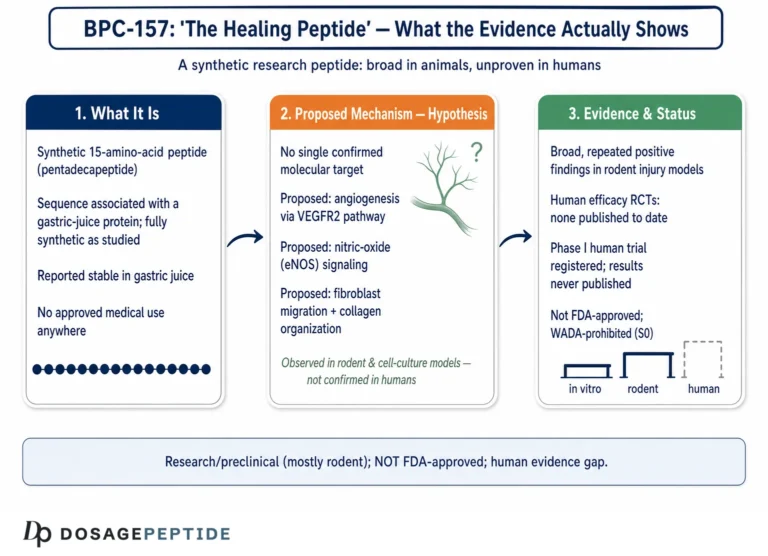
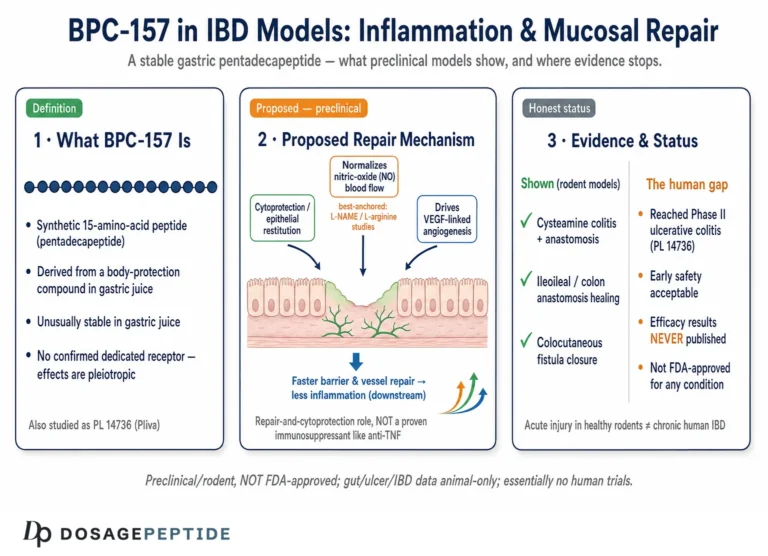
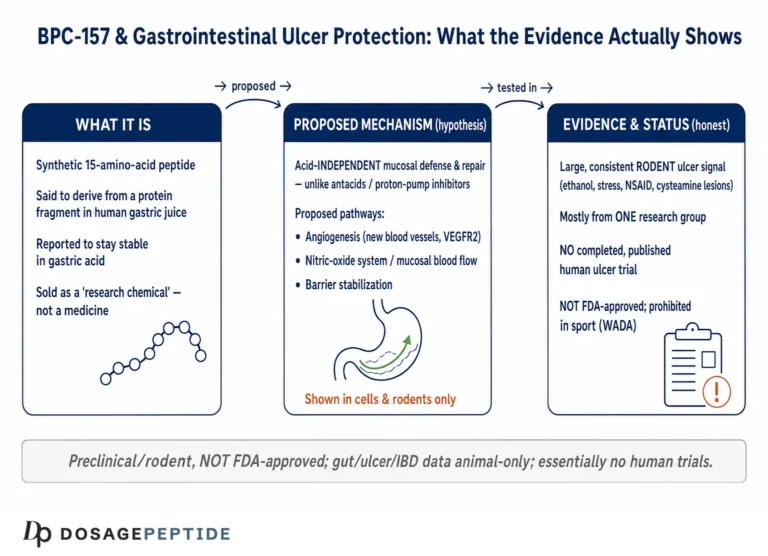
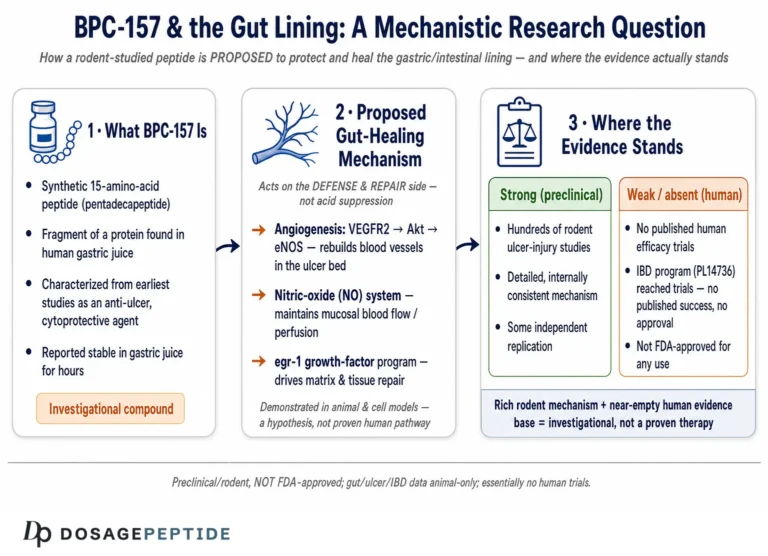
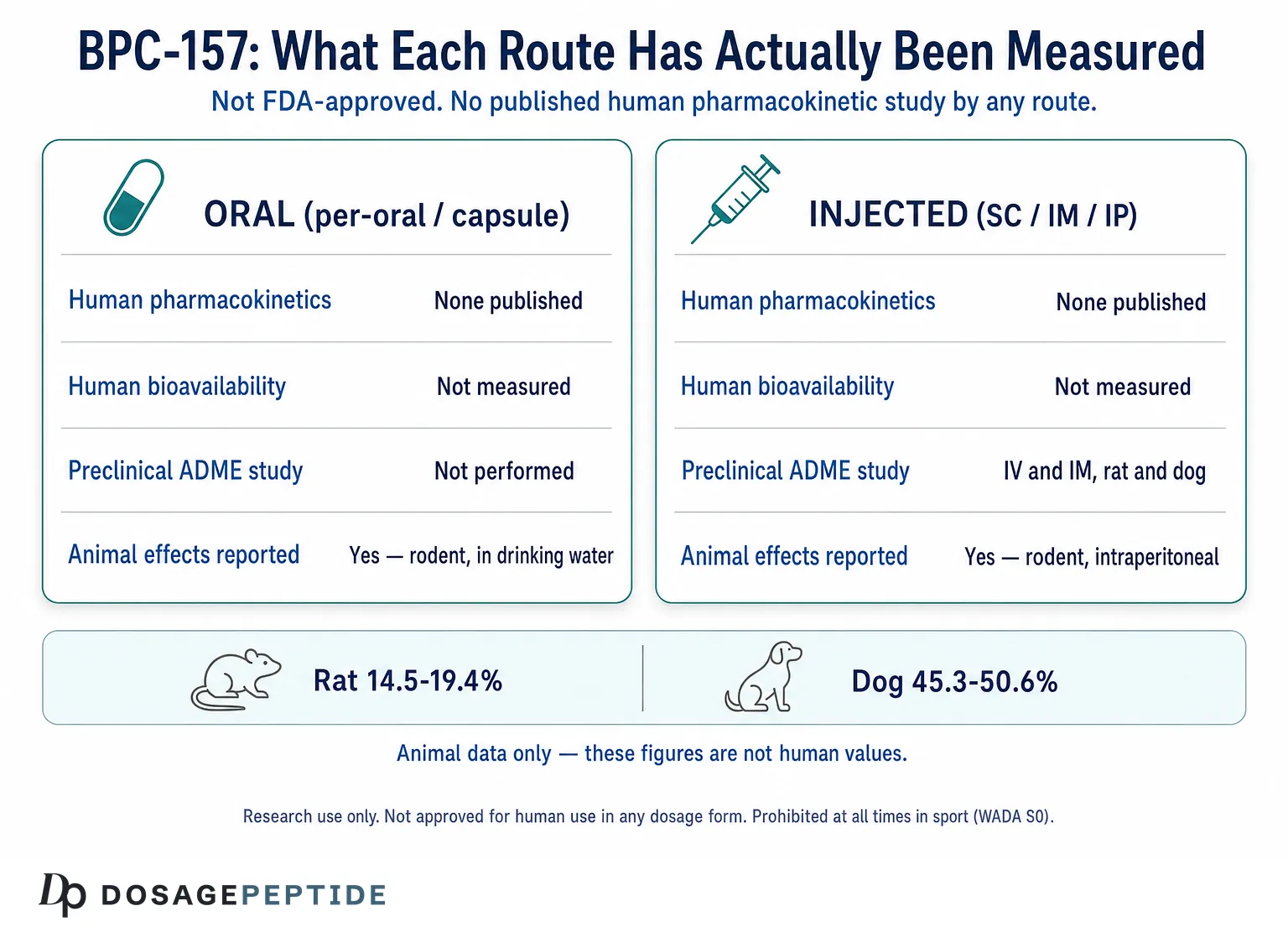
The honest answer to “oral or injection?” is that neither route has been characterised in humans. BPC-157 is not approved by FDA, or by any other national regulator, for any indication in any dosage form, and as of the most recent systematic search of the literature (April 2026) there was no published human pharmacokinetic study of an oral preparation — so no measured human oral bioavailability figure exists to quote.[1] What does exist is a large rodent literature giving the same peptide both per-orally (usually in drinking water) and parenterally, with effects reported by both routes — so “oral BPC-157 does nothing” is as unsupported as vendor claims of near-complete absorption. This page maps what each route has and has not been shown to do.
Oral vs injection at a glance: what is established for each route?
Read this as a map of evidence, not of effect: every row is what has been measured and published.
| Question | Oral (capsule, tablet, per-oral) | Injected (SC / IM / IP) |
|---|---|---|
| Approved by FDA for any indication? | No | No |
| Regulatory category | Unapproved drug; not a lawful dietary ingredient | Unapproved drug; not on FDA’s 503A Bulks List (former category 2 nomination withdrawn) |
| Published human pharmacokinetics | None. A Phase 1 oral-tablet PK study was registered in 2015 but has no posted results and its record status is “unknown” | None by any route. A two-subject IV pilot reported safety bloodwork and tolerability only — it measured no plasma concentrations and produced no human half-life |
| Measured human bioavailability | Not measured — any percentage in circulation is not traceable to a human study | Not measured in humans |
| Formal preclinical ADME study | Not performed by this route | Yes — IV and IM in rats and dogs; IM absolute bioavailability 14.5–19.4% (rat) and 45.3–50.6% (dog) |
| Animal effects reported by this route? | Yes — rats dosed in drinking water at µg/kg and ng/kg | Yes — intraperitoneal dosing at µg/kg and ng/kg is the standard parenteral arm |
| Research questions the route naturally suits | Gastrointestinal models: ulcer, colitis, anastomosis, gut lining | Regional and systemic models: tendon, muscle, ligament, vascular, organ injury |
| Dominant material risk | Unknown capsule content, no dose verification, no identity testing | Sterility, endotoxin, purity and reconstitution error |
| Anti-doping status | Prohibited at all times (WADA class S0) | Prohibited at all times (WADA class S0) |
What human evidence exists for BPC-157 by any route?
Very little. A 2026 narrative review in Pharmaceutics searching PubMed/MEDLINE, Embase, Cochrane, patent databases and the FDA, EMA and WADA websites concluded that BPC-157 has “no approved formulation, no validated dosing regimen, and no completed Phase II clinical trial”, and that the entire clinical dataset “derive[s] from fewer than 30 subjects across three uncontrolled pilot studies, none of which employed standardized pharmaceutical preparations”.[1] It adds that the human pharmacokinetic profile “remains critically undercharacterized” and that the peptide lacks BCS classification, permeability and excipient-compatibility data — the things you would need before saying anything quantitative about an oral dosage form.
The substantive PK work is preclinical. A 2022 Frontiers in Pharmacology ADME study in Sprague-Dawley rats and beagle dogs is the source of nearly every real number that circulates about this peptide: elimination half-life of parent BPC-157 under 30 minutes in both species, linear dose-proportional kinetics, and absolute intramuscular bioavailability of 14.49–19.35% in rats versus 45.27–50.56% in dogs.[2] Note what it did not do: it tested intravenous and intramuscular routes only. Per-oral administration was not studied, so it cannot be the source of an oral figure — and the rat-to-dog species gap by the same route warns against extrapolating any of it to humans.
On the human side, a 2025 pilot in Alternative Therapies in Health and Medicine infused BPC-157 intravenously in two adults (10 mg on day 1, 20 mg on day 2) and reported no measurable changes in cardiac, hepatic, renal, thyroid or glucose markers and no side effects.[3] Two subjects, intravenous, no efficacy endpoint: a tolerability signal, not a safety profile, and it says nothing about a capsule. There is one registered attempt at the study everyone wants: NCT02637284, a Phase 1 trial of an oral tablet formulation (PCO-02) in healthy volunteers, registered in 2015, with no posted results and a status listed as unknown.[4] A registered trial without results is not evidence. For the regulatory picture, see our page on whether BPC-157 is FDA-approved.
Does oral BPC-157 do anything? What the rodent literature actually used
Most pages go wrong in both directions here. The Zagreb group that originated the peptide did not only inject it: a large share of their rat experiments included a per-oral arm, and the methods sections are explicit.
The drinking-water protocol
The standard per-oral regimen recurs almost verbatim across the group’s publications: BPC-157 at 10 µg/kg or 10 ng/kg body weight given “per-orally in drinking water” at 0.16 µg/mL or 0.16 ng/mL, 12 mL per rat per day, continued until sacrifice — head-to-head against the same doses given intraperitoneally. A 2013 study of cysteamine-induced colitis and colon-colon anastomosis used exactly that design and reported healing effects with both arms.[5] The same protocol recurs in the group’s wound-healing work alongside intraperitoneal and topical arms.[6] So “oral BPC-157 is inert” is not what the primary literature says.
Why a rodent drinking-water result does not transfer to a human capsule
Four differences matter:
- Exposure pattern. A rat drinking treated water receives near-continuous low-dose exposure across the day; a capsule is a single bolus into a fasted or fed stomach. Different pharmacokinetic experiments, even at an identical daily total.
- Gastrointestinal physiology. Rat gastric pH, transit time, enzyme profile and mucosal permeability differ from human. The dog-versus-rat gap in the one formal ADME study — about 45–50% versus 14–19% by the same route — shows how far species alone can move an absorption number.[2]
- Dose scaling. Rodent per-oral doses are per kilogram, in µg and ng ranges, within a defined water volume. A capsule is a fixed milligram amount, with no body-weight scaling and no verified content.
- Endpoint. Rodent studies measured a tissue or histology outcome, not a plasma concentration. An effect after oral dosing tells you something happened, not how much peptide reached the circulation.
The accurate statement is narrow: oral activity has been reported in rodents; it has never been characterised in humans. Converting that into a human capsule regimen is assumption, not extrapolation.
Is BPC-157 stable in gastric juice — and does that mean it is absorbed?
The stability claim is real, and it is the mechanistic hinge of the oral argument. BPC-157 is described in the source literature as a partial sequence of a protein found in human gastric juice, and the originating group reports it “not destroyed in human gastric juice for more than 24 h”.[7][6] The 2026 review independently notes “unusual stability in gastric juice” — the right word for a 15-residue peptide.[1]
Gastric stability is one of four separate hurdles, and clearing the first says nothing about the other three:
| Step | Question it answers | Status for BPC-157 |
|---|---|---|
| 1. Gastric survival | Does the molecule survive stomach acid and pepsin intact? | Reported as stable in human gastric juice in the source literature |
| 2. Intestinal absorption | Does it cross the intestinal epithelium into portal blood? | Not characterised — no published human permeability data |
| 3. First-pass metabolism | Does it survive gut wall and liver on the way to circulation? | Not characterised; the peptide is rapidly cleaved to fragments in vivo |
| 4. Systemic exposure | What plasma concentration results, and for how long? | Never measured in humans after an oral dose |
A molecule can be perfectly acid-stable and still be almost entirely unabsorbed: stability and permeability are independent properties. But an unabsorbed peptide in the gut lumen is not necessarily doing nothing — it is doing whatever it does there.
Local versus systemic: the more useful way to frame the route question
The two routes are not competing to deliver the same exposure. An oral route plausibly delivers peptide to the gastrointestinal tract itself — where the densest part of the animal literature sits. Ulcer, colitis, anastomotic healing, fistula and short-bowel models are luminal and mucosal endpoints, and the originating group has framed BPC-157 as a gastrointestinal cytoprotective agent, with a programme under the code PL 14736 described as evaluated for inflammatory bowel disease.[8] Note the tension: those Phase II descriptions come from the originating group’s own reviews, while the 2026 independent review concludes no Phase II trial has been completed.[1]
The argument for injecting is regional or systemic delivery for targets outside the gut — tendon, ligament, muscle, joint. That is the reasoning behind the most substantial registered trial: NCT07437547, a randomised double-blind placebo-controlled Phase 2 study of subcutaneous BPC-157 for acute grade II hamstring strain, recruiting since February 2026, with MRI-assessed injury volume and return to sport as co-primary endpoints.[9] An ongoing trial with no results is worth watching, not citing. On that logic, our BPC-157 versus TB-500 comparison covers where the two literatures overlap.
What is actually sold as “oral BPC-157”, and what can be said about it?
Two things dominate the market: plain BPC-157 acetate in capsules — the same powder sold for injection, put into a shell — and BPC-157 arginate, an arginine salt marketed as the oral-suitable form, usually with a claim of acid resistance or better absorption.
A general chemistry principle does hold: arginine salts of peptides often differ from acetate salts in solubility and dissolution, a plausible reason to prefer one in a solid dosage form. What cannot be supported is anything quantitative — there is no published human pharmacokinetic study of BPC-157 arginate, no comparative bioavailability study against the acetate, and no peer-reviewed source for the percentages on retail pages. The 2026 review applies directly: no pharmaceutical-grade formulation of BPC-157 has been developed or validated.[1]
There is also a labelling problem. The Department of Defense’s Operation Supplement Safety programme states flatly that BPC-157 “is not a dietary ingredient” and is “an unapproved drug”, and notes that products containing it circulate in wellness channels carrying “research use only” or “not for human consumption” disclaimers.[10] That mismatch between labelling and marketing is itself a signal about the seller.
What is the regulatory and anti-doping status in 2026?
This is route-independent and frequently misreported:
- FDA approval: none, for any indication, in any dosage form. Oral and injectable are equally unapproved.[10]
- Compounding: BPC-157 is not on FDA’s 503A Bulks List, and it is no longer in category 2 of FDA’s interim compounding policies. FDA’s category 2 page — content current as of 22 April 2026 — lists BPC-157 under “Bulk drug substances nominated but withdrawn”, meaning substances “previously in category 2 of the interim policies” whose nominations “were withdrawn by the nominators”. The safety rationale FDA recorded against it still stands on that page: compounded drugs containing BPC-157 “may pose risk for immunogenicity for certain routes of administration and may have complexities with regard to peptide-related impurities and active pharmaceutical ingredient (API) characterization”, with “no, or only limited, safety-related information for the proposed routes of administration”.[11]
- Advisory committee activity: FDA’s Pharmacy Compounding Advisory Committee met on 23–24 July 2026 to consider BPC-157-related bulk drug substances — BPC-157 free base and BPC-157 acetate — for inclusion on the 503A Bulks List, for the single use FDA evaluated: ulcerative colitis. On 23 July 2026 the committee voted 8–6, with one abstention, in favour of recommending it for the list — against FDA staff’s own scientific review, which had recommended against listing.[12][13] Read that carefully: the vote is non-binding, a committee recommendation is not an FDA decision and is not an approval, final placement would require separate notice-and-comment rulemaking, and FDA has gone against its advisory panels before. Anyone telling you BPC-157 was “approved” in July 2026 is misreading a vote.
- Anti-doping: WADA’s Prohibited List places BPC-157 in class S0, non-approved substances, prohibited at all times — in and out of competition. The List names it directly, as a substance with no current approval by any governmental regulatory health authority for human therapeutic use.[14] Taking it as a capsule rather than an injection changes nothing about that. Athletes should verify status on GlobalDRO and, if they believe they have a medical case, go through their anti-doping organisation’s therapeutic use exemption process rather than assume any exemption exists.
How do the material risks differ between the two routes?
Injection risk is material and technique risk. Research-grade lyophilised powder is not made to sterile-injectable standards. Sterility, endotoxin, residual solvents and truncated sequences are all real failure modes, and FDA’s own recorded rationale for BPC-157 names immunogenicity by certain routes and peptide-related impurities as the concerns.[11] Handling error compounds it, which is why our peptide reconstitution guide treats diluent volume and sterile technique as first-order variables.
Oral risk is a content-verification problem. A capsule cannot be inspected, its fill weight cannot be confirmed by eye, and identity cannot be assumed. No analytical survey of BPC-157 capsules has been published, so nobody can put a number on it — but the pattern for peptides sold outside the regulated supply chain is documented. A 2024 Journal of Medical Internet Research study that test-purchased semaglutide from unlicensed online sellers found all delivered vials to be probable substandard or falsified products.[15] Different peptide, different product class — it establishes nothing about BPC-157 capsules, only that the unregulated channel is unreliable. Read the analytical paperwork rather than the marketing: our guide to reading a peptide certificate of analysis, HPLC purity and mass spec data covers what an identity and purity report must contain.
Neither route’s risk profile endorses the other: “oral avoids injection risk” is true and irrelevant if the capsule content is unverified. Adverse-effect signals have never been systematically collected in humans by any route — our BPC-157 side effects page is explicit about how thin that dataset is.
Where do dosage questions belong?
Deliberately not here. This article compares routes of administration and the evidence behind each. Where it reports amounts, they are the doses used in the published studies cited, reported as study facts; it gives no schedules or conversions for human use and makes no dosing recommendation. None exists for BPC-157 by any route, because no human dose-ranging study has been done.[1] For the reconstitution mathematics and vial-concentration reference material used in research settings, see the BPC-157 10 mg vial dosage protocol and the corresponding BPC-157 5 mg vial protocol. Those pages own the arithmetic; this one owns the prior question of whether the route makes sense.
Frequently Asked Questions
Does BPC-157 work in pill form?
In rats, per-oral administration in drinking water has been reported to produce effects in gastrointestinal and wound-healing models, alongside injected arms in the same studies. In humans, no oral pharmacokinetic or efficacy study has been published, so there is no evidence base for a capsule. “It works orally in rats” and “it works as a human pill” are different claims, and only the first has support.
What is the oral bioavailability of BPC-157?
Unknown. No human study has measured it, and the one formal preclinical ADME study tested only intravenous and intramuscular routes in rats and dogs, producing no oral figure. Any percentage quoted on a retail page is not traceable to a published human study. The number does not exist yet.
Is BPC-157 destroyed by stomach acid?
The originating research group reports that BPC-157 is stable in human gastric juice for more than 24 hours, and a 2026 independent review calls that stability unusual for a peptide. It concerns survival in the stomach only, and does not establish that the peptide crosses the intestinal wall, survives first-pass metabolism, or reaches the bloodstream.
Is BPC-157 arginate better than the acetate salt for oral use?
Not demonstrated. Arginine salts can behave differently from acetate salts in solubility and dissolution, a plausible formulation rationale. But there is no published human pharmacokinetic study of BPC-157 arginate and no comparative bioavailability data against the acetate, so the absorption claims attached to it are marketing positions, not findings.
Has BPC-157 been tested in humans at all?
Barely. A 2026 review found the entire human dataset comes from fewer than 30 subjects across three uncontrolled pilot studies, none using standardised preparations. A two-person intravenous pilot published in 2025 reported no adverse changes in routine bloodwork. A Phase 2 subcutaneous trial in hamstring strain began recruiting in 2026 and has no results yet.
Is BPC-157 legal to buy as an oral supplement?
It is not a lawful dietary ingredient in the United States. The Department of Defense’s supplement-safety programme describes BPC-157 as an unapproved drug, not a dietary ingredient, and it is not on FDA’s 503A Bulks List. Products are typically sold with research-use-only labelling, which is not compatible with human consumption claims.
Will oral BPC-157 show up on a drug test?
Route does not change prohibited status. WADA lists BPC-157 in class S0, non-approved substances, prohibited at all times in and out of competition, and a capsule and an injection are treated identically. Athletes should treat both forms as banned, verify status on GlobalDRO, and route any medical claim through their anti-doping organisation’s therapeutic use exemption process.
References
- Mateescu DM, Gavrilescu DM, Constantinescu FE, et al. BPC-157 as an Investigational Peptide Therapeutic: Biopharmaceutical Challenges, Formulation Strategies, and Translational Development Barriers. Pharmaceutics. 2026;18(5):625. https://pubmed.ncbi.nlm.nih.gov/42198317/
- He L, Feng D, Guo H, et al. Pharmacokinetics, distribution, metabolism, and excretion of body-protective compound 157, a potential drug for treating various wounds, in rats and dogs. Frontiers in Pharmacology. 2022;13:1026182. https://pmc.ncbi.nlm.nih.gov/articles/PMC9794587/
- Lee E, Burgess K. Safety of Intravenous Infusion of BPC157 in Humans: A Pilot Study. Alternative Therapies in Health and Medicine. 2025;31(5):20-24. https://pubmed.ncbi.nlm.nih.gov/40131143/
- ClinicalTrials.gov. NCT02637284 — Phase I, Pilot Study in Healthy Volunteers, to Assess the Safety and Pharmacokinetics of PCO-02, Which Active Ingredient is BPC-157. https://clinicaltrials.gov/study/NCT02637284
- Klicek R, Kolenc D, Suran J, et al. Stable gastric pentadecapeptide BPC 157 heals cysteamine-colitis and colon-colon-anastomosis and counteracts cuprizone brain injuries and motor disability. Journal of Physiology and Pharmacology. 2013;64(5):597-612. https://pubmed.ncbi.nlm.nih.gov/24304574/
- Seiwerth S, Milavic M, Vukojevic J, et al. Stable Gastric Pentadecapeptide BPC 157 and Wound Healing. Frontiers in Pharmacology. 2021;12:627533. https://pmc.ncbi.nlm.nih.gov/articles/PMC8275860/
- Sikiric P, Boban Blagaic A, Strbe S, et al. The Stable Gastric Pentadecapeptide BPC 157 Pleiotropic Beneficial Activity and Its Possible Relations with Neurotransmitter Activity. Pharmaceuticals. 2024;17(4):461. https://pmc.ncbi.nlm.nih.gov/articles/PMC11053547/
- Sikiric P, Seiwerth S, Rucman R, et al. Focus on ulcerative colitis: stable gastric pentadecapeptide BPC 157. Current Medicinal Chemistry. 2012;19(1):126-132. https://pubmed.ncbi.nlm.nih.gov/22300085/
- ClinicalTrials.gov. NCT07437547 — A Randomized, Double-Blind, Placebo-Controlled Phase 2 Trial of Pentadecapeptide BPC 157 for Accelerated Repair of Acute Grade II Hamstring Strain Confirmed by MRI. https://clinicaltrials.gov/study/NCT07437547
- Operation Supplement Safety (U.S. Department of Defense / CHAMP). BPC-157: A Prohibited Peptide and an Unapproved Drug Found in Health and Wellness Products. https://www.opss.org/article/bpc-157-prohibited-peptide-and-unapproved-drug-found-health-and-wellness-products
- U.S. Food and Drug Administration. Certain Bulk Drug Substances for Use in Compounding that May Present Significant Safety Risks (Category 2) — BPC-157 listed under “Bulk drug substances nominated but withdrawn”. Content current as of 22 April 2026. https://www.fda.gov/drugs/human-drug-compounding/certain-bulk-drug-substances-use-compounding-may-present-significant-safety-risks
- U.S. Food and Drug Administration. July 23-24, 2026: Meeting of the Pharmacy Compounding Advisory Committee (agenda and bulk drug substances evaluated). https://www.fda.gov/advisory-committees/advisory-committee-calendar/july-23-24-2026-meeting-pharmacy-compounding-advisory-committee-07232026
- Regulatory Affairs Professionals Society (RAPS). FDA advisory committee backs two controversial peptides. 23 July 2026. https://www.raps.org/resource/fda-advisory-committee-backs-two-controversial-peptides.html
- World Anti-Doping Agency. The Prohibited List. https://www.wada-ama.org/en/prohibited-list
- Ashraf AR, Mackey TK, Vida RG, et al. Multifactor Quality and Safety Analysis of Semaglutide Products Sold by Online Sellers Without a Prescription. Journal of Medical Internet Research. 2024;26:e65440. https://pubmed.ncbi.nlm.nih.gov/39509151/
This article is provided for research and educational reference only. BPC-157 is an investigational compound that is not approved by the FDA or any other regulatory authority for human use, in any dosage form or by any route of administration. Nothing here is medical advice, a dosing recommendation, or an endorsement of human administration by any route. All compounds discussed are intended for laboratory research use only.