The short answer. Orforglipron hits the same receptor as semaglutide and the other GLP-1 peptides, but it is not a peptide. It is a small molecule — a compact, non-peptide chemical that survives the gut, so it works as a once-daily tablet taken with or without food, where the peptides need an injection or a tightly restricted oral protocol. Three practical consequences follow: manufacturing is chemical synthesis rather than biologics production, its half-life supports daily rather than weekly dosing, and it binds a pocket on the receptor that is species-specific — ordinary mice and rats do not respond to it, which quietly invalidates the standard rodent model. On measured weight loss it is real but not the strongest option: about 11% of body weight at 72 weeks at the top dose, against roughly 15–21% for the best injectables.
Status matters here, and it changed in 2026. Orforglipron is an oral, non-peptide (small-molecule) GLP-1 receptor agonist developed by Eli Lilly, originating from a Chugai discovery program. On 1 April 2026 the U.S. Food and Drug Administration approved it as Foundayo, for chronic weight management in adults with obesity, or overweight with at least one weight-related condition, alongside a reduced-calorie diet and increased physical activity. It is the first GLP-1 pill that can be taken at any time of day without food or water restrictions. A separate application for type 2 diabetes had not been approved at the time of writing. This piece is written for researchers and scientifically literate readers who want an honest, mechanism-first map of how a non-peptide agonist actually differs from its peptide cousins in metabolic research models — what the data support, what remains open, and where the popular shorthand (“an oral Ozempic”) obscures more than it reveals.
What Orforglipron Is — and Why “Non-Peptide” Is the Whole Story
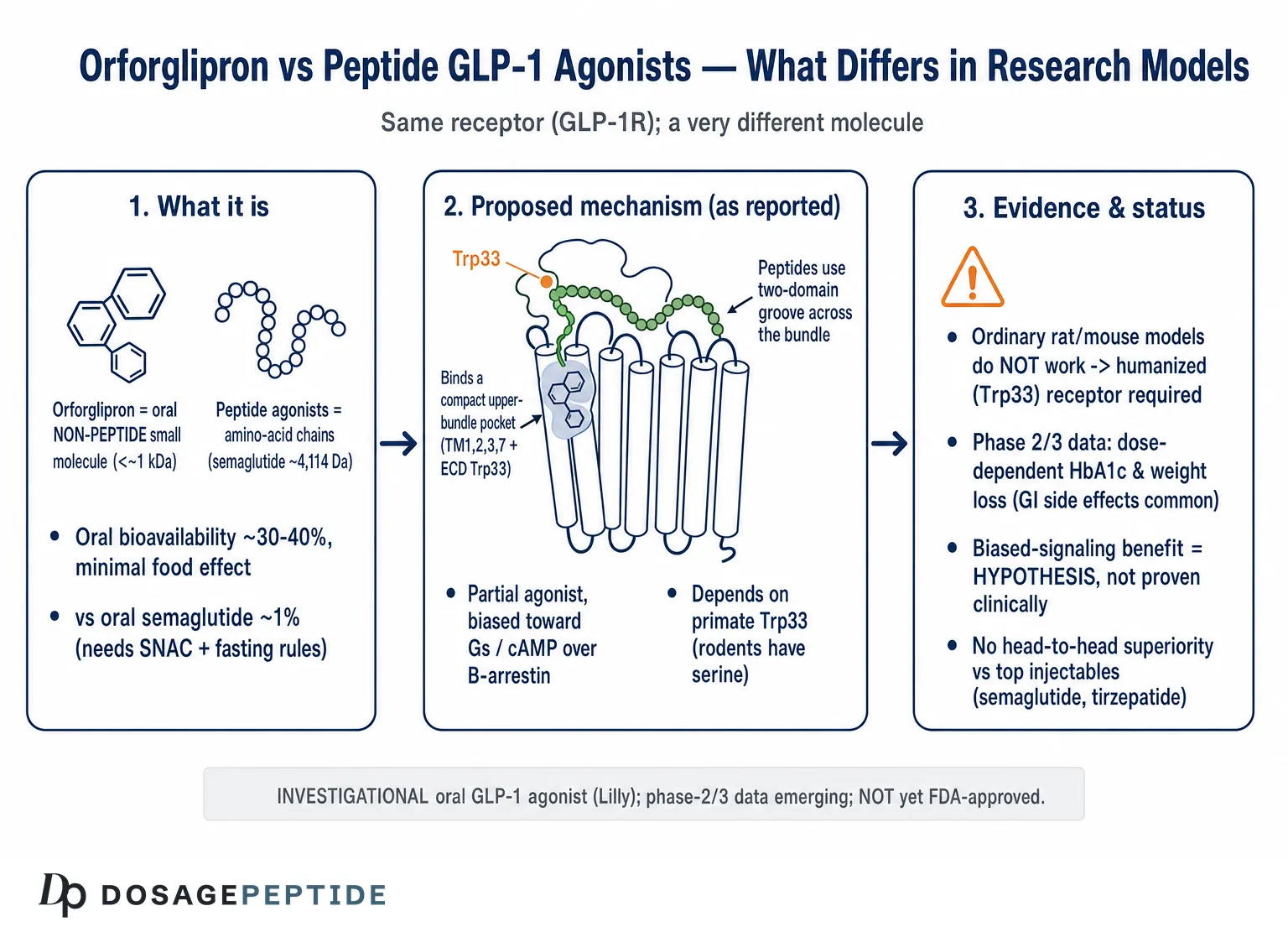
Orforglipron (development codes LY3502970 and, earlier, OWL833) is a synthetic, orally bioavailable small molecule that activates the GLP-1 receptor.1 That single sentence already contains the fault line separating it from every GLP-1 medicine that came before. The established agents in this class — semaglutide, liraglutide, dulaglutide, exenatide — are peptides: chains of amino acids engineered from or around the native GLP-1 sequence, with modifications (fatty-acid acylation, amino-acid substitutions to resist the enzyme dipeptidyl peptidase-4) that extend their half-life. Orforglipron contains no peptide backbone at all. It is a conventional drug-like molecule built from aromatic and heteroaromatic ring systems, with a molecular weight under roughly 1 kilodalton — on the order of a fifth the mass of semaglutide, which weighs in near 4,114 daltons.110
Why does the peptide-versus-non-peptide distinction dominate everything downstream? Because a peptide’s chemistry dictates its behavior. Peptides are large, polar, and vulnerable. Taken orally, they are digested by gastric and intestinal proteases and absorbed across the gut wall at vanishingly low efficiency. This is precisely why the class was, for two decades, an injectable-only class, and why the one oral peptide agonist that reached market — oral semaglutide — requires an elaborate absorption-enhancer technology (the sodium N-(8-[2-hydroxybenzoyl]amino)caprylate carrier, or SNAC) plus strict dosing rules: take on an empty stomach, with no more than about 120 mL of plain water, then wait at least 30 minutes before eating, drinking, or taking other medications.9 Even with SNAC, oral bioavailability sits around 1%. A small molecule sidesteps this entire problem. Orforglipron is absorbed like an ordinary oral drug, with reported oral bioavailability in the 30–40% range and, importantly, minimal food effect — meaning it can be taken without the fasting-and-water choreography that oral peptide therapy demands.10
The design logic was therefore explicit: reproduce the pharmacology of an injectable peptide agonist in a molecule small and stable enough to survive the gut and be swallowed as a daily pill. Chugai’s medicinal-chemistry program ran multiple cycles of structure–activity optimization to arrive at OWL833/LY3502970, tuning both receptor affinity and the drug-like properties (solubility, permeability, metabolic stability) that a peptide simply cannot achieve.1 To appreciate what an unusual achievement this is, it helps to remember why non-peptide agonists of GLP-1 were considered so hard: the receptor is a class B G-protein-coupled receptor whose natural ligand is a 30-residue peptide that drapes across a large, shallow binding surface. Small molecules historically struggle to activate such receptors because there is no compact, druggable orthosteric pocket for them to fill. Orforglipron’s structure is interesting precisely because it solves that problem in an unexpected way — which is the subject of the next section.
For readers tracing how this compound sits alongside its peptide relatives across the metabolic-research literature, the site’s companion analyses of what evidence shows orforglipron alters systemic metabolic pathways in models and of how semaglutide activates GLP-1 receptors in metabolic research models provide useful side-by-side context for the peptide comparison developed below.
The Shared Foundation: Incretin Biology Both Ligands Exploit
Before cataloguing differences, it is worth being explicit about the common biology, because the differences only make sense against that shared backdrop. GLP-1 is an incretin hormone: it is released from intestinal L-cells in response to nutrient ingestion and, among other actions, potentiates glucose-dependent insulin secretion, suppresses glucagon, slows gastric emptying, and acts on central circuits to reduce appetite and food intake.3 Its receptor, the GLP-1 receptor, is a class B (secretin-family) G-protein-coupled receptor expressed on pancreatic beta cells, in the central nervous system, and in several peripheral tissues. Every agent in this therapeutic story — native GLP-1, the injectable peptide analogs, oral semaglutide, and orforglipron — ultimately does its work by turning on this one receptor and thereby recruiting the glucose-lowering and weight-reducing physiology that incretin signaling produces.3
This shared endpoint is precisely why the class produces a recognizable common profile: dose-dependent reductions in HbA1c and body weight, a gastrointestinal side-effect signature dominated by nausea and altered bowel habit (a predictable consequence of slowed gastric emptying and central effects), and a glucose-dependent insulinotropic action that carries a low intrinsic risk of hypoglycemia when used as monotherapy. When orforglipron reproduces these features, it is not because it resembles a peptide chemically — it does not — but because it converges on the same receptor and therefore the same downstream biology. The convergence is functional, not structural. Two travelers can reach the same city by road and by air; the destination is identical, but almost nothing about the journey is, and the choice of route determines what can go wrong, how fast the trip is, and who can take it. That analogy, imperfect as all analogies are, captures why comparing orforglipron with peptide agonists is worthwhile: the destination (GLP-1 receptor activation and its metabolic consequences) is shared, but the molecular route is so different that it changes the drug’s absorption, its species reach, its signaling texture, and the very experiments needed to study it.
Holding this in mind guards against two opposite errors. The first is to assume that because orforglipron shares the receptor it must behave identically to peptides in every respect; the binding mode, signaling bias, pharmacokinetics, and species-specificity sections below show why that is false. The second is to assume that because orforglipron is chemically alien to the peptides it must be a fundamentally different kind of therapy; the shared incretin endpoint shows why that too is false. The accurate picture is a single receptor approached by two very different molecular strategies, yielding overlapping but not identical pharmacology — and it is the non-overlapping parts that this article is really about.
The Structural Divide: An Allosteric Pocket, Not the Peptide Groove
The most consequential difference between orforglipron and peptide agonists is not a matter of degree but of kind: the two ligand types occupy physically different parts of the same receptor. This was resolved by cryo-electron microscopy in a 2020 study that captured the GLP-1 receptor bound to LY3502970 in an active, G-protein-coupled state.1
Consider first how the native peptide works. Full-length GLP-1 (and the peptide drugs that mimic it) binds by the “two-domain” mechanism characteristic of class B GPCRs: the peptide’s C-terminus is captured by the receptor’s large extracellular domain (ECD), and its N-terminus then inserts deep into the transmembrane helical bundle, threading through a wide groove and contacting a broad constellation of transmembrane helices to pry the receptor into its active shape.2 The peptide, in effect, spans the whole binding cleft, from the outer ECD down into the core. It is a large ligand making many contacts across a large surface.
Orforglipron does something entirely different. Rather than reproducing the peptide’s sprawling footprint, the small molecule tucks into a compact, mostly hydrophobic pocket in the upper portion of the helical bundle. According to the cryo-EM analysis, it engages the ECD, extracellular loop 2, and transmembrane helices 1, 2, 3, and 7 — while notably not contacting helices 4, 5, and 6, which the peptide relies on.1 In other words, orforglipron occupies a smaller, more specialized site and stabilizes the active receptor through a partly distinct set of contacts. It is best described as binding an allosteric-style pocket in the upper helical bundle rather than filling the orthosteric peptide groove in the conventional way. This is how a molecule a fraction of the peptide’s size can nonetheless flip the receptor into a signaling-competent conformation: it does not need to mimic the peptide’s every contact, only to trigger the conformational rearrangement that couples the receptor to its downstream G protein.
The single most striking structural detail — and the one with the largest practical consequence for research models — concerns a specific residue in the extracellular domain: tryptophan 33 (Trp33). In the cryo-EM structure, the indole side chain of Trp33 folds down like a lid over one branch of the orforglipron molecule (an indole–tetrahydropyran moiety), forming aromatic and hydrophobic interactions that are essential for high-affinity binding.1 This matters enormously because Trp33 is present in primate GLP-1 receptors but replaced by serine in most non-primate species, including the rat and mouse. Mutagenesis confirmed the point: receptors carrying serine at position 33 are not effectively activated by the compound. We will return to what this does to preclinical modeling, because it is one of the defining methodological differences between studying orforglipron and studying a peptide agonist.
The honest summary of the structural picture is that orforglipron is not simply “a small version of semaglutide.” It is a chemically unrelated molecule that activates the same receptor through a partly different binding mode, exploiting a pocket the peptide barely touches and depending on a primate-specific residue the peptide does not require. Two ligands, one receptor, two mechanisms of engagement — that is the crux of the difference.
Partial and Biased Agonism: A Different Signaling Fingerprint
Binding differently is one thing; signaling differently is another, and here too orforglipron diverges from the peptide template in ways that show up in research models. The GLP-1 receptor, once activated, can couple to more than one intracellular pathway. The canonical route is through the stimulatory G protein Gs, which raises intracellular cyclic AMP and drives the insulinotropic and metabolic effects the class is prized for. But the receptor can also recruit β-arrestin, a scaffolding protein classically associated with receptor internalization, desensitization, and a separate set of signaling consequences.
The 2020 structural work reported that LY3502970 behaves as a partial agonist that is biased toward G-protein activation over β-arrestin recruitment.1 Later pharmacological characterization describes a Gs-biased signaling profile favoring cAMP generation over the arrestin arm.10 Structurally, the authors traced this bias to a subtly different positioning of the extracellular end of transmembrane helix 7 compared with the peptide-bound receptor — a conformation that, they proposed, is less able to stabilize the arrangement needed for robust β-arrestin engagement.1 Two features are worth separating here, because popular writing tends to blur them:
- Partial agonism means orforglipron, even at receptor-saturating concentrations, produces a submaximal signaling response relative to the full peptide agonist in a given assay. It pushes the receptor part-way, not all the way.
- Signaling bias means that of the pathways the receptor can drive, orforglipron preferentially activates one (Gs/cAMP) while comparatively sparing another (β-arrestin).
Why might these properties matter, and why the caution? The mechanistic hypothesis frequently advanced is that reduced β-arrestin recruitment could translate into less receptor internalization and desensitization over time, potentially preserving responsiveness during chronic dosing.10 That is a biologically reasonable idea and it is one of the genuinely distinguishing features of this molecule relative to peptide agonists, several of which are more balanced or arrestin-competent. But it must be stated carefully: the leap from “biased signaling in a cell-based assay” to “superior durable efficacy in patients” is exactly the kind of inference the GPCR field has learned to distrust. Biased-agonism stories have repeatedly looked cleaner in vitro than they proved in vivo. So the correct framing is that orforglipron has a demonstrably different signaling fingerprint from peptide agonists — partial, Gs-biased — and that this may underlie clinical behavior, but that the causal chain from receptor pharmacology to patient outcome is a hypothesis, not an established fact.
There is also an apparent paradox worth naming for honesty’s sake. If orforglipron is a partial agonist, how can it match the metabolic efficacy of full peptide agonists? The likely resolution is receptor reserve: in intact tissue there are typically far more receptors than are needed to produce a maximal downstream response, so a partial agonist occupying enough of them can still elicit a near-full physiological effect. Indeed, in humanized-receptor mouse work the orally dosed small molecule produced glucose lowering comparable to injected exenatide despite its partial-agonist profile in vitro.1 That is an elegant illustration of why in-vitro efficacy classifications do not map one-to-one onto whole-animal or human outcomes — a recurring theme when comparing this compound with its peptide relatives.
The Species-Specificity Problem That Reshapes Every Preclinical Model
If there is one difference between orforglipron and peptide GLP-1 agonists that a research scientist must internalize before designing an experiment, it is this: you cannot study orforglipron in an ordinary rat or mouse. The Trp33 dependence described above means the compound does not effectively activate the native rodent GLP-1 receptor, because rodents carry serine, not tryptophan, at that position.1 This is not a subtle potency shift; it is a near-absence of activity at the wild-type non-primate receptor. It is a property peptide agonists do not share — GLP-1 and its peptide mimetics activate rodent receptors perfectly well, which is why decades of incretin biology were worked out in standard rodent models.
The practical consequences ripple through the entire preclinical program:
- Humanized models become mandatory. To study orforglipron in vivo, investigators use mice engineered to express the human (or a humanized, Trp33-containing) GLP-1 receptor, or otherwise primate-relevant systems. The comparison of orforglipron with injected exenatide in glucose control, for instance, was performed in humanized-receptor mice precisely because the native mouse receptor would not respond to the small molecule.1
- Cross-study comparisons get harder. A peptide agonist tested in a standard C57BL/6 diet-induced-obesity model and a small molecule tested in a humanized-receptor model are not being evaluated on the same biological substrate, complicating any head-to-head reading of preclinical potency or body-weight effects.
- Cell-based assays must use the right receptor. In vitro pharmacology (cAMP accumulation, β-arrestin recruitment, binding affinity) has to be run against the human receptor or a Trp33-bearing construct; results on rodent-receptor lines would badly mislead.
- Translational confidence rests on human data. Because the most informative animal models are humanized constructs rather than the deeply characterized wild-type rodents used for peptides, a larger share of the translational weight falls on the human clinical trials than is typical for an incretin drug.
This is arguably the most under-appreciated difference in the entire comparison. When someone reads “orforglipron works like a peptide GLP-1 agonist in metabolic models,” the word “models” is doing quiet but heavy lifting: for the peptide, models means the full menagerie of standard rodents; for orforglipron, it means a narrower, humanized subset engineered around a single tryptophan residue. The receptor is the same, but the experimental toolkit that can interrogate it is not. Anyone extrapolating from a rodent peptide study to orforglipron, or vice versa, is quietly crossing a species boundary the molecule itself defines.
Pharmacokinetics: How an Oral Small Molecule Diverges From Peptide Agonists
Beyond structure and signaling, orforglipron’s pharmacokinetics differ from peptide agonists in ways that are practical rather than exotic — but they are exactly the differences that make an oral daily pill feasible. The following table lays the two ligand classes side by side; the peptide-side entries are drawn from the general behavior of the class and from oral semaglutide as the one oral peptide comparator.
| Property | Orforglipron (non-peptide) | Peptide GLP-1 agonists |
|---|---|---|
| Chemical class | Small molecule; aromatic/heteroaromatic scaffold1 | Amino-acid chains derived from/around GLP-12 |
| Approx. molecular weight | Under ~1 kDa1 | ~3.3–4.7 kDa (e.g., semaglutide ~4,114 Da)10 |
| Receptor engagement | Compact upper-bundle pocket; TM1/2/3/7 + ECD Trp331 | Two-domain: ECD capture + deep insertion across the bundle2 |
| Signaling profile | Partial agonist; Gs/cAMP-biased, spares β-arrestin1 | Generally fuller agonism; more arrestin-competent |
| Route | Oral, once daily5 | Injectable (most); one oral peptide (semaglutide + SNAC)9 |
| Food/water rules | None reported; minimal food effect10 | Oral semaglutide: fasting, ≤120 mL water, wait ≥30 min9 |
| Oral bioavailability | ~30–40%10 | Oral semaglutide ~1% (SNAC-enabled)9 |
| Half-life / Tmax | ~24–38 h; Tmax ~2–4 h10 | Varies; e.g., semaglutide ~1 week (once-weekly) |
| Metabolism / clearance | Limited hepatic metabolism, CYP3A-mediated oxidation10 | Proteolytic/peptidase degradation; renal handling of fragments |
| Preclinical model | Requires humanized (Trp33) receptor1 | Standard rodents respond2 |
Several points deserve unpacking. First, the half-life of roughly one to one-and-a-half days supports once-daily oral dosing without the injection-site logistics of the long-acting peptides, and without the once-weekly cadence that defines drugs like semaglutide and dulaglutide.10 Second, the clearance route is fundamentally different: orforglipron is handled like a conventional small molecule, cleared largely by hepatic (CYP3A-mediated) oxidative metabolism, whereas peptides are broken down by peptidases and their fragments processed renally.10 That distinction carries real research and clinical implications — a CYP3A-metabolized drug invites attention to drug–drug interactions with CYP3A inhibitors and inducers, a consideration largely irrelevant for a peptide. Third, the absence of stringent food-and-water dosing rules is not a trivial convenience: for oral semaglutide, the SNAC absorption-enhancer mechanism only works in a narrow gastric window, which is why the fasting protocol exists and why real-world adherence to it is imperfect.9 A small molecule with 30–40% bioavailability and minimal food effect removes that entire constraint.
The pharmacokinetic bottom line is that orforglipron behaves, in the body and in the lab, like a drug-like small molecule that happens to hit an incretin receptor — not like a peptide that has been coaxed into oral form. This is a difference of category, and it is the difference that makes the “oral GLP-1 without the injection” proposition mechanically plausible. Readers interested in how these pharmacokinetic and receptor-level considerations are catalogued across the peptide field may find the site’s peptide-science glossary a helpful reference for the terminology used throughout this discussion.
What the Metabolic Research Models Actually Show
With the mechanistic differences established, the fair question is whether they translate into the metabolic outcomes the class is known for — and, if so, whether orforglipron’s numbers resemble those of peptide agonists. Here the honest reading is that the human data are genuinely substantial and, at the higher doses, broadly in the range associated with injectable peptide therapy, while still not being the product of head-to-head superiority trials against the strongest injectable comparators.
Start with the preclinical signal. In humanized GLP-1-receptor mice, orally administered LY3502970 lowered glucose to a degree comparable with injected exenatide, demonstrating that a small molecule can reproduce a peptide agonist’s core metabolic action in an appropriate in-vivo model despite its partial-agonist classification.1 That result is the mechanistic bridge from “binds the receptor differently” to “produces the expected physiology.”
The human program then built out across two indications. In a 26-week phase 2 study in type 2 diabetes, orforglipron reduced HbA1c by as much as roughly 2.1 percentage points (about 1.7 points placebo-adjusted), versus about 0.4 points with placebo and 1.1 points with the injectable peptide comparator dulaglutide; body-weight change reached about −10.1 kg with orforglipron versus −2.2 kg placebo and −3.9 kg dulaglutide.4 In a parallel 36-week phase 2 obesity study, once-daily oral orforglipron produced dose-dependent weight reductions reaching a mean of about 14.7% at the top dose, with gastrointestinal effects — nausea, constipation, diarrhea — as the dominant, mostly mild-to-moderate adverse events, concentrated during dose escalation.5 These phase 2 magnitudes were sufficiently peptide-like to justify the large phase 3 program that followed.
The phase 3 data sharpen the picture. In early type 2 diabetes (a 40-week monotherapy trial, ~559 participants), orforglipron lowered HbA1c by about 1.24, 1.47, and 1.48 percentage points at 3, 12, and 36 mg respectively, versus about 0.41 with placebo, with dose-dependent weight loss alongside.6 In obesity without diabetes (a 72-week trial, ~3,127 participants), mean body-weight change reached roughly −7.5%, −8.4%, and −11.2% at 6, 12, and 36 mg versus about −2.1% with placebo on the treatment-regimen estimand, with the highest dose reaching approximately −12.4% (about 27 lb) on the efficacy estimand, accompanied by improvements in cardiometabolic risk markers.7 A separate phase 3 trial extended the evaluation to people with obesity and type 2 diabetes, again showing clinically meaningful weight reduction.8 Systematic pooling of the cardiometabolic outcomes across trials has reported consistent, dose-related benefits on glucose, weight, lipids, and blood pressure with the expected gastrointestinal tolerability signal.11
Two honest caveats frame these numbers. First, they come from placebo-controlled trials (plus, in phase 2 diabetes, an active peptide comparator in dulaglutide); they do not constitute a definitive superiority test against the most potent injectable agents such as high-dose semaglutide or the dual agonist tirzepatide, and the obesity weight-loss magnitudes, while substantial, sit somewhat below the highest figures reported for those injectables. Second, approval is recent: strong phase 3 efficacy and a 2026 label are not the same thing as a mature real-world safety record, which only accumulates after years of wide use.
Clinical Numbers at a Glance
The following table consolidates the principal reported outcomes so the peptide comparison is concrete rather than impressionistic. All figures are approximate and drawn from the cited trial reports; where they differ from the wording of the approved U.S. label, the label is what governs the marketed product.
| Study (phase, duration) | Population | Key efficacy signal | Comparator |
|---|---|---|---|
| Humanized-receptor mice (preclinical)1 | Trp33 GLP-1R mice | Glucose lowering comparable to injected exenatide | Exenatide (peptide) |
| Phase 2, 26 wk4 | Type 2 diabetes (~383) | HbA1c up to ~−2.1% (~−1.7% vs placebo); weight up to ~−10.1 kg | Placebo; dulaglutide (peptide) |
| Phase 2, 36 wk5 | Obesity/overweight (~272) | Weight up to ~−14.7% (dose-dependent) | Placebo |
| Phase 3 (ACHIEVE-1), 40 wk6 | Early type 2 diabetes (~559) | HbA1c ~−1.24/−1.47/−1.48% (3/12/36 mg) vs ~−0.41% placebo | Placebo |
| Phase 3 (ATTAIN-1), 72 wk7 | Obesity, no diabetes (~3,127) | Weight ~−7.5/−8.4/−11.2% vs ~−2.1% placebo; up to ~−12.4% (efficacy estimand) | Placebo |
| Phase 3 (ATTAIN-2)8 | Obesity + type 2 diabetes | Clinically meaningful weight reduction | Placebo |
The pattern the table makes visible is that a non-peptide agonist reproduces the qualitative metabolic profile of the peptide class — dose-dependent HbA1c and weight reduction with a GI-dominated tolerability signature — across both indications and both trial phases. That qualitative convergence, achieved through a different binding mode and signaling bias, is the central scientific point of the whole comparison. For a deeper look at how these efficacy trajectories play out over time, the companion article on what research says about orforglipron’s long-term effects on weight loss examines the durability question in more detail.
Efficacy Versus Injectable and Oral Peptide Agonists: An Honest Comparison
It is tempting, given the numbers above, to declare orforglipron “as good as the injectables in a pill.” That overstates what the evidence licenses, and the overstatement is worth dismantling because it recurs constantly in popular coverage.
Against oral semaglutide — the most relevant like-for-like comparison, since both are daily oral agents — cross-trial and emerging comparative data suggest orforglipron delivers at least comparable, and by some reports greater, HbA1c lowering, while sidestepping the fasting-and-water dosing constraints that dog the oral peptide.910 Here the small-molecule advantages are most defensible: the pharmacokinetic and convenience differences are structural, not marginal, and they favor orforglipron on practicality even before efficacy is weighed.
Against the strongest injectable agents, the comparison is more nuanced and demands restraint. Injectable semaglutide at high dose and, especially, the GIP/GLP-1 dual agonist tirzepatide have reported obesity weight-loss figures reaching the high teens and low twenties in percentage terms — generally above orforglipron’s roughly 12–15% range across its phase 2 and phase 3 obesity data.57 A dual agonist like tirzepatide is, mechanistically, a different animal, engaging two incretin receptors rather than one; the site’s overview of how tirzepatide works makes clear why single-receptor comparisons undersell the multi-agonist class. The honest position is therefore that orforglipron appears to bring peptide-class-range efficacy in an oral small molecule — a genuinely notable result — without having demonstrated superiority to the best injectables, and while sitting below the top of the injectable efficacy distribution.
There is a further subtlety that the biased-agonism discussion feeds into. One might hypothesize that orforglipron’s partial, Gs-biased pharmacology could confer advantages in tolerability or durability — perhaps a gentler GI profile or slower desensitization. The available trial data show the familiar GLP-1 GI signature (nausea, constipation, diarrhea, worst during escalation), so there is no evidence of a dramatically different tolerability class; whether the signaling bias buys durability is simply not yet answered by long-term comparative data.57 Mechanistic plausibility is not clinical proof, and the field’s history counsels waiting for the outcome trials rather than reasoning forward from receptor pharmacology.
A further dimension the peptide comparison raises is maintenance. Weight regain after stopping incretin therapy is a well-documented pattern with the peptide agonists, and it is a fair question whether an oral small molecule behaves differently. Emerging phase 3b work has examined orforglipron in a maintenance role — including a trial evaluating whether people who first lost weight on injectable incretin therapy can preserve that loss after switching to the oral agent.8 Framed honestly, this positions orforglipron less as a magic-bullet replacement and more as a potentially convenient oral option within a chronic-disease management model in which continued receptor engagement, by whatever molecule, is what sustains the effect. It does not exempt the small molecule from the biology of the class: stop activating the receptor and the incretin-driven appetite and metabolic effects recede, regardless of whether the ligand was a peptide or a pill.
The measured conclusion: orforglipron’s differences from peptide agonists are real and, in the oral-convenience dimension, decisive; in the raw-efficacy dimension, it is competitive rather than clearly superior. Approval settled the delivery question, not the potency one. Anyone claiming more than that is running ahead of the data.
Where These Differences Matter for Research Design
For the researcher rather than the clinician, the practical upshot of everything above is that studying orforglipron requires different scaffolding than studying a peptide agonist. Four design consequences follow directly from the mechanistic differences.
Choose the right receptor system. Because of the Trp33 dependence, any binding, functional, or in-vivo study must use a human or humanized (Trp33-containing) GLP-1 receptor. Assays run on native rodent receptors will show little to no activity and would be misread as the compound being inert.1 This is the opposite of the peptide situation, where rodent systems are informative by default.
Measure the right signaling endpoints. Given the partial-agonist, Gs-biased profile, functional characterization should distinguish cAMP/Gs signaling from β-arrestin recruitment rather than collapsing them into a single “activity” readout. A study that measures only cAMP would miss the very property (arrestin sparing) that most distinguishes orforglipron from balanced peptide agonists.1
Account for small-molecule ADME. Studies of exposure, metabolism, and interactions must treat orforglipron as a CYP3A-metabolized small molecule — considering hepatic clearance, potential drug–drug interactions, and oral-absorption variables — rather than applying the peptidase-degradation and renal-handling framework appropriate to peptides.10
Weight the human data appropriately. Because the most translatable animal models are humanized constructs rather than the exhaustively validated wild-type rodents behind the peptide literature, evidence synthesis should lean comparatively more on the human trials and be cautious about importing conclusions from peptide rodent studies.12
A worked example makes the stakes vivid. Suppose a group wants to compare the anti-obesity potency of orforglipron and a peptide agonist in diet-induced-obese mice, the standard workhorse model for the peptide class. Run naively, the experiment would dose both compounds in wild-type animals and conclude that orforglipron is nearly inert — a false negative created entirely by the serine-33 rodent receptor, not by any real difference in efficacy.1 To make the comparison meaningful, the group must instead use humanized-receptor animals for the orforglipron arm, at which point the two compounds are no longer being tested in identical genetic backgrounds, and any potency difference is entangled with model differences. There is no fully clean way to run the head-to-head in rodents, which is one more reason the definitive comparisons have had to be made in humans. This single methodological wrinkle — invisible if one thinks of orforglipron as “just an oral GLP-1 drug” — reshapes how the entire preclinical evidence base for the compound must be read, and it is a direct downstream consequence of the Trp33 binding detail resolved by cryo-EM.
These are not incidental housekeeping notes; they are the concrete ways in which “orforglipron differs from peptide GLP-1 agonists in metabolic research models” cashes out at the bench. The receptor target is shared, but the experimental design, the model selection, and the interpretive frame all shift when the ligand is a Trp33-dependent, partial, biased small molecule rather than a peptide.
Limitations and Open Questions
An honest account has to foreground what is not yet known, because the enthusiasm around an oral GLP-1 pill tends to outrun the evidence.
Approval is new, so real-world safety data are thin. The safety profile on the label is dominated by the expected GLP-1 gastrointestinal effects, generally mild to moderate and worst during dose escalation: nausea in roughly 26–35% of participants, constipation 20–27%, diarrhea 21–25%, vomiting 13–24%. The label also carries a boxed warning for thyroid C-cell tumours, shared with the GLP-1 class; notably, orforglipron is not pharmacologically active in rats or mice and did not produce tumours in rodents, and the human relevance of the rodent finding remains undetermined. What is genuinely not yet available is long-term, wide-population safety — the kind that only emerges after years of use.57
Absence of definitive head-to-head superiority trials. Much of the “as good as injectables” framing rests on cross-trial comparison, which is notoriously unreliable given differences in populations, endpoints, and estimands. Rigorous head-to-head trials against high-dose injectable semaglutide and tirzepatide are what would settle the relative-efficacy question, and reading cross-study numbers as if they were such trials is a methodological error.
The biased-agonism hypothesis is unproven clinically. The partial, Gs-biased signaling profile is well characterized structurally and pharmacologically, but its predicted clinical benefits (durability, tolerability) remain hypotheses.1 The GPCR literature is full of biased-agonism stories that did not translate; caution is warranted.
Preclinical translation is constrained by the model problem. The Trp33 species barrier means the deep, decades-long rodent foundation available for peptides does not exist in the same form for orforglipron; humanized models are newer and less exhaustively characterized, which is a real limitation on preclinical confidence.1
Metabolism-related interaction risk. CYP3A-mediated clearance introduces a drug–drug-interaction dimension (with CYP3A inhibitors/inducers) that peptide agonists largely avoid; the full interaction profile is still being mapped.10
None of these caveats diminishes the scientific interest of the compound. They simply locate it correctly: orforglipron is a genuinely novel, mechanistically distinct oral GLP-1 receptor agonist with strong but still-maturing evidence, not a finished, proven substitute for the injectable peptides. For readers following how single-receptor incretin agonism sits within the broader signaling landscape, the analysis of how incretin pathways are engaged across the class provides additional mechanistic grounding.
Regulatory Status
Precision about regulatory status matters here, because it moved recently and a great deal of writing about orforglipron still describes the pre-2026 situation.
Orforglipron was approved by the FDA on 1 April 2026 under the brand name Foundayo, following a development program spanning obesity and type 2 diabetes with thousands of participants across the ATTAIN and ACHIEVE trial families.678 The approved indication is narrow and specific: in combination with a reduced-calorie diet and increased physical activity, to reduce excess body weight in adults with obesity, or overweight with at least one weight-related condition. It is not approved for type 2 diabetes; Lilly has said it intends to file separately for that indication on the strength of the ACHIEVE program.
The label is worth reading rather than paraphrasing. Foundayo is a once-daily tablet, swallowed whole, taken with or without food and without water-timing restrictions — the practical difference that distinguishes it from oral semaglutide. Dosing starts at 0.8 mg once daily and steps up no faster than every 30 days through 2.5, 5.5, 9, 14.5 and 17.2 mg, with 17.2 mg the maximum. In the two pivotal 72-week trials the top dose produced an average weight reduction of 11.1% versus 2.1% on placebo in participants without diabetes, and 9.6% versus 2.5% in participants with type 2 diabetes; 54.5% of the first group lost at least 10% of body weight, against 13% on placebo. Note that the strengths on the label are not expressed the same way as the doses named in the trial publications (3, 12 and 36 mg); for anything concerning the marketed product, the label figures are the ones that count. Approval in other jurisdictions, including the European Union, follows its own timetable and should be checked locally rather than assumed from the U.S. decision.
Two clarifications follow, and approval makes them more important rather than less. First, an approved medicine is the specific product a regulator reviewed: a manufactured tablet of known identity, strength, and quality, prescribed and monitored. Material described or sold as “orforglipron” outside that regulated supply chain is not Foundayo and carries the usual serious concerns — unverified identity, purity, and provenance — none of which have anything to do with the molecule’s intrinsic pharmacology and everything to do with sourcing. Second, clinical decisions about incretin therapy belong with a prescriber working from the label, not with a research-grade vial or an article like this one.
Frequently Asked Questions
What is the single biggest difference between orforglipron and peptide GLP-1 agonists?
Chemical class, and everything that flows from it. Orforglipron is a non-peptide small molecule (under about 1 kDa), whereas semaglutide, liraglutide, and their relatives are peptides several times larger.110 Being a small molecule is what lets orforglipron survive the gut and work as a daily pill without absorption-enhancer technology or fasting rules, and it is why the molecule binds the receptor in a different, more compact pocket than the peptide does.1
Do orforglipron and peptide agonists target the same receptor?
Yes — both activate the glucagon-like peptide-1 receptor. The difference is how. Peptides use a two-domain mechanism, draping across the extracellular domain and inserting deep across the transmembrane bundle. Orforglipron tucks into a compact pocket in the upper helical bundle, contacting transmembrane helices 1, 2, 3, and 7 plus a key extracellular residue, and not engaging helices 4, 5, and 6 the way the peptide does.12
Why can’t orforglipron be studied in ordinary mice or rats?
Its binding depends on tryptophan 33 in the receptor’s extracellular domain, a residue present in primates but replaced by serine in rodents. Receptors with serine at that position are not effectively activated, so studying orforglipron in vivo requires mice engineered to carry a human or humanized (Trp33-containing) receptor.1 Peptide agonists activate rodent receptors normally, which is why the peptide literature could rely on standard rodent models.
What does “partial and biased agonist” mean for orforglipron?
Partial agonism means it produces a submaximal signaling response compared with the full peptide in a given assay; biased agonism means it preferentially drives the Gs/cyclic-AMP pathway while comparatively sparing β-arrestin recruitment.1 The hypothesis is that arrestin sparing could reduce receptor desensitization over time, but that clinical benefit is unproven. Despite partial agonism in vitro, receptor reserve allows near-full metabolic effects in vivo, as shown by glucose lowering comparable to injected exenatide in humanized-receptor mice.1
Is orforglipron as effective as injectable semaglutide or tirzepatide?
Not demonstrably superior, and probably below the top of the injectable range. Orforglipron’s obesity weight-loss figures cluster around roughly 12–15% across phase 2 and phase 3, whereas high-dose injectable semaglutide and especially the dual agonist tirzepatide have reported higher figures.57 There are no definitive head-to-head superiority trials against those injectables, so cross-trial comparisons should be read cautiously. Against oral semaglutide specifically, orforglipron is at least competitive and far more convenient to dose.910
How does orforglipron’s dosing differ from oral semaglutide?
Substantially. Oral semaglutide relies on the SNAC absorption enhancer, achieves only about 1% bioavailability, and must be taken fasting with no more than about 120 mL of water, followed by a 30-minute wait before eating or other medicines.9 Orforglipron, a small molecule with roughly 30–40% bioavailability and minimal food effect, is taken once daily without those food-and-water restrictions.10
Is orforglipron approved by the FDA?
Yes, for one indication. The FDA approved it on 1 April 2026 as Foundayo, for chronic weight management in adults with obesity or with overweight plus at least one weight-related condition, alongside diet and exercise.678 It is not approved for type 2 diabetes, and approval in other countries follows separate timetables. Approval applies to the manufactured product reviewed by the regulator — research-grade material sold under the same chemical name is not that product.
Does the different mechanism mean fewer gastrointestinal side effects?
No clear evidence of that so far. Across the trials, orforglipron shows the familiar GLP-1 gastrointestinal signature — nausea, constipation, diarrhea — generally mild to moderate and most common during dose escalation, similar to the peptide class.57 Whether its Gs-biased signaling ultimately yields any tolerability or durability advantage is an open question awaiting long-term comparative data.
References
- Kawai T, Sun B, Yoshino H, et al. Structural basis for GLP-1 receptor activation by LY3502970, an orally active nonpeptide agonist. Proc Natl Acad Sci U S A. 2020;117(47):29959-29967. PMID: 33177239. https://pmc.ncbi.nlm.nih.gov/articles/PMC7703558/
- Zhang Y, Sun B, Feng D, et al. Cryo-EM structure of the activated GLP-1 receptor in complex with a G protein. Nature. 2017;546(7657):248-253. PMID: 28538729. https://pubmed.ncbi.nlm.nih.gov/28538729/
- Nauck MA, Meier JJ. Incretin hormones: their role in health and disease. Diabetes Obes Metab. 2018;20(Suppl 1):5-21. PMID: 29364588. https://pubmed.ncbi.nlm.nih.gov/29364588/
- Frias JP, Hsia S, Rosenstock J, et al. Efficacy and safety of oral orforglipron in patients with type 2 diabetes: a multicentre, randomised, dose-response, phase 2 study. Lancet. 2023;402(10400):472-483. PMID: 37369232. https://pubmed.ncbi.nlm.nih.gov/37369232/
- Wharton S, Blevins T, Connery L, et al. Daily oral GLP-1 receptor agonist orforglipron for adults with obesity. N Engl J Med. 2023;389(10):877-888. PMID: 37351564. https://pubmed.ncbi.nlm.nih.gov/37351564/
- Orforglipron, an oral small-molecule GLP-1 receptor agonist, in early type 2 diabetes (ACHIEVE-1). N Engl J Med. 2025. doi:10.1056/NEJMoa2505669. https://www.nejm.org/doi/full/10.1056/NEJMoa2505669
- Orforglipron, an oral small-molecule GLP-1 receptor agonist for obesity treatment (ATTAIN-1). N Engl J Med. 2025. doi:10.1056/NEJMoa2511774. https://www.nejm.org/doi/full/10.1056/NEJMoa2511774
- Orforglipron, an oral small-molecule GLP-1 receptor agonist, for the treatment of obesity in people with type 2 diabetes (ATTAIN-2): a phase 3, double-blind, randomised, multicentre, placebo-controlled trial. Lancet. 2025. doi:10.1016/S0140-6736(25)02165-8. https://www.thelancet.com/journals/lancet/article/PIIS0140-6736(25)02165-8/abstract
- Buckley ST, Baekdal TA, Vegge A, et al. Transcellular stomach absorption of a derivatized glucagon-like peptide-1 receptor agonist. Sci Transl Med. 2018;10(467):eaar7047. PMID: 30429357. https://pubmed.ncbi.nlm.nih.gov/30429357/
- Orforglipron: a comprehensive review of an oral small-molecule GLP-1 receptor agonist for obesity and type 2 diabetes. Int J Mol Sci. 2026;27(3):1409. PMCID: PMC12898445. https://pmc.ncbi.nlm.nih.gov/articles/PMC12898445/
- Efficacy and safety of orforglipron, an oral small-molecule GLP-1 receptor agonist, on cardiometabolic outcomes: a meta-analysis and systematic review. Cardiovasc Diabetol Endocrinol Rep. 2026. PMCID: PMC12922244. https://pmc.ncbi.nlm.nih.gov/articles/PMC12922244/
Educational and research-use disclaimer: This article is provided solely for scientific and educational purposes. Orforglipron is approved in the United States as Foundayo for chronic weight management only; it is not approved for type 2 diabetes or any other disease, and approval elsewhere follows separate national decisions. Cross-trial comparisons with peptide agonists do not constitute head-to-head evidence. Research-grade material sold under the name “orforglipron” is not the approved medicine and is not for human use. Nothing here is medical advice or a recommendation for human use. Readers should consult qualified healthcare professionals and the current approved labelling before making any decisions.