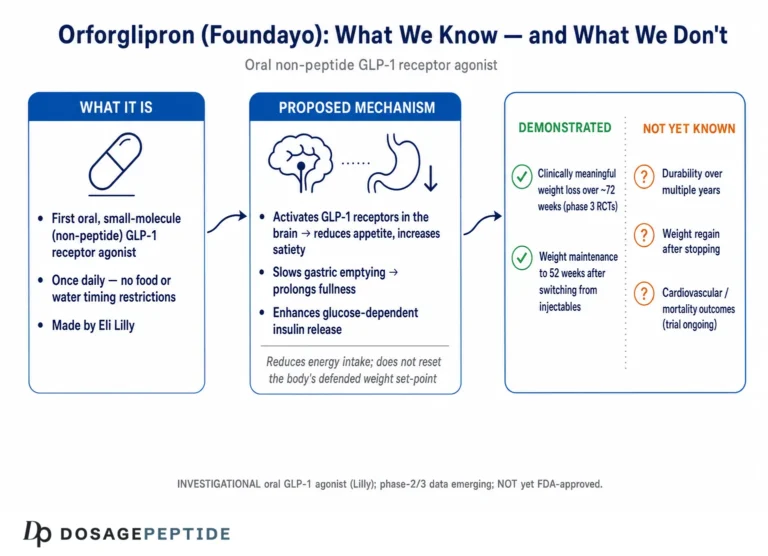
Orforglipron switches on the GLP-1 receptor from a binding pocket inside the membrane — a site the natural hormone never touches.1 That one structural fact explains the rest of the compound: why a small molecule can survive the gut and work as a tablet, why it needs no fasting-and-water window, and why it still triggers the same intracellular cascade (cAMP, PKA, Epac2) as an injected GLP-1 peptide.
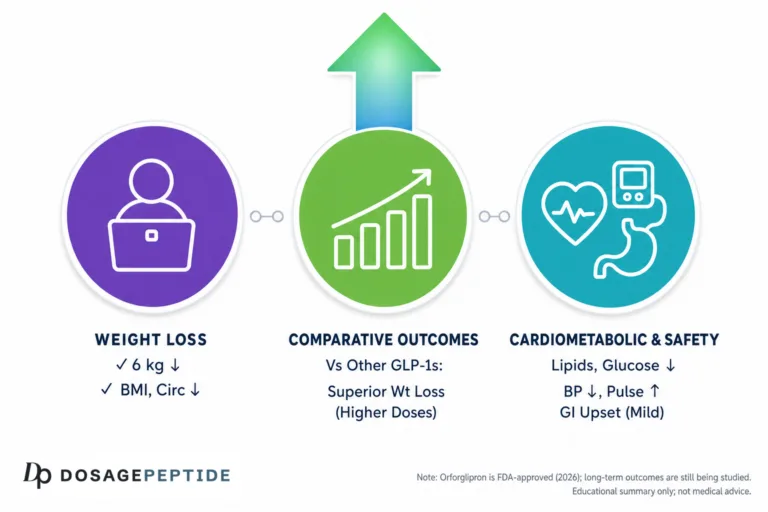
Downstream, that cascade sharpens glucose-dependent insulin secretion in pancreatic beta cells, slows gastric emptying, and acts on the brain’s appetite circuits. In humans it produces weight loss and lower A1C, alongside improvements in blood pressure, triglycerides and cholesterol — most of which plausibly follows from the weight loss rather than from a separate lipid mechanism.56
The FDA approved orforglipron in April 2026 under the brand name Foundayo, for chronic weight management in adults with obesity or overweight with at least one weight-related condition.1314 It is not approved for type 2 diabetes; that is a separate submission. Below, each rung of the evidence ladder is kept distinct — a cAMP readout in a transfected cell line and a mathematically inferred index of beta-cell function in a phase 3 trial are very different kinds of knowledge, and the word “models” hides that difference.
What Orforglipron Is and Why Its Chemistry Matters
Orforglipron belongs to a class of compounds that would have seemed nearly impossible a decade ago: a small, orally bioavailable molecule that mimics the action of a 30-amino-acid gut hormone at a receptor evolved to recognize peptides. The native ligand, GLP-1, is an incretin released from intestinal L-cells after eating; it acts on the GLP-1 receptor, a class B (secretin-family) G-protein-coupled receptor, to amplify glucose-dependent insulin secretion and produce a cascade of downstream metabolic effects.11 Class B GPCRs bind their peptide ligands through a large extracellular domain and a deep transmembrane groove, an architecture that has historically frustrated attempts to design orally active small molecules against them.
Peptide-based GLP-1 receptor agonists — semaglutide, liraglutide, dulaglutide, exenatide — solved the potency problem but inherited the liabilities of peptides: rapid enzymatic degradation, negligible oral absorption, and, in the one oral peptide case (oral semaglutide), a dependence on an absorption enhancer plus strict fasting and water-volume dosing conditions. Orforglipron was rationally designed to sidestep those constraints. It is a non-peptide, meaning it is not built from a chain of amino acids and is therefore not a substrate for the peptidases that dismantle GLP-1 analogues.1 Its pharmacokinetic profile supports once-daily oral dosing, and dedicated food-effect studies indicate it can be taken without the food and water restrictions that constrain oral semaglutide.10
Two chemical facts shape everything that follows. First, orforglipron is a partial agonist at the GLP-1 receptor relative to the native peptide — it does not drive the receptor to the same maximal signaling output that full-length GLP-1 does in vitro.1 Second, it is a biased agonist: it strongly stimulates the G-protein/cyclic-AMP arm of receptor signaling while producing little or no recruitment of β-arrestin.1 Both properties are established at the level of molecular and cellular models, and both are frequently invoked to explain the compound’s clinical behavior. As we will see, the leap from “partial and biased in a cell assay” to “this is why it behaves as it does in patients” is exactly the kind of inference that deserves careful handling rather than confident assertion.
The molecule’s development history reinforces how deliberately these properties were engineered. Orforglipron originated as OWL833, a compound emerging from a small-molecule GLP-1 discovery effort, before Eli Lilly advanced it through the LY3502970 designation and into full clinical development.11 Its pharmacokinetics were characterized early: the phase 1a single- and multiple-ascending-dose study in ninety-two healthy participants established a profile compatible with once-daily oral administration, and the phase 1b study extended that characterization into people with type 2 diabetes, where glucose-lowering pharmacodynamics were observed.23 A dedicated food-effect study then addressed the practical question that had constrained oral semaglutide, indicating that orforglipron’s absorption did not require the strict fasting-and-water regimen that the peptide product demands.10 These are not headline efficacy findings, but they are the pharmacological groundwork that makes a daily pill plausible, and they are worth separating from the later weight-loss numbers that dominate popular coverage.
For readers who want the broader class context, orforglipron sits within the same incretin-based therapeutic lineage as the injectable agents discussed in the site’s pillar on what tirzepatide is and how it works, and it represents one branch of the rapid diversification traced in how retatrutide fits into the evolution of peptide therapeutics. Orforglipron’s distinguishing feature within that lineage is not a new target — it is the same GLP-1 receptor — but a new chemotype and route.
Reading the Title Honestly: What “Alters Metabolic Pathways in Models” Actually Means
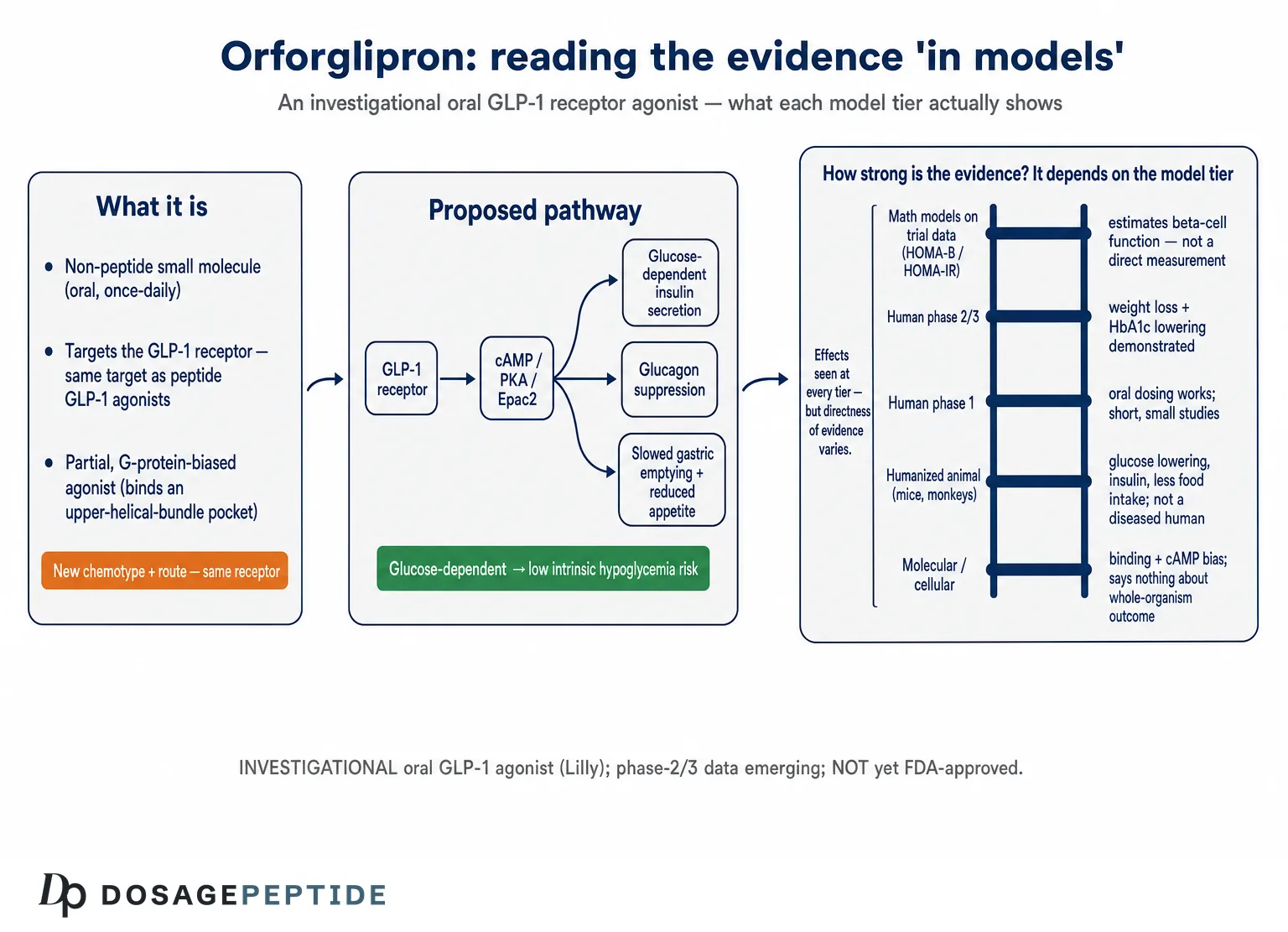
Before surveying the evidence, it is worth being explicit about the epistemology, because the phrase “in models” is the hinge on which honest interpretation turns. In pharmacology, a “model” is any simplified system used to stand in for the biology we ultimately care about. Orforglipron has been studied across at least five distinct model tiers, and each answers a different question with a different degree of directness.
At the most reductionist tier are molecular and cellular models: recombinant receptors in transfected cell lines, cryo-electron-microscopy structures, and biochemical readouts of cyclic AMP or β-arrestin. These tell us with high precision how the molecule engages the receptor and what proximal signal it generates, but they say nothing on their own about whether a whole organism will lose weight or lower its blood glucose.
Next are animal models: because the native GLP-1 receptor differs between species in a way that matters for this specific molecule, much of the preclinical work used humanized GLP-1-receptor transgenic mice and non-human primates rather than ordinary rodents.1 These systems test whether receptor engagement translates into integrated physiology — insulin secretion, glucose lowering, reduced food intake — in a living body, but a mouse or monkey is still not a person with metabolic disease.
Then come human clinical models, which themselves subdivide. Phase 1 pharmacology studies model drug handling and short-term glucose responses in healthy volunteers and in people with diabetes.23 Phase 2 and phase 3 trials model efficacy and safety in defined patient populations over months.456 And crucially, many of the “metabolic pathway” conclusions drawn from these trials rest on mathematical models applied to human data — the homeostatic model assessment indices (HOMA-B for beta-cell function, HOMA-IR for insulin resistance), which are computed estimates rather than direct measurements of the underlying physiology.9
This last point is the quiet irony embedded in the title. When a trial reports that orforglipron “improved beta-cell function,” that statement often rests on HOMA-B — a value derived from fasting glucose and insulin through an equation, not from a hyperglycemic clamp directly measuring insulin output.9 The evidence that orforglipron alters metabolic pathways is genuinely strong, but a meaningful fraction of it is model-inferred at both ends: a compound designed against a receptor model, evaluated through physiological models, and quantified with statistical models. Recognizing this does not diminish the findings; it simply calibrates how we phrase them. Throughout the rest of this article, each claimed pathway effect is tagged, implicitly or explicitly, with the model tier that supports it.
The Molecular Starting Point: How Orforglipron Engages the GLP-1 Receptor
The clearest window into orforglipron’s mechanism comes from structural biology. In 2020, Kawai and colleagues solved a high-resolution cryo-electron-microscopy structure of LY3502970 in complex with the active-state human GLP-1 receptor and its heterotrimeric G protein.1 The structure revealed something genuinely informative: the small molecule occupies a binding pocket in the upper portion of the receptor’s helical bundle, making contacts with the extracellular domain, extracellular loop 2, and transmembrane helices 1, 2, 3, and 7.1 This is a distinctly different footprint from the native peptide, which threads deep into the transmembrane core and contacts nearly every helix.
Because orforglipron engages a shallower, partially extracellular pocket rather than reproducing the peptide’s deep insertion, it stabilizes a receptor conformation that is active but not identical to the fully peptide-bound state. This structural distinction is the mechanistic root of the two pharmacological signatures noted earlier: partial agonism (the receptor is switched on, but not to the peptide’s full ceiling) and G-protein bias (the conformation favors coupling to the stimulatory G protein over the arrestin pathway).1
The structure also explained a preclinical puzzle with direct methodological consequences. A primate-specific tryptophan residue at position 33 of the extracellular domain (Trp33) forms a critical contact with the molecule.1 Ordinary rodents lack this residue, so orforglipron is far less active at the native mouse receptor — which is precisely why the in-vivo pharmacology had to be conducted in humanized-receptor transgenic mice and in non-human primates, whose receptors carry the human-like residue.1 This is not a trivia point: it means that a large swath of the standard rodent obesity and diabetes toolkit could not be applied to orforglipron in the usual way, and it underscores how species differences at a single amino acid can dictate which models are even usable.
Two additional molecular properties round out the picture and matter for interpreting the whole-organism data. First, orforglipron is reported to be highly potent and selective for the GLP-1 receptor over other class B GPCRs, including the closely related receptors for glucagon and GIP.111 That selectivity is mechanistically important: it means the metabolic effects observed in the models can be attributed to GLP-1-receptor engagement specifically, rather than to promiscuous activation of the broader incretin-and-glucagon receptor family — a distinction that separates orforglipron cleanly from the multi-receptor agonists such as tirzepatide (GLP-1/GIP) and retatrutide (GLP-1/GIP/glucagon). Second, the partial-agonist character means that in a head-to-head cellular comparison against native GLP-1, orforglipron does not reach the peptide’s maximal cAMP output; it is a strong but sub-maximal activator.1 Whether sub-maximal receptor activation is a liability (less signaling) or an advantage (less desensitization, better tolerability) is precisely the kind of question the molecular models raise but cannot themselves resolve — it requires the integrated read-outs of the higher model tiers.
In those humanized and primate systems, the molecular engagement translated into function. Oral administration of orforglipron lowered glucose in humanized GLP-1-receptor transgenic mice to a degree comparable to injected exenatide, and in cynomolgus monkeys it stimulated insulin secretion and reduced food consumption, again comparably to an injectable peptide agonist.1 These findings established, at the animal-model tier, that a non-peptide occupying an unconventional pocket could nonetheless drive the integrated incretin response.
The Proximal Signaling Pathway: cAMP, PKA, Epac2, and the Question of Bias
Once orforglipron stabilizes the active receptor conformation, the immediate downstream events follow the canonical GLP-1-receptor script — with a twist. The receptor couples to the stimulatory G protein (Gs), activating adenylyl cyclase, raising intracellular cyclic AMP (cAMP), and thereby engaging two principal effectors: protein kinase A (PKA) and the cAMP-regulated guanine-nucleotide exchange factor Epac2.11 In pancreatic beta-cells this cAMP-PKA-Epac2 axis is the molecular engine of glucose-dependent insulin secretion, amplifying the exocytotic response to a rise in blood glucose without forcing insulin release when glucose is low. That glucose-dependence is why incretin-based agents carry a low intrinsic risk of hypoglycemia compared with sulfonylureas or insulin.
The distinguishing feature of orforglipron at this tier is its signaling bias. In cellular assays it robustly stimulates GLP-1-receptor-mediated cAMP accumulation while producing little detectable β-arrestin recruitment.1 β-arrestins classically mediate receptor desensitization and internalization; the theory, therefore, is that a G-protein-biased agonist might sustain cAMP signaling by avoiding the arrestin-driven shutdown that limits a full agonist’s effect over time. A parallel line of GLP-1 pharmacology has explored exactly this idea, showing that reduced arrestin recruitment can prolong cAMP signaling at glucagon-family receptors and, in some engineered analogues, improve metabolic outcomes in obese mice.12
Here the honesty directive matters. It is tempting to present the causal chain as settled: “orforglipron is G-protein biased, therefore it sustains signaling, therefore it produces durable weight loss with acceptable tolerability.” The first link is a solid cellular-model finding. The remaining links are plausible hypotheses that the human data are consistent with but do not prove. Signaling bias is notoriously assay-dependent — the apparent degree of bias can shift with the cell system, the reference ligand, and the readout used — and translating a bias factor measured in a transfected line into a specific clinical property remains one of the harder problems in GPCR pharmacology. The measured cAMP bias is real; the clinical consequences attributed to it are, at present, mechanistic conjecture supported by circumstantial consistency rather than by a decisive experiment. A rigorous reading treats bias as a characterized molecular property and an attractive explanatory hypothesis, not as a demonstrated cause of any particular patient outcome.
Pancreatic Islet Pathways: Insulin Secretion, Beta-Cell Function, and Glucagon
Moving up from the signaling cascade to islet physiology, orforglipron’s effects have been characterized in both animal and human models. Mechanistically, cAMP-driven potentiation of insulin exocytosis is glucose-dependent: the drug amplifies secretion when glucose is elevated and stands down when it is not. In cynomolgus monkeys, orforglipron stimulated insulin secretion directly.1 In humans, the phase 1b multiple-ascending-dose study in people with type 2 diabetes demonstrated glucose-lowering pharmacodynamics consistent with incretin action.3
The most granular human data on islet pathways come from a phase 2 mechanistic analysis. In a randomized trial of 378 participants with type 2 diabetes, orforglipron at doses of 12 mg and higher increased HOMA-B — a model-derived index of beta-cell function — by up to roughly 123% (using C-peptide) to 132% (using insulin), while decreasing HOMA-IR, an index of insulin resistance, by up to about 16% to 23% over 26 weeks.9 Improvements in the proinsulin-to-insulin ratio and in fasting proinsulin, along with favorable shifts in adiponectin and insulin-like growth factor-binding protein-2, rounded out a picture of enhanced islet function and improved insulin sensitivity.9
These are meaningful signals, but their model-inferred nature must travel with them. HOMA-B and HOMA-IR are computed from fasting glucose and either insulin or C-peptide via a homeostatic equation; they are validated population-level surrogates, not direct measurements of insulin secretory capacity or of tissue insulin sensitivity in a given individual.9 A large HOMA-B increase is genuinely encouraging and is consistent with the mechanism, but it is a modeled estimate, and part of an apparent “improvement in beta-cell function” on a GLP-1 agonist reflects the acute secretagogue effect and weight-loss-associated de-stressing of the islet rather than durable regeneration of beta-cell mass. Whether any of these agents truly rebuilds beta-cell reserve, as opposed to relieving the metabolic load on existing cells, is not resolved by HOMA indices and remains an open research question for the entire class.
On the alpha-cell side, GLP-1-receptor agonism suppresses glucagon secretion in a glucose-dependent manner, reducing inappropriate hepatic glucose output; the class effect is reflected in orforglipron’s reported reductions in fasting glucagon.8 The net islet consequence — more glucose-appropriate insulin, less glucagon, lower fasting and postprandial glucose — is the pathway that underlies the glycemic efficacy seen in the diabetes trials, to which we turn next. Readers interested in how these incretin-driven islet and hepatic pathways are dissected in the related dual-agonist context will find a complementary treatment in the discussion of how tirzepatide influences incretin pathways.
Beyond the Pancreas: Gastric Emptying, Appetite Circuits, and Energy Balance
GLP-1-receptor agonism is not confined to the islet. Two extra-pancreatic pathways dominate the weight and appetite effects, and orforglipron engages both in the model systems studied.
The first is gastric emptying. GLP-1-receptor activation slows the rate at which the stomach empties into the small intestine, blunting postprandial glucose excursions and prolonging the sense of fullness. This delay is part of why incretin agonists reduce post-meal glucose spikes independently of their direct insulinotropic action, and it also contributes to the gastrointestinal adverse-event profile — nausea, early satiety — that characterizes the whole class.8
The second, and quantitatively the more important for weight, is central appetite regulation. GLP-1 receptors are expressed in hypothalamic nuclei and in hindbrain regions such as the area postrema and nucleus tractus solitarius, circuits that integrate satiety signaling and modulate food intake.8 Engagement of these circuits reduces caloric intake, and in orforglipron’s animal models the readout was direct: reduced food consumption in non-human primates.1 In humans, the downstream consequence is documented as weight loss across the phase 2 and phase 3 programs. A caveat on the central pathway is worth stating: the precise anatomy of small-molecule GLP-1-agonist action on human appetite centers is inferred largely from the peptide literature and animal work, since one cannot directly observe hypothalamic engagement in a trial participant. The outcome (reduced intake, weight loss) is well measured; the site of action is model-mapped.
It is worth pausing on why the central pathway matters more than the peripheral one for body weight. Slowed gastric emptying contributes to short-term fullness and to postprandial glucose control, but the stomach adapts and the effect tends to attenuate with continued exposure; sustained weight loss over months tracks far more closely with the persistent reduction in appetite and caloric intake driven by hypothalamic and hindbrain signaling.8 This is why a durable weight response, rather than a transient one, is taken as evidence that the central circuitry — not merely the gut-motility effect — is meaningfully engaged. In orforglipron’s case the animal-model readout of reduced food consumption in primates and the sustained human weight trajectories across 36- and 72-week trials are jointly consistent with genuine central engagement, even though the anatomical site cannot be observed directly in a clinical study.16
The integrated result of slowed gastric emptying plus reduced central drive to eat is a negative energy balance, and the human weight-loss data are substantial. In the 36-week phase 2 obesity trial, mean weight reduction ranged from about 9.4% to 14.7% across orforglipron dose cohorts, with 46% to 75% of participants achieving at least 10% weight loss versus 9% on placebo.4 In the pivotal 72-week phase 3 ATTAIN-1 trial in adults with obesity (without diabetes), the highest dose produced mean weight reductions in the range of roughly 11% to 12%, with a meaningful fraction of participants reaching 15% or 20% thresholds.6 These figures place orforglipron in a clinically relevant range for an oral agent, while remaining measured: the effect sizes, though large for a pill, are generally reported as somewhat below the highest injectable benchmarks, and cross-trial comparisons are hazardous without head-to-head data.
Lipid and Cardiometabolic Pathways
Weight loss and improved glycemia propagate into the lipid and vascular compartments, and the orforglipron program has tracked these secondary metabolic pathways as trial endpoints. Across the phase 2 and phase 3 studies, treatment was associated with reductions in triglycerides and low-density-lipoprotein (LDL) cholesterol, increases in high-density-lipoprotein (HDL) cholesterol, and improvements in blood pressure and waist circumference.68 The complete ATTAIN-1 results published in the New England Journal of Medicine reported improvement across the measured cardiometabolic risk factors, and a systematic review and meta-analysis of the cardiometabolic outcomes concluded that the pattern is consistent across the trial base.68
Interpreting these lipid and blood-pressure shifts requires a mechanistic distinction that is easy to blur. Some of the improvement is almost certainly secondary to weight loss — losing 10% of body weight improves triglycerides and blood pressure regardless of the agent used. A portion may reflect more direct GLP-1-pathway effects on hepatic lipid handling and vascular biology, mechanisms that have been explored for the class in dedicated work on how GLP-1 pathways regulate lipid metabolism in atherogenic dyslipidemia and on GLP-1 signaling mechanisms in arterial stiffness. For orforglipron specifically, the trials measure the net change; they are not designed to partition how much is weight-mediated versus drug-direct, and the honest statement is that both contribute in proportions the current data do not cleanly separate.
A further and important limit: improvement in cardiometabolic risk factors is not the same as demonstrated reduction in cardiovascular events. Surrogate improvements in lipids and blood pressure are encouraging but do not, by themselves, establish that orforglipron reduces heart attacks, strokes, or cardiovascular death. Dedicated cardiovascular-outcome trials are the appropriate model for that question, and until they read out, any statement about hard-outcome benefit is premature. This is exactly the kind of surrogate-versus-outcome gap that has historically humbled metabolic drug development, and it applies here in full.
Glycemic Efficacy Across the Diabetes Models
The type 2 diabetes program provides the most quantitative demonstration that orforglipron’s pathway engagement produces the intended integrated outcome: durable lowering of chronic glycemia. In the 26-week phase 2 dose-response study in people with type 2 diabetes, orforglipron produced reductions in glycated hemoglobin (HbA1c) that reached approximately 2.1 percentage points at the higher doses, compared with roughly 1.1 points for the active comparator dulaglutide and about 0.4 points for placebo.5 That the small molecule matched or exceeded an injectable peptide comparator on the central glycemic endpoint, within a single blinded trial, was the finding that moved the compound decisively into large-scale development.
Mechanistically, an HbA1c reduction of that magnitude is the summed footprint of every islet and extra-pancreatic pathway discussed above: amplified glucose-dependent insulin secretion, suppressed glucagon and hepatic glucose output, slowed gastric emptying that blunts postprandial excursions, and the indirect glycemic benefit of substantial weight loss improving peripheral insulin sensitivity.811 HbA1c is itself a useful model of average glycemia — it reflects the fraction of hemoglobin glycated over the preceding roughly three months — and it is the endpoint regulators have long accepted as a surrogate for glycemic control, though not, on its own, for microvascular or cardiovascular outcomes.
The phase 3 ACHIEVE program was designed to confirm and extend these phase 2 signals in larger, longer, and more diverse diabetes populations, including head-to-head evaluation against oral semaglutide, and the sponsor has reported that these trials met their glycemic endpoints, reconfirming the compound’s potential as a foundational glucose-lowering agent.7 A phase 3 study in early type 2 diabetes has been reported in the peer-reviewed literature as well.7 The honest framing here mirrors the obesity story: the glycemic effect is real, reproducible, and mechanistically coherent, but the precise placement of orforglipron relative to established oral and injectable options depends on the pre-specified terms of the head-to-head trials rather than on cross-study impressions, and none of it converts a surrogate endpoint into demonstrated long-term outcome benefit.
One further nuance separates the diabetes and obesity models in a way that bears on mechanism. In people with type 2 diabetes, glucose-lowering is constrained by a partially exhausted islet, so the insulinotropic pathway operates against a background of relative beta-cell stress; the HOMA-B improvements reported for orforglipron suggest the drug relieves some of that functional strain.9 In people with obesity but without diabetes, glycemic pathways are comparatively intact, and the dominant metabolic action shifts toward the appetite and energy-balance circuits. The same molecule, engaging the same receptor, therefore expresses a somewhat different pathway emphasis depending on the metabolic model it is placed in — a reminder that “alters metabolic pathways” is context-dependent even within the human population.
| Metabolic pathway | Principal tissue / site | Observed effect with orforglipron | Strongest supporting model |
|---|---|---|---|
| cAMP–PKA–Epac2 signaling | GLP-1R-expressing cells | Robust cAMP accumulation; minimal β-arrestin recruitment (G-protein bias)1 | Cellular / structural |
| Glucose-dependent insulin secretion | Pancreatic β-cells | Enhanced insulin release; improved HOMA-B (up to ~123–132%)19 | NHP + human phase 2 |
| Glucagon suppression | Pancreatic α-cells | Reduced fasting glucagon; lower hepatic glucose output8 | Human trials (class-consistent) |
| Gastric emptying | Stomach / GI tract | Slowed emptying; blunted postprandial glucose; GI adverse events8 | Class pharmacology + human safety data |
| Appetite / satiety | Hypothalamus, hindbrain | Reduced food intake; weight loss14 | NHP (intake) + human outcome |
| Insulin sensitivity | Liver, muscle, adipose (systemic) | Reduced HOMA-IR (up to ~16–23%); favorable adiponectin9 | Human phase 2 (model-inferred) |
| Lipid / cardiometabolic | Systemic | Lower triglycerides and LDL; higher HDL; lower blood pressure68 | Human phase 3 (largely weight-mediated) |
The Evidence Ladder: From Cell Assays to Phase 3
The table below organizes the orforglipron evidence by model tier, making explicit what each rung establishes and what it cannot. This is the single most useful frame for answering the title’s question honestly: the compound alters metabolic pathways at every tier studied, but the directness of the evidence varies enormously.
| Model tier | System | What it establishes about metabolic pathways | Key limit |
|---|---|---|---|
| Molecular / structural | Cryo-EM of receptor complex; recombinant-cell cAMP and β-arrestin assays | Binding pocket, partial agonism, G-protein/cAMP bias vs β-arrestin1 | Says nothing about whole-organism outcome; bias is assay-dependent |
| Animal (humanized) | Humanized GLP-1R transgenic mice; cynomolgus monkeys | Oral glucose lowering; stimulated insulin secretion; reduced food intake1 | Species-specific receptor; not a diseased human |
| Human phase 1 | Healthy volunteers; people with type 2 diabetes | Oral PK supports once-daily dosing; glucose-lowering pharmacodynamics; food-independent dosing2310 | Short duration; small samples |
| Human phase 2 | Type 2 diabetes; obesity/overweight | HbA1c reduction; 9.4–14.7% weight loss at 36 wk; HOMA-B up, HOMA-IR down49 | Beta-cell “function” is model-inferred (HOMA) |
| Human phase 3 | ATTAIN (obesity), ACHIEVE (diabetes) programs | Confirmed weight and glycemic efficacy; broad cardiometabolic risk-factor improvement567 | Risk factors ≠ cardiovascular events; not yet approved |
Read top to bottom, the ladder is unusually complete — a consequence of the intense commercial and scientific interest in an oral GLP-1 agent. Read critically, each rung hands off a hypothesis to the next: the structure predicts a signaling signature, the signature is confirmed in cells, the cell finding is shown to produce physiology in humanized animals, and the physiology is finally demonstrated as clinical efficacy in humans. The chain is coherent and, at the top, well populated with large randomized data. What the chain does not do is license the reverse inference — taking a clinical outcome and attributing it specifically to the cellular bias — without additional evidence.
How Orforglipron Compares With Peptide GLP-1 Agonists
Placing orforglipron beside the established peptide agonists clarifies what is genuinely novel about it and what is simply shared class biology. The novelty is chemical and pharmacokinetic, not target-based: it hits the same receptor as semaglutide and the GLP-1 component of tirzepatide, but as a non-peptide small molecule taken by mouth.
| Property | Orforglipron | Injectable peptide GLP-1 RAs (e.g., semaglutide) | Oral semaglutide |
|---|---|---|---|
| Chemical class | Non-peptide small molecule1 | Peptide analogue | Peptide analogue |
| Route | Oral, once daily2 | Subcutaneous injection | Oral |
| Food / water restriction | Not required per PK studies10 | N/A (injected) | Strict fasting + limited water |
| Receptor engagement | Upper-helical-bundle pocket; partial, G-protein-biased agonist1 | Deep transmembrane binding; full agonist | Deep transmembrane binding; full agonist |
| Degradation liability | Not a peptidase substrate1 | Engineered for protease resistance + albumin binding | Peptide + absorption enhancer |
| Regulatory status (August 2026) | FDA-approved April 2026 as Foundayo for weight management; not approved for type 2 diabetes1314 | Approved (multiple indications) | Approved |
Two honest observations follow. First, the metabolic pathways orforglipron engages are, by design, the same canonical GLP-1-receptor pathways that the peptides engage — cAMP-driven insulin secretion, glucagon suppression, delayed gastric emptying, central satiety. The compound is not opening a new metabolic route; it is reaching an established route by a new door. Second, whether its partial, biased profile confers a distinct clinical fingerprint — for instance, a different tolerability or durability curve than full peptide agonists — is an open question that only head-to-head and long-term data can answer. Early phase 3 comparisons against oral semaglutide have begun to appear, but drawing firm superiority or non-inferiority conclusions requires the specific trials designed for that purpose, interpreted on their pre-specified terms rather than by cross-trial eyeballing.
For the manufacturing- and handling-oriented reader, it is worth flagging one practical divergence from the injectable-peptide research workflow: because orforglipron is an orally dosed small molecule rather than a lyophilized peptide, the reconstitution-and-subcutaneous-injection paradigm familiar from research peptides does not apply to it in the same way. Where that paradigm is relevant — for the peptide agents in this class — the site’s peptide glossary defines the recurring terms, and long-term weight-maintenance considerations for the broader class are examined in the discussion of whether semaglutide offers a sustainable long-term weight-loss solution.
Safety, Tolerability, and What the Models Do Not Cover
A pathway-focused article would be incomplete without noting where the metabolic-benefit story intersects with tolerability, because the same pathways that produce efficacy also produce the characteristic adverse events. Slowed gastric emptying and central appetite modulation are inseparable from the class’s gastrointestinal side-effect profile: nausea, vomiting, diarrhea, and constipation, generally mild to moderate and most prominent during dose escalation.6 In the phase 3 obesity data, gastrointestinal events were the most common adverse events, and treatment discontinuation for adverse events occurred in a minority of participants — reported on the order of several percent higher than placebo across the active dose groups.6 This is consistent with the injectable class and reflects on-target pharmacology rather than an idiosyncratic toxicity.
Several boundaries of the current evidence deserve explicit statement:
- Duration. The longest pivotal exposures run to roughly 72 weeks.6 Obesity and type 2 diabetes are lifelong conditions; multi-year safety and the trajectory of weight regain after discontinuation are not yet fully characterized for orforglipron specifically.
- Cardiovascular outcomes. As emphasized above, improved risk factors are not proven event reduction; dedicated outcome trials are the correct model, and none has yet established a hard-outcome benefit for orforglipron.
- Population breadth. Efficacy and safety are best characterized in the enrolled populations (adults with obesity and/or type 2 diabetes). Extrapolation to other groups — adolescents, pregnancy, advanced organ dysfunction — is not supported by the current model base.
- Mechanistic attribution. The biased-agonism narrative remains a hypothesis for explaining clinical behavior, not a demonstrated cause.
- Regulatory status. Orforglipron is an approved prescription medicine for weight management only, sold as Foundayo tablets.13 It is not approved for type 2 diabetes, and material sold outside the pharmacy channel — including anything offered as a “research” powder or vial — carries the usual concerns of uncertain identity, purity, and dosing.
A final tolerability nuance connects back to the biased-agonism discussion. Some observers have speculated that a partial, G-protein-biased agonist might separate efficacy from gastrointestinal intolerance more favorably than a full agonist, since β-arrestin signaling has been implicated in aspects of the emetic response for related receptors. The orforglipron trials do show a recognizable, dose-dependent gastrointestinal signal rather than an absence of one, which tempers the strongest version of that hope.6 The most defensible statement is that its tolerability profile falls within the expected range for the class, that dose titration is used to manage it as with the peptides, and that any claim of a bias-driven tolerability advantage awaits direct comparative evidence rather than mechanistic supposition.
The reasonable synthesis is that orforglipron’s metabolic-pathway engagement is genuine, well-characterized across an unusually complete model ladder, and clinically productive in the populations studied — and that this is entirely compatible with its long-term and hard-outcome profile still maturing, and several of its most-repeated mechanistic explanations still carrying the status of well-motivated hypothesis.
Regulatory Status and How to Read the Claims
Because orforglipron sits at a moment of intense public attention, the gap between what has been demonstrated and what has been approved deserves a clear statement. The phase 3 program has reported successful topline results and peer-reviewed publications across obesity (the ATTAIN trials) and type 2 diabetes (the ACHIEVE trials), and the sponsor has stated that global regulatory submissions were initiated on the strength of those data.567 On the strength of that programme the FDA granted marketing authorization in April 2026, under the brand name Foundayo, for chronic weight management only.1314 What follows still matters: approval for one indication is not approval for all of them. Orforglipron is authorised for weight management, not for type 2 diabetes, where a separate submission is pending; and outside the United States its status varies by country and continues to evolve.
Two interpretive cautions help a reader navigate the surrounding commentary. First, “successful phase 3 trial” means the study met its pre-specified primary endpoint with acceptable safety in its defined population; it does not certify a place in clinical practice, a comparative ranking against alternatives, or long-term outcomes. Second, headline weight-loss percentages are estimand-dependent — the same trial can report somewhat different figures under an “efficacy” estimand (effect if treatment is taken as directed) versus a “treatment-regimen” estimand (effect regardless of adherence), and responsible reporting names which is being quoted.6 When a single number is cited without that context, it should be read as indicative rather than definitive.
The bottom line for the title’s question: the evidence that orforglipron alters systemic metabolic pathways is strong and layered, spanning structural, cellular, animal, and large human-trial models. The appropriate scientific posture is confidence about the existence and general direction of those pathway effects, measured caution about their precise magnitude and durability, explicit humility about mechanistic attributions such as biased agonism, and clear acknowledgment that approval for weight management does not settle the long-term outcome questions, which remain open.
Frequently Asked Questions
Is orforglipron FDA-approved?
Yes, for one indication. The FDA approved orforglipron in April 2026 as Foundayo, for chronic weight management in adults with obesity, or overweight with at least one weight-related condition, alongside a reduced-calorie diet and more physical activity.1314 It is not approved for type 2 diabetes, where the ACHIEVE programme has reported results and a separate submission is pending. The label carries a boxed warning about thyroid C-cell tumours.13
What makes orforglipron different from semaglutide or tirzepatide?
It targets the same GLP-1 receptor, but it is a non-peptide small molecule rather than a peptide analogue, which allows once-daily oral dosing without the strict fasting-and-water requirements of oral semaglutide.110 Structurally it binds an upper-helical-bundle pocket and acts as a partial, G-protein-biased agonist, whereas the peptides insert deep into the receptor and act as full agonists.1 The metabolic pathways engaged are the same; the chemistry and route are what is new.
What does “alters metabolic pathways in models” actually mean here?
“Models” spans several tiers: molecular structures and cell assays that show receptor binding and cAMP signaling; humanized transgenic mice and monkeys that show glucose lowering, insulin secretion, and reduced food intake; and human trials that show weight loss and improved glycemia.14 Notably, some human “pathway” conclusions rest on mathematical models such as HOMA-B and HOMA-IR, which estimate beta-cell function and insulin resistance rather than measuring them directly.9 The evidence is strong, but it is important to know which model tier supports each claim.
How does orforglipron lower blood glucose?
Through the canonical GLP-1-receptor cascade: activation of the receptor raises intracellular cyclic AMP via the stimulatory G protein, engaging PKA and Epac2 to amplify glucose-dependent insulin secretion from pancreatic beta-cells while suppressing glucagon from alpha-cells and slowing gastric emptying.111 Because the insulin effect is glucose-dependent, the intrinsic hypoglycemia risk is low relative to insulin or sulfonylureas.
How much weight loss has been seen in trials?
In the 36-week phase 2 obesity trial, mean weight reduction ranged from about 9.4% to 14.7% across dose cohorts, with 46% to 75% of participants losing at least 10% versus 9% on placebo.4 In the 72-week phase 3 ATTAIN-1 trial the highest dose produced mean reductions in the roughly 11% to 12% range.6 These figures are estimand-dependent and should not be compared head-to-head against other drugs’ trials without dedicated comparative studies.
What is “biased agonism,” and does it matter clinically?
Orforglipron preferentially activates the G-protein/cAMP pathway while producing little β-arrestin recruitment in cell assays.1 The theory is that avoiding arrestin-driven receptor shutdown could sustain signaling, and related GLP-1 work supports the idea in principle.12 But signaling bias is assay-dependent, and no decisive experiment has shown that the measured bias causes a specific clinical outcome. It is best treated as a characterized molecular property and an attractive hypothesis, not a proven driver of patient results.
Why was orforglipron tested in humanized mice and monkeys instead of ordinary rats?
A primate-specific tryptophan residue (Trp33) in the receptor’s extracellular domain is critical for orforglipron binding, and ordinary rodents lack it, so the drug is far less active at the native rodent receptor.1 Preclinical pharmacology therefore relied on humanized GLP-1-receptor transgenic mice and non-human primates, whose receptors carry the human-like residue — a clear example of how species differences dictate which models are usable.
Does improving cardiometabolic risk factors mean orforglipron prevents heart attacks?
Not yet. The trials show improvements in blood pressure, triglycerides, LDL and HDL cholesterol, and waist circumference, much of it plausibly secondary to weight loss.68 Improved risk factors are surrogate endpoints; demonstrating reduced cardiovascular events requires dedicated cardiovascular-outcome trials, which have not yet established a hard-outcome benefit for orforglipron.
Can orforglipron be reconstituted and injected like research peptides?
The reconstitution-and-injection workflow applies to lyophilized peptide agents, not to orforglipron, which is an orally administered small molecule studied as a once-daily tablet.2 Applying peptide-handling practices to it is a category error. For the peptide members of this class, standard terminology is defined in the site’s glossary, but orforglipron’s pharmacology is fundamentally that of an oral drug.
References
- Kawai T, Sun B, Yoshino H, et al. Structural basis for GLP-1 receptor activation by LY3502970, an orally active nonpeptide agonist. Proc Natl Acad Sci U S A. 2020;117(47):29959-29967. PMID: 33177239. PMCID: PMC7703558. https://pubmed.ncbi.nlm.nih.gov/33177239/
- Pratt E, Ma X, Liu R, et al. Orforglipron (LY3502970), a novel, oral non-peptide glucagon-like peptide-1 receptor agonist: A Phase 1a, blinded, placebo-controlled, randomized, single- and multiple-ascending-dose study in healthy participants. Diabetes Obes Metab. 2023;25(9):2634-2641. PMID: 37344954. https://pubmed.ncbi.nlm.nih.gov/37344954/
- Pratt E, Ma X, Liu R, et al. Orforglipron (LY3502970), a novel, oral non-peptide glucagon-like peptide-1 receptor agonist: A Phase 1b, multicentre, blinded, placebo-controlled, randomized, multiple-ascending-dose study in people with type 2 diabetes. Diabetes Obes Metab. 2023;25(9):2642-2649. PMID: 37264711. https://pubmed.ncbi.nlm.nih.gov/37264711/
- Wharton S, Blevins T, Connery L, et al. Daily Oral GLP-1 Receptor Agonist Orforglipron for Adults with Obesity. N Engl J Med. 2023;389(10):877-888. PMID: 37351564. https://pubmed.ncbi.nlm.nih.gov/37351564/
- Frias JP, Hsia S, Eyde S, et al. Efficacy and safety of oral orforglipron in patients with type 2 diabetes: a multicentre, randomised, dose-response, phase 2 study. Lancet. 2023;402(10400):472-483. PMID: 37369232. https://pubmed.ncbi.nlm.nih.gov/37369232/
- Aronne LJ, Ahmad NN, Bays HE, et al. Orforglipron in adults with obesity (ATTAIN-1): a phase 3, randomized, double-blind, placebo-controlled trial. N Engl J Med. 2025. Published online. doi:10.1056/NEJMoa2511774. https://www.nejm.org/doi/full/10.1056/NEJMoa2511774
- Eli Lilly and Company. Orforglipron demonstrated statistically significant efficacy and successful Phase 3 results triggering global regulatory submissions (ACHIEVE and ATTAIN program announcements). 2025. https://investor.lilly.com/news-releases/news-release-details/lillys-oral-glp-1-orforglipron-successful-third-phase-3-trial
- Efficacy and safety of orforglipron, an oral small-molecule GLP-1 receptor agonist, on cardiometabolic outcomes: a meta-analysis and systematic review. PMC. 2025. PMCID: PMC12922244. https://www.ncbi.nlm.nih.gov/pmc/articles/PMC12922244/
- Rosenstock J, Frias JP, Rider J, et al. Orforglipron, an oral non-peptide glucagon-like peptide-1 receptor agonist, improves markers of β-cell function and insulin sensitivity in type 2 diabetes. Diabetes Obes Metab. 2025;27(11):6314-6322. PMID: 40808573. https://pubmed.ncbi.nlm.nih.gov/40808573/
- Ma X, Pratt E, Chowdhury S, et al. Effect of Food Consumption on the Pharmacokinetics, Safety, and Tolerability of Once-Daily Orally Administered Orforglipron (LY3502970). Diabetes Ther. 2024. doi:10.1007/s13300-024-01554-1. https://link.springer.com/article/10.1007/s13300-024-01554-1
- Kansakar S, et al. Orforglipron: A Comprehensive Review of an Oral Small-Molecule GLP-1 Receptor Agonist for Obesity and Type 2 Diabetes. Int J Mol Sci. 2026;27(3):1409. PMCID: PMC12898445. https://www.ncbi.nlm.nih.gov/pmc/articles/PMC12898445/
- Jones B, Buenaventura T, Kanda N, et al. Genetic and biased agonist-mediated reductions in β-arrestin recruitment prolong cAMP signaling at glucagon family receptors. J Biol Chem. 2021;296:100133. PMCID: PMC7948418. https://www.ncbi.nlm.nih.gov/pmc/articles/PMC7948418/
- FOUNDAYO (orforglipron) tablets, for oral use — US FDA Prescribing Information, 2026. accessdata.fda.gov
- Eli Lilly and Company. FDA approves Lilly’s Foundayo (orforglipron), the only GLP-1 pill for weight loss that can be taken any time of day without food or water restrictions. Investor news release, April 2026. investor.lilly.com
Educational and research-use disclaimer: This article is provided solely for scientific and educational purposes. Orforglipron is approved in the United States, as Foundayo, for chronic weight management only; it is not approved for type 2 diabetes or any other disease, and it is a prescription medicine carrying a boxed warning. The metabolic-pathway effects described here derive from molecular, cellular, animal, and human-trial models of varying directness, and several mechanistic interpretations (including biased agonism) remain hypotheses. Nothing here is medical advice or a recommendation for human use. Any legitimate investigation of this compound should occur within properly authorized clinical research under appropriate regulatory oversight, and readers should consult qualified professionals and applicable regulations before making any decisions.