Short answer: in rats, BPC-157 heals gut lesions quickly and across a wide range of injury types. In humans, it has never been shown to heal an ulcer at all — no published randomized trial has measured endoscopic ulcer healing, and the peptide is not approved by the FDA for any use.13 That gap between the animal data and the human data is the whole story, and this page is about how wide it is.
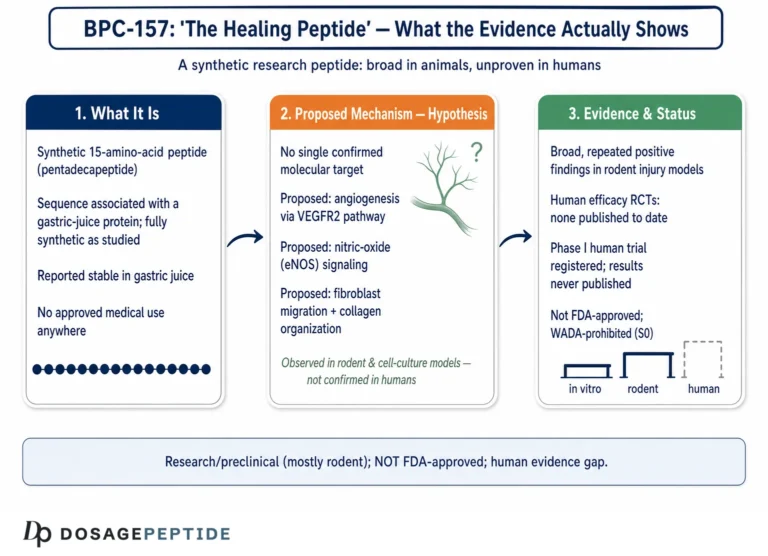
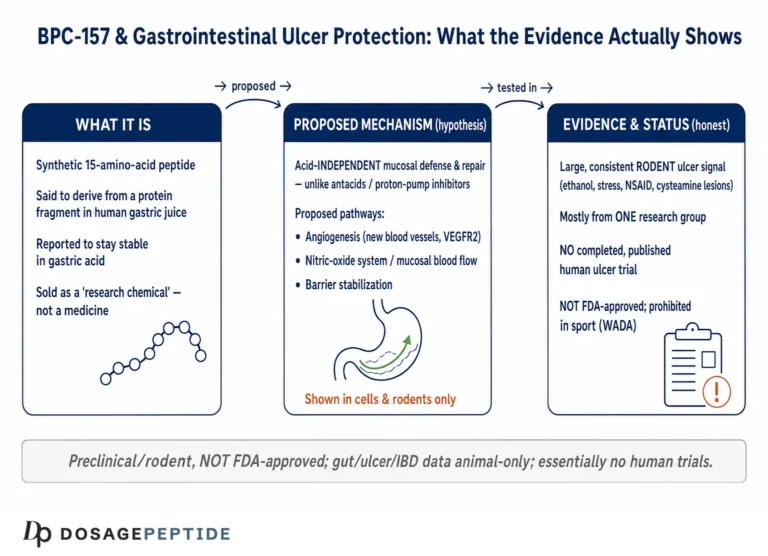
BPC-157 is a 15-amino-acid peptide taken from a protein found in human gastric juice.12 In rodents it reduced or healed injury in six different gut models: restraint stress, cysteamine-induced duodenal ulcer, high-proof ethanol, NSAID damage, surgical reflux esophagitis, and chemical colitis.16 The proposed mechanism is unusually well mapped for a research peptide — new blood-vessel growth through VEGFR2–Akt–eNOS signaling,3 the nitric oxide system,5 and growth-factor and Egr-1 activity in healing tissue.
What you will not find here is a dose, a schedule, or a claim that it works in people. This page is research-use-only reference information, not medical advice and not a human protocol. It covers: what BPC-157 is, how ulcers actually form, the mechanisms proposed for gut protection, exactly which rodent models were run and what each one showed, how that compares with proton-pump inhibitors, where the evidence is strong, where it collapses into extrapolation, and what the regulatory reality is.
What BPC-157 Is and Its Anti-Ulcer Origin Story
BPC-157 stands for “Body Protection Compound-157.” It is a synthetic peptide of fifteen amino acids, with the sequence Gly-Glu-Pro-Pro-Pro-Gly-Lys-Pro-Ala-Asp-Asp-Ala-Gly-Leu-Val. Its origin is central to why it is discussed in the context of the gut at all. The peptide corresponds to a partial sequence of a larger protein — body protection compound — that was identified in human gastric juice. In other words, BPC-157 was not designed as a wound-healing agent that happened to be tried in the stomach; it was pulled from the stomach’s own secretions and characterized, from its earliest studies, as an anti-ulcer and cytoprotective agent.12
That gastric-juice heritage matters for a practical reason: BPC-157 is reported to be notably stable in human gastric juice, remaining intact for many hours where many peptides would be rapidly degraded by acid and proteases.2 A molecule that survives the hostile chemistry of the stomach is, at least in principle, well-suited to acting there. This stability is one reason the compound has been explored with oral as well as injectable delivery in animal work, and it distinguishes BPC-157 from the many fragile peptides that cannot withstand the gut lumen.
The bulk of the foundational research on BPC-157 comes from the laboratory of Predrag Sikirić and colleagues at the University of Zagreb, beginning in the early 1990s and continuing across hundreds of publications. The very first characterizations framed it explicitly as an agent that protected the stomach and duodenum. A widely cited 1994 study in Life Sciences reported that BPC-157 protected against gastric and duodenal lesions induced by restraint stress, by cysteamine, and by 96% ethanol in rats, comparing it favorably with H2-receptor antagonists, dopamine agents, and other gut peptides.1 From that starting point, the research program expanded outward — to tendon, ligament, muscle, nerve, bone, cornea, and blood vessels — but the gastrointestinal tract has always been its home turf.2
It is worth being clear-eyed about the shape of this literature. It is large, it is mechanistically ambitious, and it is heavily concentrated in a single research group. That concentration is not a reason to dismiss the findings — many have been methodologically careful and some have been echoed by independent labs — but it is an important structural feature to keep in mind when weighing how robust the picture is. For a general orientation to the compound and its claimed healing biology, the site’s pillar overview, what is BPC-157, the healing peptide explained, provides the broader context into which this gut-specific discussion fits.
The Gut Lining and How Ulcers Actually Form
To evaluate a claim about “gut lining protection,” it helps to be precise about what the lining is and what an ulcer represents, because the terms are used loosely in popular writing. The gastrointestinal mucosa is not a passive sheet of tissue; it is a dynamic, layered defense system that continually repairs itself.
The stomach and intestine are lined by a single layer of epithelial cells sitting on a basement membrane, above a connective-tissue layer (the lamina propria) rich in blood vessels. Protecting that epithelium is a series of overlapping defenses often described as a “mucosal barrier”: a surface layer of mucus and bicarbonate that buffers acid, the tight junctions between epithelial cells that keep luminal contents out, a dense subepithelial network of capillaries (the mucosal microcirculation) that supplies oxygen and nutrients and removes back-diffused acid, and rapid restitution — the process by which surviving epithelial cells migrate to cover small defects within minutes to hours. Behind all of this sits the capacity for full regeneration, in which stem cells proliferate and new blood vessels form to rebuild deeper injuries.
An erosion is a superficial defect confined to the mucosa. An ulcer, by contrast, is a deeper break that penetrates through the mucosa into the submucosa or beyond — a genuine excavation of the wall. Ulcers form when aggressive factors overwhelm these defenses: gastric acid and pepsin, Helicobacter pylori infection, non-steroidal anti-inflammatory drugs (NSAIDs) that suppress protective prostaglandins, ischemia (inadequate blood flow), bile reflux, alcohol, and severe physiological stress. The classic conceptual framework, dating to Robert’s work on “cytoprotection,” is a balance sheet: injury results when aggression exceeds defense, and healing requires either reducing aggression or strengthening defense and repair.
It is also worth appreciating just how fast and continuous mucosal turnover is, because it reframes what “protection” even means. The surface epithelium of the stomach and intestine is among the most rapidly renewing tissues in the body, with cells replaced over a matter of days. Small superficial defects are routinely repaired within minutes to a few hours by restitution alone, without any cell division — surviving cells simply flatten and migrate across the gap under a protective layer of mucus and plasma exudate. Deeper injuries that destroy the epithelial basement membrane and the underlying capillary bed cannot be fixed this way; they require the slower work of cell proliferation, granulation-tissue formation, and, critically, the growth of new blood vessels to perfuse the rebuilt tissue. This is the precise point at which angiogenesis becomes rate-limiting, and it is the precise point at which BPC-157’s proposed mechanism is claimed to intervene. An ulcer, in this framing, is not just a hole but a failure of the balance between ongoing destruction and this multi-stage repair — a wound that the tissue cannot close because aggression persists, perfusion is inadequate, or both.
This distinction — reducing aggression versus strengthening defense and repair — is the single most useful lens for understanding where BPC-157 is claimed to act. The dominant conventional drugs for ulcer disease work almost entirely on the aggression side: proton-pump inhibitors and H2 blockers suppress acid, and antibiotics eradicate H. pylori. The preclinical case for BPC-157 is different in character. It is claimed to work primarily on the defense and repair side — not by neutralizing acid, but by preserving the microcirculation, accelerating the formation of new blood vessels, and speeding the rebuilding of injured tissue. Whether that is a meaningful advantage or merely a different mechanism with no proven clinical payoff is precisely what the human-evidence gap leaves unresolved.
The Central Mechanism: Angiogenesis and the Mucosal Microcirculation
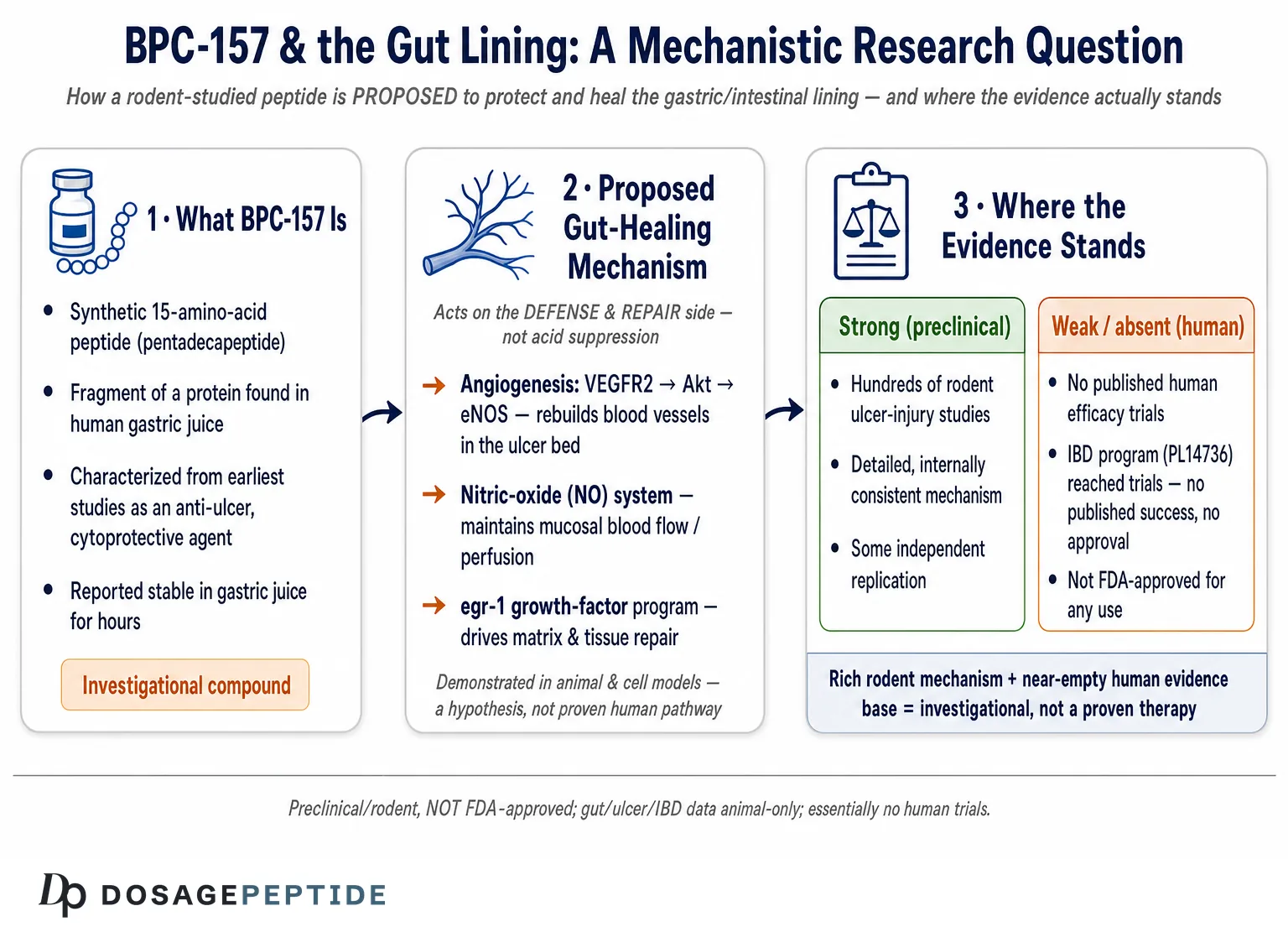
If there is one mechanism that sits at the center of BPC-157’s proposed gut-protective biology, it is angiogenesis — the formation of new blood vessels — and the preservation and restoration of blood flow to injured tissue. This is biologically coherent, because the mucosal microcirculation is one of the most important determinants of whether an ulcer heals or deepens. Tissue starved of blood flow cannot repair; revascularization is the rate-limiting step in healing many kinds of wounds.
The most influential mechanistic finding here comes from work by Hsieh and colleagues, published in the Journal of Molecular Medicine in 2017. Using endothelial cells and animal models of ischemia and wound healing, they reported that BPC-157 promoted new blood-vessel formation and that this pro-angiogenic effect was associated with the vascular endothelial growth factor receptor 2 (VEGFR2), the principal receptor through which VEGF drives angiogenesis. Specifically, BPC-157 was linked to VEGFR2 internalization and activation of the downstream VEGFR2–Akt–eNOS signaling pathway, increasing both VEGFR2 expression and the activity of the machinery that builds new capillaries.3 In plain terms, the peptide appeared to sensitize or upregulate the cell’s own angiogenic receptor system rather than acting as a crude growth factor itself.
Applied to the gastric lining, the logic is straightforward. In an ulcer, the vascular bed at the base of the lesion is damaged, and re-establishing perfusion is essential to granulation-tissue formation, re-epithelialization, and closure. A compound that amplifies VEGFR2-driven angiogenesis would, in principle, accelerate that revascularization and therefore the healing of the ulcer bed. Rodent studies of gastric injury reported increased blood-vessel density and improved mucosal blood flow in BPC-157-treated animals, consistent with this angiogenic mechanism.4 A 2025 review synthesizing the compound’s pleiotropic effects framed the control and modulation of angiogenesis, working in concert with the nitric oxide system, as the organizing principle of its reported organ-protective activity.4
Two honest caveats belong alongside this attractive story. First, the angiogenesis mechanism is a double-edged concept: any agent that promotes new blood-vessel growth invites reasonable questions about whether it could, in theory, support the vasculature of tumors, and BPC-157 has not been characterized in long-term human safety studies that could address such concerns. This is a hypothetical rather than a documented harm, but it is the kind of question that only proper clinical development can answer. Second, most of the angiogenesis data are from ischemia, wound, and vascular models; while they are mechanistically relevant to gut healing, the leap from “promotes angiogenesis in endothelial cells and ischemic tissue” to “heals human peptic ulcers” is still a leap. The mechanism is plausible and partly demonstrated; the clinical conclusion is not.
The Nitric Oxide System — BPC-157’s Signaling Partner
Running through nearly all of BPC-157’s gut research is the nitric oxide (NO) system, and understanding it is essential to understanding the proposed mechanism. Nitric oxide is a gaseous signaling molecule with a central role in the gastrointestinal tract: it is a potent vasodilator that maintains mucosal blood flow, it modulates mucus secretion, and it participates in the integrity of the mucosal barrier. Endothelial nitric oxide synthase (eNOS) is the enzyme that generates NO in blood-vessel walls, which is why it reappears at the end of the VEGFR2–Akt–eNOS pathway described above.
The Zagreb group has argued that BPC-157 functions as a kind of stabilizer or regulator of the NO system rather than a simple donor or blocker — that it participates in the homeostatic response of the NO system to injury, promoting protective NO signaling where it is needed.5 The experimental tools used to probe this are standard pharmacology: L-arginine (the substrate for NO synthesis, which increases NO production) and L-NAME (a nitric oxide synthase inhibitor, which blocks it). Across many studies, BPC-157’s protective effects were shown to interact with these tools — L-NAME often aggravating injury and BPC-157 counteracting the aggravation — which is the classic experimental signature used to implicate the NO pathway in a compound’s mechanism.5
In gastric-injury models specifically, this NO involvement dovetails with the angiogenesis story. The eNOS-generated nitric oxide that sustains mucosal blood flow is precisely what protects the lining against acid back-diffusion and ischemic deepening of a lesion, and it is downstream of the VEGFR2–Akt–eNOS cascade that the angiogenesis work identified.34 The alcohol-lesion literature provides a concrete illustration: in ethanol-induced gastric injury, BPC-157’s cytoprotection has been attributed to a combination of vascular protection and modulation of both the prostaglandin and nitric oxide systems, with the peptide maintaining perfusion and limiting the vascular congestion and hemorrhagic damage that ethanol produces.6
The measured reading is that the NO system is genuinely and repeatedly implicated in BPC-157’s gut effects in animals, and that this is one of the better-characterized aspects of its pharmacology. What remains unproven is whether NO-mediated cytoprotection of this kind produces clinically meaningful ulcer prevention or healing in humans, where the drivers of ulceration (chiefly H. pylori and NSAIDs) and the standard of care (acid suppression and eradication) are very different from an acute rat model.
Beyond Blood Vessels: Growth Factors, Egr-1, and Cytoprotection
Angiogenesis and nitric oxide are the backbone, but the proposed mechanism has several additional layers that are worth laying out, because they explain why BPC-157 is described as acting on healing as a coordinated program rather than a single switch.
One recurring theme is the modulation of early growth-response signaling. Research has reported that BPC-157 stimulates expression of the egr-1 gene and its co-repressor nab2.4 Egr-1 is a transcription factor that sits near the top of wound-healing gene programs: it helps drive the generation of cytokines and growth factors and the early formation of extracellular matrix, including the collagen deposition that rebuilds a wound bed, and it is itself linked to the promotion of angiogenesis. Upregulating this early-response machinery would, in principle, accelerate the transition from injury to granulation tissue to closure — the same sequence needed to heal an ulcer.
A second theme is broad cytoprotection at the cellular level. The peptide has been associated with the FAK–paxillin pathway involved in cell adhesion and migration — relevant to epithelial restitution, in which cells crawl to cover a defect — and with effects on growth factors and their receptors that extend beyond VEGF. The overall picture the primary authors advance is of a molecule that stabilizes multiple healing pathways simultaneously, which is also how they explain its unusually broad range of reported effects across different tissues.2
A third, and important, feature is what BPC-157’s gastroprotection does not appear to depend on. Early comparative work indicated that the peptide protected the stomach and duodenum through mechanisms distinct from acid suppression and, at least in part, independent of the classical prostaglandin-only model of cytoprotection.1 In one instructive model, BPC-157 was able to counteract cysteamine-induced lesions even in totally gastrectomized rats, a preparation designed to strip away confounding gastric factors and isolate a more fundamental cytoprotective action.5 This is part of why the compound is framed as a “cytoprotective” and “organoprotective” agent in the primary literature rather than as an antacid: its proposed benefit is preserving and rebuilding tissue, not neutralizing the chemical insult.
A fourth thread worth naming is the “brain-gut axis” framing that the primary authors have layered on top of the local mucosal story. In their model, BPC-157 does not act only at the site of the lesion; it is proposed to influence the systemic and neural regulation of gut healing, interacting with the same stress-response biology — in the tradition of Selye’s work on stress and Robert’s work on cytoprotection — that governs how the organism as a whole responds to injury.11 This is why the same peptide is reported to influence such a wide array of tissues from a single systemic dose: the claim is that it stabilizes a general, conserved protective response rather than acting through one tissue-specific receptor. Whether one finds that unifying claim compelling or over-reaching, it is the conceptual scaffold on which much of the gut work is built, and it explains why the literature so often reads injury in the stomach as a window onto a body-wide protective system.
These mechanistic layers are best understood as a coherent hypothesis supported by animal and cell data, not as a fully validated human pharmacology. The honest summary is that BPC-157 appears, in rodents, to orchestrate a pro-healing program — angiogenesis via VEGFR2, perfusion via NO/eNOS, matrix and cytokine generation via egr-1, and cell migration via adhesion signaling — and that this program is a reasonable explanation for the ulcer-healing effects observed. For readers interested in how this same repair biology is invoked in other tissues, the site’s discussion of whether BPC-157 is the missing link in treating inflammation and joint pain examines the tendon and joint side of the literature, where similar angiogenic and growth-factor arguments are made.
The Ulcer Models: What Rodent Studies Actually Tested
Vague statements that BPC-157 “heals ulcers” obscure the specific, and quite varied, injury models in which it was tested. Being concrete about these models is the fairest way to see both the breadth of the preclinical signal and its limits — every one of these is an acute or subacute animal model, not a human disease.
| Ulcer / injury model | How injury is induced | What it models | Reported BPC-157 effect (rodent) |
|---|---|---|---|
| Restraint stress | Physical immobilization stress | Stress-related gastric erosions | Reduced lesion formation1 |
| Cysteamine | Cysteamine dosing | Duodenal ulcer | Protection and healing, even in gastrectomized rats15 |
| Ethanol (96%) | Intragastric high-proof alcohol | Hemorrhagic gastric lesions | Cytoprotection; reduced vascular congestion16 |
| NSAID exposure | Indomethacin, diclofenac, etc. | Drug-induced gastric/GI lesions | Reduced lesions in animal reports2 |
| Esophagitis / sphincter failure | Surgical reflux model | Reflux esophagitis | Improved mucosal outcomes7 |
| Colitis / IBD-type | Chemical colitis models | Inflammatory bowel injury | Reduced injury; basis for PL14736 program8 |
| Intestinal anastomosis / fistula | Surgical join or fistula creation | Post-surgical healing | Improved anastomosis/fistula healing89 |
Several of these deserve a closer look. The ethanol model is a workhorse of gastroprotection research because high-proof alcohol produces rapid, visually obvious hemorrhagic lesions. In the classic Robert’s intragastric-alcohol paradigm, BPC-157 has been reported to counteract not only the local gastric damage but a broader constellation of systemic effects, with the peptide administered close to the time of alcohol exposure reducing vascular congestion across organs — findings the authors interpret as evidence of a generalized cytoprotective response rather than a purely local one.6
The cysteamine duodenal-ulcer model is important because duodenal ulcers are difficult to protect against and because the gastrectomized-rat variant was specifically designed to test whether the effect survived removal of the stomach’s own contribution. That BPC-157 remained active in that stripped-down preparation was taken as evidence of a fundamental cytoprotective mechanism.5 The esophagitis-with-sphincter-failure model extends the story upward into reflux disease, reporting improved mucosal outcomes when the peptide was applied in a surgically induced reflux setting.7
What unites the table is also its central limitation. These are induced, acute injuries in healthy young rodents, read out over hours to weeks, typically with the peptide given at or near the time of injury. Human peptic ulcer disease is chronic, is dominated by H. pylori and NSAID use, unfolds over months to years, and is already treated by highly effective acid-suppressing drugs. Demonstrating that a peptide blunts an acute ethanol burn in a rat stomach is a real pharmacological finding; it is not evidence that the same peptide heals a human’s H. pylori-associated ulcer better than, or even as well as, standard care. The models establish plausibility and mechanism, not clinical efficacy.
From Stomach to Whole Gut: Colitis, Fistulas, and the IBD Program
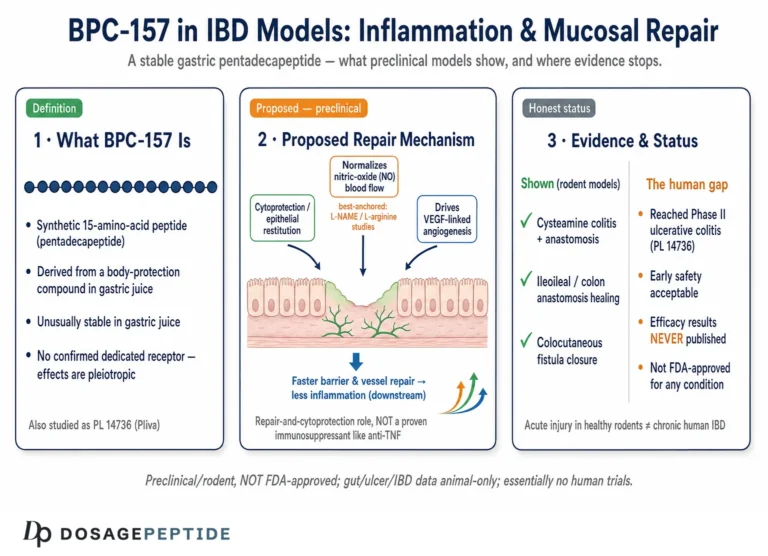
The most clinically ambitious chapter of the BPC-157 gut story concerns inflammatory bowel disease, and it is also the chapter where the gap between promise and delivery is most visible. BPC-157 was advanced into a formal drug-development program for IBD under a series of code names — PL-10, PLD-116, and PL14736 — associated with the Croatian pharmaceutical company Pliva.89
The preclinical rationale was substantial. In rodent models, BPC-157 was reported to reduce injury in chemically induced colitis and, notably, to improve the healing of difficult surgical problems that plague IBD patients: intestinal anastomoses (the surgical joining of two bowel segments) and fistulas (abnormal connections that fail to close). Studies within the PL14736 program reported that the peptide healed ileoileal anastomoses and colocutaneous fistulas in rats, with the nitric oxide system again implicated in the mechanism.89 Fistula and anastomosis healing is a demanding endpoint — it requires coordinated angiogenesis, granulation, and tissue bridging — so a positive signal there is mechanistically meaningful and consistent with the angiogenic/NO story developed above.
Here, however, the honest accounting turns sober. Despite entering clinical development for inflammatory bowel disease, BPC-157 has no published, peer-reviewed Phase 2 or Phase 3 efficacy results demonstrating benefit in human IBD patients. The program is frequently cited as having reached clinical trials, and that citation is accurate as a matter of development history, but a citation to a trial’s existence is not the same as published evidence that the trial worked. The compound never emerged as an approved IBD therapy, and the human efficacy data that would justify the confident marketing claims made about “gut healing” simply are not in the public literature. This is the pivotal fact for anyone weighing the gut-protection question: the most serious attempt to turn the rodent findings into a human medicine did not produce a published success.
This is exactly the distinction that separates a mechanistically interesting compound from a proven treatment. The site’s companion article on what research says regarding BPC-157 healing effects on the gut and inflammation surveys the same body of colitis and inflammation work from a complementary angle; read together, the two pieces make the same underlying point — a large, coherent animal literature sitting atop a near-empty human evidence base.
How BPC-157 Compares With Conventional Anti-Ulcer Agents
Placing BPC-157 beside the drugs that actually treat ulcer disease clarifies both what is distinctive about its proposed mechanism and how far it sits from clinical validation. The comparison is not a competition — BPC-157 has never been through the trials that would let it compete — but it shows what a mechanism looks like when it is backed by decades of human outcome data versus when it is backed by rodent models alone.
| Agent / class | Primary mechanism | Side of the balance | Human evidence level |
|---|---|---|---|
| Proton-pump inhibitors (e.g., omeprazole) | Irreversibly block gastric acid secretion | Reduce aggression | Extensive RCTs; approved standard of care |
| H2-receptor antagonists (e.g., ranitidine, famotidine) | Reduce acid secretion via histamine blockade | Reduce aggression | Extensive RCTs; approved |
| H. pylori eradication (antibiotics + acid suppression) | Remove the causative infection | Remove aggression | Extensive RCTs; approved, curative for most |
| Misoprostol (prostaglandin analog) | Restores protective prostaglandins; mucus/bicarbonate | Strengthen defense | RCTs; approved for NSAID-ulcer prevention |
| Sucralfate | Physical barrier over ulcer base | Strengthen defense | RCTs; approved |
| BPC-157 | Angiogenesis (VEGFR2), NO/eNOS perfusion, growth-factor/egr-1 healing | Strengthen defense & repair | Rodent/preclinical only; no published human efficacy trials; not FDA-approved |
The comparison highlights two things. First, BPC-157’s proposed niche is genuinely different from the acid-suppression backbone of modern ulcer therapy: it is a repair-and-perfusion agent, not an antacid, which is part of why it attracts interest as a potential complement rather than a replacement. In concept, an agent that accelerates healing of an established lesion could sit alongside acid suppression — but “in concept” is doing heavy lifting in that sentence. Second, the evidence gulf is stark. Every conventional agent in the table earned its place through randomized controlled trials with hard clinical endpoints in humans. BPC-157 has not run that gauntlet for any gut indication. Its mechanistic story is arguably richer and more modern-sounding than that of, say, sucralfate — but sucralfate has proven human efficacy and BPC-157 does not, and mechanism does not substitute for outcomes.
There is also a sobering lesson from misoprostol, the one approved agent that works on the defense side through the same broad logic (restoring protective signaling). Misoprostol works, but its clinical adoption has been limited by tolerability, illustrating that even a validated mucosal-defense mechanism can struggle to become a mainstay. A repair-focused peptide with no human efficacy data starts far behind that.
How Strong Is the Evidence, Really?
This is the section that most determines whether a reader walks away with an accurate impression, so it is worth stating the evidence hierarchy plainly. The BPC-157 gut literature is a case study in the difference between quantity of evidence and quality of evidence for a clinical claim.
What is strong. The preclinical mechanistic case is unusually detailed and internally consistent. There are hundreds of rodent studies; the angiogenesis mechanism has a defined molecular anchor in VEGFR2–Akt–eNOS signaling from independent cell and animal work;3 the NO-system involvement is reproduced across many models using standard pharmacological tools;5 and the compound’s stability in gastric juice and broad tissue effects are well documented.2 A 2019 independent review in Cell and Tissue Research by Gwyer, Wragg, and Wilson — notable for being written outside the originating laboratory — concluded that the studies it examined consistently reported positive healing effects, while also noting the need for more and better-controlled work.10 A 2025 literature-and-patent review likewise catalogs a broad, multifunctional preclinical profile.12
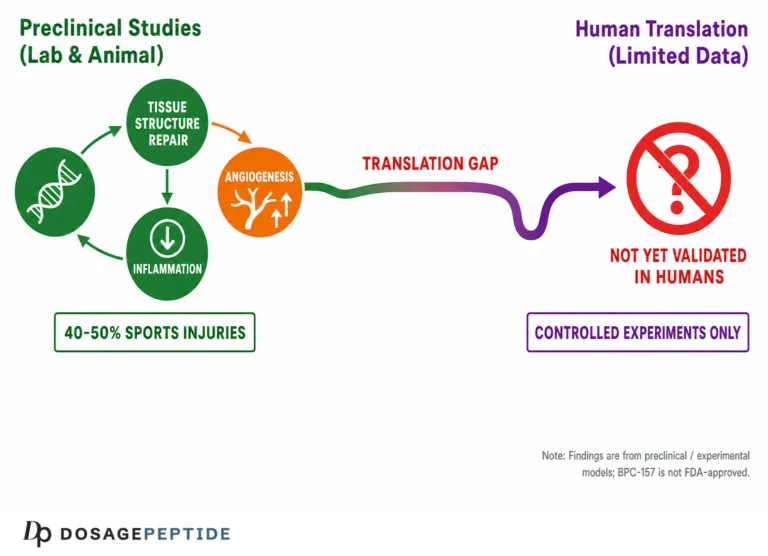
What is weak or absent. The human evidence for gut protection is, for practical purposes, missing. There are no published randomized controlled trials demonstrating that BPC-157 prevents or heals ulcers, gastritis, or IBD in people. The IBD development program (PL14736) reached clinical stages but did not yield published efficacy results or an approved product.89 Independent replication outside the primary research group, while it exists for some effects, is thinner than the raw publication count suggests, because a large fraction of the corpus originates from one collaborative network. And the well-known problem of preclinical-to-clinical translation — where compounds that heal beautifully in young, healthy, genetically uniform rodents fail in older, sicker, heterogeneous humans — applies with full force to a peptide that has never been rigorously tested in patients.
The correct posture, then, is neither dismissal nor endorsement. It is accurate to say that BPC-157 has a rich, plausible, and partly independently supported mechanism for protecting and healing the gut lining in animals. It is not accurate to say that it is a proven gut-protective therapy, or that the mechanism has been shown to matter in humans. Anyone who collapses the first statement into the second is overstating the evidence. Readers who want to keep the mechanistic vocabulary straight while following this evidence base can consult the site’s peptide glossary, which defines many of the terms — angiogenesis, cytoprotection, eNOS — used throughout this discussion.
Research Models, Methodology, and Handling Context
Understanding how BPC-157 has been studied clarifies both what the data can and cannot support. The gut work falls into recognizable methodological tiers, and the endpoints used explain why the findings are mechanistically rich but clinically inconclusive.
In vitro and cell work. Endothelial-cell assays underpin the angiogenesis mechanism, measuring VEGFR2 expression and internalization, tube formation, and Akt/eNOS activation.3 These are appropriate for dissecting a signaling pathway but say nothing directly about whole-organ healing. Rigorous gut-specific cell work would extend to gastric or intestinal epithelial monolayers measuring barrier integrity (transepithelial resistance), restitution (migration into a scratch wound), and tight-junction protein expression — assays that are less prominent in the corpus than the vascular work.
Rodent models. The animal work is the heart of the evidence and uses the injury paradigms tabulated earlier — restraint stress, cysteamine, ethanol, NSAIDs, reflux, colitis, and surgical anastomosis/fistula models.1678 Endpoints typically include macroscopic lesion area, histological scoring, blood-flow and blood-vessel measures, and the L-arginine/L-NAME pharmacological probes used to implicate NO. The gastrectomized-rat cysteamine study is a good example of a methodologically deliberate design intended to isolate mechanism.5 These models are standard and informative for cytoprotection research, but they are acute-injury models in healthy animals, not chronic-disease models in relevant patient-like populations.
Human studies. This tier is where the architecture is missing. There is no published body of controlled human trials with endoscopic ulcer-healing endpoints, symptom scores, or IBD remission rates for BPC-157. The compound is widely sold as a “research chemical,” which raises a separate methodological hazard entirely apart from the biology: material of uncertain purity, identity, and sterility. Because BPC-157 is not manufactured to pharmaceutical standards for these uses, real-world products vary, and impurities or mislabeling are documented risks in the unregulated peptide market. Educational resources such as the site’s peptide reconstitution guide describe the general laboratory handling of lyophilized peptides, but it must be stressed that careful handling changes nothing about the underlying evidence question: a perfectly reconstituted vial of a compound with no human efficacy data is still a compound with no human efficacy data.
Safety, Regulatory Status, and Honest Framing
Because BPC-157 is often marketed with an air of proven safety, precision here matters. In the rodent literature, BPC-157 has a strikingly clean acute-toxicity profile: high doses have been reported without obvious acute toxic effects, and the primary authors frame favorable safety as one of the compound’s defining features.211 That is a real observation in animals. But “no obvious acute toxicity in rats” is not the same as “safe for chronic human use,” and several caveats are essential:
- No long-term human safety data. Chronic administration to humans has not been characterized in controlled studies. The angiogenesis mechanism that plausibly aids healing also warrants formal study of any theoretical effect on tumor vasculature — a question that only proper clinical development can resolve, and that remains open.
- Population and duration mismatch. Animal safety was established in young, healthy rodents over short periods. Ulcer and IBD patients are often older, on multiple medications, and would require prolonged treatment — a very different safety context.
- Product quality. Because the compound is not produced under pharmaceutical regulation for these uses, purity, sterility, and correct identity of marketed material cannot be assumed.
The regulatory status is unambiguous and important. BPC-157 is not approved by the FDA for any human or veterinary use; it is an unapproved new drug. In 2023, the FDA effectively barred U.S. compounding pharmacies from producing it by placing it in the category of substances that raise significant safety concerns for compounding under sections 503A and 503B of the Federal Food, Drug, and Cosmetic Act.13 The U.S. Department of Defense’s Operation Supplement Safety and other authorities have flagged BPC-157 as a prohibited peptide and unapproved drug appearing in wellness products.13 And in sport, BPC-157 is prohibited: anti-doping authorities including USADA treat it as a non-approved substance banned at all times, so athletes risk sanctions if it is detected.14
The honest synthesis is straightforward. BPC-157 occupies an unusual position: a compound with a large, mechanistically detailed, and partly independently supported preclinical case for protecting and healing the gastrointestinal lining — and, simultaneously, essentially no published human efficacy evidence, no regulatory approval, and active regulatory and anti-doping prohibitions. Both halves of that description are true at once. A rich rodent mechanism and an empty human evidence base are not contradictory; they are the normal state of an investigational compound that has not completed clinical development. The scientifically responsible reading is to find the mechanism genuinely interesting, to insist on the distinction between animal plausibility and human proof, and to treat any legitimate investigation of BPC-157 in ulcer disease as a matter for properly authorized clinical research rather than self-experimentation or off-label use. For adjacent examples of how the same repair biology is discussed with the same evidentiary caution, the site’s articles on whether BPC-157 can help heal nerves and boost brain health and whether scientific evidence supports BPC-157 as a long-term tendonitis therapy apply the same framework to other tissues.
Frequently Asked Questions
Does BPC-157 actually heal ulcers in humans?
There is no published, peer-reviewed evidence that it does. The ulcer-healing findings come from rodent models — restraint stress, cysteamine, ethanol, NSAID, and reflux injuries — where BPC-157 reduced lesions and accelerated healing.16 No controlled human trials with endoscopic ulcer-healing endpoints have been published, and BPC-157 is not FDA-approved for any use.13 For proven human ulcer treatment, the established options remain acid suppression (proton-pump inhibitors, H2 blockers) and, where relevant, Helicobacter pylori eradication — interventions backed by extensive randomized trials.
How is BPC-157 thought to protect the gut lining?
The leading proposed mechanism is a coordinated pro-healing program rather than acid suppression. It centers on angiogenesis — new blood-vessel formation linked to VEGFR2 and the downstream Akt–eNOS pathway — which restores blood flow to injured mucosa,3 supported by modulation of the nitric oxide system that maintains mucosal perfusion,5 plus effects on growth factors and the egr-1 wound-healing gene program.4 Importantly, this is a mechanism demonstrated in animals and cells, not a proven pathway in human patients.
Why is BPC-157 connected to the stomach specifically?
Because it comes from there. BPC-157 is a synthetic fragment of a larger “body protection compound” identified in human gastric juice, and it was characterized from its earliest studies as an anti-ulcer, cytoprotective agent.12 It is also reported to be unusually stable in gastric juice, surviving for many hours where many peptides would be destroyed — a property relevant to acting within the gut.2
Was BPC-157 ever in clinical trials for inflammatory bowel disease?
Yes, as a development program under the codes PL-10, PLD-116, and PL14736 associated with Pliva, supported by rodent studies of colitis, fistula, and anastomosis healing.89 However, the program did not produce published Phase 2 or Phase 3 efficacy results in human IBD patients, and no approved product resulted. Reaching clinical trials is a matter of development history; it is not the same as published evidence of human benefit.
Is the animal evidence for BPC-157 reliable?
It is extensive and mechanistically consistent, and some effects have independent support — a 2019 review in Cell and Tissue Research from outside the originating lab reported consistently positive healing findings while calling for better-controlled work.10 The main caveats are that a large share of the corpus comes from a single research network, independent replication is thinner than the publication count implies, and preclinical-to-clinical translation is historically unreliable. Animal plausibility is real; human proof is absent.
Is BPC-157 legal or approved?
It is not FDA-approved for any human or veterinary use and is considered an unapproved new drug. In 2023 the FDA acted to bar U.S. compounding pharmacies from producing it, and it has been flagged by U.S. Department of Defense supplement-safety resources as a prohibited peptide found in wellness products.13 It is also banned in sport by anti-doping authorities including USADA as a non-approved substance.14
How does BPC-157’s mechanism differ from a proton-pump inhibitor?
Fundamentally. Proton-pump inhibitors and H2 blockers work by reducing gastric acid — the aggression side of ulcer biology — and have decades of human trial data. BPC-157’s proposed action is on the defense-and-repair side: preserving blood flow and accelerating tissue rebuilding via angiogenesis, nitric oxide, and growth-factor signaling.34 The two are conceptually complementary, but only acid suppression has proven human efficacy; BPC-157 does not.
Could BPC-157’s angiogenesis effect be harmful?
It is a legitimate open question. Promoting new blood-vessel growth is helpful for wound healing but raises theoretical concerns about supporting tumor vasculature, and BPC-157 has not undergone the long-term human safety studies that could address this.3 This is a hypothetical rather than a documented harm, but it is exactly the kind of question that only proper clinical development — which has not been completed — can answer.
What is the bottom line for someone researching BPC-157 and gut protection?
That BPC-157 has one of the more detailed preclinical mechanisms in the peptide field for protecting and healing the gastrointestinal lining in animals — anchored in angiogenesis, nitric oxide, and growth-factor biology — and, at the same time, essentially no published human efficacy evidence and no regulatory approval. Treat it as an investigational research compound with an interesting hypothesis, not as a validated therapy, and treat confident marketing claims of proven “gut healing” with appropriate skepticism.
References
- Sikiric P, Seiwerth S, Grabarevic Z, et al. The beneficial effect of BPC 157, a 15 amino acid peptide BPC fragment, on gastric and duodenal lesions induced by restraint stress, cysteamine and 96% ethanol in rats. A comparative study with H2 receptor antagonists, dopamine promotors and gut peptides. Life Sci. 1994;54(5):PL63-68. PMID: 7904712. https://pubmed.ncbi.nlm.nih.gov/7904712/
- Seiwerth S, Milavic M, Vukojevic J, et al. Stable Gastric Pentadecapeptide BPC 157 and Wound Healing. Front Pharmacol. 2021;12:627533. PMCID: PMC8275860. https://www.ncbi.nlm.nih.gov/pmc/articles/PMC8275860/
- Hsieh MJ, Liu HT, Wang CN, et al. Therapeutic potential of pro-angiogenic BPC157 is associated with VEGFR2 activation and up-regulation. J Mol Med (Berl). 2017;95(3):323-333. PMID: 27847966. https://pubmed.ncbi.nlm.nih.gov/27847966/
- Sikiric P, Skrtic A, Gojkovic S, et al. Stable Gastric Pentadecapeptide BPC 157 as a Therapy and Safety Key: A Special Beneficial Pleiotropic Effect Controlling and Modulating Angiogenesis and the NO-System. Pharmaceuticals (Basel). 2025. PMCID: PMC12195719. https://pmc.ncbi.nlm.nih.gov/articles/PMC12195719/
- Sikiric P, Seiwerth S, Rucman R, et al. Stable gastric pentadecapeptide BPC 157-NO-system relation. Curr Pharm Des. 2014;20(7):1126-1135. PMID: 23755725. https://pubmed.ncbi.nlm.nih.gov/23755725/
- Gojkovic S, Krezic I, Vrdoljak B, et al. Robert’s Intragastric Alcohol-Induced Gastric Lesion Model as an Escalated General Peripheral and Central Syndrome, Counteracted by the Stable Gastric Pentadecapeptide BPC 157. Biomedicines. 2021;9(10):1300. PMCID: PMC8533388. https://www.ncbi.nlm.nih.gov/pmc/articles/PMC8533388/
- Kolovrat M, Gojkovic S, Krezic I, et al. An Experimental Model of Prolonged Esophagitis With Sphincter Failure in the Rat and the Therapeutic Potential of Gastric Pentadecapeptide BPC 157. J Pharmacol Sci. 2019. https://www.sciencedirect.com/science/article/pii/S1347861319343695
- Klicek R, Sever M, Radic B, et al. Pentadecapeptide BPC 157, in clinical trials as a therapy for inflammatory bowel disease (PL14736), is effective in the healing of colocutaneous fistulas in rats: role of the nitric oxide-system. J Pharmacol Sci. 2008;108(1):7-17. PMID: 18818478. https://pubmed.ncbi.nlm.nih.gov/18818478/
- Vuksic T, Sever M, Klicek R, et al. Stable gastric pentadecapeptide BPC 157 in trials for inflammatory bowel disease (PL-10, PLD-116, PL14736, Pliva, Croatia) heals ileoileal anastomosis in the rat. Surg Today. 2007;37(9):768-777. PMID: 17713731. https://pubmed.ncbi.nlm.nih.gov/17713731/
- Gwyer D, Wragg NM, Wilson SL. Gastric pentadecapeptide body protection compound BPC 157 and its role in accelerating musculoskeletal soft tissue healing. Cell Tissue Res. 2019;377(2):153-159. PMID: 30915550. https://pubmed.ncbi.nlm.nih.gov/30915550/
- Sikiric P, Seiwerth S, Rucman R, et al. Brain-gut axis and pentadecapeptide BPC 157: theoretical and practical implications. Curr Neuropharmacol. 2016;14(8):857-865. PMID: 27138887. https://pubmed.ncbi.nlm.nih.gov/27138887/
- Jozwiak M, Bauer M, Kamysz W, Kleczkowska P. Multifunctionality and Possible Medical Application of the BPC 157 Peptide—Literature and Patent Review. Pharmaceuticals (Basel). 2025;18(2):185. PMID: 40005999. PMCID: PMC11859134. https://pmc.ncbi.nlm.nih.gov/articles/PMC11859134/
- Operation Supplement Safety (U.S. Department of Defense). BPC-157: a prohibited peptide and an unapproved drug found in health and wellness products. 2024. https://www.opss.org/article/bpc-157-prohibited-peptide-and-unapproved-drug-found-health-and-wellness-products
- U.S. Anti-Doping Agency (USADA). BPC-157: Experimental Peptide Creates Risk for Athletes. https://www.usada.org/spirit-of-sport/bpc-157-peptide-prohibited/
Educational and research-use disclaimer: This article is provided solely for scientific and educational purposes. BPC-157 is not approved by the U.S. Food and Drug Administration, the European Medicines Agency, or any comparable regulator for the treatment, cure, or prevention of peptic ulcer disease, gastritis, inflammatory bowel disease, or any other condition, and no human efficacy for gut-lining protection has been demonstrated in published controlled trials. The gastrointestinal findings described here are drawn from animal and cell-based research. Nothing herein is medical advice or a recommendation for human use. BPC-157 is an unapproved drug in the United States, is restricted for compounding, and is prohibited in sport by anti-doping authorities. Any legitimate investigation of this compound should occur within properly authorized preclinical or clinical research under appropriate oversight. Consult qualified professionals and applicable regulations before making any decisions.