Short answer: yes — in the major weight-loss trials, a meaningful portion of the weight lost on GLP-1 receptor agonists is fat-free mass (which includes muscle, water, and other lean tissue), not fat alone. But this is not unique to these drugs: essentially every method of substantial, rapid weight loss — dieting, bariatric surgery, very-low-calorie regimens — sheds some lean tissue alongside fat.[8] Across the published body-composition analyses, roughly 25–40% of the weight lost is fat-free mass, with fat mass making up the majority.[8] The nuance that matters — and where the research is still genuinely debated — is whether that lean-mass reduction translates into lost strength or physical function, or whether it is simply the expected, largely benign consequence of a smaller body carrying less tissue. This article walks through what the DEXA sub-studies actually reported, why the numbers look the way they do, and what the literature says about preserving lean mass.
This is a research-reference summary of published human trial data. It is not medical advice, and the vendor-grade “research” peptides sold online are not the FDA-approved medicines discussed below.
| Trial / compound | Total weight change | Fat mass vs. lean / fat-free mass split reported | Notes |
|---|---|---|---|
| STEP 1 — semaglutide 2.4 mg (DEXA exploratory sub-analysis, n = 140)[2] | −15.0% vs. −3.6% placebo at week 68 | Total fat mass fell −19.3%; total lean body mass fell −9.7%. Lean mass as a proportion of total body mass rose ~3.0 points (fat fell faster than lean). | Semaglutide (Wegovy/Ozempic) is FDA-approved. DEXA “lean mass” includes water, not muscle alone. |
| SURMOUNT-1 — tirzepatide (DEXA sub-study, n = 160 completers)[4] | Up to ~20–22% in the full trial[3] | Total fat mass −33.9% vs. −8.2% placebo; total lean mass −10.9% vs. −2.6%. About 75% of weight lost was fat, ~25% lean — a ratio similar in the placebo group. | Tirzepatide (Zepbound/Mounjaro) is FDA-approved. Fat-to-lean ratio improved from 0.93 to 0.70. |
| Retatrutide (phase 2 body-composition substudy, type 2 diabetes)[6] | Up to ~24% in the phase 2 obesity trial[5] | Fat mass fell substantially (~26% at 8 mg by 36 weeks); lean-mass loss made up ~35% of total weight lost — not disproportionately more despite larger total loss. | Retatrutide is investigational (phase 3, not approved). Most body-comp data are from the T2D substudy, not the obesity cohort. |
How much of GLP-1 weight loss is lean mass?
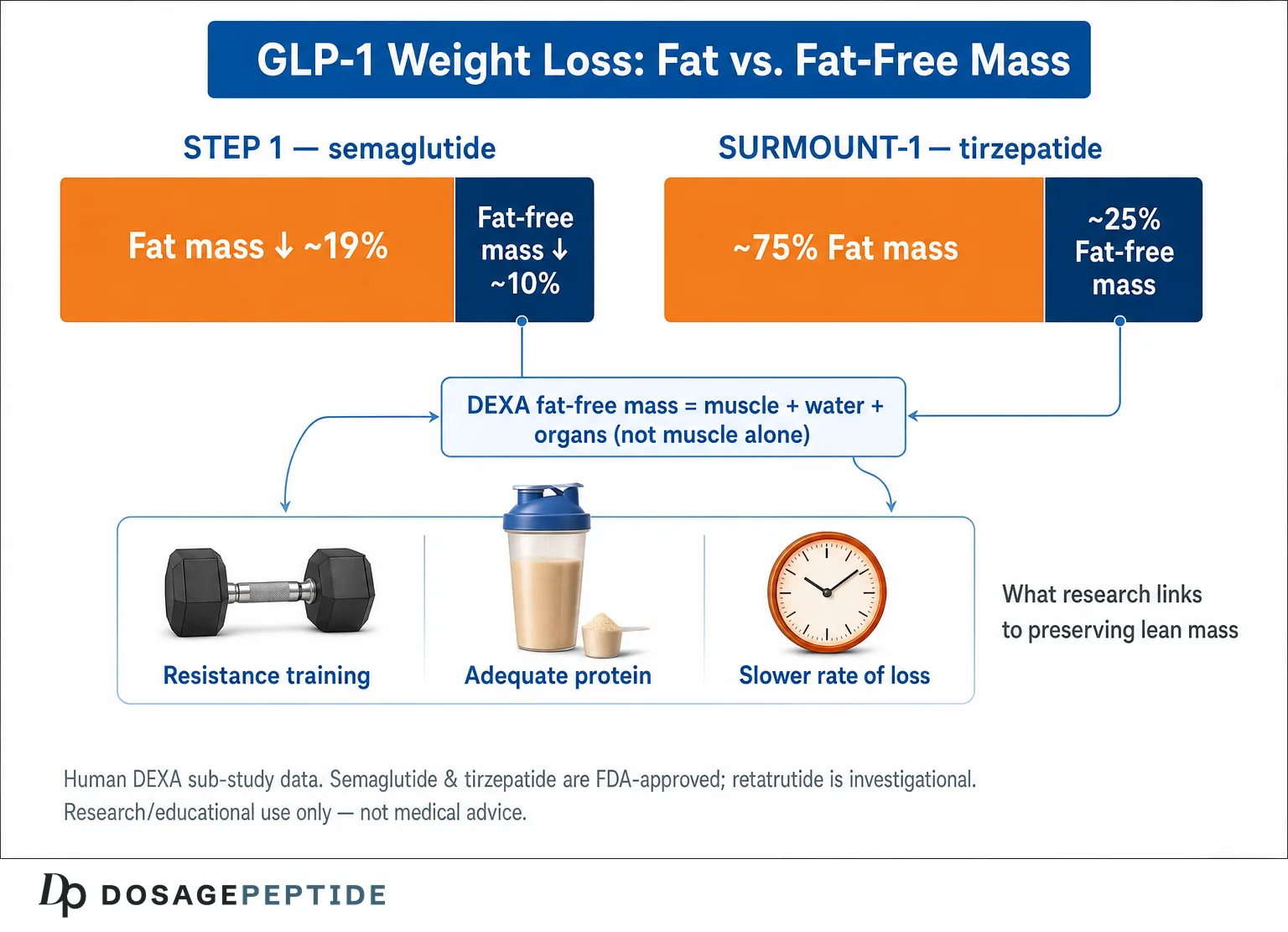
The most-cited human data come from DEXA (dual-energy X-ray absorptiometry) sub-studies nested inside the large registration trials, beginning with the STEP 1 program that supported semaglutide’s approval for weight management.[1] In the STEP 1 exploratory analysis of semaglutide 2.4 mg, participants lost about 15% of body weight; DEXA showed total fat mass fell ~19.3% while total lean body mass fell ~9.7%.[2] Crucially, because fat was lost faster than lean tissue, the proportion of the body that was lean actually increased by about 3 percentage points — participants ended up leaner as a fraction of a smaller body.[2]
The tirzepatide picture in SURMOUNT-1 is similar. In the DEXA sub-study, total fat mass dropped ~33.9% versus ~8.2% on placebo, while total lean mass dropped ~10.9% versus ~2.6%.[4] Expressed as a fraction of weight lost, roughly three-quarters was fat and one-quarter was lean — and notably that ~75/25 split was seen in the placebo group too, reinforcing that the lean component tracks with weight loss itself rather than being a drug-specific toxicity.[4] Across reviews of this literature, the commonly reported range is that fat-free mass accounts for about 25–40% of total weight lost.[8]
One caveat is essential: DEXA “lean mass” or “fat-free mass” is not a pure muscle measurement. It bundles skeletal muscle with body water, connective tissue, and organ mass. A large body carrying excess fat also carries extra water and structural tissue, so some of the “lean” loss is simply the tissue no longer needed to support a heavier frame — not necessarily contractile muscle.[8]
Why does any rapid weight loss reduce lean mass?
Losing fat-free mass alongside fat is a general feature of energy deficit, not a peculiarity of GLP-1 pharmacology. When the body is in a sustained caloric shortfall, it draws on both fat and, to a lesser degree, protein stores; larger, heavier bodies also carry more supporting muscle and water that is shed as weight comes off. Studies of diet-induced and surgical weight loss have long reported that roughly a quarter to a third of weight lost is fat-free mass, with older adults often at the higher end of that range.[9] Because GLP-1 and dual/triple agonists produce large, relatively fast weight loss, the absolute amount of lean tissue lost can be larger simply because the total loss is larger — even when the percentage split is unremarkable.[8]
Is lean-mass loss with GLP-1 drugs actually harmful?
This is where honest reporting requires nuance, because the research community does not fully agree. Sarcopenia — the clinical condition of concern — is defined by low muscle strength and impaired physical performance, not by muscle mass on a scan alone.[8] By that definition, current evidence does not establish that GLP-1 therapy causes clinical sarcopenia in typical patients, and several analyses report that measured strength and physical function are largely preserved during treatment. A mechanistic paper in mice and humans concluded that GLP-1–driven weight loss did not produce a disproportionate loss of muscle mass or function.[7]
The counter-argument focuses on vulnerable groups. In older adults — who start with less muscle reserve and are already at risk of age-related decline — some longer-term observations have reported reductions in handgrip strength and signals of accelerated functional decline with prolonged use, while shorter studies suggest relative preservation.[13] The fair summary from the literature is that the lean-mass reduction is real and measurable, but whether it is clinically harmful appears to depend heavily on age, baseline muscle, rate of loss, and whether resistance exercise and protein intake are maintained.[8] Anyone reading marketing claims of either “muscle-sparing miracle” or “muscle-wasting danger” is being oversold in one direction or the other.
What does research suggest preserves lean mass during weight loss?
The interventions with the strongest evidence base are not peptides at all — they are resistance training and adequate protein. Randomized trials in weight-losing adults show that progressive resistance exercise, performed roughly two to three times per week, is the most consistent way to retain muscle and function during an energy deficit.[9] In one randomized study of older adults with overweight or obesity, combining a higher-protein diet with resistance training produced the most favorable fat-free-mass outcomes.[9] Protein intake in the range often cited by obesity researchers (roughly 1.2–1.6 g/kg/day) supports muscle protein synthesis during deficit, but the data indicate protein alone is insufficient without the resistance-training stimulus.[9] A slower rate of weight loss may also blunt lean-tissue loss, though this trades off against the appeal of fast results. These are research findings on populations, not a personal prescription, and dedicated trials such as LEAN-PREP are now testing exercise-plus-protein strategies specifically alongside semaglutide and tirzepatide.[10] Readers modeling doses for research contexts sometimes use tools like a peptide reconstitution and dosage calculator to keep their record-keeping consistent.
Where do GH-axis peptides fit in the muscle and lean-mass research?
Separate from the incretin drugs, a different peptide class — growth-hormone-releasing-hormone (GHRH) analogues — has been studied in lean-mass and body-composition contexts. Tesamorelin is the most relevant example. It is FDA-approved (as Egrifta) for a narrow indication: reduction of excess abdominal fat in people with HIV-associated lipodystrophy.[11] In its clinical trials, tesamorelin reduced visceral adipose tissue;[11] in CT imaging analyses it was associated with increases in muscle area and reductions in intramuscular fat.[12] That mechanism — stimulating endogenous GH pulsatility — is biologically distinct from GLP-1 receptor agonism, and the two are studied for different purposes.
It is important to be precise about the evidence tier here. Tesamorelin’s approval is for HIV-associated lipodystrophy, not for general muscle-building or as an “add-on” to GLP-1 weight loss, and there is no robust trial evidence that combining it with incretin drugs preserves muscle — that idea is speculative “stacking,” not a research-supported protocol. For background on the compound, dosagepeptide.com maintains reference pages on what tesamorelin is and how it works and on the visceral-fat findings and safety signals, plus a research-focused tesamorelin reconstitution reference and a broader overview of the peptides most studied in muscle-growth contexts. All of these describe published research only; vendor peptides are research-use-only materials, not the approved medicine.
How do the compounds differ — semaglutide vs. tirzepatide vs. retatrutide?
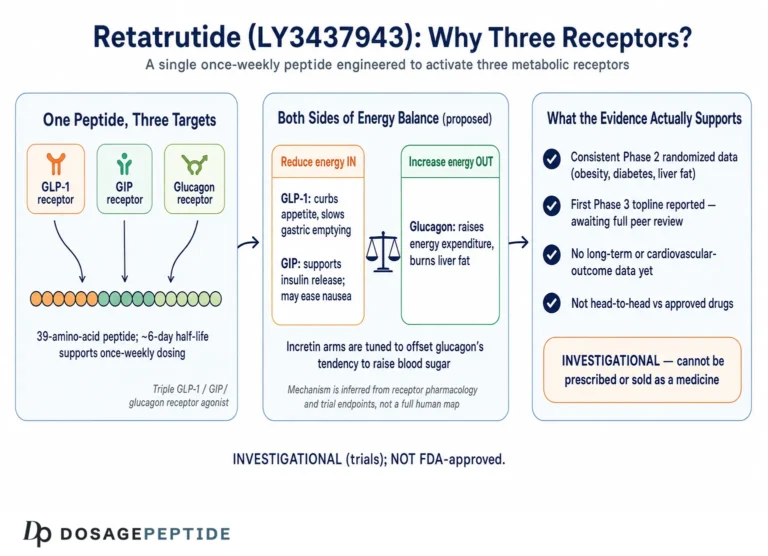
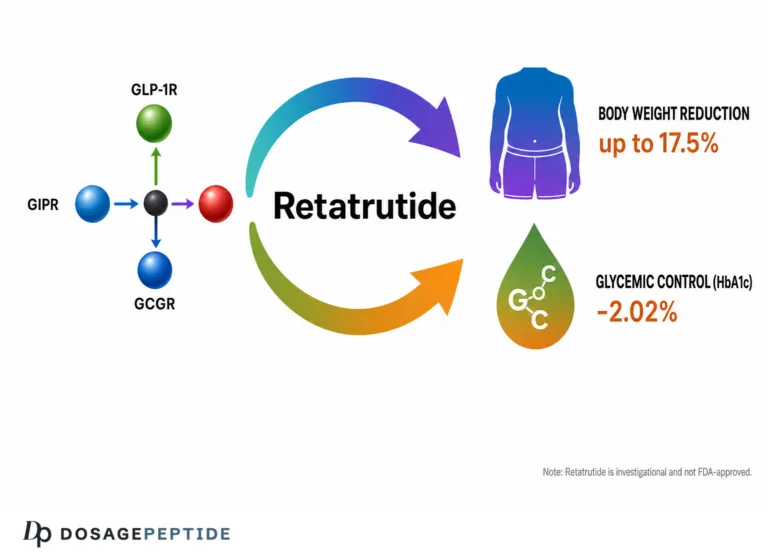
The three differ in receptor targets and in the magnitude of weight loss they produce, which in turn shapes the absolute (not percentage) lean-mass numbers. Semaglutide is a single GLP-1 receptor agonist; tirzepatide is a dual GIP/GLP-1 agonist; retatrutide is a triple GIP/GLP-1/glucagon agonist and remains investigational.[5] As total weight loss climbs from ~15% (semaglutide) to ~20–22% (tirzepatide) to ~24% (retatrutide phase 2), the absolute quantity of fat-free mass lost tends to rise simply because more total mass is lost — yet the published proportional splits stay broadly in the same 25–40% band, and the retatrutide substudy specifically reported that its larger weight loss did not come with disproportionately more lean loss.[6] Whether the glucagon component of retatrutide meaningfully changes body composition versus GIP/GLP-1 agents is not yet settled by head-to-head data. For a compound-by-compound comparison, see the reference page on retatrutide versus semaglutide versus tirzepatide, and the dedicated retatrutide research reconstitution protocol for the investigational agent specifically.
For the other half of the picture — how much weight these compounds actually take off, over what timeframe, and what returns after stopping — see our review of the best-evidenced peptides for fat loss.
Frequently Asked Questions
Does Ozempic cause muscle loss?
Semaglutide (the molecule in Ozempic and Wegovy) is associated with a reduction in lean/fat-free mass during weight loss. In the STEP 1 DEXA sub-analysis, total lean body mass fell about 9.7% while fat mass fell about 19.3%.[2] Because fat was lost faster, lean tissue actually became a larger share of the smaller body. Some lean-mass reduction accompanies essentially all substantial weight loss.
Is muscle loss on GLP-1 drugs permanent?
The trial data measure body composition during active treatment and don’t establish permanence. In principle, muscle mass responds to training and protein stimulus, and lean tissue lost during a deficit can be regained with resistance exercise and adequate intake in the general weight-loss literature.[9] Long-term data on recovery of function specifically after GLP-1 therapy remain limited, so firm claims either way are not yet supported.
Do you lose more muscle on semaglutide or tirzepatide?
Head-to-head body-composition data are limited, and comparing sub-studies across trials is imperfect. In their respective DEXA analyses, both showed roughly 75% of weight lost as fat and ~25% as lean, with tirzepatide producing larger absolute losses because total weight loss was greater.[4] Some routine-care datasets suggest tirzepatide’s larger loss carries more absolute lean loss, but proportionally the splits are similar.
Does protein prevent muscle loss on GLP-1 medications?
Adequate protein supports muscle maintenance during weight loss, but the evidence indicates protein alone is not enough — it works best combined with resistance training.[9] Obesity researchers commonly cite protein targets around 1.2–1.6 g/kg/day during active weight loss. Dedicated trials are now testing protein-plus-exercise strategies specifically alongside GLP-1 therapy.[10]
Is the lean mass lost on GLP-1 drugs actually muscle?
Not entirely. DEXA “lean” or “fat-free” mass includes water, connective tissue, and organ mass in addition to skeletal muscle.[8] A heavier body carries extra supporting tissue and water that is shed with weight, so a portion of measured “lean” loss is not contractile muscle. This is one reason mass-based scan numbers can overstate functional muscle loss.
Does losing lean mass on these drugs hurt my strength?
The evidence is mixed and still debated. Several analyses report that measured strength and physical performance are largely preserved during GLP-1 therapy, and one mechanistic study found no disproportionate loss of muscle function.[7] However, some longer-term data in older adults report reductions in handgrip strength, so vulnerable groups may warrant more attention.[13]
Does retatrutide cause more muscle loss because weight loss is greater?
Not proportionally, according to available data. Retatrutide produced larger total weight loss in trials, yet its phase 2 body-composition substudy reported lean-mass loss of about 35% of total weight lost — a proportion comparable to other agents, not disproportionately higher.[6] Retatrutide remains investigational (phase 3) and is not FDA-approved, so its long-term body-composition profile is not fully characterized.
Can tesamorelin or GH-axis peptides offset GLP-1 muscle loss?
There is no robust trial evidence that combining tesamorelin with GLP-1 drugs preserves muscle. Tesamorelin is FDA-approved only for HIV-associated lipodystrophy, where it reduces visceral fat;[11] in CT imaging analyses it increased muscle area and reduced muscle fat.[12] Using it to “protect muscle” during weight loss is speculative stacking, not a research-validated protocol, and vendor peptides are not the approved medicine.
How much weight loss is muscle across all these drugs?
Reviews of the GLP-1 body-composition literature generally put fat-free mass at about 25–40% of total weight lost, with fat making up the majority.[8] That range overlaps what is seen with diet and surgical weight loss, which is why many researchers view it as expected rather than drug-specific — while still emphasizing exercise and protein to protect function.
References
- Wilding JPH, et al. Once-Weekly Semaglutide in Adults with Overweight or Obesity (STEP 1). New England Journal of Medicine, 2021. https://www.nejm.org/doi/full/10.1056/NEJMoa2032183
- Impact of Semaglutide on Body Composition in Adults With Overweight or Obesity: Exploratory Analysis of the STEP 1 Study. Journal of the Endocrine Society, 2021. https://academic.oup.com/jes/article/5/Supplement_1/A16/6240360
- Jastreboff AM, et al. Tirzepatide Once Weekly for the Treatment of Obesity (SURMOUNT-1). New England Journal of Medicine, 2022. https://www.nejm.org/doi/full/10.1056/NEJMoa2206038
- Look M, et al. Body composition changes during weight reduction with tirzepatide in the SURMOUNT-1 study. Diabetes, Obesity and Metabolism, 2025. https://dom-pubs.onlinelibrary.wiley.com/doi/10.1111/dom.16275
- Jastreboff AM, et al. Triple–Hormone-Receptor Agonist Retatrutide for Obesity — A Phase 2 Trial. New England Journal of Medicine, 2023. https://www.nejm.org/doi/full/10.1056/NEJMoa2301972
- Effects of retatrutide on body composition in people with type 2 diabetes: a phase 2 substudy. The Lancet Diabetes & Endocrinology, 2025. https://www.thelancet.com/journals/landia/article/PIIS2213-8587(25)00092-0/abstract
- Weight loss with GLP-1 medicines does not result in a disproportionate loss of muscle mass or function in obese mice and humans. Cell Reports Medicine, 2026. https://www.cell.com/cell-reports-medicine/fulltext/S2666-3791(26)00082-0
- Sarcopenia in the era of GLP-1 receptor agonists: Implications for the internist. The American Journal of Medicine, 2026. https://www.amjmed.com/article/S0002-9343(26)00162-2/fulltext
- Verreijen AM, et al. Effect of a high protein diet and/or resistance exercise on the preservation of fat-free mass during weight loss in overweight and obese older adults: a randomized controlled trial. Nutrition Journal, 2017. https://www.ncbi.nlm.nih.gov/pmc/articles/PMC5294725/
- LEAN Mass Preservation with Resistance Exercise and Protein during semaglutide and tirzepatide therapy (LEAN-PREP): a protocol for a randomised controlled trial. BMJ Open, 2026. https://pmc.ncbi.nlm.nih.gov/articles/PMC13110620/
- Falutz J. Spotlight on tesamorelin in HIV-associated lipodystrophy. BioDrugs, 2011. https://pubmed.ncbi.nlm.nih.gov/22050344/
- Adrian S, et al. The Growth Hormone Releasing Hormone Analogue, Tesamorelin, Decreases Muscle Fat and Increases Muscle Area in Adults with HIV. The Journal of Frailty & Aging, 2019. https://www.sciencedirect.com/science/article/pii/S2260134124003049
- Prokopidis K, et al. Glucagon-like peptide-1 receptor agonists and muscle strength changes in older adults: Risks beyond muscle mass reductions. British Journal of Pharmacology, 2025. https://pubmed.ncbi.nlm.nih.gov/41577337/
Research-use-only disclaimer: This article is an educational summary of published clinical research and is provided by dosagepeptide.com, an independent peptide research reference library. It is not medical advice, not a diagnosis, and not a recommendation to use any drug or peptide. Semaglutide and tirzepatide are FDA-approved medicines that should only be used under qualified medical supervision; retatrutide is investigational and not approved; tesamorelin is approved only for a specific HIV-related indication. Research-grade peptides sold by vendors are not the approved pharmaceutical products and are intended strictly for laboratory research use, not for human consumption. Consult a licensed healthcare professional for any medical decision.