No approved treatment raises NAD+ to slow, stop, or reverse Parkinson’s disease. The completed randomized trials of NAD+ precursors in Parkinson’s were built to answer a narrower question — does the compound reach the brain, does it actually change NAD+ chemistry there, and is it safe — and on those points they were largely positive. Whether it changes the course of the disease is unresolved. The biological case is real: NAD+ decline intersects with mitochondrial complex I dysfunction, failing quality control of damaged mitochondria, and alpha-synuclein misfolding. This page explains that case, what each trial actually measured, and how NR, NMN, niacin, and intravenous NAD+ differ.
This distinction matters. It is easy to slide from “NAD+ metabolism is disturbed in Parkinson’s disease” to “raising NAD+ treats Parkinson’s disease,” and the second statement is not supported by the current evidence. The largest completed randomized trials of an NAD+ precursor in Parkinson’s disease were designed primarily to answer questions about safety and target engagement (does the compound actually reach the brain and change NAD+ chemistry?), not to demonstrate that the disease’s clinical course is altered.1,2 A definitive phase III efficacy trial has been conducted but, at the time of writing, its primary clinical results have not been published.3
What NAD+ Is and Where the Parkinson’s Question Comes From
Nicotinamide adenine dinucleotide is one of the most fundamental molecules in living cells. It is a coenzyme built from two nucleotides joined at their phosphate groups, and it exists in two interconverting forms: an oxidized form (NAD+) that accepts electrons and a reduced form (NADH) that carries them. This redox couple is the central currency of metabolism. During glycolysis, the citric acid cycle, and fatty-acid oxidation, NAD+ is reduced to NADH; NADH then delivers its electrons to complex I of the mitochondrial electron transport chain, which begins the cascade that ultimately produces adenosine triphosphate (ATP), the cell’s usable energy.4 A closely related phosphorylated form, NADP(H), supports biosynthesis and antioxidant defense. Without adequate NAD+, oxidative energy production stalls.
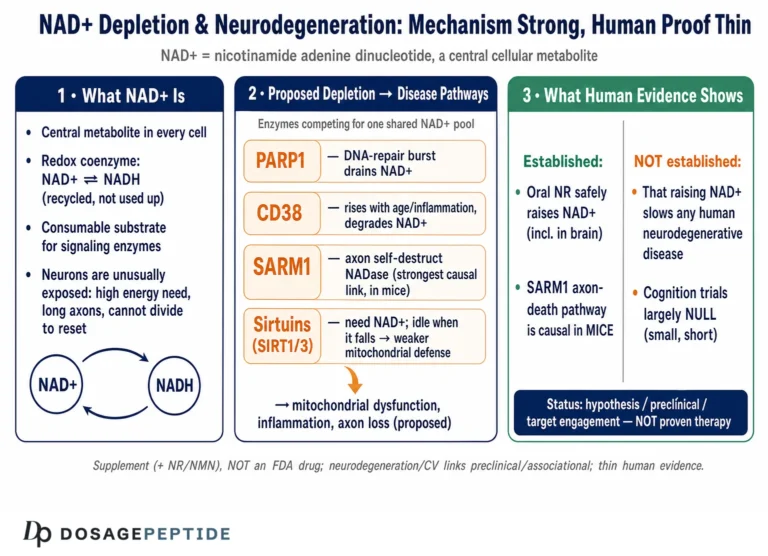
NAD+ is not only a redox carrier. It is also consumed as a substrate by several families of signaling enzymes. Sirtuins (SIRT1 through SIRT7) are NAD+-dependent deacylases that regulate mitochondrial biogenesis, DNA repair, inflammation, and stress resistance. Poly(ADP-ribose) polymerases (PARPs), most prominently PARP1, cleave NAD+ to build ADP-ribose polymers on target proteins as part of the DNA-damage response. CD38, a cell-surface glycohydrolase that increases with age and inflammation, degrades NAD+ and its precursors. Because these enzymes physically break NAD+ apart, heavy demand on any of them draws down the cellular pool. The cell must continually resynthesize NAD+ to keep up.4
That resynthesis happens through three main routes. The de novo pathway builds NAD+ from the amino acid tryptophan via the kynurenine pathway, passing through the neurotoxic intermediate quinolinic acid before reaching NAD+.8 The Preiss-Handler pathway starts from nicotinic acid (a form of vitamin B3). The salvage pathway, which supplies most NAD+ in most tissues, recycles nicotinamide released by the consuming enzymes back into NAD+, with the enzyme nicotinamide phosphoribosyltransferase (NAMPT) catalyzing the rate-limiting step and nicotinamide mononucleotide adenylyltransferases (NMNAT1, NMNAT2, NMNAT3) completing the loop. Nicotinamide riboside (NR) and nicotinamide mononucleotide (NMN) are precursors that feed into the salvage pathway at points downstream of NAMPT, which is part of why they are attractive supplemental substrates.13
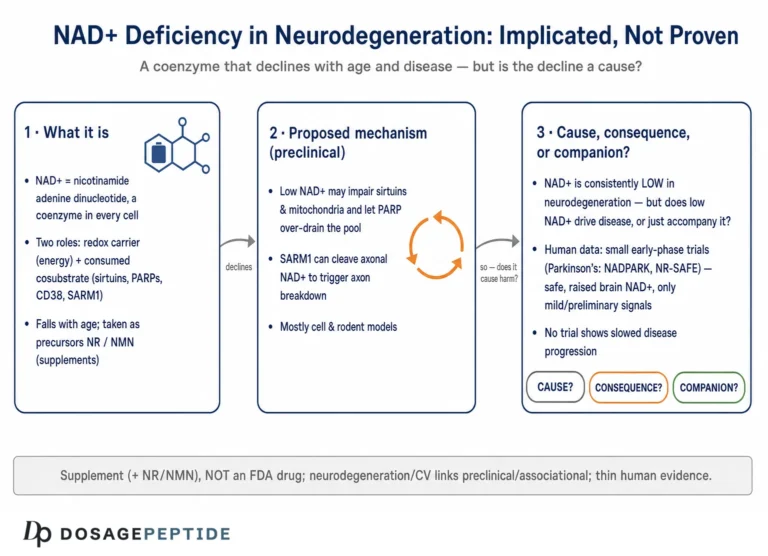
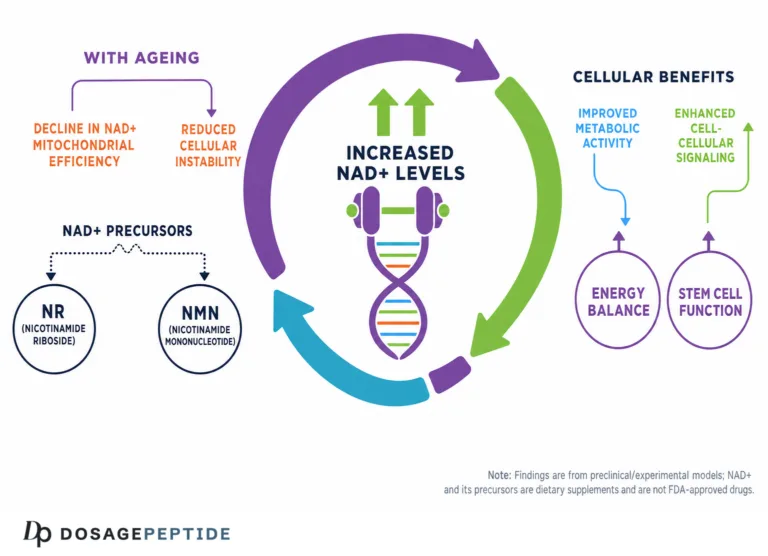
The Parkinson’s question arises from a simple but robust observation: NAD+ availability declines. Population data show that the plasma NAD+ metabolome is dysregulated in ostensibly healthy aging, with a measurable shift toward NAD+-consuming and away from NAD+-preserving metabolites over the human lifespan.12 Because advancing age is by far the strongest risk factor for Parkinson’s disease, a metabolic decline that tracks with age is inherently interesting. More specifically, tissue studies in Parkinson’s disease have found lowered NAD+ and reduced levels of NAD+-synthesizing machinery in affected brain regions. One study reported significantly decreased NMNAT3 protein in the caudate nucleus of people who died with Parkinson’s disease, alongside experimental evidence that alpha-synuclein pathology itself reduces NMNAT3 and impairs neurite formation, effects that could be rescued by targeting the NAD+ pathway in the model system.6
Skeletal-muscle measurements add another data point. Investigators using phosphorus magnetic resonance spectroscopy reported that people with Parkinson’s disease had both lower maximal mitochondrial ATP-production capacity and lower resting NAD+ levels than controls, with NAD+ around 0.75 mM in patients versus 0.91 mM in controls in one analysis.4 None of these findings prove that NAD+ decline causes Parkinson’s disease. They establish an association and a plausible mechanistic entry point, which is the correct starting condition for a research hypothesis rather than a therapeutic claim. Readers seeking the practical handling information the research community references for the compound itself can consult the site’s NAD+ research protocol overview, which treats it strictly as a laboratory material.
The Molecular Mechanism: How NAD+ Decline Could Feed Parkinson’s Biology
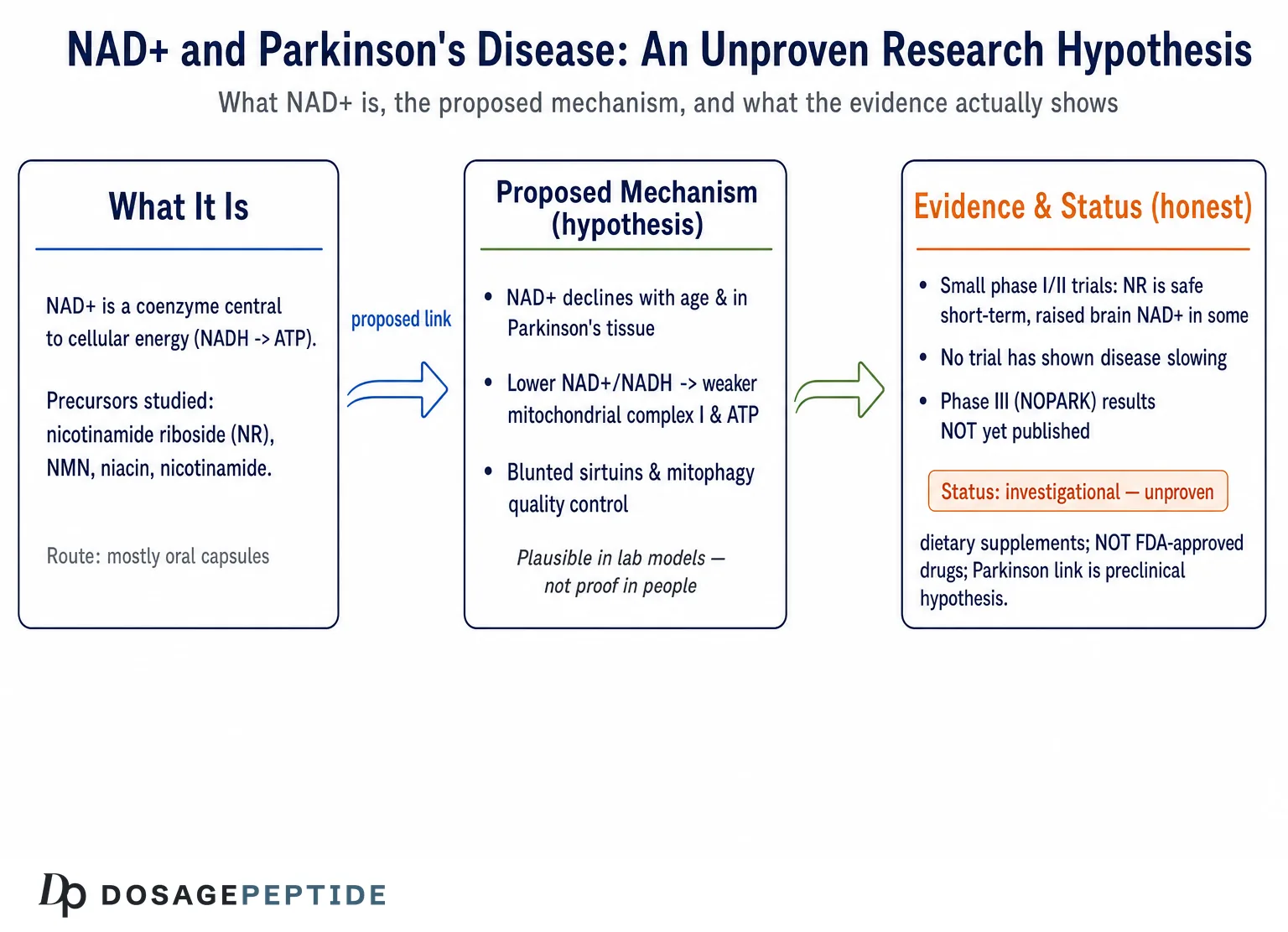
To understand why researchers connect NAD+ to Parkinson’s disease, it helps to line up the mechanism against the disease’s defining lesions. Parkinson’s disease is characterized by the progressive loss of dopaminergic neurons in the substantia nigra pars compacta and by the accumulation of intracellular aggregates of alpha-synuclein known as Lewy bodies. Dopaminergic neurons of the substantia nigra are metabolically demanding, with long, highly branched, poorly myelinated axons and autonomous pacemaker activity that imposes a heavy, continuous energy load. Cells living close to their energetic ceiling are especially vulnerable to anything that erodes ATP production, and NAD+ sits squarely at the top of that production chain.1,4
The first and best-established connection is mitochondrial complex I. Deficiency of complex I in Parkinson’s disease has been described for more than three decades, and complex I inhibitors such as rotenone and MPP+ (the toxic metabolite of MPTP) reliably produce parkinsonism in animals and, in the human case of MPTP, in people.7 Complex I is the enzyme that oxidizes NADH back to NAD+ while pumping protons to drive ATP synthesis. When complex I is impaired, NADH accumulates, NAD+ regeneration slows, the NAD+/NADH ratio falls, and the electron transport chain leaks more reactive oxygen species. A low NAD+/NADH ratio is simultaneously a symptom of bioenergetic failure and a driver of further dysfunction, because so many repair and signaling enzymes need free NAD+ to work.4
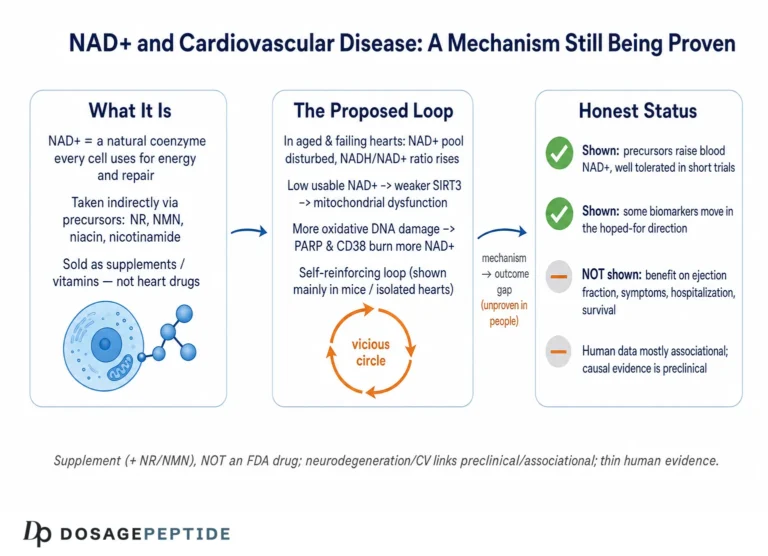
The second connection runs through NAD+-consuming enzymes. Oxidative and DNA damage, both elevated in the Parkinsonian brain, activate PARP1, which can consume large quantities of NAD+ in an attempt to repair the genome. A specific, PARP-driven form of programmed cell death termed parthanatos has been implicated in dopaminergic neuron loss, and pathological alpha-synuclein has been reported to promote PARP1 activation, creating a feed-forward loop in which aggregation drives NAD+ depletion, which impairs the very quality-control systems that would otherwise clear the aggregates.1 Rising CD38 expression during neuroinflammation adds a second drain on the NAD+ pool. On the other side of the ledger, sirtuins that depend on NAD+ (particularly the mitochondrial SIRT3 and the nuclear SIRT1) normally support antioxidant defenses and mitochondrial biogenesis, so a falling NAD+ supply blunts exactly the protective programs a stressed neuron needs.4
The third and most actively investigated connection is mitochondrial quality control. Healthy cells continuously identify and dispose of damaged mitochondria through mitophagy and mount a mitochondrial unfolded protein response (UPRmt) when protein-folding stress builds inside the organelle. Several Parkinson’s-linked genes, including PINK1 and PRKN (parkin), sit directly in the mitophagy pathway. A 2025 study reported that NAD+ boosters improved mitochondrial quality control in Parkinson’s disease models specifically by enhancing the UPRmt and mitophagy, and argued that this pathway is important for maintaining mitochondrial homeostasis and may influence disease progression.5 In this framing, NAD+ is not merely fuel; it is a signal that licenses the cell to repair and recycle its own power plants.
The fourth connection is the kynurenine pathway, which is simultaneously the de novo route to NAD+ and a major node of neuroinflammation. Tryptophan catabolism along this pathway generates both the neuroprotective metabolite kynurenic acid, made largely by astrocytes, and the neurotoxic metabolite quinolinic acid, released by activated microglia, which acts as an NMDA-receptor agonist and can cause excitotoxicity.8,9 Because quinolinic acid is also the immediate precursor of NAD+, the pathway couples the cell’s attempt to make NAD+ from scratch to its inflammatory state. Dysregulation of this balance has been repeatedly documented in Parkinson’s disease, and a 2025 analysis described a vitamin B6-dependent inflammatory shift in the kynurenine pathway in Parkinson’s patients.16 Taken together, these four threads describe a plausible, multi-pathway mechanism. What they cannot do by themselves is tell us whether raising NAD+ in a living human brain changes the clinical trajectory of the disease. That requires evidence of a different kind.
What the Evidence Actually Shows, and at What Level of Confidence
Separating mechanism from proof is the single most important discipline in reading this literature. The mechanistic case is strong and internally consistent. The clinical case is early, small, and deliberately modest in what it claims. Here it is worth being explicit about the hierarchy of evidence, from weakest to strongest: cell-culture experiments, animal models, uncontrolled human observations, small randomized safety trials, and finally large randomized efficacy trials with disease-relevant endpoints. NAD+ in Parkinson’s disease currently has a great deal at the lower rungs and very little at the top.1
At the preclinical level, NAD+ precursors have shown protective effects across multiple Parkinson’s models. Boosting NAD+ has improved mitochondrial function, reduced alpha-synuclein toxicity, and extended survival in fruit-fly and rodent systems, and the 2025 UPRmt/mitophagy work provided a specific mechanistic account of one way this protection might occur.1,5,6 These are meaningful signals, but animal models of Parkinson’s disease are notoriously imperfect predictors of human benefit; the graveyard of neuroprotective agents that worked in mice and failed in people is large. Preclinical success is a reason to run a human trial, not a substitute for one.
The most important human data come from a small set of Norwegian trials. The NADPARK study, published in Cell Metabolism in 2022, was a randomized, double-blind, placebo-controlled phase I trial in 30 newly diagnosed, treatment-naive patients who received 1,000 mg of oral nicotinamide riboside or placebo for 30 days.1 Its purpose was to establish safety and target engagement. It succeeded on both counts: NR was well tolerated and produced a significant, though variable, increase in cerebral NAD+ measured by phosphorus magnetic resonance spectroscopy, alongside changes in related metabolites in cerebrospinal fluid. In the subgroup whose brain NAD+ actually rose (the responders), the investigators observed altered cerebral metabolism on FDG-PET and reported an associated mild clinical improvement, and blood and muscle transcriptomics showed upregulation of mitochondrial, lysosomal, and proteasomal gene programs.1 These are encouraging exploratory findings. They are not proof of efficacy: the trial was not powered or designed to demonstrate a change in disease progression, the clinical signal was in a post-hoc responder subgroup, and 30 days is a fraction of the timescale over which Parkinson’s disease evolves.
The follow-up NR-SAFE trial, published in Nature Communications in 2023, tested a much higher dose, 3,000 mg of NR daily (1,500 mg twice daily), against placebo for four weeks in 20 patients, again primarily to assess safety.2 All 20 participants completed the study. There were 42 adverse events in total, 25 in the NR group and 17 in the placebo group, and critically all were graded mild, with no moderate or severe events and no statistically significant difference in adverse-event frequency between arms. No painful flushing was reported. The NR group showed a statistically significant improvement in total MDS-UPDRS score (from 51.0 to 40.3, p = 0.007) while placebo did not, but the authors themselves flagged this as preliminary and potentially confounded, including by differences in the timing of levodopa dosing relative to assessment.2 A responsible reading treats NR-SAFE as reassuring on high-dose safety and hypothesis-generating on efficacy, nothing more.
The decisive test is the NOPARK study (NCT03568968), a phase III randomized, double-blind, placebo-controlled trial of 1,000 mg oral NR daily over 52 weeks in roughly 400 patients with early Parkinson’s disease across multiple Norwegian centers, with the change in total MDS-UPDRS as its primary endpoint.3 This is the appropriately sized, appropriately long, efficacy-focused trial the field needs. As of this writing the trial has completed enrollment and follow-up, but its primary clinical results have not been published, so no conclusion about efficacy can be drawn. Until those results appear, the honest evidence level for “NAD+ precursors slow Parkinson’s progression” is: plausible mechanism, safe in the short term at the doses tested, and unproven in humans. Alongside these interventional data sit epidemiological signals that are hypothesis-supporting but causally weak, discussed in the next section.
NAD+ Precursors Compared: NR, NMN, Niacin, Nicotinamide, and Intravenous NAD+
“Raising NAD+” is not a single intervention. Several distinct molecules feed the NAD+ pool through different entry points, with different pharmacokinetics, regulatory histories, and depths of evidence. Confusing them is a common source of overstatement, because a safety or efficacy finding for one precursor does not automatically transfer to another. The table below summarizes the main options at a high level; it is a comparison of research characteristics, not a ranking of therapeutic value, and none of these are approved to treat Parkinson’s disease.
| Compound | Entry point into NAD+ metabolism | Typical research route | Human data in Parkinson’s disease | Regulatory framing (US) |
|---|---|---|---|---|
| Nicotinamide riboside (NR) | Salvage pathway, downstream of NAMPT | Oral | Most studied: NADPARK, NR-SAFE, NOPARK1,2,3 | Dietary-supplement ingredient (NDI/GRAS reviewed)14 |
| Nicotinamide mononucleotide (NMN) | Salvage pathway, one step past NR | Oral | General safety and NAD+-raising in healthy adults; no PD efficacy trials13 | Contested supplement status; not established as a PD drug |
| Niacin (nicotinic acid) | Preiss-Handler pathway | Oral / dietary | Dietary-intake epidemiology only; no interventional PD proof10,11 | Vitamin B3; approved for lipid indications, not PD |
| Nicotinamide (niacinamide) | Salvage pathway substrate; PARP/sirtuin feedback | Oral | Limited; high doses can inhibit sirtuins | Vitamin B3 form; not a PD drug |
| NAD+ itself (IV or injectable) | Requires extracellular breakdown before uptake | Intravenous / subcutaneous (research) | Tolerability pilots only; no PD efficacy data | Not an approved drug for any neurological indication |
A few points deserve emphasis. First, oral NR has by far the deepest Parkinson’s-specific dossier, precisely because the Norwegian group built a coherent program around it. NMN raises blood NAD+ in healthy volunteers and has been reported safe in short studies, but it has not been tested for Parkinson’s efficacy, and questions have been raised about tissue-specific effects of chronic oral NMN in preclinical work.13 Second, niacin’s connection to Parkinson’s disease rests almost entirely on observational dietary epidemiology rather than intervention. A cross-sectional NHANES analysis of US adults reported that higher dietary niacin intake was associated with lower Parkinson’s prevalence, on the order of a 23% lower risk per additional 10 mg of niacin, and a large European EPIC cohort sub-study examined niacin and tryptophan intake against incident Parkinson’s disease across roughly 494 cases among more than 130,000 participants.10,11 These associations are interesting and consistent with the NAD+ hypothesis, but cross-sectional and cohort designs cannot establish causation and are vulnerable to reverse causation and confounding, since diet, appetite, and gastrointestinal function all change with prodromal Parkinson’s disease.
Third, the physical form matters biologically. NAD+ is a large, charged molecule that does not readily cross cell membranes intact; much of an oral or intravenous NAD+ dose is broken down to precursors before cellular uptake, which is part of the rationale for using membrane-permeant precursors like NR instead.4 Intravenous NAD+ has a visible presence in wellness clinics, but its Parkinson’s evidence base is limited to small tolerability pilots, and clinic marketing should not be mistaken for clinical proof. Finally, dose and direction are not linear: very high nicotinamide can feed back to inhibit sirtuins, and more NAD+ precursor is not automatically better. Researchers interested in how NAD+ sits within broader combination approaches sometimes review the site’s research compound combinations overview and the enzyme-modulation entry on 5-Amino-1MQ, an NNMT-related research compound, purely as background on how NAD+-adjacent pathways are studied, not as Parkinson’s interventions.
Research Models and Methodology: How This Question Is Studied
Because the clinical evidence is thin, most of what is known about NAD+ and Parkinson’s biology comes from experimental models, and understanding those models is essential to interpreting the claims made from them. The methodology spans several scales, each with characteristic strengths and blind spots.
At the cellular level, researchers use dopaminergic cell lines and induced pluripotent stem cell (iPSC)-derived neurons, sometimes carrying Parkinson’s-associated mutations such as PINK1, PRKN, LRRK2, or GBA. These systems allow precise measurement of NAD+/NADH ratios, mitochondrial membrane potential, oxygen-consumption rate (via Seahorse-type respirometry), ATP output, mitophagy flux, and alpha-synuclein aggregation, and they permit clean genetic and pharmacological manipulation. Their limitation is context: a neuron in a dish lacks the aging, the vasculature, the glial partners, and the decades-long timescale of human disease. A compound that restores NAD+ and rescues mitochondrial function in a two-week culture experiment has cleared a low bar relative to a human brain.5,6
At the organismal level, the workhorses are toxin and genetic models. Toxin models use complex I inhibitors, chiefly MPTP in mice and non-human primates and rotenone in rats, to acutely damage dopaminergic neurons; these reproduce the bioenergetic lesion and motor deficits but not the slow, spreading, age-dependent synucleinopathy of human disease. Genetic models overexpress human alpha-synuclein or knock out mitophagy genes, capturing aspects of aggregation and quality-control failure but often with incomplete nigral cell loss. Invertebrate models in Drosophila and C. elegans allow rapid, high-throughput testing of NAD+ manipulation on survival and locomotion. Across these systems, NAD+ boosting has repeatedly improved outcomes, which is encouraging but must be weighted by the well-documented poor translation of Parkinson’s models to human neuroprotection.1
The methodological centerpiece of the human work is target engagement measurement. It is not enough to give an oral precursor and hope; investigators need to know whether brain NAD+ actually changed. The NADPARK program used phosphorus-31 magnetic resonance spectroscopy, a non-invasive technique that detects NAD+ and NADH resonances in living brain tissue, to demonstrate that oral NR raised cerebral NAD+ in a subset of participants.1 This is a genuine methodological advance, because it converts a plausibility argument (“the precursor should reach the brain”) into a measurement, and it also revealed the important reality of responders and non-responders: not everyone who took NR showed a rise in brain NAD+, which has major implications for trial design and for interpreting any downstream clinical effect. Complementary readouts included FDG-PET for cerebral glucose metabolism, cerebrospinal fluid metabolomics, and blood and skeletal-muscle transcriptomics to trace the systemic response.1
Clinical outcome measurement introduces its own methodology. The standard instrument is the Movement Disorder Society Unified Parkinson’s Disease Rating Scale (MDS-UPDRS), a multi-part rating of motor and non-motor function. It is the accepted primary-endpoint measure in NOPARK, but it has meaningful test-retest variability, is sensitive to the timing of symptomatic dopaminergic medication, and depends partly on examiner judgment. This is precisely why the NR-SAFE authors flagged levodopa-timing as a possible confounder of their UPDRS signal, and why short trials are ill-suited to detecting the slow separation of progression curves that disease modification would produce.2 A well-designed efficacy trial therefore needs adequate size, a long enough duration for progression to manifest, blinding, standardized assessment conditions, and ideally pre-specified biomarker sub-analyses to separate responders from non-responders. The gap between the elegant mechanistic experiments and the demanding requirements of a convincing clinical trial is exactly where enthusiasm most often outruns evidence.
Safety and Tolerability in the Research Setting
Safety and efficacy are separate questions, and it is entirely possible for a compound to be well tolerated while remaining unproven for the condition of interest. That is the current situation for NAD+ precursors in Parkinson’s disease. The short-term tolerability data, particularly for oral nicotinamide riboside, are reassuring within the limits of the trials conducted, but they are not a statement about long-term safety, about frail or elderly populations over years, or about drug interactions in people taking multiple Parkinson’s medications.
The most directly relevant safety dataset is NR-SAFE, which was explicitly designed to probe tolerability at a high dose. Over four weeks, 3,000 mg of NR daily produced only mild adverse events, with no moderate or severe events and no significant excess over placebo; the most frequently reported events in the NR arm included extrapyramidal symptoms, headache, tremor, muscle cramps, fatigue, nausea, and dyspepsia, several of which overlap with the underlying disease and its treatment.2 The absence of painful flushing is notable because flushing is a classic dose-limiting effect of nicotinic acid (niacin); NR and nicotinamide generally avoid the flushing that niacin causes, which is one reason they are favored for chronic dosing. The lower-dose NADPARK trial similarly reported that 1,000 mg daily was well tolerated over 30 days.1 Broader supplement-safety literature on NR in non-Parkinson populations has generally supported tolerability at commonly studied doses, and NMN has likewise been reported to raise blood NAD+ safely in short studies of healthy adults.13
These reassurances come with substantial caveats that a careful reader should hold in mind. First, the trials are small and short. Twenty participants over four weeks, or thirty over one month, cannot detect uncommon adverse events or effects that only emerge with months to years of exposure, which is exactly the exposure that disease modification would require. Second, the populations were selected: early-stage, often newly diagnosed patients able to participate in a trial, not the full spectrum of advanced disease, multimorbidity, and polypharmacy seen in practice. Third, theoretical concerns exist that have not been resolved in humans. Because NAD+ metabolism intersects with cell proliferation and with the kynurenine pathway, and because some preclinical work has raised tissue-specific concerns about chronic high-dose precursor exposure (for example, questions about metabolite accumulation with sustained oral NMN in animal models), long-term safety cannot be assumed from short-term tolerability.13 Fourth, methylation load is a plausible consideration: clearance of excess nicotinamide consumes methyl groups, and the metabolic consequences of chronically high precursor intake over years are not well characterized in this population.
There is also the matter of source and quality. In a research context, the identity, purity, and endotoxin status of a compound materially affect both the validity of an experiment and the safety of any handling. Injectable NAD+ preparations used outside regulated trials vary widely in provenance, and intravenous NAD+ administration in particular has been associated with infusion-related discomfort (nausea, chest tightness, flushing) that is typically managed by slowing the infusion rate but underscores that route and formulation matter.4 None of this constitutes clinical guidance. The appropriate summary is that oral NR appears well tolerated in the short term at the doses tested in early Parkinson’s trials, that other precursors and routes have thinner safety records, and that long-term safety in Parkinson’s disease specifically remains unestablished pending completed, published, adequately long trials.
Handling and Reconstitution in a Research Context
This section describes how NAD+ and its precursors are handled as laboratory materials, because handling directly affects the reproducibility and interpretability of research. It is not a how-to for self-administration and carries no implication that these compounds should be used to address Parkinson’s disease or any other condition outside a properly authorized study. The clinical trials discussed above used pharmaceutical-grade oral capsules manufactured and quality-controlled to trial standards, which is a very different thing from a lyophilized research vial.
Oral precursors such as NR and NMN are the simplest to handle because they are supplied as capsules or powders intended for oral use, and the human Parkinson’s trials all used the oral route.1,2 Their main practical vulnerabilities are moisture and heat: NMN in particular is hygroscopic and can degrade if exposed to humidity, so powders are kept sealed, cool, and dry, and analytical labs verify content by high-performance liquid chromatography rather than trusting label claims. For any quantitative experiment, confirming compound identity and purity before use is a basic control, because degraded or mislabeled material is a common hidden source of irreproducibility.
Lyophilized (freeze-dried) NAD+ intended for reconstitution introduces additional handling considerations that mirror those of injectable research peptides. Freeze-dried material is generally stored frozen, often at minus 20 degrees Celsius or colder, with colder storage preferred for long-term stability, and is protected from light and repeated freeze-thaw cycling, each of which can degrade sensitive dinucleotides. Reconstitution is typically performed with a sterile diluent added slowly down the inner wall of the vial rather than directly onto the powder, followed by gentle swirling rather than vigorous shaking, since mechanical agitation and foaming can damage the molecule; the vial is then allowed to dissolve fully before use. Once in solution, NAD+ is far less stable than in its dried state and is kept refrigerated at roughly 2 to 8 degrees Celsius and used within a limited window, on the order of days to a couple of weeks depending on conditions, because aqueous NAD+ hydrolyzes over time. Concentration is a function of the diluent volume added to a known mass; laboratories track this explicitly so that any downstream measurement is traceable to a defined concentration. General principles of this kind are covered in the site’s peptide reconstitution guide and the associated reconstitution calculator, which exist to support accurate laboratory record-keeping rather than to encourage use.
Two broader points frame all of this. First, handling quality is a research-validity issue before it is anything else: an experiment run with degraded, contaminated, or inaccurately concentrated material produces uninterpretable data, which is one way that poorly controlled work generates the exaggerated claims this article is trying to counter. Second, none of these handling details change the compounds’ status. A carefully reconstituted NAD+ solution is still an unapproved research material, and meticulous technique does not convert a preclinical hypothesis into a validated Parkinson’s treatment. The site’s general research compound reference index catalogs handling parameters for many such materials on the same understanding: they are educational references for people working in controlled settings, not endorsements of use.
Limitations and the Human-Evidence Gap
Every honest account of NAD+ and Parkinson’s disease converges on the same conclusion: the human evidence gap is wide, and the most important results are not yet in. It is worth cataloguing the specific limitations, because they are what separate a promising research program from a proven therapy, and because they are exactly the details that hype tends to omit.
The first limitation is trial size and duration. The two completed randomized trials in Parkinson’s disease enrolled 30 and 20 participants and lasted 30 days and 4 weeks respectively.1,2 These are appropriate designs for their stated purposes, safety and target engagement, but they are structurally incapable of demonstrating disease modification, which manifests as a gradual divergence of progression curves over a year or more. Any clinical improvement seen in such short trials is more likely to reflect symptomatic effects, measurement variability, or confounding than a change in the underlying neurodegenerative process. The NR-SAFE authors’ own caution about levodopa-timing confounding their UPDRS signal is a model of the appropriate humility.2
The second limitation is the responder problem. NADPARK showed that oral NR raises brain NAD+ in some participants but not others, and that clinical and metabolic signals clustered in the responder subgroup.1 This heterogeneity is scientifically important but clinically double-edged: it means that even if NAD+ elevation helps, an intention-to-treat analysis that includes non-responders may dilute the effect below detectability, while a responder-only analysis risks the statistical pitfalls of post-hoc subgrouping. Sorting out who responds, why, and how to identify them in advance is unfinished work.
The third limitation is the model-to-human translation gap already discussed. The mechanistic and preclinical case is strong, but Parkinson’s disease has an unusually long history of interventions that protected neurons in animals and then failed in rigorous human trials, from antioxidants to anti-apoptotic agents to other mitochondrial strategies. NAD+ boosting could be different, but the base rate argues for caution until the phase III data are published.1,5 The fourth limitation concerns the epidemiology: the cross-sectional NHANES analysis linking higher dietary niacin intake to lower Parkinson’s prevalence is consistent with the hypothesis but cannot establish causation, and the larger EPIC-based cohort study examined niacin and tryptophan intake against incident Parkinson’s disease without providing the kind of confirmed protective association that would strengthen the causal case.10,11 Observational designs of this type are in any event particularly vulnerable to reverse causation, because prodromal Parkinson’s disease alters diet, smell, appetite, and gastrointestinal function years before diagnosis.
The fifth limitation is conceptual: “NAD+ deficiency” is not a single, cleanly measured, universally agreed entity in Parkinson’s disease. Different studies measure NAD+ in different tissues (brain, cerebrospinal fluid, blood, skeletal muscle) using different techniques, and these compartments do not move in lockstep. The finding of lower NAD+ or lower NAD+-synthesizing enzymes in some Parkinson’s tissues is real and reproducible in places, but whether it is a primary driver of neurodegeneration, a downstream consequence of mitochondrial failure, or both at once is not resolved.4,6 A therapy premised on correcting a deficiency needs a clear picture of what deficiency it is correcting and where. Until the NOPARK results and comparable trials are published and, ideally, independently replicated, the responsible bottom line is that NAD+ precursors remain an unproven, investigational approach in Parkinson’s disease, however biologically attractive the rationale.3
Regulatory Status: Supplements, Not Approved Parkinson’s Drugs
Regulatory status is where the gap between marketing and reality is often widest, so it deserves precise statement. No NAD+ precursor is approved by the US Food and Drug Administration (FDA), the European Medicines Agency (EMA), or any comparable authority as a drug to treat, prevent, or slow Parkinson’s disease. The compounds discussed here occupy a mix of dietary-supplement and investigational categories, and none of those categories authorizes a Parkinson’s therapeutic claim.
Nicotinamide riboside, the most-studied precursor, is regulated in the United States as a dietary-supplement ingredient. The specific commercial form, nicotinamide riboside chloride, was reviewed under the FDA’s New Dietary Ingredient (NDI) notification process (in 2015 and again for higher use levels) and separately received a “no questions” response under the Generally Recognized As Safe (GRAS) pathway for use in certain foods.14 It is essential to understand what these determinations do and do not mean. NDI notification and GRAS review concern the safety of an ingredient for use in supplements or foods at specified levels; they are emphatically not findings of efficacy, and they say nothing about treating any disease. A supplement lawfully sold under DSHEA (the Dietary Supplement Health and Education Act) cannot legally be marketed with claims to treat or cure a disease such as Parkinson’s, and doing so would render it an unapproved drug. European regulators, via EFSA, have similarly evaluated NR for safety as a novel food ingredient, again a safety-of-consumption question rather than a therapeutic endorsement.
Nicotinamide mononucleotide occupies a more contested regulatory position; its status as a lawful dietary-supplement ingredient has been the subject of regulatory reconsideration, in part because it has also been investigated as a drug, which under US rules can complicate its supplement status. Niacin and nicotinamide are established forms of vitamin B3 with recognized nutritional roles and, in niacin’s case, approved uses for lipid disorders, but neither is approved for Parkinson’s disease. NAD+ itself, particularly in injectable or intravenous form, is not an FDA-approved drug for any neurological indication; intravenous NAD+ offered in wellness settings is generally provided outside the drug-approval framework, and its use for Parkinson’s disease is unsupported by adequate evidence.4
Where the drug-development framework does apply is in the clinical trials themselves. Studies such as NADPARK, NR-SAFE, and NOPARK are conducted under research authorizations with ethics-committee oversight, informed consent, and regulatory registration (NOPARK is registered as NCT03568968), precisely because testing a compound for a disease indication is a regulated activity distinct from selling it as a supplement.1,2,3 That structure is the legitimate path by which an investigational hypothesis could, if the data support it, eventually become an approved therapy. It has not reached that endpoint. Until a regulator reviews adequate and well-controlled efficacy data and grants an indication, any statement that an NAD+ precursor treats or slows Parkinson’s disease is unsupported by regulatory fact, regardless of how it is framed in advertising. The correct reading of the current status is straightforward: these are supplement ingredients and research compounds with an interesting scientific rationale and an unfinished clinical story.
Frequently Asked Questions
Does NAD+ or a precursor like nicotinamide riboside treat Parkinson’s disease?
No. There is no approved NAD+-based treatment for Parkinson’s disease. The link between NAD+ decline and Parkinson’s progression is an active research hypothesis supported by mechanistic and preclinical data and by small early-phase human trials that were designed to test safety and whether the compound reaches the brain, not to prove it changes the disease’s course.1,2 A large phase III efficacy trial has been conducted, but its primary clinical results have not been published, so efficacy remains unproven.3
What is the strongest human evidence so far?
The NADPARK phase I trial (30 patients, 1,000 mg oral NR for 30 days) showed that NR was well tolerated and raised cerebral NAD+ in a subset of participants, with exploratory metabolic and mild clinical signals in that responder subgroup.1 The NR-SAFE trial (20 patients, 3,000 mg NR daily for 4 weeks) confirmed good short-term tolerability at a high dose.2 Both are small, short, and primarily safety-focused; neither establishes that NAD+ precursors slow Parkinson’s disease.
If NAD+ falls with age and in Parkinson’s disease, doesn’t raising it obviously help?
Not necessarily. A deficiency being associated with a disease does not mean correcting it changes the disease. Lower NAD+ in Parkinson’s tissues could be a driver of neurodegeneration, a downstream consequence of mitochondrial failure, or both, and the different tissue compartments measured (brain, blood, muscle) do not always move together.4,6 Only adequately sized, long-enough, controlled trials can tell whether restoring NAD+ alters clinical progression, and those results are not yet available.
How is NAD+ deficiency thought to connect to Parkinson’s biology mechanistically?
Through several converging pathways: impaired mitochondrial complex I lowers the NAD+/NADH ratio and ATP output; NAD+-consuming enzymes such as PARP1 and CD38 draw down the pool during DNA damage and inflammation; falling NAD+ blunts protective sirtuin activity and mitochondrial quality control (mitophagy and the mitochondrial unfolded protein response); and the kynurenine pathway couples NAD+ synthesis to neuroinflammation via metabolites like quinolinic acid.4,5,8 These mechanisms are plausible and reproducible in models but do not by themselves prove clinical benefit in people.
Are NR, NMN, niacin, and IV NAD+ interchangeable?
No. They enter NAD+ metabolism at different points, have different pharmacokinetics, and have very different depths of evidence in Parkinson’s disease. Oral NR has the only substantial Parkinson’s-specific trial program; NMN has general NAD+-raising and safety data in healthy adults but no Parkinson’s efficacy trials; niacin’s Parkinson’s connection is limited to dietary epidemiology; and intravenous NAD+ has only small tolerability pilots.10,11,13 A finding for one precursor does not transfer automatically to another.
Is nicotinamide riboside safe?
In the short-term trials conducted so far, oral NR has been well tolerated, including at 3,000 mg daily for four weeks, with only mild adverse events and no significant excess over placebo.2 However, “well tolerated in a small, short trial” is not the same as “proven safe long-term in Parkinson’s disease.” Long-term safety over the months-to-years timescale relevant to disease modification, and safety in advanced or medically complex patients, has not been established.
What does the regulatory status actually mean?
Nicotinamide riboside is regulated in the US as a dietary-supplement ingredient that has been reviewed for safety under NDI and GRAS pathways; those are safety-of-use determinations, not findings of efficacy and not approval to treat any disease.14 No NAD+ precursor is FDA- or EMA-approved to treat, prevent, or slow Parkinson’s disease. Marketing any of them as a Parkinson’s treatment would be a disease claim not supported by regulatory review.
What would it take to change the answer to “yes, it helps”?
Publication of adequately powered, sufficiently long, randomized, placebo-controlled trials, most immediately the phase III NOPARK study, showing a statistically robust and clinically meaningful slowing of Parkinson’s progression on a validated endpoint such as the MDS-UPDRS, ideally replicated by independent groups and supported by biomarker evidence of target engagement.3 Until then, the honest description is a promising, unproven research hypothesis.
References
- Brakedal B, Dolle C, Riemer F, et al. The NADPARK study: a randomized phase I trial of nicotinamide riboside supplementation in Parkinson’s disease. Cell Metabolism. 2022;34(3):396-407. PMID: 35235774. https://pubmed.ncbi.nlm.nih.gov/35235774/
- Berven H, Kverneng S, Sheard E, et al. NR-SAFE: a randomized, double-blind safety trial of high dose nicotinamide riboside in Parkinson’s disease. Nature Communications. 2023;14:7793. PMC10684646. https://pmc.ncbi.nlm.nih.gov/articles/PMC10684646/
- The NOPARK study: a phase III randomised controlled trial of nicotinamide riboside in early Parkinson’s disease. ClinicalTrials.gov NCT03568968; Neuro-SysMed. https://clinicaltrials.gov/study/NCT03568968
- ATP and NAD+ deficiency in Parkinson’s disease. Nutrients. 2023;15(4):943. PMC9961646. https://pmc.ncbi.nlm.nih.gov/articles/PMC9961646/
- Zhou X, et al. NAD+-boosters improve mitochondria quality control in Parkinson’s disease models via mitochondrial UPR. Advanced Science. 2025. https://advanced.onlinelibrary.wiley.com/doi/10.1002/advs.202408503
- Alpha-synucleinopathy reduces NMNAT3 protein levels and neurite formation that can be rescued by targeting the NAD+ pathway. Human Molecular Genetics. 2022;31(17):2918-2933. PMC9433734. https://www.ncbi.nlm.nih.gov/pmc/articles/PMC9433734/
- Mitochondrial complex I deficiency: guilty in Parkinson’s disease. Signal Transduction and Targeted Therapy. 2022;7:136. PMC9035149. https://www.ncbi.nlm.nih.gov/pmc/articles/PMC9035149/
- Kynurenine pathway in Parkinson’s disease – an update. eNeurologicalSci. 2020;21:100270. PMC7585940. https://pmc.ncbi.nlm.nih.gov/articles/PMC7585940/
- The involvement of neuroinflammation and kynurenine pathway in Parkinson’s disease. Parkinson’s Disease. 2011;2011:716859. PMC3109408. https://pmc.ncbi.nlm.nih.gov/articles/PMC3109408/
- Association between dietary niacin intake and risk of Parkinson’s disease in US adults: NHANES 2005-2018. Frontiers in Nutrition. 2024. PMC11291445. https://pmc.ncbi.nlm.nih.gov/articles/PMC11291445/
- Association of dietary niacin and tryptophan intake with the risk of Parkinson’s disease in the EPIC4ND cohort. Research Square preprint. https://www.researchsquare.com/article/rs-9436550/v1
- The plasma NAD+ metabolome is dysregulated in “normal” aging. Rejuvenation Research. 2019;22(2):121-130. PMC6482912. https://www.ncbi.nlm.nih.gov/pmc/articles/PMC6482912/
- Irie J, et al. Oral administration of nicotinamide mononucleotide is safe and efficiently increases blood NAD levels in healthy subjects. Frontiers in Nutrition. 2022;9:868640. PMC9036060. https://www.ncbi.nlm.nih.gov/pmc/articles/PMC9036060/
- ChromaDex NIAGEN (nicotinamide riboside) New Dietary Ingredient (NDI) and GRAS regulatory record; FDA GRAS Notice GRN 000635. https://www.fda.gov/food/gras-notice-inventory/agency-response-letter-gras-notice-no-grn-000635
- Progresses in both basic research and clinical trials of NAD+ in Parkinson’s disease. Mechanisms of Ageing and Development / ScienceDirect. 2021. https://www.sciencedirect.com/science/article/abs/pii/S0047637421000713
- Parkinson’s disease is characterized by vitamin B6-dependent inflammatory kynurenine pathway dysfunction. npj Parkinson’s Disease. 2025. https://www.nature.com/articles/s41531-025-00964-7
Educational and research-use disclaimer: This article is provided solely for educational and scientific-information purposes. NAD+ and its precursors (including nicotinamide riboside, nicotinamide mononucleotide, niacin, and nicotinamide) are discussed here as research compounds and, where applicable, dietary-supplement ingredients. They are not approved by the FDA, EMA, or any comparable authority to diagnose, treat, cure, or prevent Parkinson’s disease or any other disease, and nothing above should be interpreted as a claim of efficacy or as medical advice. The proposed link between NAD+ deficiency and Parkinson’s disease progression is an unproven research hypothesis. Individuals with Parkinson’s disease or any medical condition should make decisions only in consultation with a qualified, licensed healthcare professional and should not use any research compound outside an appropriately authorized and supervised setting.