GHK-Cu has never been tested as a therapy for organ or tissue transplantation in humans, and it is not approved for any systemic medical use. The reason the question keeps being asked is that the peptide touches nearly every pathway that governs recovery after major surgery, at least in preclinical models: oxidative stress, cytokine signalling, angiogenesis, collagen remodelling, and fibrosis. A transplanted organ is hit by cold storage, oxygen deprivation, and a burst of ischemia-reperfusion injury the moment blood flow returns — and a molecule that plausibly blunts all of that will attract speculation. Plausible mechanism is not evidence of benefit. This page maps exactly where the data stop.
Transplant recovery is one of the hardest problems in medicine. A transplanted organ endures a brutal sequence of injuries: cold storage, oxygen deprivation during transport, and then a burst of oxidative and inflammatory damage the moment blood flow is restored — ischemia-reperfusion injury (IRI).1 Layered on top of that are the recipient’s immune attack on foreign tissue, the wound-healing penalties imposed by immunosuppressant drugs, and the constant risk of infection. Any molecule that plausibly touches oxidative stress, cytokine signaling, angiogenesis, collagen remodeling, and fibrosis will inevitably attract speculation about a transplant role. GHK-Cu touches all of those pathways in preclinical models, which is exactly why the question keeps getting asked — and exactly why it deserves a careful, sober answer.
What GHK-Cu Is and Where It Comes From
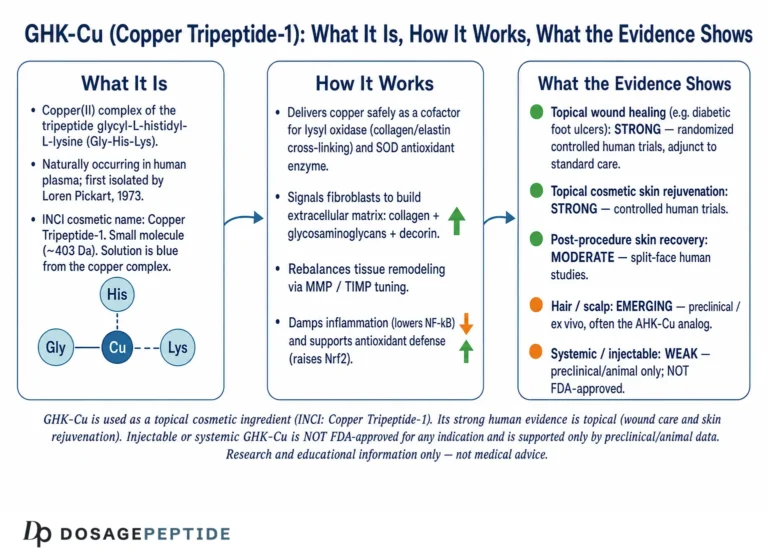
GHK is a naturally occurring tripeptide — a chain of just three amino acids, glycine, L-histidine, and L-lysine — with a molecular weight of roughly 340 daltons. It was first isolated in 1973 by biochemist Loren Pickart from human plasma albumin, in the course of experiments showing that a factor in the serum of younger people could make aged human liver tissue synthesize proteins in a more youthful pattern.2 The histidine residue gives the peptide a high affinity for copper(II) ions, and the physiologically active form is the copper complex, written GHK-Cu. In the body, GHK is thought to be liberated from larger proteins such as collagen during tissue injury, where it may act as a signal that marshals repair — a plausible reason evolution conserved it.3
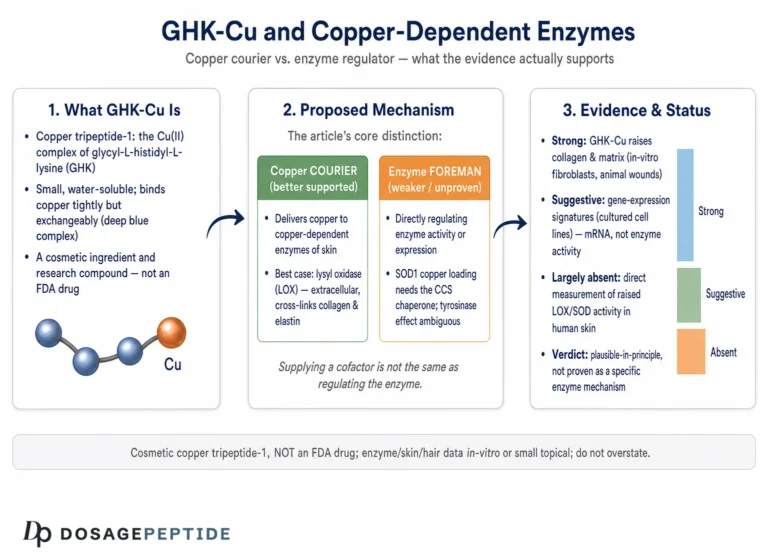
Copper itself is the key to understanding why GHK-Cu is not "just another peptide." Copper is an essential trace element and a required cofactor for enzymes central to connective-tissue biology, including lysyl oxidase (which cross-links collagen and elastin) and superoxide dismutase (an antioxidant enzyme). Free copper ions are toxic and pro-oxidant; the value of GHK is that it chelates copper, buffering it and shuttling it in a controlled, bioavailable form.3 This dual identity — peptide signal plus copper carrier — is what lets a single small molecule influence such a wide range of downstream processes.
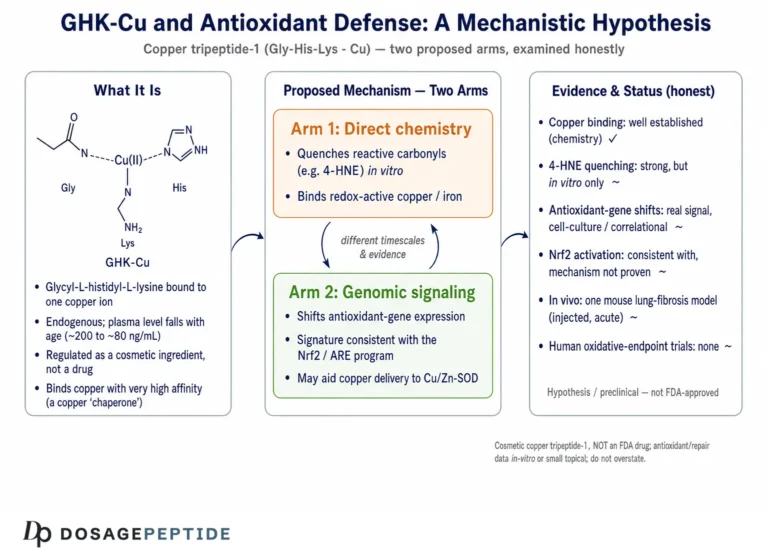
Circulating GHK levels are reported to decline with age, from around 200 ng/mL in young adults to about 80 ng/mL by age sixty, a correlation that fueled interest in the peptide as an anti-aging and regenerative agent.3 Since the 1970s, GHK-Cu has accumulated decades of use in topical cosmetic formulations, where it is valued for its collagen-stimulating and skin-remodeling effects and is used at very low concentrations. In that cosmetic context it has an extensive real-world safety record, discussed later in this article. Importantly, cosmetic use and the speculative injectable "research" use that circulates in peptide communities are very different exposure scenarios, and the safety data from one does not automatically transfer to the other.
For readers new to the compound, DosagePeptide.com maintains a plain-language primer covering its structure, proposed mechanisms, and the practical caveats around it in What is GHK-Cu? Mechanism, Benefits, Risks & How to Use. It is worth reading alongside this piece, because the transplant question sits on top of that foundational biology. The short version: GHK-Cu is a small, copper-carrying signaling peptide with strong laboratory credentials in wound and connective-tissue repair, a modest but growing clinical literature confined almost entirely to topical skin applications, and no established role in any organ-level therapeutic setting.
It also helps to be precise about terminology. "GHK" refers to the copper-free tripeptide; "GHK-Cu" refers to the copper complex. Many published studies use one form or the other, and the two are not perfectly interchangeable — some gene-expression effects have been observed with copper-free GHK, while enzyme-cofactor and antioxidant effects depend on the copper. Throughout this article the specific form used in a given study is noted where the source makes it clear, because conflating them is a common way that online summaries overstate the evidence.
Why Transplant Recovery Is a Biologically Hard Problem
To evaluate whether GHK-Cu could plausibly help transplant recovery, you first have to understand what "recovery" actually demands at the tissue level. A transplant is not a single event but a cascade of overlapping insults, and each one recruits a different set of biological pathways. Understanding those pathways is what lets us judge, mechanistically, where a repair-oriented peptide might even theoretically fit — and where it plainly does not.
The first and arguably most universal insult is ischemia-reperfusion injury. During procurement, transport, and implantation, the donor organ is deprived of oxygenated blood (ischemia), then abruptly reperfused when the recipient’s circulation is connected. Reperfusion floods the oxygen-starved tissue with a burst of reactive oxygen species, triggers mitochondrial dysfunction, and activates innate immune sensors that release pro-inflammatory cytokines such as TNF-α and IL-6.1 The clinical consequences are serious and well documented: IRI is a leading driver of delayed graft function, longer hospital stays, higher acute-rejection risk, and worse long-term graft survival.1 Because IRI is fundamentally a problem of oxidative stress and cytokine signaling, it is the transplant sub-problem where GHK-Cu’s laboratory pharmacology looks most relevant — a point we return to, with heavy caveats, below.
The second insult is the adaptive immune response. The recipient’s T cells recognize the donor organ’s major histocompatibility complex molecules as foreign and mount an attack; acute rejection occurs in a substantial fraction of transplants, most often in the first six to twelve months.1 This is precisely the process that immunosuppressant regimens are designed to blunt. Crucially, GHK-Cu is not an immunosuppressant and has no demonstrated capacity to prevent allograft rejection; nothing in its mechanism addresses T-cell allorecognition. Any framing of GHK-Cu as a transplant "treatment" that ignores rejection is fundamentally incomplete.
The third set of challenges is iatrogenic — caused by the necessary treatment itself. The immunosuppressant drugs that keep the graft alive carry well-known costs: bone-marrow suppression, hyperlipidemia, nephrotoxicity, heightened infection and malignancy risk, and notably delayed wound healing.1 Mammalian target of rapamycin (mTOR) inhibitors in particular are associated with impaired surgical-wound closure. This is the one place where a collagen-stimulating, angiogenesis-supporting molecule like GHK-Cu is most often invoked as a hypothetical adjunct — the idea being that a peptide that accelerates dermal repair might counteract drug-induced healing delays. That hypothesis is biologically coherent but, it must be stressed, entirely untested in transplant patients.
Finally, there is fibrosis and chronic graft dysfunction. Over months and years, many grafts develop interstitial fibrosis and tubular atrophy — a progressive scarring that erodes organ function and is a major cause of late graft loss. Fibrosis is driven substantially by the TGF-β1/Smad signaling axis and by persistent, senescent myofibroblasts that refuse to undergo apoptosis. This is the fourth pathway where GHK’s laboratory data intersect with transplant biology, because several preclinical studies show GHK modulating exactly these fibrotic programs. Again, intersection at the level of pathway is not the same as demonstrated benefit at the level of patient outcome, and the distance between the two is the entire subject of this article.
Molecular Mechanisms Relevant to Tissue Repair and Inflammation
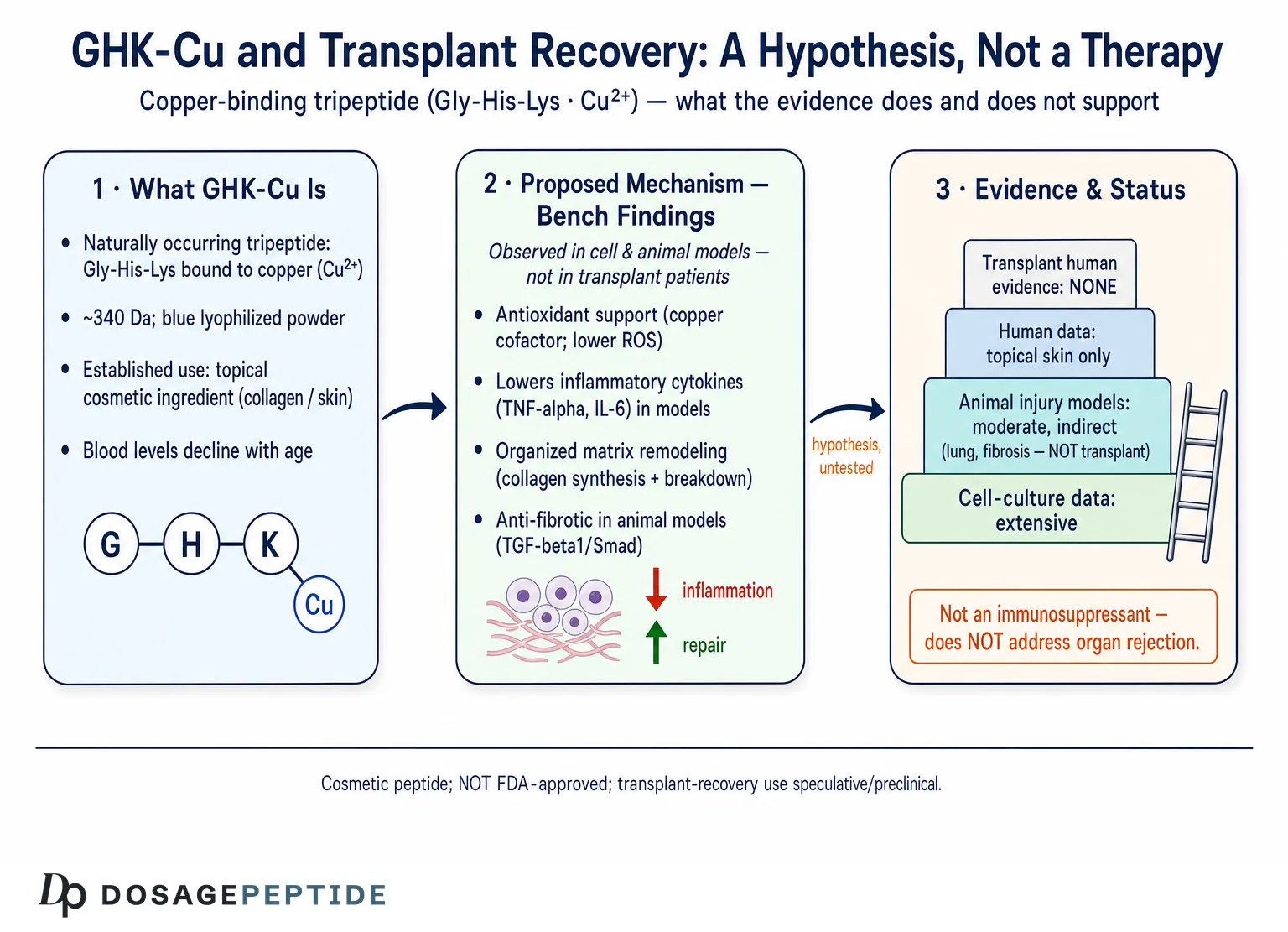
GHK-Cu’s appeal to researchers comes from the sheer breadth of biological processes it appears to touch. Rather than acting on a single receptor, it behaves like a pleiotropic modulator — nudging many pathways at once. The most striking demonstration of this comes from gene-expression profiling. In cultured human cells, GHK at low nanomolar concentrations altered the expression of a large fraction of the human genome; Pickart and Margolina’s 2018 review in the International Journal of Molecular Sciences reported that GHK influenced roughly 31.2% of assessed human genes at a threshold of 50% or greater change, and modulated thousands of genes in directions consistent with tissue repair, anti-inflammatory signaling, and DNA-repair upregulation.3 Whether such broad genomic effects translate to meaningful physiology in an intact human organ is unknown, but the finding is what puts GHK in a different category from most single-pathway peptides.
The best-characterized mechanism is connective-tissue remodeling. GHK-Cu stimulates fibroblasts to synthesize type I collagen, elastin, proteoglycans, and glycosaminoglycans — the structural scaffold of skin and many organs.4 Critically, it does not simply push collagen production in one direction; it modulates both the synthesis and the controlled breakdown of matrix, regulating matrix metalloproteinases and their tissue inhibitors (TIMPs).4 This bidirectional control is important, because uncontrolled collagen deposition is fibrosis, not healing. A molecule that promotes organized remodeling rather than raw deposition is, at least in theory, better suited to the delicate balance that healthy repair requires.
The second mechanism is copper delivery and antioxidant support. By chelating copper, GHK-Cu supplies the cofactor for lysyl oxidase (collagen cross-linking) and superoxide dismutase (dismutation of superoxide radicals). In an acute lung injury model in mice, GHK-Cu treatment reduced reactive-oxygen-species production and increased superoxide dismutase activity, consistent with an antioxidant role.5 Given that reperfusion injury is fundamentally an oxidative event, this antioxidant capacity is one of the clearest points of mechanistic contact between GHK-Cu’s biology and transplant IRI — though the contact is purely conceptual until tested in a transplant model.
The third mechanism is anti-inflammatory cytokine modulation. In that same lipopolysaccharide-induced acute lung injury study, GHK-Cu decreased TNF-α and IL-6 production and suppressed NF-κB p65 and p38 MAPK signaling, two central inflammatory hubs.5 Separately, GHK-Cu has been reported to reduce TNF-α-induced IL-6 secretion in human dermal fibroblasts and to dampen the acute-phase response that can otherwise worsen scarring.3 Because dysregulated NF-κB activation and cytokine release are hallmarks of reperfusion injury and early graft inflammation, this is the second major mechanistic overlap with transplant biology.
Fourth is angiogenesis and cell migration. GHK-Cu promotes the formation of new blood vessels and stimulates fibroblast and keratinocyte migration into wound beds — both essential for revascularizing and re-epithelializing damaged tissue.4 Adequate blood supply is a rate-limiting factor in almost all healing, and impaired angiogenesis contributes to poor surgical outcomes. A fifth and more recently characterized mechanism concerns senescence and fibrosis: a 2024–2025 study from the University of Washington reported that GHK can reverse cellular senescence and induce apoptosis in myofibroblasts, activate stemness markers such as p63 and PCNA, and shift aged fibroblasts from a pathological, persistent collagen-depositing phenotype back toward physiological collagen contraction.6 In a bleomycin model of pulmonary fibrosis, GHK inhibited fibrosis progression by suppressing TGF-β1/Smad-mediated epithelial-to-mesenchymal transition.7 Taken together, these mechanisms sketch a molecule that could, in principle, touch every phase of the transplant injury cascade except allograft rejection. The word "could" is doing all the work in that sentence.
What the Evidence Actually Shows (and at What Level)
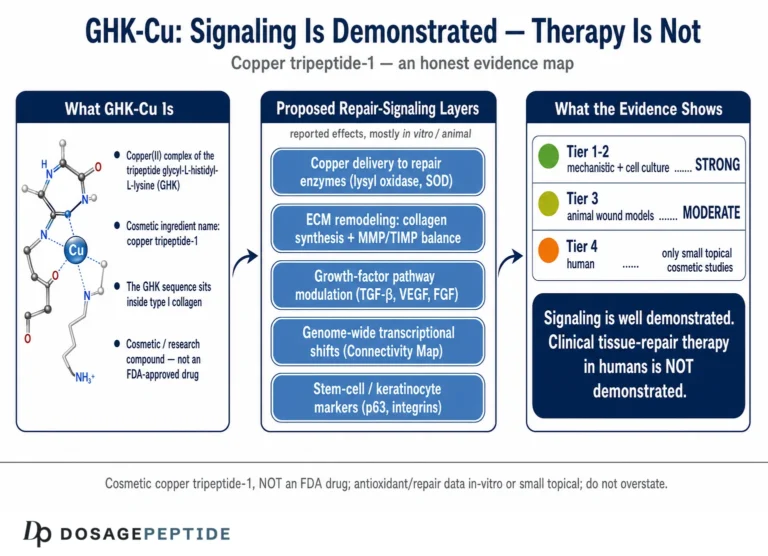
This is the most important section in the article, because the honest answer to "how strong is the evidence?" is: strong at the bench, thin in the clinic, and effectively absent for transplantation. It is worth stating the evidence hierarchy explicitly, from most to least supported, so readers can calibrate their expectations.
Tier 1 — In vitro and cell-culture evidence (extensive). GHK-Cu’s effects on cultured fibroblasts, keratinocytes, and other cell types are the best-documented part of its profile. Collagen and glycosaminoglycan stimulation, matrix-metalloproteinase modulation, antioxidant enzyme support, and the broad gene-expression shifts described above are all reproducible in cell systems.3,4 This tier tells us what GHK-Cu can do to cells, which is genuinely a lot. It does not tell us what it does to a living organ under the stress of transplantation.
Tier 2 — Animal-model evidence (moderate, indirect). Rodent studies support several organ-protective and anti-fibrotic effects: reduced injury and inflammation in LPS-induced acute lung injury,5 attenuated bleomycin-induced pulmonary fibrosis,7 reduced cigarette-smoke-induced emphysema and oxidative stress,8 and reversal of age-related fibrosis.6 These are meaningful results, but every one of them is a disease or injury model chosen for a different indication. None is a transplant model. The animal record is also not uniformly favorable, even for wound healing: a controlled study of a topical copper-tripeptide complex in an irradiated rat model found no improvement in healing — there was no difference in flap ischemia, blood-vessel number or area, or VEGF expression versus controls, and the treated group actually showed a slightly larger mean ischemic area.9 There is, to be clear, no published rodent kidney-transplant, liver-transplant, or skin-graft study demonstrating that GHK-Cu improves graft survival or function. The animal evidence is suggestive of general repair and anti-inflammatory activity, not of transplant efficacy.
Tier 3 — Human clinical evidence (minimal, topical only). Human data for GHK-Cu are almost entirely confined to topical dermatology and cosmetics — improvements in skin appearance, wrinkle depth, and skin density in small studies, plus its long cosmetic track record. As of 2026 there is at least one registered controlled clinical trial evaluating a topical GHK-Cu gel for the healing of small, standardized punch-biopsy wounds in healthy volunteers (ClinicalTrials.gov identifier NCT07437586), comparing it against a vehicle gel with re-epithelialization time as the primary endpoint.10 That trial is a welcome step toward rigorous human wound-healing data, but note what it is: a study of surface skin wounds in healthy people, not systemic administration and not transplant recipients. There is no registered or published clinical trial of GHK-Cu in any solid-organ or tissue transplant setting.
Tier 4 — Transplant-specific human evidence (none). This tier is empty. No randomized controlled trial, no cohort study, no case series, and no case report establishes that GHK-Cu improves recovery, reduces rejection, mitigates ischemia-reperfusion injury, or prevents chronic fibrosis in human transplant patients. Every statement connecting GHK-Cu to transplant recovery is, at present, an extrapolation from lower tiers of evidence. That extrapolation may be scientifically reasonable as a hypothesis-generating exercise, but it is not a basis for clinical use, and anyone presenting it as established fact is overstating the science.
The takeaway is a familiar one in translational medicine: mechanistic plausibility is common, and clinical proof is rare and hard-won. GHK-Cu has an unusually rich mechanistic story, which is why it generates so much speculation. But the transplant question specifically sits at Tier 4, where the evidence is absent. The most intellectually honest framing is that GHK-Cu presents a set of testable hypotheses about transplant recovery — hypotheses that would require dedicated transplant models and, eventually, carefully controlled clinical trials to evaluate. None of that work has been done.
Preclinical Organ-Injury Models: Lung, Liver, Skin, and Beyond
Because the transplant literature on GHK-Cu is empty, the closest available proxies are preclinical organ-injury studies. Reviewing them carefully is useful precisely because it shows both why the transplant hypothesis is tempting and why it remains unproven. Each model isolates one facet of injury that also appears in transplantation, but none reproduces the full transplant scenario of an allogeneic organ under immune attack.
The acute lung injury work is the most cited organ-protective study. Park and colleagues, publishing in Oncotarget in 2016, induced acute lung injury in mice with lipopolysaccharide and treated with GHK-Cu. Treated animals showed reduced histological lung damage, less infiltration of inflammatory cells into the lung parenchyma, lower ROS, higher superoxide dismutase activity, and decreased TNF-α and IL-6, with the effects tracking suppression of NF-κB p65 and p38 MAPK signaling.5 The authors framed GHK-Cu as a potential candidate for acute lung injury / acute respiratory distress syndrome. For transplant relevance, the interesting parallel is that lung, kidney, and liver reperfusion injuries share the same oxidative-and-cytokine core — but a chemically induced inflammatory insult in a native mouse lung is a long way from a reperfused human allograft.
The pulmonary fibrosis studies extend the picture toward chronic injury. In a bleomycin-induced fibrosis model, GHK reduced inflammatory-cell infiltration and interstitial thickening and attenuated fibrosis, apparently by suppressing TGF-β1/Smad 2/3 signaling and epithelial-to-mesenchymal transition.7 A cigarette-smoke emphysema model in mice similarly reported that GHK-Cu attenuated pulmonary inflammation and tissue damage by reducing oxidative-stress pathways.8 Because chronic allograft fibrosis is a major cause of late graft failure and is TGF-β-driven, these anti-fibrotic data are the mechanistic bridge most often cited in speculation about long-term graft protection. The bridge is real at the level of shared signaling, and entirely notional at the level of demonstrated graft outcomes.
Liver and other tissues appear in the broader GHK literature mostly through the original Pickart observations and review-level summaries. GHK’s capacity to improve tissue repair has been described across skin, lung connective tissue, bone, liver, and stomach lining, and cultured liver cells are among the cell types reported to respond to it.3 These are broad, review-level statements rather than dedicated transplant experiments, and they should be read as evidence of general regenerative activity rather than organ-transplant efficacy. It is telling that despite decades of research, no group has published a controlled transplant-model study — a gap that itself is informative about how speculative the transplant application remains.
The wound-healing models are the most directly transplant-adjacent, because surgical wound closure is a real and immediate part of transplant recovery. A study of a topical copper-tripeptide complex in an irradiated rat wound model — a setting chosen to mimic impaired healing — is often invoked in this context, but its result was actually negative: the copper-tripeptide group showed no improvement in flap ischemia, no difference in blood-vessel number or area, and no change in VEGF expression relative to controls, and in fact had a slightly larger mean ischemic area (roughly 5.0 versus 3.8 cm²).9 Impaired healing from radiation is a reasonable analog for impaired healing from immunosuppressant drugs, which is the mechanism by which GHK-Cu is most plausibly relevant to transplant patients — yet this particular model failed to demonstrate the expected benefit, a useful reminder that even the wound-healing case is far from a sure thing. And "most plausibly relevant" still means untested: no study has examined GHK-Cu wound healing in immunosuppressed transplant recipients, where drug interactions, infection risk, and altered immunity could all change the outcome in unpredictable ways.
Synthesizing the preclinical picture: GHK-Cu consistently behaves as a broad-spectrum tissue-repair and anti-inflammatory agent across multiple organ-injury models. That consistency is genuinely encouraging for the general hypothesis that it supports healing. It provides zero direct evidence about transplantation, and the leap from "reduces LPS lung inflammation in mice" to "helps a human kidney transplant recover" involves crossing several validated-model and species barriers that translational medicine routinely fails to cross.
How GHK-Cu Compares With Other Repair-Oriented Approaches
Placing GHK-Cu alongside other agents helps calibrate its position: it is neither uniquely powerful nor uniquely evidence-backed, and in the transplant setting the standard-of-care comparators are on an entirely different footing. The table below summarizes the comparison at a high level; the discussion that follows unpacks the nuances.
| Approach | Primary proposed action | Highest evidence tier | Transplant-specific human evidence |
|---|---|---|---|
| GHK-Cu | Matrix remodeling, antioxidant, anti-inflammatory, anti-fibrotic (preclinical) | Small topical clinical + animal models | None |
| BPC-157 (research peptide) | Angiogenesis, cytoprotection (preclinical) | Animal models | None |
| TB-500 / Thymosin β4 | Cell migration, angiogenesis (preclinical) | Animal models | None |
| Standard immunosuppressants (e.g., tacrolimus, MMF) | Prevent T-cell-mediated rejection | Large RCTs; approved | Extensive; standard of care |
| Machine perfusion / IRI-targeted micronutrients | Reduce ischemia-reperfusion injury | Clinical trials (mixed/emerging) | Growing |
The first comparison is with other "research peptides" frequently discussed together with GHK-Cu, such as BPC-157 and TB-500 (a fragment related to thymosin β4). These share GHK-Cu’s basic situation: intriguing preclinical angiogenic and cytoprotective data, popularity in the peptide community, and a near-total absence of controlled human trials, let alone transplant trials. Review-level discussions sometimes group GHK-Cu with BPC-157 as agents that reduce fibrosis markers and support cell survival in animal models. The honest reading of that grouping is that these are all early-stage, mechanistically interesting compounds occupying the same evidentiary tier, not validated therapeutics. Being "better studied than BPC-157" is faint praise when neither has transplant data.
The second, and far more important, comparison is with the actual standard of care in transplantation. Immunosuppressant regimens — calcineurin inhibitors like tacrolimus, antiproliferatives like mycophenolate, mTOR inhibitors, and induction agents — are supported by decades of large randomized controlled trials and are the reason modern transplantation works at all.1 These drugs directly address the central threat to a graft: immune rejection. GHK-Cu does nothing of the kind. It is therefore a category error to position GHK-Cu as an alternative to, or even a peer of, standard transplant pharmacotherapy. At most, the coherent hypothesis is that GHK-Cu could be an adjunct aimed at healing and inflammation — and even that adjunct role is unproven and carries theoretical risks (discussed under Limitations) that could conflict with immunosuppression goals.
The third comparison is with IRI-targeted strategies that are actually being developed for transplantation, such as normothermic machine perfusion, complement inhibitors, and various antioxidant and micronutrient interventions delivered during organ preservation. Reviews of anti-inflammatory and antioxidant strategies against transplant IRI describe a field actively testing such approaches in preclinical and clinical settings.1 These efforts share conceptual ground with GHK-Cu’s antioxidant and anti-cytokine mechanisms, and one could imagine GHK-Cu being formally evaluated as a perfusate additive in a controlled study. But that study has not been done, and the interventions currently advancing through transplant research pipelines have transplant-specific data behind them that GHK-Cu simply lacks.
The comparative bottom line is that GHK-Cu’s mechanistic breadth makes it interesting relative to other early-stage repair peptides, but that breadth does not elevate it to the level of proven transplant interventions. In the specific hierarchy of transplant medicine, it currently ranks as an untested hypothesis, well below both approved drugs and the IRI-directed strategies undergoing formal clinical evaluation.
Research Models and Methodology
Understanding how GHK-Cu is studied clarifies why its evidence base looks the way it does and what a legitimate transplant investigation would need to include. The methodology also explains several recurring pitfalls in how the compound’s effects get reported and, too often, exaggerated online.
At the most basic level, GHK-Cu is studied in cell culture. Fibroblasts, keratinocytes, and disease-relevant primary cells (for example, fibroblasts from fibrotic lung tissue) are exposed to defined concentrations — often in the low nanomolar range, around 10 nM — and outcomes such as collagen synthesis, gene expression, migration, and cytokine secretion are measured.3,7 These assays are powerful for dissecting mechanism because they isolate a single cell type under controlled conditions. Their weakness is precisely that isolation: a fibroblast in a dish has no immune system, no circulation, no drug metabolism, and no competing injury signals, so a clean effect in culture routinely fails to reproduce in a whole organism.
The next tier is animal models, typically rodents, in which an injury is induced and GHK or GHK-Cu is administered by injection, topical application, or another route. Good methodology in these studies includes vehicle controls, multiple dose levels, blinded histological scoring, and objective biochemical endpoints (cytokine levels, oxidative-stress markers, fibrosis quantification). The lung-injury and fibrosis studies cited here generally used such controls, which is why they are reasonably credible within their scope.5,7,8 The methodological limitation for the transplant question is one of model choice: chemically induced injury in a native organ does not reproduce the alloimmune, ischemia-reperfusion, and immunosuppressed context of a real transplant. A rigorous transplant study would require an actual transplant model — for example, a rodent orthotopic kidney or heterotopic heart allograft — with graft survival, function, rejection grading, and fibrosis as endpoints. No such GHK-Cu study exists in the literature.
Human study methodology, where it exists, has so far centered on topical dermatology. The registered punch-biopsy wound trial (NCT07437586) illustrates good design for that setting: a within-subject randomized comparison of GHK-Cu gel versus vehicle gel on paired standardized wounds, with objective re-epithelialization time as the primary endpoint, plus secondary measures of wound-area reduction, symptoms, infection, and scar quality, and a defined follow-up.10 This is exactly the kind of controlled, blinded, endpoint-driven design that the broader GHK-Cu field needs more of. It is also, again, a study of surface wounds in healthy adults — the methodology does not extend to systemic or transplant use, and the results, whatever they are, will not answer the transplant question.
Several methodological pitfalls recur when GHK-Cu data are interpreted. First is the GHK versus GHK-Cu conflation noted earlier: studies use different forms, and treating them as identical inflates the apparent consistency of the evidence. Second is dose and route mismatch: cosmetic topical exposure, injectable research use, and the concentrations used in cell culture are wildly different, and safety or efficacy from one does not transfer to another. Third is indication drift, where a result from a skin or lung model is quietly repackaged as evidence for an unrelated application like transplantation. Fourth is overreliance on gene-expression breadth: the finding that GHK affects a large fraction of the genome is remarkable, but a change in expression is not the same as a beneficial clinical outcome, and broad genomic effects can just as easily raise safety questions as promise benefits.
For readers who want to see how methodology shapes practical research-context parameters — vial sizes, reconstitution, and handling — DosagePeptide.com’s structured protocol pages, such as the GHK-Cu 100 mg vial dosage protocol and the GHK-Cu 50 mg vial dosage protocol, lay out the handling variables in a laboratory framing. Those pages are explicitly research-oriented and, like this article, do not describe or endorse human transplant use.
Safety and Tolerability
Any discussion of a possible transplant application has to take safety especially seriously, because transplant recipients are a uniquely vulnerable population — immunosuppressed, often with compromised kidney or liver function, and on multiple interacting medications. The available safety data for GHK-Cu, however, come almost entirely from cosmetic and low-dose contexts and do not address that population at all.
In its established cosmetic use, GHK-Cu has a reassuring track record. It has been used topically for decades at very low concentrations (on the order of 0.002% in formulations), and no significant health problems have been attributed to this use.3 In vitro toxicity work has generally reported no reduction in fibroblast viability at concentrations far above cosmetic levels, and the lethal-dose figures described in animal toxicology are extremely high relative to any plausible topical exposure. (These specific toxicology values are not documented in the mechanistic skin-regeneration reviews cited elsewhere here and should be verified against a dedicated toxicology source.) The general reading of the topical literature is that GHK-Cu is well tolerated on skin, with the most common issues being local — transient irritation, redness, or itching at the application site.
The dominant safety consideration for GHK-Cu is copper load, not the peptide backbone. Copper is essential but toxic in excess. In topical cosmetic use, the copper delivered is a tiny fraction of the tolerable daily intake, so systemic copper toxicity from cosmetics is implausible.4 That calculus changes with hypothetical systemic or repeated injectable exposure, which is exactly the route implied by any "transplant recovery" scenario. Copper metabolism is also a specific contraindication concern: individuals with Wilson’s disease or other disorders of copper handling should avoid GHK-Cu, because they cannot safely process additional copper — a general principle of copper metabolism and toxicology rather than a finding from any GHK-Cu study specifically. In a transplant context, where liver function (central to copper excretion) and kidney function are frequently impaired, the copper-handling question becomes considerably more delicate and has never been studied.
A second, underappreciated safety issue is product quality. GHK-Cu circulates through a fragmented, largely unregulated international marketplace, and independent lab-testing reports have described problems including absent or degraded peptide content, contamination, and copper that is not properly chelated. (These marketplace-quality findings come from independent product-testing reports rather than from the mechanistic reviews cited elsewhere in this article.) The chelated copper bond can be disrupted under certain conditions (for example, low pH with some cosmetic actives), releasing free copper that behaves very differently — and more dangerously — than the buffered complex. For any injected material, contamination and endotoxin risk are serious concerns entirely separate from the pharmacology of GHK-Cu itself. An immunosuppressed transplant patient is exactly the person for whom an unsterile or mislabeled injectable could be catastrophic.
A third category is theoretical and drug-interaction risks specific to transplantation that have never been evaluated. GHK-Cu’s broad gene-expression effects and its stimulation of angiogenesis and cell proliferation raise unanswered questions in a population already at elevated risk of malignancy from immunosuppression; a pro-proliferative signal is not obviously benign in that setting. Its anti-inflammatory and immunomodulatory actions could, in principle, interact unpredictably with a carefully calibrated immunosuppressant regimen — either compounding or counteracting intended effects. And its influence on collagen and matrix biology in a healing surgical field could have both desirable (better wound closure) and undesirable (aberrant scarring, or interference with graft architecture) consequences. None of these interactions has been studied, which means the honest safety statement for the transplant scenario is not "it appears safe" but rather "the relevant safety questions have not been asked, let alone answered."
The overall safety picture, then, is bifurcated. For low-dose topical cosmetic use, GHK-Cu has a long and generally benign record. For systemic, injectable, or transplant-adjacent use — the use implied by this article’s title — there is essentially no controlled human safety data, several specific reasons for caution (copper load, product quality, pro-proliferative signaling, immunosuppressant interactions), and a uniquely vulnerable target population. That asymmetry is one of the strongest arguments against extrapolating from the cosmetic record to a transplant application.
Handling and Reconstitution in a Research Context
This section describes handling considerations for GHK-Cu strictly within a laboratory research framework, and only because such details bear on data quality and reproducibility. Nothing here should be read as instructions for human use, and certainly not for use in transplant recovery, which is not an established or approved application in any form.
GHK-Cu supplied for research is typically a lyophilized (freeze-dried) powder, often as a distinctive blue solid — the color reflects the bound copper. Because the peptide is small and the copper complex is sensitive to its chemical environment, several handling variables materially affect the integrity of the material and therefore the reliability of any experiment. The most important are the reconstitution solvent, pH, temperature, and light exposure.
Reconstitution in a research setting generally uses bacteriostatic or sterile water added slowly against the vial wall to dissolve the lyophilate gently, avoiding vigorous agitation that can shear or denature peptide. The copper-chelation chemistry is pH-sensitive: as noted in the safety section, acidic conditions and certain co-formulated actives can disrupt the peptide-copper bond and liberate free copper, which changes the material’s behavior and can confound results.4 For this reason, careful researchers document the diluent, concentration, and pH and avoid mixing GHK-Cu with incompatible low-pH agents. After reconstitution, protocol references generally call for labeling the vial with the reconstitution date and storing it refrigerated at roughly 2–8 °C, protected from light, with lyophilized material kept frozen for longer-term storage.
Stability and pharmacokinetic properties are also relevant to experimental design. GHK-Cu is small enough (around 340 Da) that, in circulation, it is generally thought to have a relatively short plasma half-life, with the peptide undergoing gradual degradation and the copper redistributing to tissue stores. Robust human pharmacokinetic data for GHK are sparse, however, and precise half-life figures should be treated with caution rather than reported as settled. A short half-life — if confirmed — has direct methodological implications: single static exposures poorly represent sustained signaling, and dosing schedules or delivery systems substantially shape the biological readout. These are the kinds of parameters that distinguish a well-controlled study from an uninterpretable one, which is the entire reason to attend to handling at all.
DosagePeptide.com catalogs GHK-Cu in the context of multi-peptide research blends as well as single-peptide preparations. The compound appears, for instance, as a component of the KLOW blend; readers can review that formulation framing in the KLOW 80 mg vial dosage protocol and the companion KLOW dosage protocol guide. These pages, and the broader peptide dosages index, present handling and reconstitution parameters explicitly for research documentation. They do not describe therapeutic protocols, and the presence of a structured "protocol" format should never be mistaken for evidence that GHK-Cu is an appropriate or lawful treatment for transplant recovery or any other medical condition. It is not.
The reason handling matters to the central question is indirect but real: much of the confusion around GHK-Cu’s supposed clinical potential stems from poorly controlled, poorly documented experiments whose results cannot be trusted or reproduced. Rigorous handling is a precondition for generating the kind of clean preclinical data that would be needed even to justify a formal transplant study. In that sense, careful research-context handling is part of the long path that might one day produce transplant-relevant evidence — a path that, as of 2026, has barely begun.
Limitations and the Human-Evidence Gap
Having surveyed what GHK-Cu can do, it is essential to be explicit and thorough about what the evidence cannot support, because the limitations are the heart of the honest answer to this article’s title. The central limitation is simple: there is no human evidence — none — that GHK-Cu improves recovery after transplant surgery. Every argument for such a role is an extrapolation, and extrapolations fail in translational medicine far more often than they succeed.
The first limitation is the model-to-transplant gap. All of the supportive preclinical evidence comes from injury models — chemical lung injury, bleomycin fibrosis, smoke-induced emphysema, irradiated wounds, aging fibroblasts — that were designed to study other conditions. Transplantation adds features none of these models capture: an allogeneic organ recognized as foreign, ischemia-reperfusion during implantation, and mandatory immunosuppression. A compound can perform beautifully in a chemical-injury model and do nothing, or something harmful, in a transplant. Without dedicated transplant-model studies, the preclinical data cannot be extended to the transplant setting with any confidence.
The second limitation is the mechanism-to-outcome gap. GHK-Cu’s mechanistic breadth — touching oxidative stress, cytokines, angiogenesis, matrix remodeling, and fibrosis — is often presented as if it were evidence of benefit. It is not. Affecting a pathway is not the same as improving an outcome, and pleiotropy cuts both ways: a molecule that modulates a third of the genome is as capable of unintended consequences as intended ones. In a transplant patient, pro-proliferative and pro-angiogenic signaling could theoretically raise malignancy or aberrant-remodeling concerns, and immunomodulatory effects could perturb a finely tuned immunosuppressant regimen. Broad mechanism is a reason to investigate carefully, not a reason for confidence.
The third limitation is the rejection blind spot. The single greatest threat to a transplanted organ is immune rejection, and GHK-Cu has no demonstrated activity against alloimmune rejection whatsoever. Any framing that presents GHK-Cu as a transplant "treatment" while ignoring rejection is fundamentally misleading, because it omits the problem that actually determines graft survival. At best, GHK-Cu could be hypothesized as an adjunct addressing healing and inflammation — and even that adjunct hypothesis is untested and potentially in tension with immunosuppression.
The fourth limitation is dose, route, and pharmacokinetic uncertainty. The human data that exist are topical and low-dose; the transplant hypothesis implies systemic exposure at unknown doses, by unknown routes, with a short-half-life peptide whose systemic pharmacology in sick, immunosuppressed patients is entirely uncharacterized. The copper-load question — benign in cosmetics — becomes genuinely uncertain with systemic dosing in patients who often have impaired hepatic and renal function. The fifth limitation is product-quality and safety-data scarcity: an unregulated supply chain with documented contamination and mislabeling problems is a poor foundation for use in the most infection-vulnerable patients in medicine, and controlled safety data for systemic use simply do not exist.
The sixth and most fundamental limitation is the absence of any clinical trial in transplantation. There is no registered or published trial — not even an early-phase safety study — of GHK-Cu in solid-organ or tissue transplant recipients. Until such studies are designed, conducted, and reported, the correct scientific stance is that the transplant application is an open, untested hypothesis. This is not a case of "emerging evidence" or "early but promising" data; it is a case of a mechanistically interesting molecule that has never been studied for the indication in question. Readers should treat any source claiming that GHK-Cu "helps transplant recovery" as making an unsupported claim that runs ahead of the science.
Regulatory Status
The regulatory picture reinforces everything above and is important for anyone trying to understand where GHK-Cu legitimately sits. In the United States, GHK-Cu is not an FDA-approved drug for any indication. It has no approved labeling, no established therapeutic dose, and no sanctioned medical use for wound healing, tissue repair, organ protection, or — emphatically — transplant recovery. Its long-standing legitimate use is as a cosmetic ingredient in topical skincare products, a category regulated very differently from drugs and not requiring demonstration of therapeutic efficacy.
The material sold as injectable or systemic GHK-Cu in the peptide marketplace occupies a different and more problematic status. It is generally distributed as a "research chemical" or "for research use only" product, explicitly not for human consumption. That labeling is a regulatory and legal boundary, not a mere formality: it reflects the fact that the material has not been evaluated or approved for administration to people, is not manufactured to pharmaceutical (GMP) standards required for injectable drugs, and carries no assurance of the sterility, purity, or identity that any legitimate injectable medicine must meet. Purchasing a research-use compound does not convert it into a therapy, and using it as one falls outside every applicable regulatory framework.
Internationally, the situation is broadly similar. GHK-Cu is not authorized by the EMA as a medicinal product for transplant or systemic indications, and it is likewise absent from the approved-drug registers of other major regulators for such uses. Its presence is in cosmetics regulation, where topical copper peptides are permitted subject to the usual cosmetic-safety rules, not in the therapeutic-goods frameworks that govern medicines. The one genuinely medical development worth flagging is the emergence of at least one registered clinical trial of a topical GHK-Cu gel for surface wound healing (NCT07437586).10 Registration of that trial is a normal, proper step toward generating regulated evidence — but it is a study of a topical skin product, and even a positive result would not confer any approval for systemic or transplant use. It is, if anything, a reminder of how early-stage the clinical evaluation of GHK-Cu remains.
The regulatory bottom line is unambiguous. GHK-Cu is an approved cosmetic ingredient, an active research compound, and an unapproved drug. For the specific question of transplant recovery, there is no regulatory pathway on which GHK-Cu currently sits, no approval anywhere, and no clinical program underway. Anyone weighing the science should hold these facts alongside the biology: a molecule can be simultaneously fascinating in the laboratory and entirely unestablished in the clinic, and GHK-Cu is a textbook example of that combination.
Frequently Asked Questions
Is GHK-Cu an approved treatment for transplant recovery?
No. GHK-Cu is not approved by the FDA, the EMA, or any other major regulator as a treatment for transplant recovery or for any systemic medical condition. It is an approved cosmetic ingredient for topical skincare and is otherwise sold as a research-use-only compound not intended for human consumption. There is no clinical trial — not even an early safety study — evaluating GHK-Cu in transplant recipients. Any claim that it "helps transplant recovery" is an unproven hypothesis, not an established fact.
Does any evidence directly show GHK-Cu improves transplant outcomes?
No direct evidence exists. The research most often cited consists of cell-culture experiments and animal models of other conditions — acute lung injury, pulmonary fibrosis, emphysema, and aging-related fibrosis5,6,7,8 (and at least one irradiated-wound model that, notably, found no benefit from the copper-tripeptide complex9). None of these is a transplant model, and none involves human transplant patients. The connection to transplantation is entirely an extrapolation based on shared biological pathways (oxidative stress, inflammation, fibrosis), which is a reasonable basis for a research hypothesis but not for any claim of benefit.
Why do people speculate about GHK-Cu for transplants at all?
Because GHK-Cu’s preclinical mechanisms overlap conspicuously with several transplant injury processes. It shows antioxidant and anti-inflammatory activity (relevant to ischemia-reperfusion injury), promotes organized matrix remodeling and angiogenesis (relevant to surgical wound healing), and suppresses TGF-β1/Smad-driven fibrosis in animal models (relevant to chronic graft scarring).5,6,7 That mechanistic breadth makes the hypothesis tempting. But overlapping mechanisms are common in early-stage compounds, and they routinely fail to translate into clinical benefit when actually tested.
Could GHK-Cu prevent organ rejection?
There is no evidence that it can, and its known mechanisms do not address the core cause of rejection. Rejection is driven primarily by the recipient’s T cells recognizing the donor organ as foreign, which is why transplant patients require dedicated immunosuppressant drugs.1 GHK-Cu is not an immunosuppressant and has no demonstrated activity against alloimmune rejection. Presenting it as a way to prevent rejection would be seriously misleading and could be dangerous if it led anyone to under-value proven immunosuppressive therapy.
Is GHK-Cu safe to use systemically?
Systemic safety in humans has not been established. GHK-Cu’s reassuring safety record comes from decades of low-dose topical cosmetic use, which is a completely different exposure than injection or systemic dosing.3,4 Systemic use raises unstudied concerns about copper load (especially in people with impaired liver or kidney function, or copper-metabolism disorders like Wilson’s disease), pro-proliferative signaling in immunosuppressed patients, potential interactions with immunosuppressant drugs, and the contamination and mislabeling described in independent testing of the unregulated peptide supply chain. For a transplant population — among the most vulnerable in medicine — these unanswered questions are especially serious.
What is the strongest human evidence for GHK-Cu right now?
The strongest human evidence remains in topical dermatology and cosmetics — effects on skin appearance and, prospectively, on wound healing. The most rigorous ongoing effort is a registered controlled trial of a topical GHK-Cu gel on standardized punch-biopsy wounds in healthy volunteers, comparing it against a vehicle gel (NCT07437586).10 That is a genuine step forward for evidence quality, but it studies surface skin wounds in healthy people, not systemic administration and not transplant recipients. Even a positive result would not support transplant use.
How does GHK-Cu compare with other repair peptides like BPC-157?
They occupy a similar evidentiary tier. BPC-157, TB-500/thymosin β4, and GHK-Cu all have intriguing preclinical data on angiogenesis, cytoprotection, or tissue repair, popularity in peptide communities, and a near-total absence of controlled human trials — and none has any transplant-specific human data. GHK-Cu is arguably better characterized mechanistically, but being "better studied" than another unproven compound does not make it a proven therapy for transplantation.
Where can I learn more about GHK-Cu’s general biology?
For a foundational overview of structure, mechanism, and practical caveats, see DosagePeptide.com’s What is GHK-Cu? primer, and the research-context handling details in the GHK-Cu 100 mg protocol page. These resources describe GHK-Cu strictly in an educational and research framing and, like this article, do not describe or endorse human transplant use. For the primary science, the Pickart and Margolina reviews and the specific animal studies listed in the References below are the best starting points.
References
- Salvadori M, Rosso G, Bertoni E, et al. Update on ischemia-reperfusion injury in kidney transplantation; and reviews on anti-inflammatory strategies and immunosuppression in transplantation. PMC / TeachMeSurgery. Available at: https://pmc.ncbi.nlm.nih.gov/articles/PMC7019324/ and https://pmc.ncbi.nlm.nih.gov/articles/PMC4478600/
- Pickart L. The isolation and history of GHK from human plasma albumin (1973); overview in Pickart L, Margolina A. Regenerative and Protective Actions of the GHK-Cu Peptide in the Light of the New Gene Data. Int J Mol Sci. 2018;19(7):1987. PMID: 29986520.
- Pickart L, Margolina A. Regenerative and Protective Actions of the GHK-Cu Peptide in the Light of the New Gene Data. Int J Mol Sci. 2018;19(7):1987. Available at: https://www.mdpi.com/1422-0067/19/7/1987 (PMID: 29986520).
- Pickart L, Vasquez-Soltero JM, Margolina A. GHK Peptide as a Natural Modulator of Multiple Cellular Pathways in Skin Regeneration. Biomed Res Int. 2015. PMC4508379. Available at: https://pmc.ncbi.nlm.nih.gov/articles/PMC4508379/
- Park JR, Lee H, Kim SI, Yang SR. The tri-peptide GHK-Cu complex ameliorates lipopolysaccharide-induced acute lung injury in mice. Oncotarget. 2016. PMC5295439. Available at: https://pmc.ncbi.nlm.nih.gov/articles/PMC5295439/
- He Q, Mazzola J, Ladiges W. The naturally occurring peptide GHK reverses age-related fibrosis by modulating myofibroblast function. Aging Pathobiol Ther. 2024/2025. PMC12352503. Available at: https://pmc.ncbi.nlm.nih.gov/articles/PMC12352503/
- Zhou XM, et al. GHK Peptide Inhibits Bleomycin-Induced Pulmonary Fibrosis in Mice by Suppressing TGFβ1/Smad-Mediated Epithelial-to-Mesenchymal Transition. Front Pharmacol. 2017;8:904. PMC5733019. Available at: https://pmc.ncbi.nlm.nih.gov/articles/PMC5733019/
- Glycyl-L-histidyl-L-lysine-Cu2+ attenuates cigarette smoke-induced pulmonary emphysema and inflammation by reducing oxidative stress pathway. Front Mol Biosci. 2022;9:925700. Available at: https://www.frontiersin.org/journals/molecular-biosciences/articles/10.3389/fmolb.2022.925700/full
- Parker NP, et al. Effects of topical copper tripeptide complex on wound healing in an irradiated rat model. Otolaryngol Head Neck Surg. 2013;149(3):384-9. PMID: 23744835. Available at: https://pubmed.ncbi.nlm.nih.gov/23744835/ (This study found no improvement in wound healing versus controls.)
- Topical GHK-Cu Gel for Acute Skin Wound Healing (CuHeal). ClinicalTrials.gov identifier NCT07437586. Available at: https://clinicaltrials.gov/study/NCT07437586
Educational and research-use disclaimer: This article is provided for educational and research-information purposes only. It is not medical advice, and nothing in it should be interpreted as a recommendation to use GHK-Cu or any peptide to treat, cure, prevent, or manage any disease or medical condition, including recovery after transplant surgery. GHK-Cu is not an FDA- or EMA-approved therapy for transplantation or any systemic indication; its transplant application is speculative and unsupported by human clinical evidence. Materials sold as GHK-Cu for research are not for human consumption. Transplant recipients face serious, individualized medical risks and should make all treatment decisions solely in consultation with their qualified transplant team and physicians. Never start, stop, or alter any medication — especially immunosuppressant therapy — based on this or any online article.