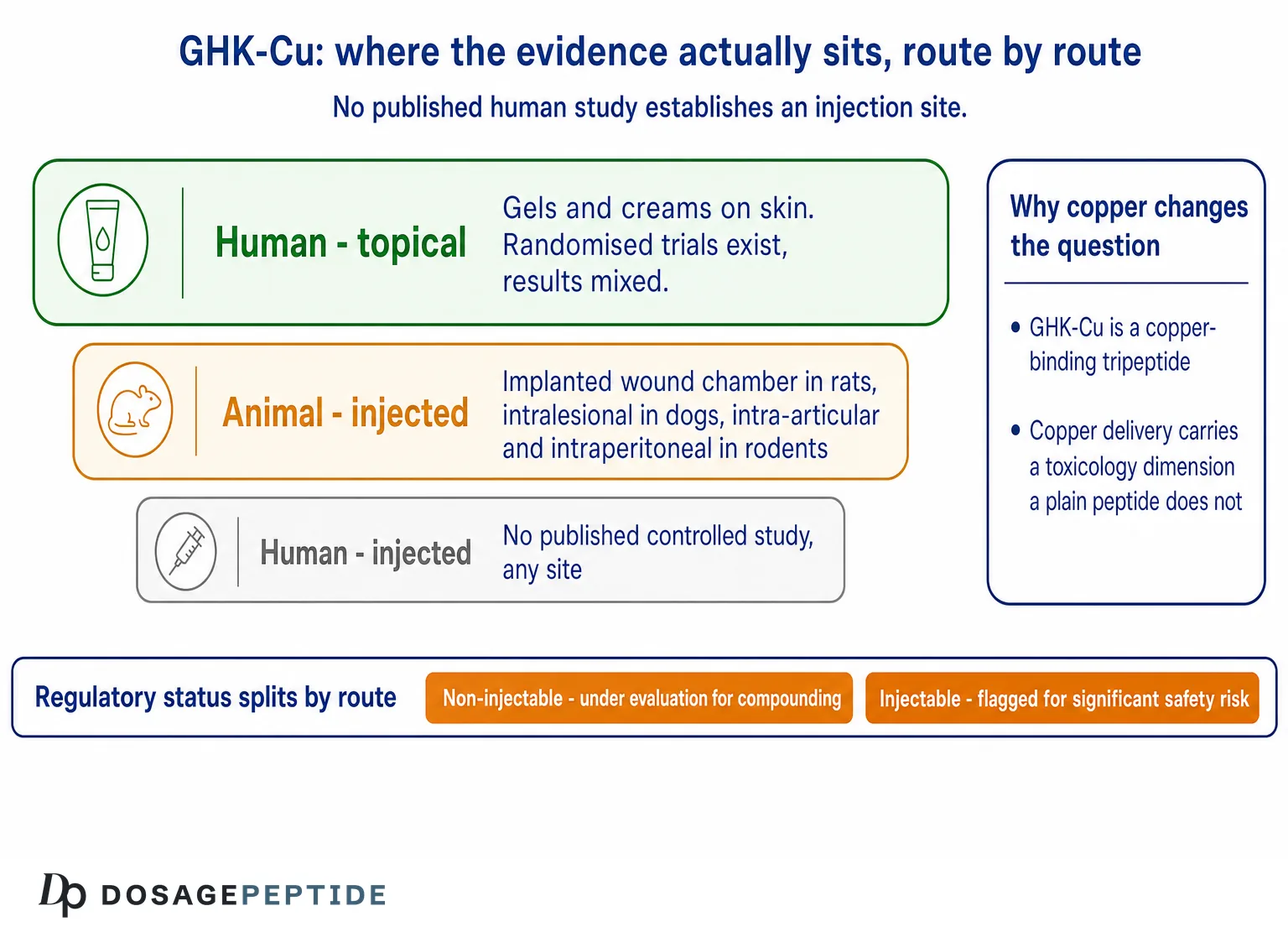
Short answer: there is no injection site for GHK-Cu, because there is no human injection evidence for GHK-Cu. Essentially every human dataset on this copper peptide is topical — gels and creams applied to skin — and the only registered interventional efficacy trial currently recruiting is also a topical gel study.[15] Not one published controlled study has injected GHK-Cu subcutaneously into a person at any site.
That is not a technicality. The injectable route is precisely the one the U.S. Food and Drug Administration singled out as raising significant safety concerns when it evaluated GHK-Cu for pharmacy compounding[12] — and the reason is the copper, which behaves differently from an ordinary peptide once it is past the skin. Sites you find listed elsewhere (abdomen, outer thigh, upper arm) are generic subcutaneous anatomy copied from other products; they describe where subcutaneous tissue is, and nothing about GHK-Cu. The table below sets out every route the research actually used, and the evidence tier of each.
| Route | Species and model it was used in | What it was used for | Evidence tier |
|---|---|---|---|
| Topical gel or cream | Humans (diabetic neuropathic plantar ulcers; venous stasis ulcers; post-CO₂-laser facial skin); rats with ischaemic open wounds | Wound closure, infection rate, erythema, skin appearance | Human randomised trials — the highest tier that exists for GHK-Cu, and the results are mixed |
| Injection into an implanted subcutaneous wound chamber | Rat (stainless-steel wire-mesh cylinder implanted under dorsal skin) | Collagen, glycosaminoglycan and total protein accumulation inside the chamber | Preclinical, rodent only — a laboratory device, not an anatomical site |
| Local (intralesional) injection into the wound itself | Dog (full-thickness metatarsal and digital foot-pad wounds) | Healing rate and type-I collagen content | Preclinical, veterinary |
| Intra-articular injection | Rat (anterior cruciate ligament reconstruction) | Graft healing, knee laxity, graft stiffness | Preclinical, rodent only; benefit did not persist |
| Intraperitoneal injection | Mouse (LPS-induced acute lung injury; bleomycin-induced pulmonary fibrosis) | Systemic anti-inflammatory and anti-fibrotic signalling | Preclinical, rodent only; not a route used in people |
| Intravenous injection | Rat (pharmacokinetics) | Plasma clearance of the tripeptide and its metabolite | Preclinical pharmacokinetics only — no efficacy endpoint |
| In vitro (no route) | Excised human skin; cultured human keratinocytes | Permeation of peptide and copper across skin, cell viability | Mechanistic laboratory work — measures barrier crossing, not outcome |
| Conventional subcutaneous injection in a person | — | — | No published controlled study. No site, no comparison, no human safety dataset |
Which routes has GHK-Cu research actually used?
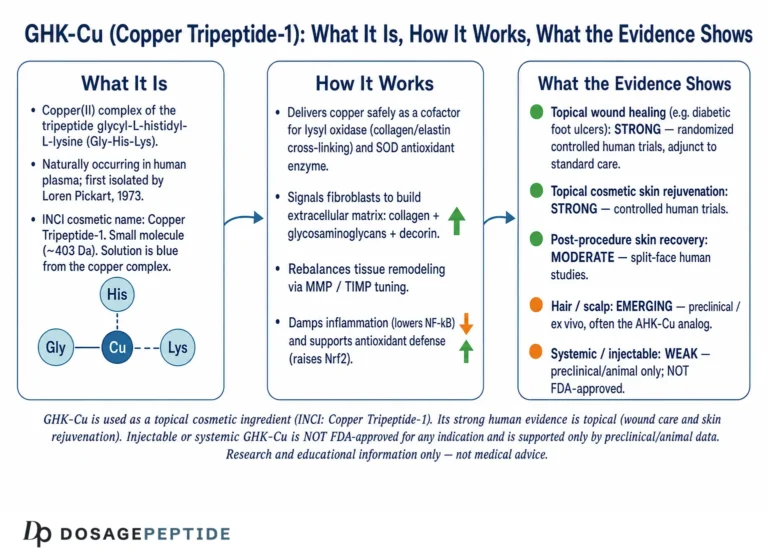
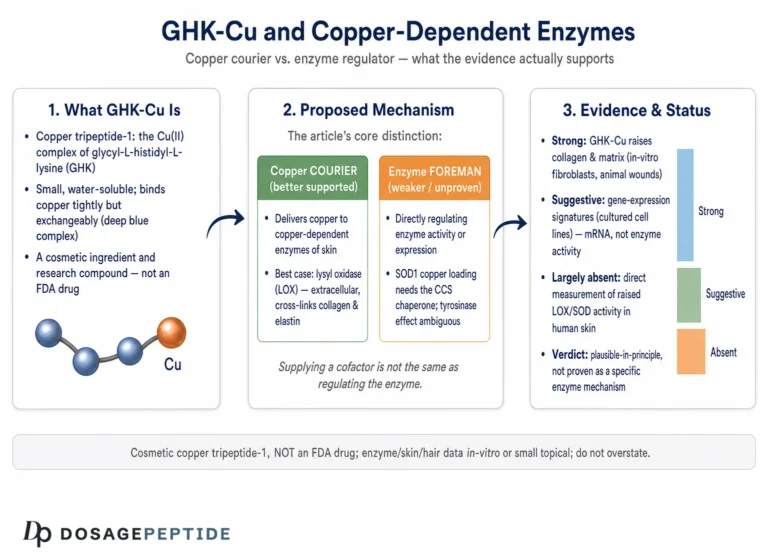
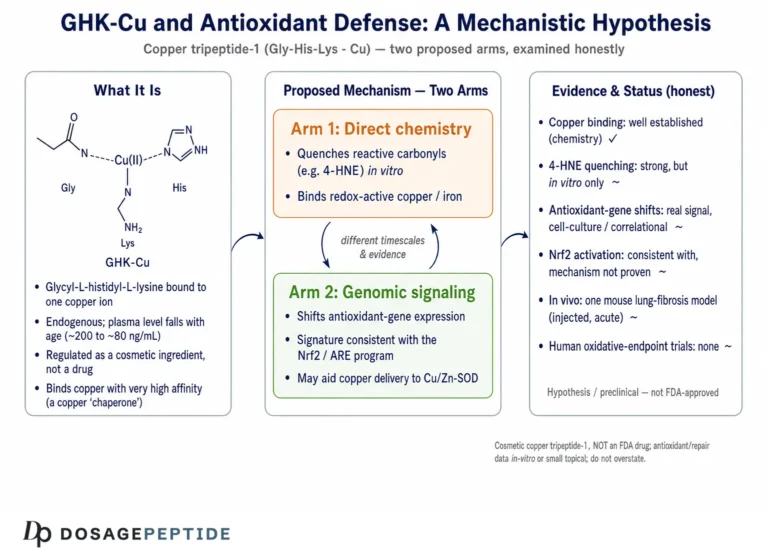
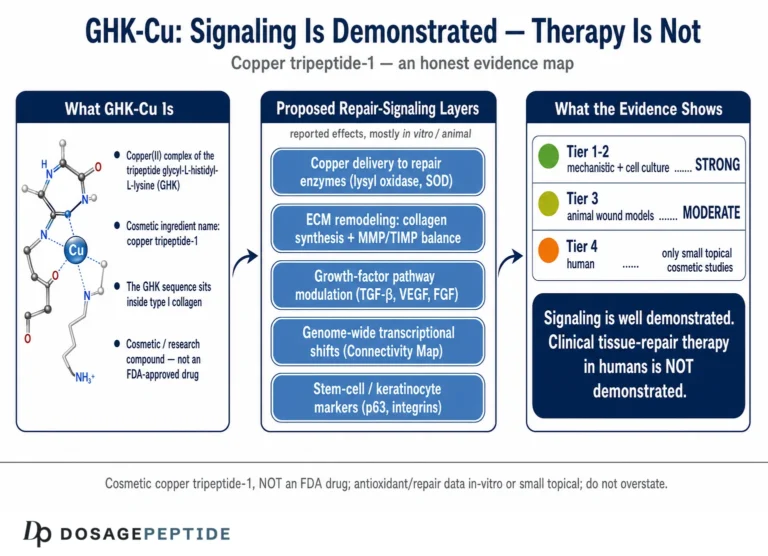
GHK-Cu is the copper(II) complex of glycyl-L-histidyl-L-lysine, a tripeptide that binds copper with high affinity. That copper is not incidental — it is the reason the route question is harder here than for a plain saline peptide, and it is the reason regulators have treated injected and non-injected GHK-Cu as two different problems. Our overview of what GHK-Cu is, how it is thought to work, and where the risks sit covers the chemistry in more depth, and the GHK-Cu 50 mg vial reference page records what published handling and reconstitution protocols actually documented. This page is only about route and site.
Sorted by evidence quality rather than by popularity, the literature falls into three unequal blocks: topical human work, animal work in which GHK-Cu was injected into wound chambers, joints or the peritoneal cavity, and cell culture. None of the three contains a controlled human injection study — which is why any comparison of injectable versus topical GHK-Cu skin research is asymmetric from the start: only one side has human trials.
Why is almost all of the human GHK-Cu evidence topical?
Because that is how GHK-Cu was developed. The compound entered clinical testing as a wound gel, and the human trials that exist tested a gel or a cream on the skin.
The most favourable of them was a multicentre, randomised, evaluator-blinded, placebo-controlled study in diabetic neuropathic ulcers. Applied topically after sharp debridement, GHK-Cu gel produced a median area closure of 98.5% versus 60.8% for vehicle (p < 0.05), and ulcer infection occurred in 7% of gel-treated ulcers versus 34% of vehicle-treated ulcers (p < 0.05).[7] That is a genuine positive human result — for a gel, on a debrided ulcer, under a standardised wound-care protocol.
The other two human trials were not positive. In 86 evaluable patients with venous stasis ulcers, a 0.4% tripeptide-copper complex cream was no better than an inert vehicle placebo; silver sulfadiazine outperformed both.[8] In a randomised study of 13 patients after CO₂ laser resurfacing, blinded evaluation and computer image analysis found no significant reduction in erythema and no significant improvement in wrinkles or objective skin quality with a GHK-Cu regimen; only the patients’ own rating of overall skin quality favoured it (P = .04).[9]
So the human record for topical GHK-Cu is one positive wound-care trial and two null or near-null cosmetic and ulcer trials. That is a modest record. It is still more than the injectable record, which is empty.
What did the studies that injected GHK-Cu actually do?
The rat wound-chamber model
The paper most often invoked as evidence that “GHK-Cu was injected” is a 1993 study in The Journal of Clinical Investigation. Stainless-steel wire-mesh cylinders were implanted subcutaneously on the backs of rats, and the animals received sequential injections into the chamber of either saline or GHK-Cu. Chamber contents were analysed for dry weight, protein, collagen, DNA, elastin and glycosaminoglycans; the concentration-dependent increases reported were in dry weight, DNA, total protein, collagen and glycosaminoglycan content, and a control tripeptide had no significant effect.[1]
It is routinely paraphrased as showing that GHK-Cu “works subcutaneously.” It does not say that. The injection target was an implanted device that collects granulation tissue and wound fluid — a controlled biochemical compartment designed to be sampled. There is no human equivalent of that site, and the paper does not report anything about a subcutaneous injection into ordinary tissue.
Injection directly into a wound in dogs
The closest published analogue to “inject near the area of interest” is a veterinary study in 12 mature English Pointers. Full-thickness 6 × 8 mm wounds in the metatarsal and digital foot pads were injected with tripeptide-copper complex, an immunostimulant, or saline at 0, 3 and 6 days after wounding. At 14 days, type-I collagen content in the tripeptide-copper-injected wounds was significantly greater than in the others, and the authors framed the rationale explicitly as keeping the drug present at the wound rather than relying on a bandage.[2]
Note what that study is and is not. It is a local injection into an open wound in a dog, measured by a tissue biochemistry endpoint. It is not a subcutaneous injection into intact tissue near an area of interest, and it involves no human.
Intra-articular and intraperitoneal routes in rodents
Two other injected routes appear in the literature, and neither is a skin route. In a rat model of anterior cruciate ligament reconstruction, 72 animals received weekly intra-articular injections of saline or GHK-Cu (0.3 or 3 mg/mL) from week 2 for four weeks. At six weeks the GHK-Cu groups showed a smaller side-to-side difference in knee laxity than saline (p = 0.009), and the lower-concentration group showed higher graft stiffness — but at 12 weeks there was no significant difference, and the authors concluded the benefit did not last once treatment stopped.[3]
The systemic animal work used the intraperitoneal route. Mice given GHK-Cu intraperitoneally at 1 or 10 µg/g every 24 hours for three days before an LPS challenge showed reduced inflammatory signalling and less lung histological damage,[5] and mice given 0.2, 2 or 20 µg/g on alternate days in a bleomycin pulmonary fibrosis model showed reduced collagen deposition and inflammatory markers.[4] Intraperitoneal dosing is a laboratory convenience route in rodents; it is not used for this kind of compound in people, and it tells you nothing about an injection site. That problem recurs across the peptide literature, which is why our guide to what “injection site” actually means in peptide research starts from the species and the model rather than from anatomy, and why our summary of what has and has not been studied for injectable and systemic GHK-Cu is organised route by route.
Does “inject near the area of interest” come from a finding?
No. It is an extrapolation, and it is worth naming the chain of reasoning so you can see where it breaks.
The chain runs: topical GHK-Cu helped a debrided human ulcer heal;[7] topical GHK-Cu accelerated closure of ischaemic rat wounds, where day-13 wound area had decreased by 64.5% with the gel versus 45.6% with vehicle and 28.2% untreated;[6] injecting it into a wound in dogs raised type-I collagen there;[2] therefore — the leap — injecting it under intact skin near a body part should deliver a local effect.
Every step before the leap involves an open wound, a compartment where the peptide sits in contact with granulation tissue and wound fluid. None tested delivery through intact skin into subcutaneous tissue, and none measured how far the compound travels from an injection point or how long it stays there. The pharmacokinetic data that do exist point the other way: after intravenous injection in rats, glycyl-L-histidyl-L-lysine was rapidly degraded to L-histidyl-L-lysine, which was rapidly cleared from blood, and the peptide is reported to be unstable in human plasma and rapidly degraded by aminopeptidases.[11] A compound with that profile is not obviously well suited to a “deliver it near the target” strategy, and no study has tested whether it is.
The barrier problem also cuts both ways. In excised human skin, over nine hours 134 ± 12 nanomoles of peptide and 705 ± 84 nanomoles of copper permeated microneedle-pretreated skin, while almost none permeated intact skin.[10] That is a real limitation of topical delivery — and it is also the clearest published argument for bypassing the stratum corneum. It is an argument about a barrier, not evidence that any particular injection site produces any particular outcome.
Why does the copper change the injection question?
A peptide dissolved in bacteriostatic water raises formulation and sterility questions. A peptide that carries a transition metal raises those questions plus a metal-exposure question, and regulators treat the two differently.
An approved injectable copper product illustrates the difference. ZYCUBO (copper histidinate) for injection is approved for the treatment of Menkes disease in pediatric patients and is given subcutaneously; its label warns that treatment may lead to further copper accumulation and related toxicity, flags potential renal tubular toxicity, glomerular injury, liver dysfunction and haematological abnormalities, and requires laboratory monitoring. In its clinical trial population of 129 treated pediatric patients, a local administration reaction was reported in 9 patients (7%).[14]
That is a different molecule, indication, population and elemental copper dose, so none of those figures transfer to GHK-Cu. The point is narrower: an injected copper complex is something a regulator monitors, and that 7% is a quantified administration-site rate that exists only because a copper product went through an approval process. For GHK-Cu itself there is no published human injection-site tolerability dataset — not a low rate, not a high rate, none. Anyone quoting an injection-site reaction rate for GHK-Cu is quoting something that has not been measured. What is documented about tolerability comes almost entirely from topical use, and is collected on our page covering reported GHK-Cu side effects and where those reports come from.
Two chemistry details are worth keeping in view. Copper(II) complexes are intensely blue — the approved copper histidinate product is described in its own label as a blue lyophilised powder[14] — so a blue reconstituted copper-peptide solution is expected chemistry, not a quality signal either way. And the Cosmetic Ingredient Review panel recorded that commercial GHK-Cu is approximately 95% pure and often contains small amounts of material described as mildly neurotoxic in animal assays, removable by a specific purification step.[11] An impurity fraction of that size is a very different proposition applied to skin at a few parts per million than it is injected.
What is the regulatory status of GHK-Cu, route by route?
This is the part of the topic where the answer is unusually clean, because the FDA drew the line at exactly the place this article is about.
GHK-Cu is not an FDA-approved drug for any indication. It appears in cosmetic products under cosmetic regulation, where the Cosmetic Ingredient Review Expert Panel concluded that copper tripeptide-1 and related ingredients are safe in the present practices of use and concentration in cosmetics — a survey-based conclusion resting on typical use concentrations of under 10 parts per million for the whole ingredient group. Worth noting, because it is routinely misquoted: the highest concentration in that survey, 0.002% in leave-on products, was reported for palmitoyl hexapeptide-12, a different ingredient in the same assessment, not for copper tripeptide-1.[11] That conclusion is about creams. It says nothing about a milligram-scale injection.
For pharmacy compounding, the FDA split the substance by route. Its interim 503A list places “GHK-Cu (except for injectable routes of administration)” in Category 1 — substances under evaluation.[13] Injectable GHK-Cu went into Category 2, the list of substances the agency has identified as raising significant safety risks, with this stated rationale: compounded injectable drugs containing GHK-Cu may pose a risk for immunogenicity due to the potential for aggregation and peptide-related impurities, and there are limited data in humans to inform safety-related considerations.[12]
The bookkeeping has since moved. All GHK-Cu nominations were withdrawn by their nominators on 22 April 2026; on 5 May 2026 one nominator clarified that it meant to withdraw only the injectable route, so GHK-Cu for non-injectable routes is being added back to Category 1. Injectable GHK-Cu now sits in the FDA’s “nominated but withdrawn” table rather than the live Category 2 table, and the agency intends to consult its Pharmacy Compounding Advisory Committee before the end of February 2027.[13] A withdrawn nomination is an administrative event, not a safety clearance — the risk summary for the injectable route is still published.[12]
One more category distinction matters. Research-grade lyophilised GHK-Cu sold for laboratory use is not a cosmetic product and is not a compounded drug. The CIR conclusion does not extend to it, the cosmetic use concentrations do not describe it, and it has no approved label of any kind.
What would an adequate human injection study need to show?
Stated plainly, so the gap is legible: to answer “where to inject GHK-Cu,” a study would need human participants, a defined injection site, a control site or a vehicle arm, a pre-specified endpoint measured by someone blinded to allocation, and reporting of local tolerability at the injection site. Nothing meeting that description has been published for GHK-Cu by any injected route.
What is coming is, again, topical. A Phase 2 randomised, double-blind, vehicle-controlled split-wound study of topical GHK-Cu gel on standardised punch-biopsy wounds, with a planned enrolment of 60 healthy adults, began recruiting in February 2026 at a single registered site, with primary completion projected for February 2027.[15] That is a registry entry with no posted results and no publication, so it is a plan rather than evidence. A split-wound vehicle-controlled design is the kind of study the field has been missing — and it is a gel study. It will not answer the injection-site question, because it does not ask it.
Until an injection study exists, the honest position is that route selection for GHK-Cu in research settings is not evidence-led. Anyone documenting handling of a research vial — whether the 50 mg vial reference or the 100 mg vial reference — is documenting laboratory practice, not a validated administration site, and it is more accurate to describe it that way than to imply an anatomy that no trial has ever tested. The same distinction runs through our general background on how peptide administration is described in the research literature.
If the goal is skin, what does the evidence actually point to?
Most people who search for a GHK-Cu injection site are after a skin, hair or wound-healing outcome. For that goal, the evidence points somewhere specific, and it is not an injection.
The human GHK-Cu record is topical, and it is mixed rather than uniformly positive. One multicentre randomised trial in diabetic neuropathic ulcers found significantly better closure and fewer infections with a topical gel than with vehicle. Two other randomised human studies — one in venous stasis ulcers, one after CO₂ laser resurfacing — found no significant advantage over vehicle on objective endpoints. That is a real but modest evidence base, and it is still incomparably stronger than the injectable evidence, which consists of zero human studies.
So the practical position is unusually clean for a peptide topic. The route with human trials behind it is the one that is also the least invasive, the one that does not put a transition metal into systemic circulation, and the one currently under study. The route with no human data is the invasive one. Where a question has a clear evidence gradient like this, following it is not caution — it is just reading the record.
Nothing here is a treatment recommendation, and topical GHK-Cu products are cosmetics rather than approved drugs. The point is narrower: if someone tells you an injection site for GHK-Cu, ask what study established it. There is no answer to that question.
Frequently Asked Questions
Is there an established subcutaneous injection site for GHK-Cu?
No. No published controlled human study has tested a subcutaneous injection of GHK-Cu at any site, so there is no established site, no comparison between sites, and no human safety data for that route. The animal studies that injected GHK-Cu used implanted wound chambers, open wounds, joints or the peritoneal cavity, none of which corresponds to a routine subcutaneous site in a person.
Why do so many sources say GHK-Cu is injected subcutaneously?
Mostly by inference from the rat wound-chamber studies, in which wire-mesh cylinders were implanted subcutaneously and then injected. The word “subcutaneously” in those papers describes where the device was implanted, not a subcutaneous injection into ordinary tissue. The distinction is easy to lose in summary, and it is the single most common misreading of this literature.
Is topical GHK-Cu actually supported in humans?
Partially. One multicentre randomised trial in diabetic neuropathic ulcers found significantly better closure and fewer infections with a topical gel than with vehicle. Two other randomised human studies — one in venous stasis ulcers, one after CO₂ laser resurfacing — found no significant advantage over vehicle on objective endpoints. So the topical evidence is real but mixed, and it is still far stronger than the injectable evidence, which does not exist.
Does injecting near the area of interest deliver a local effect?
That has not been tested for GHK-Cu. The idea is extrapolated from studies in which the compound was applied or injected into an open wound, where it sits in direct contact with healing tissue. No study has measured how far GHK-Cu spreads from an injection point, how long it persists in tissue, or whether a nearby site outperforms a distant one.
What did the FDA say about injectable GHK-Cu specifically?
In its compounding evaluation, the FDA placed GHK-Cu for injectable routes in Category 2 — substances raising significant safety risks — citing potential immunogenicity from aggregation and peptide-related impurities, and limited human data. Non-injectable GHK-Cu was handled separately, in Category 1. The injectable nomination was later withdrawn by its nominator, which is an administrative change rather than a safety clearance.
Does the copper make an injection riskier than a plain peptide?
It adds a variable that a saline peptide does not have, because copper is a metal with its own toxicology. An approved injectable copper product, copper histidinate for Menkes disease, carries label warnings about copper accumulation and requires laboratory monitoring. Those figures belong to a different molecule and dose and do not transfer to GHK-Cu — but no comparable safety dataset exists for injected GHK-Cu at all.
How much copper is in a cosmetic GHK-Cu product versus a research vial?
Very different orders of magnitude. The Cosmetic Ingredient Review recorded typical use concentrations for this ingredient group of under 10 parts per million, and a submission describing use under 10 ppm as customary. The 0.002% figure often quoted for GHK-Cu was in fact the survey maximum for palmitoyl hexapeptide-12, a different ingredient. A research vial is labelled in tens of milligrams, and cosmetic safety conclusions drawn at cosmetic concentrations on skin cannot be read across to a milligram-scale injection.
Is any human injection trial of GHK-Cu underway?
Not on ClinicalTrials.gov. A search of the registry returns three interventional records mentioning GHK-Cu. The only one currently recruiting is a Phase 2 vehicle-controlled split-wound trial of a topical gel, planned for 60 healthy adults, with primary completion projected for February 2027. A second, not yet recruiting, measures blood GHK and GHK-Cu levels after a skin patch. Neither involves an injection.
Can I just use the standard subcutaneous sites?
Abdomen, outer thigh and back of the upper arm are the standard subcutaneous sites for injections generally, and pages listing them for GHK-Cu are copying that generic anatomy. It describes where subcutaneous tissue is; it establishes nothing about GHK-Cu. No human study has injected GHK-Cu subcutaneously at any site, so there is no site-specific safety, absorption or effectiveness data to draw on — and FDA flagged the injectable route specifically.
Why is injected copper treated differently from an ordinary peptide?
Because a peptide that carries a transition metal adds a metal-exposure question to the usual formulation and sterility ones. The approved injectable copper product for Menkes disease illustrates the regulatory posture: its label warns of possible copper accumulation and toxicity, flags renal, liver and haematological risks, and mandates laboratory monitoring. Different molecule and dose, so no figures transfer — but it shows that injected copper is something regulators monitor.
Is topical GHK-Cu actually proven to work?
Partially, and honestly stated: one randomised trial in diabetic neuropathic ulcers found better closure and fewer infections versus vehicle; two others, in venous stasis ulcers and after CO₂ laser resurfacing, found no significant objective advantage. So the topical evidence is real but mixed. It is nonetheless the strongest tier that exists for this peptide, and the only route with any human trial data at all.
References
- Maquart FX, Bellon G, Chaqour B, et al. In vivo stimulation of connective tissue accumulation by the tripeptide-copper complex glycyl-L-histidyl-L-lysine-Cu2+ in rat experimental wounds. J Clin Invest. 1993;92(5):2368-2376. PubMed 8227353
- Swaim SF, Vaughn DM, Kincaid SA, et al. Effect of locally injected medications on healing of pad wounds in dogs. Am J Vet Res. 1996;57(3):394-399. PubMed 8669775
- Fu SC, Cheuk YC, Chiu WYV, Yung SH, Rolf CG, Chan KM. Tripeptide-copper complex GHK-Cu (II) transiently improved healing outcome in a rat model of ACL reconstruction. J Orthop Res. 2015;33(7):1024-1033. PubMed 25731775
- Ma WH, Li M, Ma HF, et al. Protective effects of GHK-Cu in bleomycin-induced pulmonary fibrosis via anti-oxidative stress and anti-inflammation pathways. Life Sci. 2019;241:117139. PubMed 31809714
- Park JR, Lee H, Kim SI, Yang SR. The tri-peptide GHK-Cu complex ameliorates lipopolysaccharide-induced acute lung injury in mice. Oncotarget. 2016;7(36):58405-58417. PubMed 27517151
- Canapp SO, Farese JP, Schultz GS, et al. The effect of topical tripeptide-copper complex on healing of ischemic open wounds. Vet Surg. 2003;32(6):515-523. PubMed 14648529
- Mulder GD, Patt LM, Sanders L, et al. Enhanced healing of ulcers in patients with diabetes by topical treatment with glycyl-L-histidyl-L-lysine copper. Wound Repair Regen. 1994;2(4):259-269. PubMed 17147644
- Bishop JB, Phillips LG, Mustoe TA, et al. A prospective randomized evaluator-blinded trial of two potential wound healing agents for the treatment of venous stasis ulcers. J Vasc Surg. 1992;16(2):251-257. PubMed 1495150
- Miller TR, Wagner JD, Baack BR, Eisbach KJ. Effects of topical copper tripeptide complex on CO2 laser-resurfaced skin. Arch Facial Plast Surg. 2006;8(4):252-259. PubMed 16847171
- Li H, Low YSJ, Chong HP, et al. Microneedle-mediated delivery of copper peptide through skin. Pharm Res. 2015;32(8):2678-2689. PubMed 25690343
- Johnson W Jr, Bergfeld WF, Belsito DV, et al; Cosmetic Ingredient Review Expert Panel. Safety Assessment of Tripeptide-1, Hexapeptide-12, Their Metal Salts and Fatty Acyl Derivatives, and Palmitoyl Tetrapeptide-7 as Used in Cosmetics. Int J Toxicol. 2018;37(3_suppl):90S-102S. doi:10.1177/1091581818807863. Final report released 30 June 2014: CIR full report PDF
- U.S. Food and Drug Administration. Certain Bulk Drug Substances for Use in Compounding that May Present Significant Safety Risks (Category 2 of the bulk substances nominated under sections 503A or 503B). Updated 22 April 2026. FDA.gov
- U.S. Food and Drug Administration. Bulk Drug Substances Nominated for Use in Compounding Under Section 503A of the Federal Food, Drug, and Cosmetic Act. Updated 14 May 2026. FDA category 1/2/3 list (PDF)
- Sentynl Therapeutics, Inc. ZYCUBO (copper histidinate) for injection, for subcutaneous use — prescribing information. DailyMed, U.S. National Library of Medicine. DailyMed label
- Hudson Biotech. A Phase 2, Randomized, Double-Blind, Vehicle-Controlled, Split-Wound Study of Topical GHK-Cu (Copper(II)-Peptide Complex) Gel to Accelerate Re-Epithelialization of Standardized Acute Skin Wounds in Healthy Adults. ClinicalTrials.gov identifier NCT07437586. ClinicalTrials.gov NCT07437586
Research use only. This article is an educational review of published research and regulatory records. It is not medical advice, not a protocol, and not a recommendation for human use. GHK-Cu (copper tripeptide-1, the copper(II) complex of glycyl-L-histidyl-L-lysine) is not an FDA-approved drug for any indication, and no marketing application for it has been approved. It appears in cosmetic products under cosmetic regulation; for pharmacy compounding, the FDA placed it in Category 1 (under evaluation) for non-injectable routes and published a significant-safety-risk rationale for injectable routes. Research-grade lyophilised GHK-Cu is neither a cosmetic product nor an approved pharmaceutical and carries no approved label of any kind. Nothing here should be used to diagnose, treat, cure or prevent any disease.