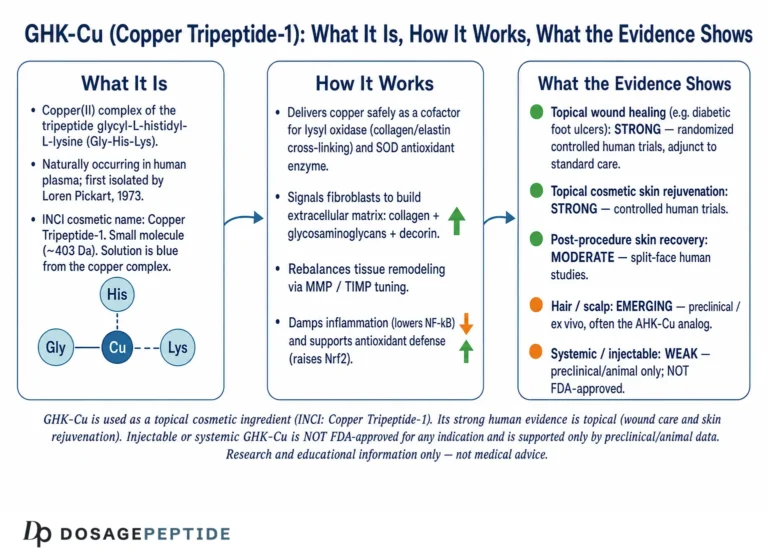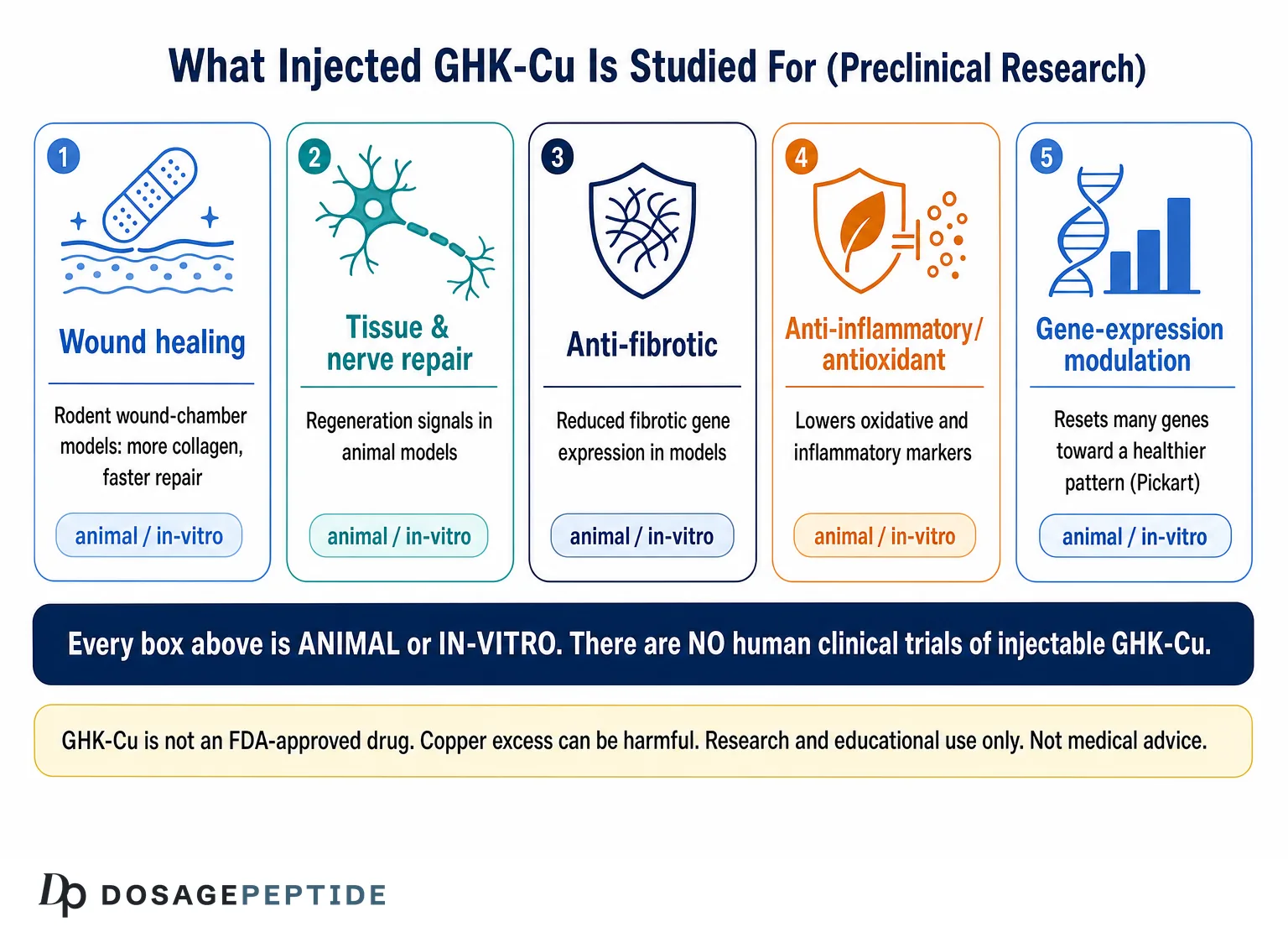
The short answer. No published human clinical trial has ever tested injected GHK-Cu — not for skin, not for wound healing, not for anything else. The dose figures that circulate online come from vendor pages and community protocols, not from a study that measured an outcome. Anyone quoting a subcutaneous GHK-Cu dose is quoting a convention, not a result.
What does exist is a substantial preclinical record: rodent wound models, cell culture, and gene-expression work that mapped what the copper tripeptide does to tissue-repair signalling once it reaches the bloodstream. This article covers that record and the copper physiology that constrains it — what injected GHK-Cu is expected to do at the molecular level, what the animal studies actually measured, why the systemic route behaves differently from a cream, and where the evidence stops. GHK-Cu is a research compound, not an approved drug, and nothing here is administration guidance.
What Is Injectable GHK-Cu, and Why Study the Systemic Route?
GHK is a naturally occurring human tripeptide first isolated by Loren Pickart in the early 1970s from human plasma. In his foundational report with Thaler, a tripeptide purified from human serum was shown to prolong the survival of cultured normal liver cells while also stimulating growth in neoplastic (hepatoma) liver cells — an early hint both of the molecule’s regenerative signaling and of the fact that its growth-modulating activity is context-dependent rather than uniformly benign.[1] In its biologically active form the peptide is complexed with copper(II) to form GHK-Cu, a small, diffusible copper-carrier molecule. Its concentration in human plasma is reported to decline substantially from young adulthood into later middle age, a decline that Pickart’s later reviews use as the conceptual rationale for reintroducing the peptide.[4] The interest in GHK-Cu subcutaneous and systemic delivery grows directly out of that origin story: because GHK is an endogenous plasma peptide that the body already produces and distributes through the circulation, researchers have long asked what happens when additional GHK-Cu is introduced into the systemic compartment rather than confined to a single local site.
In the research-peptide market, GHK-Cu is supplied as a lyophilized (freeze-dried) powder sealed in a glass GHK-Cu vial, typically in fixed masses such as 50 mg or 100 mg. It is reconstituted with a diluent to create a solution intended for subcutaneous research administration in laboratory models. It is essential to be precise about regulatory status from the outset: GHK-Cu is a research compound. It is not an FDA-approved drug, it is not a sterile pharmaceutical product manufactured to injectable-drug standards, and nothing in this article constitutes administration guidance for humans. The reference protocol pages, such as the GHK-Cu 50 mg vial dosage protocol and the larger GHK-Cu 100 mg vial dosage protocol, exist to document how research vials are handled and reconstituted, not to recommend human use.
The distinction between a systemic and a localized route matters more than it might appear. A molecule introduced into the whole-body circulation encounters plasma proteins, renal and hepatic clearance, and the body’s tightly regulated copper economy. Its distribution, half-life, and effects are therefore shaped by systemic pharmacology in a way that a locally confined molecule is not. The rest of this article is organized around that systemic frame: what injected GHK-Cu is expected to do at the molecular level, what the preclinical injected/systemic studies measured, how copper physiology constrains its behavior, and what remains unknown. Throughout, it is worth holding two ideas at once — that the mechanistic story is genuinely rich and internally coherent, and that coherence is not the same as proof of a systemic effect in a living human being.
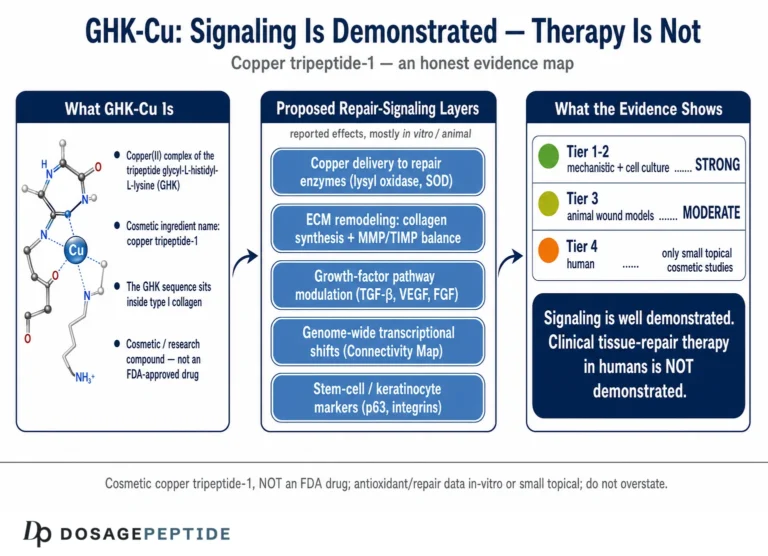
There is also a specific biological reason the systemic route attracted attention. GHK is not a foreign drug that the body must learn to process; it is an endogenous fragment, and one line of thinking holds that it may be liberated from larger proteins — for example, during tissue injury when extracellular-matrix proteins such as collagen and SPARC (osteonectin) are proteolytically degraded. Supporting this idea, the GHK sequence occurs within the alpha-2 chain of type I collagen, which means proteolysis at a wound could in principle release free GHK locally.[6] In that reading, a rise in free GHK is one of the body’s own signals that tissue has been damaged and repair should begin, and the peptide then circulates to coordinate that response. Whether or not every detail of that model is correct, it explains why researchers treated GHK-Cu as a candidate systemic repair signal rather than merely a local additive, and why they were willing to inject it into wound compartments and whole animals to see what a supraphysiologic systemic dose would do.
Research Context: Where the Injectable GHK-Cu Evidence Comes From
The injectable GHK-Cu research base was built largely in three waves. The first, in the 1970s, was Pickart’s discovery work: a factor in human plasma was identified that influenced the survival and growth behavior of cultured liver tissue, and Pickart and Thaler reported the responsible serum tripeptide.[1] The experimental design of that early work is itself instructive for the systemic question. Pickart compared how liver tissue behaved when bathed in serum of differing origin, tracked the responsible activity, and set out to isolate the factor — ultimately identifying the glycyl-histidyl-lysine tripeptide. Because the active agent was found circulating in blood, the entire premise from day one was that GHK is a systemic, blood-borne signal rather than a purely local factor. The reported age-related decline — from comparatively high plasma levels in young adulthood to markedly lower levels by later middle age — became the rationale for asking whether restoring GHK systemically could restore some of the repair competence that appears to fade with that decline.[4] This is the conceptual seed for studying it as an injected agent. It is worth flagging early, however, that even the founding observation carried a two-sided signal: the same tripeptide that prolonged normal-cell survival also stimulated growth in neoplastic cells, a duality that anyone extrapolating to systemic use should keep in view.
The second wave, in the 1980s and 1990s, was largely French and centered on the Maquart and Borel groups working on connective-tissue biology. These investigators demonstrated in fibroblast culture that GHK-Cu strongly stimulated collagen synthesis, with the effect beginning at picomolar concentrations, maximizing near a nanomolar concentration, and occurring independently of any change in cell number — a signature more consistent with specific signaling than with a generic growth push.[6] Crucially for the systemic story, they then moved into in vivo rodent models. In a frequently cited study, GHK-Cu introduced by repeated injection into stainless-steel wire-mesh wound chambers implanted subcutaneously in rats produced a concentration-dependent increase in the accumulation of connective tissue, raising dry weight, DNA, total protein, collagen, and glycosaminoglycan content at the repair site, while an inactive control tripeptide did not.[7] Because the peptide was delivered by injection into an implanted tissue compartment, this line of work is the closest thing the field has to a controlled, injected-delivery model of GHK-Cu’s repair activity.
The third wave, largely from 2008 onward, is the modern synthesis and gene-expression work led by Loren Pickart and Anna Margolina. This body of work reinterpreted the older tissue-repair data through the lens of genomics, arguing that GHK acts as a broad modulator of human gene expression that pushes cellular transcription toward a “healthier,” more youthful pattern.[2][3] These reviews are the most comprehensive maps of GHK-Cu biology available, but they are review and hypothesis papers that assemble in-vitro and animal data; they are not clinical trials of an injected product. Readers who want a broader orientation to the molecule can consult the What Is GHK-Cu pillar, which situates this systemic literature within the wider GHK-Cu picture.
Across all three waves, one feature is consistent and must be stated plainly: the systemic/injected evidence is preclinical. It is composed of cell-culture experiments, biochemical assays, and rodent studies. There is no published, peer-reviewed human clinical trial of subcutaneous or systemic GHK-Cu demonstrating efficacy for any outcome. That absence is not a minor caveat; it is the central limitation that shapes how every finding below should be read. It also shapes how the literature should be weighted: a large citation count for GHK-Cu does not translate into a large body of controlled human evidence, because much of that count consists of mechanistic and review papers building on the same underlying preclinical observations.
How Does GHK-Cu Act Systemically? The Mechanism of Action
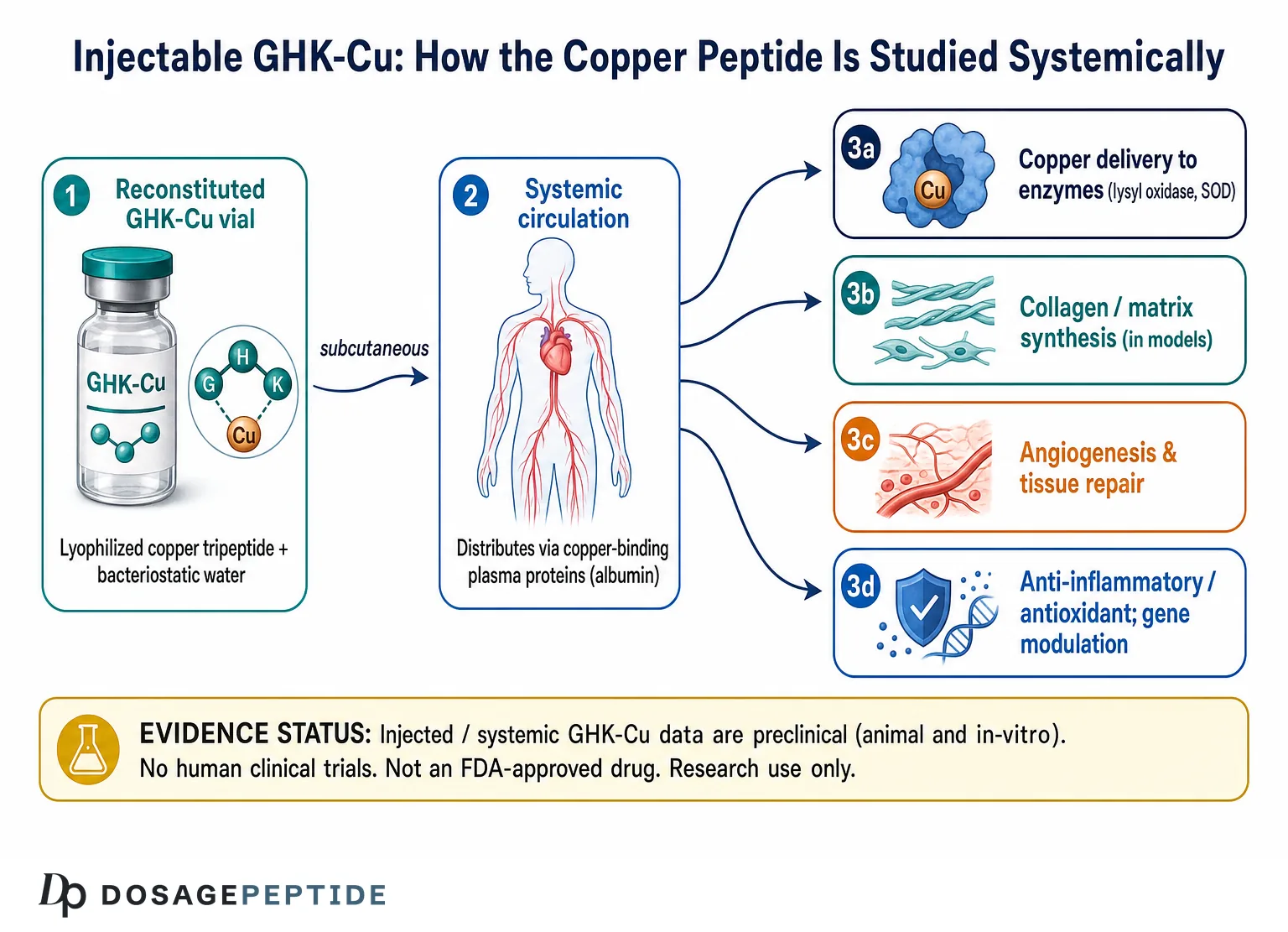
The proposed systemic GHK-Cu mechanism is best understood as several interlocking activities that share a common thread: copper handling. GHK-Cu is, at its core, a copper-transport molecule, and most of its downstream effects can be traced back to how it acquires, holds, and releases the copper ion. Reading the mechanism this way — copper first, everything else downstream — is also what keeps the safety discussion honest, because the very property that makes the biology interesting is the property that creates the systemic risk.
Copper delivery and exchange with copper-dependent enzymes
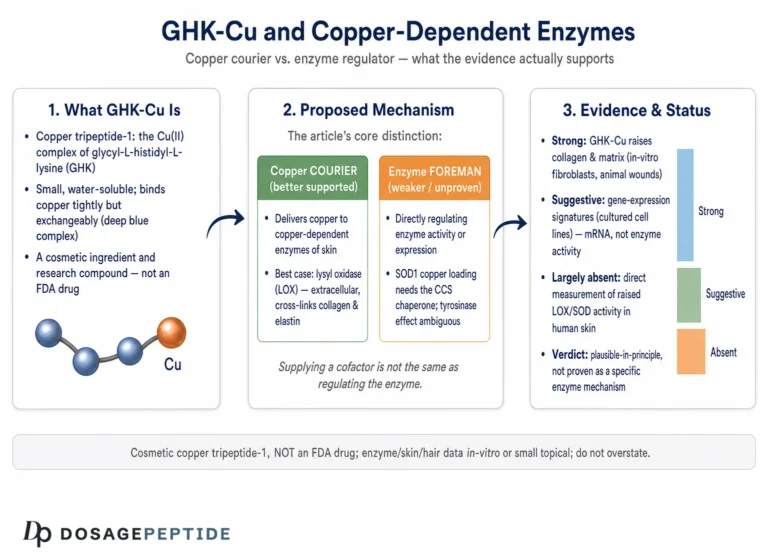
GHK binds copper(II) with an affinity that sits in a biologically useful window: tight enough to sequester the ion and shuttle it, but loose enough to hand it off to proteins and enzymes that need copper.[4] The coordination chemistry is what makes this possible. The copper is held by the imidazole nitrogen of the histidine side chain, the alpha-amino nitrogen of the glycine, and the deprotonated amide nitrogen between glycine and histidine, with the lysine side chain and neighboring molecules contributing additional interactions. This arrangement places GHK-Cu’s copper-binding strength in the same general range as the labile copper pool carried by albumin in plasma — which is precisely why the peptide can plausibly participate in physiological copper exchange rather than either locking copper away permanently or dumping it uncontrollably.[14] A carrier that binds too tightly cannot deliver its cargo; one that binds too loosely offers no advantage over a free ion and can catalyze damaging redox reactions. GHK-Cu’s intermediate affinity is the feature that lets it act as a shuttle rather than a sink or a source of free radicals. This matching of the peptide’s affinity to albumin’s is not a minor detail: it is the specific reason the copper GHK carries is expected to enter, rather than bypass, the body’s ordinary copper-exchange traffic once the molecule reaches the bloodstream.
Two copper-dependent enzyme systems are central to the tissue-repair narrative. Lysyl oxidase is a copper-requiring enzyme that cross-links collagen and elastin fibers, giving connective tissue its tensile strength; adequate copper supply is a prerequisite for functional cross-linking, and copper deficiency produces weak, poorly cross-linked matrix. Superoxide dismutase (SOD), in its copper/zinc form, is a primary antioxidant enzyme that neutralizes superoxide radicals and depends on bound copper for catalysis. By acting as a mobile copper donor, GHK-Cu is hypothesized to support the activity of these enzymes, linking copper delivery to both structural remodeling and antioxidant defense.[3] The logic is appealing precisely because it is mechanistically economical: a single copper-carrying peptide can, in principle, feed several copper-hungry enzymatic pathways at once. That same economy, however, is why it is difficult in some experiments to separate a specific GHK signaling effect from the generic effect of simply making more copper available.
Stimulation of matrix synthesis
In fibroblast cultures, GHK-Cu increases the synthesis of the major structural molecules of the extracellular matrix: collagen, elastin, and the glycosaminoglycan/proteoglycan ground substance (including dermatan sulfate and other glycosaminoglycans).[6] The concentration-response profile of the collagen effect — detectable at extremely low concentrations and independent of cell proliferation — argues that the intact tripeptide is doing something more specific than passively supplying metal. The in vivo rat wound-chamber data, in which injected GHK-Cu increased connective-tissue accumulation in a concentration-dependent way while an inactive control peptide did not, are the systemic-route corroboration of these culture findings and are important because they show the effect surviving the transition from a dish to a living animal.[7]
Matrix-remodeling and MMP modulation
Tissue repair is not only synthesis; it is a balance between deposition and controlled breakdown. GHK-Cu has been reported to modulate matrix metalloproteinases (MMPs) and their tissue inhibitors (TIMPs). In dermal fibroblast culture, the copper complex increased MMP-2 levels and MMP-2 mRNA — an enzyme involved in remodeling the collagen scaffold during repair — and also raised the secretion of the tissue inhibitors TIMP-1 and TIMP-2; notably, the MMP-2 effect was reproduced by copper ions but not by the peptide alone, whereas the broader matrix-synthesis effects require the intact tripeptide.[8] The picture that emerges is of a molecule that supports both the laying-down of new matrix and the orderly turnover of old matrix — a remodeling regulator rather than a one-directional growth signal, which is how Pickart’s synthesis of the tissue-remodeling literature frames it.[14] That the same study raised both a matrix-degrading enzyme and its inhibitors is itself telling: it suggests a coordinated remodeling program rather than a simple push in one direction, which is consistent with the idea of GHK-Cu as an organizer of repair.
Angiogenesis and anti-inflammatory/antioxidant signaling
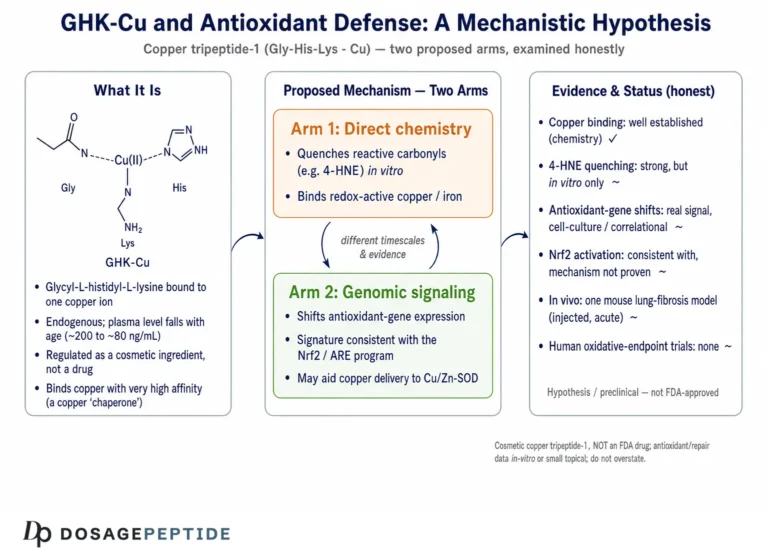
The preclinical literature also attributes to GHK-Cu the promotion of angiogenesis (the formation of new blood vessels, essential to feeding a healing wound), the recruitment of repair cells such as macrophages and capillary cells, and a set of anti-inflammatory and antioxidant effects.[2] The antioxidant activity is framed both as direct (the peptide can dampen iron- and copper-driven oxidative reactions when appropriately complexed) and indirect (through support of SOD and modulation of inflammatory signaling, including suppression of certain pro-oxidant and pro-inflammatory mediators). Pickart’s reviews argue these actions are why GHK behaves as a “protective” molecule in models of oxidative and degenerative stress.[4] A necessary caution attaches here: copper chemistry is double-edged, and a copper complex that is protective under one set of conditions can become pro-oxidant under another, which is one more reason the integrity and stoichiometry of the complex matter for how it behaves in a whole organism.
Gene-expression modulation: the systemic “reset” hypothesis
The most ambitious mechanistic claim — and the one most specific to systemic delivery — is that GHK acts as a genome-level modulator. Using the Broad Institute’s Connectivity Map dataset, Pickart and colleagues reported that GHK significantly changed the expression of a very large number of human genes (on the order of thousands when a modest expression-change threshold is applied), up-regulating many and down-regulating others in a pattern the authors interpret as a shift toward a healthier, more repair-competent state.[5] The affected pathways they highlight include DNA-repair genes, antioxidant-response genes, anti-inflammatory programs, and genes involved in tissue remodeling. In a related analysis, GHK was noted for its ability to reverse, in vitro, an aggressive gene-expression signature associated with metastatic behavior in certain tumor-cell datasets — a striking observation that is nonetheless purely computational/in-vitro and not a therapeutic claim, and one that should be read alongside the founding finding that the same peptide can stimulate growth in neoplastic cells.[5]
The mechanism proposed for how a single small peptide could touch so many genes is worth stating, because it is what makes the claim biologically conceivable rather than magical. GHK is not thought to bind each gene individually. Instead, the model holds that by delivering copper and interacting with upstream signaling and transcription-regulating machinery, GHK nudges a relatively small number of master regulators, whose downstream networks then ripple outward to the larger set of affected transcripts. Copper itself is a signaling-relevant ion, and several transcription factors and chromatin-associated processes are sensitive to metal availability and redox state. In that framing, a copper-carrying peptide sitting in the exchangeable copper pool is well positioned to exert broad, coordinated, but indirect transcriptional influence. This remains a hypothesis built to explain a database observation, not a mapped and validated pathway, and the distance between “a compound shifts a gene signature in cultured cells” and “a systemically dosed animal, let alone a person, experiences a coordinated health benefit” is exactly the distance that has not been closed.
Two caveats belong immediately alongside this hypothesis. First, gene-expression changes in cultured cells exposed to a compound do not, by themselves, establish a systemic therapeutic effect in a living organism, let alone in a human. Second, the “thousands of genes” figure is threshold-dependent and comes from a signature-matching database, not from controlled in-vivo transcriptomics after subcutaneous dosing; a different threshold yields a different count, so the headline number is a function of analytic choices as much as of biology. The gene-modulation story is the field’s most interesting mechanistic frontier and its least clinically validated.
What Did the Preclinical Wound-Healing and Tissue-Repair Studies Show?
The strongest, most reproducible systemic-route findings for GHK-Cu are in tissue repair. It is worth walking through what was actually measured, because the precision matters and because it is the precision, not the headline, that separates a genuine animal finding from a marketing slogan.
In the rat subcutaneous wound-chamber model, wire-mesh cylinders implanted under the skin create a defined healing compartment into which investigators can inject a test substance and later harvest the granulation tissue that forms. When GHK-Cu was injected into these chambers, the harvested tissue contained more collagen and more glycosaminoglycans than saline-control chambers, in a concentration-dependent manner, indicating accelerated and more robust connective-tissue formation; the stimulation of collagen synthesis was roughly twice that of non-collagen proteins, and type I and type III collagen messenger RNAs rose while an inactive control tripeptide produced no significant effect.[7] Because the compound was delivered by injection into a tissue compartment rather than merely added to cells in a dish, this is a legitimate GHK-Cu injection study of repair biology — and it is frequently cited precisely because it bridges the culture data and whole-animal outcomes.
Complementary animal work with tripeptide-copper complexes used an experimental skin-wound model and, in parallel, cultured fibroblasts. In that model, hydroxyproline, protein, DNA, and a copper-containing amine oxidase were measured over the healing time-course; in cultured fibroblasts the complexes increased collagen expression while reducing cell reproduction. Notably, the in-vivo results were not uniformly positive: the peptide-copper complexes were associated with a slower reorganization of the tissue and a delayed activation of fibroblasts in that particular model rather than straightforwardly faster healing.[9] That mixed result is worth stating rather than smoothing over, because it illustrates a real feature of the preclinical record: effects vary by model, species, formulation, and readout, and the literature is not a monotone chorus of positive findings. Across these models the recurring theme, where effects are seen, is not that GHK-Cu creates tissue from nothing, but that it appears to influence the normal repair sequence — recruitment of fibroblasts, matrix synthesis, cross-linking supported by copper-dependent lysyl oxidase, and angiogenesis.
It is worth dwelling on why the wound-chamber design is methodologically valuable, because it is what elevates the strongest reports above a simple observation. A wound chamber creates a walled-off, initially cell-free space with a defined volume; cells and matrix must migrate in and be built up over a known interval. That standardization lets investigators quantify the repair output — total collagen, hydroxyproline as a collagen marker, glycosaminoglycan content, DNA content as a proxy for cell number — and compare a treated chamber directly against a control chamber under matched conditions. When GHK-Cu-injected chambers reproducibly contain more matrix and more cells than saline controls, the inference that the peptide accelerated the repair program is reasonably well supported within the model. What the model cannot tell us is whether the same effect size, or any effect, would appear in intact human tissue, or whether the systemic exposure needed to achieve it would be safe; those are separate questions the chamber studies were never designed to answer.
The staged nature of wound healing also helps explain where GHK-Cu is proposed to act. Repair proceeds through overlapping phases: hemostasis, inflammation, proliferation (angiogenesis, fibroplasia, matrix deposition), and remodeling (maturation and cross-linking of the matrix). The preclinical data place GHK-Cu’s influence primarily in the proliferation and remodeling phases — recruiting and activating fibroblasts, feeding matrix synthesis, supporting new-vessel formation to perfuse the growing tissue, and then enabling proper cross-linking so the new matrix gains strength. A molecule that touches several sequential phases, rather than a single step, is consistent with the “coordinating signal” framing, but it also makes the biology harder to reduce to one clean mechanism and harder to predict when the whole-body copper economy, rather than a walled-off chamber, sets the terms of exposure.
The tissue-repair literature also extends conceptually toward nerve and other tissue types. Pickart and Margolina’s reviews compile evidence that GHK supports nerve outgrowth and the regeneration of several tissue types in experimental systems, and they connect this to the peptide’s broad gene-modulating and copper-delivery activities.[3] A separate analysis focused on genes relevant to nervous-system function and cognitive decline reported that GHK modulates expression of numerous such genes in the direction associated with better function — again, a transcriptomic/in-vitro observation, not a demonstrated clinical neurological effect.[10] These extensions are best read as hypotheses the authors find worth pursuing, not as demonstrated systemic outcomes.
Anti-fibrotic and anti-inflammatory signals
An apparent paradox in the GHK-Cu data is that the same molecule described as pro-synthetic (it increases collagen) is also described as anti-fibrotic. The proposed resolution lies in remodeling. Fibrosis is disorganized, excessive, poorly cross-linked matrix; healthy repair is organized, appropriately cross-linked, and self-limiting. The preclinical reviews argue that GHK-Cu supports the latter by simultaneously promoting synthesis, enabling proper cross-linking, and modulating the MMP/TIMP balance and inflammatory signaling so that deposition does not run away into scar.[2] The anti-inflammatory dimension — dampening of pro-inflammatory cytokine signaling and support of antioxidant defenses — is proposed as the mechanism that keeps the repair environment from tipping into chronic inflammation and fibrosis. It is a coherent and attractive model, but it is assembled from in-vitro and animal fragments; no human study has demonstrated an anti-fibrotic effect of systemic GHK-Cu, and the reconciliation of “more collagen” with “less fibrosis” remains a mechanistic argument rather than a measured clinical outcome.
Beyond Wound Repair: What Other Systemic Effects Have Been Explored?
While tissue repair is the best-developed thread, the preclinical literature attaches several other systemic activities to GHK-Cu, each grounded in the same copper-handling and gene-modulating biology and each carrying the same preclinical caveat.
The oldest is a liver thread. Pickart’s original discovery grew out of experiments in which the tripeptide influenced the survival and growth of liver cells, and later synthesis work compiled reports that GHK could protect hepatic tissue in experimental poisoning models.[14] Because the liver is the central organ of copper handling and a major site of oxidative stress during injury, a copper-carrying, antioxidant-supporting peptide has a plausible mechanistic story there — but the data are old, experimental, and not human, and the founding observation that the same peptide stimulates growth in neoplastic liver cells is a reminder that “acts on the liver” is not synonymous with “good for the liver” in every context.[1]
A second thread is systemic antioxidant and anti-inflammatory activity. The reviews compile evidence that GHK can blunt markers of oxidative damage and modulate inflammatory signaling in various models, and they connect this to support of Cu/Zn-SOD and to modulation of pro-inflammatory pathways.[4] A related and important point of nuance is that copper peptides can be antioxidant or pro-oxidant depending on how the copper is coordinated; the intact GHK complex is described as favoring the protective side, which is one more reason the integrity of the complex — the characteristic blue color and the proper copper-to-peptide stoichiometry — carries genuine biological significance for the compound’s behavior once it is in the body. A degraded or improperly complexed preparation cannot be assumed to behave like the well-formed complex studied in the laboratory.
A third thread is angiogenesis and cell recruitment. In models, GHK-Cu has been associated with promotion of new blood-vessel formation and with attracting immune and repair cells into a healing site.[2] Systemically, angiogenic activity is a double-edged property in principle — helpful for perfusing regenerating tissue, but something that any candidate with pro-angiogenic signaling must be evaluated against carefully in other contexts, including any setting where promoting blood-vessel growth would be undesirable. The preclinical reports do not resolve that balance for systemic dosing, and no human data address it.
A fourth thread, drawn largely from the genomic analyses, is the proposal that GHK modulates genes relevant to nervous-system function and to broad “anti-aging” programs.[10] These are the most speculative extensions of the systemic story: they rest on gene-signature matching and in-vitro observations, and they should be read as directions researchers find interesting rather than as demonstrated systemic effects. The pattern across all four threads is the same — a coherent mechanistic rationale, supportive animal or in-vitro fragments, and no controlled human confirmation. When a single molecule is proposed to help the liver, the vasculature, the nervous system, and the aging process all at once, the breadth of the claim is itself a reason for caution, not enthusiasm: broad, database-derived promise is exactly the kind of signal that most often fails to survive controlled testing.
Systemic Pharmacology and Copper Handling: What Governs GHK-Cu’s Fate?
The single most important idea for anyone thinking about the injected route is that GHK-Cu does not behave like an inert drug once it enters the body. It enters a highly regulated copper economy, and that economy governs where the copper goes and how the peptide is cleared.
Copper in plasma is not free; it is bound. The great majority of circulating copper is carried by ceruloplasmin, with a smaller, more labile pool loosely bound to albumin and to small peptides and amino acids, including GHK itself. This labile albumin-bound pool is the exchangeable compartment through which copper is trafficked between tissues, and GHK-Cu is best understood as participating in that exchangeable pool rather than sitting apart from it.[11] When GHK-Cu is introduced systemically, its copper can be handed off to, and taken up by, the normal copper-transport machinery. Practically, this means the peptide’s distribution and the copper’s ultimate fate are dominated by whole-body copper homeostasis — hepatic uptake, biliary excretion (the principal route by which the body eliminates excess copper), and the binding capacity of plasma proteins — rather than by the peptide behaving as an independent, freely distributing drug.
The peptide backbone itself is small and, like other short peptides, is subject to degradation by plasma and tissue peptidases, giving it a short intrinsic half-life. The copper it carries, however, does not disappear; it is redistributed into the body copper pool. This decoupling — a short-lived peptide carrying a persistent metal — is the key pharmacological feature of systemic GHK-Cu and the reason copper balance, not peptide half-life, is the dominant safety consideration. Because copper is both essential and potentially toxic in excess, the body maintains copper homeostasis within tight limits, and repeated systemic delivery of a copper-carrying molecule is, in effect, copper supplementation by an unusual route.[11]
The subcutaneous route adds its own layer. A subcutaneous injection creates a local depot from which the compound is absorbed into capillaries and lymphatics over time, generally producing a slower rise and a more gradual exposure than an intravenous bolus. For a small, water-soluble copper peptide, absorption from that depot would be expected to be reasonably efficient, but the depot also gives local peptidases and the local copper environment a first opportunity to act on the molecule before it reaches the systemic circulation. Whether the intact GHK-Cu complex, the free peptide, the copper alone, or some mixture predominates in blood after subcutaneous dosing has not been resolved for this compound in controlled studies. This matters because the biological actor may differ by fraction: the gene-modulating and matrix-signaling effects are attributed to the intact tripeptide, whereas the copper-loading effects follow the metal regardless of whether the peptide survives. In other words, two different consequences — the hoped-for signaling and the feared copper accumulation — may not track together, because they ride on different fragments of the same molecule.
A further consequence of copper-dominated pharmacology is that repeated dosing does not behave like repeated dosing of an ordinary short-half-life peptide, which would clear between doses and reach steady state quickly. The copper carried in does not simply clear; body copper is eliminated slowly and chiefly through bile, so a schedule of repeated systemic GHK-Cu is better thought of as incrementally adding to the body copper pool, with elimination gated by hepatic and biliary capacity. In a healthy organism with normal copper excretion this may be well tolerated within some range; in anyone with reduced excretory capacity it is exactly the wrong direction. This is the pharmacological basis for the safety discussion that follows and the reason copper balance, not peptide kinetics, is the parameter that ought to anchor any thinking about systemic exposure.
It should be emphasized that the detailed pharmacokinetics of subcutaneous GHK-Cu — absorption rate from the subcutaneous depot, plasma concentration–time curves, tissue distribution, metabolic fate of the peptide backbone, and dose-linearity — have not been characterized in controlled human studies. What is described above is a physiologically grounded expectation built from copper biochemistry and general peptide pharmacology, not from a human PK dataset for this compound. The honest position is that the systemic pharmacology of injectable GHK-Cu is reasoned rather than measured, and any number one might attach to a “dose” would therefore be extrapolation resting on assumptions the data have not tested.
How Is a Research GHK-Cu Vial Reconstituted and Handled?
The following describes laboratory handling parameters for research-grade material. It is not administration guidance for humans and contains no injection how-to instructions; it documents how a lyophilized research vial is brought into and kept in solution so that a defined quantity of material can be worked with in the laboratory.
GHK-Cu ships as a lyophilized powder to maximize stability during storage and transit, because the peptide and its copper complex are more stable dry than in solution. Reconstituting GHK-Cu means dissolving that powder in an appropriate diluent — typically bacteriostatic water (sterile water containing a small percentage of benzyl alcohol, which suppresses microbial growth in a multi-use vial). The diluent is added slowly against the inside wall of the vial rather than directly onto the powder, and the vial is swirled gently rather than shaken vigorously, because mechanical agitation can stress peptide structure and generate foaming. GHK-Cu solutions carry a characteristic blue color from the copper(II) complex, which is a useful visual indicator that the copper coordination is intact; a solution that has lost that color, or that shows particulates, is a sign that something about the complex or its purity has changed.
The relationship between the powder mass, the volume of diluent added, and the resulting concentration is straightforward arithmetic, but it is the arithmetic that most often trips people up. A fixed mass of peptide reconstituted in a larger diluent volume yields a lower concentration per unit volume, and vice versa. Getting this right is the entire purpose of the dosage and reconstitution calculator, which converts vial mass and diluent volume into concentration, and the step-by-step peptide reconstitution guide, which walks through the mechanics of bringing a lyophilized vial into solution. The vial-specific protocol pages — again, the 50 mg vial protocol and the 100 mg vial protocol — record the reconstitution parameters and reconstitution math specific to those vial masses. These are documentation of handling logistics, not endorsements of any particular quantity for use in a living subject.
| Handling parameter | Typical research practice | Rationale |
|---|---|---|
| Supplied form | Lyophilized powder in a sealed glass vial (e.g., 50 mg, 100 mg) | Dry state maximizes stability of the peptide and copper complex |
| Diluent | Bacteriostatic water (benzyl-alcohol–preserved) | Preservative suppresses microbial growth in a multi-use vial |
| Addition technique | Diluent run down the vial wall; gentle swirl, no shaking | Reduces mechanical stress on peptide structure |
| Visual check | Clear blue solution, no particulates | Blue color signals intact copper(II) coordination |
| Storage (reconstituted) | Refrigerated, protected from light | Slows degradation and copper redox reactions in solution |
| Storage (lyophilized) | Cool, dry, dark; often frozen for long-term | Dry state is the most stable; extends shelf life |
Stability in solution is finite. Once reconstituted, GHK-Cu should be kept refrigerated and protected from light, and it is not indefinitely stable; copper-containing solutions are susceptible to redox chemistry over time, which can alter both the peptide and the coordination state of the metal. Because research-grade material is not manufactured to sterile-injectable pharmaceutical standards, sterility and endotoxin content are not guaranteed by the supplier the way they would be for an approved parenteral drug — a point that belongs squarely in the safety discussion below. For definitions of terms used here (lyophilization, bacteriostatic water, glycosaminoglycan, and others), the peptide glossary is a useful companion.
What Are the Safety and Copper-Overload Considerations?
The safety profile of systemic GHK-Cu is dominated by one element: copper. Copper is an essential trace mineral — it is required for the very enzymes (lysyl oxidase, cytochrome c oxidase, Cu/Zn-SOD, ceruloplasmin) that make GHK-Cu’s repair biology possible — but it is also a redox-active metal that is toxic in excess. The body defends a narrow copper range for exactly this reason.[11]
Copper overload
Because systemic GHK-Cu is functionally a route of copper delivery, repeated or high systemic exposure raises a legitimate concern about copper accumulation. Acute copper toxicity can cause gastrointestinal effects and, at high levels, hepatic injury and hemolysis; chronic copper overload can drive oxidative tissue damage, mitochondrial injury, and multi-organ dysfunction.[12] The oral upper intake levels established for dietary copper do not translate directly to a copper-carrying peptide delivered subcutaneously, which bypasses the intestinal regulation of copper absorption entirely — one more reason the systemic dosing of GHK-Cu is genuinely uncharacterized in humans. The general principle stands: introducing a copper carrier into the systemic circulation is not a copper-neutral act, and a schedule that seems modest on a per-injection basis can still add cumulatively to the body copper pool.
Copper-metabolism disorders and Wilson’s disease
Systemic copper delivery is conceptually contraindicated in individuals with disorders of copper handling. Wilson’s disease is the paradigmatic example: an inherited defect in the ATP7B copper-transport protein that impairs the body’s ability to remove excess copper, causing toxic copper accumulation in the liver, brain, eyes, and other organs.[13] The entire clinical management of Wilson’s disease is aimed at removing copper and restricting its intake, so any molecule whose function is to deliver copper systemically runs directly counter to that goal. More broadly, any condition of impaired copper excretion or unusual copper sensitivity is a conceptual red flag for a systemically administered copper peptide. These are stated as physiological reasoning, not as clinical screening advice, and they are not a substitute for evaluation by a qualified clinician.
Sterility, injection-site, and product-quality considerations
Distinct from copper biology is the simple fact that research-grade GHK-Cu is not a sterile pharmaceutical product. Material not manufactured and tested to injectable-drug standards may carry concerns around microbial contamination, endotoxin, particulates, and purity that approved parenteral drugs are specifically controlled against, lot by lot. In research settings, injection-site reactions and local tolerability are recognized general considerations for any subcutaneously delivered peptide. None of this is dosing or how-to guidance; it is a description of why the research-only designation exists and why the compound is not a substitute for an approved therapy. The absence of pharmaceutical-grade quality control is not a technicality — it means that even the identity, purity, and copper stoichiometry of a given vial cannot be assumed without independent verification.
| Consideration | Why it matters for the systemic route |
|---|---|
| Copper is essential but toxic in excess | Systemic GHK-Cu is functionally copper delivery; excess drives oxidative harm |
| Copper homeostasis is tightly regulated | Biliary excretion and plasma-protein binding govern fate; repeated dosing challenges this balance |
| Wilson’s disease / copper-metabolism disorders | Impaired copper excretion makes systemic copper delivery conceptually contraindicated |
| Not a sterile pharmaceutical product | Contamination, endotoxin, and purity are not controlled to injectable-drug standards |
| No human PK or safety data | Dose–response, thresholds, and adverse-event profile for subcutaneous GHK-Cu are uncharacterized |
| Not FDA-approved | Research-use-only compound; not evaluated or authorized for human treatment |
Current Evidence Level: How Strong Is the Injectable GHK-Cu Research?
It is worth being unusually explicit here because the marketing environment around peptides tends to blur evidence tiers. The copper peptide injection research for GHK-Cu sits at the preclinical level. Ranked from strongest to weakest translational support, the evidence is:
- In-vivo rodent tissue-repair studies (strongest systemic-route evidence). The rat subcutaneous wound-chamber study is a genuine animal experiment with measured, concentration-dependent outcomes (collagen and glycosaminoglycan content, collagen mRNAs, DNA) and an inactive control peptide. It supports the claim that injected GHK-Cu can increase connective-tissue accumulation in rats.[7] Additional animal wound-model work exists but is more mixed, with at least one study reporting slower reorganization and delayed fibroblast activation in vivo, which tempers any claim of uniform benefit.[9]
- In-vitro / cell-culture mechanistic data. Collagen-synthesis stimulation in fibroblasts, MMP-2 and TIMP modulation, and copper-transfer chemistry are well documented in cells and biochemical systems.[6][8] These establish plausibility but not organism-level efficacy.
- Genomic / signature-based analyses. The gene-expression “reset” findings are computational and in-vitro; they are hypothesis-generating and cannot, on their own, demonstrate a systemic clinical effect.[5]
- Human clinical trials of injectable/subcutaneous GHK-Cu: none. There is no published, peer-reviewed randomized or controlled human trial of systemic GHK-Cu establishing efficacy or safety for any indication.
The honest summary is therefore: mechanistically rich, preclinically supported (but not uniformly) for tissue repair in animals, and clinically unproven in humans. Statements you may encounter that GHK-Cu “heals,” “treats,” or “reverses aging” systemically in people go beyond what the published evidence supports. The appropriate framing for every outcome discussed above is “observed in research models” or “preclinical/experimental,” never “demonstrated in humans.”
Limitations of the Injectable/Systemic GHK-Cu Evidence
Several specific limitations constrain what can be concluded, and they compound one another.
Species gap. The in-vivo data are overwhelmingly rodent. Rodent wound-healing biology, copper handling, and dose scaling do not translate one-to-one to humans, and effects seen in a rat wound chamber cannot be assumed to occur, at the same magnitude or at all, in a person. This is the classic preclinical-to-clinical chasm, and GHK-Cu has not crossed it for the injected route.
No human pharmacokinetics or pharmacodynamics. Without human PK/PD, there is no established relationship between an administered amount and a plasma concentration, no half-life, no tissue-distribution data, and therefore no rational basis for any human dosing. Anything presented as a human dose for subcutaneous GHK-Cu is extrapolation, not evidence.
Copper as a confounder and a hazard. Because so much of GHK-Cu’s activity is copper-mediated, it is difficult in some experiments to separate specific tripeptide signaling from generic copper effects — a point made concrete by the finding that the MMP-2 effect was reproduced by copper ions alone while the collagen-synthesis effect required the intact peptide.[8] The same copper that drives the biology is the primary safety liability systemically, and the therapeutic window — enough copper to help, not enough to harm — is uncharacterized for this route in humans.
Publication and interpretation bias. A substantial share of the modern synthesis literature comes from a small number of closely associated authors (notably Pickart and Margolina), and much of it consists of review and hypothesis articles rather than independent replications. This does not make the findings wrong, but it means the evidence base is narrower and more interpretively driven than the volume of citations might suggest. Independent replication of the systemic effects, especially the genomic claims, is limited.
Product-quality variability. Research-grade material varies in purity, actual copper stoichiometry, and sterility between suppliers and lots. Findings from purified research peptide in controlled experiments do not automatically extend to arbitrary vials of variable quality, adding another layer of uncertainty to any real-world use.
Outcome measures do not map cleanly to human endpoints. Much of the strongest data reports biochemical or histological outputs — hydroxyproline content, collagen and glycosaminoglycan mass, gene-expression signatures. These are legitimate scientific measurements, but they are surrogate readouts, not clinical outcomes that patients or clinicians experience. A chamber with more collagen is not the same as a demonstrated improvement in a human condition, and the leap from a molecular or tissue-level change to a meaningful health benefit is exactly the leap that clinical trials exist to test and that has not been made for this route.
Dose and exposure in the models are often high or non-physiologic. To produce measurable effects, experimental studies frequently expose cells or tissues to concentrations well above endogenous plasma GHK levels. Effects seen at those exposures cannot be assumed to occur at physiologic levels, and pushing systemic exposure high enough to reproduce them in a whole organism is precisely what raises the copper-loading concern. The very conditions that make the biology visible in the lab are the conditions that make systemic safety uncertain.
Mixed and context-dependent effects. The record is not uniformly positive, and the biology is context-sensitive: the same peptide prolongs normal-cell survival yet stimulates neoplastic-cell growth,[1] and at least one in-vivo wound model reported delayed rather than accelerated repair.[9] A candidate whose effects flip direction with context is one whose systemic behavior is especially hard to predict from selected positive findings.
Regulatory status. GHK-Cu is not FDA-approved for any human use, and the injectable/systemic route in particular has not been evaluated or authorized. The compound’s legitimate context is laboratory research, and framing it as a treatment overstates its standing.[15]
What Would Move the Injectable GHK-Cu Evidence Forward?
Reading the gaps in reverse points to what a stronger evidence base would require. First, controlled human pharmacokinetic studies of subcutaneous GHK-Cu — measuring plasma peptide and copper concentrations after defined doses — would replace physiological extrapolation with data and would clarify the copper-loading question directly. Second, independent, non-affiliated replication of the key rodent repair findings and the genomic modulation findings would test how robust and reproducible they are, and would help resolve the mixed results already present in the animal literature. Third, dose-ranging animal safety studies focused specifically on copper accumulation across repeated systemic dosing would define whether a therapeutic window plausibly exists. Fourth, well-designed human trials in a specific, measurable indication (rather than broad “anti-aging” framing) would be needed before any efficacy claim could be made. There is also a basic characterization step that would help before any of that: independent analytical confirmation of what is actually in research vials — peptide purity, the true copper-to-peptide ratio, and the absence of endotoxin and contaminants — so that findings can be tied to a defined substance rather than to material of unknown composition. Until at least the first of these steps is taken, the injectable/systemic GHK-Cu story remains a mechanistically compelling but clinically unproven hypothesis. For those tracking the compound’s broader profile beyond the systemic route, the What Is GHK-Cu overview collects the wider mechanism, benefit, and risk picture in one place.
Frequently Asked Questions
How much injectable GHK-Cu do protocols use, and is that number reliable?
Not reliable. Single-injection figures in the low milligram range, given two or three times a week with a break after several weeks, are repeated across vendor pages and community write-ups. None of them traces back to a trial. No published human study has dosed subcutaneous GHK-Cu and measured an outcome, so there is no established dose, no established frequency, and no established ceiling — only a convention that has been copied until it looks like a standard. The one number that is genuinely fixed is the concentration you end up with after reconstitution, which is arithmetic from the vial mass and the diluent volume, not a dosing recommendation.
Is there any human clinical trial of injectable or subcutaneous GHK-Cu?
No. There are no published, peer-reviewed human clinical trials of injectable or subcutaneous GHK-Cu establishing efficacy or safety for any outcome. The entire injected/systemic evidence base is preclinical — rodent in-vivo studies and in-vitro cell and biochemical experiments. Any claim of proven human efficacy for systemic GHK-Cu is not supported by the published literature and should be treated with caution.
What did the rodent GHK-Cu injection studies actually measure?
The most cited in-vivo work used rat subcutaneous wound chambers, where a test substance is injected into an implanted healing compartment. GHK-Cu produced a concentration-dependent increase in the accumulation of connective tissue, measured as higher collagen and glycosaminoglycan content, higher DNA and protein, and increased collagen mRNAs in the harvested granulation tissue, while an inactive control peptide did not. Other animal wound-model work has been more mixed, including a report of slower reorganization and delayed fibroblast activation. These are animal outcomes, not human results.
Why is copper the central safety concern with systemic GHK-Cu?
GHK-Cu is functionally a copper-delivery molecule, so systemic administration is effectively copper supplementation by an unusual route that bypasses intestinal regulation. Copper is essential but toxic in excess, and the body tightly regulates it through plasma-protein binding and biliary excretion. Repeated systemic dosing challenges that balance, raising copper-overload concerns and making the compound conceptually contraindicated in Wilson’s disease and other copper-metabolism disorders.
How does GHK-Cu behave once it is injected into the body?
The peptide is small and, like other short peptides, is degraded by peptidases, giving it a short intrinsic half-life. Its copper, however, is redistributed into the body’s exchangeable copper pool and handled by normal copper physiology. So distribution and fate are governed more by whole-body copper homeostasis and plasma copper-binding proteins (ceruloplasmin and albumin) than by the peptide acting as an independent drug. Detailed human pharmacokinetics have not been characterized.
What is the gene-expression “reset” hypothesis, and how solid is it?
Pickart and colleagues used gene-signature databases to report that GHK modulates the expression of a large number of human genes — including DNA-repair, antioxidant, and anti-inflammatory pathways — shifting expression toward a healthier pattern. It is an intriguing, mechanism-rich hypothesis, but the data are computational and in-vitro, and the “thousands of genes” figure depends on the chosen threshold. Gene-expression changes in cultured cells do not, by themselves, demonstrate a systemic clinical effect in humans.
How is a research GHK-Cu vial reconstituted?
The lyophilized powder is dissolved in a diluent, typically bacteriostatic water, added gently against the vial wall and swirled rather than shaken. An intact solution appears clear blue from the copper complex. The mass-to-volume math determines concentration and is handled with a reconstitution calculator and reconstitution guide. This describes laboratory handling of research material only — it is not administration guidance for humans and contains no injection instructions.
Is GHK-Cu an approved drug for injection?
No. GHK-Cu is a research compound, not an FDA-approved drug and not a sterile pharmaceutical product manufactured to injectable-drug standards. Research-grade material is not guaranteed for sterility, endotoxin, or purity the way an approved parenteral drug is. Its legitimate context is laboratory research, and it should not be treated as a therapy or a substitute for approved medical care.
Is injected GHK-Cu the same molecule found naturally in the body?
The peptide is the same tripeptide, glycyl-L-histidyl-L-lysine, that occurs naturally in human plasma and declines with age, complexed with copper(II) as it is in the body. That endogenous origin is part of why researchers studied the systemic route. However, being a natural molecule does not make supraphysiologic systemic dosing safe or effective; the amount, route, and copper load are what determine biological effect and risk, and those remain uncharacterized in humans.
Why does the same molecule appear both pro-collagen and anti-fibrotic?
In preclinical models GHK-Cu increases collagen synthesis while also supporting orderly remodeling — proper cross-linking via copper-dependent lysyl oxidase, balanced MMP/TIMP activity, and dampened inflammation. Healthy repair is organized, self-limiting matrix; fibrosis is disorganized excess. The proposed reconciliation is that GHK-Cu favors organized repair over runaway scarring. This remains an animal/in-vitro model of behavior and has not been shown in human tissue.
References
- Pickart L, Thaler MM. Tripeptide in human serum which prolongs survival of normal liver cells and stimulates growth in neoplastic liver. Nature: New Biology. 1973;243(124):85–87. https://pubmed.ncbi.nlm.nih.gov/4349963/
- Pickart L, Vasquez-Soltero JM, Margolina A. GHK Peptide as a Natural Modulator of Multiple Cellular Pathways in Skin Regeneration. BioMed Research International. 2015;2015:648108. https://pubmed.ncbi.nlm.nih.gov/26236730/
- Pickart L, Margolina A. Regenerative and Protective Actions of the GHK-Cu Peptide in the Light of the New Gene Data. International Journal of Molecular Sciences. 2018;19(7):1987. https://pubmed.ncbi.nlm.nih.gov/29986520/
- Pickart L, Vasquez-Soltero JM, Margolina A. The Human Tripeptide GHK-Cu in Prevention of Oxidative Stress and Degenerative Conditions of Aging. Oxidative Medicine and Cellular Longevity. 2012;2012:324832. https://pubmed.ncbi.nlm.nih.gov/22666519/
- Pickart L, Vasquez-Soltero JM, Margolina A. GHK and DNA: Resetting the Human Genome to Health. BioMed Research International. 2014;2014:151479. https://pubmed.ncbi.nlm.nih.gov/25302294/
- Maquart FX, Pickart L, Laurent M, Gillery P, Monboisse JC, Borel JP. Stimulation of collagen synthesis in fibroblast cultures by the tripeptide-copper complex glycyl-L-histidyl-L-lysine-Cu2+. FEBS Letters. 1988;238(2):343–346. https://pubmed.ncbi.nlm.nih.gov/3169264/
- Maquart FX, Bellon G, Chaqour B, et al. In vivo stimulation of connective tissue accumulation by the tripeptide-copper complex glycyl-L-histidyl-L-lysine-Cu2+ in rat experimental wounds. Journal of Clinical Investigation. 1993;92(5):2368–2376. https://pubmed.ncbi.nlm.nih.gov/8227353/
- Siméon A, Emonard H, Hornebeck W, Maquart FX. The tripeptide-copper complex glycyl-L-histidyl-L-lysine-Cu2+ stimulates matrix metalloproteinase-2 expression by fibroblast cultures. Life Sciences. 2000;67(18):2257–2265. https://pubmed.ncbi.nlm.nih.gov/11045606/
- Buffoni F, Pino R, Dal Pozzo A. Effect of tripeptide-copper complexes on the process of skin wound healing and on cultured fibroblasts. Archives Internationales de Pharmacodynamie et de Thérapie. 1995;330(3):345–360. https://pubmed.ncbi.nlm.nih.gov/8836453/
- Pickart L, Vasquez-Soltero JM, Margolina A. The Effect of the Human Peptide GHK on Gene Expression Relevant to Nervous System Function and Cognitive Decline. Brain Sciences. 2017;7(2):20. https://pubmed.ncbi.nlm.nih.gov/28212278/
- National Institutes of Health, Office of Dietary Supplements. Copper — Health Professional Fact Sheet. https://ods.od.nih.gov/factsheets/Copper-HealthProfessional/
- Royer A, Sharman T. Copper Toxicity. In: StatPearls. Treasure Island (FL): StatPearls Publishing; NCBI Bookshelf. https://www.ncbi.nlm.nih.gov/books/NBK557456/
- National Institute of Diabetes and Digestive and Kidney Diseases (NIDDK). Wilson Disease. https://www.niddk.nih.gov/health-information/liver-disease/wilson-disease
- Pickart L. The human tri-peptide GHK and tissue remodeling. Journal of Biomaterials Science, Polymer Edition. 2008;19(8):969–988. https://pubmed.ncbi.nlm.nih.gov/18644225/
- U.S. Food and Drug Administration. Development & Approval Process (Drugs). https://www.fda.gov/drugs/development-approval-process-drugs
Disclaimer: This article is provided for scientific and educational reference only. GHK-Cu is a research compound; it is not an FDA-approved drug, not a sterile pharmaceutical product, and is intended for laboratory research use only. Nothing here is medical advice, a dosing recommendation, or instructions for human administration. The injectable/systemic evidence discussed is preclinical (animal and in-vitro), and no human clinical efficacy is claimed or implied. Consult a qualified, licensed healthcare professional for any health-related decision.