Chonluten is sold as the lung member of the Khavinson “peptide bioregulator” family — a tripeptide reported as Glu-Asp-Gly (EDG), marketed for breathing, bronchial inflammation and lung repair. None of that has been tested in a human trial. As of July 2026 a PubMed search for “Chonluten” returns a single indexed record[1] and ClinicalTrials.gov lists zero registered trials[2]. It is not approved by the FDA, the EMA or any comparable regulator; it circulates as a research chemical, it is routinely confused with a different product called Bronchogen, and essentially every benefit claimed for it in marketing copy is extrapolated from class-level theory or from that other peptide. This page separates what has been measured from what has only been asserted.
This article separates the three things that routinely get blended together online: (a) what has actually been measured with Chonluten itself, (b) what has been measured with other Khavinson peptides and then attributed to Chonluten by association, and (c) what remains an unreplicated hypothesis. If you came here looking for a mechanism-of-action story with confident arrows, the accurate answer is that no such story is established.
What is Chonluten?
Chonluten is described in the peer-reviewed literature as a synthetic tripeptide, Glu-Asp-Gly, characterised as originating from respiratory lung tissue. That description comes from a 2022 paper in the International Journal of Molecular Sciences co-authored by Vladimir Khavinson himself, in which Chonluten was one of five peptides tested on a human monocytic cell line; the methods section identifies it explicitly as “tripeptide Glu-Asp-Gly, from respiratory lung,” and the abstract adds that it is “derived from bronchial epithelial cells”[1].
That is the strongest identity evidence available, and it is worth being clear about how thin it is. There is no independent structural characterisation of Chonluten in the mainstream chemical literature, no entry establishing it as a well-defined pharmaceutical ingredient, and no regulatory monograph. The sequence assignment rests on statements from the originating research programme. Vendor listings mostly repeat those statements, and a meaningful fraction of them get the chemistry wrong.
Chonluten is not Bronchogen — and the two are constantly confused
This is the single most common factual error in circulating material about Chonluten. Bronchogen is a different molecule: a tetrapeptide, Ala-Glu-Asp-Leu (AEDL), also assigned to the bronchopulmonary system within the same programme[3]. Bronchogen has a small but real animal literature behind it — including rat models of chronic obstructive pulmonary disease[4][10]. Chonluten (EDG, three residues) does not share that literature: no study of Chonluten in any animal model, respiratory or otherwise, has been published. Claims of “COPD model data” or “restoration of bronchial epithelium” under the Chonluten name trace back to those Bronchogen studies, not to any study of Chonluten.
Chonluten also sits uncomfortably close in sequence to several of its siblings. Epitalon is Ala-Glu-Asp-Gly (AEDG) — Chonluten plus one alanine. Pinealon is Glu-Asp-Arg (EDR). Vesugen is Lys-Glu-Asp (KED). These are short, chemically similar molecules whose reported biological “tissue specificity” hinges on differences of one or two residues, which is itself a reason to demand strong analytical verification of any material labelled “Chonluten.” For orientation across the whole family, see our overview of Khavinson short-peptide bioregulators and what the research base actually contains, and the definitions in the peptide research glossary.
Where does Chonluten come from? The Khavinson bioregulator programme
Chonluten is not a standalone discovery. It is one entry in a catalogue produced by a Soviet, then Russian, research programme led by Vladimir Khavinson at the Saint Petersburg Institute of Bioregulation and Gerontology. The programme’s own account of its history runs roughly as follows: beginning in the 1970s, researchers prepared complex peptide extracts from animal tissues (thymus, pineal gland, and others), observed organ-specific effects in explant cultures, and then — on the basis of the amino acid composition of those extracts — designed short synthetic di-, tri-, and tetrapeptides intended to reproduce the same tissue-specific activity[5].
Under that logic, each organ gets a peptide: pineal gland gets Epitalon, thymus gets Thymogen, vessels get Vesugen, bronchi and lungs get Chonluten (and, separately, Bronchogen). It is important to recognise this as a design heuristic, not a demonstrated pharmacological principle. The organ assignment tells you what the originators intended the peptide to target; it does not by itself constitute evidence that the peptide reaches that organ, acts there, or produces a benefit.
The programme has produced a substantial body of publications — a PubMed search on “Khavinson” combined with “peptide” returns several hundred records as of July 2026 — but that output is heavily weighted toward the better-known members of the family, and the great majority of those records list Khavinson himself or Saint Petersburg Institute of Bioregulation and Gerontology affiliates among the authors. Chonluten is at the very bottom of that distribution.
What does the proposed mechanism actually claim?
The proposed mechanism for Chonluten is the class-level Khavinson hypothesis, applied by assumption. It should be read as a hypothesis, and the paragraphs below describe it as one.
The hypothesis holds that ultrashort peptides (2–7 residues) are small enough to cross the plasma membrane and the nuclear envelope without a dedicated transporter, enter the nucleus and nucleolus, and then interact directly with chromatin — binding histone proteins, single- and double-stranded DNA, and specific promoter sequences — thereby modulating transcription of tissue-relevant genes. A 2021 systematic review from the originating group sets out this framework across the whole class[6], and a companion review extends it to the regulation of cell differentiation[7].
There is some direct experimental support for parts of this picture — but not for Chonluten. A 2011 study in Biochemistry (Moscow) incubated HeLa cells with fluorescein-labelled peptides and observed fluorescence in cytoplasm, nucleus, and nucleolus, and used fluorescence-quenching constants to argue for sequence-preferential binding to deoxyribooligonucleotides[8]. The peptides tested in that study were Epitalon, Pinealon, Testagen, and Bronchogen — not Chonluten. Similarly, a 2020 study reporting modulation of IGF1, FOXO1, TERT, TNKS2, and NF-κB expression in ageing human mesenchymal stem cell cultures used the peptides AED, KED, and KE[9] — again, not Chonluten.
What has not been established
- No identified receptor or defined molecular target for Chonluten. The gene-regulation hypothesis proposes direct nucleic-acid interaction rather than receptor binding, but no binding data specific to EDG has been published.
- No pharmacokinetics. There are no published absorption, distribution, metabolism, or excretion data for Chonluten in any species, by any route.
- No demonstration of lung tropism. Nothing published shows that Chonluten preferentially reaches, accumulates in, or acts on pulmonary tissue. The “respiratory” designation is an origin story, not a biodistribution finding.
- Limited independent replication. Most of the class-level mechanistic work originates from the programme that developed the peptides. Independent replication by unaffiliated laboratories is sparse.
What does the published evidence on Chonluten actually show?
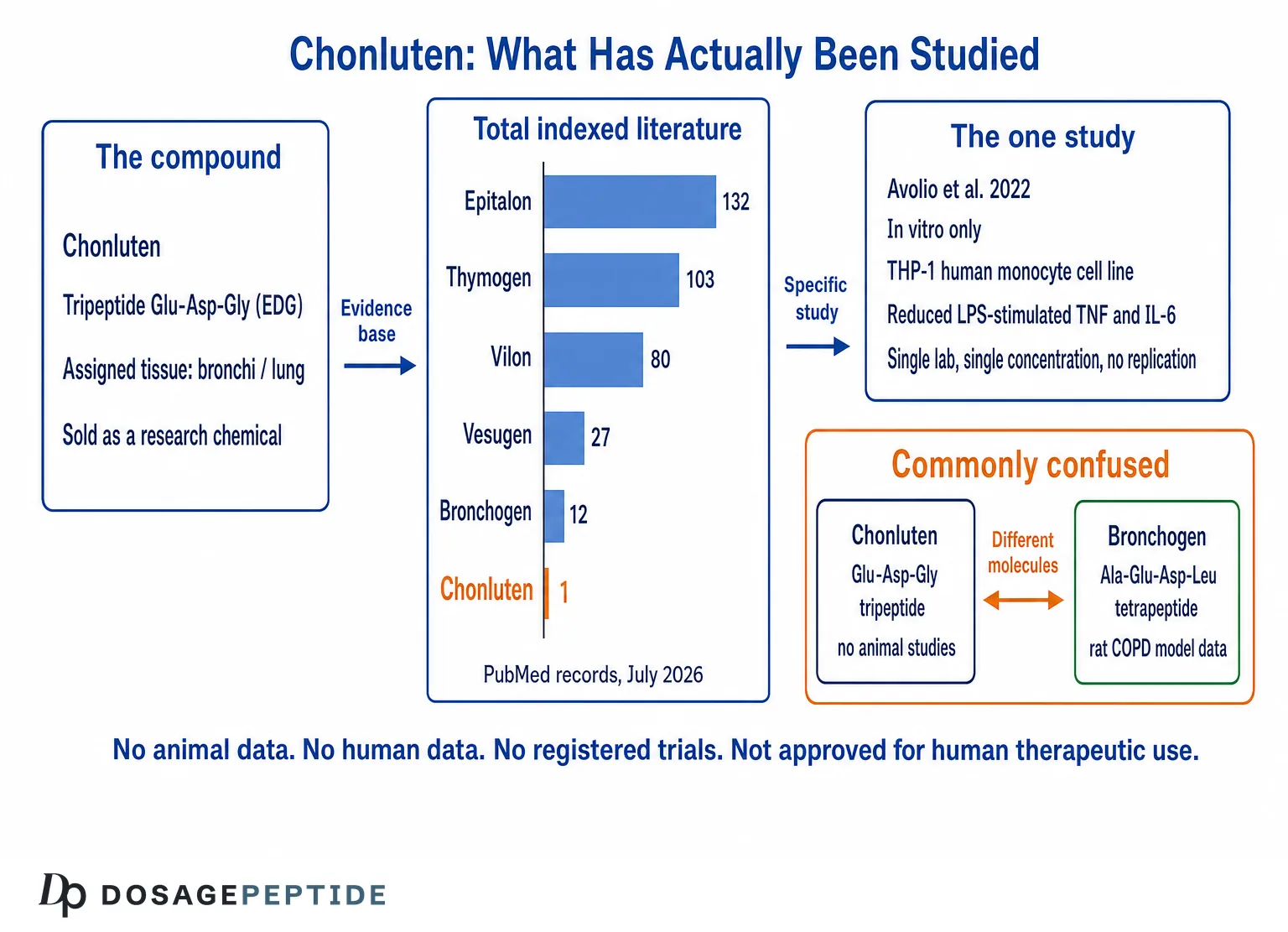
Here is the blunt version. As of July 2026, indexed literature on Chonluten specifically consists of one paper.
That paper is Avolio and colleagues, 2022, in the International Journal of Molecular Sciences[1]. It is an in-vitro study in the THP-1 human monocytic leukaemia cell line, which can be differentiated toward a macrophage phenotype with PMA. Five peptides were tested at 100 ng/mL: Epitalon, Vilon, Thymogen, the Thymalin peptide complex, and Chonluten. Reported findings relevant to Chonluten:
- Chonluten inhibited TNF production by monocytes stimulated with bacterial lipopolysaccharide (LPS), which the authors interpret in the framework of documented TNF tolerance.
- All five peptides, Chonluten included, reduced LPS-stimulated expression of TNF and the pro-inflammatory cytokine IL-6 in terminally differentiated THP-1 cells.
- Peptide-treated THP-1 cells showed reduced adhesion when layered onto LPS-activated HUVEC endothelial cells.
- Chonluten treatment was associated with a moderate but consistent apoptotic profile in a fraction of THP-1 cells.
- All five peptides increased tyrosine phosphorylation of mitogen-activated cytoplasmic kinases.
That is a legitimate, peer-reviewed in-vitro immunology result, and it is genuinely interesting — an anti-inflammatory signal in a monocyte/macrophage model is a reasonable place to start. It is also, on its own, a single experiment, in a single immortalised cell line, from a single laboratory group that includes the peptide’s originators, at a single concentration, with no animal data, no human data, and no independent replication. It establishes a hypothesis worth testing. It does not establish an effect in a living respiratory system, let alone a benefit.
Everything else you will read about Chonluten
Claims that Chonluten “restores bronchial epithelium,” “improves lung function,” “supports recovery from respiratory infection,” “boosts secretory IgA,” or “slows lung ageing” are not supported by studies of Chonluten. Where they have a traceable origin at all, they come from one of three places:
- Bronchogen (AEDL) studies. The rat COPD-model work showing normalisation of bronchial epithelial structure, increased secretory IgA and surfactant protein B, and reduced neutrophilic inflammation used the tetrapeptide Bronchogen, not Chonluten[4][10]. This is animal-model work, and it belongs to a different molecule.
- Class-level Khavinson theory. The general epigenetic-regulation framework[6] is applied to Chonluten by assumption because it shares the family label.
- General respiratory biology. Accurate background about the airway epithelium as an immune barrier[11] is used as scaffolding, with the peptide inserted at the end as the implied solution.
None of those are evidence about Chonluten. Treating them as such is the core error this article exists to correct.
How does Chonluten compare with better-documented bioregulators?
A crude but revealing comparison is simply how much indexed literature exists under each name. The counts below are raw PubMed all-fields name searches performed in July 2026. They are a measure of literature volume, not of quality, independence, or effect size — many of the hits are class-level reviews rather than primary studies, and a high count is not evidence that a peptide works.
| Peptide | Reported sequence | Assigned tissue | PubMed records (July 2026) |
|---|---|---|---|
| Epitalon / Epithalon | Ala-Glu-Asp-Gly (AEDG) | Pineal gland | ~132 |
| Thymogen | Glu-Trp (EW) | Thymus | ~103 |
| Vilon | Lys-Glu (KE) | Thymus / immune | ~80 |
| Bronchogen | Ala-Glu-Asp-Leu (AEDL) | Bronchi / lung | ~12 |
| Vesugen | Lys-Glu-Asp (KED) | Vascular endothelium | ~27 |
| Chonluten | Glu-Asp-Gly (EDG) | Bronchi / lung | 1 |
| Crystagen | Reported as a tripeptide | Immune | 1 |
The practical reading: Chonluten sits in the sparsest tier of an already thinly evidenced family. Even Vesugen, the vascular bioregulator, has roughly twenty-seven times as many indexed records behind it, and Vilon, the lysyl-glutamic acid dipeptide, has around eighty. Crystagen, the immune bioregulator, is in the same near-empty bracket as Chonluten and deserves the same scepticism. None of these have been shown to be effective for any human indication.
What is Chonluten’s regulatory status?
Chonluten is not approved for human therapeutic use by the U.S. FDA, and we could not verify a marketing authorisation from the EMA or any comparable Western regulator. It is not an FDA-approved drug for any indication, in any dosage form, by any route. There is no approved label, which means there is no authoritative statement anywhere of what a safe exposure would be.
In the United States, the compounding pathway is also effectively closed. FDA sorts bulk drug substances nominated for use in compounding into categories, and it has placed a number of nominated peptides in Category 2 — substances for which the agency has identified significant safety risks pending further evaluation. For the peptides on that list, FDA’s stated reasons include risk of immunogenicity from aggregation and peptide-related impurities, complexity of peptide characterisation, and no or only limited safety-related information for the proposed routes of administration[12]. Chonluten does not appear on the 503A bulks list itself, which is codified at 21 CFR 216.23 and currently contains six substances, none of them a peptide[13].
What Chonluten is, commercially, is a research chemical: lyophilised powder sold with “research use only” and “not for human consumption” labelling. Researchers should understand that this labelling has legal limits. In a March 2026 warning letter to a peptide seller, FDA stated plainly that, despite “Research Use Only” and “not intended for human consumption” labelling, website content establishing intended human use made the products unapproved new drugs under sections 201(g)(1) and 201(p) of the FD&C Act — and it applied the same reasoning to bacteriostatic water sold alongside the peptides[14].
This article gives no human dosing guidance and no protocol. For the vial-level reference specifications and reconstitution arithmetic that laboratory documentation typically requires, see our Chonluten 20 mg vial reference and protocol page, which is written for research documentation, not for human administration.
What should researchers know about handling and study design?
If Chonluten is going into an experimental protocol, the evidence gap changes what a well-designed study has to do. A few points follow directly from everything above.
Verify identity before you verify anything else
Because Chonluten’s identity rests on originator statements rather than an independent monograph, and because it is one alanine away from Epitalon and a residue swap away from Pinealon and Vesugen, incoming material should be characterised, not assumed. That means a certificate of analysis with mass spectrometry confirming the expected mass for Glu-Asp-Gly and HPLC purity data, ideally verified in-house. A study built on a mislabelled vial produces uninterpretable results no matter how good the rest of the design is.
Build in the controls the existing literature lacks
The one published Chonluten experiment used a single concentration (100 ng/mL) in one cell line. A study that meaningfully advances the question would add: a full concentration–response curve; a scrambled-sequence tripeptide control to test whether any effect is sequence-specific rather than a generic short-peptide or free-amino-acid effect; a vehicle control; and ideally a comparison against equimolar free glutamate, aspartate, and glycine, since two of the three residues are excitatory or metabolically active amino acids in their own right. Blinded analysis and replication by a laboratory unaffiliated with the originating programme would address the field’s most conspicuous weakness.
Expect a short peptide to behave like a short peptide
Exposure should be measured, not inferred from the peptide literature at large. A review of oral peptide delivery reports bioavailability “in most cases below 1%,” but it attributes that to relatively large molecular weight and high hydrophilicity and addresses peptide therapeutics of that kind[15]; it makes no statement about tripeptides, which are a different absorption class, so that figure should not be read across to Chonluten in either direction. No stability, half-life, absorption, or route-comparison data specific to Chonluten has been published, so any protocol should treat exposure as an unknown to be measured rather than assumed. Reconstitution technique, solvent choice, storage temperature, and freeze–thaw handling all become experimental variables; our peptide reconstitution guide covers the sterile-handling and concentration mathematics involved.
State the evidence tier in your own write-up
If you publish or document work with Chonluten, describe it for what it is: an investigational research compound with one in-vitro paper, no animal data, no human data, and no regulatory approval. The field’s credibility problem with bioregulators is largely a labelling problem — preclinical results described in clinical language — and it is fixable one careful methods section at a time.
Limitations and open questions
The limitations here are not marginal; they are the whole picture. There is no dose–response characterisation for Chonluten. There is no animal model of any respiratory condition using this specific peptide. There is no human study of any design — not a case series, not an open-label pilot, not a registered trial. There is no toxicology package, no immunogenicity assessment, and no long-term safety data. The proposed epigenetic mechanism has never been tested with Chonluten itself, and the class-level evidence for that mechanism, while not nothing, comes overwhelmingly from one research network and has seen limited independent replication.
The open questions that would actually move this forward are unglamorous: Does EDG enter mammalian cells and nuclei as the class hypothesis predicts? Does the THP-1 anti-inflammatory signal replicate in primary human monocytes and in a laboratory with no connection to the originators? Is any effect sequence-specific against a scrambled control? Does anything at all happen in a whole-animal respiratory model? Until at least the first two are answered, the fair description of Chonluten is “an interesting starting point with essentially no evidence base,” and confident statements in either direction — that it works, or that it is inert — outrun the data.
Research-use-only notice. This article is an evidence review published for research and educational reference. Chonluten is not approved by the FDA, the EMA, or any comparable regulator for the diagnosis, treatment, cure, or prevention of any disease, and nothing here is a recommendation for human use, a dosing protocol, or medical advice. Dosagepeptide.com is an independent reference library; it does not sell peptides and is not a clinic. Compounds discussed are intended for use only in controlled laboratory settings by qualified researchers, under applicable institutional and legal requirements.
Frequently Asked Questions
What is Chonluten used for?
Chonluten has no established use. It is designated by its originators as the bronchopulmonary member of the Khavinson short-peptide family, and it is sold as a research chemical for laboratory investigation. It is not approved anywhere for treating, preventing, or managing any respiratory condition, and no human study of any kind has evaluated it for any indication.
What is the amino acid sequence of Chonluten?
Peer-reviewed material from the originating research group identifies Chonluten as the tripeptide Glu-Asp-Gly (EDG), described as derived from respiratory lung and bronchial epithelial tissue. That assignment rests on statements from the programme that developed it rather than on an independent chemical monograph, so researchers should confirm identity analytically rather than relying on vendor labelling.
Is Chonluten the same as Bronchogen?
No. Bronchogen is the tetrapeptide Ala-Glu-Asp-Leu (AEDL) and is a chemically distinct molecule, even though both are assigned to the bronchopulmonary system within the same peptide family. Bronchogen has a small animal literature, including rat COPD-model work; Chonluten does not. Material citing “lung repair” or “COPD” data under the Chonluten name is generally citing Bronchogen studies.
How much peer-reviewed research exists on Chonluten?
As of July 2026, a PubMed search for “Chonluten” returns one indexed record: a 2022 in-vitro study in the THP-1 human monocyte line in which Chonluten was one of five peptides tested. ClinicalTrials.gov lists no registered trials. By comparison, Epitalon returns roughly 132 records and Vilon roughly 80 — a gap that should shape how confidently anything about Chonluten is stated.
Does Chonluten reduce inflammation?
In one in-vitro experiment, Chonluten at 100 ng/mL reduced LPS-stimulated TNF and IL-6 expression in THP-1 monocytes and reduced their adhesion to activated endothelial cells. That is a cell-culture observation from a single laboratory, not a demonstration of anti-inflammatory activity in a living organism. No animal or human data exist to support an anti-inflammatory effect in vivo.
How does Chonluten supposedly work?
The proposed mechanism is the general Khavinson hypothesis: that ultrashort peptides cross the cell and nuclear membranes, interact with histones and specific DNA sequences, and epigenetically modulate tissue-relevant gene expression. This has been investigated with other peptides in the family — Epitalon, Pinealon, Testagen, Bronchogen — but never with Chonluten. For Chonluten specifically, the mechanism is an assumption, not a finding.
Is Chonluten legal to buy?
Chonluten is generally sold under research-use-only labelling, which is not an approval and not a safety assessment. FDA has issued warning letters — including a March 2026 letter to a peptide seller — stating that “Research Use Only” labelling does not shield sellers when website content establishes intended human use, in which case the products are unapproved new drugs under the FD&C Act. Legal status also varies by jurisdiction, and purchasers should check local law rather than relying on vendor claims.
Is Chonluten safe?
Unknown, and that is the accurate answer rather than a hedge. No toxicology studies, immunogenicity assessments, or safety data of any kind have been published for Chonluten in animals or humans. In its Category 2 listings for other nominated peptides, FDA has flagged immunogenicity, peptide-related impurities, and limited safety-related information as general concerns for compounded peptides. Absence of reported harm for an unstudied compound is not evidence of safety.
What should a researcher check before studying Chonluten?
Identity and purity first: mass spectrometry confirming the expected mass for Glu-Asp-Gly, plus HPLC purity data, ideally independently verified — the family contains several near-identical short peptides that are easy to confuse or mislabel. Beyond that, a scrambled-sequence control, a vehicle control, a full concentration–response range, and blinded analysis address the specific weaknesses of the existing literature.
References
- Avolio F, Martinotti S, Khavinson VKh, et al. Peptides Regulating Proliferative Activity and Inflammatory Pathways in the Monocyte/Macrophage THP-1 Cell Line. Int J Mol Sci. 2022;23(7):3607. The only PubMed-indexed record naming Chonluten; identifies it as the tripeptide Glu-Asp-Gly and reports in-vitro effects on LPS-stimulated THP-1 cells. https://pubmed.ncbi.nlm.nih.gov/35408963/
- ClinicalTrials.gov, U.S. National Library of Medicine. Intervention search for “Chonluten” returned no registered studies; no registered study of the tripeptide Glu-Asp-Gly was identified (July 2026). https://clinicaltrials.gov/search?intr=Chonluten
- Khavinson VKh, Linkova NS, Polyakova VO, et al. Peptides tissue-specifically stimulate cell differentiation during their aging. Bull Exp Biol Med. 2012;153(1):148-151. Establishes Bronchogen as Ala-Glu-Asp-Leu and Vesugen as Lys-Glu-Asp; studies bronchial epithelial and other cell cultures, not Chonluten. https://pubmed.ncbi.nlm.nih.gov/22808515/
- Kuzubova NA, Lebedeva ES, Dvorakovskaya IV, et al. Modulating Effect of Peptide Therapy on the Morphofunctional State of Bronchial Epithelium in Rats with Obstructive Lung Pathology. Bull Exp Biol Med. 2015;159(5):685-688. Rat COPD model using the tetrapeptide Bronchogen (AEDL) — a different peptide from Chonluten. https://pubmed.ncbi.nlm.nih.gov/26468022/
- Khavinson VKh. Peptides and Ageing. Neuro Endocrinol Lett. 2002;23 Suppl 3:11-144. Programme-level account of the tissue-extract-to-short-peptide design strategy behind the bioregulator family; does not address Chonluten specifically. https://pubmed.ncbi.nlm.nih.gov/12374906/
- Khavinson VKh, Popovich IG, Linkova NS, Mironova ES, Ilina AR. Peptide Regulation of Gene Expression: A Systematic Review. Molecules. 2021;26(22):7053. Class-level review of the short-peptide gene-regulation hypothesis by the originating group; not a study of Chonluten. https://pubmed.ncbi.nlm.nih.gov/34834147/
- Khavinson V, Linkova N, Diatlova A, Trofimova S. Peptide Regulation of Cell Differentiation. Stem Cell Rev Rep. 2020;16(1):118-125. Class-level review listing sequence-specific differentiation effects across the peptide family; Chonluten is not among the peptides reviewed. https://pubmed.ncbi.nlm.nih.gov/31808038/
- Fedoreyeva LI, Kireev II, Khavinson VKh, Vanyushin BF. Penetration of short fluorescence-labeled peptides into the nucleus in HeLa cells and in vitro specific interaction of the peptides with deoxyribooligonucleotides and DNA. Biochemistry (Mosc). 2011;76(11):1210-1219. Tested Epitalon, Pinealon, Testagen and Bronchogen — not Chonluten. https://pubmed.ncbi.nlm.nih.gov/22117547/
- Ashapkin V, Khavinson V, Shilovsky G, Linkova N, Vanyushin B. Gene expression in human mesenchymal stem cell aging cultures: modulation by short peptides. Mol Biol Rep. 2020;47(6):4323-4329. Studied AED, KED and KE in mesenchymal stem cell cultures; Chonluten was not tested. https://pubmed.ncbi.nlm.nih.gov/32399807/
- Titova ON, Kuzubova NA, Lebedeva ES, et al. Antiinflammatory and regenerative effect of peptide therapy in the model of obstructive lung pathology. Ross Fiziol Zh Im I M Sechenova. 2017;103(2):201-208 (Russian). Rat nitrogen-dioxide COPD model using the tetrapeptide Bronchogen; animal data, different peptide. https://pubmed.ncbi.nlm.nih.gov/30199201/
- Invernizzi R, Lloyd CM, Molyneaux PL. Respiratory microbiome and epithelial interactions shape immunity in the lungs. Immunology. 2020;160(2):171-182. General review of airway epithelial barrier and mucosal immunity; provides background biology only, with no reference to peptide bioregulators. https://pubmed.ncbi.nlm.nih.gov/32196653/
- U.S. Food and Drug Administration. Certain Bulk Drug Substances for Use in Compounding that May Present Significant Safety Risks (Category 2 of the bulk substances nominated under sections 503A or 503B of the FD&C Act). Lists individual nominated peptides with FDA’s stated concerns, including immunogenicity from aggregation and peptide-related impurities, complexity of peptide characterisation, and no or only limited safety-related information. Chonluten is not among the substances listed. https://www.fda.gov/drugs/human-drug-compounding/certain-bulk-drug-substances-use-compounding-may-present-significant-safety-risks
- 21 CFR 216.23 — Bulk drug substances that can be used to compound drug products in accordance with section 503A of the FD&C Act (eCFR, current edition). The 503A bulks list at paragraph (a) contains six substances; Chonluten is not one of them. https://www.ecfr.gov/current/title-21/chapter-I/subchapter-D/part-216/subpart-B/section-216.23
- U.S. Food and Drug Administration. Warning Letter: Gram Peptides (MARCS-CMS 721806), 31 March 2026. Concerns peptide products (retatrutide, tirzepatide) and bacteriostatic water; states that “Research Use Only” and “not intended for human consumption” labelling does not prevent products from being unapproved new drugs where website content establishes intended human use. https://www.fda.gov/inspections-compliance-enforcement-and-criminal-investigations/warning-letters/gram-peptides-721806-03312026
- Zupančič O, Bernkop-Schnürch A. Lipophilic peptide character — What oral barriers fear the most. J Control Release. 2017;255:242-257. Reports oral bioavailability “in most cases below 1%” for peptide therapeutics of relatively large molecular weight and high hydrophilicity. General peptide pharmaceutics; it does not address tripeptides and is not specific to bioregulators. https://pubmed.ncbi.nlm.nih.gov/28457894/