The central question behind almost every search for vilon dosage is deceptively simple: how much of a Lys-Glu (KE) dipeptide would a researcher reconstitute, and at what schedule, when nearly all of the published record comes from a single laboratory lineage and none of it involves controlled human dose-ranging? This reference exists to answer that question honestly rather than confidently. It walks through what the KE dipeptide actually is, what the reconstitution arithmetic for a 20 mg vial genuinely yields at the bench, and — critically — where the milligram-and-microgram figures circulating across supplier pages and forums come from, why they are copy-pasted across an entire family of “bioregulators,” and why not one of them has been validated in a registered clinical trial.
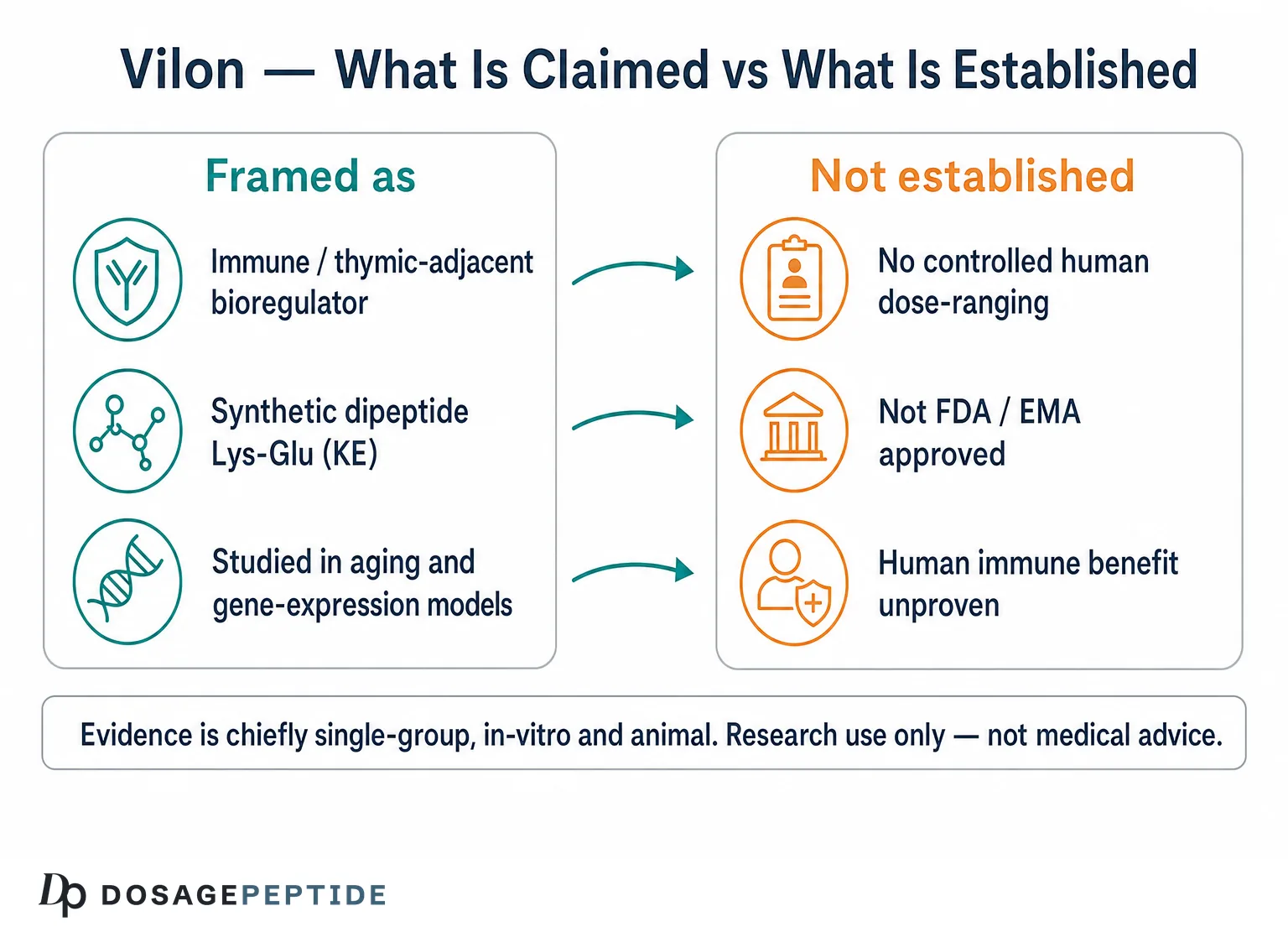
Everything below is written for laboratory and modeling contexts only. Vilon is not an approved drug in the United States, the European Union, or any comparable regulatory jurisdiction, and no number in this article should be read as a dose for a human being. The one part of this topic that is unambiguously legitimate — the concentration math — is presented in full, because getting the arithmetic right is a matter of correctness, not endorsement.
Research Context: Why “Vilon Dosage” Is a Harder Question Than It Looks
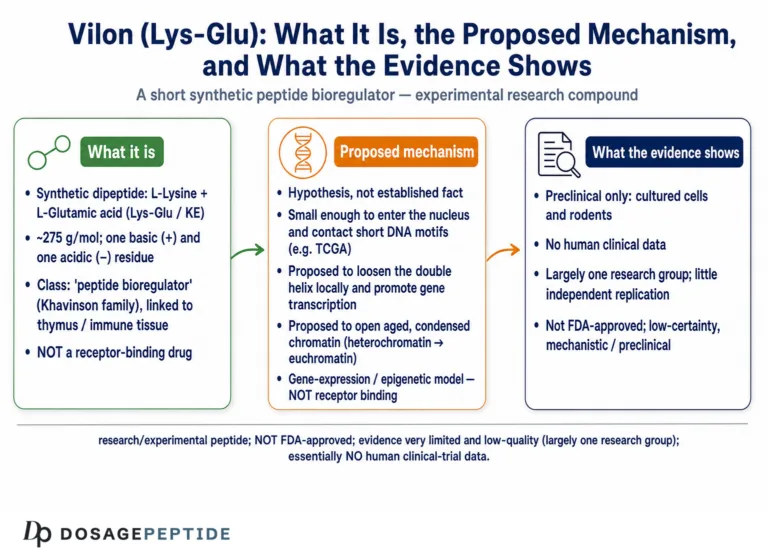
Vilon belongs to a class of compounds usually called Khavinson peptides or peptide bioregulators, named for Vladimir Khavinson and the St. Petersburg Institute of Bioregulation and Gerontology, where the concept originated in the late Soviet period and was elaborated over several decades.[2] These are ultra-short peptides — di-, tri-, and tetrapeptides — each proposed to carry tissue-specific regulatory information. Vilon is the dipeptide Lys-Glu, abbreviated KE from the single-letter amino-acid codes, with a molecular weight of roughly 275 daltons. That makes it one of the smallest molecules ever marketed to research buyers as a “peptide,” and its size is central to both the theory behind it and the difficulty of studying it.
The reason a dosing question becomes complicated is that the evidence base and the commercial figures come from two almost entirely separate worlds. The scientific literature on KE is real but narrow: it is dominated by the Khavinson group, is heavily in-vitro and rodent-based, includes a substantial body of small observational and clinical-adjacent Russian-language reports, and has seen essentially no independent Western replication of its headline longevity claims. The commercial world, by contrast, sells a standardized “vilon 20mg vial” with a recommended reconstitution and a “10–20 day course” that reappears, almost verbatim, across the entire bioregulator catalog — Vilon, Vesugen, Cardiogen, Crystagen, and others. The dosing convention, in other words, is a marketing artifact shared across chemically distinct peptides, not a figure derived from dose-response experiments on KE specifically.
There is a further wrinkle that makes this topic unusually slippery. Peptides in general are one of the most active frontiers in modern drug development — more than eighty peptide drugs have reached the market, and the pipeline is deep — which lends an unearned halo of legitimacy to any molecule with “peptide” in its name.[10] The approved peptide drugs, however, are the products of exactly the kind of rigorous, independently scrutinized, dose-ranging development program that Vilon has never undergone. The word “peptide” is doing a lot of rhetorical work on supplier pages, borrowing credibility from insulin and GLP-1 agonists to dress up a compound whose evidence base looks nothing like theirs. Separating the general promise of peptide science from the specific, thin record for this particular dipeptide is part of reading the topic honestly.
Researchers arriving at this topic therefore need three different things kept clearly separate: the molecular identity of the compound (well defined), the reconstitution arithmetic (objective and useful), and the dosing figures (unvalidated, borrowed, and to be treated as historical convention rather than evidence). Conflating these three is the single most common error in the popular write-ups, and it is what this reference is built to avoid. For readers who want the site’s structured summary of the specific product format, the Vilon 20 mg vial dosage protocol reference collects the circulated numbers in one place; the job of this article is to explain where those numbers come from and how much weight they can bear.
What Is Vilon? The KE Dipeptide at a Molecular Level
Vilon is L-lysyl-L-glutamic acid: a peptide bond joining lysine (a basic, positively charged residue at physiological pH) to glutamic acid (an acidic, negatively charged residue). This pairing of one cationic and one anionic side chain is not incidental to the Khavinson theory — it is the feature the mechanistic hypothesis leans on, because a small zwitterionic molecule with distributed charge is exactly the kind of species that could, in principle, make electrostatic contacts with the phosphate backbone and bases of DNA. The compound is fully synthetic; although it is chemically identical to a fragment found within thymalin (a thymus-derived peptide preparation used historically in Russian clinical immunology), the material sold as Vilon is manufactured by solid-phase synthesis rather than extracted from tissue.[1]
Nomenclature and how it appears on labels
The same molecule travels under several names, and the inconsistency is a frequent source of confusion when comparing sources. “Vilon,” “KE peptide,” “Lys-Glu,” and “lysylglutamic acid” all refer to the identical dipeptide. Supplier certificates of analysis typically report it as a white lyophilized powder with the sequence H-Lys-Glu-OH. Because it is a dipeptide, there is only one possible peptide bond and no sequence ambiguity, so purity questions center on synthesis byproducts and residual solvents rather than on isomers. For a fuller background on the compound’s history and naming, the companion explainer on what Vilon is and the lysylglutamic acid peptide is a useful orientation before any dosing discussion.
Why its size matters for dosing intuition
At ~275 Da, KE is roughly one-tenth the mass of a typical “small” research peptide like a growth-hormone secretagogue, and a tiny fraction of the mass of the therapeutic peptides that dominate the approved-drug landscape.[10] This has a direct, non-obvious consequence for how researchers think about quantity: a given mass of Vilon contains far more molecules than the same mass of a larger peptide. A milligram of a 275 Da dipeptide is on the order of 3.6 micromoles, whereas a milligram of a 3,600 Da peptide is only about 0.28 micromoles — more than a tenfold difference in molar terms. Any attempt to reason about “how much” from mass alone is therefore misleading across compound classes, which is one more reason the borrowed milligram figures deserve skepticism. The molar framing is also why the classic Khavinson experiments often used microgram, not milligram, quantities: at that molecular weight, microgram amounts already represent substantial molar exposures in a cell culture or a mouse.
The immune and thymic framing
Vilon is marketed under an immune and thymic banner because the KE fragment maps onto thymus-derived peptide chemistry and because the earliest experimental interest was in immune and lifespan endpoints. The thymus is the organ where T-lymphocytes mature, and it involutes with age — a well-documented feature of immune aging — so a peptide framed as “thymic” slots naturally into an immunosenescence research narrative. It is important to be precise here: the immune framing is a hypothesis about mechanism, supported by in-vitro observations of changes in lymphocyte differentiation markers, not a demonstrated clinical immune effect in humans. A 2013 report from the originating group described increased expression of the lymphocyte marker CD5 in cultured human and animal thymic cells exposed to Vilon and a related analogue,[8] which is the kind of cell-culture signal that motivates the framing but does not establish an immune outcome in an organism. This same evidentiary structure — an in-vitro marker shift read as an immune hypothesis — recurs across the whole bioregulator family, which is why the immune label should be treated as a research framing rather than a proven property of the molecule.
How Does Vilon Work? The Proposed Molecular Mechanism
The mechanism attributed to Vilon is fundamentally different from the receptor-agonist story told about most research peptides, and understanding it is essential to interpreting the dosing figures — because if the proposed mechanism is real, it operates at exposures where classical dose-response curves may not apply in the intuitive way.
The gene-expression hypothesis
Khavinson’s central proposal is that ultra-short peptides are small enough to cross the cell membrane and the nuclear envelope, enter the nucleus, and interact directly with DNA in a sequence-preferential manner, thereby modulating the transcription of specific genes.[3] Under this model, a dipeptide like KE does not bind a surface receptor and trigger a signaling cascade; instead it acts as a kind of minimal transcriptional modulator, making electrostatic and hydrogen-bond contacts in the minor groove or at promoter regions and biasing whether nearby genes are read. Molecular-modeling work from the group has proposed that KE and related peptides show binding preferences for particular short DNA motifs, and a 2016 paper laid out the general framework for how such short peptides could regulate gene expression.[4]
What has actually been measured
The most concrete molecular data for KE specifically come from cell-culture studies of gene expression. In human mesenchymal stem cell aging models, short peptides including KE were reported to shift the expression of aging-associated genes, and a 2023 study described KE regulating the longevity-associated deacetylase SIRT1 together with the DNA-repair enzymes PARP1 and PARP2, along with associated protein synthesis, in aging mesenchymal stem cells.[5] Earlier work in the same system examined short-peptide effects on aging-associated genes across “passage” and “stationary” aging paradigms, with effects that were real in the assay but modest and context-dependent.[6] These are the load-bearing mechanistic observations, and they share three features worth stating plainly: they are in vitro, they come predominantly from the originating research program, and they describe changes in transcript and protein levels rather than functional outcomes in an animal or a person.
The mechanistic caveat that governs dosing
The direct-DNA-binding hypothesis remains unconfirmed by the structural methods — X-ray crystallography, cryo-electron microscopy, or high-resolution NMR of a peptide-DNA complex — that would definitively demonstrate a dipeptide occupying a defined site on genomic DNA. Molecular modeling and expression correlations are consistent with the idea, but they do not prove it, and independent laboratories have not built a body of confirmatory structural work. This matters for dosing because a genuine gene-expression mechanism, if it exists, would likely be governed by receptor-like saturation at very low exposures rather than by mass-action scaling — meaning that “more” would not straightforwardly mean “more effect,” and that the wide milligram ranges circulated commercially have no mechanistic justification. The broader theory is laid out across several review papers,[14] and the site’s overview of peptide bioregulators and Khavinson short-peptide research situates Vilon within that framework in more detail.
How Researchers Reconstitute the Vilon 20mg Vial
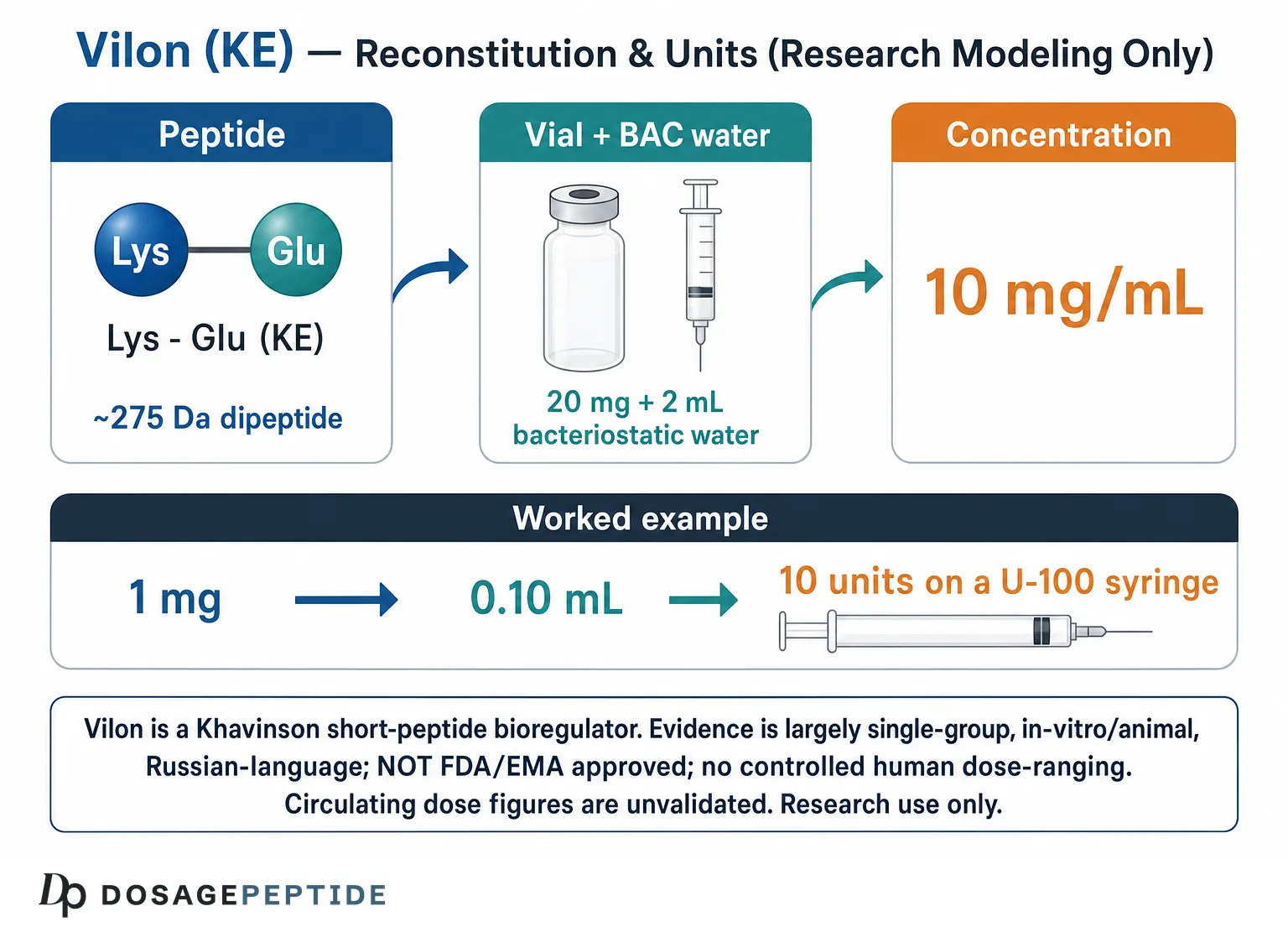
This is the portion of the topic that is genuinely, objectively useful, and where getting the numbers exactly right matters. Vilon is supplied as a lyophilized (freeze-dried) powder that must be reconstituted with a diluent before it can be handled as a solution. The near-universal choice of diluent is bacteriostatic water for injection — sterile water containing 0.9% benzyl alcohol as a preservative — which allows repeated withdrawals from a multi-use vial over a period of days without the microbial contamination risk of plain sterile water.[11] The arithmetic that follows is compound-agnostic: it is the same math used for any peptide, and it is correct regardless of whether any dose figure is meaningful.
The core formula
Reconstitution concentration is nothing more than mass divided by volume:
- Concentration (mg/mL) = vial mass (mg) ÷ diluent volume (mL)
- Amount per unit: a U-100 insulin syringe has 100 units per 1 mL, so each unit is 0.01 mL. The mass in one unit = concentration (mg/mL) × 0.01 mL.
- Units to draw for a target amount = target amount (mcg) ÷ [concentration (mg/mL) × 10]. (The factor of 10 converts because 1 mg/mL delivers 10 mcg per insulin unit.)
For a 20 mg vial, the choice of diluent volume sets the concentration, and the concentration sets how many insulin units correspond to any given microgram amount. The table below works this out for the four most common diluent volumes researchers use with a vilon 20mg vial.
| BAC water added to 20 mg vial | Concentration | Amount per insulin unit (0.01 mL) | Amount per 10 units (0.1 mL) |
|---|---|---|---|
| 1 mL | 20 mg/mL | 200 mcg | 2,000 mcg (2 mg) |
| 2 mL | 10 mg/mL | 100 mcg | 1,000 mcg (1 mg) |
| 2.5 mL | 8 mg/mL | 80 mcg | 800 mcg |
| 4 mL | 5 mg/mL | 50 mcg | 500 mcg |
A fully worked example: 20 mg + 2 mL → 10 mg/mL
Take the most common convention: 20 mg of Vilon reconstituted with 2 mL of bacteriostatic water. The concentration is 20 ÷ 2 = 10 mg/mL. Because 1 mL equals 100 units on a U-100 syringe, the full 2 mL vial holds 200 units of volume and 20,000 mcg of peptide, so each single unit carries 100 mcg. From there, converting any commonly cited target amount into a volume is straightforward, and the second table makes the mapping explicit at this 10 mg/mL concentration.
| Target amount (as reported in sources) | Volume at 10 mg/mL | Insulin units (U-100) | Withdrawals from a 20 mg vial |
|---|---|---|---|
| 100 mcg | 0.010 mL | 1 unit | 200 |
| 250 mcg | 0.025 mL | 2.5 units | 80 |
| 500 mcg | 0.050 mL | 5 units | 40 |
| 1,000 mcg (1 mg) | 0.100 mL | 10 units | 20 |
| 2,000 mcg (2 mg) | 0.200 mL | 20 units | 10 |
The right-hand column exposes something important that the popular protocols rarely reconcile: the number of withdrawals a 20 mg vial supports swings from 10 to 200 depending entirely on which circulated “dose” you plug in. A vial that lasts a “10–20 day course” at 1–2 mg per handling would last the better part of a year at the microgram exposures used in the classic experiments. That internal inconsistency — the 20 mg format is sized for milligram amounts, while the underlying science used micrograms — is a direct clue that the vial size and the “course” length are commercial conventions, not experimentally derived quantities. To run these conversions for any concentration or target you like, the interactive peptide dosage calculator automates the mass-to-units math, and the step-by-step peptide reconstitution guide covers diluent handling, swirling versus shaking, and storage of the reconstituted solution.
A second worked example: 20 mg + 2.5 mL → 8 mg/mL
Researchers who want rounder microgram-per-unit numbers sometimes choose 2.5 mL of diluent. The concentration is 20 ÷ 2.5 = 8 mg/mL, so each insulin unit (0.01 mL) carries 80 mcg and 10 units (0.1 mL) carry 800 mcg. To map a target amount to a volume at this concentration, divide the target in micrograms by 80 to get insulin units: a 400 mcg target is 5 units, an 800 mcg target is 10 units, and a 1,600 mcg target is 20 units. The total content of the vial is unchanged at 20,000 mcg regardless of diluent volume — only the concentration and therefore the volume-per-amount change — which is the whole point of choosing a diluent volume: it trades measurement precision against solution bulk. Choosing a lower concentration such as 8 mg/mL rather than 20 mg/mL makes small target amounts easier to measure accurately on a U-100 syringe, at the cost of a slightly larger total solution volume in the vial. As with every figure in this article, these numbers describe arithmetic only and are not a recommendation to administer anything to a person.
Handling and stability notes from general peptide practice
The reconstitution technique that appears consistently across general peptide handling references is to introduce the diluent slowly down the inner wall of the vial rather than directly onto the powder cake, then to swirl gently rather than shake, since mechanical agitation can shear and denature peptides and generate foam. Lyophilized dipeptides are generally more robust than large peptides, but the reconstituted solution is a different matter: once in water it should be kept refrigerated and protected from light, and the benzyl alcohol in bacteriostatic water is what makes multi-day multi-withdrawal use reasonable in the first place.[11] None of this handling guidance implies human use; it describes how to keep a research solution accurate and uncontaminated at the bench. For volume-selection questions specifically, the dedicated resource on how much bacteriostatic water to use in reconstitution walks through the trade-off between higher concentration (smaller, harder-to-measure volumes) and lower concentration (larger, easier volumes but a bulkier vial).
Modeling Vilon Concentrations for In-Vitro Research: From mg/mL to Molar
Because the most defensible experimental work on KE is in-vitro, the concentration concept that actually matters for a lot of research modeling is not “micrograms per injection” but molarity in the culture medium — and this is another place where the arithmetic is objective and worth doing carefully. Converting a stock solution into a molar concentration requires the molecular weight, and Vilon’s low mass (~275 Da) makes the numbers behave differently from larger peptides.
The molar conversion
Molarity is moles per liter, and moles are mass divided by molecular weight. A 10 mg/mL stock of Vilon is 10 g/L; dividing by 275 g/mol gives roughly 0.036 mol/L, or about 36 millimolar. That is a concentrated stock, and the cell-culture literature on short peptides typically works several orders of magnitude below it, in the nanomolar-to-micromolar range. To reach, say, a 1 micromolar working concentration from a 36 mM stock requires a dilution of about 36,000-fold — which is exactly why researchers prepare intermediate dilutions rather than pipetting vanishingly small volumes directly. The table below shows representative working concentrations and the molar framing that accompanies them.
| Concentration expression | Value (at MW ≈ 275 Da) | Typical research context |
|---|---|---|
| Reconstituted stock (20 mg + 2 mL) | 10 mg/mL ≈ 36 mM | Storage stock, never applied directly to cells |
| Working stock (100× dilution) | 0.1 mg/mL ≈ 360 µM | Intermediate for further dilution |
| High in-vitro exposure | ≈ 10 µM | Upper end of many short-peptide assays |
| Low in-vitro exposure | ≈ 1–100 nM | Range often reported for gene-expression effects |
The point of laying this out is not to recommend a concentration — it is to show that the relevant quantity concept for the strongest Vilon data is molar and in-vitro, which is completely disconnected from the milligram-per-day injection figures that dominate consumer-facing pages. A researcher modeling the gene-expression findings is working in nanomolar territory in a dish; the “protocol” figures are milligram territory in an imagined injection. Those are not two estimates of the same thing; they are answers to different questions, and treating one as validation of the other is a category error.
Planning vial economy honestly
For purely logistical planning — how long a given vial of material lasts a bench program — the days-per-vial column in the earlier table is the honest tool, provided the researcher supplies their own experimentally justified quantity rather than importing a convention. A 20 mg vial is a large amount of a 275 Da dipeptide in molar terms, and for in-vitro work it can represent an enormous number of experiments. The mismatch between that molar abundance and the “lasts a 10–20 day course” framing is, once again, a signal that the injection narrative and the science are not speaking the same language.
Vilon Dosage Figures Reported in the Literature vs Community Protocols
Here is where honesty has to be foregrounded, because the gap between what the vilon dosage literature actually supports and what the community protocols assert is the whole story. There is no published, controlled, human dose-ranging study of Vilon. There is no toxicology package establishing a no-observed-adverse-effect level in the way a drug-development program would produce. What exists is a body of experimental work using particular quantities in particular models, and a separate body of commercial “protocols” that were not derived from that work.
What the experimental literature used
The classic Khavinson-group experiments — the mouse lifespan and spontaneous-tumor study being the most cited — administered the Lys-Glu dipeptide parenterally to rodents in microgram-range quantities on intermittent schedules, consistent with the broader bioregulator research tradition of low-dose, course-based parenteral administration.[1] Reviews of the wider class describe long-term rodent studies in which peptide bioregulators were given in small doses over repeated courses, with reported increases in mean life span on the order of 20–40% across various compounds — figures that come, again, largely from the originating program.[13] The cell-culture mechanistic studies used nanomolar-to-micromolar peptide concentrations in the medium, which is the relevant “dose” concept for an in-vitro experiment and does not translate into a per-vial injection figure at all.
What the community and supplier protocols assert
The figures that dominate search results — and that reappear across supplier pages for the entire bioregulator family — typically frame Vilon as a per-day amount somewhere in the microgram-to-low-milligram range administered subcutaneously over a “10–20 day course,” often with the suggestion of repeating the course a few times per year. The tell that these are not compound-specific scientific figures is that the identical template appears for Vesugen, Cardiogen, Crystagen, and other structurally different peptides. When the same “protocol” is applied uniformly to a vascular-framed peptide, an immune-framed peptide, and a cardiac-framed peptide, it is describing a product-marketing convention, not a set of independently validated dose-response findings. The most defensible way to characterize these numbers is exactly that: a widely circulated convention of unknown provenance, not a validated dose.
| Source of figures | Model / context | Quantity concept | Evidentiary weight |
|---|---|---|---|
| Khavinson-group rodent studies | Mice, parenteral, course-based | Microgram-range per administration | Real but single-lineage, unreplicated externally |
| Cell-culture mechanistic work | Human MSC / thymocyte cultures | Nanomolar–micromolar in medium | Real in vitro; not an injection dose |
| Supplier / community “protocols” | Assumed subcutaneous, 10–20 day course | Microgram-to-milligram per day | Convention copied across the family; not validated |
| Controlled human dose-ranging | — | — | Does not exist |
The honest bottom line on vilon peptide dosage is that every specific number a researcher encounters is either (a) an experimental quantity from a narrow, unreplicated literature that cannot be extrapolated to a human, or (b) a commercial convention with no published derivation. Presenting either as guidance for a person would be indefensible. Presenting them as what they are — historical experimental quantities and marketing conventions, useful only as inputs to research modeling — is the correct frame, and it is the frame a careful reader should apply to any protocol reference page that merely lists the circulated figures, including the site’s own Vilon 20 mg protocol summary.
Vilon Injection Research: Routes, Schedules, and the “Course” Convention
Because the searches behind “vilon injection research” are really asking how the compound is handled physically in experimental settings, it is worth describing the conventions explicitly — while keeping the same firewall between description and endorsement.
Parenteral routes in the literature
In the rodent literature, the dipeptide was given parenterally, most often subcutaneously or intramuscularly, which is consistent with the fact that a small, charged, water-soluble peptide would be poorly absorbed and rapidly degraded if given orally. This is a general property of peptides: oral bioavailability is typically very low because gastric and intestinal peptidases cleave them and the gut wall poorly absorbs them, which is precisely why the approved-peptide drug world has invested so heavily in injectable formulations and in special chemistry to make even a handful of oral peptides work.[10] It is worth noting, however, that some of the historical Khavinson clinical-adjacent work with bioregulators explored oral and sublingual administration of certain short peptides, on the theory that a fraction survives to exert regulatory effects — a claim that is itself part of the unreplicated body of work rather than an established pharmacokinetic fact.
The intermittent-course pattern
The “course” concept — a run of daily administrations over roughly 10 to 20 days, repeated periodically — is the organizing schedule across the entire bioregulator tradition, and it reflects the theory’s premise that these peptides deliver a regulatory “signal” that reprograms tissue over a limited window rather than requiring continuous presence. Whether that premise is correct is unresolved, but it explains why the figures are always framed as courses rather than as indefinite daily use. The 15-year follow-up work on a pineal-gland peptide geroprotector (epithalamin), for example, used repeated courses over three years and reported reduced mortality in its cohort — a striking claim from a small single-center randomized study within the same research lineage that has not been independently reproduced by unaffiliated groups.[7] It is a different compound from Vilon and is cited here only to illustrate how the “course” schedule and the single-lineage evidence pattern run through the whole tradition.
Why the vial size and the course length do not add up
Returning to the arithmetic from the reconstitution section makes the tension concrete. If a “course” is 10–20 days and a 20 mg vial is meant to roughly cover it, the implied per-day quantity is on the order of 1–2 mg — that is, milligram-scale, matching the 10–20 withdrawals shown in the worked table at 10 mg/mL. But the experimental science that gives Vilon any claim to biological activity used microgram-scale amounts, which would make a single 20 mg vial last many months. The vial is, in effect, sized for the commercial convention and not for the experimental literature. A careful researcher should treat this mismatch not as a detail to reconcile but as evidence about how much the circulated dosing figures should be trusted: not much.
Current Evidence Level for Vilon
Stating the evidence tier precisely is the most important compliance and honesty obligation in a piece like this, so it is worth being explicit and unhedged.
Regulatory status
Vilon is not an FDA-approved drug and carries no approved indication in the United States. It is not authorized by the EMA. It is sold in the West as a research chemical, not as a medicine, and it has not been through the investigational-new-drug and controlled-trial pathway that approved peptide therapeutics complete.[10] In Russia, peptide bioregulators from this tradition have historically been used in clinical and “parapharmaceutical” contexts, but that regulatory history is specific to that jurisdiction and does not constitute FDA/EMA-grade evidence of efficacy or safety. Any statement that Vilon “treats,” “prevents,” or “cures” a condition would be unsupported by the regulatory and evidentiary record.
The shape of the evidence
The evidence for Vilon sits at the preclinical and small-observational tier, with a specific and unusual limitation: it originates almost entirely from one research program.[2] The strongest individual data points are the rodent lifespan/tumor study[1] and the in-vitro gene-expression work on SIRT1/PARP and other aging-associated genes.[5] The systematic review of peptide regulation of gene expression compiles the mechanistic case across the family,[3] and the clinical-studies reviews describe long-term observational use of several bioregulators.[9] What is conspicuously absent is the middle of the evidence pyramid: no independent replication of the longevity findings by unaffiliated Western labs, no randomized controlled human trials of Vilon specifically, and no modern pharmacokinetic characterization. Much of the corpus is also Russian-language, which has slowed external scrutiny.
How to weight it
The appropriate posture is neither dismissal nor credulity. The mechanistic hypothesis is genuinely interesting and has generated real, reproducible-within-the-lab cell-culture signals; the concept that ultra-short peptides can influence gene expression is not prima facie absurd and has attracted legitimate scientific attention. But a single-lineage evidence base with no external replication of its headline claims cannot support confident statements about human effects, and it certainly cannot support a specific dose. For readers comparing bioregulators, the closely analogous Vesugen vascular bioregulator explainer and the thymus-focused Thymalin thymic peptide research overview show the same evidentiary pattern, which is itself informative: the pattern is a property of the research tradition, not of any one peptide.
How Vilon Compares to Other Khavinson Bioregulators
Placing Vilon next to its siblings clarifies both what is distinctive about it and why the shared dosing template should be viewed skeptically.
Shared scaffold, different tissue labels
The bioregulators are marketed with tissue-specific labels — Vilon for immune/thymic, Vesugen for vascular, Cardiogen for cardiac, Crystagen for immune, and so on — each a short peptide of two to four residues with a proposed affinity for regulating genes in its named tissue.[3] The theoretical basis for the tissue specificity is the sequence-dependent DNA-motif preference described in the molecular-modeling work. Whether these tissue assignments hold up outside the modeling and the originating lab’s assays is precisely the open question. What is not in dispute is that they are all sold in similar 20 mg vials with similar reconstitution advice and the same course convention — which is why the dosing figures cannot be treated as compound-specific evidence.
Where Vilon is distinctive
Among the family, Vilon (KE) is notable for being one of the most-studied at the level of specific gene targets, thanks to the mesenchymal-stem-cell and thymocyte work.[5] It is also chemically among the simplest possible — a bare dipeptide — which makes it a favored model compound for the group’s mechanistic arguments, since demonstrating gene regulation by a two-residue peptide is the most striking version of the claim. The flip side is that a dipeptide is also the hardest case for the direct-DNA-binding hypothesis, because two residues provide very little surface for sequence-specific recognition; skeptics reasonably ask how a molecule that small could achieve the specificity the theory requires. Transcription factors typically read DNA across many base pairs using extended, folded protein surfaces; a dipeptide contacting a two-to-four-base motif is, on its face, a far weaker basis for specificity, and this is the crux of the mechanistic debate that a careful reader should keep in view.
KE beyond the bioregulator frame
It is also worth noting that Lys-Glu appears in contexts outside the anti-aging bioregulator narrative. The KE motif and closely related short peptides have been studied as components of cosmetic and tissue-repair peptide chemistry, where short lysine- and glutamate-containing sequences are of interest for their charge properties and their interactions with matrix proteins. This is a reminder that “KE” is a small, general chemical entity that different research communities have approached with different framings, and that the immune/geroprotective story is one interpretation layered onto a simple molecule, not an intrinsic property of it.
Limitations, Unknowns, and Safety Considerations in the Literature
A responsible reference has to catalog what is not known as carefully as what is, and for Vilon the list of unknowns is long.
The replication and language problem
The defining limitation is the concentration of evidence in a single research lineage and its heavy presence in Russian-language journals, which together have prevented the kind of independent, adversarial replication that turns a promising claim into an established one.[2] The 20–40% rodent lifespan figures are extraordinary claims, and extraordinary claims from a single group without external reproduction should be held provisionally, no matter how internally consistent the body of work appears. This is not an accusation of misconduct; it is the ordinary scientific standard that findings gain weight through independent replication, which here has not occurred. The reproducibility crisis across biomedicine has taught the field that even carefully conducted single-laboratory results frequently fail to replicate elsewhere, and geroprotection endpoints — lifespan, tumor incidence — are notoriously sensitive to husbandry, diet, strain, and statistical handling. A body of work that would be considered strong preliminary evidence if replicated remains, until then, exactly that: preliminary. The proper scientific response is curiosity paired with reserve, not the confident dose tables that populate the commercial internet.
Missing pharmacology and toxicology
There is no modern, published pharmacokinetic profile for Vilon in humans — no absorption, distribution, metabolism, and excretion characterization, no half-life, no bioavailability figure for any route. There is likewise no formal toxicology dossier establishing safety margins. The apparent low toxicity often asserted for the bioregulators rests on their long informal use and on the general expectation that a natural dipeptide would be rapidly metabolized to its constituent amino acids, but “probably rapidly metabolized” is a hypothesis, not a safety demonstration. The absence of a toxicology package is exactly why no responsible source can convert the circulated figures into anything resembling guidance. It is also worth naming a subtler gap: even the fundamental question of whether an injected dipeptide reaches the cell nucleus of any target tissue in an intact organism — the event the entire mechanism depends on — has not been demonstrated with modern tracer or imaging pharmacology. The in-vitro studies add peptide directly to cells in a dish, bypassing the absorption, circulation, enzymatic-survival, and cellular-uptake hurdles that a real injected dose would face. Bridging that gap is precisely the work that has not been done, and its absence is the deepest reason the dosing question has no rigorous answer.
Practical and material unknowns
At the material level, research buyers face additional uncertainty that has nothing to do with the peptide’s biology: the identity, purity, and actual mass content of any given research vial are only as reliable as the supplier’s certificate of analysis, and independent verification is rare. A vial labeled 20 mg may not contain 20 mg; a powder labeled KE may carry synthesis byproducts. These are ordinary research-chemical caveats, but they compound the dosing uncertainty: even if a meaningful dose existed, one could not be confident of delivering it from an unverified vial. And the benzyl alcohol in bacteriostatic water, while appropriate as a diluent preservative, carries its own documented handling considerations, particularly regarding volume and neonatal exposure, that are spelled out in its prescribing information.[12]
The honest synthesis
Pulling the limitations together: Vilon is a real, well-defined molecule with a genuinely interesting mechanistic hypothesis and a narrow, unreplicated evidence base; its reconstitution math is objective and useful; and its dosing figures are conventions rather than conclusions. A researcher can legitimately model concentrations, plan an in-vitro exposure, or reason about molar quantities. A researcher cannot, on the current record, state a dose for a person or claim a human effect. Holding both of those truths at once is the entire discipline this topic requires. The best version of this reference, and the reason it exists, is to give the reader the tools to do the legitimate part correctly — the reconstitution math, the molar conversions, the vial economy — while removing any illusion that those tools convert into permission to dose a human being. Rigor about the arithmetic and humility about the biology are not in tension; they are two halves of the same honest posture, and any source that offers you confident dose guidance for Vilon has abandoned at least one of them.
Frequently Asked Questions
What is the reported Vilon dosage in the research literature?
There is no validated human dose. The rodent studies from the originating laboratory used microgram-range parenteral amounts on intermittent course-based schedules, and cell-culture work used nanomolar-to-micromolar medium concentrations. The milligram-per-day figures circulated commercially are a marketing convention shared across the whole bioregulator family, not a compound-specific experimental finding, and none of these numbers constitute guidance for a person.
How do you reconstitute a Vilon 20mg vial?
Researchers reconstitute the lyophilized powder with bacteriostatic water. Adding 2 mL to a 20 mg vial gives 10 mg/mL, meaning each insulin unit (0.01 mL on a U-100 syringe) holds 100 mcg. Adding 1 mL gives 20 mg/mL; adding 4 mL gives 5 mg/mL. The diluent is introduced down the vial wall and the solution is swirled, never shaken, then refrigerated. This arithmetic is compound-agnostic and does not imply the material is intended for human use.
What is the KE dipeptide dose used in the classic experiments?
The classic Khavinson-group experiments with the Lys-Glu dipeptide used microgram-scale amounts given parenterally to rodents, reflecting the compound’s low molecular weight, where microgram masses already represent substantial molar quantities. In-vitro mechanistic studies expressed exposure as a medium concentration rather than a per-animal dose. Neither translates into an injection figure for any organism, and neither has been established as a human dose.
Is Vilon FDA-approved?
No. Vilon is not approved by the FDA or the EMA and has no approved medical indication in the United States or European Union. It is sold in Western markets as a research chemical only. It has not completed the investigational-new-drug and controlled-trial pathway that approved peptide drugs undergo, and no source should describe it as treating, preventing, or curing any condition.
How is Vilon different from Vesugen or other bioregulators?
All are short Khavinson peptides sold with tissue-specific labels — Vilon for immune/thymic, Vesugen for vascular, and so on — and all share the same proposed gene-regulation mechanism and the same commercial reconstitution and course conventions. Vilon is distinctive mainly as a bare dipeptide with comparatively detailed gene-target studies. The shared dosing template across chemically different peptides is a key reason those dose figures should be viewed as convention, not evidence.
What does the evidence actually show about how Vilon works?
The proposed mechanism is that the small, charged dipeptide enters the nucleus and influences gene expression, possibly through sequence-preferential DNA contacts. The measured data are in-vitro changes in expression of aging-associated genes such as SIRT1 and PARP enzymes in cultured cells. The direct-DNA-binding step has not been confirmed by structural biology, and the functional relevance in an intact organism remains a hypothesis rather than a demonstrated effect.
How many doses does a 20mg Vilon vial provide?
It depends entirely on which circulated figure is used, which is itself telling. At a milligram-scale amount the vial yields roughly 10–20 withdrawals, matching the commercial “course” length; at the microgram-scale amounts used in the actual experiments it would last many months. This mismatch shows the 20 mg format is sized for the marketing convention rather than for the experimental literature.
Can Vilon be taken orally?
Peptides are generally poorly absorbed orally because digestive enzymes cleave them and the gut wall absorbs them inefficiently, which is why the rodent studies used parenteral routes. Some historical Khavinson bioregulator work did explore oral and sublingual administration on the theory that a fraction survives, but that claim is part of the same unreplicated body of research and is not supported by modern pharmacokinetic data for Vilon specifically.
Why do sources disagree so much on Vilon dosage?
Because there is no authoritative source to anchor to. With no controlled dose-ranging study, every figure is either an experimental quantity from a narrow literature or a supplier convention copied across the bioregulator family. Different writers pick different anchors, so the numbers diverge. The honest reading is that the disagreement reflects an absence of evidence, not competing bodies of evidence.
References
- Khavinson VKh, Anisimov VN. A synthetic dipeptide vilon (L-Lys-L-Glu) inhibits growth of spontaneous tumors and increases life span of mice. Dokl Biol Sci. 2000;372:261–263. https://pubmed.ncbi.nlm.nih.gov/10944717/
- Anisimov VN, Khavinson VKh. Peptide bioregulation of aging: results and prospects. Biogerontology. 2010;11(2):139–149. https://link.springer.com/article/10.1007/s10522-009-9249-8
- Khavinson V, Popovich IG, Linkova NS, Mironova ES, Ilina AR. Peptide Regulation of Gene Expression: A Systematic Review. Molecules. 2021;26(22):7053. https://pubmed.ncbi.nlm.nih.gov/34834147/
- Khavinson VKh, Fedoreyeva LI, Vanyushin BF. Short Peptides Regulate Gene Expression. Bull Exp Biol Med. 2016;162(2):288–292. https://link.springer.com/article/10.1007/s10517-016-3596-7
- Khavinson VK, Linkova NS, Ashapkin VV, et al. KE peptide regulates SIRT1, PARP1, PARP2 gene expression and protein synthesis in human mesenchymal stem cells during aging. Adv Gerontol. 2023;36(3):302–312. https://pubmed.ncbi.nlm.nih.gov/37782636/
- Ashapkin VV, Khavinson VKh, Shilovsky GA, Linkova NS, Vanyushin BF. Gene expression in human mesenchymal stem cell aging cultures: modulation by short peptides. Mol Biol Rep. 2020;47(6):4323–4329. https://link.springer.com/article/10.1007/s11033-020-05506-3
- Korkushko OV, Khavinson VKh, Shatilo VB, Antonyuk-Shcheglova IA. Peptide geroprotector from the pituitary gland inhibits rapid aging of elderly people: results of 15-year follow-up. Bull Exp Biol Med. 2011;151(3):366–369. https://pubmed.ncbi.nlm.nih.gov/22451889/
- Sevostianova NN, Linkova NS, Polyakova VO, et al. Immunomodulating effects of Vilon and its analogue in the culture of human and animal thymus cells. Bull Exp Biol Med. 2013;154(4):562–565. https://pubmed.ncbi.nlm.nih.gov/23486604/
- Khavinson VKh, Kuznik BI, Ryzhak GA. Peptide bioregulators: the new class of geroprotectors. Message 2. Clinical studies results. Adv Gerontol. 2013;26(1):20–37. https://pubmed.ncbi.nlm.nih.gov/24003726/
- Muttenthaler M, King GF, Adams DJ, Alewood PF. Trends in peptide drug discovery. Nat Rev Drug Discov. 2021;20(4):309–325. https://pubmed.ncbi.nlm.nih.gov/33536635/
- Bacteriostatic Water for Injection, USP (benzyl alcohol preservative). DailyMed / U.S. National Library of Medicine. https://dailymed.nlm.nih.gov/dailymed/lookup.cfm?setid=87d6e9dc-fe3b-4593-ac9a-d7493d1959c7
- Bacteriostatic Water for Injection: Prescribing Information (benzyl alcohol handling and warnings). Drugs.com professional monograph. https://www.drugs.com/pro/bacteriostatic-water-for-injection.html
- Khavinson VKh, Kuznik BI, Ryzhak GA. Peptide bioregulators: a new class of geroprotectors. Message 1. Results of experimental studies. Adv Gerontol. 2013. https://link.springer.com/article/10.1134/S2079057013030065
- Arutjunyan AV, Popovich IG, Kozina LS, Ryzhak GA. Peptide Regulation of Ageing: From Experiment to Practice. Curr Aging Sci. 2026. https://www.benthamdirect.com/content/journals/cas/10.2174/0118746098346230250116065407
Research-use-only disclaimer: This article is an educational reference intended for laboratory and research-modeling contexts only. It is not medical advice, not a treatment protocol, and not a recommendation to administer any substance to humans or animals. Vilon is not an approved drug and is not intended for human use. Every quantity, concentration, and schedule discussed is presented solely to describe what appears in the literature or circulates in research communities, and to enable accurate reconstitution arithmetic — not as guidance for dosing a person. No statement here should be read as a claim that Vilon treats, prevents, or cures any condition.