Short answer: no — not measurably. Research has revealed a great deal about how GLP-1 signalling could influence the vessel wall, but it has not established that GLP-1 receptor agonists reliably reduce arterial stiffness in humans. The best-controlled summary evidence is, frankly, null on the classical stiffness measures.
That is not the same as saying the drugs do nothing for the heart. Semaglutide cut major adverse cardiovascular events by roughly 20% in a landmark trial of people with obesity and established cardiovascular disease but without diabetes.5 But “fewer heart attacks and strokes over years” is a different claim from “more elastic large arteries”, which is what arterial stiffness actually measures — and a drug can do the first without doing the second. Conflating the two is the commonest error in popular coverage of this topic. This page walks through the molecular link to the vascular wall, how stiffness is measured, why individual trials and meta-analyses disagree, and where the honest evidence line sits.
What GLP-1 receptor agonists are and where the class came from
Glucagon-like peptide-1 is an incretin hormone — a gut-derived peptide secreted by intestinal L-cells in response to nutrient intake. Its best-characterized job is to amplify glucose-dependent insulin secretion from pancreatic beta-cells, which is why the incretin system became a drug target for type 2 diabetes. Native GLP-1 is a small peptide of 30 or 31 amino acids that is degraded within roughly one to two minutes by the enzyme dipeptidyl peptidase-4 (DPP-4). That extreme lability is the reason native GLP-1 could never be a practical drug: infusing it works acutely, but it cannot be dosed conveniently. The entire therapeutic class exists to solve that pharmacokinetic problem.12
GLP-1 receptor agonists are engineered peptides (or, in the case of some newer agents, small molecules) that bind and activate the GLP-1 receptor while resisting DPP-4 degradation, extending the half-life from minutes to hours or days. The class splits historically into two lineages. Exendin-based agents (exenatide) derive from a peptide found in the saliva of the Gila monster lizard, which shares roughly 50% sequence homology with human GLP-1 but is naturally resistant to DPP-4. Human GLP-1-analog agents (liraglutide, semaglutide, dulaglutide) are modified versions of the human peptide, typically carrying fatty-acid acylation or fusion to an immunoglobulin fragment to slow clearance and enable once-daily or once-weekly dosing.12
The class has since expanded well beyond single-receptor GLP-1 agonism. Tirzepatide is a dual agonist that engages both the GLP-1 receptor and the glucose-dependent insulinotropic polypeptide (GIP) receptor. Retatrutide, still investigational for most indications, is a triple agonist adding glucagon-receptor activity to the GIP/GLP-1 combination. DosagePeptide maintains detailed research-oriented reference pages for several of these compounds, including tirzepatide vial protocols and retatrutide vial protocols, which document the physical handling of these peptides in laboratory settings. It is worth stressing that these multi-agonist molecules are pharmacologically distinct from pure GLP-1 agonists, so vascular findings for one member of the class do not automatically transfer to another. When this article refers to “the class,” it means the shared GLP-1-receptor component; where a specific compound was studied, it names that compound.
The clinical rationale for studying this class in vascular biology grew out of the cardiovascular outcome trials that regulators required after an earlier generation of diabetes drugs raised safety concerns. Those trials — LEADER for liraglutide, SUSTAIN-6 and later SELECT for semaglutide, REWIND for dulaglutide — were designed to rule out cardiovascular harm but instead, for several agents, demonstrated cardiovascular benefit.5 That result reframed the entire field. If these drugs cut hard cardiovascular endpoints, researchers reasoned, some vascular mechanism must be operating — and arterial stiffness, endothelial function, and plaque biology became natural places to look for it. The important nuance, developed throughout this article, is that finding a population-level outcome benefit does not tell you which vascular mechanism is responsible, and arterial stiffness turns out to be one of the mechanisms that has held up least consistently under controlled measurement.
A final framing point: much of the vascular-mechanism literature uses native GLP-1, exendin-4, or short peptide fragments in cells and animals, not the actual clinical agonists at clinical exposures. This is standard for early mechanistic work, but it means the pathway diagrams that follow describe what GLP-1-receptor signaling can do in a dish or a rodent, not necessarily what a weekly subcutaneous injection does to a human aorta over months.
The molecular signaling mechanism relevant to the vascular wall
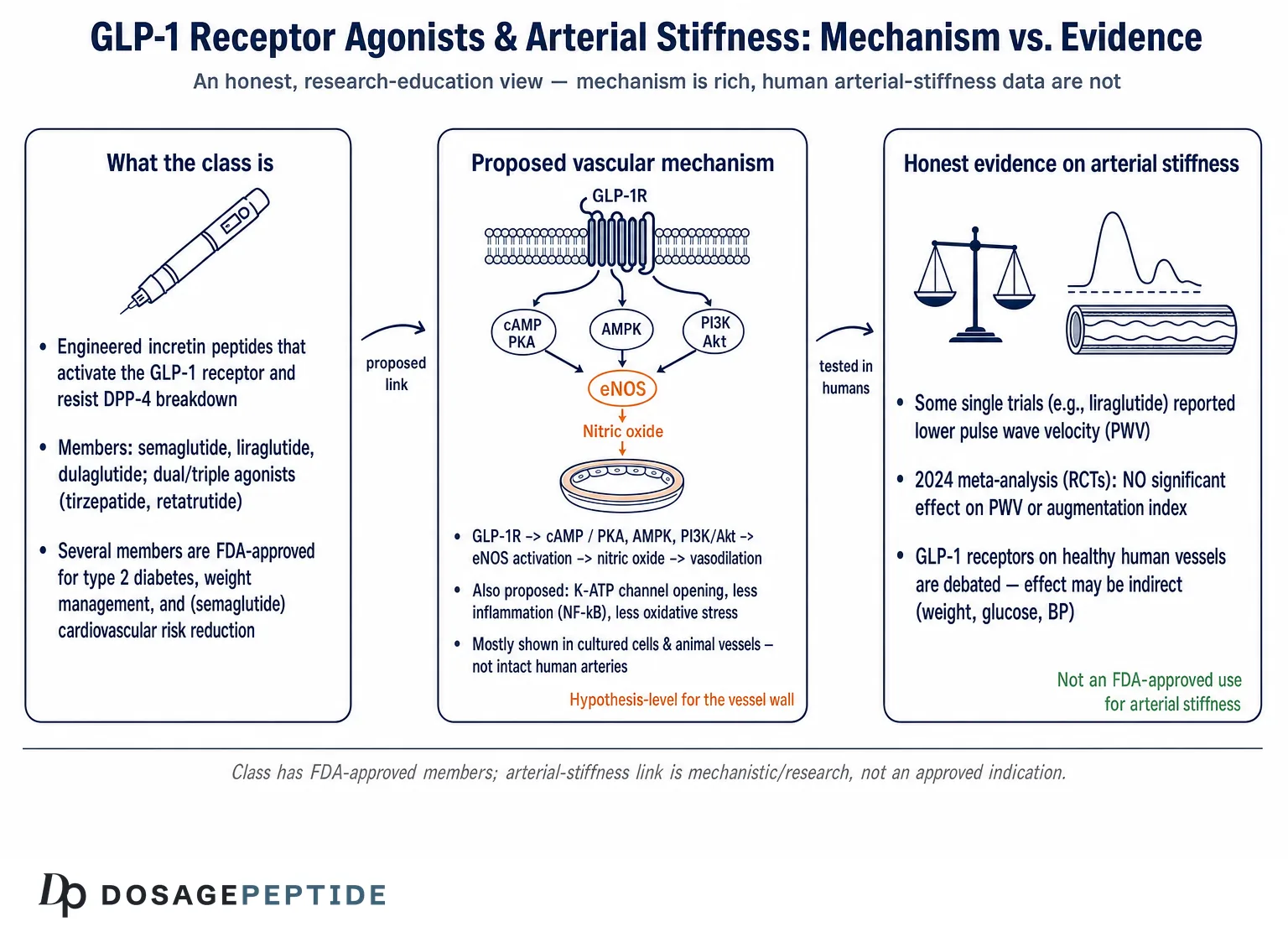
The GLP-1 receptor is a class B G-protein-coupled receptor. When an agonist binds, the canonical response is coupling to the stimulatory G-protein Gs, activation of adenylyl cyclase, and a rise in intracellular cyclic AMP (cAMP), which in turn activates protein kinase A (PKA) and the exchange protein Epac.3 In the vascular context, the most-studied downstream consequence of this cascade is stimulation of endothelial nitric oxide synthase (eNOS). Nitric oxide (NO) is the principal endothelium-derived vasodilator, and its bioavailability is a central determinant of both acute vascular tone and, over longer periods, vascular remodeling and stiffness.
Several signaling routes have been proposed to connect GLP-1-receptor activation to eNOS. Laboratory work in human umbilical vein endothelial cells showed that GLP-1 increases eNOS activity and phosphorylation at serine-1177 — the activating phosphosite — consistent with genuine enzymatic activation rather than merely increased expression.6 A widely cited mechanistic account routes this through the AMP-activated protein kinase (AMPK) and phosphoinositide 3-kinase/Akt (PI3K/Akt) pathways, with a parallel contribution from the GLP-1R/cAMP/PKA axis directly upregulating NO production.3 In effect, the model holds that agonist binding raises cAMP, engages PKA and AMPK/Akt, and converges on eNOS activation and increased NO output, producing endothelium-dependent vasodilation.
NO is not the only proposed effector. In isolated rodent coronary arteries, GLP-1-induced relaxation depended partly on enhancement of ATP-sensitive potassium (K-ATP) channel currents in vascular smooth muscle, which hyperpolarizes the cell membrane and reduces calcium entry and contraction.4 Endothelium-derived hyperpolarizing factor has also been invoked. So the mechanistic picture is one of redundant vasodilatory inputs: an endothelium-dependent, NO-mediated arm and a smooth-muscle, potassium-channel-mediated arm, at least in animal vessels.4
Beyond acute vasodilation, GLP-1-receptor signaling has been linked to processes that would plausibly influence arterial stiffness over longer timescales. Arterial stiffness is driven by structural factors — collagen deposition, elastin fragmentation, medial calcification, advanced glycation end-product crosslinking — and by functional endothelial tone. Mechanistic studies report that GLP-1 agonists reduce oxidative stress (through downregulation of NADPH oxidase isoforms such as NOX4), suppress the NLRP3 inflammasome, and dampen nuclear factor-kappa B (NF-kappaB) signaling and expression of the adhesion molecules ICAM-1 and VCAM-1 in endothelial cells.34 In cultured vascular smooth muscle cells exposed to high glucose, liraglutide attenuated abnormal proliferation, migration, and apoptosis via GLP-1-receptor-dependent inhibition of ERK1/2 and PI3K/Akt signaling.7 Each of these effects, if it operated in intact human arteries at clinical doses, could in principle slow the inflammatory and remodeling processes that stiffen vessels.
The table below summarizes the principal proposed molecular mechanisms and, crucially, the experimental system in which each was primarily observed — a distinction that governs how much weight any single mechanism can bear.
| Proposed mechanism | Key mediators | Primary experimental system | Plausible vascular consequence |
|---|---|---|---|
| eNOS activation | cAMP/PKA, AMPK, PI3K/Akt, eNOS Ser-1177 | Cultured endothelial cells (HUVEC, hCAEC)36 | Increased NO, endothelium-dependent vasodilation |
| K-ATP channel enhancement | ATP-sensitive K+ channels, membrane hyperpolarization | Isolated rat coronary artery rings4 | Smooth-muscle relaxation independent of NO |
| Anti-inflammatory signaling | NF-kappaB, ICAM-1, VCAM-1, NLRP3 | Endothelial cell culture34 | Reduced vascular inflammation and adhesion |
| Reduced oxidative stress | NOX4, ROS, MDA, protein carbonyls | Cell culture and small human RCT23 | Preserved NO bioavailability, less elastin damage |
| Anti-proliferative effect on VSMC | ERK1/2, PI3K/Akt, GLP-1R | Cultured vascular smooth muscle cells7 | Less maladaptive medial remodeling |
The unifying caveat is that nearly all of these mechanisms were characterized in reductionist systems. That does not make them wrong, but it does mean the leap from “GLP-1 activates eNOS in a cultured cell” to “a GLP-1 agonist unstiffens a human aorta” spans several unproven steps, each of which the clinical evidence must be allowed to adjudicate rather than assume.
What arterial stiffness is and why researchers study it
Arterial stiffness describes the loss of the natural elasticity of the large conduit arteries, chiefly the aorta. In a healthy young adult, the aorta acts as a pressure reservoir: it distends during systole, storing part of the stroke volume, then recoils during diastole, smoothing pulsatile flow into a steadier stream for the microcirculation. This “Windkessel” function protects small vessels in the brain and kidney from damaging pressure pulses. As arteries stiffen with age, hypertension, diabetes, and chronic inflammation, this cushioning fails. Pulse pressure widens, pulsatile energy penetrates deeper into fragile microvascular beds, and cardiac afterload rises.
Arterial stiffness is not merely a marker; longitudinal cohort studies have shown that it independently predicts cardiovascular events and mortality, which is precisely why it became an attractive intermediate endpoint for evaluating drug effects. The reference-standard measurement is carotid-femoral pulse wave velocity (cfPWV) — the speed at which the pressure wave travels between the carotid and femoral arteries. Stiffer arteries transmit the wave faster, so a higher PWV (in meters per second) indicates greater stiffness. A second common index is the augmentation index (AIx), derived from the shape of the peripheral pressure waveform, which reflects the contribution of reflected waves returning from the periphery. Both are non-invasive, reproducible in trained hands, and sensitive enough to detect change over months — the features that make them useful trial endpoints.1
Understanding these measurements is essential for reading the GLP-1 literature honestly, because a drug can improve some vascular parameters while leaving others untouched. Endothelial function (often measured as flow-mediated dilation of the brachial artery) is a functional, largely NO-dependent readout that can shift within hours to weeks. Arterial stiffness, by contrast, reflects both functional tone and slower structural change in the arterial wall, and PWV in particular is thought to be dominated by structural properties of the aortic media. A compound might plausibly improve endothelial function — consistent with the eNOS mechanism described above — without moving PWV, because the structural determinants of stiffness are harder to reverse over a short trial. This is not a hypothetical distinction; it appears to be roughly what the aggregate GLP-1 data show.
It is also why the phrase “vascular benefit” is dangerously imprecise. Studies of GLP-1 agonists have reported effects on intima-media thickness, endothelial glycocalyx, coronary flow reserve, microvascular blood volume, flow-mediated dilation, and arterial stiffness — and these do not all move together. A meta-analysis noted that GLP-1 agonists had no clear effect on classical measures of arterial stiffness even while other work suggested benefit on subclinical atherosclerosis markers such as intima-media thickness.1 Lumping these distinct endpoints under a single “vascular protection” banner is exactly the kind of overstatement this article is trying to avoid. When the title asks whether scientific evaluation can uncover GLP-1 signaling mechanisms in arterial stiffness specifically, the answer requires isolating that one endpoint from the broader and more favorable vascular narrative.
What the evidence actually shows on arterial stiffness (the honest level)
Here the article confronts its central question directly, and the honest summary is that the human evidence for a GLP-1-agonist effect on arterial stiffness is inconsistent, and the most rigorous synthesis to date is null.
Individual randomized trials have reported favorable results. In a six-month randomized controlled trial of 60 treatment-naive patients with newly diagnosed type 2 diabetes, liraglutide significantly reduced carotid-femoral pulse wave velocity from roughly 11.8 to 10.3 m/s, whereas metformin produced no meaningful change; the same trial reported improvements in myocardial global longitudinal strain and reductions in oxidative-stress markers (malondialdehyde and protein carbonyls), and the authors linked reduced oxidative stress to improved arterial elasticity.2 Other individual studies of liraglutide and dulaglutide have similarly reported PWV reductions over 6 to 12 months, and some network meta-analyses of first-line antidiabetic agents have ranked GLP-1 agonists favorably for PWV improvement.11 Taken alone, these results would suggest a class effect on stiffness.
But single trials in this space are small, frequently open-label, often compared against an active comparator rather than placebo, and enriched for patients with diabetes in whom improved glycemia and weight loss could indirectly move PWV. When these trials are pooled with appropriate scrutiny, the signal weakens. A 2024 meta-analysis of randomized controlled trials examining SGLT2 inhibitors and GLP-1 receptor agonists on arterial stiffness — 19 studies and 1,212 participants, of which five studies specifically evaluated GLP-1 agonists — found no statistically significant association between GLP-1-receptor agonists and either pulse wave velocity or augmentation index.1 Subgroup analyses by comparator, study design, population, and blinding did not rescue a benefit. The authors concluded that no evidence of a favorable change in arterial stiffness indices was found following administration of either drug class.1
How can rigorous individual trials show a benefit while a pooled analysis shows none? Several explanations coexist. Small open-label trials are especially vulnerable to measurement bias, regression to the mean, and selective emphasis, and their positive results may not survive aggregation with negative or neutral trials. Publication and outcome-reporting patterns can inflate the apparent effect of any single study. Populations differ: a benefit concentrated in newly diagnosed diabetic patients with high baseline stiffness may wash out when pooled with trials in patients with lower baseline stiffness or shorter follow-up. And the structural nature of PWV, discussed earlier, means genuinely reversing stiffness over a few months is biologically demanding, so smaller true effects are easy to miss and easy to falsely “find.” The honest reading is that a modest, population-specific, or transient effect cannot be excluded, but a robust, generalizable, class-wide reduction in arterial stiffness is not supported by the best current synthesis.1
It is important to place this against the hard-outcome data. Semaglutide reduced major adverse cardiovascular events by about 20% in the SELECT trial of over 17,000 people with obesity and cardiovascular disease, and the event curves began to separate early, within roughly the first months, far too fast to be explained by slow arterial remodeling.5 That early separation is itself evidence that the cardiovascular benefit of GLP-1 agonists is unlikely to run primarily through de-stiffening large arteries, and more likely involves faster-acting mechanisms (hemodynamic, anti-inflammatory, anti-thrombotic, or plaque-stabilizing). In other words, the outcome trials do not require an arterial-stiffness mechanism, and the arterial-stiffness trials do not consistently show one. Both observations point the same direction: arterial stiffness is a plausible but unconfirmed — and probably not central — part of the GLP-1 cardiovascular story.
Direct versus indirect effects and the receptor-expression debate
A mechanistic complication sits underneath everything above: it is genuinely uncertain whether GLP-1 receptors are meaningfully expressed on human vascular endothelial and smooth muscle cells at all. This is not a fringe quibble; it determines whether any vascular effect is a direct action on the vessel wall or an indirect consequence of the drug’s metabolic and hemodynamic effects elsewhere.
The evidence is genuinely conflicting. Some studies using immunohistochemistry and functional assays report GLP-1-receptor expression in human coronary artery endothelial cells and in vascular smooth muscle, and describe receptor-dependent signaling in those cells.4 Other groups, using more stringent antibody validation and mRNA transcript detection, failed to detect GLP-1-receptor protein or transcript in human coronary or peripheral vascular endothelium or smooth muscle, and cautioned that many commercial GLP-1-receptor antibodies are poorly specific.38 Careful mapping of receptor expression in the human heart has reinforced this caution, localizing GLP-1-receptor protein predominantly to the sinoatrial node and to a subset of cell types rather than diffusely across the vasculature.8 A frequently cited finding is that de-differentiated vascular smooth muscle cells within human atherosclerotic plaque express the receptor at higher levels than healthy, contractile smooth muscle — suggesting expression may be conditional on cell state rather than constitutive.3 Methodological factors compound the confusion: organ culture reduces the immunohistochemical signal and receptor mRNA relative to fresh tissue, so tissue handling alone can flip a result.
This debate is the crux of the “direct versus indirect” question. If canonical GLP-1 receptors are sparse or absent on healthy human vascular cells, then much of the vasodilatory and anti-inflammatory signaling documented in cultured cells or rodent vessels may not translate to a direct action on intact human arteries. Under that interpretation, whatever real vascular benefit GLP-1 agonists confer would be largely indirect — mediated through weight loss, improved glycemic control, blood-pressure reduction, favorable lipid changes, reduced systemic inflammation, and lower cardiac afterload.4 Several reviews explicitly catalog these indirect pathways and note that GLP-1-receptor activation in the brain, kidney, heart, and immune cells may account for vascular effects without requiring receptors on the vessel wall itself.34
For arterial stiffness specifically, the indirect model is attractive because it explains the data parsimoniously. Weight loss, lower blood pressure, and better glycemic control all tend to reduce measured PWV over time — but modestly, variably, and dependent on how much metabolic improvement a given patient achieves. That is exactly the pattern the trial literature shows: benefit in some populations (newly diagnosed diabetics with large metabolic gains), no benefit in pooled analyses across mixed populations.12 An indirect, metabolically mediated effect on stiffness would be expected to be inconsistent, and it is.
The upshot for readers is a warning against a common overreach. It is tempting to read a tidy diagram of GLP-1 activating eNOS in an endothelial cell and conclude that GLP-1 agonists directly relax and de-stiffen human arteries. The receptor-expression controversy means that inference is not safe. The direct vascular receptor may exist only sparsely, or only in diseased tissue, and the clinically observed effects may be predominantly downstream of metabolism. Scientific evaluation has, in fact, “uncovered” a great deal of candidate signaling — but it has simultaneously uncovered serious reasons to doubt that this signaling operates directly on the arterial wall in humans. Honesty requires holding both findings at once.
How GLP-1 receptor agonists compare with other agents
Placing GLP-1 agonists alongside other glucose-lowering and cardiovascular drugs sharpens the picture, because comparison controls for the general effects of metabolic improvement and isolates what, if anything, is special about GLP-1 signaling.
The closest comparator is the SGLT2-inhibitor class, which shares GLP-1 agonists’ status as a diabetes drug family with proven cardiovascular outcome benefits. Notably, the same 2024 meta-analysis that found no arterial-stiffness benefit for GLP-1 agonists also found none for SGLT2 inhibitors — neither class significantly changed PWV or augmentation index across the pooled trials.1 This parallel is instructive. Two drug classes with robust, independently established reductions in cardiovascular events both fail to move arterial stiffness in controlled pooling. That strongly suggests arterial stiffness is not the shared mechanism of their cardiovascular benefit, and that stiffness reduction is neither necessary for, nor a reliable marker of, the outcome improvements these drugs deliver.
Against metformin, the standard first-line diabetes therapy, GLP-1 agonists have sometimes shown an edge in individual trials — the liraglutide-versus-metformin study cited above found PWV improvement only in the liraglutide arm.2 But metformin has its own vascular literature and is not an inert comparator, and single head-to-head trials are underpowered for definitive ranking. Bayesian network meta-analyses that pit multiple antidiabetic classes against each other have produced varying rankings, with some placing GLP-1 agonists favorably for stiffness and others not, reflecting the underlying heterogeneity rather than a settled hierarchy.11
Within the GLP-1 class itself, compounds differ enough that cross-compound generalization is risky. Short-acting agents (exenatide twice daily) produce different exposure profiles and heart-rate effects than long-acting agents (once-weekly semaglutide or dulaglutide). Multi-receptor agonists complicate matters further: tirzepatide adds GIP-receptor activity, and retatrutide adds glucagon-receptor activity, each of which carries its own metabolic and potentially vascular consequences that are not reducible to the GLP-1 component. Research-education references for these distinct compounds — for example, higher-strength tirzepatide vial documentation and how to reconstitute a Retatrutide 30mg vial — underscore that these are pharmacologically separate entities. A stiffness result for liraglutide simply does not license a claim about tirzepatide, and vice versa.
The comparative bottom line is that GLP-1 agonists are not uniquely potent arterial de-stiffeners relative to their peers, and the peers that share their outcome benefits share their apparent lack of a robust stiffness effect. If anything, comparison reinforces the theme that the class’s demonstrated cardiovascular value operates largely through channels other than large-artery elasticity. Readers comparing compounds for research documentation can consult DosagePeptide’s broader dosage protocol index for how these agents differ in physical formulation, while keeping in mind that formulation differences say nothing about clinical arterial-stiffness effects.
Research models and methodology used to study the question
The inconsistency in this field is partly a story about methodology, so it is worth cataloging the experimental systems used and what each can and cannot establish.
Cell-based systems. Cultured human endothelial cells (umbilical-vein HUVECs and coronary-artery hCAECs) and vascular smooth muscle cells are the workhorses of mechanism discovery. They established eNOS phosphorylation at Ser-1177, the cAMP/PKA and AMPK/Akt links, and the anti-inflammatory suppression of NF-kappaB and adhesion molecules.367 Their strength is mechanistic precision; their weakness is that supraphysiologic peptide concentrations, immortalized cell lines, and the receptor-expression uncertainty discussed above limit how far findings extrapolate to intact human arteries.
Ex vivo vessel preparations. Isolated arterial rings (often rodent coronary or aortic segments) mounted in organ baths allow direct measurement of vasodilation and pharmacological dissection of the pathways involved — for instance, using eNOS inhibitors or K-ATP-channel blockers to show endothelium-dependence and channel involvement.4 These preparations bridge cells and whole organisms but rely on animal vessels whose GLP-1-receptor biology may differ from human, and they measure acute tone rather than chronic stiffness.
Animal models. Rodent models of diabetes, obesity, atherosclerosis (such as ApoE-deficient mice), and vascular injury/restenosis have tested GLP-1 agonists on plaque burden, neointimal proliferation, and endothelial function. They support anti-atherosclerotic and anti-restenotic hypotheses and allow genetic dissection (for example, testing whether an effect persists in eNOS-knockout animals). But species differences in vascular receptor expression and the accelerated, artificial nature of these disease models limit translation.
Human physiological studies. Acute human infusion studies of native GLP-1 have measured coronary and microvascular responses directly — some reporting increased microvascular blood volume or decreased microcirculatory resistance, others finding no effect on coronary flow reserve.4 These are the most physiologically relevant mechanism studies but are small, acute, and use native peptide rather than the chronic agonists.
Randomized controlled trials with imaging/tonometry endpoints. The clinical arterial-stiffness question rests on RCTs that measure cfPWV and AIx (by applanation tonometry or oscillometry) at baseline and after months of treatment.12 The methodological pitfalls here are decisive: many are open-label (no placebo blinding of an operator-dependent measurement), use active comparators, enroll modest numbers, and vary in follow-up duration, baseline stiffness, and concomitant metabolic change. Tonometry itself, while reproducible in expert hands, is sensitive to operator technique, heart rate, and blood pressure at the time of measurement — all of which GLP-1 agonists can alter, potentially confounding the stiffness reading.
The table below maps model type to inferential reach. The pattern it reveals is characteristic of an immature evidence base: strong, specific mechanistic claims from reductionist systems, and weak, inconsistent confirmation from the human endpoints that actually matter for the title question.
| Model | What it can establish | Key limitation for arterial-stiffness claims |
|---|---|---|
| Cell culture | Molecular pathways (eNOS, cAMP/PKA, NF-kappaB) | Supraphysiologic doses; receptor-expression doubt; no tissue architecture |
| Ex vivo arterial rings | Acute vasodilation, endothelium/channel dependence | Animal vessels; measures tone, not chronic stiffness |
| Animal disease models | Plaque, restenosis, causal gene dissection | Species differences; artificial accelerated disease |
| Human acute infusion | Real human microvascular/coronary responses | Small, acute, native peptide not chronic agonist |
| RCT with PWV/AIx | Clinical stiffness change over months | Open-label bias, active comparators, confounding, heterogeneity1 |
Safety and tolerability in the approved clinical context
Because approved GLP-1 receptor agonists are widely prescribed, their safety profile is well characterized — and it is essential to distinguish this established clinical safety information from any research-context handling of the peptides, which is not a clinical use and carries entirely different, unquantified risks.
The dominant adverse effects of GLP-1 agonists are gastrointestinal: nausea, vomiting, diarrhea, and constipation, largely attributable to delayed gastric emptying and central appetite effects.9 These are typically dose-dependent, most pronounced during dose escalation, and tend to attenuate over time, which is why clinical dosing uses gradual titration. Nausea is generally less common with long-acting than short-acting agents.9 Gastrointestinal effects are the leading cause of discontinuation in trials and real-world use.
Relevant to the cardiovascular focus of this article, GLP-1 agonists modestly increase resting heart rate — typically a few beats per minute — through mechanisms that are still being clarified. This is a consistent class finding and is worth flagging in any vascular discussion, because a drug that raises heart rate while purportedly improving arterial mechanics illustrates that “cardiovascular effect” is multidimensional and not uniformly favorable. The heart-rate increase has not, in the outcome trials, translated into net cardiovascular harm, but it remains a monitored effect.
Other safety considerations documented in regulatory labeling and pharmacovigilance include a boxed warning for a risk of thyroid C-cell tumors based on rodent data (with human relevance unconfirmed), contraindication in people with a personal or family history of medullary thyroid carcinoma or multiple endocrine neoplasia type 2, and cautions regarding pancreatitis and gallbladder events.9 The pancreatitis signal has been debated for over a decade; long-term trials have not confirmed a clear increase in pancreatitis or pancreatic cancer risk for the class as a whole, though case reports and pharmacovigilance analyses continue to associate individual agents with acute pancreatitis, and vigilance for persistent severe abdominal pain is standard.9 Gallbladder-related events (cholelithiasis, cholecystitis) appear modestly increased, plausibly related to rapid weight loss. Additional considerations include injection-site reactions, potential interaction with the absorption of oral medications due to delayed gastric emptying, and the need for caution with insulin or sulfonylureas because of hypoglycemia risk in combination.9
None of this safety information should be read as reassurance about non-clinical or research-only exposure. The tolerability data above come from pharmaceutical-grade products administered under medical supervision with structured titration and monitoring. They say nothing about the safety of research-grade material handled outside that framework, and this article does not endorse such use. The safety profile is presented here for scientific completeness and to make the point that even an approved, well-tolerated class carries a nontrivial adverse-effect burden — another reason to keep claims about vascular “benefits” proportionate to the actual evidence.
Handling and reconstitution in a research context
Because DosagePeptide serves a research-education audience, a brief, non-prescriptive note on how these lyophilized peptides are physically handled in laboratory settings is appropriate — strictly as reference information, not as instructions for human use, which would be inappropriate and unsafe for compounds outside their approved clinical formulations.
Peptide-based GLP-1 receptor agonists supplied for research are typically provided as a lyophilized (freeze-dried) powder that must be reconstituted before any in-vitro or laboratory procedure. The standard laboratory practice is to introduce a suitable sterile diluent — commonly bacteriostatic water for reconstitution work — slowly down the inner wall of the vial rather than directly onto the powder, then to allow the peptide to dissolve by gentle swirling rather than vigorous shaking, since agitation can shear and denature peptide chains and generate foaming. The final concentration is a simple function of the mass of peptide in the vial and the volume of diluent added, and it is this concentration that governs the volume needed to deliver any given quantity in a laboratory measurement.
Reconstituted peptides are generally unstable and are handled accordingly: kept refrigerated at roughly 2 to 8 degrees Celsius, protected from light, and used within a limited window (often a few weeks), with lyophilized material stored frozen for longer-term stability. These handling principles are common across research peptides and are documented in DosagePeptide’s compound-specific reference pages and its general reconstitution and dosage-calculation resources. Multi-agonist and single-agonist compounds are handled by the same general physical principles even though their pharmacology differs; readers can consult the site’s peptide-blend and stack references for how combination formulations are documented.
The reason this section belongs in an arterial-stiffness article at all is narrow: physical handling has no bearing on the biological question. Correct reconstitution technique determines whether a peptide is intact and accurately quantified in an experiment; it says nothing about whether that peptide reduces arterial stiffness. Conflating meticulous handling with therapeutic efficacy is a subtle but real error in peptide discourse — a compound can be perfectly reconstituted and still lack any proven effect on the endpoint of interest. The evidence sections above, not the handling section, answer the title’s question.
Limitations and the human-evidence gap
Stepping back, the gap between mechanism and clinical proof in this field is wide and worth stating plainly, because it is the honest answer to whether scientific evaluation has “uncovered” GLP-1 signaling in arterial stiffness.
First, the mechanistic and clinical literatures are misaligned. The mechanistic literature is deep, specific, and largely supportive of a vascular action — eNOS activation, NO release, anti-inflammatory and anti-proliferative effects.3467 The clinical arterial-stiffness literature is shallow, heterogeneous, and, in its most rigorous synthesis, null.1 A rich mechanism with a null clinical endpoint is a familiar and cautionary pattern in pharmacology: it usually means either the mechanism does not operate at clinical exposures, or it is offset by counterregulatory effects, or the endpoint is the wrong place to look.
Second, the foundational receptor question is unresolved. If canonical GLP-1 receptors are not robustly expressed on healthy human vascular cells, the direct-action hypothesis loses its anatomical basis, and the observed clinical effects must run indirectly through metabolism — which would make any stiffness effect small, slow, and contingent on how much weight and glycemic improvement occurs.3 The field has not settled this, and until it does, mechanistic diagrams should be read as hypotheses.
Third, the clinical trials that exist are methodologically limited for this specific endpoint: predominantly small, frequently open-label, often active-comparator, enriched for diabetic populations, short in duration relative to the timescale of arterial remodeling, and dependent on operator- and hemodynamics-sensitive tonometry.12 No large, blinded, placebo-controlled RCT has been powered with arterial stiffness as its primary endpoint in a general population, so the highest tier of evidence for this precise question does not exist.
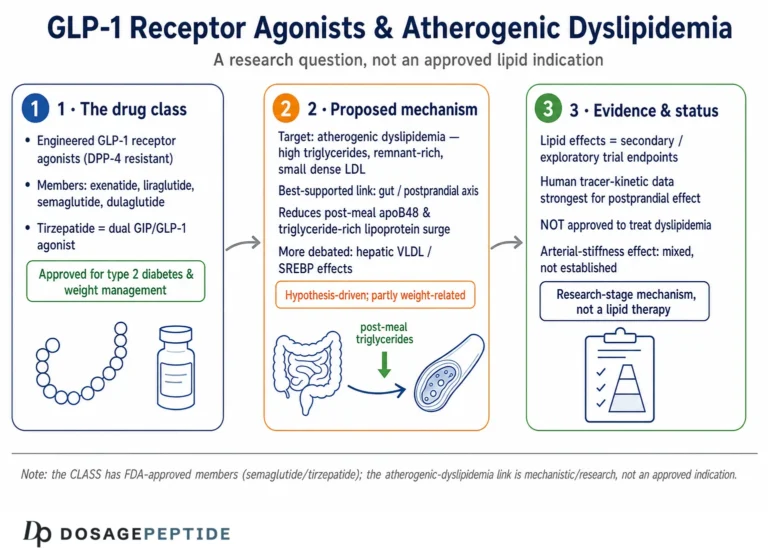
Fourth, the disease-link claims must be kept in their lane. The associations between GLP-1 agonism and dyslipidemia, endothelial dysfunction, and arterial stiffness are mechanistic and observational research threads, not approved therapeutic indications. GLP-1 agonists are approved for type 2 diabetes, chronic weight management, and — for semaglutide — cardiovascular risk reduction in a specific population, plus a handful of other specific indications; they are not approved to treat, cure, or prevent arterial stiffness or dyslipidemia as such.510 The cardiovascular outcome benefit is real and regulator-recognized, but it is an outcome benefit, not a validated arterial-stiffness mechanism, and the early separation of event curves in SELECT argues against stiffness reduction being its main driver.5
The honest synthesis, then: scientific evaluation has uncovered a plausible and detailed set of candidate signaling mechanisms by which GLP-1 could influence the vascular wall, and it has simultaneously uncovered that these mechanisms do not translate into a reliable, measurable reduction in human arterial stiffness in controlled study. Both halves are the answer. Anyone presenting only the first half is telling half the story.
Regulatory status of the class
Regulatory status is where the approved-versus-research distinction becomes concrete, and it is worth stating precisely to avoid any implication that arterial stiffness is an approved use.
Multiple GLP-1 receptor agonists are approved by the U.S. Food and Drug Administration and by the European Medicines Agency, but their approved indications are specific and do not include arterial stiffness, dyslipidemia, or endothelial dysfunction as standalone treatment targets. The core approvals across the class are as adjuncts to diet and exercise for glycemic control in type 2 diabetes (exenatide, liraglutide, dulaglutide, semaglutide, and the dual agonist tirzepatide), and for chronic weight management in eligible patients (liraglutide as Saxenda, semaglutide as Wegovy, tirzepatide as Zepbound).1012
The cardiovascular expansion is the most relevant regulatory event for this article. On the strength of the SELECT trial, in March 2024 the FDA approved semaglutide 2.4 mg (Wegovy) for reducing the risk of major adverse cardiovascular events in adults with established cardiovascular disease and either obesity or overweight — making it the first weight-management GLP-1 agonist with a cardiovascular risk-reduction indication.510 Liraglutide and dulaglutide carry cardiovascular indications in type 2 diabetes based on the LEADER and REWIND trials, respectively.10 More recent label expansions have added indications such as obstructive sleep apnea for tirzepatide and metabolic dysfunction-associated steatohepatitis for semaglutide, illustrating how quickly the class’s approved footprint is expanding.10 Crucially, none of these approvals is for arterial stiffness. The cardiovascular indication is defined by hard clinical events, not by an arterial-elasticity endpoint.
Several compounds discussed alongside the class remain investigational for many uses. Retatrutide, the triple agonist, is in clinical development and is not broadly approved; compounds documented on research-reference pages are frequently supplied for laboratory research rather than as approved therapeutics. Research-grade peptides are not FDA-approved drugs, are not manufactured or labeled for human administration, and are explicitly outside the regulatory framework that governs the approved products — a distinction that matters enormously for both safety and legality. The existence of an approved GLP-1 agonist with a cardiovascular indication does not confer approval, safety validation, or efficacy evidence on research-grade material or on unproven endpoints like arterial stiffness.
The regulatory bottom line mirrors the scientific one. The class is well-established and approved for defined metabolic and, in one case, cardiovascular-outcome indications; it is not approved for, and the evidence does not support, a claim that it treats arterial stiffness. Readers documenting these compounds for research should treat regulatory status and evidence level as strictly separate from physical-handling references, and should not infer therapeutic claims from either.
Frequently Asked Questions
Do GLP-1 receptor agonists reduce arterial stiffness in humans?
The best current evidence says: not reliably. Some individual randomized trials, particularly in newly diagnosed diabetic patients, reported reductions in pulse wave velocity with agents like liraglutide.2 However, a 2024 meta-analysis pooling 19 randomized controlled trials (five specifically on GLP-1 agonists, 1,212 total participants) found no statistically significant effect on pulse wave velocity or augmentation index.1 The honest reading is that a modest, population-specific effect cannot be excluded, but a robust, class-wide reduction in arterial stiffness is not supported.
If GLP-1 agonists reduce heart attacks, doesn’t that prove they improve arteries?
Not in the arterial-stiffness sense. Semaglutide reduced major adverse cardiovascular events by about 20% in the SELECT trial, and the event curves began to separate early, within roughly the first months — far too fast to reflect slow arterial remodeling.5 This early separation actually argues that the cardiovascular benefit runs mainly through faster-acting mechanisms rather than through de-stiffening large arteries. Outcome benefit and arterial-stiffness reduction are distinct claims, and the former does not prove the latter.
What is the proposed molecular mechanism linking GLP-1 to blood vessels?
The most-studied pathway is activation of endothelial nitric oxide synthase (eNOS), leading to nitric oxide release and vasodilation, via cAMP/protein kinase A together with AMPK and PI3K/Akt signaling.36 Additional proposed mechanisms include enhancement of ATP-sensitive potassium channels in smooth muscle, anti-inflammatory suppression of NF-kappaB and adhesion molecules, and reduced oxidative stress.4 Most of this was demonstrated in cultured cells or animal vessels, not in intact human arteries.
Are GLP-1 receptors even present on human blood vessels?
This is genuinely unresolved. Some studies detect GLP-1 receptors in human coronary endothelial and smooth muscle cells; others, using stricter antibody validation and mRNA detection, do not find them in healthy vascular tissue and note that many commercial antibodies are non-specific.34 One recurring finding is higher receptor expression in de-differentiated smooth muscle cells within atherosclerotic plaque, suggesting expression may depend on cell state. If vascular receptors are sparse, the drugs’ vascular effects may be largely indirect.
How does GLP-1 agonism compare with SGLT2 inhibitors for arterial stiffness?
Both classes have strong cardiovascular outcome data, yet the same 2024 meta-analysis found neither class significantly improved pulse wave velocity or augmentation index.1 The fact that two effective cardiovascular drug classes both fail to move arterial stiffness in pooled analysis reinforces the conclusion that stiffness reduction is not the shared mechanism of their benefit.
Is arterial stiffness an FDA-approved indication for any GLP-1 agonist?
No. Approved indications include type 2 diabetes glycemic control, chronic weight management, and — for semaglutide 2.4 mg since March 2024 — cardiovascular risk reduction in adults with established cardiovascular disease and obesity or overweight.510 Arterial stiffness, dyslipidemia, and endothelial dysfunction are research and mechanistic topics, not approved treatment targets. The cardiovascular indication is defined by clinical events, not by an arterial-elasticity endpoint.
What are the main side effects of GLP-1 receptor agonists?
The most common are gastrointestinal — nausea, vomiting, diarrhea, and constipation — most pronounced during dose escalation and usually attenuating over time.9 The class also modestly raises resting heart rate, carries a boxed warning for thyroid C-cell tumors based on rodent data, and has monitored signals for pancreatitis and gallbladder events.9 These data come from supervised clinical use of approved products and do not describe the risks of research-grade material outside that setting.
Why do individual trials show a benefit but meta-analysis does not?
Small, often open-label individual trials are vulnerable to measurement bias, regression to the mean, and population-specific effects — a benefit concentrated in high-baseline-stiffness diabetic patients can wash out when pooled with neutral trials.12 Because pulse wave velocity is dominated by structural arterial properties that are slow to reverse, genuinely large effects over a few months are biologically demanding, making both false positives in single studies and true nulls in pooling likely.
References
- Rizos EC, et al. The effect of SGLT2 inhibitors and GLP1 receptor agonists on arterial stiffness: A meta-analysis of randomized controlled trials. Journal of Diabetes and Its Complications. 2024. PubMed: https://pubmed.ncbi.nlm.nih.gov/38833853/
- Lambadiari V, et al. Effects of 6-month treatment with the glucagon-like peptide-1 analogue liraglutide on arterial stiffness, left ventricular myocardial deformation and oxidative stress in subjects with newly diagnosed type 2 diabetes. Cardiovascular Diabetology. 2018. PMC: https://pmc.ncbi.nlm.nih.gov/articles/PMC5759220/
- Battistoni A, et al. Glucagon-like peptide-1 receptor agonists and the endothelium: molecular and clinical insights into cardiovascular protection. Frontiers in Medicine. 2025. PMC: https://pmc.ncbi.nlm.nih.gov/articles/PMC12454090/
- Pahud de Mortanges A, et al. GLP-1 Receptor Agonists and Coronary Arteries: From Mechanisms to Events. Frontiers in Pharmacology. 2022. https://www.frontiersin.org/journals/pharmacology/articles/10.3389/fphar.2022.856111/full
- Lincoff AM, et al. Semaglutide and Cardiovascular Outcomes in Obesity without Diabetes (SELECT). New England Journal of Medicine. 2023. https://www.nejm.org/doi/full/10.1056/NEJMoa2307563
- Ding L, Zhang J. Glucagon-like peptide-1 activates endothelial nitric oxide synthase in human umbilical vein endothelial cells. Acta Pharmacologica Sinica. 2012. https://www.nature.com/articles/aps2011149
- Shi L, et al. Liraglutide attenuates high glucose-induced abnormal cell migration, proliferation, and apoptosis of vascular smooth muscle cells by activating the GLP-1 receptor, and inhibiting ERK1/2 and PI3K/Akt signaling pathways. Cardiovascular Diabetology. 2015. PMC: https://www.ncbi.nlm.nih.gov/pmc/articles/PMC4327797/
- Baggio LL, et al. GLP-1 Receptor Expression Within the Human Heart. Endocrinology. 2018. https://academic.oup.com/endo/article/159/4/1570/4850600
- Filippatos TD, et al. Adverse Effects of GLP-1 Receptor Agonists. Review of Diabetic Studies. PMC: https://pmc.ncbi.nlm.nih.gov/articles/PMC5397288/
- Collins L, Costello RA. Glucagon-Like Peptide-1 Receptor Agonists (StatPearls). NCBI Bookshelf. https://www.ncbi.nlm.nih.gov/books/NBK551568/
- Wang J, et al. Effects of first-line antidiabetic drugs on the improvement of arterial stiffness: A Bayesian network meta-analysis. Journal of Diabetes. 2023. PMC: https://www.ncbi.nlm.nih.gov/pmc/articles/PMC10415870/
- Latif W, Ahmad H, et al. Compare and Contrast the Glucagon-Like Peptide-1 Receptor Agonists (GLP1RAs) (StatPearls). NCBI Bookshelf. https://www.ncbi.nlm.nih.gov/books/NBK572151/
Educational and research-use disclaimer: This article is provided solely for scientific education and research-reference purposes. It is not medical advice and does not diagnose, treat, cure, or prevent any disease. GLP-1 receptor agonists discussed here are approved only for specific indications (such as type 2 diabetes, chronic weight management, and, for semaglutide, cardiovascular risk reduction in a defined population); their relationships to arterial stiffness, dyslipidemia, and endothelial function remain research hypotheses and mechanistic observations, not established therapies. Research-grade peptides are not FDA-approved drugs and are not intended for human administration. Nothing here should be interpreted as encouraging non-prescription or off-label use. Consult a qualified licensed healthcare professional for any medical decision.