In the largest obesity trial of tirzepatide, average body weight fell 15.0% on 5 mg, 19.5% on 10 mg and 20.9% on 15 mg after 72 weeks, against 3.1% on placebo — roughly 16 to 22 kg from a starting weight of about 105 kg.1 That is the closest thing to a verified “before and after” that exists for this compound. It took about 18 months, it required continuous weekly dosing, and it came with a dose-escalation period in which most people felt nauseated.
This page gives you the measured version: how much changed, how fast, when it stopped, and what happened to the people who quit. We don’t publish transformation photos — further down you’ll see exactly what those leave out. dosagepeptide.com is a research-use-only dosage reference, not a clinic; nothing here is medical advice or a promise of results.
How much weight actually changed
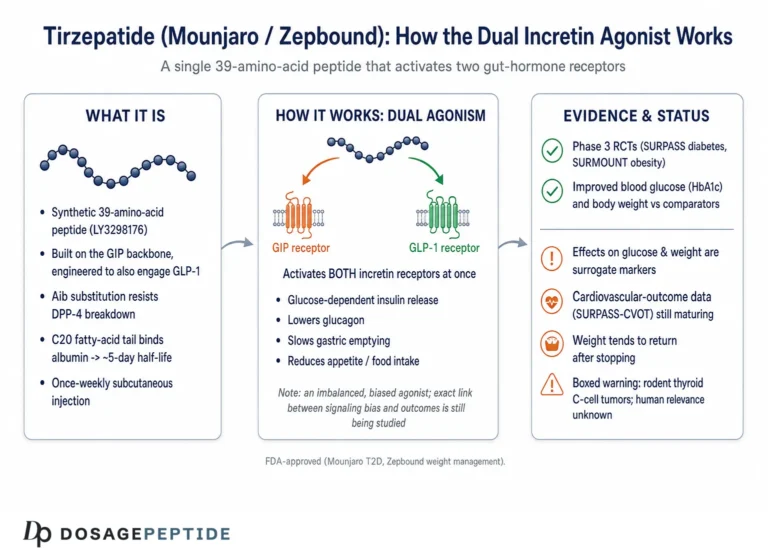
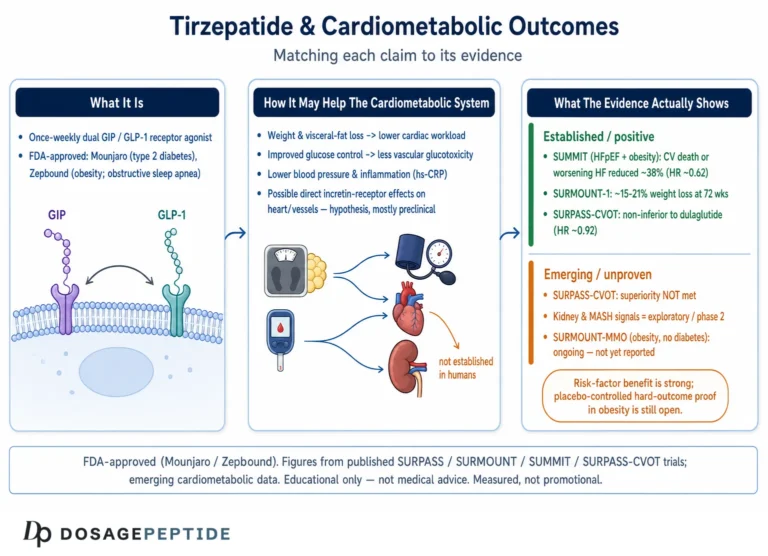
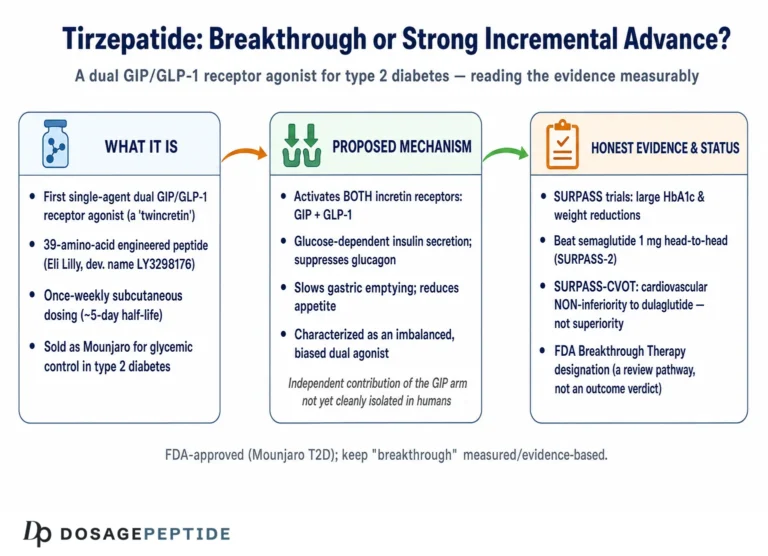
Tirzepatide is a dual GIP/GLP-1 receptor agonist tested in large phase 3 randomised controlled trials: the SURMOUNT programme in obesity and the SURPASS programme in type 2 diabetes. These are controlled human studies with placebo groups and published dropout rates — a different class of evidence from a testimonial.
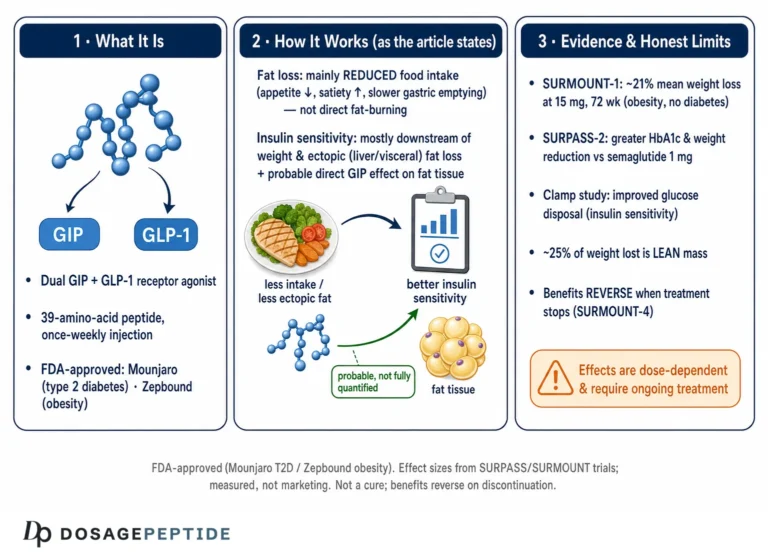
SURMOUNT-1 randomised 2,539 adults with obesity (mean weight 104.8 kg, mean BMI 38.0) to one of three tirzepatide doses or placebo for 72 weeks.1 The headline averages hide the more useful numbers, which are the proportions:
| Outcome at 72 weeks | 5 mg | 10 mg | 15 mg | Placebo |
|---|---|---|---|---|
| Mean weight change | −15.0% | −19.5% | −20.9% | −3.1% |
| Lost at least 5% of body weight | 85% | 89% | 91% | 35% |
| Lost at least 20% of body weight | — | 50% | 57% | 3% |
| Stopped because of side effects | 4.3% | 7.1% | 6.2% | 2.6% |
Read the second row carefully, because it is the one a photo gallery can never show you: even on the highest dose, roughly one participant in ten did not reach a 5% reduction. And 35% of the placebo group did — diet, activity and trial participation alone moved the number for a third of people.
In type 2 diabetes the endpoint was blood sugar rather than the scale. SURPASS-1 ran 40 weeks and lowered HbA1c by 1.87 to 2.07 percentage points versus +0.04 with placebo, with 7.0 to 9.5 kg of weight loss alongside it.2
The timeline: when changes appeared, and when they stopped
This is the part most “before and after” content gets wrong, because a two-photo format implies a straight line. The measured curve is not straight — it is steep early, then flattens.
Weeks 0–20: escalation, not results. SURMOUNT-1 started every participant at a low dose and stepped it up over roughly 20 weeks.1 Gastrointestinal side effects clustered in exactly this window. This is the phase where people expect a visible change and mostly do not get one.
Weeks 24–36: most people hit their plateau. A post-hoc analysis of SURMOUNT-1 and SURMOUNT-4 tracked when weight loss actually levelled off, defining a plateau as less than 5% further change over a 12-week window. Median time to plateau was 24.3 weeks for participants who were overweight, 26.0 weeks at class I obesity, and 36.1 weeks at class II and class III.3 Put plainly: the heavier the starting point, the longer the curve kept falling.
By week 72: nearly everyone has plateaued. In the same analysis, between 87.6% and 90.2% of participants had reached their plateau by week 72, depending on BMI category.3 Higher doses (10 and 15 mg), younger age and female sex were each associated with reaching that plateau later.
Years 2–3: mostly held, slightly off the peak. Participants with obesity and prediabetes who continued to 176 weeks were at −12.3% (5 mg), −18.7% (10 mg) and −19.7% (15 mg) versus −1.3% on placebo.4 Progression to type 2 diabetes over that period was 1.3% on tirzepatide against 13.3% on placebo.
So the honest answer to “how long until I see something” is: measurable change accumulates over months, and for most people the steep part is over somewhere between six and nine months.
What happened to the people who stopped
SURMOUNT-4 is the single most useful trial for interpreting an “after” photo, because it tested what a snapshot cannot: what comes next. All 783 participants took tirzepatide openly for 36 weeks and lost a mean of 20.9%. Then 670 of them were randomly assigned either to keep going or to switch to placebo for another 52 weeks.5
| Week 36 → week 88 | Continued tirzepatide | Switched to placebo |
|---|---|---|
| Further weight change | −5.5% | +14.0% |
| Kept at least 80% of the weight lost | 89.5% | 16.6% |
| Total change from week 0 | −25.3% | −9.9% |
Five out of six people who stopped did not hold their result. The effect tracked ongoing dosing — which means any single “after” image is a measurement of one moment, not of a permanent state.
What before-and-after photos leave out
Photo galleries are not a weaker form of the trial data; they are a different thing altogether, and four specific gaps make them unreliable:
- Survivorship. Nobody posts the 9–15% who did not reach a 5% reduction, or the 4–7% who stopped because of side effects.1 Trials publish those people. Galleries delete them.
- No dose, no duration, no verification. A photo pair carries no evidence of what was taken, at what dose, for how long, or whether the substance was even tirzepatide of known purity.
- Confounding. Diet, training, other medications, lighting, posture and camera distance all move the image. None of them move a randomised comparison against placebo.
- No follow-up. SURMOUNT-4 showed that a result photographed at month nine can be substantially undone by month twenty-one without continued dosing.5
There is also a difference the images cannot convey at all: trial participants received pharmaceutical-grade drug under medical supervision, with scheduled monitoring. That is not the same product or the same context as unregulated research material of unknown identity and purity.
Side effects, and when they show up
Across the trials the most common adverse events were gastrointestinal — nausea, diarrhoea, vomiting and constipation — mostly mild to moderate, and concentrated during the dose-escalation period rather than spread evenly.12 In SURPASS-1, nausea affected 12–18% of tirzepatide participants versus 6% on placebo, diarrhoea 12–14% versus 8%, and vomiting 2–6% versus 2%.2 No clinically significant or severe hypoglycaemia was reported with tirzepatide in that trial.
Discontinuation because of adverse events reached 7.1% on the 10 mg dose in SURMOUNT-1.1 The 3-year SURMOUNT-1 analysis identified no new safety signals.4 Full serious-risk information belongs in the prescribing documentation for the approved medicines and is outside the scope of a research reference.
Research-use context and dosage reference
The tirzepatide referenced on this site is for research use only. It is not sold, and must not be used, as a treatment or a weight-loss product. Approved tirzepatide medicines exist, but they are prescription products dispensed and monitored by licensed clinicians — a different thing from research-grade material. If you are weighing tirzepatide for a health reason, that is a conversation for a qualified healthcare professional.
For the figures used in the literature and for reconstitution maths, use the reference tools rather than anecdote: the tirzepatide 10 mg vial protocol, the 15 mg vial protocol, and the tirzepatide dosage calculator for reconstitution and injection volume. These are research reference figures, not dosing instructions for human use.
Frequently Asked Questions
How much weight did people lose on tirzepatide?
In SURMOUNT-1, mean body weight fell 15.0% on 5 mg, 19.5% on 10 mg and 20.9% on 15 mg over 72 weeks, versus 3.1% on placebo. Between 85% and 91% of participants lost at least 5% of their body weight, and 50–57% of those on the two higher doses lost at least 20%.1
How long does it take to see results?
Months, not weeks. The first ~20 weeks are dose escalation. Median time to a weight plateau was 24.3 weeks for participants who were overweight and 36.1 weeks at class II–III obesity, and roughly 88–90% of participants had plateaued by week 72.3
Are there real tirzepatide before and after photos?
We don’t publish them. Individual photos carry no dose, duration, purity or follow-up, and they systematically exclude the people who saw little or no change — who were 9–15% of trial participants even at the highest dose.1 The verifiable equivalent is the trial data above, which reports averages, proportions and dropouts.
Does the weight come back if you stop?
Largely, in the one trial designed to test it. In SURMOUNT-4, people who switched to placebo at week 36 regained 14.0% over the following year, while those who continued lost a further 5.5%. Only 16.6% of the stoppers kept at least 80% of what they had lost, against 89.5% of those who continued.5
Do the results last for years?
They held with continued dosing. At 176 weeks, participants with obesity and prediabetes were at −12.3% to −19.7% depending on dose, versus −1.3% on placebo, and 1.3% had developed type 2 diabetes against 13.3% on placebo.4
What are the most common side effects?
Gastrointestinal ones — nausea, diarrhoea, vomiting, constipation — mostly mild to moderate and concentrated during the first ~20 weeks of dose escalation.12 In SURMOUNT-1, 4.3–7.1% of participants stopped because of adverse events, versus 2.6% on placebo.1
Why do results differ so much between people?
The trial averages sit on top of wide individual variation, and the plateau analysis found that dose, age, sex and starting BMI all shifted how long weight kept falling.3 A mean of −20.9% is not a prediction for any single person.
References
- Jastreboff AM, Aronne LJ, Ahmad NN, et al. Tirzepatide once weekly for the treatment of obesity. N Engl J Med. 2022;387(3):205-216. PMID: 35658024. https://pubmed.ncbi.nlm.nih.gov/35658024/
- Rosenstock J, Wysham C, Frías JP, et al. Efficacy and safety of a novel dual GIP and GLP-1 receptor agonist tirzepatide in patients with type 2 diabetes (SURPASS-1): a double-blind, randomised, phase 3 trial. Lancet. 2021;398(10295):143-155. PMID: 34186022. https://pubmed.ncbi.nlm.nih.gov/34186022/
- Horn DB, Kahan S, Batterham RL, et al. Time to weight plateau with tirzepatide treatment in the SURMOUNT-1 and SURMOUNT-4 clinical trials. Clin Obes. 2025;15(3):e12734. PMID: 39800653. https://pubmed.ncbi.nlm.nih.gov/39800653/
- Jastreboff AM, le Roux CW, Stefanski A, et al. Tirzepatide for obesity treatment and diabetes prevention. N Engl J Med. 2024;392(10):958-971. PMID: 39536238. https://pubmed.ncbi.nlm.nih.gov/39536238/
- Aronne LJ, Sattar N, Horn DB, et al. Continued treatment with tirzepatide for maintenance of weight reduction in adults with obesity: the SURMOUNT-4 randomized clinical trial. JAMA. 2024;331(1):38-48. PMID: 38078870. https://pubmed.ncbi.nlm.nih.gov/38078870/