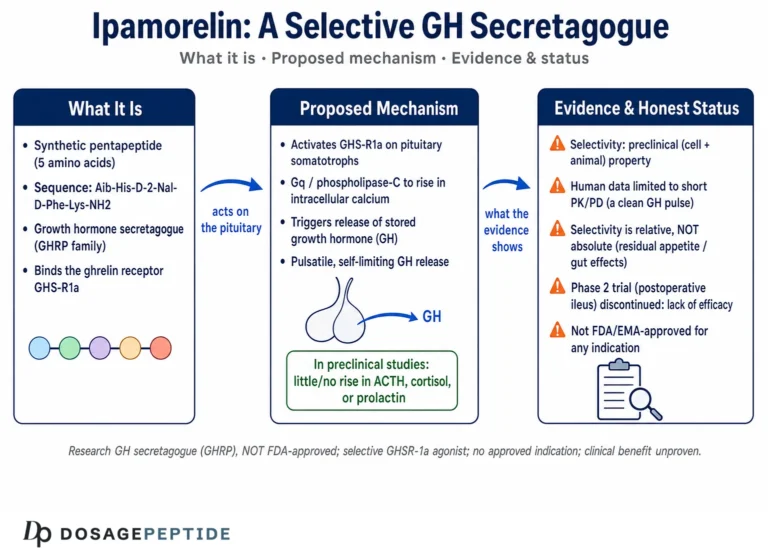
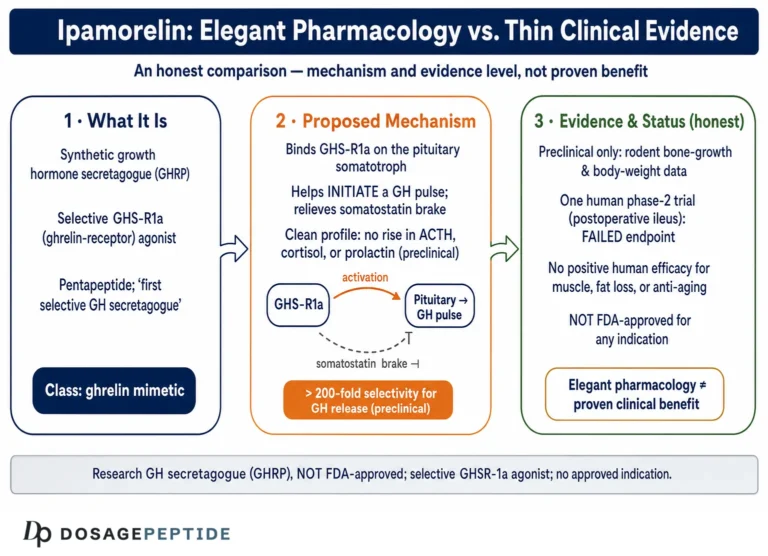
Ipamorelin has been through only two kinds of human study: a pharmacokinetic and growth-hormone-response study in healthy volunteers,2 and a clinical programme in postoperative ileus after bowel surgery.3 Neither tested — or could test — whether ipamorelin is selective for the GHSR-1a receptor. The ileus programme missed its primary endpoint, and development was halted.
The selectivity evidence comes from somewhere else entirely: a single body of preclinical work published in 1998, in rat pituitary cells and in live rats and swine.1 Receptor selectivity is established in binding and signalling assays, not in patients. Asking which clinical trials proved it is like asking which road tests proved the alloy in an engine’s pistons — the road test tells you the car moves, not what the metal is.
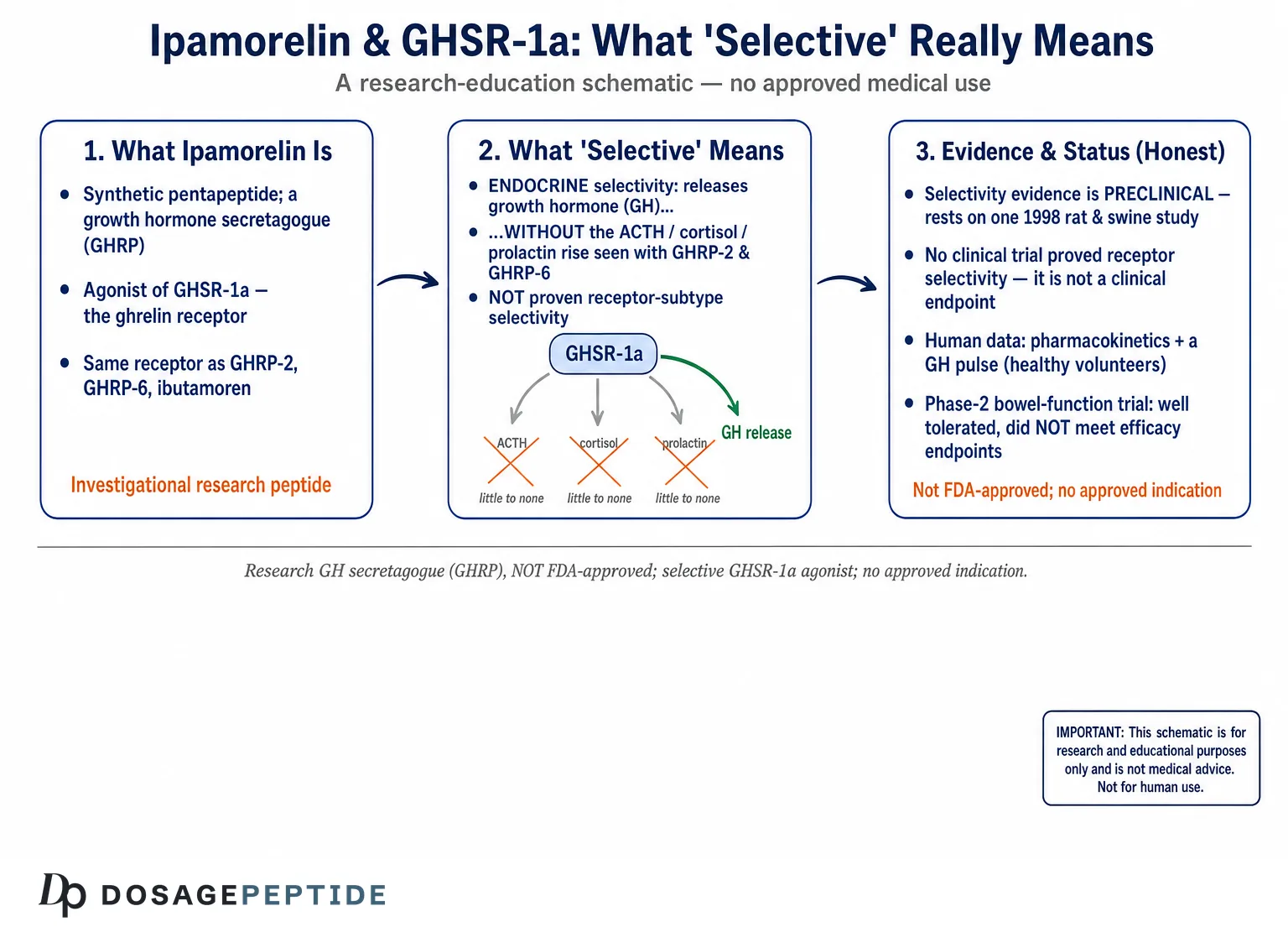
There is a second confusion worth clearing before the details. When the 1998 researchers called ipamorelin “selective,” they meant it released growth hormone without the ACTH, cortisol and prolactin spikes its chemical cousins caused — selectivity of endocrine output, not of receptor binding.1 Below: what the GHSR-1a receptor is, what the 1998 data showed and in which species, exactly what the human studies measured, why ipamorelin is conspicuously missing from the modern cryo-EM structures of this receptor, how it compares with other ghrelin-receptor agonists, and where it stands legally. Ipamorelin is a research peptide, approved nowhere for anything.
Two Meanings of “Selective” — and Why the Distinction Governs Everything
Before touching the evidence, it pays to define terms precisely, because almost every misreading of the ipamorelin literature traces back to a slippage between two ideas that share a word.
Receptor selectivity is a statement about molecular targets. A receptor-selective ligand binds and activates one receptor (or receptor subtype) at concentrations well below those at which it touches others. Demonstrating it requires radioligand-binding or functional assays across a panel of candidate receptors, ideally with measured affinities (Ki or Kd) and potencies (EC50). This is bench pharmacology, done in cells and membranes.
Endocrine (or functional) selectivity is a statement about physiological output. A hormone secretagogue is “selective” in this sense if it triggers the release of one hormone — here, growth hormone (GH) — without meaningfully disturbing others such as adrenocorticotropic hormone (ACTH), cortisol, or prolactin. This is measured in whole animals or people by sampling circulating hormone levels.
The distinction matters enormously for the title’s question. When the literature says ipamorelin is “the first selective growth hormone secretagogue,” it is making the second kind of claim: ipamorelin releases GH cleanly, without the corticotropic and lactotropic side effects seen with earlier growth-hormone-releasing peptides (GHRPs).1 It does not mean that ipamorelin binds GHSR-1a while snubbing some other GH-releasing receptor. In fact, all of the classic GHRPs — GHRP-2, GHRP-6, hexarelin, ibutamoren, and ipamorelin — act on the same receptor, GHSR-1a.4 Their differing endocrine footprints arise not from binding different receptors but from differences in potency, pharmacokinetics, and, plausibly, from biased or differential downstream signaling and off-target contacts that are still not fully mapped.
Once this is clear, the title’s question resolves into two more answerable ones. First: what evidence, and of what type, shows that ipamorelin acts on GHSR-1a at all? Second: what evidence shows its endocrine selectivity — GH without ACTH/cortisol/prolactin — and in which species? The answer to the first is preclinical molecular pharmacology inferred from the shared receptor pharmacology of the GHRP class; the answer to the second is the 1998 rat-and-swine work, partially echoed by human GH-release data. In neither case is there a clinical trial that set out to prove receptor selectivity, because that is not a question human trials are built to answer. Readers who want the flip side of this coin — the precision-of-targeting framing — will find it explored in the companion article on which studies demonstrate ipamorelin’s precision in targeting the GHSR-1a receptor, which approaches the same evidence base from the angle of target engagement rather than clinical proof.
The Receptor Itself: GHSR-1a From Orphan to Ghrelin Target
To evaluate any claim about “selective action on the GHSR-1a receptor,” one has to know what that receptor is and how it came to be understood — a history that, tellingly, ran in reverse of the usual order.
In 1996, a team at Merck cloned a G-protein-coupled receptor expressed in the pituitary and the hypothalamus of swine and humans and showed that it was the molecular target of a class of small synthetic molecules that had been known since the 1970s and 1980s to stimulate GH release — the growth hormone secretagogues.5 A companion report characterized the same G-protein-linked receptor for these secretagogues.10 This was the receptor now called the growth hormone secretagogue receptor type 1a (GHS-R1a, or GHSR-1a). Crucially, at the moment of its discovery it was an orphan receptor: the synthetic secretagogues that activated it were laboratory creations, and the body’s own ligand was unknown.
That endogenous ligand was found three years later. In 1999, Kojima and colleagues isolated ghrelin, a 28-amino-acid acylated peptide from the stomach, and showed it to be the natural agonist of GHSR-1a.6 Ghrelin carries an unusual n-octanoyl modification on its third residue that is essential for receptor binding and activation. This sequence — receptor first, then hormone — is a textbook example of “reverse pharmacology,” and it is the reason the receptor still bears the historical “secretagogue” name rather than being called simply the ghrelin receptor.
Two features of GHSR-1a bear directly on any selectivity discussion. First, the receptor exists in more than one form. The gene produces the full-length, signaling-competent GHSR-1a and a truncated splice variant, GHSR-1b, which lacks two transmembrane helices and does not itself signal in the classic way.5 When we speak of ipamorelin acting on “GHSR-1a,” the “1a” is doing real work: it specifies the functional receptor. Second, GHSR-1a is notable for its exceptionally high constitutive activity — it signals to a substantial degree even in the absence of any ligand, a property with genuine physiological relevance for GH pulsatility and appetite regulation.8 This constitutive tone complicates simple “agonist binds, receptor fires” narratives and is one reason the receptor’s pharmacology is richer than the marketing shorthand suggests.
GHSR-1a is expressed most densely in the pituitary somatotrophs (the GH-producing cells) and in hypothalamic nuclei, but also in the stomach, pancreas, heart, and elsewhere — a distribution that explains why ghrelin-receptor agonists have been investigated not only for GH release but for appetite, gastric motility, and cardiovascular effects.4 When ipamorelin engages this receptor on somatotrophs, it couples through Gq/11 and phospholipase C to raise intracellular calcium and trigger GH secretion, and it can also recruit Gi and β-arrestin pathways — the same signaling repertoire ghrelin uses.6 For a broader orientation to the vocabulary used across this field, the site’s peptide research glossary defines terms such as secretagogue, agonist, and constitutive activity in plain language.
The Foundational Evidence: Raun 1998 and the Preclinical Selectivity Case
Essentially the entire scientific basis for calling ipamorelin “selective” rests on one paper: Raun and colleagues, published in the European Journal of Endocrinology in 1998 under the unambiguous title “Ipamorelin, the first selective growth hormone secretagogue.”1 Understanding exactly what that study did — and did not do — is the crux of this article.
Ipamorelin is a synthetic pentapeptide, Aib-His-D-2-Nal-D-Phe-Lys-NH2, discovered within a program that systematically pared down the structure of earlier growth-hormone-releasing peptides. The researchers were exploring analogues that lacked the central Ala-Trp dipeptide of GHRP-1, and ipamorelin emerged from that series as a compound combining high GH-releasing potency with an unusually clean endocrine profile.1
The study was, in modern terms, a preclinical pharmacology package with three tiers. In vitro, ipamorelin released GH from primary rat pituitary cells in culture with potency and efficacy comparable to GHRP-6, and its action could be blocked by a growth-hormone-secretagogue-receptor antagonist — evidence that it worked through the GHS receptor rather than through the separate GHRH receptor.1 In vivo, in anesthetized rats and in swine, ipamorelin produced robust, dose-dependent GH release. And in the experiments that gave the paper its title, the authors compared the hormonal “spillover” of ipamorelin against GHRP-2 and GHRP-6: whereas those comparators elevated ACTH and cortisol, ipamorelin released GH without stimulating ACTH or cortisol above the levels seen with GHRH itself.1
That last result is the origin of the “selective” label, and it is worth stating precisely what it establishes and what it does not. It establishes endocrine selectivity in rats and pigs: a cleaner GH signal with far less corticotropic activation than its peers. It does not establish that ipamorelin binds GHSR-1a to the exclusion of other receptors — the study did not present a broad receptor-panel binding screen showing exclusivity, and indeed the mechanistic model has always been that ipamorelin works through the same GHS receptor as the other GHRPs.1 The selectivity is in the output, not in a demonstrated one-receptor-only binding fingerprint.
It is also worth being candid that this is, remarkably, still the foundational and near-singular primary source for ipamorelin’s defining property nearly three decades later. Much of what circulates online as “ipamorelin is highly selective for GHSR-1a” is a paraphrase, several hands removed, of this one 1998 rodent-and-swine study — often with the endocrine sense of “selective” silently upgraded to a receptor-subtype claim it never made. That does not make the finding wrong; the endocrine selectivity is real and reproducible. It does mean the evidentiary base is narrower and more preclinical than the confident secondary literature implies, and that any responsible summary should say so plainly. The contrast with a growth-hormone-releasing-hormone analogue that works through an entirely different receptor is instructive here; readers can see how a GHRH-based approach is framed in the discussion of what research says about sermorelin’s role in stimulating natural growth hormone.
What the Human Studies Actually Measured
If the receptor-selectivity evidence is preclinical, what did the genuinely clinical studies of ipamorelin measure? The honest answer clarifies why none of them addresses the title’s question directly.
The first substantial human data came from a pharmacokinetic–pharmacodynamic (PK/PD) study by Gobburu and colleagues, published in Pharmaceutical Research in 1999.2 This was a dose-escalation trial in healthy male volunteers, with eight subjects at each of five ascending intravenous infusion rates. Its aim was to characterize how the body handles ipamorelin and how that translates into GH release. The findings were tidy: the pharmacokinetics were dose-proportional, with a short terminal half-life of roughly two hours, a clearance of about 0.078 L/h/kg, and a steady-state volume of distribution near 0.22 L/kg; and a single infusion produced a single, sharp episode of GH release peaking well under an hour after dosing before declining to baseline.2 The GH response was modeled with an indirect-response approach linking drug concentration to hormone output.
Notice what this study demonstrates and what it cannot. It demonstrates that in humans, ipamorelin is cleared quickly and reliably provokes a discrete pulse of GH — behavior entirely consistent with a GHS-receptor agonist acting on pituitary somatotrophs. But it is a whole-body physiology study. It measured a hormone in the blood; it did not, and structurally could not, isolate which receptor subtype the peptide engaged or demonstrate selectivity against other receptors. The GH pulse is a downstream readout compatible with GHSR-1a agonism but not a direct measurement of it.
The other major clinical program had nothing to do with GH at all. Because GHSR-1a is expressed in the gut and ghrelin is a prokinetic (motility-promoting) hormone, ipamorelin was repositioned by its later developer as a candidate for postoperative ileus — the temporary paralysis of the bowel that follows abdominal surgery. A prospective, randomized, double-blind, placebo-controlled proof-of-concept study led by Beck and colleagues (the Ipamorelin 201 Study Group), published in the International Journal of Colorectal Disease in 2014, tested intravenous ipamorelin against placebo in patients undergoing bowel resection.3 The trial found that ipamorelin was well tolerated, but it did not meet its efficacy endpoints: the differences between ipamorelin and placebo in the key and secondary analyses were not statistically significant. Median time to first tolerated meal, for instance, was 25.3 hours with ipamorelin versus 32.6 hours with placebo (p = 0.15) — a numerical trend that did not reach significance. It was explicitly a proof-of-concept study, and ipamorelin’s clinical development for this indication did not go on to yield an approved product.3 This gut program rested on a rodent model showing that ipamorelin accelerated gastric emptying and restored contractility after surgical intestinal manipulation through a ghrelin-receptor-mediated, cholinergic mechanism.12
It is worth pausing on why this gut-motility program is, in an oblique way, the strongest human-adjacent evidence that ipamorelin engages GHSR-1a at all — and why even it falls short of the title’s demand. The logic runs like this: ghrelin is a prokinetic hormone; its receptor is expressed on enteric neurons; a ghrelin-receptor agonist should therefore promote gut motility. Ipamorelin did exactly that in the rodent model, and the effect was consistent with a ghrelin-receptor, cholinergic-neuron mechanism.12 When the same compound was carried into surgical patients, however, it produced only a non-significant numerical trend toward faster recovery rather than a demonstrated benefit — so the human data neither confirm the rodent finding nor establish that any effect is mediated through the ghrelin receptor. Even had the trial been clearly positive, attributing the benefit to GHSR-1a would have been an inference to the best explanation, not a direct measurement. The trial did not, for instance, co-administer a selective GHSR-1a antagonist to confirm that the benefit vanished when the receptor was blocked, which would have been the closest thing to a clinical demonstration of receptor mediation. Absent that, the human motility signal remains suggestive rather than probative of receptor-level action, and it says nothing at all about selectivity — only about engagement.
The point for our question is that even ipamorelin’s most advanced human trial measured a clinical endpoint — return of bowel function — that is several causal steps removed from receptor selectivity. It was designed to test whether engaging the ghrelin-receptor system produces a measurable clinical effect — a hypothesis the trial did not confirm — and in any case it is not a characterization of the receptor pharmacology itself. The following table lays out the evidence types side by side.
| Study / source | Model & type | What it measured | What it tells us about GHSR-1a selectivity |
|---|---|---|---|
| Raun et al. 19981 | Rat pituitary cells; live rats & swine (preclinical) | GH release; ACTH/cortisol spillover vs GHRP-2/6; antagonist blockade | Directly supports endocrine selectivity (GH without ACTH/cortisol) and action via the GHS receptor; does not prove single-subtype binding exclusivity |
| Gobburu et al. 19992 | Healthy human volunteers (clinical PK/PD) | Pharmacokinetics; magnitude/timing of GH pulse | Confirms a clean GH pulse in humans — consistent with GHSR-1a agonism, but not a receptor-level measurement |
| Beck et al. 20143 | Post-surgical patients (clinical, phase 2 proof-of-concept) | Time to recovery of bowel function; safety | Well tolerated but no statistically significant efficacy benefit vs placebo; a downstream clinical endpoint that says nothing about receptor selectivity |
| Rodent POI model12 | Rats, gastric motility (preclinical) | Gastric emptying; smooth-muscle contractility | Effect blocked/consistent with ghrelin-receptor mechanism; peripheral, not selectivity-defining |
Read together, these entries make the honest picture unmistakable: the receptor-mechanism evidence is preclinical, and the clinical evidence is about physiology and outcomes, not receptor characterization. There is no human trial in this list whose purpose or design could demonstrate that ipamorelin acts selectively on GHSR-1a. Researchers modeling the timing and magnitude of such a GH pulse for study-planning purposes sometimes use tools like the site’s reconstitution and dosage calculator to reason about concentrations, though such arithmetic is educational and unrelated to receptor pharmacology.
Structural Biology: How the Receptor Was Finally Seen — and Why Ipamorelin Isn’t in the Pictures
If clinical trials cannot show receptor selectivity, what can? The gold standard for understanding how a ligand engages a receptor is structural biology — and here the field has advanced dramatically, though in a way that quietly exposes how little of that work involves ipamorelin specifically.
For most of GHSR-1a’s history, its three-dimensional structure was unknown, and mechanistic claims about how any agonist “fits” the receptor were modeling and inference. That changed around 2021, when several groups used cryo-electron microscopy (cryo-EM) to solve high-resolution structures of the active human ghrelin receptor in complex with its G protein and various agonists. One set of structures captured GHSR-1a bound to ghrelin and to the synthetic non-peptide agonist ibutamoren (MK-677), coupled to G protein, revealing the architecture of the ligand-binding pocket and the conformational changes that accompany activation.7 Another study detailed the molecular recognition of the acylated ghrelin peptide, showing how a salt bridge between residues in transmembrane helices III and VI is broken on agonist binding, dividing the pocket into two cavities that accommodate different parts of the ligand.9
These are genuinely illuminating results. They explain, at atomic resolution, how agonists switch GHSR-1a on and why the receptor couples to Gq. But notice the ligands that were actually resolved: ghrelin, GHRP-6, ibutamoren, and (in later work) anamorelin. Ipamorelin itself has not, to the available literature, been the subject of a published high-resolution GHSR-1a co-structure. What we know about how ipamorelin sits in the pocket is therefore extrapolated — reasonably, but still extrapolated — from the shared GHRP pharmacophore and from the structures of its close relatives. Statements circulating online that describe ipamorelin’s “specific contacts between its D-2-Nal and D-Phe residues and hydrophobic subpockets” in the receptor are plausible molecular-modeling hypotheses, not observations from an ipamorelin–GHSR-1a structure, and they should be read as the former.
This is the deepest layer of the honesty problem. The tools that could directly characterize ipamorelin’s receptor engagement — binding panels and co-crystallographic or cryo-EM structures — have been applied lavishly to ghrelin, ibutamoren, and anamorelin, and only glancingly, if at all, to ipamorelin. So the compound whose very name in the literature is “the first selective secretagogue” is, paradoxically, one of the less structurally interrogated members of its class. Its selectivity story remains anchored to functional endocrine data from 1998 rather than to modern target-engagement structures.
How Ipamorelin Compares With Other Ghrelin-Receptor Agonists
Placing ipamorelin beside its relatives clarifies both what is distinctive about it and how much of that distinctiveness is endocrine rather than receptor-level. All of the agents below act on GHSR-1a; they differ in chemistry, pharmacokinetics, and hormonal “cleanliness.”
| Agent | Chemical class | Receptor | Distinguishing endocrine feature | Development status |
|---|---|---|---|---|
| Ipamorelin | Synthetic pentapeptide | GHSR-1a | GH release with little/no ACTH, cortisol, or prolactin rise (endocrine selectivity)1 | Investigational; phase 2 (postoperative ileus) not carried to approval3 |
| GHRP-6 | Hexapeptide | GHSR-1a | Potent GH release but stimulates appetite and raises cortisol/prolactin1 | Research/investigational |
| GHRP-2 | Hexapeptide | GHSR-1a | Strong GH release with notable ACTH/cortisol activation1 | Research/investigational |
| Ibutamoren (MK-677) | Non-peptide, orally active | GHSR-1a | Sustained GH/IGF-1 elevation; structurally resolved with receptor7 | Investigational; not approved |
| Anamorelin | Non-peptide, orally active | GHSR-1a | Appetite/lean-mass focus in cancer cachexia; receptor co-structure solved | Approved in some jurisdictions (e.g., Japan) for cancer cachexia; not FDA-approved |
| Relamorelin | Peptide analogue | GHSR-1a | Prokinetic; studied for diabetic gastroparesis13 | Investigational |
| Sermorelin (for contrast) | GHRH(1-29) analogue | GHRH receptor, not GHSR-1a | Works through a different receptor entirely | Historically approved as a diagnostic; different mechanism |
The table drives home two lessons. First, ipamorelin’s claim to fame — endocrine selectivity — is a comparative statement within a class that all shares the same receptor. It is “cleaner” than GHRP-2 and GHRP-6, not “more receptor-selective” in the binding sense. Second, the sermorelin row is the true control for the concept of receptor selectivity: sermorelin acts on the GHRH receptor, a wholly different target, which is what genuine receptor-level distinction looks like. Comparing ipamorelin to GHRP-6 is comparing two keys cut for the same lock; comparing either to sermorelin is comparing keys for different locks. Blends that combine a GHRH analogue with a ghrelin-receptor agonist exploit exactly this two-lock complementarity, an approach discussed in the analysis of whether the Grow-H blend truly boosts strength and repair.
The Mechanistic Chain: From GHSR-1a to a Growth-Hormone Pulse
Even though ipamorelin’s receptor engagement has not been visualized directly, the downstream mechanism is well characterized for the receptor as a whole, and ipamorelin is presumed to follow the same path. Tracing that chain shows both why the GH-pulse data are consistent with GHSR-1a action and why they cannot, by themselves, prove selectivity.
When an agonist binds GHSR-1a on a pituitary somatotroph, the receptor couples predominantly to the Gq/11 family of G proteins. This activates phospholipase C, which generates inositol trisphosphate and diacylglycerol, driving a rise in intracellular calcium and activation of protein kinase C. The calcium rise triggers exocytosis of GH-containing secretory granules — the physical event behind the measured hormone pulse.6 GHSR-1a can additionally engage Gi/o signaling and recruit β-arrestins, and its notably high constitutive activity means the receptor contributes a baseline signaling tone that agonists amplify rather than switch on from zero.8
There is an important second layer at the level of the whole organism. GH secretion is governed by the interplay of two hypothalamic signals: growth-hormone-releasing hormone (GHRH), which acts through the GHRH receptor to stimulate GH, and somatostatin, which inhibits it. Ghrelin-receptor agonists like ipamorelin do not merely act on the pituitary in isolation; they also modulate hypothalamic circuits and appear to act synergistically with GHRH while dampening somatostatin tone.4 This is why the physiological GH response to a secretagogue reflects a network, not a single cell — and why a clean GH pulse in a human volunteer is compatible with GHSR-1a agonism but is not a clean readout of receptor selectivity: several receptors and cell types shape the final hormone level.
A further wrinkle deserves mention because it is so often overlooked. Because GHSR-1a signals constitutively — that is, it maintains basal activity without any agonist bound — the receptor system is better thought of as a rheostat that agonists turn up rather than a switch they flip from off to on.8 This has a subtle consequence for interpreting selectivity claims. Two agonists acting on the identical receptor can produce different physiological footprints not only through different binding but through different degrees of stabilizing particular active conformations, differential recruitment of Gq versus Gi versus β-arrestin, and differing effects on the receptor’s constitutive tone. In principle, ipamorelin’s clean endocrine profile could reflect such biased or conformation-specific signaling at GHSR-1a rather than any difference in which receptor it binds. This is an attractive hypothesis, but it must be labeled as one: the biased-signaling explanation for ipamorelin’s selectivity has not been rigorously established with the pathway-resolved assays (comparative Gq, Gi, and arrestin readouts) that would be needed to confirm it.
The endocrine selectivity that defines ipamorelin most likely arises somewhere in this chain. The leading interpretation is that ipamorelin engages GHSR-1a on somatotrophs efficiently while producing less of the corticotroph activation (ACTH/cortisol) that GHRP-2 and GHRP-6 cause — whether through subtly different receptor conformations, biased signaling, differential access to relevant cell populations, or reduced off-target activity is not definitively established.1 That mechanistic humility is appropriate: the observation of endocrine selectivity is solid; the molecular explanation for it remains partly hypothetical.
Research Models and Methodology
Understanding the methods behind ipamorelin’s evidence base clarifies what each tier can and cannot support — and where a real receptor-selectivity study would have to sit.
In vitro receptor and cell assays. The most direct level for characterizing receptor action uses cloned receptors expressed in cell lines, radioligand-binding assays to measure affinity, and functional readouts (calcium flux, inositol phosphate accumulation, cAMP, β-arrestin recruitment) to measure potency and efficacy. The 1998 work included primary rat pituitary cell assays with antagonist blockade to confirm action through the GHS receptor,1 and the broader class has been characterized in recombinant GHSR-1a systems.4 A definitive selectivity study for ipamorelin would screen it across a panel of receptors and report comparative affinities — the kind of dataset abundant for ghrelin and ibutamoren but thin for ipamorelin specifically.
Structural methods. Cryo-EM and X-ray crystallography reveal how a ligand physically engages the receptor. The 2021 GHSR-1a structures with ghrelin, GHRP-6, ibutamoren, and later anamorelin represent this tier.79 Ipamorelin has not been resolved this way, so its binding mode is inferred.
Animal pharmacology. Whole-animal studies measure physiological output — GH release, hormone spillover, gastric motility. The rat and swine experiments of 1998 and the rodent postoperative-ileus model belong here.112 These are excellent for endocrine selectivity and downstream effects but cannot isolate receptor-subtype binding.
Human clinical studies. The PK/PD volunteer study and the postoperative-ileus trial define this tier.23 They characterize human pharmacokinetics, the GH pulse, safety, and a clinical endpoint. None was designed to characterize receptor pharmacology, and none could.
The methodological bottom line: ipamorelin’s selectivity evidence lives in the lower two tiers (cell assays and animal pharmacology) and, for the receptor-subtype question specifically, is inferential even there, because the modern binding-panel and structural datasets that would nail it down were largely built with other ghrelin-receptor agonists. Anyone documenting handling and study parameters for this compound — as summarized in the general peptide reconstitution guide — should treat receptor-selectivity claims as preclinical inference, not clinically proven fact.
Safety, Tolerability, and What the Human Record Supports
Ipamorelin’s human safety record, though limited, is one of the more reassuring aspects of its profile — a claim that must nonetheless be stated with care, because “well tolerated in small short-term studies” is not the same as “established as safe for ongoing use.”
In the healthy-volunteer PK/PD study, single intravenous infusions across a range of doses produced the expected transient GH pulse and were characterized without reports of serious adverse effects, consistent with the compound’s short half-life and self-limiting hormonal action.2 In the postoperative-ileus proof-of-concept trial, ipamorelin was described as well tolerated; the most common adverse events (nausea, vomiting, dyspepsia) were the kind expected in patients recovering from recent bowel surgery and could not be cleanly attributed to the peptide.3 The endocrine selectivity documented preclinically — GH release without appreciable ACTH, cortisol, or prolactin elevation — is itself a favorable safety-relevant feature, since it predicts fewer of the stress-hormone and lactotropic side effects associated with less selective secretagogues.1
Several caveats temper this picture:
- Small, short, specific populations. The human data comprise a dose-ranging study in a few dozen healthy men and one proof-of-concept surgical trial. This is not the breadth or duration of exposure needed to characterize long-term safety.
- Route matters. The human studies used intravenous administration. Research and non-clinical use of reconstituted material is often subcutaneous, and safety data do not transfer automatically across routes.
- GH-axis effects are not free. Any agent that repeatedly stimulates GH can, in principle, affect glucose handling and fluid balance and raise IGF-1; the short human studies were not powered to detect chronic metabolic consequences.
- Product quality. Material sold outside regulated channels varies in purity, and impurities or mislabeling are real hazards independent of the molecule’s intrinsic pharmacology.
The fair reading is that ipamorelin has not generated major short-term safety signals in the limited human settings studied, and that its endocrine selectivity is a genuine advantage over cruder secretagogues. But a clean short-term profile in healthy volunteers and surgical patients provides no assurance about repeated long-term self-administration, and — critically for this article — it provides no evidence at all about receptor selectivity, which is a mechanistic rather than a safety question.
Handling and Reconstitution in a Research Context
Because ipamorelin is typically encountered as a lyophilized (freeze-dried) powder, a brief and strictly educational note on laboratory handling is warranted — with the emphasis that this is standard research-peptide practice, not a usage recommendation, and that ipamorelin is not an approved therapeutic for any indication.
Lyophilized peptides are generally reconstituted with sterile or bacteriostatic water for laboratory purposes. The diluent is directed slowly against the inside wall of the vial rather than sprayed onto the powder, and the vial is swirled gently rather than shaken, because vigorous agitation can shear peptide bonds and denature the material. The chosen volume of diluent simply sets the concentration: a fixed mass of peptide in a larger volume yields a lower concentration per unit volume, the arithmetic that underlies any reconstitution chart.
| Parameter | Typical research-context practice |
|---|---|
| Lyophilized storage | Cool, dark conditions; long-term stability favored by freezing |
| After reconstitution | Refrigerated; used within a limited window |
| Light and heat | Minimize exposure; both can degrade peptides |
| Agitation | Swirl gently; avoid shaking or foaming |
| Freeze-thaw | Repeated cycles degrade peptides; avoid |
| Sterility | Aseptic technique; bacteriostatic water for multi-use practice |
It bears repeating that meticulous handling changes nothing about the evidence question. A perfectly reconstituted, high-purity vial of ipamorelin is still a compound whose GHSR-1a selectivity rests on preclinical inference and whose clinical development never reached approval. Good technique preserves whatever biological activity the molecule has; it does not upgrade the evidence. Researchers can find the compound cataloged alongside related material through the site’s central dosages index, which is organized for educational reference rather than as guidance for human use.
Limitations and the Clinical-Evidence Gap
Pulling the threads together, the limitations that bear on the title’s question are specific and compounding.
Category mismatch. The single largest limitation is conceptual: receptor selectivity is not the kind of thing clinical trials measure. No human study of ipamorelin was designed to characterize receptor-subtype binding, so asking “which clinical studies show selective action on GHSR-1a” has, strictly, an empty answer set — not because ipamorelin fails to act on GHSR-1a, but because the evidence for that action is preclinical and inferential.
A narrow foundational base. The defining “selectivity” finding rests essentially on one 1998 study in rats and swine.1 That study is solid for what it claims — endocrine selectivity — but it is a single primary source, decades old, and it did not present the broad receptor-panel data that would establish binding exclusivity.
The endocrine-versus-receptor conflation. Secondary and commercial sources routinely upgrade “releases GH without ACTH/cortisol/prolactin” into “binds GHSR-1a and nothing else.” The first is demonstrated; the second is not the same claim and is not directly demonstrated for ipamorelin.
Absence from modern structural work. The cryo-EM revolution that visualized ghrelin, ibutamoren, and anamorelin bound to GHSR-1a has not yet included ipamorelin, so its binding mode remains extrapolated rather than observed.79
Halted clinical development. Ipamorelin’s furthest clinical advance was a phase 2 proof-of-concept study in postoperative ileus that did not lead to an approved product,3 so there is no large-scale, regulatory-grade human dataset of any kind — let alone one addressing receptor pharmacology.
The clinical-evidence gap, then, is not a small crack to be papered over with mechanism talk. Responsible communication about ipamorelin and GHSR-1a means resisting the pull of confident receptor-selectivity language and stating plainly that the selectivity claim is (a) real in the endocrine sense, (b) preclinical in its evidentiary basis, and (c) not something any clinical study set out to prove. For readers tracking how this evidence base evolves across the peptide field, the site’s companion analysis of ipamorelin’s target precision examines the same literature from a complementary angle.
Regulatory Status
Ipamorelin’s regulatory picture is straightforward once stated plainly, and it is frequently misrepresented, so precision matters.
No therapeutic approval. Ipamorelin is not approved as a drug for any indication by the U.S. Food and Drug Administration, the European Medicines Agency, or any comparable major regulator. Its most advanced clinical use — postoperative ileus — reached only a phase 2 proof-of-concept trial and did not proceed to an approved product.3 There is, correspondingly, no approved indication of any kind.
U.S. compounding status. Ipamorelin has been the subject of regulatory attention within the U.S. compounding framework. In 2023, the FDA placed ipamorelin among peptide bulk drug substances in Category 2 of its interim 503A bulks list — a category signaling that the agency identified potential concerns and that the substance should not be used in compounded preparations pending review. In 2024, ipamorelin acetate was removed from Category 2 following withdrawal of its nomination, which does not constitute approval for compounding but rather reflects the nomination’s procedural status.11 The net effect is that ipamorelin does not have a settled, sanctioned place within the U.S. compounding system.
Research-only reality. In practice, ipamorelin circulates as a “research chemical” or investigational peptide, sold for laboratory use and not as a medicine. This status carries the familiar hazards of unregulated supply — variable purity, inconsistent labeling, and no manufacturing oversight — that are independent of the molecule’s intrinsic pharmacology.
The regulatory synthesis is that ipamorelin is an investigational compound with a favorable but limited early human safety record, no approved therapeutic use, and an unsettled standing in compounding. Any legitimate exploration of its receptor pharmacology or clinical potential belongs in formal preclinical and clinical research under appropriate oversight, not in informal use.
Frequently Asked Questions
Which clinical studies proved ipamorelin’s selectivity for GHSR-1a?
None did, and that is not a knock on ipamorelin — it reflects what clinical studies can measure. Receptor selectivity is a molecular-pharmacology property established in cell and animal experiments, not in human trials. The human studies of ipamorelin measured its pharmacokinetics and the growth-hormone pulse it produces in volunteers,2 and its effect on bowel-function recovery after surgery.3 The receptor-mechanism evidence is preclinical, anchored to a 1998 study in rats and swine.1
What does “selective” actually mean for ipamorelin?
It means endocrine selectivity: ipamorelin releases growth hormone without meaningfully raising ACTH, cortisol, or prolactin, unlike the related peptides GHRP-2 and GHRP-6.1 It does not mean ipamorelin binds one receptor while ignoring others — all of these secretagogues act on the same receptor, GHSR-1a.4 The selectivity is in the hormonal output, not in a demonstrated single-receptor binding fingerprint.
Does ipamorelin act on the ghrelin receptor?
Yes, by all available evidence it acts as an agonist of GHSR-1a, the ghrelin receptor — the same target used by ghrelin itself and by other growth-hormone-releasing peptides.46 Its action through the growth-hormone-secretagogue receptor was supported in the original study by antagonist-blockade experiments in pituitary cells.1 What has not been done for ipamorelin specifically is a modern high-resolution receptor co-structure.
Has ipamorelin’s structure bound to GHSR-1a been solved?
Not in the published literature. The 2021 cryo-EM structures of the active ghrelin receptor were solved with ghrelin, GHRP-6, ibutamoren, and later anamorelin — not ipamorelin.79 Descriptions of exactly how ipamorelin’s residues fit the receptor pocket are molecular-modeling hypotheses extrapolated from related ligands, not observations from an ipamorelin–receptor structure.
Is ipamorelin FDA-approved?
No. Ipamorelin is not approved for any indication by the FDA, EMA, or other major regulators. Its most advanced clinical development was a phase 2 proof-of-concept trial for postoperative ileus that did not lead to an approved product.3 It has also had an unsettled status within the U.S. 503A compounding framework.11
What did the human trials of ipamorelin show?
The healthy-volunteer study showed dose-proportional pharmacokinetics, a short (~2-hour) half-life, and a single, clean growth-hormone pulse after infusion.2 The surgical trial found ipamorelin was well tolerated but did not significantly improve bowel-function recovery versus placebo — the differences in its efficacy endpoints were not statistically significant (e.g. time to first tolerated meal 25.3 vs 32.6 hours, p = 0.15) — and as a proof-of-concept study it did not yield an approved therapy.3 Neither addressed receptor selectivity.
How is ipamorelin different from sermorelin?
They work through different receptors, which is what genuine receptor-level distinction looks like. Ipamorelin is a ghrelin-receptor (GHSR-1a) agonist; sermorelin is an analogue of growth-hormone-releasing hormone (GHRH) that acts on the separate GHRH receptor. Comparing ipamorelin to GHRP-6 is comparing two ligands for the same receptor; comparing it to sermorelin is comparing ligands for different receptors.
Is the “first selective GH secretagogue” label justified?
Yes, in the sense its authors intended. The 1998 study genuinely showed that ipamorelin released GH without the corticotropic spillover of GHRP-2 and GHRP-6, making it the first secretagogue with that clean endocrine profile.1 The label becomes misleading only when it is silently reinterpreted as a claim about exclusive receptor-subtype binding, which the study did not establish.
How is ipamorelin handled in a research setting?
As a lyophilized powder, it is reconstituted with sterile or bacteriostatic water using gentle technique (swirl, do not shake), stored cool and dark, and protected from freeze-thaw cycles — standard research-peptide practice.2 Handling quality preserves activity but has no bearing on the evidentiary status of its receptor-selectivity claim.
References
- Raun K, Hansen BS, Johansen NL, et al. Ipamorelin, the first selective growth hormone secretagogue. Eur J Endocrinol. 1998;139(5):552-561. PMID: 9849822. https://pubmed.ncbi.nlm.nih.gov/9849822/
- Gobburu JV, Agersø H, Jusko WJ, Ynddal L. Pharmacokinetic-pharmacodynamic modeling of ipamorelin, a growth hormone releasing peptide, in human volunteers. Pharm Res. 1999;16(9):1412-1416. PMID: 10496658. https://link.springer.com/article/10.1023/A:1018955126402
- Beck DE, Sweeney WB, McCarter MD; Ipamorelin 201 Study Group. Prospective, randomized, controlled, proof-of-concept study of the ghrelin mimetic ipamorelin for the management of postoperative ileus in bowel resection patients. Int J Colorectal Dis. 2014;29(12):1527-1534. PMID: 25331030. https://link.springer.com/article/10.1007/s00384-014-2030-8
- Sinha DK, Balasubramanian A, Tatem AJ, et al. Beyond the androgen receptor: the role of growth hormone secretagogues in the modern management of body composition in hypogonadal males. Transl Androl Urol. 2020;9(Suppl 2):S149-S159. PMCID: PMC7108996. https://pmc.ncbi.nlm.nih.gov/articles/PMC7108996/
- Howard AD, Feighner SD, Cully DF, et al. A receptor in pituitary and hypothalamus that functions in growth hormone release. Science. 1996;273(5277):974-977. PMID: 8688086. https://pubmed.ncbi.nlm.nih.gov/8688086/
- Kojima M, Hosoda H, Date Y, et al. Ghrelin is a growth-hormone-releasing acylated peptide from stomach. Nature. 1999;402(6762):656-660. PMID: 10604470. https://pubmed.ncbi.nlm.nih.gov/10604470/
- Liu H, Sun D, Myasnikov A, et al. Structural basis of human ghrelin receptor signaling by ghrelin and the synthetic agonist ibutamoren. Nat Commun. 2021;12:6410. PMCID: PMC8568970. https://pmc.ncbi.nlm.nih.gov/articles/PMC8568970/
- Méar Y, Enjalbert A, Thirion S. GHS-R1a constitutive activity and its physiological relevance. Front Neurosci. 2013;7:87. PMCID: PMC3665924. https://pmc.ncbi.nlm.nih.gov/articles/PMC3665924/
- Wang Y, Guo S, Zhuang Y, et al. Molecular recognition of an acyl-peptide hormone and activation of ghrelin receptor. Nat Commun. 2021;12:5064. PMCID: PMC8379176. https://pmc.ncbi.nlm.nih.gov/articles/PMC8379176/
- Pong SS, Chaung LY, Dean DC, et al. Identification of a new G-protein-linked receptor for growth hormone secretagogues. Mol Endocrinol. 1996;10(1):57-61. PMID: 8838144. https://pubmed.ncbi.nlm.nih.gov/8838144/
- U.S. Food and Drug Administration. Bulk drug substances under section 503A / Pharmacy Compounding Advisory Committee briefing materials (peptide substances including ipamorelin). FDA, 2023–2024. https://www.fda.gov/drugs/human-drug-compounding/bulk-drug-substances-used-compounding-under-section-503a-fdc-act
- Venkova K, Mann W, Nelson R, Greenwood-Van Meerveld B. Efficacy of ipamorelin, a ghrelin mimetic, on gastric dysmotility in a rodent model of postoperative ileus. J Exp Pharmacol. 2012;4:31-38. PMCID: PMC4863553. https://pmc.ncbi.nlm.nih.gov/articles/PMC4863553/
- Camilleri M, Acosta A. Emerging treatments in neurogastroenterology: relamorelin: a novel gastrocolokinetic synthetic ghrelin agonist. Neurogastroenterol Motil. 2015;27(3):324-332. PMID: 25545036. https://pubmed.ncbi.nlm.nih.gov/25545036/
Educational and research-use disclaimer: This article is provided solely for scientific and educational purposes. Ipamorelin is an investigational research peptide; it is not approved by the FDA, EMA, or any comparable regulator for the treatment, cure, or prevention of any disease. Its selective action on the GHSR-1a receptor is supported by preclinical pharmacology and refers principally to endocrine selectivity (growth-hormone release without ACTH, cortisol, or prolactin spillover), not to any clinical trial demonstrating receptor-subtype exclusivity, and no such clinical study exists because receptor selectivity is not a clinical-trial endpoint. Nothing here is medical advice or a recommendation for human use. Any legitimate investigation of this compound should occur within properly authorized preclinical or clinical research under appropriate oversight. Readers should consult qualified professionals and applicable regulations before making any decisions.