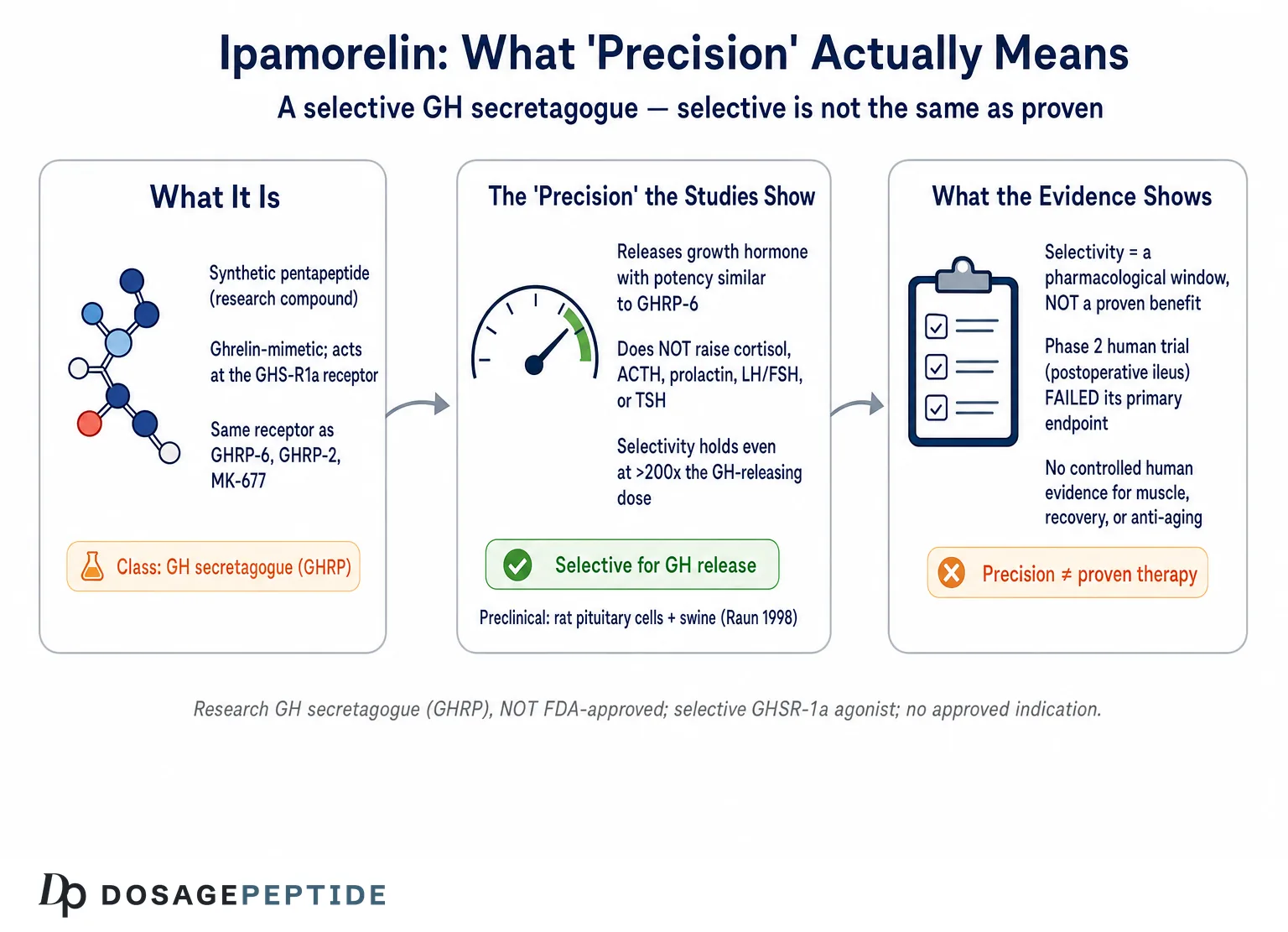
The research on Ipamorelin establishes one thing clearly and leaves a much bigger question open. What it establishes: Ipamorelin releases growth hormone without meaningfully raising cortisol, prolactin or ACTH — the finding that earned it the label “the first selective growth hormone secretagogue” in the founding 1998 pharmacology work. What it does not establish: that this receptor-level cleanliness translates into any measured clinical benefit in humans. The human record is thin, and the one company-run clinical programme that tested a real endpoint did not deliver.
That gap is the whole story, and it is why “precision” deserves interrogating rather than accepting. Precision sounds like a clinical virtue, and marketing copy deploys it as though it were one — implying that Ipamorelin is a refined instrument where older peptides were blunt. The pharmacology behind the word is genuine and replicable. The leap from that pharmacology to a therapeutic claim is not.
What “Precision” Actually Means for a Growth Hormone Secretagogue
To evaluate any claim about Ipamorelin’s precision, you first have to be clear about the axis on which that precision is measured. The pituitary gland does not release growth hormone (GH) in isolation. The same neuroendocrine machinery that governs GH secretion sits alongside the pathways controlling adrenocorticotropic hormone (ACTH) and its downstream product cortisol, the reproductive gonadotropins luteinizing hormone (LH) and follicle-stimulating hormone (FSH), prolactin (PRL), and thyroid-stimulating hormone (TSH). A compound designed to raise GH is “precise” or “selective” to the degree that it moves GH while leaving those other hormones undisturbed.
This matters because the earlier synthetic secretagogues did not manage that separation. The original growth-hormone-releasing peptides — GHRP-6, its more potent successor GHRP-2, and hexarelin — are potent GH releasers, but human studies showed they also produce reproducible increases in prolactin, ACTH, and cortisol.10 That cross-axis activity is modest relative to the GH response, but it is real and repeatable, and it is precisely the property that defines those peptides as non-selective. For a researcher trying to study the GH axis cleanly — or, hypothetically, for any future clinical use — an unwanted rise in cortisol is a confounder at best and a safety concern at worst.
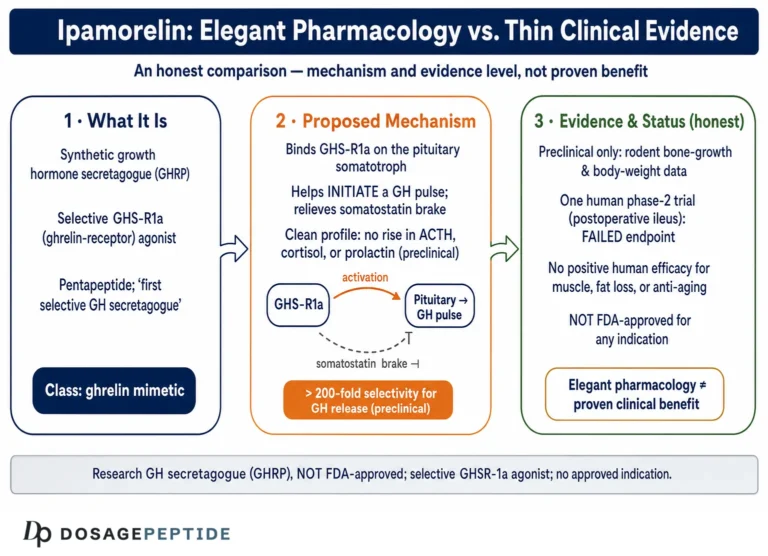
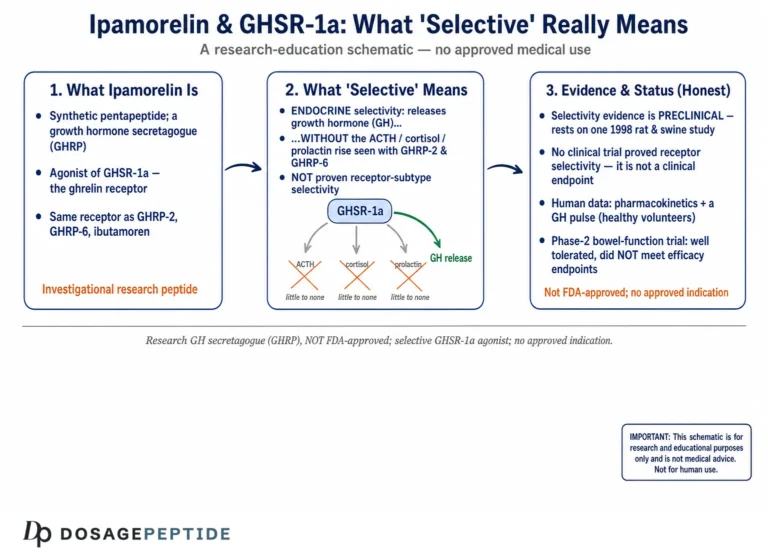
Ipamorelin’s claim to precision is therefore a claim about what it does not do. In the founding pharmacology, it released GH with a potency comparable to GHRP-6 but did not raise ACTH or cortisol above the levels seen with GHRH stimulation, even at doses more than 200-fold higher than the dose needed to release GH.1 That is the specific, measurable meaning of “precision” here: a wide separation between the dose that releases GH and the dose that begins to perturb the stress axis. It is a pharmacological window, not a therapeutic promise.
It is worth naming a second, subtler point. “Selectivity for GH release” is not the same as “selectivity for one receptor.” Ipamorelin acts at the growth hormone secretagogue receptor type 1a (GHS-R1a, the ghrelin receptor), the same receptor engaged by GHRP-6 and the endogenous hormone ghrelin.1 The difference between Ipamorelin and GHRP-6 is not that one hits a different receptor; both are GHS-R1a agonists. The difference is in the downstream neuroendocrine consequences — the functional selectivity of the response — which is why the exact molecular basis of Ipamorelin’s cleaner profile remains only partly understood. Researchers examining how Ipamorelin engages that receptor in detail may find the companion analysis on studies demonstrating Ipamorelin’s precision at the GHS-R1a receptor a useful complement to the comparative framing here.
Mapping the Family: Two Mechanistic Classes of Growth Hormone Peptides
Before Ipamorelin can be compared with “growth hormone peptides,” that catch-all phrase needs to be disaggregated, because it lumps together compounds that work through two entirely different receptors and produce two different secretion patterns. Collapsing them into one category is the single most common source of confusion in popular writing about this class.
The first class is the GHRH analogs. Growth-hormone-releasing hormone is the hypothalamic peptide that normally instructs the pituitary to make and release GH, acting through the GHRH receptor. Synthetic analogs reproduce that signal. Sermorelin is a truncated GHRH fragment corresponding to the first 29 amino acids of the native hormone; CJC-1295 is a modified GHRH analog engineered for a dramatically longer half-life.4 These compounds amplify the physiological “go” signal for GH synthesis. Readers exploring that arm of the family can see how it is framed in the site’s discussion of what research says about sermorelin’s role in stimulating natural growth hormone.
The second class is the ghrelin-receptor agonists, also called GH secretagogues or ghrelin mimetics. These act not at the GHRH receptor but at GHS-R1a, the receptor cloned in 1996 as the target of synthetic secretagogues and later found to be the natural receptor for ghrelin, the acylated stomach peptide isolated in 1999.23 This class includes the peptide GHRPs (GHRP-6, GHRP-2, hexarelin), the selective peptide Ipamorelin, and the orally active non-peptide MK-677 (ibutamoren). They work through a partly distinct intracellular pathway and, importantly, they also suppress somatostatin, the hormone that brakes GH release. Because Ipamorelin and a GHRH analog push GH through complementary mechanisms — one amplifying the accelerator, the other releasing the brake — the two are frequently paired in research framings, which is why Ipamorelin so often appears alongside CJC-1295 in exploratory protocols.
| Attribute | GHRH analogs (sermorelin, CJC-1295) | Ghrelin-receptor agonists (Ipamorelin, GHRP-2/6, MK-677) |
|---|---|---|
| Receptor | GHRH receptor | GHS-R1a (ghrelin receptor)2 |
| Endogenous counterpart | GHRH (hypothalamus) | Ghrelin (stomach)3 |
| Core action | Amplifies the GH “release” signal | Triggers release and suppresses somatostatin brake |
| Secretion pattern | Preserves pulsatile GH release | Amplifies GH pulses; also stimulates appetite (ghrelin action) |
| Selectivity concern | Relatively GH-focused | Older GHRPs spill onto ACTH/cortisol/PRL; Ipamorelin does not110 |
| Example route | Subcutaneous | Subcutaneous (peptides); oral (MK-677)5 |
Ipamorelin belongs squarely to the second class. Its distinction within that class — the whole reason it was synthesized — is that it delivers the ghrelin-receptor GH-releasing effect without the off-axis hormonal noise that the earlier members of its own family produce. That intra-class refinement, not a difference from the GHRH analogs, is what “Ipamorelin precision versus growth hormone peptides” most accurately refers to.
The Founding Study: Raun 1998 and the Origin of “Selective”
The scientific claim of precision traces to a single foundational paper: Raun and colleagues’ 1998 report in the European Journal of Endocrinology, titled, with unusual directness, “Ipamorelin, the first selective growth hormone secretagogue.”1 Everything downstream in the popular literature about Ipamorelin’s selectivity is, ultimately, an echo of this study, so it repays close reading.
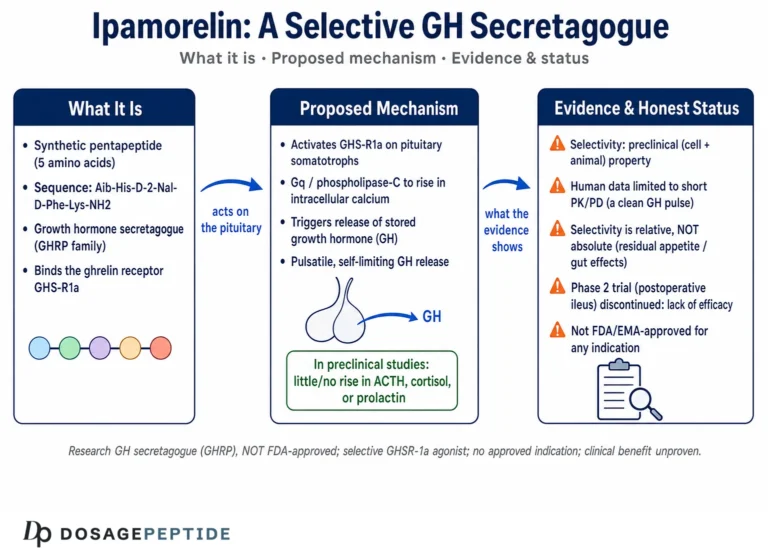
Ipamorelin is a synthetic pentapeptide, Aib-His-D-2-Nal-D-Phe-Lys-NH2, developed at what was then Novo Nordisk. Raun’s group characterized it across the standard tiers of pharmacology. In vitro, in primary rat pituitary cell cultures, Ipamorelin released GH with a potency and efficacy close to GHRP-6 (a half-maximal effective concentration in the low nanomolar range and an efficacy of roughly 85% of the GHRP-6 maximum).1 In vivo, in conscious swine, it released GH with a dose producing half-maximal effect (ED50) of about 2.3 nmol/kg. Pharmacological profiling — including the ability of a GHRP-receptor antagonist to block the effect — established that Ipamorelin, like GHRP-6, releases GH through the GHRP/ghrelin-type receptor rather than the GHRH receptor.1
The pivotal finding, the one that earned the “selective” label, was the hormonal specificity. When the investigators measured other pituitary hormones, Ipamorelin did not release ACTH or cortisol at levels different from those seen after GHRH stimulation, and it did not affect FSH, LH, prolactin, or TSH.1 Critically, this lack of effect on ACTH and cortisol persisted even at doses more than 200-fold above the ED50 for GH release. The authors’ own summary was measured and precise: Ipamorelin is the first GHRP-receptor agonist with a selectivity for GH release similar to that displayed by GHRH. That is the sentence the entire “precision” narrative rests on.
Two honest caveats belong with this celebrated result. First, it is preclinical: the selectivity data come from rat pituitary cells and swine, not from a controlled comparison in humans. Second, “selective” here is a comparative, not absolute, term — it means selective relative to the other GHRPs, whose cortisol and prolactin effects were the benchmark. The study is strong, replicable pharmacology, and it genuinely established a real property. It did not establish that Ipamorelin does anything clinically useful, and Raun’s paper never claimed it did. The gap between “selective GH secretagogue” and “effective therapy” is the gap this entire article is about.
Why the Older GHRPs Spill Over: The Non-Selective Benchmark
Ipamorelin’s precision only means something against a backdrop of imprecision, so it is worth documenting what the earlier peptides actually do. The relevant human evidence comes from studies of GHRP-2 and hexarelin, the two most potent classic GHRPs, and from work on the prototype GHRP-6.
In human studies, GHRP-2 and hexarelin produced GH responses that exceeded even a maximal dose of GHRH — they are extremely potent GH releasers — but they simultaneously produced slight but reproducible increases in prolactin (lower in magnitude than the response to TRH) and in ACTH and cortisol (comparable to the response to corticotropin-releasing hormone).10 The activity of these peptides, in the authors’ framing, is “not fully specific.” GHRP-6, the original of the class, similarly stimulates prolactin and cortisol alongside GH in human work. The cross-axis effect is modest against the size of the GH response, but it is consistent, and it is the defining signature of non-selectivity.
Why does this spillover happen? The GHS-R1a receptor these peptides activate is expressed not only in the pituitary somatotrophs that make GH but also in the hypothalamus and other central sites, and its activation can engage neural circuits that feed into the ACTH/cortisol stress axis. The classic GHRPs appear to engage these pathways enough to nudge cortisol upward. Ipamorelin, despite acting at the same receptor, does not — a functional selectivity whose molecular basis is still not fully resolved, and which is one of the genuinely interesting open questions in this pharmacology. The practical consequence is clean: Ipamorelin lets a researcher raise GH in a model system without introducing a cortisol confound, which is exactly why it became a preferred tool for studying the GH axis.
The distinction has one more layer worth flagging honestly. The mild cortisol rise from the older GHRPs is sometimes portrayed in fitness literature as a fatal flaw and Ipamorelin’s clean profile as a decisive therapeutic advantage. That overstates the stakes. In none of these compounds — selective or not — has a GH-raising effect been shown to produce a proven clinical benefit in a controlled human trial with a hard endpoint. A cleaner hormonal profile makes Ipamorelin a better research probe and, plausibly, a safer candidate on paper; it does not make it an effective drug. Precision improves the tool without validating the use.
The Receptor Behind the Precision: GHS-R1a Biology
To understand why Ipamorelin’s selectivity is scientifically interesting rather than merely convenient, it helps to look at the receptor itself, because the GHS-R1a is an unusual and instructive piece of machinery. Cloned in 1996 as the target of synthetic secretagogues, it is a seven-transmembrane G-protein-coupled receptor expressed most densely in the pituitary somatotrophs and in the hypothalamic arcuate and ventromedial nuclei, with additional expression in the hippocampus and other central regions.2 That distribution is the anatomical reason a single receptor can influence GH release, appetite, and — through downstream circuitry — the stress axis. When an agonist activates GHS-R1a, it does not simply flip one switch; it engages a receptor sitting at a crossroads of several neuroendocrine pathways.
One of the receptor’s most striking features is its high constitutive activity: even in the absence of any ligand, GHS-R1a signals at roughly half its maximal capacity, an unusually large basal tone for a GPCR.13 This ligand-independent activity is thought to be physiologically meaningful — it may set a tonic level of GH and appetite signaling — and it complicates the simple picture of agonists as on-switches. It also means that different agonists can stabilize the receptor in subtly different active conformations, biasing which intracellular pathways get engaged. That concept of biased agonism or functional selectivity is the most credible current explanation for why Ipamorelin and GHRP-6, binding the same receptor, produce different neuroendocrine outputs: they may favor different downstream couplings, so that Ipamorelin drives the GH-release arm strongly while engaging the circuits feeding the ACTH/cortisol axis only weakly.
The honest caveat is that this remains a working hypothesis rather than a fully mapped mechanism. The empirical fact — Ipamorelin releases GH without raising cortisol, GHRP-6 does not manage that separation — is solid and replicable.110 The molecular story of why, in terms of which signaling pathways each peptide biases and how that maps onto the receptor’s conformational states, is still an area of active investigation. For a compound whose entire identity rests on selectivity, it is a genuinely open and interesting question that this receptor-level uncertainty persists. Precision at the level of observed hormones has outrun mechanistic explanation at the level of receptor signaling — a reminder that even a well-established pharmacological property can have an incompletely understood basis.
Ipamorelin Versus the GHRH Analogs: Complement, Not Competitor
Because sermorelin and CJC-1295 are the other peptides most often mentioned in the same breath as Ipamorelin, it is worth being precise about how they differ — and why the comparison is partly a category error. They are not really rivals; they act on different receptors and, in research framings, are often combined precisely because their mechanisms are complementary.
CJC-1295 illustrates the GHRH-analog approach at its most engineered. In the one published human pharmacokinetic and pharmacodynamic study, Teichman and colleagues gave healthy adults single and multiple subcutaneous doses and observed dose-dependent increases in mean GH of roughly two- to tenfold lasting six days or more, and increases in IGF-1 of about 1.5- to threefold lasting nine to eleven days, with an estimated half-life of nearly a week.4 The version with the drug affinity complex (DAC) binds circulating albumin and produces a sustained, days-long elevation of GH and IGF-1. That is a fundamentally different secretion profile from Ipamorelin’s: where a GHRH analog with DAC produces a prolonged “bleed” of GH, a ghrelin-receptor agonist like Ipamorelin produces a sharper, more pulse-like release that better mimics the body’s natural episodic GH pattern.
The mechanistic logic behind pairing them is straightforward. A GHRH analog amplifies the pituitary’s instruction to release GH; a ghrelin-receptor agonist both adds an independent release signal and lifts the somatostatin brake. Two levers, two mechanisms, one output. This is why Ipamorelin appears in combination research framings with CJC-1295, and why blended growth-hormone-axis products — discussed on the site’s analysis of whether the Grow-H blend truly boosts strength and repair — combine agents from both classes. It is essential to read those combinations correctly: the mechanistic rationale for complementarity is real, but the existence of a plausible mechanism is not the same as demonstrated clinical benefit from the combination, which has not been established in controlled human trials.
The honest comparative summary is that Ipamorelin’s precision is about hormonal selectivity (it does not raise cortisol), whereas the GHRH analogs’ distinguishing feature is pharmacokinetics (how long the signal lasts). These are different virtues on different axes, and neither has been shown to translate into an approved therapy. Comparing Ipamorelin to sermorelin on “precision” is a bit like comparing two tools by different criteria; the useful comparison is within Ipamorelin’s own ghrelin-receptor class, against GHRP-6, GHRP-2, and MK-677.
Ipamorelin Versus MK-677: Peptide Pulse Versus Oral Saturation
The most instructive within-class comparison is between Ipamorelin and MK-677 (ibutamoren), because MK-677 is the one member of the ghrelin-mimetic family that has been through a rigorous, long-duration, controlled human trial — and its results are a sobering lesson in how a clean GH-raising mechanism behaves when finally tested against real clinical endpoints.
MK-677 is an orally active, non-peptide ghrelin-receptor agonist. Because it is small and orally bioavailable, it can be taken as a daily tablet and produces a sustained elevation of GH and IGF-1, in contrast to Ipamorelin’s injected, pulse-like action. The pivotal study was Nass and colleagues’ two-year, double-blind, randomized, placebo-controlled trial in 65 healthy older adults, published in Annals of Internal Medicine in 2008.5 Over twelve months, MK-677 enhanced pulsatile GH secretion, restored IGF-1 toward young-adult levels, and significantly increased fat-free mass by roughly 1.6 kg — a genuine, statistically real change in body composition. That is arguably the strongest single piece of human evidence that any ghrelin-mimetic can move a body-composition endpoint.
And yet the trial is also a cautionary tale, which is exactly why it matters for evaluating Ipamorelin. The increase in fat-free mass did not translate into improved muscle strength or better functional outcomes, and the compound worsened insulin sensitivity and raised fasting glucose in some participants.5 In other words, the best-studied member of Ipamorelin’s own receptor class raised the right hormones and even changed the scale reading for lean mass, but failed to produce the functional benefit that would justify calling it a therapy, and introduced a metabolic downside. The lesson generalizes: raising GH and IGF-1, even successfully and durably, is not automatically the same as producing a clinically meaningful outcome.
| Feature | Ipamorelin | GHRP-2 / GHRP-6 / hexarelin | MK-677 (ibutamoren) |
|---|---|---|---|
| Class | Selective peptide ghrelin-receptor agonist | Peptide ghrelin-receptor agonists | Oral non-peptide ghrelin mimetic |
| GH-releasing potency | Comparable to GHRP-61 | High; GHRP-2/hexarelin exceed max GHRH10 | Sustained GH/IGF-1 elevation5 |
| Cortisol / ACTH / prolactin | No significant rise1 | Reproducible mild increases10 | Relatively GH-focused; metabolic effects noted5 |
| Route | Subcutaneous (research) | Subcutaneous / nasal (research) | Oral5 |
| Best human evidence | Phase 2 postoperative-ileus trial (failed primary endpoint)6 | Human pharmacology, no approved indication | 2-year RCT: +lean mass, no strength gain, worse insulin sensitivity5 |
| Regulatory status | Not FDA/EMA approved | Not approved; WADA-prohibited class | Not FDA approved |
The table makes the central point visible. Ipamorelin’s advantage over its peptide cousins is selectivity; its disadvantage relative to MK-677 is that it has never been tested in anything approaching a two-year clinical trial. On the question the title poses — what makes Ipamorelin precise — the answer is clear and well-evidenced. On the unspoken follow-up — whether that precision produces benefit — the honest answer is that the best evidence in the whole class (MK-677’s) shows how easily GH elevation fails to become clinical value.
Where Precision Has Not Translated: The Human Clinical Record
Ipamorelin has an unusually informative human clinical record for a compound of its kind, because unlike most research peptides it was actually taken into controlled trials with a hard endpoint — and the results are the most important, and most underreported, fact about it.
Ipamorelin’s clinical development was aimed not at bodybuilding or anti-aging but at postoperative ileus, the temporary paralysis of gut motility that follows abdominal surgery. The rationale was sound: as a ghrelin-receptor agonist, Ipamorelin should stimulate gastrointestinal motility, and preclinical rodent work supported a prokinetic effect on gastric emptying.11 This is exactly the kind of mechanism-to-indication reasoning that looks compelling on paper. The compound advanced into human testing on that logic.
The definitive test was the proof-of-concept, randomized, double-blind, placebo-controlled Phase 2 trial reported by Beck and colleagues in 2014, which enrolled 114 patients undergoing open or laparoscopic bowel resection, randomized to twice-daily intravenous Ipamorelin (0.03 mg/kg) or placebo for up to seven postoperative days.6 The drug was well tolerated at the tested dose. But it failed: Ipamorelin did not shorten the time to first meal intake compared with placebo, and the trial showed no significant difference in measurable colonic function between the groups. It did not meet its primary endpoint. The development program in this indication was discontinued.
This outcome deserves emphasis because it is almost entirely absent from the enthusiastic secondary literature. When Ipamorelin is discussed online, it is nearly always framed around its selectivity and its theoretical benefits for body composition, recovery, or sleep — benefits for which there is no controlled human trial evidence at all. Meanwhile, the one indication in which it was rigorously tested in humans, and the one for which there was a genuine mechanistic rationale and a completed Phase 2 trial, produced a negative result. A researcher weighing Ipamorelin’s clinical promise should hold that asymmetry front of mind: the confident claims are untested, and the tested claim did not pan out.
None of this means Ipamorelin is inert. Its selectivity is real, its GH-releasing action is real, and negative trials in one indication do not exclude activity in others. But the correct scientific posture is that Ipamorelin is a well-characterized pharmacological tool whose translation into any proven clinical benefit remains unestablished — and, on the one hard test it has faced, unsuccessful.
There is a broader lesson here about how to read the growth-hormone-secretagogue field, and it applies well beyond Ipamorelin. The history of this class, traced across the comprehensive reviews of its development, is a repeated pattern in which compounds with clean, compelling mechanisms and reliable GH-raising effects entered clinical testing and then failed to demonstrate the functional or outcome benefits regulators require.9 The GHRH analog and ghrelin-mimetic programs have collectively enrolled thousands of participants over three decades, and the number of approved drugs to emerge for the anti-aging, body-composition, or recovery indications that dominate popular discussion is essentially zero. That track record is not a reason to dismiss the biology, which is genuine, but it is a strong reason to discount confident efficacy claims. When a compound’s marketing runs far ahead of its trial record — as Ipamorelin’s does — the trial record is the more reliable guide. Ipamorelin’s precision earns it a place as an excellent research probe for dissecting the GH axis; it does not earn it the therapeutic status that its selectivity is so often invoked to imply.
The Preclinical Evidence: Bone, Body Weight, and Their Limits
Beyond the acute selectivity pharmacology, Ipamorelin has been studied in a set of rodent experiments that are frequently cited as evidence of “anabolic” or “bone-building” effects. These studies are real and were competently done, but they are routinely over-read, so it is worth stating exactly what they show and what they do not.
Johansen and colleagues, in a 1999 study, showed that Ipamorelin administered subcutaneously to rats induced statistically significant longitudinal bone growth, and that chronic treatment stimulated body-weight gain in young female rats.7 Svensson and colleagues, in a 2000 study in the Journal of Endocrinology, found that both Ipamorelin and GHRP-6 increased body weight and total tibial and vertebral bone mineral content (measured by DXA) in adult female rats compared with vehicle controls.8 On their face, these look like impressive anabolic results.
But the same Svensson study contains the crucial qualifier that popular summaries almost always omit: when total bone mineral content was corrected for the increase in body weight — that is, expressed as a bone-mineral-content-to-body-weight ratio — the effect was unaffected.8 In plain terms, the animals grew bigger and their bones grew proportionally, but the bone did not become denser relative to body size. That is what you would expect from a GH-mediated increase in overall growth, and it is a materially weaker claim than “Ipamorelin builds bone density.” The distinction between absolute mass gain and density gain is exactly the kind of nuance that gets flattened when preclinical data are repackaged as consumer claims.
Three further limits bound what these rodent studies can support. First, they are growth and body-composition studies in normal or growing animals, not disease models, so they say little about any therapeutic context. Second, effects on a scale reading (body weight, bone mass) are notoriously poor predictors of functional benefit — the MK-677 human trial is the definitive demonstration that lean-mass gain need not mean strength gain.5 Third, none of this rodent work has a controlled human counterpart. The bone and body-weight literature establishes that Ipamorelin’s GH-releasing action produces the expected downstream growth effects in rodents; it does not establish a clinical use in humans.
Research Models and Methodology
The credibility of any claim about Ipamorelin depends on the methods behind it, and the compound’s evidence base spans a fairly complete preclinical hierarchy with only a thin clinical layer on top.
In vitro pituitary assays. The foundational selectivity work used primary rat pituitary cell cultures to measure GH release and to compare potency and efficacy against GHRP-6, and used receptor-antagonist studies to confirm that the effect runs through the GHRP/ghrelin-type receptor rather than the GHRH receptor.1 These assays are well suited to characterizing a secretagogue’s direct pituitary action but cannot speak to whole-organism outcomes.
Conscious large-animal models. Raun’s use of conscious swine to establish the in vivo ED50 and, crucially, the dose separation between GH release and cortisol/ACTH stimulation is methodologically strong: measuring the absence of an off-target effect across a more-than-200-fold dose range is a demanding test, and passing it is what justified the “selective” designation.1
Rodent chronic-dosing models. The bone and body-weight studies used repeated subcutaneous dosing in rats with DXA-based body-composition endpoints and direct measures of longitudinal bone growth.78 These are appropriate for characterizing chronic GH-axis effects but, again, are conducted in normal animals rather than disease models.
Human trials. The clinical methodology was appropriate and rigorous for its stated purpose: a multicenter, randomized, double-blind, placebo-controlled Phase 2 design with an objective gastrointestinal endpoint (time to first meal, colonic function) in a defined surgical population.6 The trial’s failure is therefore not attributable to weak design; it is a genuine negative result. What the human record conspicuously lacks is any controlled trial of the endpoints for which Ipamorelin is popularly promoted — muscle, recovery, sleep, or anti-aging outcomes. Those have simply never been tested in humans in a controlled fashion.
The methodological bottom line is that Ipamorelin’s selectivity is well-established by strong preclinical pharmacology, its growth effects are established in rodents, and its clinical benefit rests on a single completed human trial that was negative. Any statement that leaps from the robust selectivity data to a confident clinical claim is crossing a methodological gap that the evidence does not bridge. Researchers documenting handling parameters can consult the site’s peptide reconstitution guide and the broader dosage index for how these compounds are cataloged for educational reference.
Safety and Tolerability in Context
Ipamorelin’s selectivity gives it a plausibly favorable safety rationale, but “plausibly favorable” and “established safe” are different statements, and the distinction matters.
The theoretical safety argument is genuine. Because Ipamorelin does not raise cortisol, ACTH, prolactin, or the gonadotropins in the founding pharmacology, it avoids the endocrine perturbations that make the older, non-selective GHRPs less clean.1 In the one controlled human trial, twice-daily intravenous dosing for up to a week was reported to be well tolerated in postsurgical patients.6 Those are real, if limited, safety data points.
Several caveats temper the picture and should be stated plainly:
- Short duration. The human tolerability data cover about a week of dosing in a surgical setting. There are no controlled long-term human safety data for Ipamorelin. By contrast, the long-term human data that do exist for the ghrelin-mimetic class — from MK-677 — include worsened insulin sensitivity and higher fasting glucose over twelve months, a reminder that sustained GH-axis stimulation carries metabolic considerations regardless of hormonal selectivity.5
- Population. Safety in surgical patients does not automatically transfer to healthy individuals dosing over months for body-composition goals, a use for which no controlled safety data exist.
- GH-axis effects generally. Any agent that raises GH and IGF-1 can, in principle, cause fluid retention, joint discomfort, and effects on glucose handling; these are class considerations for GH secretagogues, not specific reassurances from Ipamorelin trials.
- Product quality. Material sold outside regulated channels as “research chemical” varies in purity, and impurities or mislabeling are real hazards independent of the molecule’s intrinsic profile.
- Anti-doping. GH secretagogues as a class are prohibited in sport under World Anti-Doping Agency rules; for tested athletes this is a regulatory hazard regardless of pharmacology.
The reasonable reading is that Ipamorelin’s selectivity plausibly reduces some endocrine risks relative to the older GHRPs, and that short-term human tolerability was acceptable in the one trial that measured it — but that a favorable short-term, cortisol-sparing profile is not evidence of long-term safety and certainly not evidence of benefit. Absence of demonstrated harm and absence of demonstrated efficacy coexist here.
Handling and Reconstitution in a Research Context
Because Ipamorelin is encountered almost exclusively as a lyophilized (freeze-dried) powder in a sealed vial, a brief, strictly educational note on laboratory handling is warranted — with the emphasis that this describes standard research-peptide practice, not a usage recommendation, and that Ipamorelin is not an approved therapeutic for any indication.
Lyophilized peptides are generally reconstituted with sterile or bacteriostatic water for laboratory purposes. The diluent is directed slowly against the inside wall of the vial rather than sprayed onto the powder, and the vial is gently swirled rather than shaken, because vigorous agitation can shear peptide bonds and denature the material. The chosen diluent volume simply sets the concentration: a fixed mass of peptide dissolved in a larger volume yields a lower concentration per unit volume, which is the arithmetic behind any reconstitution chart. Terms encountered in this context are explained in the site’s peptide research glossary.
| Parameter | Typical research-context practice |
|---|---|
| Lyophilized storage | Cool, dark conditions; freezing favored for long-term stability |
| After reconstitution | Refrigerated; used within a limited window |
| Light and heat | Minimize exposure; both degrade peptides |
| Agitation | Swirl gently; avoid shaking or foaming |
| Freeze-thaw | Repeated cycles degrade peptides; avoid |
| Sterility | Aseptic technique; bacteriostatic water for multi-use practice |
Meticulous handling changes nothing about the evidence question. A perfectly reconstituted, high-purity vial of Ipamorelin is still a compound with a selective GH-releasing action and no proven clinical benefit. Good technique preserves whatever biological activity the molecule has; it does not create efficacy where none has been demonstrated. It is also worth noting that purity and identity are not givens for material obtained outside regulated pharmaceutical supply: independent analyses of research-grade peptides have repeatedly found discrepancies between labeled and actual content, so any experimental observation made with unverified material carries a confound that no amount of careful reconstitution can remove. Certificate-of-analysis documentation and, ideally, independent mass-spectrometry confirmation are the only reliable checks, and even those speak to the vial in hand rather than to any therapeutic value of the molecule.
Regulatory Status
Ipamorelin’s regulatory picture is straightforward once the marketing haze is cleared away: it has no approved therapeutic use anywhere.
No approval, any indication. Ipamorelin is not approved as a drug by the FDA, the EMA, or any comparable major regulator for obesity, muscle wasting, growth-hormone deficiency, postoperative ileus, or any other condition. Its most advanced clinical program — the postoperative-ileus Phase 2 trial — ended in a negative result, and development in that indication was discontinued.6 There is, correspondingly, no approved label that could be extended to any other use.
Compounding scrutiny. In the United States, Ipamorelin has been among the peptide substances examined by the FDA in the context of pharmacy compounding under Section 503A, with regulatory reviews raising the familiar concerns about characterization, immunogenicity, and the absence of adequate clinical effectiveness data for such peptides.12 The clear signal is continued regulatory caution about compounded peptide products, Ipamorelin included.
Anti-doping prohibition. Growth hormone secretagogues and GH-releasing peptides are prohibited in sport under the World Anti-Doping Agency’s rules. Athletes subject to testing should assume that use of Ipamorelin constitutes an anti-doping rule violation.
The regulatory synthesis is that Ipamorelin is an investigational compound with well-characterized pharmacology, no approved indication, a negative pivotal trial in its lead indication, unresolved compounding status, and a sport prohibition. Any legitimate exploration of the compound belongs in properly authorized preclinical or clinical research under appropriate oversight — not off-label or informal use. For readers tracking how the evidence base for this and related compounds evolves, the site’s receptor-level analysis of Ipamorelin is a natural next step.
Frequently Asked Questions
What makes Ipamorelin “precise” or “selective”?
Its precision is a specific, measurable pharmacological property: Ipamorelin releases growth hormone with a potency comparable to the older peptide GHRP-6, but without significantly raising ACTH, cortisol, prolactin, or the reproductive hormones — even at doses more than 200-fold above the dose needed to release GH.1 The classic GHRPs (GHRP-2, GHRP-6, hexarelin) do produce reproducible increases in prolactin, ACTH, and cortisol, which is why they are called non-selective.10 “Precision” here means a wide separation between the GH effect and the stress-hormone effect — a pharmacological window, not a proven clinical advantage.
Does Ipamorelin act on a different receptor than other growth hormone peptides?
Not from the other ghrelin mimetics. Ipamorelin, GHRP-6, GHRP-2, hexarelin, and MK-677 all act on the same receptor, GHS-R1a (the ghrelin receptor).2 Ipamorelin’s selectivity is a difference in the downstream hormonal consequences, not in which receptor it binds. The GHRH analogs (sermorelin, CJC-1295) are the ones that act on a genuinely different receptor, the GHRH receptor.4
Has Ipamorelin been proven to work in humans?
No, not for any indication. The one completed controlled human trial — a Phase 2 study in 114 bowel-resection patients testing whether Ipamorelin speeds gastrointestinal recovery after surgery — failed to meet its primary endpoint, showing no significant benefit over placebo.6 The body-composition, recovery, and sleep benefits often attributed to Ipamorelin have not been tested in controlled human trials at all.
How does Ipamorelin compare with CJC-1295 and sermorelin?
They work through different receptors and are complementary rather than competing. Sermorelin and CJC-1295 are GHRH analogs that amplify the pituitary’s GH-release signal; CJC-1295 with DAC produces a long, sustained GH and IGF-1 elevation lasting many days.4 Ipamorelin is a ghrelin-receptor agonist that produces a sharper, pulse-like release and adds a second mechanism by lifting the somatostatin brake. This is why the two classes are often paired in research framings — though a plausible mechanistic rationale for combining them is not the same as demonstrated clinical benefit.
How does Ipamorelin compare with MK-677?
Both act on the ghrelin receptor, but MK-677 is orally active and produces sustained GH/IGF-1 elevation, whereas Ipamorelin is injected and pulse-like. MK-677 is the only member of the class studied in a long, rigorous human trial: over two years in older adults it increased fat-free mass but did not improve strength and worsened insulin sensitivity.5 That result is a key lesson — raising GH successfully does not guarantee a functional benefit.
Do the rat studies mean Ipamorelin builds bone and muscle?
They show less than the headlines suggest. Ipamorelin increased body weight and total bone mineral content in rats, but when bone mineral content was corrected for the body-weight increase, the effect disappeared — the bones grew in proportion to overall growth rather than becoming denser.8 These are growth studies in normal rodents, not disease models, and they have no controlled human counterpart. They demonstrate the expected downstream effects of GH release, not a proven anabolic therapy.
Is Ipamorelin approved or legal?
It is not approved as a drug for any condition by the FDA, EMA, or other major regulators. Its lead clinical program (postoperative ileus) ended in a negative trial, it has faced U.S. regulatory scrutiny in the compounding context with concerns about characterization and lack of effectiveness data, and growth hormone secretagogues are prohibited in sport by WADA.612
Is Ipamorelin safer than the older GHRPs?
On paper, plausibly — because it does not raise cortisol, ACTH, or prolactin, it avoids some endocrine perturbations of the non-selective peptides.1 But this is a rationale, not established long-term safety. Human tolerability data cover only about a week of dosing, and class-wide data (from MK-677) show that sustained GH-axis stimulation can worsen glucose handling regardless of hormonal selectivity.5 A cleaner profile is not the same as a proven-safe drug.
References
- Raun K, Hansen BS, Johansen NL, et al. Ipamorelin, the first selective growth hormone secretagogue. Eur J Endocrinol. 1998;139(5):552-561. PMID: 9849822. https://pubmed.ncbi.nlm.nih.gov/9849822/
- Howard AD, Feighner SD, Cully DF, et al. A receptor in pituitary and hypothalamus that functions in growth hormone release. Science. 1996;273(5277):974-977. PMID: 8688086. https://pubmed.ncbi.nlm.nih.gov/8688086/
- Kojima M, Hosoda H, Date Y, et al. Ghrelin is a growth-hormone-releasing acylated peptide from stomach. Nature. 1999;402(6762):656-660. PMID: 10604470. https://pubmed.ncbi.nlm.nih.gov/10604470/
- Teichman SL, Neale A, Lawrence B, et al. Prolonged stimulation of growth hormone (GH) and insulin-like growth factor I secretion by CJC-1295, a long-acting analog of GH-releasing hormone, in healthy adults. J Clin Endocrinol Metab. 2006;91(3):799-805. https://academic.oup.com/jcem/article-abstract/91/3/799/2843281
- Nass R, Pezzoli SS, Oliveri MC, et al. Effects of an oral ghrelin mimetic on body composition and clinical outcomes in healthy older adults: a randomized trial. Ann Intern Med. 2008;149(9):601-611. PMCID: PMC2757071. https://pmc.ncbi.nlm.nih.gov/articles/PMC2757071/
- Beck DE, Sweeney WB, McCarter MD, et al. Prospective, randomized, controlled, proof-of-concept study of the ghrelin mimetic ipamorelin for the management of postoperative ileus in bowel resection patients. Int J Colorectal Dis. 2014;29(12):1527-1534. https://link.springer.com/article/10.1007/s00384-014-2030-8
- Johansen PB, Nowak J, Skjaerbaek C, et al. Ipamorelin, a new growth-hormone-releasing peptide, induces longitudinal bone growth in rats. Growth Horm IGF Res. 1999;9(2):106-113. PMID: 10373343. https://pubmed.ncbi.nlm.nih.gov/10373343/
- Svensson J, Lall S, Dickson SL, et al. The GH secretagogues ipamorelin and GH-releasing peptide-6 increase bone mineral content in adult female rats. J Endocrinol. 2000;165(3):569-577. https://joe.bioscientifica.com/view/journals/joe/165/3/569.xml
- Ishida J, Saitoh M, Ebner N, et al. Growth hormone secretagogues: history, mechanism of action, and clinical development. JCSM Rapid Commun. 2020;3(1):25-37. doi:10.1002/rco2.9. https://onlinelibrary.wiley.com/doi/full/10.1002/rco2.9
- Arvat E, Di Vito L, Maccagno B, et al. Effects of GHRP-2 and hexarelin, two synthetic GH-releasing peptides, on GH, prolactin, ACTH and cortisol levels in man. Comparison with the effects of GHRH, TRH and hCRH. Peptides. 1997;18(6):885-891. https://www.sciencedirect.com/science/article/abs/pii/S0196978197000168
- Greenwood-Van Meerveld B, Kriegsman M, Nelson R. Efficacy of ipamorelin, a ghrelin mimetic, on gastric dysmotility in a rodent model of postoperative ileus. J Exp Pharmacol. 2012;4:149-160. PMCID: PMC4863553. https://pmc.ncbi.nlm.nih.gov/articles/PMC4863553/
- U.S. Food and Drug Administration. Pharmacy Compounding Advisory Committee (PCAC) Briefing Document, 2024 (peptide substances review, Section 503A bulk drug substances). https://www.fda.gov/media/182088/download
- Mear Y, Enjalbert A, Thirion S. GHS-R1a constitutive activity and its physiological relevance. Front Neurosci. 2013;7:87. doi:10.3389/fnins.2013.00087. PMCID: PMC3665924. https://pmc.ncbi.nlm.nih.gov/articles/PMC3665924/
Educational and research-use disclaimer: This article is provided solely for scientific and educational purposes. Ipamorelin is an investigational growth hormone secretagogue and is not approved by the FDA, EMA, or any comparable regulator for the treatment, cure, or prevention of any disease. Its lead clinical program (postoperative ileus) did not meet its primary endpoint, and no human efficacy for body composition, recovery, anti-aging, or other popularly claimed uses has been demonstrated in controlled trials. Nothing here is medical advice or a recommendation for human use, and growth hormone secretagogues are prohibited in sport by WADA. Any legitimate investigation of this compound should occur within properly authorized preclinical or clinical research under appropriate oversight. Readers should consult qualified professionals and applicable regulations before making any decisions.