Someone holding a 600 mg glutathione vial almost always arrives with the same question: how many milligrams per dose, how many units on the syringe, and how many times a week? This article answers the arithmetic completely and honestly — but it also answers the question behind the question, which has a very different answer: there is no validated, approved, or trial-established injectable glutathione dose for skin lightening, antioxidant support, or “detox” in humans. The research question this page actually addresses is therefore narrower and more useful: what is genuinely known about glutathione as a molecule, what is documented about each route of administration, and what can — and cannot — be inferred about the number on a vial label?
The short version, stated up front so nothing is buried: the dilution math is knowable and exact. The dose is not established. Those two statements are not in tension, and the rest of this article explains why both are true at the same time.
What Does a 600 mg Glutathione Vial Actually Contain?
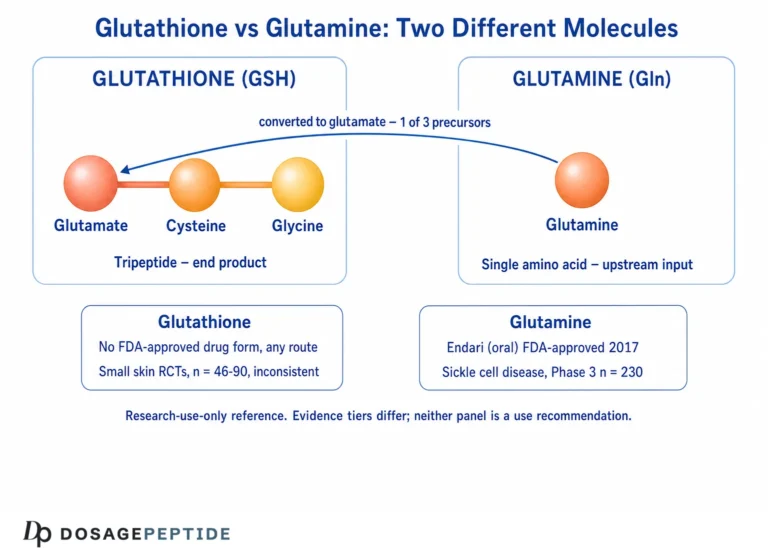
Glutathione is not a synthetic designer peptide in the way that most compounds catalogued on this site are. It is gamma-L-glutamyl-L-cysteinyl-glycine — a tripeptide built from three ordinary amino acids: glutamate, cysteine, and glycine. Essentially every cell in the human body makes it, continuously, in the cytosol, and it is the most abundant non-protein thiol in mammalian tissue, present at millimolar concentrations intracellularly. If you are researching glutathione, you are not researching an exotic molecule. You are researching one of the most thoroughly characterised small molecules in all of biochemistry.
The structural detail that matters most is the gamma peptide bond. In an ordinary peptide, amino acids link through the alpha-carboxyl group. In glutathione, glutamate donates its side-chain (gamma) carboxyl to cysteine’s amino group. This is not a chemical curiosity — it is functionally decisive. The gamma linkage makes glutathione resistant to the standard intracellular peptidases that would otherwise chew it apart in minutes, which is precisely why the cell can maintain such a large standing pool of it. Only one enzyme family, gamma-glutamyl transferase (GGT), cleaves that bond efficiently, and GGT is anchored on the outer face of cell membranes — abundantly on intestinal epithelium, kidney, and liver.
That single anatomical fact — GGT sitting on the outside of the gut and liver — is the hinge on which the entire oral-versus-injectable debate turns, and we return to it repeatedly below. It is also the reason that glutathione behaves less like a drug you can dose and more like a metabolite the body insists on managing itself.
Why 600 mg specifically?
There is no pharmacological derivation behind the 600 mg vial. It is a supply-chain number, not a dose-finding number. Research-chemical vials are filled at round figures that divide conveniently: 600 mg splits cleanly into six 100 mg portions or three 200 mg portions. The figure also happens to echo the quantity used in a much-cited and methodologically weak 1996 open-label Italian series, which administered 600 mg intravenously twice daily for 30 days to nine untreated early Parkinson-disease patients[1] — a study that had nothing whatsoever to do with skin, used a different route, and was never replicated under blinding. No regulator, no trial, and no pharmacopoeia established 600 mg as a per-dose or per-vial unit for any cosmetic or antioxidant use. It is important to say this plainly, because the presence of a specific number on a label creates a strong and entirely false impression that someone, somewhere, calculated it.
The vial also contains glutathione as a lyophilised powder — and often, in the research-chemical market, as glutathione supplied under dietary-supplement grade rather than sterile-injectable grade. That distinction is not pedantry; as documented later in this article, it is the exact failure mode behind the FDA’s formal warning on the compound[2].
For the full background on glutathione as a molecule — its synthesis, its redox role, and why it is called the master antioxidant — see our companion overview on what glutathione is and what the master-antioxidant research actually shows.
What Is the Research Context for Injectable Glutathione?
Glutathione occupies an unusual and somewhat uncomfortable position in the research literature. Its basic biology is textbook-grade settled. Its therapeutic administration — particularly by injection — is close to evidence-free. Very few compounds sit at such an extreme distance between “we understand this molecule” and “we have no idea what injecting it accomplishes.”
The three distinct research literatures
When people search for glutathione dosing, they are usually unaware that they are colliding three separate bodies of literature that do not speak to each other:
- Redox biochemistry. Decades of rigorous mechanistic work on the GSH/GSSG couple, glutathione peroxidase, glutathione-S-transferase, glutamate-cysteine ligase, and Nrf2-driven transcriptional control. This literature is excellent. It says nothing about what happens when you inject the finished tripeptide.
- Cosmetic depigmentation. A small cluster of mostly Asian trials, almost entirely oral or topical, mostly under 12 weeks, none of them large, measuring melanin index by instrument. Modest effects, inconsistent, reversible.
- Neurology and oncology adjunct use. Small Parkinson-disease trials and chemotherapy-toxicity adjunct studies. These used intravenous administration for entirely unrelated indications and never generated a cosmetic dose.
The commercial glutathione market — the IV drip bars, the vial listings, the “dosage charts” that populate search results — is built almost entirely on quietly borrowing credibility from literatures one and three to sell an application that only literature two ever tested, and that literature two tested by a different route.
What a clinical-trial registry search reveals
This is worth doing yourself rather than taking on faith. A ClinicalTrials.gov search for interventional glutathione studies in skin lightening, hyperpigmentation, or melasma returned six registered trials as of July 2026. Every one of them delivers glutathione topically, orally, or locally into the target tissue — ultrasound-assisted topical delivery, an oral effervescent tablet, microneedling-assisted application, mesotherapy, and, in one Phase 2 study, direct local injection into gingival tissue. Not one of them tests intravenous or subcutaneous glutathione for systemic skin lightening. The registry is not hiding a body of evidence. There is no body of evidence to hide.
That absence is the single most important fact on this page, and it is confirmed independently by the published reviews. A 2016 South African Medical Journal safety review searching MEDLINE through 30 September 2015 concluded flatly that despite widespread reported use, there are no studies of IV glutathione use for skin lightening, and no studies of its safety for chronic use for any indication[3]. A systematic review in the International Journal of Dermatology (online 2024, in print 2025), covering ten years of literature, found exactly one placebo-controlled study of IV glutathione — a small comparison reporting 6 of 16 versus 3 of 16 responders at p = 0.054 — and concluded that IV glutathione is contraindicated due to lack of efficacy and side effects[4].
And note: even that literature concerns intravenous glutathione. Subcutaneous glutathione — the route implied by a lyophilised vial, bacteriostatic water, and an insulin syringe — has an even thinner evidence base than IV, which is itself close to zero. There is no published pharmacokinetic characterisation of subcutaneous glutathione in humans establishing bioavailability, half-life, or dose-response. Nobody knows what fraction of a subcutaneous glutathione dose survives to reach systemic circulation intact, and nobody has published the study that would tell you.
What Mechanisms Have Been Studied?
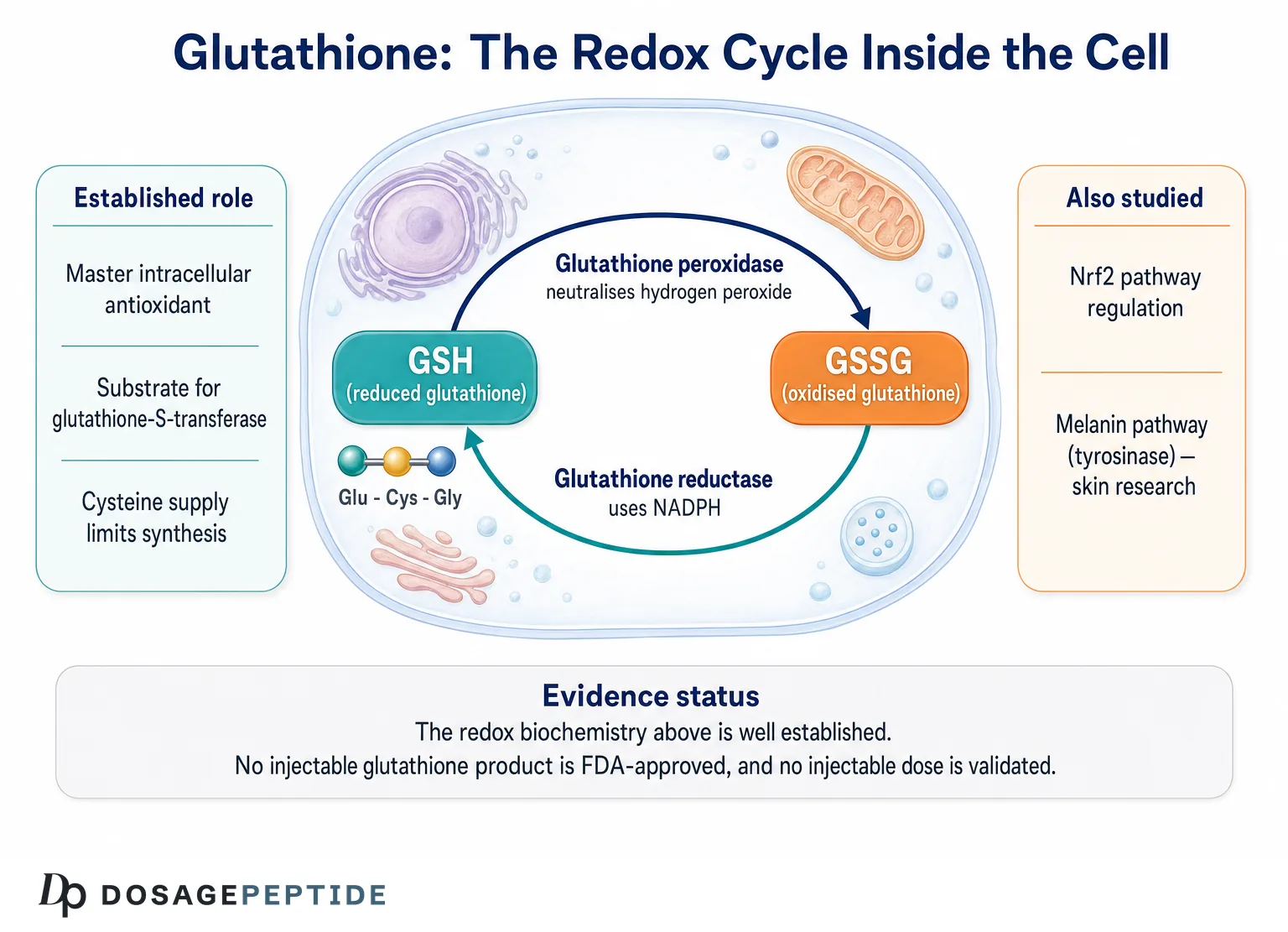
This is the section where confidence is warranted, because the mechanism work is real. The critical discipline is to keep mechanism and outcome separate: a well-characterised mechanism is not evidence that a given route and dose engages that mechanism in a living person.
The GSH/GSSG redox couple
Glutathione’s reactive element is the cysteine thiol (–SH). Two glutathione molecules can be oxidised, joining via a disulfide bridge to form glutathione disulfide (GSSG). Glutathione reductase, using NADPH from the pentose phosphate pathway, converts GSSG back to two GSH. The ratio of GSH to GSSG is the cell’s principal redox buffer, typically maintained above 100:1 in a healthy cytosol. This ratio is not merely a passive readout — it actively sets the redox state of protein cysteines throughout the cell, which in turn gates the activity of dozens of enzymes and transcription factors. Glutathione is a signalling variable, not just a sponge for free radicals.
It is worth being precise about what that implies. Because the couple is a ratio, the biologically meaningful quantity is not the absolute amount of glutathione present but the balance between its reduced and oxidised forms in a specific compartment — and compartments differ. Mitochondrial glutathione is regulated separately from cytosolic glutathione, and neither is the same pool as the small amount circulating in plasma. A number measured in blood is not a number measured where the chemistry happens.
Glutathione peroxidase and glutathione-S-transferase
Two enzyme families do most of the downstream work. Glutathione peroxidases (GPx) use GSH to reduce hydrogen peroxide and lipid hydroperoxides to water and alcohols, consuming GSH and producing GSSG. Glutathione-S-transferases (GST) conjugate GSH onto electrophilic xenobiotics, creating water-soluble adducts that are exported and excreted — this is the phase-II detoxification chemistry that the word “detox” originally referred to before marketing appropriated it. Both are extremely well described. Both operate inside cells, on the intracellular glutathione pool.
That last point carries more weight than it is usually given. Neither enzyme family can act on tripeptide that is sitting in plasma or in the subcutaneous interstitium. For an injected molecule to reach the chemistry, it would have to enter the cell — and the cell has no dedicated importer for intact glutathione. The canonical route in is dismantling at the membrane by GGT and re-synthesis inside from the constituent amino acids.
Nrf2 and the antioxidant response element
Glutathione synthesis is controlled at the transcriptional level, largely through the transcription factor Nrf2 acting on antioxidant response elements (ARE) in the promoters of the genes encoding glutamate-cysteine ligase (catalytic subunit GCLC and modifier subunit GCLM) and glutathione synthetase. The rate-limiting step is GCL, and the rate-limiting substrate is cysteine availability — not glycine, not glutamate, and not, notably, finished glutathione.
This has a direct and under-appreciated implication. The cell’s glutathione level is a regulated set-point governed by feedback (GSH inhibits GCL) and by cysteine supply. Flooding the extracellular compartment with intact tripeptide does not obviously perturb a system engineered to control itself from the inside. This is a mechanistic reason for scepticism about injectable glutathione that exists entirely independent of the missing trials.
The antimelanogenic mechanisms
Three mechanisms are cited to explain glutathione’s depigmenting effect, and they are mechanistically plausible in vitro:
- Direct tyrosinase inhibition. Glutathione chelates the copper ion at tyrosinase’s active site. Tyrosinase is the rate-limiting enzyme of melanogenesis; inhibit it and melanin output falls.
- The eumelanin-to-pheomelanin switch. This is the mechanism most often cited. Thiol compounds, glutathione among them, intercept dopaquinone in the melanin synthesis pathway and shunt it toward cysteinyl-dopa and ultimately pheomelanin (red-yellow) rather than eumelanin (brown-black). The visible result is lighter skin.
- Indirect antioxidant action. By quenching reactive oxygen species and free radicals that stimulate melanogenesis, glutathione may reduce pigment production upstream.
All three are demonstrated in cell and enzyme systems. None of the three has been shown to be engaged, at any particular plasma concentration, by an injected dose in a human being. That is a different claim entirely, and it is the claim on which every injectable dosage chart silently rests.
The second mechanism also deserves a moment of honesty that the marketing literature never gives it. Pheomelanin is the less photoprotective pigment. Shifting melanin production from eumelanin to pheomelanin means, mechanistically, reducing the skin’s own UV defence. The concern that chronic systemic glutathione could raise long-term skin cancer risk in previously well-protected individuals is not a scare-tactic invention — the peer-reviewed safety literature states directly that the switch from brown to red melanin production may increase the risk of sun-induced skin cancers in previously protected individuals[3]. No study has quantified that risk, in either direction. It remains theoretical. But it is theoretical because nobody has looked, not because anyone has ruled it out.
What Is the Current Evidence Level for Each Route?
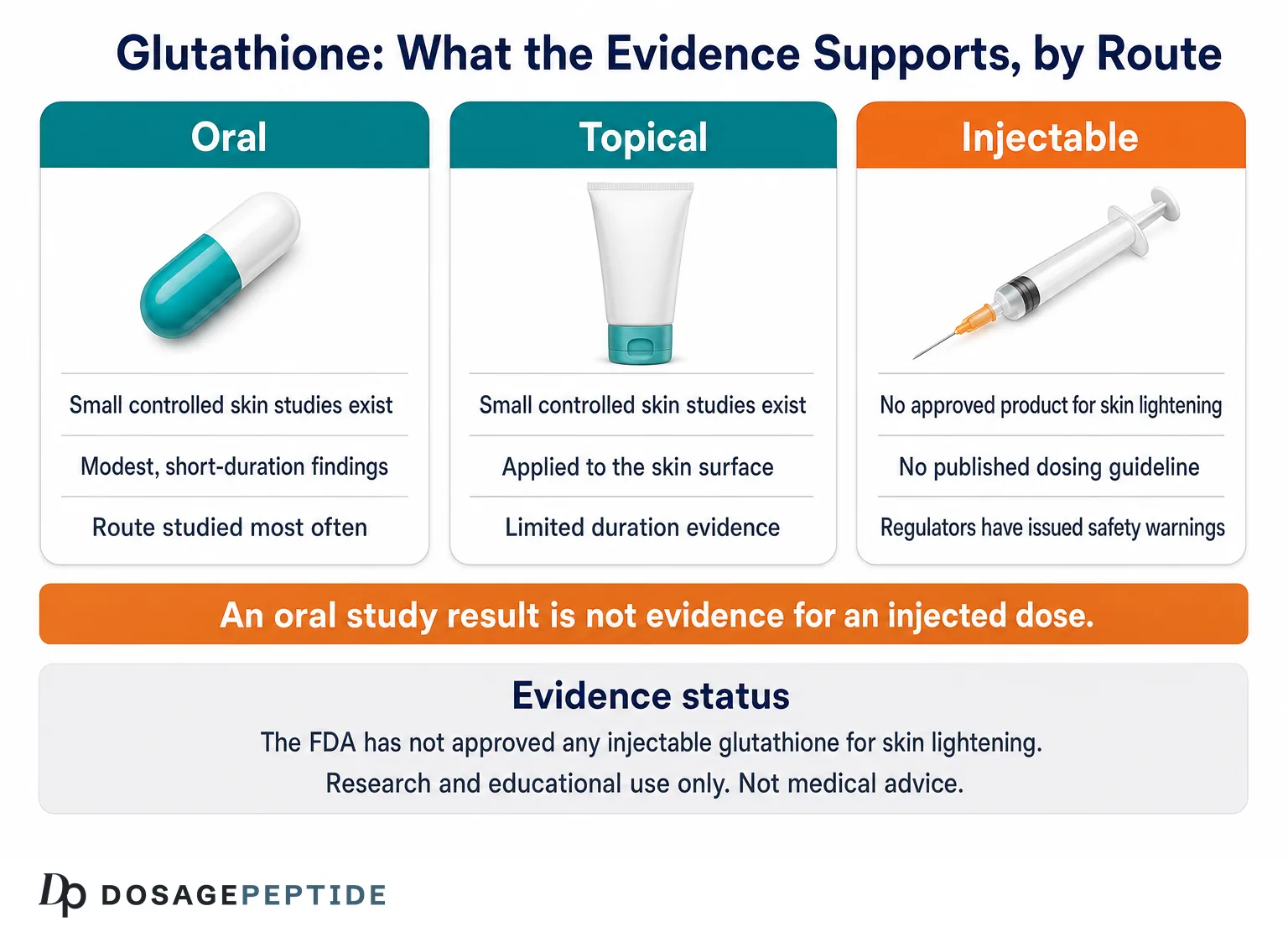
Evidence tier must be stated per route, because the routes are not interchangeable. Here is the honest map.
| Route | Evidence tier | What actually exists | Established dose? |
|---|---|---|---|
| Oral (capsule/tablet) | Small human RCTs, low-to-moderate quality | Several randomised placebo-controlled trials, 250–500 mg/day, 4–12 weeks, n = 60–83. Mixed results. | No. Cosmetic supplement use; not an approved therapeutic dose. |
| Topical | Small human RCTs | 2% oxidised glutathione (GSSG) lotion, 10 weeks, n = 30, split-face design. Positive on melanin index. | No. Cosmetic formulation, not an approved drug. |
| Buccal / sublingual lozenge | Case series | One case series of glutathione lozenges in 30 participants, reporting a decreased melanin index. No control group[3]. | No. |
| Intravenous (skin lightening) | Essentially none | One weak placebo-controlled study identified across a 10-year systematic review. No guidelines for dose or duration. | No. Not approved anywhere for this use. |
| Intravenous (Parkinson disease) | Small pilot RCT, negative on primary outcome | 21 participants, 1,400 mg IV three times weekly for 4 weeks. Well tolerated; no significant UPDRS difference. | No — and a different indication entirely. |
| Subcutaneous (any indication) | No published human evidence | No PK study. No efficacy trial. No safety cohort. No registered trial. | No. |
The oral trials, reported accurately
The trial most frequently invoked — and most frequently misrepresented — is Arjinpathana & Asawanonda (2012). Sixty healthy medical students in Bangkok were randomised to 500 mg/day of oral glutathione in two divided doses, or placebo, for four weeks. Melanin index fell consistently at all six measured sites in the glutathione group, but the reduction reached statistical significance versus placebo at only two of six sites — the right side of the face (p = 0.021) and the sun-exposed left forearm (p = 0.036). The authors’ own conclusion is a model of restraint: oral glutathione lightens skin colour in a small number of subjects, long-term safety has not been established, and more extensive trials are warranted[5].
Weschawalit and colleagues (2017) ran a 12-week three-arm randomised placebo-controlled trial in healthy women at 250 mg/day of either reduced (GSH) or oxidised (GSSG) glutathione. Melanin index and UV spots “tended to be lower” than placebo; wrinkle reduction reached significance at some sites; no serious adverse effects[6]. The language — “tended to be lower” — is doing real work there and should not be upgraded in retelling.
The most instructive trial is the one that is almost never cited: Sitohang and colleagues (2021), a randomised, double-blind, controlled multicentre Indonesian trial conducted across three teaching-hospital dermatovenereology clinics in 83 participants who completed the study. The intervention was not glutathione alone: it was an oral combination supplement of L-glutathione with ascorbic acid, alpha-lipoic acid, and zinc aspartate. Reductions in spot ultraviolet in certain subgroups, spot polarisation, and skin tone were greater in the supplement group than in placebo — but the difference was not statistically significant[7]. The largest and most rigorously designed trial in this literature found no significant difference.
Two caveats cut in opposite directions and both belong in an honest summary. Because the product was a four-ingredient blend, the null result cannot be pinned on glutathione specifically — but by exactly the same logic, no positive claim about glutathione can be extracted from it either. And the trial is systematically absent from the pages selling the compound, which is itself informative.
The topical trial
Watanabe and colleagues (2014) conducted a randomised, double-blind, matched-pair, placebo-controlled split-face trial in 30 healthy women aged 30–50, applying 2% (w/w) oxidised glutathione lotion to one side of the face and placebo to the other, twice daily for 10 weeks. Melanin index was significantly lower on the GSSG side from early in the trial through to week 10 (p<0.001 at 10 weeks), with additional improvements in stratum corneum moisture, wrinkle formation, and smoothness[8]. This is, by design, the cleanest study in the entire glutathione depigmentation literature — the split-face architecture eliminates between-subject variance almost entirely, because each participant serves as her own control under identical sun exposure, identical skin type, and identical behaviour.
It is also, by construction, a study about a lotion. It is evidence for topical 2% GSSG. It is evidence for nothing else.
The reviews converge
Two independent reviews reach compatible conclusions. Davids and colleagues (2016), searching MEDLINE, found no studies of intravenous glutathione for skin lightening at all, and no studies of its safety for chronic use for any indication — noting that every trial that does exist, across every indication, ran either a few doses or 4–12 weeks[3]. Sarkar and colleagues (2025) found roughly equal numbers of included studies at low and high risk of bias, described topical and oral effects as “moderately efficacious” but “unsustainable,” and stated that IV glutathione is contraindicated[4].
“Unsustainable” is another word worth pausing on. It means the effect reverses when you stop. No trial has demonstrated a durable pigmentary change from any route.
How does this compare to the GHK-Cu skin literature?
A useful calibration exercise: compare glutathione to another compound in the same category on this site.
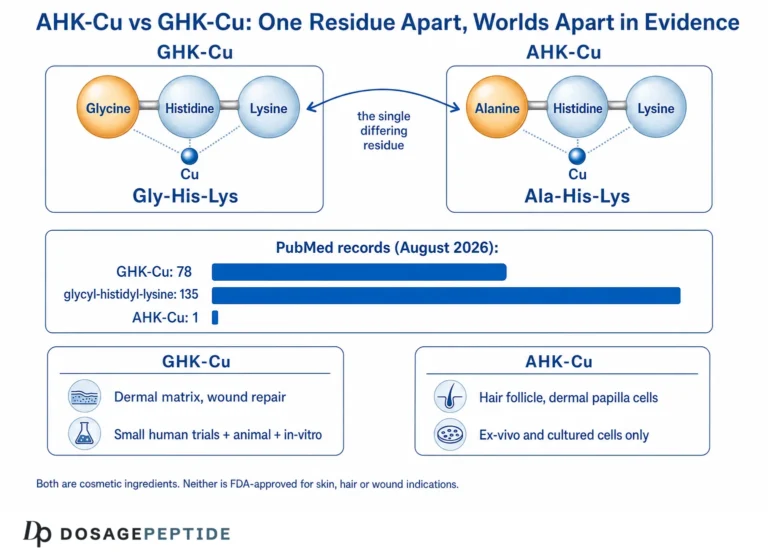
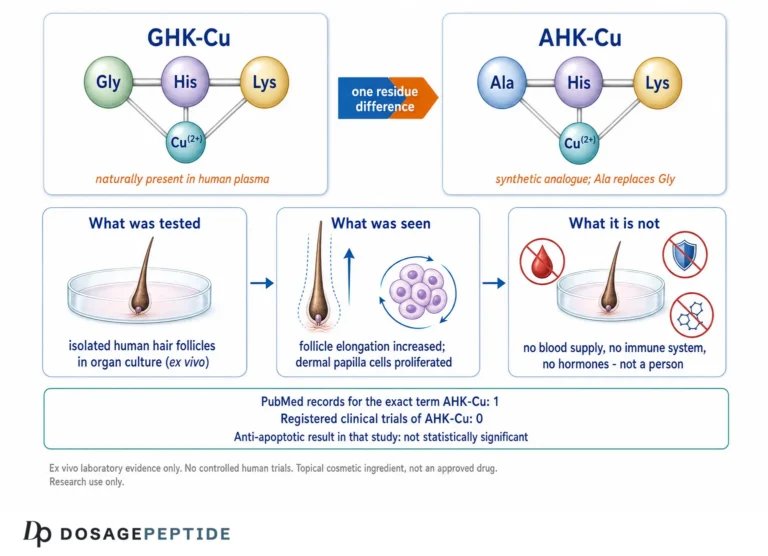
GHK-Cu — glycyl-L-histidyl-L-lysine complexed with copper — shares glutathione’s basic situation in outline: an endogenous small peptide, a substantial mechanistic literature, and a large gap between mechanism and clinical proof. But the shape of its evidence differs in an instructive way. GHK-Cu has a considerably richer topical literature, including cosmetic formulation studies, and its systemic injectable use faces the same evidentiary void that glutathione’s does. Our analysis of injectable versus topical GHK-Cu in the skin research literature works through that route distinction in detail, and the GHK-Cu 50 mg vial dosage protocol documents the corresponding reconstitution figures.
The pattern generalises across this entire compound category, and it is the single most valuable thing to internalise from this page: for skin-directed peptides, the topical evidence is almost always better than the injectable evidence, and the injectable route is almost always the one being sold. That is not a coincidence. Topical formulations are cheap to test, low-risk to trial, and cosmetically regulated. Injectables are expensive to test, carry real liability, and would require the sponsor to generate exactly the data that currently does not exist. The market has responded to those incentives by simply skipping the step.
Glutathione is the most extreme instance of the pattern. Its best-designed study is a split-face lotion trial[8]. Its most-sold form is an injection whose entire skin-lightening evidence base is a single weak placebo-controlled study that a systematic review used as grounds to call the route contraindicated[4].
Why Can’t an Oral Study Set an Injectable Dose?
This is the central deception of the glutathione niche, and it is worth dismantling explicitly because it is committed so casually that most people repeating it do not realise they are doing it.
The move looks like this: cite Arjinpathana & Asawanonda’s 500 mg/day result. Note that oral bioavailability is poor. Conclude, apparently reasonably, that injection “bypasses the bioavailability problem” and therefore that an injectable dose — smaller, since it skips first-pass — must be at least as effective. Arrive at a number. Print a chart.
Every step of that reasoning is invalid, and here is precisely why.
The oral bioavailability data does not point where people think it points
Witschi and colleagues (1992) gave seven healthy volunteers a single oral dose of glutathione at 0.15 mmol/kg — roughly 3 grams for an average adult. Over the following 270 minutes, plasma concentrations of glutathione, cysteine, and glutamate did not increase significantly. Their conclusion: the systemic availability of oral glutathione is negligible in man, because dietary glutathione is hydrolysed by intestinal and hepatic gamma-glutamyl transferase before it can reach circulation intact[9].
Now hold two facts side by side. Oral glutathione at 3 grams does not measurably raise plasma glutathione. Oral glutathione at 500 mg/day nonetheless produced a measurable melanin index change at two facial and forearm sites. Those facts together mean the oral effect — whatever it is — is not mediated by intact circulating tripeptide.
That is a devastating problem for the injectable inference. If the oral result does not depend on plasma glutathione, then raising plasma glutathione by injection is not “doing the oral thing, better.” It is doing a completely different thing whose effect on melanocytes nobody has measured.
The picture is further complicated by Richie and colleagues (2015), a six-month randomised double-blind placebo-controlled trial of oral glutathione at 250 or 1,000 mg/day in 54 non-smoking adults. Unlike Witschi’s single-dose study, chronic dosing did raise body stores: at six months, glutathione rose approximately 30–35% in erythrocytes, plasma, and lymphocytes and 260% in buccal cells at the high dose (p<0.05). All values returned to baseline after a one-month washout[10]. The most likely explanation is that chronic oral glutathione works as a slow cysteine delivery system — hydrolysed in the gut, absorbed as constituent amino acids, and reassembled endogenously — rather than as intact tripeptide crossing the enterocyte.
If that interpretation is right, the injectable route does not improve on the oral route. It bypasses the very mechanism by which the oral route appears to work.
Route determines everything, and there is no conversion factor
Routes are not interchangeable units of the same currency. Changing route changes absorption kinetics, peak concentration, tissue distribution, metabolic fate, immunogenic exposure, and the risk profile. There is no arithmetic that converts “500 mg orally, daily, for four weeks, with a marginal two-site melanin effect” into any subcutaneous number whatsoever. Not a conservative one. Not an aggressive one. Not any number at all. The conversion does not exist because the required pharmacokinetic bridging study has never been published.
It is worth being explicit about what such a study would have to contain, because the list makes the size of the gap concrete: a measured plasma concentration-time curve after a subcutaneous dose; an absolute bioavailability figure against an intravenous reference; an elimination half-life; evidence about whether the injected molecule survives in plasma as intact tripeptide or is cleaved at the endothelium by GGT within minutes; a demonstration that any of it reaches skin; and finally, a dose-ranging study linking those exposures to a pigmentary outcome. Not one of those six steps has been published for subcutaneous glutathione. A dosage chart is the answer to step six. It is being sold before step one exists.
When you encounter a page that cites oral trials and then presents an injection chart, the citation and the chart are not connected. The citations lend borrowed authority to a number they do not support. That is the route-swap, and it is the mechanism by which a genuinely inconclusive literature gets laundered into a confident dosage table.
What Is the Reconstitution Math for a 600 mg Vial?
Here is the arithmetic, presented for exactly what it is: the dilution math for a documented research protocol. It is not a validated dose, not an approved dose, and not a recommendation. It is the correct answer to the question “if a protocol specifies X mg at concentration Y, what does the syringe read?” That question has a right answer, and getting it right matters — because bad arithmetic on top of an unvalidated protocol compounds two problems instead of one.
Step 1: concentration
Concentration is mass divided by volume. Nothing more.
600 mg ÷ 3.0 mL = 200 mg/mL
This is the figure our glutathione 600 mg vial dosage protocol page documents, and everything below stays consistent with it. Adding bacteriostatic water does not change the mass of glutathione in the vial — only the volume it occupies. Add more water and each millilitre carries less drug; add less and each millilitre carries more. The total is always 600 mg.
Before choosing any volume, confirm the water physically fits. A 600 mg lyophilised cake is small, but vial capacity varies. If the vial is a 10 mL type, 3.0 mL sits comfortably inside. If it is a 3 mL vial, 3.0 mL does not fit — the powder occupies volume too, and headspace matters. Our guide to how much bacteriostatic water to use for peptide reconstitution covers the vial-capacity check in detail, and the general peptide reconstitution guide covers technique.
Step 2: the U-100 syringe conversion
This is where most errors happen. An insulin syringe is marked in units, not millilitres. On a U-100 syringe:
1 unit = 0.01 mL — that is the definition, and it never changes regardless of what is in the syringe.
Therefore, at 200 mg/mL:
1 unit = 0.01 mL × 200 mg/mL = 2 mg
Which inverts to the working rule for this specific dilution:
units = mg ÷ 2
That rule is true only at 200 mg/mL. Change the water volume and the rule changes. Our guide to insulin syringe units for peptides works through why units and millilitres are so frequently confused, and the reconstitution dosage calculator will do the conversion for any vial and volume combination.
Step 3: the chart
Using 600 mg + 3.0 mL bacteriostatic water = 200 mg/mL:
| Dose (mg) | Volume (mL) | U-100 units | Doses per 600 mg vial |
|---|---|---|---|
| 50 mg | 0.25 mL | 25 units | 12 |
| 100 mg | 0.50 mL | 50 units | 6 |
| 150 mg | 0.75 mL | 75 units | 4 |
| 200 mg | 1.00 mL | 100 units | 3 |
The 50 mg row sits below the 100–200 mg range the protocol documents, and the 150 mg row sits between the two stated figures. Both are shown to demonstrate the conversion rule, not because any protocol documents them.
Verify the arithmetic yourself. 100 mg ÷ 200 mg/mL = 0.50 mL. 0.50 mL ÷ 0.01 mL/unit = 50 units. And 3.0 mL total ÷ 0.50 mL per dose = 6 doses. Every row closes.
How the chart changes with different water volumes
The vial is fixed at 600 mg. Only the water is a choice. Here is what a 200 mg dose looks like across four dilutions:
| BAC water | Concentration | 1 unit = | 200 mg dose | Practical note |
|---|---|---|---|---|
| 1.5 mL | 400 mg/mL | 4 mg | 0.50 mL = 50 units | Smallest volume; least dilution margin for measurement error |
| 3.0 mL | 200 mg/mL | 2 mg | 1.00 mL = 100 units | Protocol-page baseline; fills a 1 mL syringe completely |
| 4.0 mL | 150 mg/mL | 1.5 mg | 1.33 mL = 133 units | Exceeds a 1 mL syringe — requires two draws |
| 6.0 mL | 100 mg/mL | 1 mg | 2.00 mL = 200 units | Clean 1 unit = 1 mg arithmetic, but 2 mL is a large SC volume; needs a ≥10 mL vial |
Notice the trade-off that this table makes visible and that no marketing chart ever shows. Diluting more makes the arithmetic prettier and the volume worse. Diluting less makes the volume manageable and the measurement less forgiving. At 400 mg/mL, a one-unit misread on the syringe is a 4 mg error. At 100 mg/mL it is a 1 mg error — but the delivered volume is then 2 mL. There is no free lunch here, and the 200 mg/mL choice on the protocol page is a compromise, not an optimum.
Why is 200 mg a volume problem?
Here is a genuinely practical point that competing pages almost universally miss, and it follows directly from the chart above.
At 200 mg/mL, a 200 mg dose is 1.0 millilitre. That is not a trivial subcutaneous volume. It is a large one.
A comprehensive review of factors influencing pain at subcutaneous injection sites reports that injected volumes of up to 0.5–0.8 mL are not expected to increase pain substantially beyond the needle insertion itself, while large subcutaneous injection volumes are associated with pain. The generally accepted maximum for subcutaneous administration sits around 1.5 mL, though volumes up to 3 mL are reported as well tolerated specifically in the abdomen[11].
So 1.0 mL is not impossible. It is, however, above the threshold at which volume itself becomes a source of pain. Most compounds catalogued on this site deliver in the 0.05–0.25 mL range; a 200 mg glutathione dose at the protocol concentration delivers four to twenty times that.
The practical consequences are worth spelling out:
- Volume-driven discomfort is expected, not anomalous. At 1.0 mL, the discomfort widely reported anecdotally with this protocol is a predictable consequence of bolus volume rather than a sign of a compounding fault or a technique problem.
- Site capacity is finite. Subcutaneous tissue accommodates a bolus by distending. A full millilitre creates a visible, palpable depot that takes meaningfully longer to disperse.
- Higher concentration is not a free fix. Reconstituting at 400 mg/mL halves the volume to 0.50 mL — but doubles the tonicity contribution of the dissolved solute. The same literature states that injectable products should ideally be isotonic, at an osmolality of about 300 mOsm/kg, and that an upper limit of about 600 mOsm/kg has been proposed in order to prevent pain[11]. Nobody has published the osmolality of research-grade glutathione reconstituted at 200 or 400 mg/mL. That trades a known volume problem for an unmeasured tonicity problem.
- pH is entirely unaddressed. Glutathione in solution is acidic. Reconstituted glutathione is not buffered to physiological pH the way a licensed injectable would be, and the same review notes that a pH close to the physiological one is recommended to minimise pain, irritation, and tissue damage[11]. This alone plausibly accounts for a substantial share of anecdotal reports of stinging.
None of this is an argument that a smaller volume would be safe or effective. It is an argument that the volume problem is real, physical, and predictable — and that its existence is itself evidence that nobody formulated this product for subcutaneous delivery. Licensed subcutaneous drugs are engineered around exactly these constraints: buffer strength, osmolality, viscosity, excipient choice, and volume are all optimised before a product reaches a syringe. A dietary-supplement-grade powder in a vial is not engineered around anything.
Frequency and course length, as documented
The documented protocol references 100–200 mg per dose, 2–3 times weekly, across a roughly 12-week course. It does not specify where within that range a given dose sits, nor whether the figure changes over the course. The table below therefore models a flat 100 mg course and a flat 200 mg course as the two bounds of the documented range. This is an illustration of the range, not a schedule that anyone has documented, and certainly not a titration anyone has studied.
| Schedule | Doses over 12 weeks | At 100 mg/dose | At 200 mg/dose |
|---|---|---|---|
| 2× weekly | 24 | 2,400 mg = 4 vials | 4,800 mg = 8 vials |
| 3× weekly | 36 | 3,600 mg = 6 vials | 7,200 mg = 12 vials |
Vial counts round up in practice: a reconstituted vial holds 3.0 mL and doses do not split across vial boundaries, so real-world consumption meets or exceeds the arithmetic minimum. The upper bound of the range — 200 mg per dose — is what produces the roughly 8 and roughly 12 vial figures the protocol page lists for the two schedules.
Every one of those numbers is arithmetically correct and every one of them is downstream of an unvalidated premise. The 100–200 mg range was not derived from a dose-finding study, because no dose-finding study of injectable glutathione for any cosmetic endpoint exists. The 2–3× weekly frequency was not derived from a half-life measurement, because subcutaneous glutathione half-life in humans has not been published. The 12-week duration mirrors the duration of the oral cosmetic trials — which is to say, it was borrowed from studies of a different route.
The chart is real arithmetic performed on undocumented inputs. Both halves of that sentence are true and neither cancels the other.
What Do Regulators Actually Say?
This section is stated with precision, because regulatory status is the part most often fudged.
United States FDA
The FDA has not approved any injectable glutathione product for skin lightening, whitening, or brightening. There is no FDA-approved injectable glutathione dose for that indication, because there is no FDA-approved injectable glutathione product for that indication. Any chart claiming otherwise is claiming something that does not exist.
The FDA has, however, warned about the compound directly. On 1 February 2019, the agency warned compounders not to use L-glutathione powder distributed by Letco Medical, of Decatur, Alabama, to compound sterile injectable drugs. The agency had received a report concerning seven patients at an outpatient clinic who, on 9 January 2019, each received 7 mL (1,400 mg) of intravenous L-glutathione at a concentration of 200 mg/mL, compounded by a pharmacy from Letco-repackaged material. Within minutes of the infusion the patients experienced symptoms of varying degrees, including nausea, vomiting, lightheadedness, chills, body aches and sneezing; one patient experienced low blood pressure and difficulty breathing and was transferred to a hospital. A second report, received on 4 February 2019, described a further patient at a different pharmacy who received a 12 mL (2,400 mg) infusion of the same 200 mg/mL concentration and was admitted to hospital for a possible bloodstream infection. FDA laboratory testing of powder samples found excessive bacterial endotoxin, with some results as high as five times the appropriate limit calculated from the doses received. Critically, the powder the pharmacies had received was labelled “Caution: Dietary Supplement”, and the foreign manufacturer confirmed to FDA that it marketed the ingredient in the US only for use in dietary supplements, not for sterile drugs[2].
One detail in that report deserves emphasis, because it lands squarely on the arithmetic above. The compounded product was L-glutathione at 200 mg/mL — the identical concentration that 600 mg plus 3.0 mL of water produces. The concentration on this page and the concentration in the FDA’s adverse-event report are the same concentration. What differed was not the mathematics. It was what else was in the powder.
Read the labelling point again in the context of a research-chemical vial. The FDA’s warning is not that glutathione is inherently toxic. It is that supplement-grade glutathione powder is not sterile-injectable-grade material, and using it as such harms people. A vial sold for research use is, by definition, not manufactured to sterile-injectable pharmacopoeial standards.
The Australian endotoxin cluster
The FDA case was not isolated. Johnstone and colleagues documented seven cases of probable endotoxin poisoning in Sydney, Australia, traced to compounded glutathione infusions from a single pharmacy. Patients reacted within two hours — fever, hypotension, muscle twitches, vomiting, diarrhoea, and abdominal, neck and back pain — with fever to 39.5 °C and blood pressure as low as 79/47 in the index case, and an average illness duration of three days. Testing found all seven unused vials and the powder sample exceeded the internationally accepted maximum pyrogenic threshold of 5 endotoxin units/kg/h. Glutathione from a different supplier showed no contamination[12].
Two independent clusters, two continents, same failure mode: the powder, not the molecule. This is a supply-chain hazard, and it is invisible on inspection. Endotoxin has no smell, no colour, and no effect on how a solution looks after reconstitution. It is heat-stable, so it survives conditions that kill bacteria, and it is not removed by sterile-filtering the finished solution.
Philippine FDA
The Philippine FDA has issued the most explicit advisory of any regulator, warning the public about the dangers associated with the use of injectable lightening agents such as glutathione. Its stated grounds are worth reporting in substance: there are no published clinical trials that have evaluated the use of injectable glutathione for skin lightening, and there are no published guidelines for appropriate dosing regimens and duration of treatment. The agency states that it has not approved any injectable products for skin lightening, and that injectable glutathione is approved in the Philippines only as an adjunct treatment in cisplatin chemotherapy. It lists side effects including toxic effects on the liver, kidneys, and nervous system, raises the possibility of Stevens-Johnson syndrome, notes theoretical concerns about long-term skin cancer risk given glutathione’s effect on melanin production, and flags transmission of infectious agents such as HIV and hepatitis B and C, particularly where a non-medical practitioner administers the treatment or it is done in a non-sterile facility[13].
Saudi Food and Drug Authority
The Saudi Food and Drug Authority has warned against all skin-whitening injection products containing glutathione, stating that such products are not registered with the SFDA and are marketed illegally, without licence, via websites and social media. Its inspectors observed a group of unregistered products — naming RM Glutathione, Tatiomax, Saluta, Reiki and Glutax — marketed with claims that they whiten the skin through intravenous or under-skin injections. The authority stressed the dangers of such products given their unknown manufacturing conditions and the fact that their safety is not guaranteed because of their additive content[14].
That phrase — under-skin injections — is the only place in any regulator statement surveyed here where the subcutaneous route for cosmetic glutathione is named explicitly. A regulator saw the practice, named it, and warned against it. That is the closest thing to an official position on subcutaneous glutathione that exists, and it is a warning, not a dose.
What “approved somewhere” does and does not mean
Parenteral glutathione does hold approval in at least one jurisdiction for a specific medical indication: the Philippine FDA approves injectable glutathione as an adjunct treatment in cisplatin chemotherapy, and explicitly not for cosmetic use[13]. This fact is routinely cited as though it validates cosmetic injection. It does not. An approval is an approval for a specific indication, at a specific dose, by a specific route, in a specific product. It does not travel. A drug approved for chemotherapy adjunct use is not thereby a validated skin-lightening agent, any more than an approved anaesthetic is a validated sleep aid. Note also that the same regulator which grants that approval is the one issuing the warning — in the same document.
What Are the Documented Risks?
Risks fall into two categories that should never be conflated: risks of the molecule, and risks of the product.
Risks attributed to the molecule and route
Drawn from the regulatory advisories and safety literature cited above — reported as documented concerns, with the honest caveat that most derive from regulatory positions and adverse-event surveillance rather than controlled cohorts, precisely because the controlled cohorts do not exist:
- Toxic effects on the liver, kidneys, and nervous system — listed by the Philippine FDA as side effects associated with the use of injectable glutathione for skin lightening[13].
- Stevens-Johnson syndrome — a rare, potentially fatal severe cutaneous adverse reaction, raised as a possibility by the Philippine FDA in the same advisory[13].
- Theoretical long-term skin cancer risk from the eumelanin-to-pheomelanin shift reducing endogenous photoprotection — raised in the peer-reviewed safety literature as a direct mechanistic consequence[3] and echoed by the Philippine FDA[13]. It is unquantified in either direction.
- Acute infusion reactions. The reactions documented in the FDA cluster — nausea, vomiting, chills, body aches, hypotension, breathing difficulty — occurred within minutes and were attributed to endotoxin rather than to glutathione itself[2]. That attribution matters, and it is stated here rather than blurred, because the correct inference is about sourcing, not pharmacology.
- Complete absence of chronic safety data. The 2016 safety review makes this point sharply: even the trials that exist across all indications ran only a few intravenous doses or 4–12 weeks. No study has reported long-term IV glutathione use, for any indication. Nobody knows what a year of it does[3].
Risks of the product
These are, on the current evidence, the risks that have actually harmed people:
- Endotoxin contamination — documented in two independent clusters totalling fifteen patients across the US and Australia, with at least two hospitalisations recorded in the US reports alone[2][12]. Endotoxin is a heat-stable bacterial cell-wall fragment. It is not removed by sterile filtration of the finished solution and it is not detectable by eye.
- Grade mismatch — dietary-supplement-grade powder used as if it were sterile injectable material. This is the specific thing the FDA warned about, and it is structurally the same situation as any research-grade vial.
- Unknown identity and purity. Nothing on a research-chemical vial certifies that the contents are 600 mg of glutathione, that they are the reduced rather than the oxidised form, or that the balance is inert. It is worth noting that the FDA found the certificate of analysis accompanying the implicated material was a translated copy of the manufacturer’s own document, and did not carry the manufacturer’s dietary-supplement-only statement[2]. A COA is a document, not a test.
- Infection risk from non-sterile technique — the Philippine FDA specifically flags transmission of infectious agents including HIV and hepatitis B and C in the context of injectable lightening agents[13].
The uncomfortable synthesis: the documented harms from injectable glutathione so far have come predominantly not from glutathione but from what came in the vial alongside it. That is not reassurance. It is a warning that the hazard sits in the part nobody can inspect.
How Do Oral Glutathione and NAC Compare as Routes?
If the research goal is raising systemic glutathione — as distinct from lightening skin — the injectable route is not obviously the leading candidate, and it is worth understanding why.
Oral glutathione
Single-dose oral glutathione does not measurably raise plasma glutathione, even at 3 grams[9]. Chronic oral glutathione at 250–1,000 mg/day over six months does raise measured body stores — approximately 30–35% in erythrocytes, plasma, and lymphocytes at the high dose, with a reduction in the oxidised-to-reduced ratio in whole blood, and levels returning to baseline after a one-month washout[10]. The mechanism is almost certainly indirect — supplying cysteine for endogenous synthesis, not delivering intact tripeptide.
What Richie’s trial does not show, and must not be read as showing: any effect on skin pigmentation, or any relevance to injection. It measured glutathione in blood compartments. It is a study about glutathione status. It is not a cosmetic study. The reversal to baseline after a single month without dosing is also worth registering: whatever the pathway does, it does not stay done.
N-acetylcysteine
NAC is a cysteine prodrug — it delivers the rate-limiting substrate and lets the cell build its own glutathione via the pathway it already controls. NAC is FDA-approved as an antidote for acetaminophen overdose and as a mucolytic; those are its established, approved indications. It is not approved as a skin-lightening agent, an anti-aging agent, or a general antioxidant therapy, and no controlled trial establishes it as any of those things. No trial has tested NAC as a depigmenting agent at all.
The honest framing is a mechanistic one and nothing more. NAC engages the glutathione system through the pathway the cell actually regulates: it supplies the substrate that limits the rate-limiting enzyme, and lets the existing feedback machinery decide what to do with it. Injectable glutathione attempts to hand the cell a finished product for which the cell has no dedicated importer. Neither is validated for the uses people search for. But only one of them is a coherent proposal about how the biology works, and coherence is not evidence — it is only the minimum entry requirement for a hypothesis worth testing.
The Parkinson-disease literature, and why it cannot launder a skin claim
The IV glutathione work most often cited comes from Parkinson-disease research, and it deserves accurate reporting. Hauser and colleagues (2009) conducted a randomised, double-blind, placebo-controlled pilot trial of intravenous glutathione at 1,400 mg three times weekly for four weeks in 21 people with Parkinson disease. Glutathione was well tolerated with no safety concerns identified. But on efficacy: there were no significant differences in UPDRS scores. Over the treatment period, ADL-plus-motor scores improved by a mean of 2.8 units more in the glutathione group (p = 0.32), and over the subsequent eight weeks worsened by a mean of 3.5 units more in the glutathione group (p = 0.54). The authors described a possible mild symptomatic effect requiring larger study[15]. Neither p-value is anywhere near significance.
The earlier open-label Italian series — the one whose 600 mg quantity echoes through the vial market — studied nine untreated early Parkinson patients on 600 mg IV twice daily for 30 days and reported a 42% decline in disability[1]. It had no control group, no blinding, and nine participants. It is hypothesis-generating at best, and the properly controlled randomised trial that eventually followed did not confirm it. That sequence — a dramatic uncontrolled result, followed by a null randomised trial — is one of the most common patterns in all of clinical research, and it is exactly why open-label series do not establish doses.
Now note carefully what this literature is. It is intravenous, not subcutaneous. It is Parkinson disease, not skin. Its doses are 1,400 mg per infusion or 1,200 mg/day — six to seven times the 200 mg figure on cosmetic charts. And its controlled result was negative on the primary outcome. It contributes precisely nothing to a cosmetic dose. When you see a glutathione page cite “Parkinson trials” as evidence of safety or efficacy, it is performing the same route-swap described earlier, with an indication-swap stacked on top.
What Are the Limitations of the Available Evidence?
Stated without hedging, because this is the section that determines how much weight anything above can bear.
Limitations of the depigmentation literature
- Sample sizes are small. The largest trial discussed here reported 83 completers; the others enrolled between 30 and 60 participants. These are underpowered for anything but large effects, and the effects are not large.
- Durations are short. Four to twelve weeks. Skin pigmentation is a slow-turnover system, and cancer latency is measured in decades. A twelve-week trial cannot detect either a durable benefit or a long-latency harm.
- Populations are narrow. Predominantly Asian women with Fitzpatrick skin types IV–V, often young and healthy. Generalisability beyond that is unestablished.
- Risk of bias is substantial. The systematic review found roughly equal numbers of studies at low and high risk of bias[4].
- Interventions are not always the molecule. The largest trial tested a four-ingredient blend[7]; another compared microneedling-assisted delivery. Attributing an outcome to glutathione requires that glutathione was the only thing that varied, and it often was not.
- Outcomes are instrumental, not clinical. Melanin index by reflectance instrument is a physical measurement. A statistically significant melanin index change is not necessarily a change a person would notice in a mirror.
- Effects reverse. Described as “unsustainable” in the review literature[4]. No trial has shown a durable pigmentary change after cessation.
- Publication bias is likely and is visible. The multicentre trial that found no significant difference[7] is almost never cited by pages promoting the compound. That asymmetry is itself data about the field.
Limitations specific to the injectable question
- No efficacy trial exists for the subcutaneous route. Not underpowered — absent. Independent reviews confirm the intravenous evidence base amounts to a single weak study, and find nothing at all for skin lightening in one case[3][4].
- No pharmacokinetic data for the subcutaneous route in humans. Bioavailability, Cmax, Tmax, half-life, and tissue distribution are all unknown.
- No dose-response relationship. The 100–200 mg range has no empirical foundation. It could be an order of magnitude too high or too low, and there is no way to find out from the published record.
- No duration rationale. The 12-week figure is borrowed from oral trials.
- No formulation data. Osmolality, pH, and buffer content of research-grade glutathione reconstituted at 200 mg/mL are unpublished, despite being the documented determinants of subcutaneous injection pain and tissue irritation[11].
- No long-term safety data at all, for any route or indication.
- No product standard. The material is not manufactured to sterile-injectable specification, and the documented harms trace to exactly that gap[2].
Limitations of this article
This page cannot tell you an injectable glutathione dose, because that number does not exist to be told. What it can do is give the correct arithmetic for a documented protocol, an accurate accounting of the evidence behind each route, and a clear view of exactly where the number on any dosage chart — including the one above — actually comes from. Any page offering more confidence than that is offering confidence it has not earned.
Frequently Asked Questions
What is the correct glutathione injection dosage?
There is no established correct dose. No adequately controlled clinical trial of injectable glutathione for skin lightening or general antioxidant use has been published, and no regulator has approved an injectable glutathione product for those uses. Documented research protocols reference 100–200 mg per dose, 2–3 times weekly, but those figures were not derived from dose-finding studies. The arithmetic converting them to syringe units is exact; the figures themselves are not validated.
How much bacteriostatic water for a 600 mg glutathione vial?
The documented protocol uses 3.0 mL, giving 600 mg ÷ 3.0 mL = 200 mg/mL. At that concentration, one U-100 unit (0.01 mL) carries 2 mg, so units = mg ÷ 2. Verify the vial physically accommodates 3.0 mL before adding it. Other volumes are arithmetically valid but change the units conversion — 1.5 mL gives 400 mg/mL, 6.0 mL gives 100 mg/mL.
How many units is 200 mg of glutathione?
At 200 mg/mL (600 mg in 3.0 mL), 200 mg is 1.00 mL, which is 100 units on a U-100 insulin syringe. That is a full 1 mL syringe and a large subcutaneous volume — the published literature indicates volumes above roughly 0.8 mL begin contributing meaningfully to injection pain, with about 1.5 mL generally regarded as the practical subcutaneous maximum outside the abdomen.
Is glutathione FDA-approved for skin whitening?
No. The FDA has not approved any injectable glutathione product for skin lightening, whitening, or brightening. In February 2019 the FDA warned compounders not to use dietary-supplement-grade L-glutathione powder to make sterile injectables, after eight patients across two reports developed adverse reactions traced to bacterial endotoxin measured at up to five times the acceptable limit. The Philippine FDA and the Saudi SFDA have issued their own warnings against injectable glutathione for cosmetic use.
Does oral glutathione actually lighten skin?
The evidence is inconclusive. A four-week trial at 500 mg/day found melanin index reductions reaching significance at two of six measured sites. A twelve-week trial at 250 mg/day found trends toward lower melanin index. But a multicentre Indonesian randomised trial of a glutathione-containing combination supplement in 83 completers found differences that were not statistically significant. The review literature describes any effect as moderate, localised, and unsustainable.
Why can’t I use the oral trial dose as an injectable dose?
Because routes are not convertible without a bridging pharmacokinetic study, and none exists. Worse, single-dose oral glutathione at 3 grams does not measurably raise plasma glutathione — meaning the oral cosmetic effect, whatever it is, is probably not mediated by circulating tripeptide at all. Injection does not perform the oral mechanism more efficiently; it bypasses it. This route-swap is the central error in the glutathione dosage niche.
What are the risks of injectable glutathione?
The Philippine FDA lists toxic effects on the liver, kidneys, and nervous system, raises the possibility of Stevens-Johnson syndrome, and flags transmission of bloodborne infections. A theoretical long-term skin cancer risk follows from the eumelanin-to-pheomelanin shift reducing natural photoprotection. The harms actually documented in clusters, however, came from endotoxin contamination of supplement-grade powder used to compound injectables — fifteen patients across two continents.
Does the Parkinson’s disease research support glutathione injections for skin?
No. Those trials were intravenous, not subcutaneous; studied Parkinson disease, not pigmentation; used 1,400 mg IV three times weekly or 600 mg IV twice daily — six to seven times any cosmetic figure; and the controlled one was negative on its primary outcome, with no significant UPDRS differences (p = 0.32 during treatment). That literature contributes nothing to a cosmetic dose.
Is NAC a better way to raise glutathione than injecting it?
NAC supplies cysteine, the rate-limiting substrate for the body’s own glutathione synthesis, so it works through the pathway the cell already regulates rather than bypassing it. It is FDA-approved as an acetaminophen antidote and mucolytic — not as an antioxidant therapy, skin-lightening agent, or anti-aging compound, and no trial has tested it as a depigmenting agent. Neither NAC nor injectable glutathione is validated for the uses people typically search for.
References
- Sechi G, Deledda MG, Bua G, Satta WM, Deiana GA, Pes GM, Rosati G. Reduced intravenous glutathione in the treatment of early Parkinson’s disease. Progress in Neuro-Psychopharmacology & Biological Psychiatry. 1996;20(7):1159–70.
- U.S. Food and Drug Administration. FDA highlights concerns with using dietary ingredient glutathione to compound sterile injectables. Compounding Alert, 7 June 2019.
- Davids LM, van Wyk JC, Khumalo NP. Intravenous glutathione for skin lightening: inadequate safety data. South African Medical Journal. 2016;106(8):782–6.
- Sarkar R, Yadav V, Yadav T, Janaani P, Mandal I. Glutathione as a skin-lightening agent and in melasma: a systematic review. International Journal of Dermatology. 2025;64(6):992–1004 (published online 23 October 2024).
- Arjinpathana N, Asawanonda P. Glutathione as an oral whitening agent: a randomized, double-blind, placebo-controlled study. Journal of Dermatological Treatment. 2012;23(2):97–102.
- Weschawalit S, Thongthip S, Phutrakool P, Asawanonda P. Glutathione and its antiaging and antimelanogenic effects. Clinical, Cosmetic and Investigational Dermatology. 2017;10:147–53.
- Sitohang IBS, Anwar AI, Jusuf NK, Arimuko A, Norawati L, Veronica S. Evaluating oral glutathione plus ascorbic acid, alpha-lipoic acid, and zinc aspartate as a skin-lightening agent: an Indonesian multicenter, randomized, controlled trial. Journal of Clinical and Aesthetic Dermatology. 2021;14(7):E53–E58.
- Watanabe F, Hashizume E, Chan GP, Kamimura A. Skin-whitening and skin-condition-improving effects of topical oxidized glutathione: a double-blind and placebo-controlled clinical trial in healthy women. Clinical, Cosmetic and Investigational Dermatology. 2014;7:267–74.
- Witschi A, Reddy S, Stofer B, Lauterburg BH. The systemic availability of oral glutathione. European Journal of Clinical Pharmacology. 1992;43(6):667–9.
- Richie JP, Nichenametla S, Neidig W, et al. Randomized controlled trial of oral glutathione supplementation on body stores of glutathione. European Journal of Nutrition. 2015;54(2):251–63.
- Usach I, Martinez R, Festini T, Peris JE. Subcutaneous injection of drugs: literature review of factors influencing pain sensation at the injection site. Advances in Therapy. 2019;36(11):2986–2996.
- Johnstone T, Quinn E, Tobin S, et al. Seven cases of probable endotoxin poisoning related to contaminated glutathione infusions. Epidemiology and Infection. 2018;146(7):931–934.
- Food and Drug Administration (Philippines). FDA Advisory No. 2019-182: Unsafe Use of Glutathione as Skin Lightening Agent.
- Saudi Food and Drug Authority. SFDA warns from skin-whitening injections. Warning, 30 November 2015.
- Hauser RA, Lyons KE, McClain T, Carter S, Perlmutter D. Randomized, double-blind, pilot evaluation of intravenous glutathione in Parkinson’s disease. Movement Disorders. 2009;24(7):979–83.
Research use only. This article is an educational summary of published scientific literature and regulatory positions, prepared by an independent peptide research reference library. It is not medical advice, not a therapeutic recommendation, and not an instruction to administer any substance to any person. Injectable glutathione is not approved by the FDA for skin lightening, antioxidant therapy, “detox,” or any cosmetic indication, and no validated human dosing protocol for those uses exists. The reconstitution arithmetic presented here documents the mathematics of a protocol described in the research-chemical literature; it is not an endorsement of that protocol and does not imply that the doses referenced are safe, effective, or appropriate. Compounds discussed are not approved for human therapeutic use. Consult a qualified licensed healthcare professional regarding any health decision.