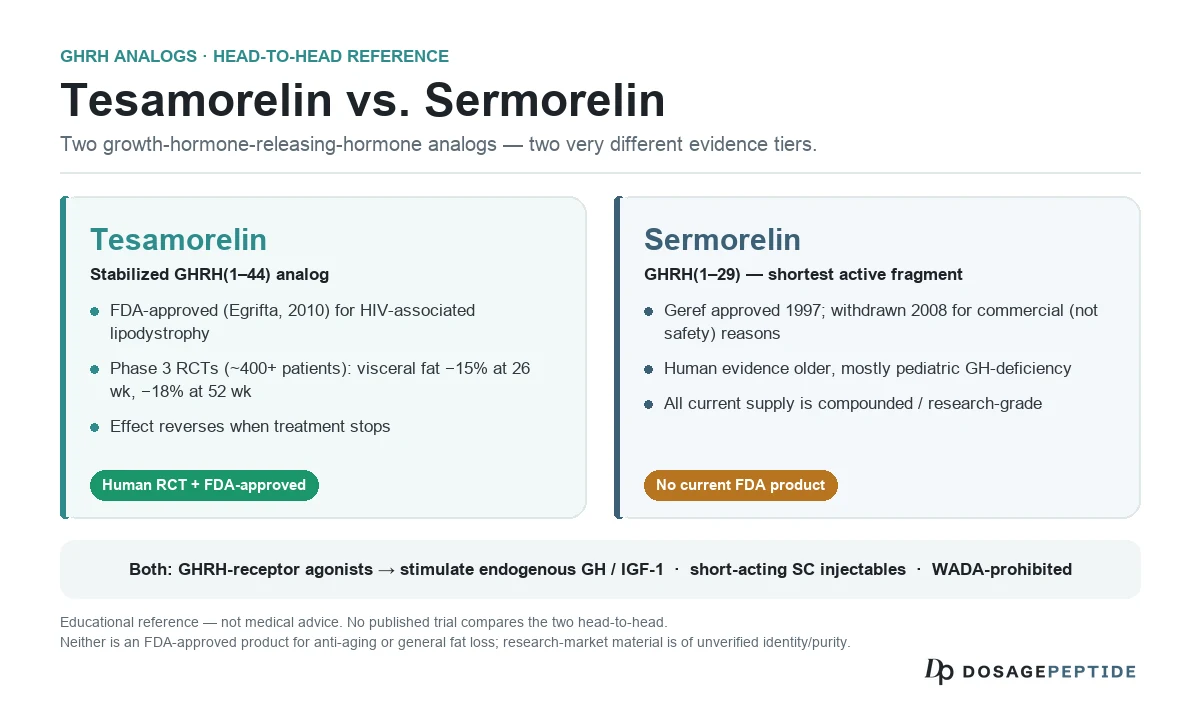
Search for tesamorelin vs sermorelin and you will find the two peptides discussed as if they were interchangeable “growth-hormone peptides” — two ways of nudging the body to release its own growth hormone. At the level of receptor biology that framing is fair: both are analogs of growth-hormone-releasing hormone (GHRH), and both act on the same pituitary receptor to stimulate pulsatile, endogenous growth-hormone (GH) secretion and a downstream rise in insulin-like growth factor 1 (IGF-1).[7] But the moment you move from mechanism to evidence, the two compounds separate sharply, and that separation is the whole point of this reference.
Here is the honest headline, stated up front. Tesamorelin is the stronger-evidence molecule: it is supported by multiple randomized, double-blind, placebo-controlled Phase 3 human trials of roughly 400 patients each, and it carries a current U.S. Food and Drug Administration (FDA) approval — Egrifta, cleared in 2010 for one specific indication, reduction of excess visceral fat in HIV-associated lipodystrophy.[1][9] Sermorelin, by contrast, was FDA-approved decades ago (Geref, 1997) but the manufacturer voluntarily withdrew it in 2008, and the FDA determined that withdrawal was not for reasons of safety or effectiveness.[10] Today there is no FDA-approved sermorelin finished product; every current supply is compounded or research-grade, and its human evidence base is older and mostly about pediatric growth-hormone deficiency.
The Short Answer
Tesamorelin is the one with real trial evidence and a current FDA approval — but only for one narrow use: reducing excess visceral belly fat in HIV-associated lipodystrophy. Sermorelin has no FDA-approved product on the U.S. market today; the original one was pulled in 2008 for commercial reasons, not safety. Neither compound is an approved anti-ageing, muscle-building, or general fat-loss drug, and neither has been tested in a large trial for the goals most people are searching for.
| Tesamorelin | Sermorelin | |
|---|---|---|
| What it is | Stabilized full-length GHRH(1–44) analog | GHRH(1–29), the shortest fully active fragment |
| Human evidence | Two Phase 3 RCTs, ~400 patients each, CT-imaged endpoint | Older, smaller work; no modern body-composition RCT in healthy adults |
| FDA status now | Approved (Egrifta, 2010) — HIV lipodystrophy only | No marketed approved product since 2008 |
| What was measured | Visceral fat on CT, triglycerides, IGF-1 | GH response in diagnostic testing; growth velocity in children |
| Half-life | Short — daily injection in trials | Very short (~10–20 minutes) |
| Banned in sport | Yes (WADA S2) | Yes (WADA S2) |
This article is educational reference material for people trying to read the science accurately — not medical advice, not a therapeutic recommendation, and not instructions for human use. Neither compound should be understood as a proven “anti-aging” or general fat-loss agent, and both are prohibited in sport by the World Anti-Doping Agency (WADA).[8] With that framing set, the sections below compare the two on structure, mechanism, regulatory status, human evidence, safety, and the single most important caveat of all: no published trial has ever compared them head-to-head.
What Tesamorelin and Sermorelin Actually Are
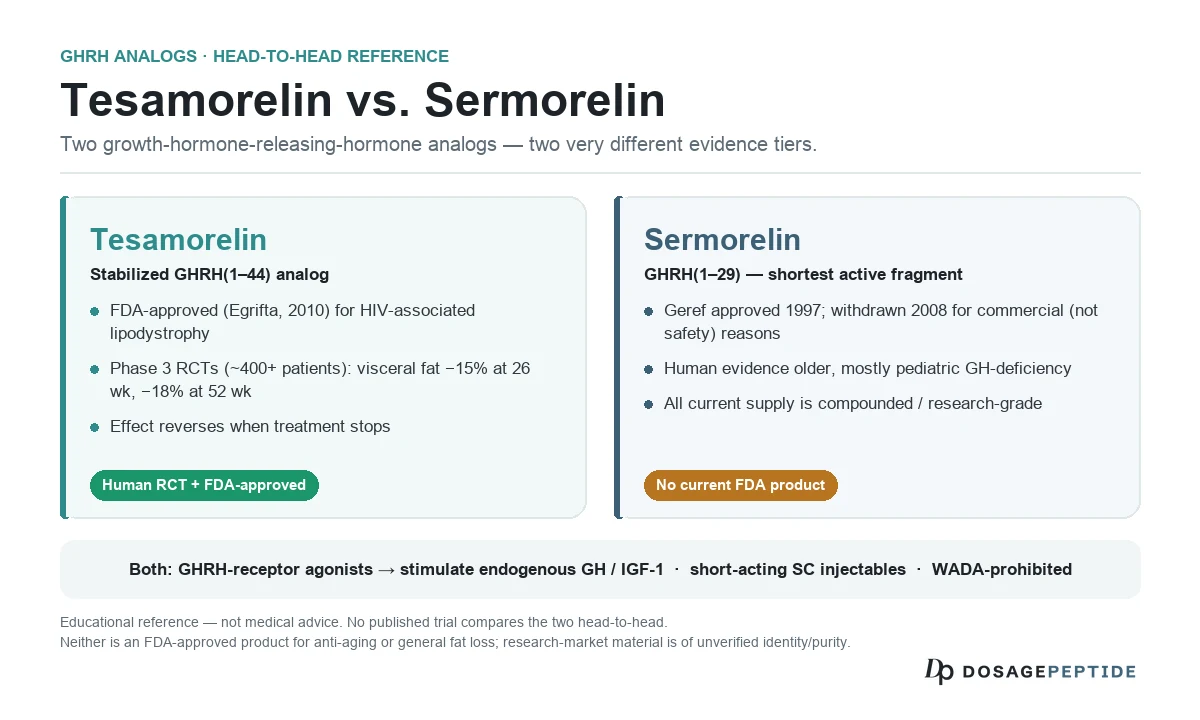
Both peptides belong to the same pharmacological family: synthetic analogs of human GHRH, the hypothalamic peptide that tells the pituitary to release growth hormone. Native human GHRH is a 44-amino-acid peptide, and its biological activity resides in the N-terminal region.[7] Tesamorelin and sermorelin represent two different engineering answers to the same problem — how to turn that endogenous signaling peptide into something usable in research or clinical settings.
Tesamorelin: a stabilized full-length GHRH analog
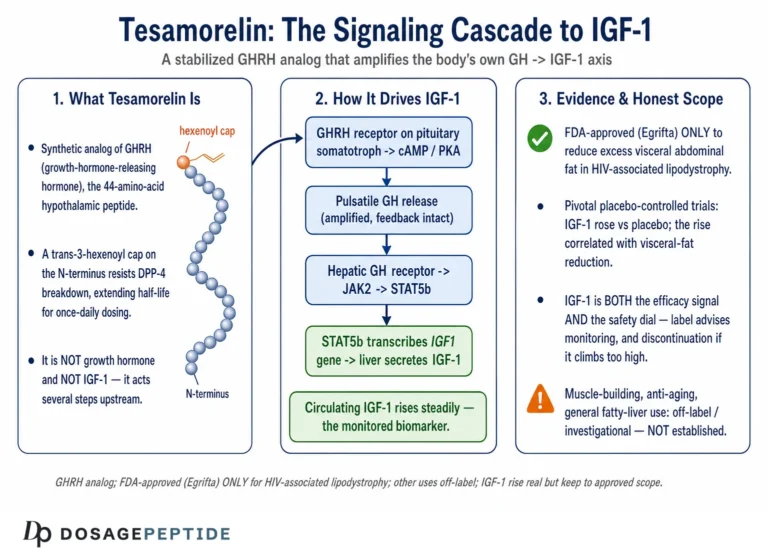
Tesamorelin is a stabilized synthetic analog built on the full GHRH(1–44) sequence. Its defining modification is a trans-3-hexenoyl group attached to the N-terminal tyrosine, a chemical change designed to protect the peptide from rapid cleavage by dipeptidyl peptidase-4 (DPP-4), the enzyme that quickly inactivates native GHRH.[4] The result is a GHRH-receptor agonist that survives slightly longer in circulation than the unmodified hormone while still producing the same fundamental action: stimulation of the somatotroph cells of the anterior pituitary to release GH in a pulsatile, physiologic pattern, which in turn raises IGF-1.[1] We cover the molecule’s biology in more depth in our reference on what tesamorelin is, how it works, and its studied effects.
Sermorelin: the shortest fully active GHRH fragment
Sermorelin takes the opposite design route. Rather than stabilizing the full sequence, it is the truncated GHRH(1–29) fragment — the shortest N-terminal portion of human GHRH that retains full biological activity.[5] Because those first 29 residues contain the receptor-activating region, sermorelin binds and activates the same GHRH receptor and elicits GH secretion much like the native hormone. What it lacks is any enzymatic-stabilization modification, so it is degraded quickly and is even shorter-acting than tesamorelin. That short duration is precisely the limitation that later motivated the development of stabilized and PEGylated GHRH successors.[6] Our overview of how sermorelin’s structure lets it mimic native hypothalamic peptides unpacks that fragment design further.
So the first honest distinction is structural: tesamorelin is a modified full-length analog engineered for resistance to degradation, whereas sermorelin is an unmodified short fragment that reproduces GHRH activity but not GHRH stability. Both are GHRH-receptor agonists; neither is growth hormone itself, and neither works if the pituitary cannot respond.
How Each One Works: GHRH-Receptor Agonism
The mechanism that unites tesamorelin and sermorelin is worth stating precisely, because it also defines the limits of what either can do. Both are secretagogues — they do not supply growth hormone; they prompt the body to release its own. This is a meaningful contrast with recombinant human growth hormone (somatropin), which is exogenous GH given directly.
The shared pathway
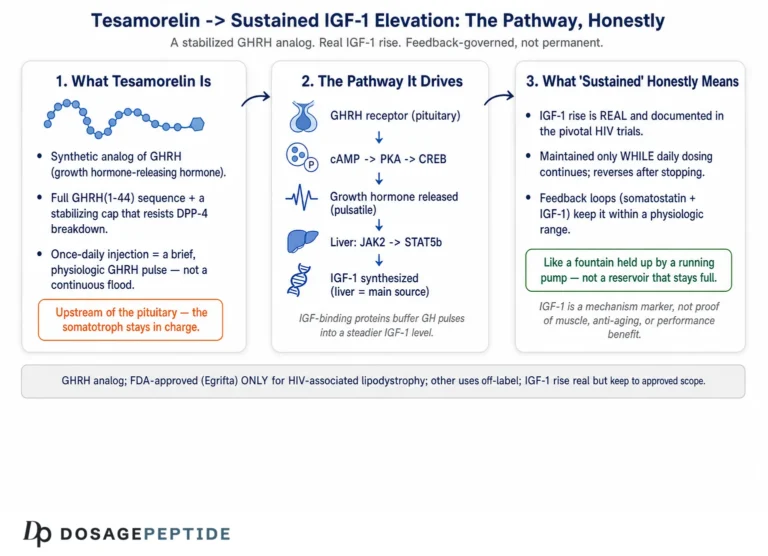
When a GHRH analog binds the GHRH receptor on pituitary somatotrophs, it triggers intracellular signaling (classically via cyclic AMP) that promotes the synthesis and pulsatile release of stored growth hormone.[7] The released GH then acts on the liver and peripheral tissues to increase production of IGF-1, the mediator of many of GH’s downstream effects. In the pivotal tesamorelin trial, IGF-1 rose by roughly 81% relative to placebo — a clear pharmacodynamic signal that the peptide was engaging its target and driving the GH–IGF-1 axis.[1] The molecular signaling that links receptor engagement to sustained IGF-1 elevation is explored in our reference on how signaling networks drive tesamorelin-induced IGF-1 elevation.
Why “pulsatile and endogenous” matters
Because these analogs stimulate the pituitary rather than replacing GH, the resulting secretion tends to preserve the body’s natural pulsatile rhythm and remains subject to normal feedback control — somatostatin, IGF-1 negative feedback, and the finite secretory capacity of the gland. This is often presented in marketing as an inherent safety advantage over direct GH. The honest version is narrower: preserved feedback is a plausible physiological difference, but it does not make a GHRH analog “safe,” “anti-aging,” or appropriate for use outside a studied indication. A system that is still regulated can still be pushed in ways that have not been tested for long-term outcomes. Sermorelin’s pituitary-signaling behavior is discussed in more detail in our reference on how sermorelin affects pituitary signaling in endocrine research.
The consequence of short half-lives
A defining practical feature of both peptides is that they are short-acting. Per its FDA label, tesamorelin has a mean elimination half-life of roughly 18 minutes after a single subcutaneous dose and about 37 minutes with multiple dosing.[9] Sermorelin (GRF 1–29) is even more transient, with a plasma half-life on the order of 10–20 minutes in humans, limited by renal ultrafiltration and enzymatic degradation at the N-terminus.[6] These are minutes, not hours — which is why clinical dosing of both has been once-daily subcutaneous injection, and why any marketing that implies a single injection produces long-lasting circulating peptide activity is misleading.
Where GHRH analogs sit among GH secretagogues
It helps to place tesamorelin and sermorelin within the broader landscape of compounds that raise growth hormone, because they are frequently confused with a different class. Both belong to the GHRH-analog class — molecules that act on the GHRH receptor, the same target as the native hypothalamic hormone. A separate class of GH secretagogues (for example the ghrelin-mimetic compounds that act on the growth-hormone-secretagogue receptor) works through a different receptor entirely and is sometimes studied in combination with GHRH analogs in research settings. For the purposes of this comparison, the important point is narrow and factual: tesamorelin and sermorelin are both GHRH-receptor agonists, so they share a mechanism with each other and with native GHRH, but not with the ghrelin-receptor secretagogues. That shared receptor is exactly why the two are so often lumped together — and why the evidence differences below are so easy to overlook.
How We Got Here: A Short Field History
Understanding why one of these peptides has robust human data and the other does not requires a little history, because the two molecules were developed to answer different questions in different eras.
GHRH itself was characterized in the early 1980s, isolated originally from pancreatic tumors in patients with acromegaly and shown to consist of a 44-residue amidated peptide (and shorter active derivatives).[7] Once researchers recognized that the N-terminal 29 residues carried the full GH-releasing activity, sermorelin (GRF 1–29) became the natural first clinical tool. It was studied as a provocative diagnostic test of pituitary GH-secretory capacity and as a treatment for children with idiopathic growth-hormone deficiency, where daily bedtime injection increased height velocity in some patients.[5] This is the origin of sermorelin’s human evidence: a pediatric-endocrinology tool from the 1990s, later commercialized as Geref.
Tesamorelin arrived later and was engineered for a different purpose entirely: a durable, degradation-resistant GHRH analog aimed at the metabolic problem of visceral fat accumulation in people with HIV on antiretroviral therapy. Its clinical program in the late 2000s was built around large, rigorously controlled trials with a hard imaging endpoint (visceral adipose tissue measured by CT), and it culminated in FDA approval in 2010.[4] The result of these two separate histories is an asymmetry that no amount of mechanistic similarity erases: tesamorelin was carried through modern Phase 3 development, and sermorelin was not.
The Regulatory Reality: FDA and WADA, Stated Plainly
Regulatory status is a hard fact, not a matter of interpretation, so it deserves a plain-language section. The sermorelin vs tesamorelin comparison is, more than anything, a comparison of two very different regulatory realities.
Tesamorelin’s FDA status
Tesamorelin was approved by the FDA on 10 November 2010 as Egrifta (later reformulated as Egrifta SV) for the reduction of excess abdominal fat in HIV-infected patients with lipodystrophy. It is the first — and, as of this writing, the only — GHRH analog with a current FDA indication, and it remains actively marketed.[4][9] That approval is narrow and specific. It is not an approval for general weight loss, for bodybuilding, for “anti-aging,” or for use in people without HIV-associated lipodystrophy. Research-grade tesamorelin sold outside that channel is not the approved finished drug.
Sermorelin’s FDA status
Sermorelin was FDA-approved in 1997 as Geref, but its manufacturer (EMD Serono) voluntarily discontinued it and requested withdrawal of the new drug application in December 2008. Crucially, when the FDA formally addressed the withdrawal, it determined that Geref was not withdrawn for reasons of safety or effectiveness — the decision was commercial.[10] This distinction matters in both directions. It means sermorelin’s disappearance from the market is not evidence that it failed or was unsafe; but it also means there is no FDA-approved sermorelin finished product available today. Everything currently sold as sermorelin is compounded (through 503A/503B pharmacies) or research-grade, which is not the same as an approved, GMP-manufactured, batch-tested drug.
WADA status of both
For anyone in competitive sport, the regulatory picture is simpler and identical: both tesamorelin and sermorelin are GHRH analogs, and GHRH and its synthetic analogs are prohibited by WADA. Analytical laboratories have developed mass-spectrometry methods specifically to detect sermorelin, tesamorelin, and related analogs in anti-doping samples.[8] Prohibition in sport reflects the biological plausibility of the GH-axis mechanism — not a determination that either substance is a proven or safe therapy.
Tesamorelin: What the Human Evidence Shows
The reason tesamorelin sits at the top of this comparison’s evidence hierarchy is a specific, checkable body of Phase 3 data. It is worth walking through what those trials actually measured.
The pivotal trial randomized 412 HIV-infected patients with abdominal fat accumulation to 2 mg of subcutaneous tesamorelin daily or placebo for 26 weeks, in a double-blind, placebo-controlled design. The primary endpoint was the percent change in visceral adipose tissue (VAT) on CT. Tesamorelin reduced VAT by about 15.2%, while placebo increased it by 5.0% (P<0.001), and it also improved triglycerides and the total-to-HDL cholesterol ratio.[1] A second large randomized trial of similar design (404 patients, with a 6-month efficacy phase and a 6-month extension) reproduced the effect, and patients who continued tesamorelin to 12 months showed a sustained VAT reduction of roughly 18%.[2]
The 52-week safety-extension data reinforced two honest points at once. First, the VAT reduction was durable while treatment continued (about −18% sustained over 52 weeks, with parallel triglyceride improvement). Second, and just as important, the benefit reversed when the drug was stopped — visceral fat re-accumulated after discontinuation.[3] That reversibility is a crucial, often-omitted caveat: tesamorelin’s effect is a maintained pharmacological state, not a one-time “fix.” We discuss the visceral-fat data and its limits further in our reference on tesamorelin’s visceral-fat effects and safety profile.
A further nuance sharpens what the trials actually showed. The reduction was relatively selective for visceral adipose tissue — the metabolically active fat packed around the abdominal organs — while subcutaneous fat was not reduced to a clinically significant extent.[4] That selectivity is part of why the drug made sense for HIV-associated lipodystrophy specifically, where the clinical problem is central/visceral fat accumulation. It also underscores why the result should not be read as a general “fat-burning” effect: the trials measured a specific fat compartment in a specific population, using CT imaging, not overall body weight or cosmetic slimming.
What this evidence does not establish is equally important. It is human data in one population (people with HIV-associated central fat accumulation) with one endpoint (visceral fat). It is not evidence that tesamorelin causes general weight loss, builds muscle, improves body composition in healthy adults, or delivers “anti-aging” benefits. The strongest, cleanest human dataset in this entire comparison is also a narrow one.
Sermorelin: What the Human Evidence Shows
Sermorelin’s human evidence is real but old, and it points in a different direction than the modern marketing suggests. The best-documented human uses come from pediatric endocrinology.
As a diagnostic agent, a single intravenous dose of sermorelin (about 1 µg/kg) was used as a provocative test of pituitary GH-secretory capacity, notable for producing relatively few false-positive results compared with some other provocative tests.[5] As a treatment, once-daily subcutaneous sermorelin (about 30 µg/kg at bedtime) increased height velocity in some prepubertal children with idiopathic growth-hormone deficiency, with responses sustained over roughly 12 months and, in a few children, longer.[5] That is the core of sermorelin’s human record: a diagnostic tool and a pediatric growth therapy from the 1990s.
One honest comparison from that era is worth keeping in view, because it tempers the “GH-boosting” framing sermorelin now attracts. In the pediatric studies, the increase in height velocity produced by sermorelin was less than that produced by once-daily subcutaneous somatropin (recombinant GH itself).[5] That makes biological sense: a secretagogue that asks the pituitary to release its own GH is constrained by that gland’s secretory capacity and feedback, whereas exogenous GH is not. It is a useful reminder that stimulating endogenous GH is not automatically equivalent to, or stronger than, giving GH directly — and that the peptide’s documented effect sizes are modest even in the population where it was best studied.
What is missing is any modern randomized controlled trial supporting the popular adult claims — “anti-aging,” body-recomposition, sleep, or general GH-boosting benefits in healthy adults. Those uses are research-context or off-label extrapolations from the peptide’s mechanism, not conclusions from adequate adult efficacy trials. Our reference on what research actually says about sermorelin and natural GH stimulation works through that gap in detail. The honest evidence tier for sermorelin is therefore “human, but older and narrow,” with the further complication that the material available today is not the FDA-approved product those older studies used.
Head-to-Head vs. Cross-Trial: The Only Fair Comparisons
This is the honesty centerpiece of the comparison, and it can be stated in one sentence: no published randomized controlled trial has ever directly compared tesamorelin against sermorelin. Every comparison you will read — including this one — is indirect, assembled from separate trials run in different populations, at different times, with different endpoints. That is a legitimate way to describe two molecules, but it is a weak basis for claiming one is “better” than the other for any shared purpose.
The table below is explicit about what kind of evidence backs each comparison you might want to make. Notice how quickly the “evidence strength” column drops once you leave each drug’s own trials.
| Comparison | Study design available | Evidence strength | Honest result |
|---|---|---|---|
| Tesamorelin vs placebo (visceral fat, HIV lipodystrophy) | Multiple double-blind, placebo-controlled Phase 3 RCTs (~400+ patients) | Strong (direct) | VAT reduced ~15% at 26 wk, ~18% at 52 wk; reverses on stopping[1][3] |
| Sermorelin vs placebo/comparator (pediatric GHD) | Older human studies; diagnostic and growth-velocity data | Moderate, dated (human but not modern RCT) | Increased height velocity in some GH-deficient children[5] |
| Tesamorelin vs sermorelin (any shared endpoint) | None — no direct trial exists | Not established (cross-trial inference only) | Cannot be ranked head-to-head; populations and endpoints differ |
| Either peptide for adult “anti-aging” / general fat loss | No adequate RCTs | Not established | Mechanistic extrapolation only; not a proven outcome |
The practical takeaway: it is accurate to say tesamorelin has the higher-quality and more recent human evidence, because that describes each drug’s own trial record. It is not accurate to say a trial proved tesamorelin outperforms sermorelin, because no such trial was ever run. Keeping those two statements distinct is the difference between honest reading and marketing.
Reading the Numbers Honestly: The Full Comparison
With the evidence caveats in place, the attribute-by-attribute comparison below summarizes the documented facts for each peptide. Every cell reflects the cited sources; where something is not established, the table says so rather than guessing.
| Attribute | Tesamorelin | Sermorelin |
|---|---|---|
| Class | Stabilized synthetic GHRH(1–44) analog (trans-3-hexenoyl group resists DPP-4 cleavage) | Synthetic GHRH(1–29) — shortest N-terminal fragment with full activity |
| Mechanism | GHRH-receptor agonist → pulsatile endogenous GH release → ↑ IGF-1 | GHRH-receptor agonist → pulsatile endogenous GH release → ↑ IGF-1 |
| Primary studied use | Reduction of excess visceral fat in HIV-associated lipodystrophy | Diagnostic GH-secretion test; pediatric idiopathic GH deficiency |
| Highest evidence tier | FDA-approved + multiple Phase 3 double-blind, placebo-controlled RCTs[1][2] | Human but older/limited; mainly pediatric GHD; no modern adult RCT[5] |
| Typical route | Subcutaneous injection, once daily | Subcutaneous (treatment) or intravenous (single-dose diagnostic) |
| Half-life | ~18 min (single dose); ~37 min (multiple doses)[9] | ~10–20 min in humans[6] |
| Reference dosing (research settings only) | Clinical label: 2 mg SC daily (HIV lipodystrophy) | Historic clinical: ~30 µg/kg/day SC (pediatric GHD); 1 µg/kg IV diagnostic |
| FDA status | Approved 2010 (Egrifta) — the only GHRH analog with a current indication | Approved 1997 (Geref); withdrawn 2008 for commercial (not safety/efficacy) reasons; no current approved product[10] |
| Sport status | WADA-prohibited (GHRH analog)[8] | WADA-prohibited (GHRH analog)[8] |
| Direct head-to-head trial | None — no published RCT compares the two | None — no published RCT compares the two |
A structural side-by-side
Because the two are so often conflated, a compact structural table clarifies exactly how they differ at the molecule level.
| Structural property | Tesamorelin | Sermorelin |
|---|---|---|
| Parent sequence | Full GHRH(1–44) | GHRH(1–29) fragment |
| Stabilizing modification | Yes — N-terminal trans-3-hexenoyl group (DPP-4 resistance) | None |
| Relative duration | Short, but longer than native/sermorelin | Very short |
| Receptor engaged | GHRH receptor | GHRH receptor |
| Net pharmacodynamic effect | ↑ endogenous GH & IGF-1 | ↑ endogenous GH & IGF-1 |
Evidence tier by reported use
The single most useful way to read this pair is not “which peptide is stronger” but “which specific use has which tier of evidence.” The table below maps each commonly discussed use to its strongest available evidence and an honest interpretation. Notice that the rows people care most about — adult fat loss, anti-aging, muscle — are exactly the rows with the weakest support.
| Reported use | Strongest evidence tier | Honest interpretation |
|---|---|---|
| Tesamorelin — visceral fat in HIV-associated lipodystrophy | Multiple Phase 3 double-blind, placebo-controlled RCTs[1] | Established in that population; benefit reverses on discontinuation |
| Tesamorelin — general weight loss / anti-aging | No adequate RCTs | Not established; extrapolation beyond the approved indication |
| Sermorelin — provocative GH-deficiency diagnostic test | Older human clinical use[5] | Documented historical diagnostic role |
| Sermorelin — pediatric idiopathic GH deficiency | Older human studies (growth velocity)[5] | Increased height velocity in some children; dated evidence |
| Sermorelin — adult anti-aging / GH-boosting | No modern RCT | Not established; mechanistic claim only |
| Either — muscle building / athletic performance | None (WADA-prohibited)[8] | Not established; prohibited in sport |
| Tesamorelin vs sermorelin — head-to-head | No direct trial | Cannot be ranked; cross-trial inference only |
Safety and Tolerability in Studied Settings
Safety data, like efficacy data, are only as good as the trials behind them — and here again tesamorelin has the deeper record. The table and notes below describe what was reported in studied settings; they are not a safety endorsement for use outside those settings, and they cannot speak to research-grade material of unverified quality.
| Safety dimension | Tesamorelin | Sermorelin |
|---|---|---|
| Overall tolerability in trials | Generally well tolerated over 26–52 weeks[3] | Well tolerated in historical studies[5] |
| Most common events | Injection-site reactions, arthralgia, myalgia, peripheral edema, headache (GH-class effects)[4] | Transient facial flushing; injection-site pain[5] |
| IGF-1 / GH-axis effect | Raises IGF-1 (~81% vs placebo in the pivotal trial)[1] | Stimulates GH/IGF-1 (general GH-axis caveats apply) |
| Glucose effects in trials | No clinically significant glycemic worsening reported over 52 wk[3] | Not characterized in modern adult trials |
| Label cautions | Contraindicated in active malignancy and pregnancy; monitor glucose (per FDA label)[9] | General GH-axis cautions; no current FDA finished-product oversight |
| Product-quality oversight | Approved, GMP-manufactured finished drug (Egrifta) | Compounded / research-grade only today |
Two honest emphases belong here. First, because tesamorelin raises IGF-1, its label carries GH-class cautions — contraindications in active malignancy and pregnancy, and glucose monitoring — even though the trials did not show significant glycemic worsening.[9] Second, sermorelin’s reassuring historical tolerability was established with an approved, quality-controlled product in children; it does not automatically transfer to adult use of a compounded or research-grade material whose identity and purity are not guaranteed.
Beyond the Primary Endpoint: Cardiometabolic and GH-Axis Signals
A fair comparison should acknowledge the secondary signals each peptide generated, without inflating them into approved benefits.
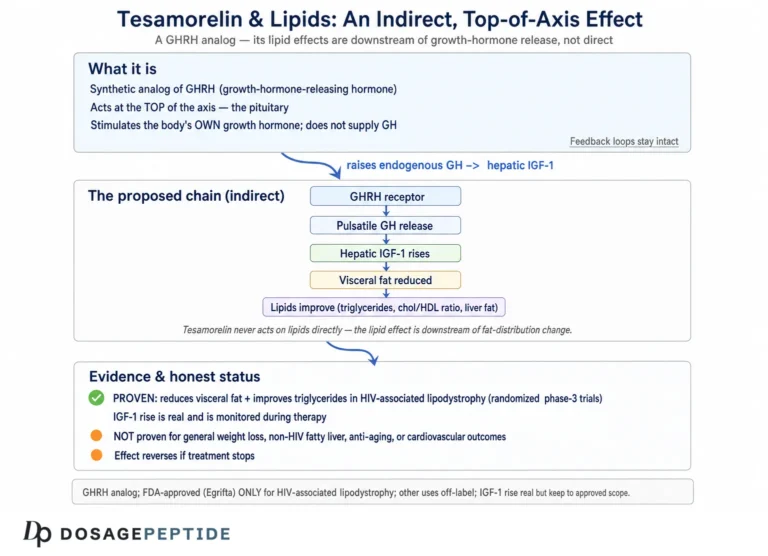
For tesamorelin, the visceral-fat trials also reported improvements in lipid parameters — lower triglycerides and an improved total-to-HDL cholesterol ratio — alongside the VAT reduction.[1] Because visceral adiposity is itself linked to cardiometabolic risk, these lipid changes are biologically coherent. There has also been research interest in tesamorelin’s effect on liver fat (NAFLD) in people with HIV. Those are legitimate research directions, but they remain secondary endpoints and specific-population findings — not a general cardiovascular-outcomes claim. How tesamorelin intersects with lipid metabolism is discussed in our reference on how tesamorelin influences lipid metabolism through endocrine crosstalk.
For sermorelin, the “beyond-the-endpoint” discussion is mostly hypothetical in adults: proposed effects on sleep quality, body composition, or vitality are mechanistic extrapolations from GH-axis stimulation rather than trial-confirmed outcomes. In children with GH deficiency, the meaningful secondary observation was simply that catch-up growth was sustained over months of treatment.[5] The asymmetry persists even in the secondary data: tesamorelin’s extra signals come from controlled trials, sermorelin’s adult extras come from reasoning about mechanism.
What the Evidence Does NOT Show
Stating the negatives explicitly is central to reading this comparison honestly. The following are not established by the cited evidence, for either peptide:
- No head-to-head superiority. No trial shows tesamorelin beats sermorelin (or vice versa) on any shared endpoint. The two have never been compared directly.
- No proven general fat-loss or anti-aging effect. Tesamorelin’s proven benefit is visceral-fat reduction in HIV-associated lipodystrophy specifically; it is not approved or proven for weight loss in the general population. Sermorelin has no modern adult efficacy trials for these uses at all.
- No muscle-building or performance claim. Neither peptide is demonstrated to build muscle or enhance athletic performance; both are, in fact, banned in sport.[8]
- No permanence. Tesamorelin’s visceral-fat benefit reverses on discontinuation; the data describe an ongoing pharmacological effect, not a lasting change.[3]
- No equivalence between trial data and research-market vials. The human evidence was generated with characterized clinical material. It does not validate the identity, purity, or safety of research-grade product sold outside that context.
Limitations of This Comparison
Even the well-supported parts of this reference carry limitations that a careful reader should keep in view.
- Population specificity. Tesamorelin’s strong data come entirely from people with HIV-associated lipodystrophy. Extrapolating those results to other populations is not supported by the trials.
- Age of the sermorelin evidence. Sermorelin’s human record is decades old and pediatric; it predates modern trial standards for the adult uses now marketed.
- Cross-trial inference. Comparing the two relies on separate studies with different designs, endpoints, and eras — a structurally weaker basis than a single controlled comparison.
- Surrogate endpoints. Visceral fat and IGF-1 are meaningful measures, but they are surrogate/intermediate endpoints, not hard clinical outcomes like cardiovascular events.
- Product identity. Research-market peptides are not manufactured to pharmaceutical identity and purity standards, so a vial’s contents cannot be assumed from its label without independent testing.
Practical and Research Context
For readers working in laboratory research settings, the reconstitution and measurement mechanics are the same for either peptide — both are lyophilized peptides reconstituted with bacteriostatic water and handled with the same care — but that shared handling says nothing about interchangeable evidence. Our peptide reconstitution guide walks through the mixing and storage steps, the reconstitution dosage calculator handles the measurement math, and the research glossary defines the terms used throughout this article (GHRH, secretagogue, IGF-1, half-life, VAT). The per-vial reference pages — for example the tesamorelin 10 mg vial reference, the tesamorelin 5 mg and tesamorelin 20 mg references, and the sermorelin 10 mg and sermorelin 5 mg references — describe reconstitution measurement for research use only, not personal or therapeutic dosing.
An unavoidable practical caveat sits alongside all of this: material sold in the research-chemical channel is not the FDA-approved finished drug, and its identity and purity are not guaranteed. When tesamorelin or sermorelin is obtained as research-grade material from a third-party supplier such as Prime Lab Peptides (research use only), the trial data summarized above do not automatically apply to that vial — published efficacy and safety were established with characterized clinical product, and only independent identity/purity testing can confirm what a given research-market vial actually contains.
How to Read a GHRH-Analog Study
Because so much confusion in the tesamorelin vs sermorelin discussion comes from mismatched comparisons, a few reading habits help:
- Identify the population. A tesamorelin trial in HIV lipodystrophy and a sermorelin study in GH-deficient children are not evidence about the same people — or about healthy adults.
- Identify the endpoint. Visceral fat on CT, height velocity, and IGF-1 level are different measures. A change in one is not a change in the others.
- Check the tier. Modern double-blind RCT, older human study, or mechanistic extrapolation? The tier determines how much confidence a claim earns.
- Note the era and the product. Old data generated with an approved drug may not describe today’s compounded or research-grade material.
- Separate mechanism from outcome. Shared GHRH-receptor agonism does not mean shared, proven results.
Common Misconceptions
“They’re basically the same peptide”
Mechanistically they are close — both are GHRH-receptor agonists — but structurally and evidentially they diverge. Tesamorelin is a stabilized full-length GHRH(1–44) analog with modern Phase 3 data and a current FDA approval; sermorelin is an unmodified GHRH(1–29) fragment with older, mostly pediatric human data and no current approved product. “Same receptor” is not “same evidence.”
“Sermorelin was pulled because it was unsafe”
No. The FDA explicitly determined that Geref (sermorelin) was not withdrawn for reasons of safety or effectiveness; the withdrawal was a commercial decision.[10] The absence of an approved product today is a market fact, not a safety verdict.
“Tesamorelin is an approved fat-loss drug”
Only in a very specific sense. It is approved to reduce excess visceral fat in HIV-associated lipodystrophy, not for general weight loss or cosmetic fat reduction, and the effect reverses when treatment stops.[3] Reading its approval as a green light for general weight management overstates what the FDA cleared.
“These peptides last a long time between injections”
They do not. Both are short-acting — tesamorelin’s half-life is roughly 18–37 minutes and sermorelin’s about 10–20 minutes — which is why studied dosing is once-daily subcutaneous injection.[9][6]
Key Takeaways
- Same family, different evidence. Both are GHRH-receptor agonists that raise endogenous GH and IGF-1, but tesamorelin has far stronger and more recent human data than sermorelin.
- Tesamorelin is FDA-approved (narrowly). Egrifta (2010) is the only GHRH analog with a current indication — visceral fat in HIV-associated lipodystrophy — supported by Phase 3 RCTs.[1]
- Sermorelin has no current FDA product. Approved in 1997, withdrawn in 2008 for commercial (not safety/efficacy) reasons; today it is compounded or research-grade only.[10]
- No head-to-head trial exists. Any ranking of the two is cross-trial inference, not direct evidence.
- Both are short-acting and WADA-prohibited. Minutes-long half-lives, once-daily studied dosing, and banned in sport.[8]
- Neither is an anti-aging or general fat-loss cure. Tesamorelin’s benefit is narrow and reversible; sermorelin’s adult claims are unproven; research-market vials are not the trial product.
How Fast Does Each One Work?
Most comparison pages answer this with a guess. The trial record answers it for tesamorelin only, and not at all for sermorelin.
- The hormone response is immediate — and it is not a result. Both compounds trigger a growth-hormone pulse within minutes of injection, and IGF-1 drifts upward over the following days to weeks. That is receptor pharmacology working as designed. It says nothing about whether anything visible changes.
- Tesamorelin’s measured change took months. The pivotal trial assessed visceral fat at 26 weeks, not weeks 2 or 4, and found roughly a 15% reduction versus placebo; a second trial reproduced it and, at 52 weeks of continued dosing, sustained about an 18% reduction. Nothing in that programme supports a one-month transformation.
- Sermorelin has no comparable timeline, because no trial tracked fat or lean mass in healthy adults over months. Any specific week-by-week sermorelin timeline you find is extrapolated from mechanism, not measured.
- The change is rented, not owned. Tesamorelin’s visceral-fat reduction was measured while dosing continued. There is no published evidence that it persists once dosing stops.
Which One Does the Research Actually Support — and For What?
Stripped of clinic marketing, the evidence divides cleanly:
- Visceral fat in a specific patient population: tesamorelin, and only tesamorelin, has randomized evidence and an approval — for HIV-associated lipodystrophy, not for general belly fat.
- Anti-ageing, everyday fat loss, muscle gain, sleep, recovery: neither. No adequately powered randomized trial of either compound exists for any of those endpoints in healthy adults. A clinic presenting sermorelin as the “gentler anti-ageing option” is describing a plausible mechanism, not a demonstrated outcome. The same gap applies to the oral GH secretagogue MK-677, whose largest trial added lean mass without adding strength.
- Diagnostic GH-axis testing: sermorelin’s real historical role. It was used to provoke and measure pituitary function — a diagnostic tool, which is a different thing from a treatment.
- “It raises IGF-1”: both do, and this is the least useful fact in the comparison. Moving a biomarker is not the same as improving an outcome. The tesamorelin trials matter precisely because they measured an outcome on a CT scan rather than stopping at a blood marker.
Side Effects Reported in the Trials
Because tesamorelin was studied in large controlled trials, its adverse-event profile is documented; sermorelin’s modern profile in healthy adults essentially is not.
- Tesamorelin: injection-site reactions (redness, itching, pain) were the most common complaint, along with joint pain, limb swelling, muscle aches, and hypersensitivity reactions. The clinically important one is metabolic: like anything that raises GH and IGF-1, it can worsen glucose control, so blood sugar was monitored throughout the programme. IGF-1 rising above the normal range was also tracked as a safety parameter.
- Sermorelin: the historical record notes injection-site reactions and flushing. There is no modern controlled dataset quantifying side effects in healthy adults using it off-label for body composition, so nobody can honestly quote a frequency.
- The unmeasured variable: material sold as research-grade “tesamorelin” or “sermorelin” is not the pharmaceutical product used in these trials. Its identity, purity, and actual content are not verified by any regulator, so trial safety data does not transfer to it.
Frequently Asked Questions
What is the main difference between tesamorelin and sermorelin?
Both are GHRH-receptor agonists that stimulate the body’s own growth-hormone release, but they differ in structure and evidence. Tesamorelin is a stabilized full-length GHRH(1–44) analog with a current FDA approval (Egrifta) and multiple Phase 3 trials. Sermorelin is the shorter GHRH(1–29) fragment whose human evidence is older and mostly pediatric, and it has no FDA-approved product on the market today.
Is tesamorelin or sermorelin stronger?
No trial has ever compared them head-to-head, so “stronger” can only refer to evidence quality, not a measured contest. On that basis, tesamorelin has the higher-tier and more recent human data — multiple randomized, placebo-controlled Phase 3 trials — while sermorelin’s human record is older and narrower. Any claim that one out-performs the other on a shared outcome is cross-trial inference, not proof.
Is sermorelin FDA-approved?
Not currently. Sermorelin was approved in 1997 as Geref, but the manufacturer voluntarily withdrew it in 2008. The FDA determined the withdrawal was not for reasons of safety or effectiveness — it was commercial. Today there is no FDA-approved sermorelin finished product; all supply is compounded (503A/503B) or research-grade, which is not equivalent to an approved, batch-tested drug.
What is tesamorelin actually approved for?
Tesamorelin (Egrifta) is FDA-approved specifically to reduce excess visceral abdominal fat in people with HIV-associated lipodystrophy. That is its only indication. It is not approved for general weight loss, bodybuilding, or anti-aging, and the visceral-fat benefit reverses when the drug is stopped.
How long do these peptides stay active in the body?
Both are short-acting. According to its FDA label, tesamorelin has a mean elimination half-life of roughly 18 minutes after a single dose and about 37 minutes with repeated dosing. Sermorelin’s half-life is even shorter, around 10–20 minutes in humans. These minutes-long durations are why studied dosing for both is once-daily subcutaneous injection.
Are tesamorelin and sermorelin used for anti-aging?
They are marketed that way, but no modern randomized controlled trial supports adult “anti-aging,” fat-loss, or general GH-boosting claims for either peptide. Sermorelin’s documented human uses are diagnostic testing and pediatric growth-hormone deficiency; tesamorelin’s proven use is visceral-fat reduction in HIV lipodystrophy. Anti-aging use is mechanistic extrapolation, not a proven outcome.
Are they banned in sport?
Yes. Both tesamorelin and sermorelin are GHRH analogs, and GHRH and its synthetic analogs are on the World Anti-Doping Agency Prohibited List. Anti-doping laboratories have developed methods specifically to detect them. Athletes subject to anti-doping rules should treat both as prohibited and consult the current WADA Prohibited List, which is updated annually.
Does research-grade material match the studies?
Not necessarily. The human trial data for both peptides were generated with characterized clinical product. Research-grade peptides sold outside that channel are not manufactured to pharmaceutical identity and purity standards, so a vial’s contents cannot be assumed from its label. Trial evidence describes the studied drug, not an arbitrary research-market vial, which would require independent testing to characterize.
Can I use this article to choose a dose?
No. This is educational reference material, not medical advice or a dosing recommendation. The dosing figures cited (such as tesamorelin 2 mg daily in trials, or historic pediatric sermorelin dosing) describe what was studied in clinical or research settings, not what any individual should take. Decisions about any peptide belong with a qualified clinician, and neither compound is offered here for human therapeutic use.
References
- Falutz J, Allas S, Blot K, et al. Metabolic effects of a growth hormone-releasing factor in patients with HIV. N Engl J Med. 2007;357(23):2359–70. PMID 18057338.
- Falutz J, Potvin D, Mamputu JC, et al. Effects of tesamorelin, a growth hormone-releasing factor, in HIV-infected patients with abdominal fat accumulation: a randomized placebo-controlled trial with a safety extension. J Acquir Immune Defic Syndr. 2010;53(3):311–22. PMID 20101189.
- Falutz J, Allas S, Mamputu JC, et al. Long-term safety and effects of tesamorelin, a growth hormone-releasing factor analogue, in HIV patients with abdominal fat accumulation. AIDS. 2008;22(14):1719–28. PMID 18690162.
- Dhillon S. Tesamorelin: a review of its use in the management of HIV-associated lipodystrophy. Drugs. 2011;71(8):1071–91. PMID 21668043.
- Prakash A, Goa KL. Sermorelin: a review of its use in the diagnosis and treatment of children with idiopathic growth hormone deficiency. BioDrugs. 1999;12(2):139–57. PMID 18031173.
- Esposito P, Barbero L, Caccia P, et al. PEGylation of growth hormone-releasing hormone (GRF) analogues. Adv Drug Deliv Rev. 2003;55(10):1279–91. PMID 14499707.
- Grossman A, Savage MO, Besser GM. Growth hormone releasing hormone. Clin Endocrinol Metab. 1986;15(3):607–27. PMID 2429796.
- Memdouh S, Gavrilović I, Ng K, Cowan D, Abbate V. Advances in the detection of growth hormone releasing hormone synthetic analogs. Drug Test Anal. 2021;13(11–12):1871–87. PMID 34665524.
- U.S. Food and Drug Administration. EGRIFTA / EGRIFTA SV (tesamorelin) prescribing information. Drugs@FDA, NDA 022505 (approved 10 Nov 2010).
- U.S. FDA / Federal Register. Determination that GEREF (sermorelin acetate) injection was not withdrawn from sale for reasons of safety or effectiveness. 78 FR 14103, 4 Mar 2013.
Research-use disclaimer: This article is educational reference material summarizing published research and regulatory context. It is not medical advice, not a therapeutic recommendation, and not instructions for human use. Tesamorelin is FDA-approved only for HIV-associated lipodystrophy; sermorelin has no current FDA-approved product. Neither is approved for anti-aging or general fat loss, and both are prohibited in sport by WADA. Any mention of dosing refers to clinical or laboratory research settings only. Always verify current regulatory and clinical-trial status through primary sources such as the FDA, ClinicalTrials.gov, and PubMed.