The question in this article’s title — whether sermorelin affects dopaminergic activity associated with sexual motivation — packs at least three separate scientific claims into a single phrase, and it is worth pulling them apart before pretending to answer it. It assumes, first, that sermorelin reaches or influences brain dopamine systems; second, that it does so specifically in the circuits that generate sexual desire rather than, say, movement or reward-in-general; and third, that the net effect is meaningful enough to call an “effect.” None of those three assumptions is established for sermorelin. What we actually have is a growth-hormone-releasing-hormone (GHRH) analog with a narrow, decades-old diagnostic pedigree, a real and fascinating — but different — body of neuroscience linking the dopamine and GHRH systems, and a large, well-characterized literature on how dopamine drives sexual motivation that has essentially nothing to say about sermorelin.
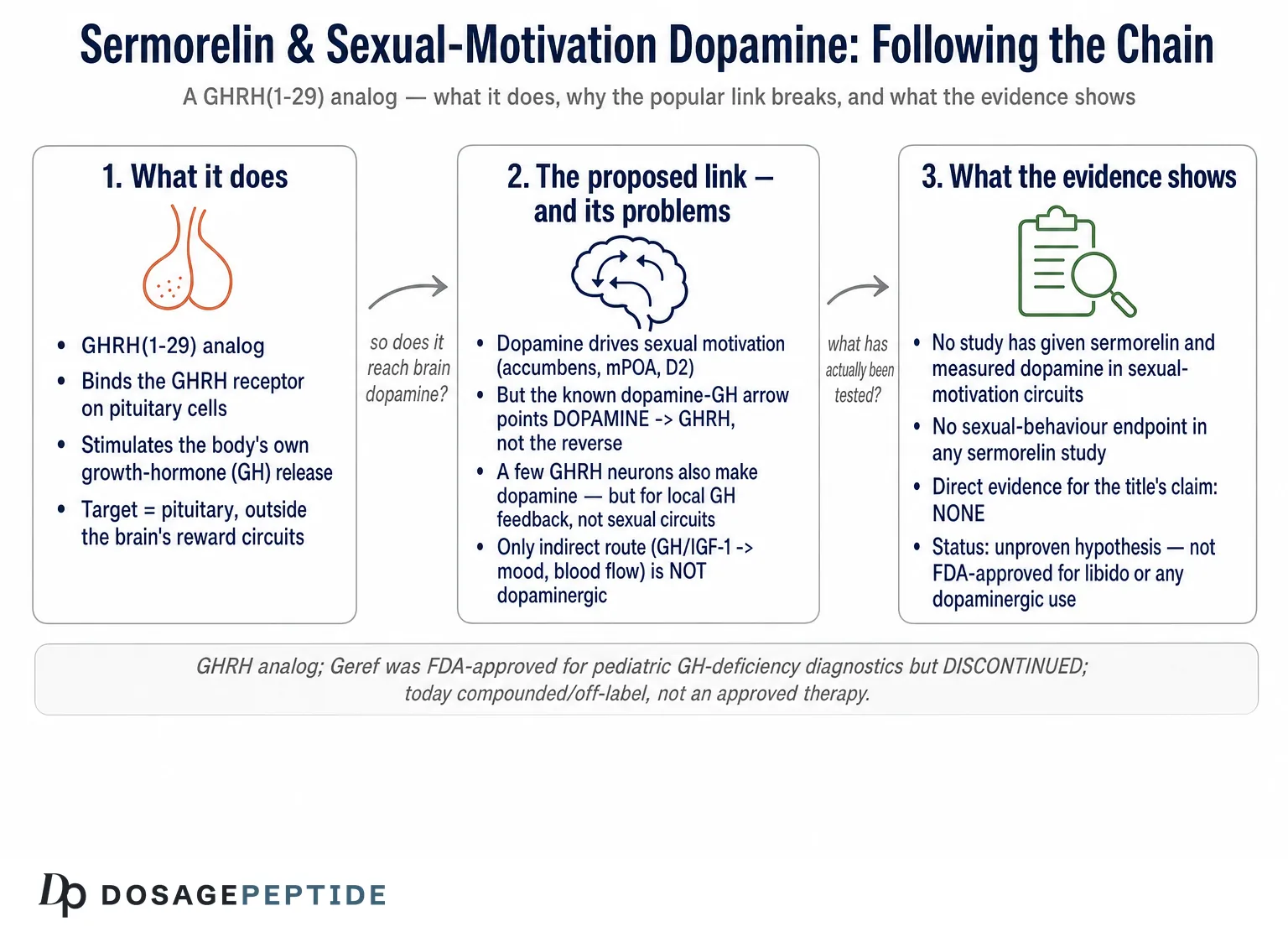
So rather than affirm the premise, this piece treats it as an open research question and examines each link in the chain honestly. The honest summary, stated up front so nothing here is mistaken for hype: there is no direct study — human or animal — that has administered sermorelin and measured dopaminergic activity in the mesolimbic, medial-preoptic, or incertohypothalamic circuits that govern sexual motivation, or that has measured sexual-motivation behavior as an endpoint. On the specific question asked, the evidence level is zero. What can be discussed rigorously is why the question arises at all, which of its underlying links have genuine support, which run in the opposite direction from what the title implies, and whether the whole inference is even mechanistically plausible.
This article is written for researchers and scientifically literate readers who want a precise map of a popular but under-examined idea. We will define what sermorelin actually is and the limits of its track record; describe what “dopaminergic activity associated with sexual motivation” means in neuroscience; show that the best-documented dopamine–GHRH link points the other way; explore the genuine and surprising overlap between GHRH neurons and dopamine; weigh the only plausible indirect route (the growth-hormone/IGF-1 axis and libido); document the direct-evidence gap; compare sermorelin with compounds that really do act on the dopamine–sex axis; interrogate the plausibility of the premise; outline what a real investigation would require; and set out the safety and regulatory context. Throughout, the guiding rule is restraint: sermorelin is not an approved therapy for sexual dysfunction, low libido, or any dopaminergic condition, and nothing here should be read as suggesting otherwise.
What Sermorelin Actually Is — and the Narrow Limits of Its Track Record
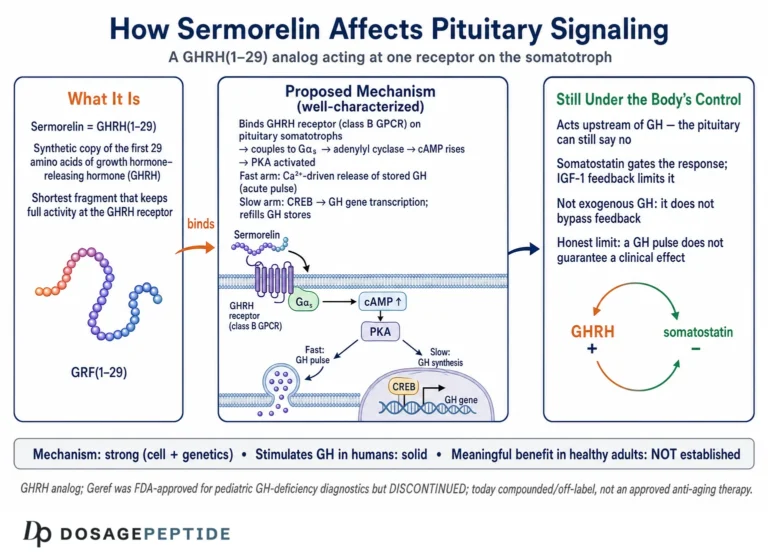
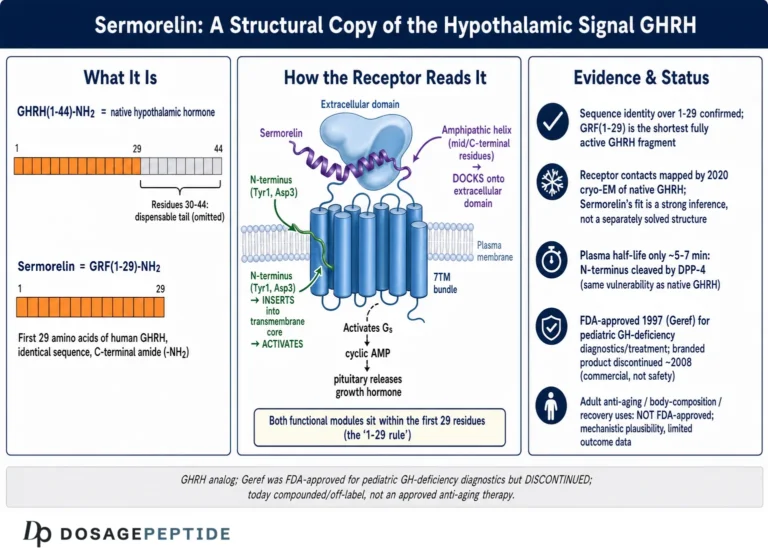
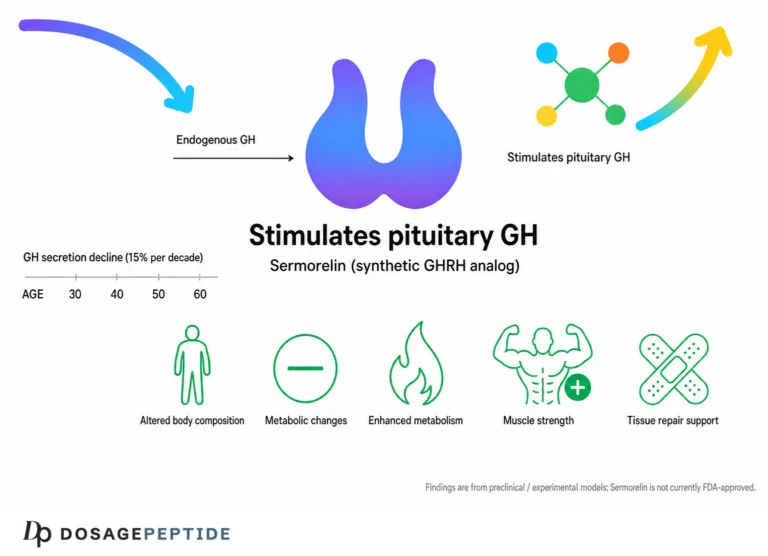
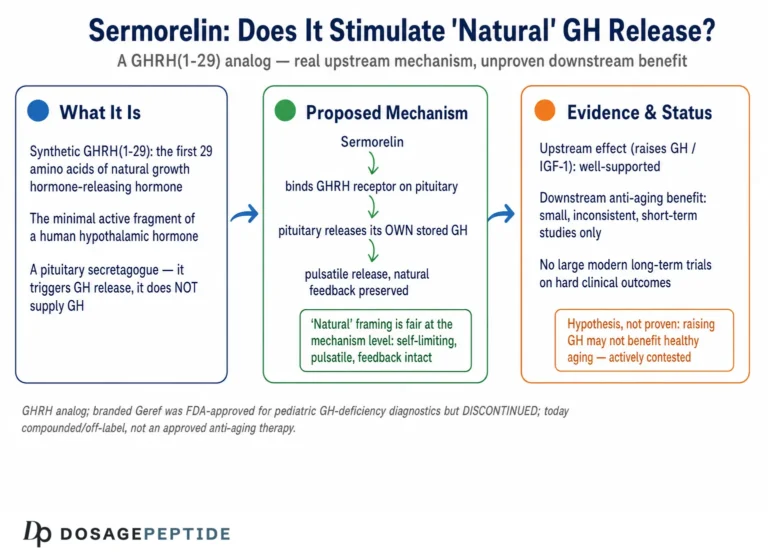
Sermorelin is a synthetic peptide corresponding to the first 29 amino acids of human growth-hormone-releasing hormone, written GHRH(1–29) and sometimes labeled GRF(1–29). Native GHRH is a 44-residue hypothalamic peptide, but classic structure–activity work established that the N-terminal 29 residues retain full intrinsic biological activity at the GHRH receptor on pituitary somatotrophs.1 In other words, sermorelin is the shortest fragment that still behaves like the whole hormone: it binds the GHRH receptor, raises intracellular cyclic AMP in somatotrophs, and stimulates the synthesis and pulsatile release of growth hormone (GH) from the anterior pituitary. Because it works one step upstream of the pituitary, its action is inherently gated by the body’s own feedback: somatostatin tone, existing GH and IGF-1 levels, and the finite secretory capacity of the gland all constrain how much GH any GHRH stimulus can produce.2 That physiological ceiling is a defining feature, and it matters for every downstream claim, including the one this article examines.
The regulatory history is specific and frequently misstated. Sermorelin was marketed as Geref and received U.S. Food and Drug Administration approval principally as a diagnostic agent — a provocative test of pituitary GH reserve, given as a single intravenous dose — and was also studied for promoting growth in some prepubertal children with idiopathic GH deficiency.1 Its evidentiary base is therefore rooted in pediatric endocrinology and pituitary diagnostics, not in adult wellness, mood, libido, or neuropharmacology. Critically, the branded product was discontinued: the manufacturer withdrew it from the market in the mid-to-late 2000s for commercial reasons, as recombinant human GH came to dominate the pediatric GH-deficiency market, not because of any safety or efficacy failure. The practical consequence is that today sermorelin has no marketed, FDA-approved finished-drug form. It circulates almost entirely as a compounded preparation (through 503A/503B pharmacies where a prescription and clinical indication exist) and, separately, as a “research chemical” of variable provenance. For any use touching sexual function or dopamine, sermorelin is unambiguously off-label and unapproved.
It is worth being explicit about what this pedigree does and does not license us to infer. The diagnostic and pediatric-growth data tell us that sermorelin reliably stimulates GH secretion in people with an intact pituitary — that much is well supported and is the subject of the site’s companion overview on what research says about sermorelin’s role in stimulating natural growth hormone. They tell us nothing, directly, about brain dopamine or sexual behavior. The molecule’s structural mimicry of the native hypothalamic peptide — the reason a 29-residue fragment can impersonate a 44-residue hormone — is itself a rich topic, explored separately in the discussion of the structural features that let sermorelin mimic native hypothalamic peptides. But mimicking GHRH at the pituitary is a long way from modulating dopaminergic tone in the ventral striatum during sexual arousal, and the distance between those two statements is exactly the territory this article has to cross.
A useful mental model is to hold three tiers of sermorelin biology distinct: the primary target (the pituitary GHRH receptor and GH secretion), the secondary endocrine consequences (circulating GH and its hepatic and peripheral mediator, IGF-1), and any hypothesized tertiary central effects (actions on brain circuits, including dopaminergic ones). The evidence is strong at tier one, moderate and well-studied at tier two, and effectively absent at tier three for the sexual-motivation question. Popular claims collapse all three tiers into a single confident sentence; scientific honesty requires keeping them apart.
Unpacking the Question: What “Dopaminergic Activity Associated With Sexual Motivation” Means
To evaluate whether sermorelin touches it, we first have to be precise about what “dopaminergic activity associated with sexual motivation” refers to, because it is not one thing. Sexual behavior is conventionally divided into an appetitive (motivational, anticipatory) phase — seeking, courtship, arousal, the drive to initiate — and a consummatory phase — the motor patterns of copulation itself. Dopamine is implicated across both, but through anatomically and functionally distinct systems.6
Three dopaminergic pathways carry most of the relevant signal. The mesolimbic/mesocortical system, whose cell bodies sit in the ventral tegmental area and project to the nucleus accumbens and prefrontal cortex, is central to the preparatory phase: sexual arousal, motivation, incentive salience, and reward.6 The nigrostriatal system supports the sensorimotor coordination that copulation requires. The incertohypothalamic system, along with dopamine acting within the medial preoptic area (mPOA) of the hypothalamus, participates in penile reflexes and the organization of copulatory behavior. Receptor pharmacology adds another layer: the pro-sexual effects of dopamine are attributed largely to D2-like receptors (including D2, D3, and D4 subtypes), and dopamine agonists that reach these receptors can facilitate erection and sexual response.6
The experimental backbone for this is decades deep. Microdialysis studies show that dopamine release rises in the nucleus accumbens and mPOA in male rats presented with a receptive female or sexual cues. Pharmacological dissection has refined the picture: in one instructive study, activating dopamine receptors in the nucleus accumbens — but not in the mPOA — reversed the profound sexual inhibition seen in sexually satiated (“exhausted”) male rats, restoring copulatory activity, whereas in already-motivated animals the same manipulation did little.7 That result nicely illustrates that accumbal dopamine acts on motivation and on the release of inhibition rather than simply on the mechanics of the act. Clinically, the dopamine agonist apomorphine, delivered sublingually, was developed as a centrally acting treatment for erectile dysfunction precisely because it engages this pro-erectile dopaminergic pathway rather than the peripheral vascular route used by PDE5 inhibitors, producing erections adequate for intercourse in a substantial fraction of attempts in controlled trials.8
The appetitive–consummatory distinction is not academic pedantry; it changes what any claim about a compound has to demonstrate. A drug could, in principle, raise dopamine in a way that improves the motor coordination of copulation without touching desire, or heighten incentive salience without altering performance, or do both, or neither. “Sexual motivation” specifically names the appetitive, drive-related dimension — the wanting, the seeking, the willingness to work for a sexual reward — which maps most tightly onto mesolimbic accumbal dopamine. A compound that only nudged, say, hypothalamic reflex circuitry would not be affecting “sexual motivation” in the sense the title uses, even if it changed some sexual output. This precision matters when evaluating sermorelin, because the vague popular claim rarely specifies which dopaminergic subsystem or which phase of behavior it means, and a claim that cannot be pinned to a measurable variable cannot really be tested or falsified. It is also worth noting that most of the mechanistic dissection summarized here comes from male rodent models; the dopaminergic contribution to female sexual motivation is studied but comparatively less mapped, which adds a further layer of caution to any cross-species, cross-sex extrapolation.
So “dopaminergic activity associated with sexual motivation” is a concrete, measurable, well-mapped set of phenomena: extracellular dopamine in the accumbens and mPOA, D2-family receptor signaling, and behavioral readouts such as anticipatory approach, latency to initiate, and copulatory efficiency. Any honest claim that sermorelin “affects” this system would need to touch one of these measurable variables. Keeping that concreteness in mind is the antidote to vague marketing language, which tends to invoke “dopamine” as a mood-word rather than as a specific neurotransmitter with a specific anatomy. Readers interested in how a compound that genuinely targets central arousal circuitry is studied can compare this with the melanocortin literature discussed in the site’s coverage of whether melanotan II could play a role in hypoactive sexual desire disorder, where the mechanistic target is explicit and directly measured.
The Best-Documented Dopamine–GHRH Link Runs the Opposite Direction
Here is the first place the popular framing goes wrong. There is a robust, textbook relationship between dopamine and the GHRH/GH system — but the arrow of causation points from dopamine to GHRH and GH, not from GHRH (or sermorelin) to the dopamine systems of sexual motivation.
The classic demonstration is the L-dopa growth-hormone stimulation test. Administering L-dopa, the metabolic precursor of dopamine, raises circulating GH in humans, with a peak typically 30–60 minutes after an oral dose — a finding first reported in the early 1970s and subsequently used clinically as a provocative test of somatotropic function.3 The mechanism is central: dopaminergic (and broader catecholaminergic) input to the hypothalamus stimulates GHRH release and/or withdraws somatostatin tone, and the resulting GHRH surge drives pituitary GH secretion.2 In the comprehensive neuroendocrine framework, GHRH and somatostatin are the two final hypothalamic mediators of GH release, and they are themselves modulated by upstream neurotransmitters — noradrenergic, cholinergic, serotonergic, and dopaminergic — that relay metabolic, neural, and endocrine information onto the somatotropic axis.2
This matters for the title’s premise in a specific way. When someone reasons that “sermorelin is connected to dopamine, therefore sermorelin affects sexual-motivation dopamine,” they are almost always half-remembering this upstream relationship — the fact that dopamine influences GHRH — and running it backward. But a compound occupying the GHRH receptor on the pituitary does not thereby reach back up into the ventral tegmental area or nucleus accumbens and change dopamine release there. The pituitary sits outside the blood–brain barrier; the somatotrophs sermorelin stimulates are the endpoint of the hypothalamic signal, not a node that projects into limbic dopamine circuits. There is no established efferent pathway by which pituitary GHRH-receptor activation feeds forward into the mesolimbic dopamine system that governs sexual desire. The well-known dopamine–GH link is real, but it is an input to the GH axis, not an output of it, and certainly not an output aimed at sexual-motivation circuits.
To be fair to the question, “runs the other way” is not the same as “impossible in reverse.” Endocrine feedback loops can be bidirectional, and, as the next section shows, there is a genuine and recently characterized point of contact between GHRH-producing neurons and dopamine. But the headline relationship — the one that appears in every endocrinology textbook and every GH stimulation-test protocol — is dopamine acting on GHRH, not GHRH acting on the dopamine of desire. Any argument for the latter has to be built from much thinner, more specialized material, and has to survive the objection that the obvious link is directional and points the wrong way.
The Genuine Overlap: GHRH Neurons That Also Synthesize Dopamine
If there is a legitimate seed of biology behind the title’s question, it lives here — and it is more interesting, and more limited, than the popular version. A subset of GHRH-producing neurons in the arcuate nucleus of the hypothalamus co-expresses tyrosine hydroxylase (TH), the rate-limiting enzyme of catecholamine biosynthesis. In other words, some of the very neurons that make GHRH are also equipped to make dopamine, and they can release it into the median eminence alongside GHRH. This is not folklore; it is the subject of active circuit neuroscience.
A pivotal 2020 study characterized a population of tyrosine-hydroxylase-expressing neurons that participate in a short-loop negative feedback on GH secretion: GH itself signals back onto these TH neurons — many of them associated with the GHRH system — via growth-hormone receptors. When the researchers deleted the GH receptor specifically from TH-expressing cells (or throughout the brain), GH pulse secretion and body growth increased markedly in both sexes, establishing that this TH/dopaminergic population is a functionally meaningful node in the autoregulation of the GH axis.4 More recent work has extended the theme but also tempered it: a 2026 study examining dopamine release and D2 dopamine receptors on GHRH and somatostatin cells concluded that dopamine produced within these particular populations has only minor effects on the GH axis, and it underscored that the precise identity of the dopamine-releasing and D2-receptor-expressing populations, and their full physiological role, remain incompletely resolved.5 Reviews of GHRH-neuron biology now treat this dopaminergic capacity as one of several neuromodulatory features of these “gatekeeper” cells.12
This is a real overlap between the GHRH and dopamine systems — but notice carefully what kind of overlap it is. It is intra-hypothalamic and it is about GH autoregulation. The dopamine in question is released locally, in the arcuate nucleus and median eminence, as part of a feedback circuit that tunes how much GH the pituitary makes. It is not the mesolimbic dopamine of the nucleus accumbens, nor the mPOA/incertohypothalamic dopamine that organizes copulatory behavior and sexual reward. The anatomical, functional, and behavioral distance between “TH-positive GHRH neurons that dampen GH via short-loop feedback” and “accumbal dopamine that drives sexual motivation” is enormous. They share a neurotransmitter molecule and a general brain region (the hypothalamus is adjacent to, but distinct from, the limbic reward pathways), and little else.
It is also worth being precise about what tyrosine-hydroxylase co-expression does and does not imply. Tyrosine hydroxylase is the rate-limiting enzyme for the entire catecholamine pathway, and its presence in a neuron indicates the capacity to synthesize dopamine (and, with further enzymes, noradrenaline), not that the cell functions as a classical mesolimbic dopamine neuron. Indeed, work in the arcuate nucleus has shown that not all TH-positive cells contain detectable dopamine and that their signaling is context-dependent rather than uniformly “dopaminergic” in the reward-circuit sense — and the most recent analysis specifically found that dopamine made within GHRH and somatostatin cells contributes only modestly to GH control.5 This is a recurring subtlety in hypothalamic neurochemistry: molecular markers borrowed from the midbrain dopamine system do not automatically confer midbrain-like function. Reading “GHRH neurons can make dopamine” as “GHRH neurons are part of the reward dopamine system” is exactly the kind of shortcut that turns a nuanced finding into an overreaching headline.
There is a further, subtler point. Even within this genuine overlap, the demonstrated direction is again awkward for the title’s premise. In the short-loop model, GH feeds back onto these TH neurons to restrain further GH release, and the locally released dopamine has been proposed to contribute to that brake (albeit modestly) — a mechanism that sits downstream of GH. Whether administering exogenous GHRH-receptor agonism (as sermorelin does at the pituitary) would meaningfully change the activity of these particular arcuate dopamine neurons, let alone propagate any such change to distant sexual-motivation circuits, is simply not something the current literature addresses. The overlap is real enough to make the question non-absurd; it is nowhere near specific enough to answer it in the affirmative. For readers tracking how sermorelin’s central and pituitary actions are studied more broadly, the site’s discussion of how sermorelin affects pituitary signaling in endocrine research lays out the primary-target biology that these feedback circuits sit around.
The Only Plausible Indirect Route: GH, IGF-1, Mood, and Libido
If sermorelin has any believable connection to sexual motivation at all, it is unlikely to run through a direct action on dopamine neurons. The more defensible — though still indirect and heavily qualified — route is endocrine: sermorelin raises GH, GH raises IGF-1, and the GH/IGF-1 axis is correlated with aspects of sexual function and general well-being. This is a real literature, and it deserves an honest reading that neither dismisses nor inflates it.
Several strands converge. Adult GH deficiency (AGHD) is associated with reduced quality of life, low mood, diminished vitality, and, as a frequently overlooked feature, sexual dysfunction. In one prospective study of AGHD patients, the overall prevalence of sexual dysfunction was strikingly high — on the order of 71% overall, and notably higher in untreated than in GH-treated patients — leading the authors to argue that sexual-function assessment should be part of the routine evaluation of AGHD.9 Complementing this, a clinical study found that serum IGF-1 levels correlated significantly with patient-reported sexual-function scores (using validated instruments such as the Sexual Health Inventory for Men), supporting a role for the GH/IGF-1 axis in erectile and sexual function.10 Broader reviews of GH action on the adult gonads describe plausible peripheral mechanisms: IGF-1-mediated effects on gonadal steroidogenesis, on nitric-oxide-dependent vascular function relevant to erection, and on tissue trophic support, with IGF-1 serving as the principal mediator of many of GH’s physiological effects.11
Read carefully, though, this literature supports a much narrower proposition than the title implies. First, most of the signal comes from deficiency states: restoring a deficient GH/IGF-1 axis toward normal is associated with improved sexual function and mood, which says little about whether raising GH in an already-replete person would do anything, and nothing about a dopaminergic mechanism specifically. Second, the associations are largely correlational and confounded: IGF-1 tracks with age, general health, testosterone, metabolic status, sleep, and body composition, all of which independently shape libido, so an IGF-1–libido correlation does not isolate a causal peptide effect. Third, and most importantly for this article, none of these mechanisms is dopaminergic. The proposed routes are vascular (nitric oxide, blood flow), gonadal (steroidogenesis), and psychological (energy, mood, well-being) — not a demonstrated change in accumbal or mPOA dopamine release. Even where mood improves with GH replacement, attributing that to dopamine specifically is an unsupported extra step; well-being is multiply determined.
A concrete example of the confounding is instructive. Suppose a middle-aged research subject with borderline-low IGF-1, poor sleep, and mild depressive symptoms receives sermorelin, and reports improved libido over several weeks. It is tempting to read this as sermorelin “working on desire.” But GH secretion is itself entrained to slow-wave sleep, and interventions that improve sleep quality raise nocturnal GH; improved sleep independently lifts mood and libido; regression to the mean and expectancy (placebo) effects are powerful for subjective sexual outcomes; and any coincident change in body composition, energy, or self-image feeds back onto desire. Disentangling a genuine peptide effect from this thicket requires randomization, blinding, and objective endpoints — none of which an anecdote or an open-label observation provides. This is why the correlational IGF-1–libido data, while real, cannot be promoted to a causal, mechanism-specific claim, and certainly not to a dopaminergic one.
The fair conclusion is that the GH/IGF-1 axis has a real but modest and mostly deficiency-conditional relationship with sexual function, plausibly mediated by peripheral and psychological factors, and that sermorelin — as a GHRH agonist that can raise GH/IGF-1 in people with an intact pituitary — could in principle participate in that endocrine relationship. But “could participate in an endocrine correlation with libido, chiefly in deficiency” is a very different and far weaker claim than “affects dopaminergic activity associated with sexual motivation.” The former is defensible with caveats; the latter remains unsupported. The relationship between sermorelin’s central endocrine effects and higher cognitive-affective function is examined further in the site’s piece on whether sermorelin supports cognitive function in age-related neurodegeneration, which grapples with the same deficiency-versus-enhancement distinction.
Direct Evidence That Sermorelin Alters Sexual-Motivation Dopamine: The Gap
This section is deliberately short, because the honest answer is short. A search of the primary literature returns no study — clinical or preclinical — in which sermorelin was administered and dopaminergic activity in sexual-motivation circuits was measured, and none in which sexual-motivation behavior was an endpoint of sermorelin treatment. There is no microdialysis study of accumbal or mPOA dopamine after sermorelin. There is no rodent copulation-behavior study with sermorelin as the intervention. There are no human trials of sermorelin for libido, sexual desire, arousal, or erectile function with dopaminergic biomarkers. On the exact question this article asks, the evidence level is not “weak” or “mixed” — it is absent.
It helps to see why the confident-sounding claim can nonetheless be assembled from real citations, because each individual link is genuine even though the chain does not hold. The reasoning that produces “sermorelin affects sexual-motivation dopamine” typically stitches together the following true statements, each of which is doing less work than it appears to.
| Link in the inferential chain | Is the individual statement true? | Does it support the title’s claim? |
|---|---|---|
| Sermorelin is a GHRH(1–29) agonist that raises GH1 | Yes, well established | No — concerns the pituitary, not brain dopamine |
| Dopamine regulates GHRH/GH secretion (L-dopa test)23 | Yes | No — direction is dopamine→GHRH, not the reverse |
| Some GHRH neurons co-express TH and release dopamine45 | Yes | No — intra-hypothalamic GH autoregulation, not limbic sexual circuits |
| Dopamine drives sexual motivation (accumbens, mPOA, D2)67 | Yes | No — true of dopamine, but not shown to be engaged by sermorelin |
| GH/IGF-1 correlates with sexual function91011 | Partly, mostly in deficiency | No — correlational, non-dopaminergic, confounded |
| Sermorelin changes dopamine in sexual-motivation circuits | Untested — no data | Unsupported |
The pattern is the classic anatomy of an overreaching claim: a stack of individually accurate facts, each about an adjacent system, welded into a conclusion that none of them actually reaches. Every arrow either points the wrong way, concerns the wrong dopamine population, or is correlational rather than mechanistic. The load-bearing final step — sermorelin measurably altering sexual-motivation dopamine — has simply never been tested. For a researcher, that absence is the single most important takeaway, because the internet abounds with confident secondary statements that imply a settled answer where there is, in fact, no study at all.
How Sermorelin Compares With Agents That Genuinely Target the Dopamine–Sex Axis
One of the clearest ways to locate sermorelin on this map is to place it beside compounds that actually do act, in demonstrated ways, on the dopamine-and-sexual-motivation axis or its close neighbors. The contrast is not a competition — sermorelin has never entered this arena — but it shows what a real dopamine-sexual agent looks like in terms of mechanism and evidence, and how far sermorelin sits from that profile.
| Agent / class | Primary mechanism relevant to sexual motivation | Nature of the evidence |
|---|---|---|
| Apomorphine (dopamine D1/D2 agonist) | Directly activates central dopamine receptors in pro-erectile/arousal pathways | Controlled clinical trials in erectile dysfunction; centrally acting8 |
| L-dopa (dopamine precursor) | Raises central dopamine; also stimulates GHRH/GH secretion | Established GH stimulation test; dopamine→GH direction23 |
| PT-141 / bremelanotide (melanocortin agonist) | Activates MC4 receptors in hypothalamic circuits upstream of dopamine/arousal | Approved for premenopausal HSDD; central mechanism studied6 |
| Dopamine agonists in accumbens (experimental) | Reverse sexual inhibition, increase motivation (satiated rats) | Preclinical microinjection studies with behavioral endpoints7 |
| GH / IGF-1 (endocrine) | Peripheral vascular and gonadal support; mood/energy | Correlational and deficiency-replacement data; non-dopaminergic91011 |
| Sermorelin (GHRH analog) | Pituitary GHRH-receptor agonism; raises GH/IGF-1 | No sexual-motivation or dopaminergic studies of any kind |
Two lessons stand out. First, the agents with real dopamine-sexual credentials act directly on the relevant receptors or circuits — apomorphine on central dopamine receptors, the accumbens microinjections on accumbal dopamine, PT-141 on hypothalamic melanocortin circuits that sit upstream of arousal and dopaminergic output. Sermorelin does none of this; its receptor target is the pituitary somatotroph. Second, even L-dopa, the one compound in the table that connects dopamine and the GH axis, does so in the opposite direction from the title’s premise: it uses dopamine to drive GH, not GH machinery to drive sexual dopamine. Sermorelin’s neighbors on the endocrine side (GH/IGF-1) reach sexual function only through non-dopaminergic, largely peripheral routes.
The comparison also highlights how the melanocortin peptides — PT-141 in particular — occupy the niche that popular writing sometimes tries to assign to sermorelin: a peptide that acts centrally to influence sexual desire. But PT-141 does so through a defined melanocortin-receptor mechanism with regulatory approval for a sexual indication, whereas sermorelin is a GH-axis peptide with no such mechanism or indication. Readers who want to see what a genuinely central, libido-oriented peptide mechanism looks like can consult the site’s analysis of how PT-141 influences neuroendocrine pathways to enhance libido and energy, which stands as an informative counter-example to the sermorelin premise rather than a parallel to it.
Assessing the Premise: Is It Even Mechanistically Plausible?
Absence of evidence is not, by itself, evidence of absence, so the responsible next question is whether the underlying hypothesis is at least mechanistically plausible — the kind of thing that could be true and merely awaits testing — or whether the biology actively argues against it. On balance, the plausibility is low, for several converging reasons.
The receptor geography is wrong. Sermorelin’s target, the GHRH receptor on pituitary somatotrophs, lies at the endpoint of the hypothalamic–pituitary axis and outside the blood–brain barrier. The dopamine systems of sexual motivation lie in the midbrain and limbic forebrain. There is no established efferent projection by which occupying the pituitary GHRH receptor would alter firing or dopamine release in the ventral tegmental area, nucleus accumbens, or mPOA. The one documented GHRH–dopamine contact point — the arcuate TH/GHRH neurons — is a local GH-autoregulatory loop, not a relay into limbic reward circuitry.45
The directionality is inconvenient. Where dopamine and the GH axis genuinely interact, dopamine is the driver of GHRH/GH, and, in the short-loop feedback model, any locally released dopamine appears to act as a modest brake on GH rather than a promoter. Neither configuration provides a natural route for a pituitary-level GHRH agonist to increase the dopaminergic tone that promotes sexual desire.24
The plausible indirect route is not dopaminergic. The one defensible way sermorelin could nudge sexual function — via GH/IGF-1 effects on vasculature, gonadal steroidogenesis, mood, and energy — does not run through the dopamine systems the title names. So even a “yes, it might help libido a little in some people” would not vindicate the specific dopaminergic claim; it would substitute a different, non-dopaminergic mechanism.1011
The physiological ceiling limits magnitude. Because sermorelin works upstream of the pituitary and is subject to somatostatin feedback and the gland’s finite secretory capacity, the GH/IGF-1 changes it can produce are bounded — unlike exogenous GH, which bypasses this regulation.2 Whatever downstream endocrine influence on sexual function is possible is correspondingly modest, and modest endocrine shifts are an even weaker basis for claiming a measurable change in central dopaminergic activity.
None of this proves that a carefully designed experiment could never detect some effect of sermorelin on some dopamine-related readout — biology occasionally surprises, and the arcuate TH/GHRH overlap keeps the door from being fully shut. But plausibility is not a binary; it is a weighing of priors. Here the priors point away from the hypothesis: wrong receptor geography, inconvenient directionality, a non-dopaminergic indirect route, and a bounded magnitude. A researcher should treat “sermorelin affects sexual-motivation dopamine” not as a promising lead but as a low-prior conjecture that would need direct, well-controlled data to move at all. The most intellectually honest position is agnosticism tilted toward skepticism, rather than the tentative affirmation that marketing language tends to smuggle in.
What a Real Investigation Would Require
It is worth spelling out what it would actually take to answer the title’s question, both because it clarifies how far current knowledge falls short and because it distinguishes a testable hypothesis from an untestable slogan. A credible research program would proceed in tiers, each with endpoints matched to the specific claim.
Preclinical circuit-level work. The foundational experiments would administer sermorelin to appropriate animal models and directly measure dopaminergic activity in the circuits of interest — for example, in vivo microdialysis or fiber-photometry of dopamine release in the nucleus accumbens and medial preoptic area, with and without sexual cues, and electrophysiological or activity-marker readouts in ventral tegmental and incertohypothalamic dopamine populations. Crucially, these would need vehicle controls and, ideally, comparison with a positive control known to move the system (such as a dopamine agonist), so that a null result could be interpreted as genuinely null rather than as an insensitive assay.
Behavioral endpoints. In parallel, validated sexual-motivation paradigms — anticipatory approach, partner preference, latency to initiate copulation, and copulatory efficiency — would test whether any dopaminergic change translates into altered motivation, since a biochemical blip without behavioral consequence would not justify the word “affects” in any meaningful sense.7 Distinguishing appetitive from consummatory effects would be essential, given how differently the dopaminergic subsystems contribute to each.
Mechanistic dissection. Because sermorelin acts on the pituitary, a positive behavioral or neurochemical signal would immediately raise the question of route: is any effect direct (unlikely, given receptor geography) or secondary to GH/IGF-1? Designs that clamp or block the GH/IGF-1 response, or that compare sermorelin with matched exogenous GH, would be needed to separate a hypothetical central action from a downstream endocrine one — and to test whether any effect is dopaminergic at all rather than vascular, gonadal, or affective.
Human translation. Only after coherent preclinical signals would controlled human studies be warranted, and they would need to enroll defined populations (for instance, GH-deficient versus GH-replete participants), use validated sexual-function instruments alongside, where feasible, neuroimaging or pharmacological probes of dopaminergic tone, and control rigorously for the confounders — testosterone, metabolic status, sleep, mood, relationship factors — that dominate real-world libido. Until at least the first tier is done, every statement about sermorelin and sexual-motivation dopamine is hypothesis, not finding. Researchers documenting the compound’s handling and study parameters can consult the broader educational material catalogued in the site’s peptide research glossary, which frames terms like GHRH analog, secretagogue, and IGF-1 in a way that keeps these mechanistic distinctions visible.
Safety, Sourcing, and Regulatory Status
Because the premise touches a sensitive use case — sexual function — it is important to be exact about status and safety, precisely so that an unsupported mechanistic claim is not compounded by an unsupported safety or legitimacy claim.
No approval for this or any sexual indication. Sermorelin is not approved by the FDA, the European Medicines Agency, or any comparable regulator for low libido, sexual dysfunction, erectile dysfunction, or any dopaminergic or neuropsychiatric condition. Its historical FDA approval (as Geref) was for pediatric GH-deficiency diagnostics and treatment, and that branded product was discontinued for commercial reasons.1 There is no approved indication that could be stretched to cover sexual motivation, and any such use is off-label and unendorsed by the evidence.
Compounded and research-grade material varies. Today sermorelin is encountered mainly as a compounded prescription preparation or as a “research chemical.” Material sold outside regulated channels varies in purity, may carry endotoxin or peptide-related impurities, and is sometimes mislabeled — risks that are independent of the molecule’s intrinsic pharmacology and entirely a function of sourcing. Informal self-experimentation compounds these uncertainties with the absence of medical oversight.
Known pharmacology and cautions. As a GH secretagogue, sermorelin’s expected effects and cautions derive from the GH/IGF-1 axis, not from any sexual or dopaminergic action. Stimulating GH is not universally benign: contexts involving active malignancy, certain proliferative conditions, or where IGF-1 elevation is undesirable warrant particular caution, and any legitimate clinical use requires professional evaluation. Injection-site reactions and effects tied to GH elevation (such as fluid retention or effects on glucose handling at higher exposures) are the relevant considerations — again, none of which speaks to sexual motivation.
The honest bottom line on status. A clean safety record in a supervised GH-axis context provides no assurance of benefit for sexual motivation and no evidence for a dopaminergic mechanism. Absence of demonstrated harm and absence of demonstrated efficacy can coexist, and for the specific question of this article they do. Anyone encountering marketing that pairs sermorelin with promises about libido, drive, or “dopamine” should recognize that the pairing rests on inference across adjacent systems, not on data, and should weight it accordingly. The compound’s legitimate, evidence-bearing story remains the one told across the site’s sermorelin coverage: a GHRH analog studied for GH secretion, with its real mechanisms and its real limits.
Frequently Asked Questions
Does sermorelin directly increase dopamine in the brain’s sexual-motivation circuits?
There is no evidence that it does. No study has administered sermorelin and measured dopamine release in the nucleus accumbens, medial preoptic area, or other circuits that govern sexual motivation, and none has used sexual-motivation behavior as an endpoint. Sermorelin’s established action is at the pituitary GHRH receptor, where it stimulates growth-hormone secretion.1 Any claim that it directly modulates limbic or hypothalamic sexual-motivation dopamine is unsupported by primary data.
But isn’t there a real connection between dopamine and GHRH?
Yes — and it mostly runs the other way. Dopamine (for example, via L-dopa) stimulates GHRH release and thereby raises growth hormone, which is why the L-dopa test is used to probe GH reserve.23 That is dopamine acting on the GH axis, not a GHRH agonist acting on the dopamine systems of sexual desire. Reading this well-known upstream relationship backward is the most common source of confusion behind the title’s premise.
What about GHRH neurons that also make dopamine — doesn’t that prove a link?
It proves a genuine but narrow overlap. A subset of GHRH neurons in the arcuate nucleus co-expresses tyrosine hydroxylase and can release dopamine as part of a short-loop feedback that helps regulate GH secretion.45 This is intra-hypothalamic GH autoregulation, not the mesolimbic or medial-preoptic dopamine that drives sexual motivation. Sharing a neurotransmitter molecule and a brain region is not the same as sharing a functional circuit for sexual desire.
Could sermorelin improve libido indirectly, through growth hormone and IGF-1?
Possibly, and modestly, but chiefly in people with a genuine GH/IGF-1 deficiency, and through non-dopaminergic routes. Adult GH deficiency is associated with a high prevalence of sexual dysfunction, and IGF-1 levels correlate with sexual-function scores; restoring a deficient axis can improve mood, energy, and sexual function.91011 These effects are largely vascular, gonadal, and psychological — not a demonstrated change in sexual-motivation dopamine — and they say little about GH-replete individuals.
Is sermorelin approved for sexual dysfunction or low desire?
No. Sermorelin has never been approved for any sexual, libido, or dopaminergic indication by the FDA, EMA, or any comparable regulator. Its historical approval (as Geref) was for pediatric growth-hormone-deficiency diagnostics and treatment, and that product was later discontinued for commercial reasons.1 Present-day use is compounded or research-grade and, for sexual applications, entirely off-label and unsupported by evidence.
How does sermorelin compare with peptides actually studied for sexual desire, like PT-141?
They are fundamentally different. PT-141 (bremelanotide) acts on central melanocortin receptors in circuits upstream of arousal and is approved for a specific sexual indication; apomorphine acts directly on central dopamine receptors and was developed for erectile dysfunction.68 Sermorelin acts on the pituitary GHRH receptor and has no sexual indication or demonstrated central sexual mechanism. It is not a member of the dopamine-sexual class; it is a GH-axis peptide.
Is the idea that sermorelin boosts sexual dopamine at least plausible?
The plausibility is low. The receptor geography is wrong (pituitary target, not limbic circuits), the documented dopamine–GH interactions point the opposite direction, the only defensible indirect route is not dopaminergic, and the GH changes sermorelin can produce are bounded by pituitary feedback.24 A surprise cannot be ruled out, but the honest posture is skepticism pending direct data, not tentative endorsement.
What research would be needed to actually answer this question?
Direct measurement, not inference. It would require administering sermorelin in controlled animal models and measuring dopamine release in sexual-motivation circuits (microdialysis or photometry), validated sexual-behavior endpoints, designs that separate any direct central action from downstream GH/IGF-1 effects, and only then rigorously controlled human studies in defined populations. Until at least the preclinical tier is done, every statement linking sermorelin to sexual-motivation dopamine is hypothesis rather than finding.
References
- Prakash A, Goa KL. Sermorelin: a review of its use in the diagnosis and treatment of children with idiopathic growth hormone deficiency. BioDrugs. 1999;12(2):139-157. PMID 18031173. https://pubmed.ncbi.nlm.nih.gov/18031173/
- Muller EE, Locatelli V, Cocchi D. Neuroendocrine control of growth hormone secretion. Physiol Rev. 1999;79(2):511-607. PMID 10221989. https://pubmed.ncbi.nlm.nih.gov/10221989/
- Boyd AE 3rd, Lebovitz HE, Pfeiffer JB. Stimulation of human-growth-hormone secretion by L-dopa. N Engl J Med. 1970;283(26):1425-1429. PMID 5481776. https://www.nejm.org/doi/full/10.1056/NEJM197012242832602
- Wasinski F, Pedroso JAB, dos Santos WO, et al. Tyrosine Hydroxylase Neurons Regulate Growth Hormone Secretion via Short-Loop Negative Feedback. J Neurosci. 2020;40(22):4309-4322. PMID 32317389. PMCID PMC7252485. https://pubmed.ncbi.nlm.nih.gov/32317389/
- de Souza GO, Gusmão DO, de Sousa ME, Martins MG, Basso AS, Donato J Jr. The role of dopamine release and D2 dopamine receptor in GHRH and somatostatin cells in controlling growth hormone secretion. Front Endocrinol (Lausanne). 2026. doi:10.3389/fendo.2025.1741139. PMCID PMC12832554. https://www.ncbi.nlm.nih.gov/pmc/articles/PMC12832554/
- Melis MR, Sanna F, Argiolas A. Dopamine, Erectile Function and Male Sexual Behavior from the Past to the Present: A Review. Brain Sci. 2022;12(7):826. PMID 35884633. PMCID PMC9312911. https://pubmed.ncbi.nlm.nih.gov/35884633/
- Guadarrama-Bazante IL, Rodríguez-Manzo G. Nucleus accumbens dopamine increases sexual motivation in sexually satiated male rats. Psychopharmacology (Berl). 2019;236(4):1303-1312. PMID 30536080. https://pubmed.ncbi.nlm.nih.gov/30536080/
- Altwein JE, Keuler FU. Oral treatment of erectile dysfunction with apomorphine SL. Urol Int. 2001;67(4):257-263. PMID 11741126. https://pubmed.ncbi.nlm.nih.gov/11741126/
- Monzani ML, Pederzoli S, Volpi L, et al. Sexual Dysfunction: A Neglected and Overlooked Issue in Adult GH Deficiency: The Management of AGHD Study. J Endocr Soc. 2021;5(3):bvab002. PMID 33604495. PMCID PMC7874571. https://pubmed.ncbi.nlm.nih.gov/33604495/
- Pastuszak AW, Liu JS, Vij A, et al. IGF-1 levels are significantly correlated with patient-reported measures of sexual function. Int J Impot Res. 2011;23(4):157-160. PMID 21753778. https://pubmed.ncbi.nlm.nih.gov/21753778/
- Zhou XY, Ma JN, Shen YY, Xie XR, Ren W. Effects of Growth Hormone on Adult Human Gonads: Action on Reproduction and Sexual Function. Int J Endocrinol. 2023;2023:7492696. PMID 37064267. PMCID PMC10104746. https://pubmed.ncbi.nlm.nih.gov/37064267/
- Jamieson BB. The gatekeepers of growth: the neural roles and regulation of growth hormone-releasing hormone neurons. J Neuroendocrinol. 2026;38(1):e70117. PMCID PMC12799329. https://www.ncbi.nlm.nih.gov/pmc/articles/PMC12799329/
Educational and research-use disclaimer: This article is provided solely for scientific and educational purposes. Sermorelin is a growth-hormone-releasing hormone (GHRH) analog whose branded diagnostic product (Geref) was FDA-approved for pediatric growth-hormone-deficiency diagnostics and treatment and has since been discontinued; it is not approved by the FDA, EMA, or any comparable regulator for the treatment of sexual dysfunction, low libido, or any dopaminergic or neuropsychiatric condition, and no effect of sermorelin on dopaminergic activity associated with sexual motivation has been demonstrated. Today the compound is available only as a compounded prescription preparation or as a research-grade material of variable quality. Nothing here is medical advice or a recommendation for human use. Any legitimate investigation of this compound should occur within properly authorized preclinical or clinical research under appropriate oversight, and individuals should consult qualified professionals and applicable regulations before making any decisions.